Showing posts with label Manchester Canals. Show all posts

Sunday, 5 April 2026

What a difference 47 years can make ........ The Rochdale Canal transformed

Forty-seven years is a pretty big chunk of any one’s life and in my case falls short of the six decades I have lived here in the city.

It is also the space between the pictures taken by a young art student and roughly the time I revisited the place with some of my own.

The canal was finished in 1804 and ran for 32 miles across the Pennines from the Duke’s Canal at Castlefield Basin to join the Calder and Hebble Navigation at Sowerby Bridge in West Yorkshire. In his description of the canal network published in 1830 Priestley was in no doubt of the canal’s importance.

"The canal is one of the main links in the chain of inland navigation between the east and west seas, being made for vessels of such size as enables them to navigate the tide way, and to pass between Liverpool and Hull without the expense of reshipping their cargoes, thus affording great advantages to the populous towns of Manchester, Rochdale, Halifax, Wakefield and other son the banks of the intermediate rivers. The Baltic produce can thus be readily conveyed into Lancashire and the manufacturers of Lancashire in return exported through the ports of Goole and Hull to Hamburg, Petersburg, Lubeck and other continental markets. The stone from Cromwell Bottom and its neighbourhood is hereby also conveyed to Rochdale and Manchester. These connections are likely to make it ultimately an undertaking of considerable profit to the proprietors.”*

So our own international highway and one that carried everything from “corn, timber, woollen cloth, coals and raw materials.” But like all our canals find it difficult to compete with the railways and finally closed in 1952, although the section through the heart of the city from Castlefield to Piccadilly proved profitable and stayed open.


Location; the Rochdale Canal


Pictures; from the collections of Eileen Blake and Andrew Simpson , map of the canal network around Manchester from Bradshaw’s map of 1830, The Inland Navigation of England and Wales, and the extract from Joseph Priestley’s Historical Account of the Navigable Rivers, Canals, and Railways, 1830 courtesy of Digital Archives http://www.digitalarchives.co.uk/ 

* Priestley, Joseph, Historical Account of the Navigable Rivers, Canals, and Railways, 1830, Page 579

Saturday, 4 April 2026

That house over the canal ……….. 41 Chorlton Street

Now, I am reunited with a building that has fascinated me for over 52 years.

The house in 2016

It is the one that stands on Chorlton Street and straddles the Rochdale Canal.

I always assumed it had once been the home of the lockkeeper, and alternated between thoughts of how cool it would be to live there, with the obvious ones of living directly over a stretch of water on a very busy city street.

Back in the early 1970s it seemed to be unoccupied and as the years went by I had less reason to go down that part of Chorlton Street and just forgot about the place.*

But now I see it appears to be occupied again, and after someone recently asked me about it, the fascination has returned, and with it a mystery.

It does not appear on street directories for the 19th or early 20th centuries, and in 1851 is clearly shown as two buildings, one of which is a warehouse and a place of business and the other residential.

The warehouse and house, 1851

That said a Mr. John Holroyd is listed in the Rate Books for 1863 occupying 41 and 43 Chorlton Street in a property owned by the Rochdale Canal Company.  

All of which was confirmed by a street directory for the same year which describes him as “Lock keeper”.

And as every researcher knows once you have a reference in the historical records, it all comes together.

So, the same Rate Books record the property belonging to the Rochdale Canal from 1847 through into the late 19th century but the census returns stubbornly refuse to record who lived in 41 and 43.

Just occasionally there is a break through and from 1871 through to 1895 and I know that Barton Manchester and his family were there.  

A decade earlier he had been working the canal boats as an assistant, and on the night of the census was with William Wignall and Mr. Wignall’s family on a 50 ton “flat” boat moored on the Dukes Canal.

The house, 1955

He married Elizabeth Baron in 1867 and four years later they were settled in the house over the water.  He described himself as as a waterman.  Ten years later is listed as a “Lock keeper” and he and Elizabeth had a young family with the eldest of the four children aged 7 down and the youngest just 1.

And there the family stay, until his death in 1895.  Elizabeth had died in 1890 and both are buried in Philips Park.** He left £502 and a family that were launched on careers which took them away from the waterways.  The eldest was a clerk to a solicitor, and by 1911 was a “Railway Traffic Regulator", while the others were in various skilled occupations.

In time I will search out their lives, but for now I wll close with what little more I know of Mr. Manchester.  I doubt we will find a reference to his birth or any earlier historical records before 1861.

I know that when he married Elizabeth he was illiterate, giving his mark beside the signature of his wife.  

But there is a clue to that earlier life, and that comes from his first name, which is replicated by another “waterman” who in 1861 was plying another canal, working a boat with his father and family.  He too was called Barton, and I wonder if there is any connection with the aqueduct that carried the Duke’s Canal over the river Irwell at Barton -Upon-Irwell.

The house and canal, 2016

Fanciful perhaps, but possible.

Leaving me just book time to explore the lives of Thomas and Mary Holroyd, Willam Diamond, and Alexander Heap all of whom at some point resided in that house over the canal on Chorlton Street.

To which I can now add this from Hayley Flynn, "I thought you might like some info I found on the house on Chorlton Street over the canal. 

I'm writing a little bit about it at the moment and noticed you'd also been curious over the years - love the occupants you tracked down - Barton Manchester! 

This is the recent update I've written in my article: 

It seems that the Canals and Rivers Trust were the owners of the house until it was sold to an individual, Michael Maybin, in the early 2000s. Maybin continued to live in his flat in Hulme, presumably renting the property out. He died in 2019, evidenced by a police appeal to locate his next of kin; since then the house has remained occupied.

When you look on google maps it's after 2019 that the front of the house has physical changes too, which I guess would signal new occupants but I've not found any new documents relating to the owners so maybe it's still part of his estate".

Location, Manchester

Pictures; 41 Chorlton Street, 2016, from the collection of Andrew Simpson,  British Waterways narrow boats, proceeding to Hassall's Warehouse, Ducie Street, leaving Chorlton Street Lock, 1955, m54248, courtesy of Manchester Libraries, Information and Archives, Manchester City Council, http://images.manchester.gov.uk/index.php?session=pass and 41 &43 Chorlton Street, 1851 from Adshead’s map of Manchester 1851 courtesy of Digital Archives Association, http://digitalarchives.co.uk/


*Little David Street, https://chorltonhistory.blogspot.com/2016/10/lost-and-forgotten-streets-of_14.html

**Philips Park Cemetery, Plot FNon Conformist 426 


Tuesday, 23 December 2025

One canal …… 18 pictures ……. 45 or so years ago ..... walking the Rochdale in 1979


A short series bringing together for the fist time pictures I took walking the Rochdale Canal from Princess Street to the Castlefield Basin.*


Most have appeared before but not together in the order in which I walked the canal back in 1979.

But given my memory and my total failure to make notes of each shot at the time I took them some may well be out of sync.

Back then the canal was still in a shabby state and despite the work of restoration there was still an air of decay, which was added to by the state of the buildings which stood along its path.

Many had seen better days, a few were derelict waiting for something to happen, and I since I walked the walk some have been demolished and some have been renovated.

The first stretch from Princess Street took in the power station, which had supplied steam to the neighbouring offices and warehouses, through pipes which ran the length of the canal.


Passing these pipes could be a tad unnerving as in places steam would escape from the joints, leaving you wondering if you would suddenly encounter a burst of scalding water. 


The pipes have gone, the overgrown towpath has been cleaned up, and sections of the canal have been transformed, which rather makes the 18 pictures something special.

Although I am the first to admit the quality of some are iffy.

Location; The Rochdale Canal

Pictures; The Rochdale Canal, 1979, from the collection of Andrew Simpson


*One canal ….. 24 pictures ,walking the Rochdale Canal in 1979, https://chorltonhistory.blogspot.com/search/label/One%20canal%2018%20pictures

Thursday, 20 March 2025

Looking down on a vanished Castlefield ....... circa 1972

Now it is easy to forget just how run down, neglected and pretty dismal was the area around the Castlefield Canal Basin just a few decades ago.

It was a place waiting for something to happen, but sadly no one knew quite what and the extent of that forlorn landscape was caught by David Easton in a series of pictures he took from a moving train.

He posted them recently on face book apologising for  “the quality of these images. 

I hope they are of some interest though. 

Those of Castlefield were taken from a moving train and have been scanned from ageing slides. This was about 1972/3 when there was still some barge traffic on the Ship Canal. 

Some barges occasionally found their way onto the Bridgewater Canal although I think the warehouses were already out of use.”

And when I saw them I was immediately transported back to a time
before the developers saw a potential for the area and when sitting beside the canal with food and a drink meant nothing more than a sandwich and a bottle of fizzy pop.

So for all those who never knew the canal basin with its empty warehouses and sunken boats here again are a selection of Castlefield in 1972.

Pictures; from the collection of David Easton, 1972

Thursday, 27 January 2022

The Rochdale Canal 1974


I have always been drawn to canals and also to railways, but canals have that added attraction of water which most of us fine compelling.

<
But what really attracts me are not  the water way holidays with those old converted narrow boats or the modern zippy but ugly little cabin cruisers, it is the way a canal takes you right back to that working industrial Britain of the late 18th and 19th century Britain.

Back then they were not genteel extensions of the rolling countryside but busy places where hard people competed, working long hours in all sorts of weathers carrying everything from coal to fine bone china.

Now I not against the modern transformation of our waterways for without the holiday and pleasure cruises I doubt that the canals would still be with us.  All that hard work, dedication and financial sacrifice by the canal enthusiasts who dug out the mud, restored the lock gates and reopened these lost waterways is balanced now by the tourist and boat owner.

So I was so pleased to receive a set of photographs of the Rochdale Canal in 1974 from Eileen Blake. She used them for an A level course and they are the very stuff of what makes a canal fascinating to me.

They are of that section which connects the Duke’s Canal at Castlefield with the Dale Street Basin.

This was the Manchester terminus for the Rochdale and from there it is possible to head out east of the city on the Ashton Canal.

Here then are a selection of Eileen’s pictures with more to follow and later something of my stories of walking this part of the canal.

Pictures; from the collection of Eileen Blake ©

Thursday, 18 March 2021

Sitting beside the M&S Junction Canal Basin …….. and waiting for the Bridgwater to reopen

Now Manchester may not be the premier Venice of the North, which is a title claimed for a number of cities from Birmingham, to Amsterdam, as well as places in France, Germany, Poland, and Russia.


But we do have our canals and the basins at Castlefield and Dale Street are  pretty attractive place to spend away a few hours with or without a boat.

We also have the lost canal arms which were branches off the main waterways which ran into warehouse and factory complexes.

I have always been fascinated by the one around the Aytoun and Whitworth Street area.

But today it is the arm that ran off the Rochdale Canal, under Great Bridgwater Street, and terminated beside Calder Street.  It is still marked as active on the OS map for 1950 and carried the title of the M&S Junction Canal Basin.


In my early years in the city, I knew nothing of it, so I am not sure if it was filled in or lay derelict, during the middle decades of the last century.

Either way it now forms part of the revamped area around the Bridgewater Canal.

Andy was there recently, and recorded the scene.

Somewhere I have an earlier set of pictures but back then we tended to go in the bar opposite the Bridgwater, and I must confess the drink won over the photos.


And that is all I have to say, although doubtless there will be someone who can help me with my lack of canal knowledge, and also suggest the name of the bar which I do remember had the word piano in its name.

Happily soon after I posted the story, Gordon Howe, got back with the name, which was Pitcher and Piano.

So at least Gordon has a sense of history.

Location; Manchester


Pictures; Around the Bridgewater Hall, 2021, from the collection of Andy Robertson


Saturday, 27 February 2021

A view …… with a bit of water thrown in ……


These I like and so I shall just leave the pictures to do the rest.

Castlefield on a wet February day.


Location; Castlefield


Pictures; water and things, Castlefield, 2021, from the collection of Andy Robertson


Wednesday, 24 February 2021

The cranes have it …. travels with Andy at Pomona


Somewhere there may be a set of recollections from the people who worked the waterway during the last two century.

Not that those memories would help me know what they would have thought of the forest of cranes and the new build which rise along the banks of the canal.


Location; Pomona


Picture; the cranes have it, 2021, from the collection of Andy Robertson


Tuesday, 23 February 2021

Tales of past canals …. Shelton Lock and adventures with a narrow boat .... 1947

Now, I have been fascinated by canals ever since I came across a disused one close to where my grandparents lived in Chellaston.


I would have been no more than 10, and the sight of an overgrown waterway with the lock gates hanging at crazy angles as they rotted away from neglect, set me wondering about the purpose of this stretch water.

Of course,  I didn’t think about its history, or its future, after all most 10 year old’s only live in the present, and when I went looking for Shelton Lock just about a decade ago, it had vanished.

It stood by the trolley bus terminus, but after 62 years even the terminus has  gone leaving just the New Bridge Inn as a clue to the canal, which is now a footpath.

All of which is an introduction to Narrow Boat, by L.T.C. Rolt, who recorded a series of canal trips in 1939, at a time when the canal network was in decline.

The volume of traffic had been declining for over half a century and with it was the strong possibility that a way of life which had existed for 170 or so years would also go.

In his introduction he wrote, “Most people know no more of the canals than they do of the old green roads which the pack-horse trains once travelled.  

The canal network around Manchester, 1831

Of all the authors who have written of their journeyings about England, only Mr. Temple Thurston chose to travel by water, and his delightful book ‘The Flower of Gloster’, being published nearly thirty years ago, stands on the small shelf in my library which is sufficient to contain all that has been written on canals.  

For they have lapsed into the  neglected obscurity which overtook the turnpikes when the railway disposed the stage-coach and ruined the great posting house along Watling Street and the North Road.  Now the motor-car has brought the road into its own again, but the canals gave withdrawn still further into the shadows.  

Knowledge of them is confined to the narrow hump-backed bridges which trap the incautious motorist, or to an occasional glimpse from the train of a ribbon of still water winding through the meadows to some unknown destination”.*

The Rochdale Canal, 1979

Which is pretty much where I came into the story in 1959, looking over the bridge at Shelton Lock and wondering at that sheet of still green water, almost entirely hidden by reeds broken only by the odd floating bit of debris.

Fifteen years earlier most of canals were still being used, and this was what allowed Mr. Rolt to borrow a relative’s narrow boat and make a series f journeys, which became the book.

The Rochdale Canal, 2003

But Narrow Boat is not just a catalogue of watery adventures, but a record of the men, women, and children who still worked the canals, and description of their way of life.

There is  a detailed glossary at the back, which includes a definition of a barge and how it differs from a narrow boat and much else.

Added to which there are some fine period photographs and a wealth of images by the artist Eric Gaskell, whose chosen method was the lino cut.

So far, I am only on chapter one, but have also ordered up ‘The Flower of Gloster’, which between them will add to my knowledge of the of a time when many people had turned their back on canals.


And I notice that his map includes the Derby Canal which ran through Shelton Lock, which means I might just get a description of the waterway in happier times.

Leaving me just to say that the canal was closed in the 1960s, but there are plans to excavate it.**

Alas while he got as far as Middlewich, the glories of our own canals in Manchester were a narrow boat too far.

Pictures; from the collection of Andrew Simpson, 1979-2003, map of the canal network around Manchester from Bradshaw’s map of 1830, The Inland Navigation of England and Wales, and the extract from Joseph Priestley’s Historical Account of the Navigable Rivers, Canals, and Railways, 1830 courtesy of Digital Archives http://www.digitalarchives.co.uk/ 

*Narrow Boat, L.T.C. Rolt, 1944 page 11

**Shelton Lock, https://en.wikipedia.org/wiki/Shelton_Lock and The Derby Canal, https://en.wikipedia.org/wiki/Derby_Canal#:~:text=The%20Derby%20Canal%20ran%2014%20miles%20%2823%20km%29,in%201793%20and%20was%20fully%20completed%20in%201796.


Friday, 17 April 2020

Watersmeet …… Stretford ….. doing the essential walk and making it historic .... no. 1

We each take those “essential walks” in a different way, and in Andy’s case it had to be beside water, and that meant a stretch of one of his favourite canals.

And after that walk was over he shared it with me, adding, “This is where I did my daily exercise today, just happened to have my camera with me”.

Already a friend of his responded, with “Many thanks for lovely photos, keep exercising your camera”.

And I hope he does.

I could have gone into the history of the canal, but that’s been done.*

Location; Stretford


Pictures; Watersmeet, Stretford, 2020, from the collection of Andy Robertson


*Memories of the Duke’s Canal at Stretford, https://chorltonhistory.blogspot.com/2014/05/memories-of-dukes-canal-at-stretford.html

Tuesday, 9 July 2019

From timber yard to wine bar, the last 45 years of the Rochdale Canal

I have been writing about the Rochdale Canal recently because of a wonderful collection of photographs taken in 1974 by Eileen Blake. 

They perfectly capture the canal when it was still a neglected stretch of waterway. The towpaths were overgrown, there were half sunken barges in the water and the same shabby run down look characterised the buildings most of which most were either empty or seemed to have turned their back on the canal.

 Even the hospital on the corner of Oxford Road and Whitworth Street had become an empty place before being torn down for a not very pleasant car park. I often walked it at this time getting on at Princess Street and making my way past the power station whose pipes passed steam along the towpath to heat the surrounding buildings, and on under Oxford Road passing the railway arches and on into Castlefield.

It was a place to take school parties who dutifully recorded all I told them and never fell in. There was still plenty of working yards like the timber on in the picture but the impression you got was that this place had had it. A tired rather forgotten legacy of a time when the canal would have been busy and the area hummed with activity.

It closed in 1952, although our little stretch had a longer life given that it connected the Castlefield and Dale Street canal basins. Now of course after a lot of hard working and lots of money the whole canal is now open again, and it is possible to navigate from the centre of Manchester out across the Pennines to Yorkshire.

But for me it is this short section which reflects the change in our city. At Castlefield there is a new hotel, bar and Dukes 92, a little further along the old Deansgate arches are now Deansgate Lock with more bars and of course in the space between Princess Street and Aytoun Street hard by the canal is the Gay Village.

 I still walk the stretch and enjoy all that it has become but a little of me misses those pipes that ran from the power station past the hospital venting steam and water, as well as the old crumbling warehouses and the isolation for few ventured who along its bleak tow path.

 Pictures; from the collection of Eileen Blake and Andrew Simpson

Monday, 7 January 2019

Telling the story of our canals ………… a new book in the making

Now if you were born in the first half of the last century, you will have seen our canal network slowly decline, from a once proud and busy set of waterways, to a dismal, neglected and in places dangerous afterthought.

The Rochdale Canal, 1980
But many are now fully restored and while they may not anymore be used to transport goods, they offer up opportunities for recreation, from those who take to the water in colorful boats to those who walk the water or cycle its paths enjoying the scenery and reflecting on the history.

And all of that, has inspired Peter and I  to write a new book, which will feature the much-loved Cheshire Ring.

Like all the other Topping/Simpson books, it will be a mix of original Peter paintings, contemporary and old photographs, along with stories about the canals, the people who worked on and around them, and the buildings and places of interest which survive along the line of each waterway.

The Rochdale Canal, 1979
The chapters will be designed so that they can be walked, cycled, or sailed, with plenty of places to stop off to take in the sites, or the local hostelries.

At this point we are still in the planning stage, and welcome contributions, which can be stories, photographs or memorabilia.*

For our part Peter has already begun painting some of the iconic buildings on the Ring, and I have started the research, which has taken me back to my favourites which are Bradshaw’s The Inland Navigation of England and Wales, and  Joseph Priestley’s Historical Account of the Navigable Rivers, Canals, and Railways, published in 1830.

Both are full of maps historical background and wonderful descriptions of the network in its heyday.

Added to which there are some fascinating memories from people who describe the canals when they were still working waterways, children who played along the derelict towpaths, and plenty from those who take to water for holidays or the odd weekend.

All of which leaves me to share my own favourite canal which is the Rochdale, which will be well known to those who take it to cross through the city from the Castlefield to the Dale Street Basins.

Manchester Canals, 1830
"The canal is one of the main links in the chain of inland navigation between the east and west seas, being made for vessels of such size as enables them to navigate the tide way, and to pass between Liverpool and Hull without the expense of reshipping their cargoes, thus affording great advantages to the populous towns of Manchester, Rochdale, Halifax, Wakefield and others on the banks of the intermediate rivers. 

The Baltic produce can thus be readily conveyed into Lancashire and the manufacturers of Lancashire in return exported through the ports of Goole and Hull to Hamburg, Petersburg, Lubeck and other continental markets. 


The Rochdale Canal, 2003 
The stone from Cromwell Bottom and its neighborhoods is hereby also conveyed to Rochdale and Manchester. 

These connections are likely to make it ultimately an undertaking of considerable profit to the proprietors.” **

So, our own international highway and one that carried everything from “corn, timber, woollen cloth, coals and raw materials.”

But like all our canals find it difficult to compete with the railways and finally closed in 1952, although the section through the heart of the city from Castlefield to Piccadilly proved profitable and stayed open.

Pictures; from the collection of Andrew Simpson, 1979-2003, map of the canal network around Manchester from Bradshaw’s map of 1830, The Inland Navigation of England and Wales, and the extract from Joseph Priestley’s Historical Account of the Navigable Rivers, Canals, and Railways, 1830 courtesy of Digital Archives http://www.digitalarchives.co.uk/ 

*You can contact us by leaving a comment on the blog, or emailing peter@pubbooks.co.uk or leaving a message at 07521 557888


** Priestley, Joseph, Historical Account of the Navigable Rivers, Canals, and Railways, 1830, Page 579


Friday, 18 August 2017

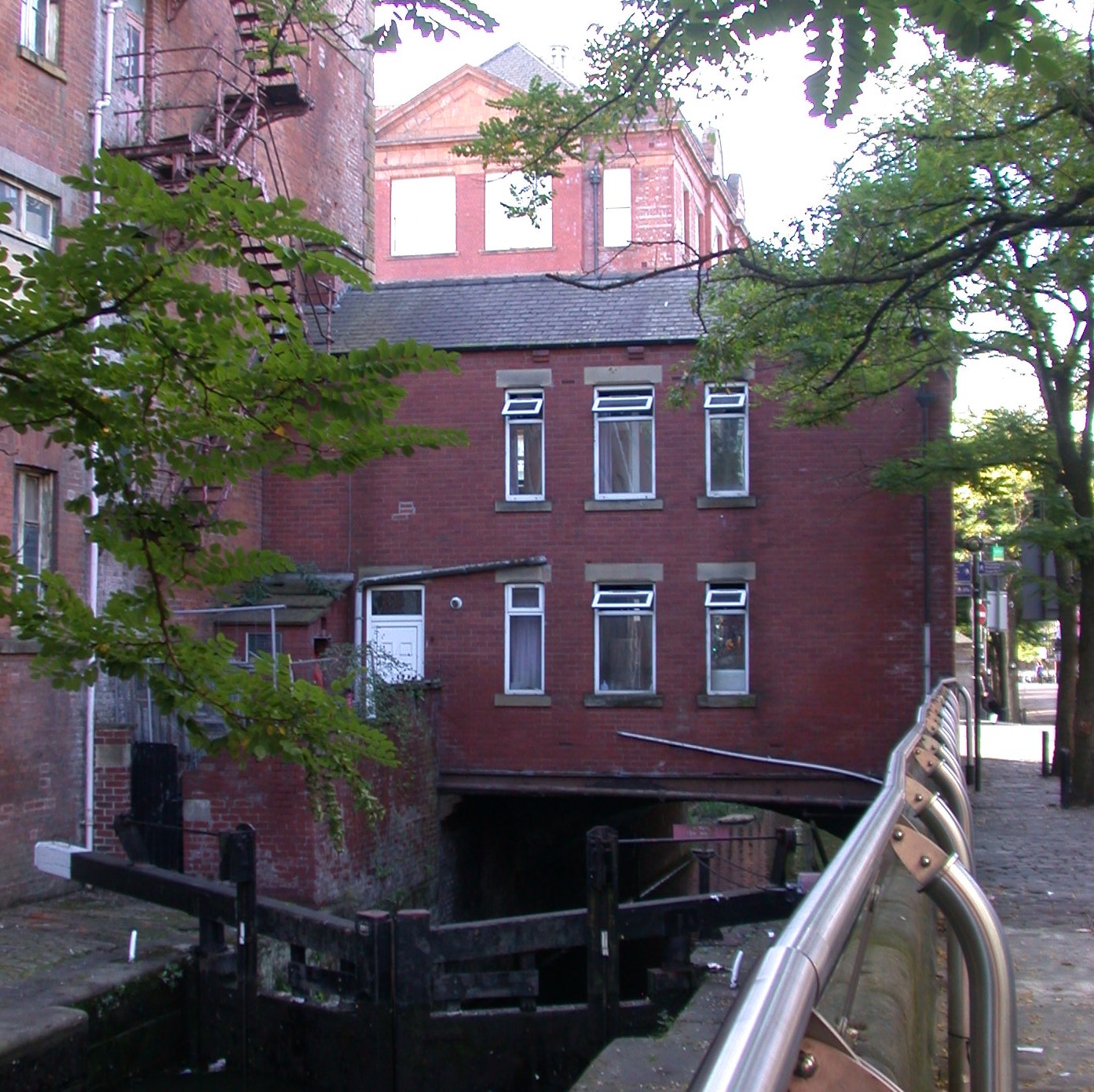
Of locks, and underground chambers, travelling the Rochdale Canal


Travelling along the Rochdale Canal by boat from Castlefied to Piccadilly is as you would expect totally different from walking the stretch along the towpath.

Now I have walked its length loads of times from the years when it was an overgrown neglected place to the popular walk of today.

Back then it seemed a bit of adventure.  Chances were you would be the only one on the canal and the loneliness was added to by the state of the buildings along the way.  Most were tall some derelict and all seemed to have turned their back on the canal, so that apart from a timber yard the rest had their entrances on the street side.  No one you thought wanted to know about this relic from the past.

And on a grey wet morning those same buildings made the place just that bit more desolate and not somewhere where even the adventurer in me choose to be as dusk came on.

The boat offered a totally different experience.  First you were with people all of whom knew  what they were doing which I suppose my contribution to the journey was limited to helping push the lock gates open and then close them.

And then there are the locks themselves which are a pretty neat way of getting a boat to go up and down hill.
We were going up from Castlefield to Dale Street and that meant I think eight sets of lock doors to open and close.

Once in the lock at the lowest level it is impressive how the water cascading into the chamber does its business and fairly quickly you reach the height of the towpath and you are on your way again.

More than anything it is the power of water that gets you.  It comes into the lock at some speed.

But it is also that even when the locks are closed there is a constant transference of water.  Some of it from side gullies from the lock above to the next one below, and in other cases just back falling over the lock behind..

I can’t remember how long the journey took but much longer than if I walked it.  But then that is the attraction of hiring a boat and doing the canals.  You can stop if you wish after the lock manoeuvre and wait the next one out for a while moored to the side of the towpath and reflecting on the amount of effort and the degree of progress on a lazy boating holiday.

But all of this would have been much romantic tosh to the people that worked the canals.  They carried everything from coal to fine bone china and lived on the water, often with large families.  And they endured those journeys come sun or snow, or heavy rain when the surface of the water seemed to boil to those bitter frozen moments when nothing on the canal could move.

I was reminded of this by the picture of the two boats entering the last stretch of the way along the Rochdale before entering the Dale Street Basin.  At the rear are two women busy themselves with what I take to be domestic chores and in one is a young girl, probably born on the barge and destined to grow up on it.  What is all the more remarkable is the date.  For it is 1955, and most of the Rochdale has been closed but these two families are still making a living, travelling the one bit of the canal still open and prosperous.

Their journey like ours would have taken them through the heart of the city, past timber yards, the rebuilt railway viaduct at Deansgate, under Oxford Road and on taking in a power station the park by the old school and via London Road into the Dale Street Basin.

What I am not sure of is the last part of the journey which today takes you underneath the modern office block now known as 111 on the corner of London Road and Ducie Street.

It is built over the canal and the massive concrete pillars which the building rests on are all around you.  It is an odd and a little disconcerting experience and reminds me of that part in The Third Man where the amoral criminal Harry Lime is pursued by the authorities through the sewers of Vienna.

It is another of those places that where once I would have boldly gone in my 30s armed only with an old Pentax K 100 camera today I judge it to be a place left well alone.

So that’s the end of the journey which began as a wish to share some of the photographs of the canal by Eileen Blake from 1974 and turned into an  extended ramble.

Pictures; from the collection of Eileen Blake and Andrew Simpson, “narrow boats passing under Aytoun Street,” L Kaye, 1955, m54251, Courtesy of Manchester Libraries, Information and Archives, Manchester City Council 
and under 111 Piccadilly by courtesy of Pennine waterways, www.pennincewaterways.co.uk/
And the other stories on the canal at http://chorltonhistory.blogspot.co.uk/search/label/Rochdale%20Canal

Friday, 26 February 2016

Pictures I remember taking .............. along the Rochdale Canal

Now this one has featured before and will do so again.

We are on that stretch of the Rochdale Canal by the Deansgate Tunnel.

There will be plenty of people who like me will remember when the canal was a neglected and almost forgotten waterway with half sunken boats testifying to that neglect.

I have walked up and down it, seen its restoration along with the coming of those bars under the railway arches and can remember the steam that escaped from the lagged pipes a little further back at Oxford Road.

Location; the Rochdale Canal, Manchester

Picture; the Rochdale Canal, 2014, from the collection of Andrew Simpson

Friday, 19 February 2016

You can never get enough of canals ............ walking the Duke’s Canal one Sunday in February nu 3

This is the last of the set of three stories featuring the pictures of Andy Robertson’s stroll down the Duke’s Canal one Sunday in February.

Now I have pretty much said all I wanted to say about Andy’s trips so I shall just leave you with the pictures.

The history of the Duke’s Canal can be found elsewhere on the blog, and no doubt will be added to in good time.

What I really like about walking the canal from Stretford is the way that you can still get a sense of the history of the area and the promise of what is to some.

A little of of the old industrial activity still exists but much has gone, leaving for a while acres of empty land.

But nature and the developer abhor a vacuum and in the last decade or so tall residential properties have begun to fill the spaces.

So I guess next time Andy walks the walk these bits of land with the  city sky line beyond will be full of new busy activity.

Location; The Duke’s Canal


Pictures; along the Duke’s Canal, 2016, from the collection of Andy Robertson

*The Duke’s Canal, http://chorltonhistory.blogspot.co.uk/search/label/The%20Duke%27s%20Canal

Wednesday, 17 February 2016

You can never get enough of canals ............ walking the Duke’s Canal one Sunday in February nu 2


Yesterday I was down on the Duke’s Canal featuring pictures from my old friend Andy Robertson.

The place is in constant change.  As industry retreats from the side of the canal developers have been quick to move in with residential property, but there is still plenty of open land with more than a bit of opportunity for any one with a spray can and a bit of daring to leave their mark alongside the remnants of warehouse, factories, dye works and timber yards

The history of the Duke’s Canal can be found elsewhere on the blog, and no doubt will be added to in good time.

So for now I shall leave you with Andy's Sunday stroll along the waterway. with the promise of more to come.

Location; The Duke’s Canal

Pictures; along the Duke’s Canal, 2016, from the collection of Andy Robertson

*The Duke’s Canal, http://chorltonhistory.blogspot.co.uk/search/label/The%20Duke%27s%20Canal