Showing posts with label Chorlton in the 1950s. Show all posts

Monday, 4 May 2026

523 Barlow Moor Road, captured in a moment in time in 1960

Now I am back at 523 Barlow Moor Road where my friend Ann Love lived during the 1950s and 60s.

It is still there today but has undergone conversion into flats.

Over the last few months Ann has been sharing her memories of growing up in the house providing a vivid account of everything from the kitchen range to her bedroom along with some wonderful sketches of both the inside and exterior of the house.

And now along with more stories her husband has produced a series of detailed models of the property which perfectly create a large Chorlton house in 1960.

"The basement, or cellar as we used to call it, was reached by a door and steps from the kitchen.

It was always cool, and an ideal place for storage.

Half way down the steps was a wide shelf, where cold meats were kept, on a large platter, then continuing down, there were five rooms.

Firstly there was the coal cellar, this could also be reached by a door on the side of the house next to the workshop.

Once or twice a year the coal cart would arrive, with sacks of coal, the cart would stop in the drive, and the coal man would lift the sacks of coal from the cart and empty them down through the doorway into the cellar.

 We would have to count the sacks s they were emptied, because once the coal was in the cellar, it was just a big heap. The coal men were covered in soot from carrying sacks of coal all day.

All through the winter coal would have to be carried up from the cellar in buckets to keep the range in the kitchen alight.


Under the Dining room was a storage area for food – there was a meat safe, with wire mesh to keep out the flies, and jars and big earthenware bowls with preserves, and preserved eggs in isinglass.

The small room under the hall was full of shelves of tinned goods, corned beef and salmon, and pickles.

Under the lounge were coffins, standing on end, which Dad had made during quiet periods, in case of flu epidemics, and bad weather in winter. 

They were in a variety of different sizes, and good places to play when my cousins came over to play hide and seek!

Under the kitchen was where the planks of wood were stored, before being carried down the garden to be made into coffins. When the house was on fire, this could have been a real problem if it had caught fire."

© Ann Love

Models; Howard Love 2014


Saturday, 2 May 2026

Another 20 objects in the story of Chorlton ........ nu 1 the ration announcement

I am looking at a card sent to the Chorlton branch of the Manchester and Salford Co-op shop on Beech Road in the summer of 1953.

Over the years I have seen everything from a declaration of war to letters from the good and the great along with plenty of other official stuff which once carried great significance.

But in its way this little piece of paper is up there with the rest and would certainly have been greeted by the people of Chorlton as a very important moment, for this marked almost the end of 14 years of rationing which had begun in 1940.

“Limits had been imposed on the sale of bacon, butter and sugar.

Then on 11 March 1940 all meat was rationed. Clothes coupons were introduced and a black market soon developed while queueing outside shops and bartering for extra food became a way of life.

There were allowances made for pregnant women who used special green ration books to get extra food rations, and breastfeeding mothers had extra milk.

Restrictions were gradually lifted three years after war had ended, starting with flour on 25 July 1948, followed by clothes on 15 March 1949.

On 19 May 1950 rationing ended for canned and dried fruit, chocolate biscuits, treacle, syrup, jellies and mincemeat.

Petrol rationing, imposed in 1939, ended in May 1950 followed by soap in September 1950.

Three years later sales of sugar were off ration and last May butter rationing ended."*

So this marked one of those moments to be savoured and perhaps marked the real end to the war and the return to “normalcy.”

Now rationing couldn’t have been easy but it was a real attempt to prevent the dramatic rise in food prices which had marked the first three years of the Great War.

Back then the continued rise in the cost of living had not only meant great hardship for the majority of the country but contributed to a real sense that some were profiteering from the shortages at the expense of the rest.

And so I am pleased that Bob Jones shared this little bit of history with me.

Pictures; courtesy of Bob Jones

*1954: Housewives celebrate end of rationing, http://news.bbc.co.uk/onthisday/hi/dates/stories/july/4/newsid_3818000/3818563.stm


Friday, 1 May 2026

Hough End Hall still a working farm in the 1950s

This will be the last of the descriptions of the Hall from Oliver Bailey whose family rented and then owned Hough End and the surrounding land.

The Hall from Nell Lane, in 1952
It is a fascinating account not least because it is the only detailed description of the place during the 20th century.

There are a few anecdotes about the place from people who remember it as children and there is the 1938 survey commissioned by the Egerton Estate.

But most of these anecdotal accounts are vague and lack detail while the Egerton survey cannot be copied or photographed.

Back in the 19th century there is a short description of the Hall by the historian  John Booker which includes an engraving * and an inventory of the contents of the farm in 1849 published in the Manchester Guardian but this  sheds little light on the Hall itself.

So Oliver has cornered the market on descriptions of the Hall in the 20th century and at anytime come to that.

And in the process of sharing these memories he provided a plan of the buildings which to my knowledge apart from the Egerton survey is the only idea we have of what was there.

The Hall and surround buildings 1950s
It confirms that part of the hall was a smithy and right up to the end the place was a working farm with Mr Bailey’s pigs, horses and cattle and Jimmy Ryan’s rabbits.

“At one time my father had Highland cattle in the field where the school once was and there may be pictures in the Manchester Evening News archive. 

"My memory might be playing tricks there, he definitely had Highland cattle but they may have been in the field near Chorlton Station or perhaps even in both locations.

He also had a peacock with a couple of peahens and for a period Hough End was nicknamed Peacock farm because of the noise they made and because the peacock used to fly across Nell Lane into the park so lots of people saw it. 

There was a deep depression in the field near the rear left hand corner of the plot of the Hall itself and it was made a by a bomb which dropped there during the second world war, certainly it was known as bomb crater corner. 

According to family history the blast knocked my father over – he was an ARP Warden during the war so could have been out at night on fire watch.

During the war there was a riding school at Hough End, a Mc somebody – a search through a trade directory might find him - and my sisters learnt to ride horses at that time. The horses were kept in the loose boxes in the long building parallel to Mauldeth Road."

All that is left is for me to thank Oliver and his family for taking the trouble to recall the old hall and just hope it provokes more memories.

© Oliver Bailey, 2014

Picture; Hough End Hall from Nell Lane, T Baddeley, 1952, m47852, courtesy of Manchester Libraries, Information and Archives, Manchester City Council, http://images.manchester.gov.uk/index.php?session=pass

Plan; © Oliver Bailey, 2014

*John Booker, A History of the Chapels of Didsbury & Chorlton, 1857, Cheetham Chetham Society Manchester

Thursday, 30 April 2026

Looking for a ball of wool, a lb. of apples and much more on Wilbraham Road

I doubt that any one born before 1980 would ever think that the stretch of Wilbraham Road from Albany down to Manchester Road would be populated by a string of fast food outlets, bars and charity shops or that Quarmby’s, Dewhurst’s and Meadow’s would have vanished like snow under a winter sun.

It’s not an original idea I know, but in the space of two decades much traditional retailing has gone.

I miss it, but I recognize that that way of shopping has pretty much gone, and the arrival of the bar culture has at least kept the shops from staying closed.

What follows are two pictures taken some time in the 1950s into the 1960s, of the businesses on Wilbraham Road and Barlow Moor Road.

I could write more, having explored the history of some of the shops, and made comment on the road signs and bus stops, but I won’t.  

However, the challenge is there for anyone what can to trawl their memory and offer up some memories of the shops, or better still some pictures.

Location; Chorlton

Pictures; Wilbraham and Barlow Moor Road’s, circa 1950s/60s. from the collection of Dave King

Wednesday, 29 April 2026

Hough End Hall in the 1950s

Now the thing about very old buildings is that usually we focus on that very old bit.

So it is with Hough End Hall built in 1596 and for a big chunk of its history the family home of the Mosley family.

Most of the accounts of the place concentrate on its Elizabethan design and the Mosley family and ignore the last two hundred years when it was a farm house and later still an office and restaurant.

But I am more interested in its time as the home of tenant farmers during the 19th century and then its uncertain time from the 1920s when it was under threat of demolition by road widening plans.

Today there is nothing much left and so I have decided to call on the memory of Oliver Bailey whose father took possession of the Hall and surrounding land at the beginning of the Second World War and worked it in conjunction with his farm at Park Brow.

Here and over the next few weeks are short accounts of what was once three and which I hope will set off more memories from other people.

"Looking at the front of the hall on the right hand side I remember a man called John Hallsworth had a blacksmith shop in the 1950s. 

He had been an iron worker with British Road Services and rented the smithy at Hough End from my father after he retired from BRS.

There was a wooden staircase up the wall of the hall inside the smithy itself. He he made a couple of gates for Park Brow Farm. 

Sam & Jack Priday, who were farriers with a smithy in Withington,  came round and used the forge to shoe my father’s Suffolk Punch horse. 

I remember walking beside him as he used a horse drawn single furrow plough in the field next to Mauldeth Roadd, probably late 1940s. 


At the rear right hand end there were various add-on outbuildings at the back, probably nineteenth century. 

One was a cottage and another a store of some sort that had fallen into disrepair .

The left wing of the Hall suffered severe structural damage which was perhaps caused by subsidence and had to be rebuilt in the 1950s by the Egerton Estate and I remember they used artificial stone lintels and cills for the mullioned windows. 

On the upper floor there was an old mangle that was basically a large box full of cobbles that rolled back and forth on rollers on the wooden base when it was worked by turning the handle.

 I think that ended up in Ordsall Hall, definitely went to Salford as Manchester had no interest."

© Oliver Bailey, June 2014

Pictures; Hough End Hall, 1952, m47850,the hall from the south east, 1952 m 47856 and the hall and duck pond, 1952, all by T Baddeley, m47859, courtesy of Manchester Libraries, Information and Archives, Manchester City Council, http://images.manchester.gov.uk/index.php?session=pass

Next, a plan a riding school and the man who kept rabbits

Tuesday, 28 April 2026

Living on our Meadows ...... stories from the Brownhill family

We are on the meadows, when people still worked and lived there.

Now everyone knows about the sewage works which were first established here in the 1870s, continued well into the last century.

Less well known perhaps is that two families of those who worked on the plant lived close by, and their houses stood by what is now the footbridge over the Brook.

The rest as they say belongs to Catherine Brownhill who sent over these pictures and the accompanying story.

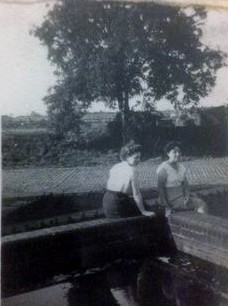
“Hi Andrew, Malcolm (my husband) lived at No. 1 Cottage, Withington Sewage Works. Hughie  and Lily Edwards lived next door. Lily was 90 last October and Malcolm & his brother went to visit her. 

He has taken some pictures of photographs from her album. 

Over the next few days I’ll send them to you with as much info as I can. This picture is likely Lily and a friend at the Sewage Works. Ivygreen Road houses are in the background. The 2 cottages would be to the right of this picture. The tree is still there today.

This is the same tree with the ‘cottages’ in the picture. They were sturdy brick built semi-detached houses. 

Malcolm’s Dad, Jack Brownhill can be seen bowling in a game of cricket. 

The cottages were at the end of the cobbled road just where the bridge is. 

Below are the four Brownhill children. Jack and Irene were their parents. 

Over the years Irene worked in the laundry on Crossland Road and in three chip shops, on the Green and Beech Road. She attended the school on the Green. 

Pictured are Jeanette, Malcolm, Graham and Ray with the air gun.

The last one for today. 

These buildings were in front of the cottages and to the left and the buildings behind housed the engine room and various sheds. 


Back to the photo, where the car/van is this was a barn where straw was stored for the sheep in the fields and chickens were kept in one of the rooms to the right. Malc’s Dad had a Morris Minor and all the lads would take turns to drive it, Malc could only just see above the steering wheel. 

It was chopped up at the end of its life and was put over the bank of the brook. 

Bits of it may still be there, though we think that when the banks were reinforced in recent years the motor debris may have been cleared. This would have been to the left of where the bridge is now”.

Location; the Meadows

Pictures; living on the Meadows, circa 1950s-60s, from the Brownhill Collection

Monday, 27 April 2026

That house beside Malton Avenue that everyone remembers

Now this is one of those buildings with a history and almost everyone you talk to will remember it as everything from a doctor’s to a cafe and to an office.

It is on the corner of Barlow Moor Road and Malton Avenue and was built sometime after 1910 when the area was redeveloped.

It had once been part of the estate of the Holt family whose extensive garden ran from the corner of Beech Road along Barlow Moor Road down High Lane almost to Cross Road and then across back to Beech Road.

When the last of the family died in 1908 their large house was demolished, the trees along the eastern side of the garden were cut down and the Corporation used a stretch to build the tram terminus while the rest became houses, shops and the Palais de Luxe cinema.*

Sadly until now I had not come across much more about the place, and then out of the blue Douglas wrote to me asking about the cinema.  He “lived in the detached house right next to the cinema, on the corner of Malton Avenue and Barlow Moor Road, no 477, so the cinema wall formed one side of our garden. I went to the Burnage High School for Boys and also the Wilbraham School of Music in High Lane.”**

And all of a sudden the building was given a new lease of life as a place which was a home.

Now in the fullness of time I hope that Douglas will share more memories of number 477, the cinema and life on Barlow Moor Road in the 1940s

*A forgotten photograph, ............ the Palais de Luxe in 1928
http://chorltonhistory.blogspot.co.uk/2012/03/forgotten-photograph-palais-de-luxe-in.html 
from the series Chorlton cinemas, http://chorltonhistory.blogspot.co.uk/search/label/Chorlton%20cinemas

**Douglas Cook, www.whitedownmusic.co.uk
Picture; 477/483 Barlow Moor Road, 1959, A.H.Downes, m17516, courtesy of Manchester Libraries, Information and Archives, Manchester City Council, http://images.manchester.gov.uk/index.php?session=pass

Saturday, 11 April 2026

What a difference 68 years makes …….. deep in Chorlton

Now here is an image of Chorlton which will nudge some memories.

We are on that twisty path which leads off from Brookburn Road, following the line of the Brook.

I have walked it countless times over the years, but only always remember it as a tree lined route into the heart of the meadows.

As such on a wet February day with the light fading fast it can be a magical place, which is no less so in high summer when the dense vegetation makes it a place where you can feel quite alone.

Originally the road had been constructed to give access to the sewage plant which was built and enlarged from the 1870s.


Before that the area which we now call the Meadows, and which was part of the flood plain for the Mersey had been farmed as meadowland, which is a type of farming dating back to the 17th century and involves careful flooding of the land at intervals, for the production of early grass to feed the cattle.

In the 1930s, bits were used for tipping rubbish and more recently it has become part of the Mersey Valley, whose wardens dramatically altered the landscape with whole planting of trees.

So, this picture is a revelation of how it once looked.  The caption says, “Chorlton-cum-Hardy, Brookburn Road, Withington Sewage Works, Boy Scouts Hut, Entrance to Manchester Corporation (Rivers' Dept), Withington Sewage Works from Brookburn Road, Boy Scouts Hut in middle distance”.

Leaving me just to say, ......... step forward those who remember it as such.

Location; Chorlton

Picture; Entrance to Manchester Corporation (Rivers' Dept), Withington Sewage Works from Brookburn Road, Boy Scouts Hut in middle distance, 1958, R.E. Stanley,  courtesy of Manchester Libraries, Information and Archives, Manchester City Council, http://images.manchester.gov.uk/index.php?session=pass

Friday, 10 April 2026

Remembering a lost Chorlton farm from over 88 years ago

Now I am looking at two pictures of Park Brow Farm which was doing the business of growing food from before the start of the 19th century.

And what makes the two pictures all the more remarkable is that I know one of the sons of the last farmer.

He is Oliver Bailey and his family ran the farm from sometime after 1911 and before that had been on Chorlton Row from the 1760s.*

Over the years Oliver has made available a whole heap of family documents from the contract his ancestor signed with the Egerton’s back in the middle of the 18th century to receipts for night soil from the 1850s, house and farm inventories and lots more.

Added to which he was able to describe in some detail the inside of Hough End Hall before it was much knocked about by a succession of developers in the late 1960s.

And his memories have also opened up the story of Park Brow Farm before it too was developed with that small group of houses to the west of the farm house and the barn conversion.

So I shall start with the farm yard and this photograph from 1938.

Oliver tells me that one of the young lads is his brother and the building behind them with the tall chimney was “used for boiling up p food bought from the UCP,” while the two elephants Mr Bailey hosted when the travelling circus arrived were watered from the wooden pump directly in front of the building.

And given that this was the farm yard, the two downstairs rooms of the building to our left were the kitchen and office, with the living room and dining room facing south onto the garden which backed on to Sandy Lane.

Now I could go on but think I will save the rest for another day, which will include more pictures of the front of the farm house, something on the certificates the farm won and a piece of garden furniture which links the farm to the old Assize Courts in town.

Those intrigued by the idea of hosting two elephants can read the story on blog which will also offer up some fine pictures of the Bailey bulls on the land where Adastral House now stands and can summon up in their imagination an image of the young Oliver driving live stock through Chorlton back to Park Brow from the railway station.

All of which just leaves me to ponder on how rural is the scene of the farm house when this picture was taken in the summer of 1940.

Location; Park Brow Farm, Chorlton-cum-Hardy

Pictures, the farm yard, 1938, m17381, and the farmhouse looking north, 1940, m17388, courtesy of Manchester Libraries, Information and Archives, Manchester City Council, http://images.manchester.gov.uk/index.php?session=pass

*Chorlton Row is now Beech Road

Thursday, 9 April 2026

A map, dance lessons in the Con Club and a mystery

Now here is one of those fascinating little bits of history which like so many is the result of nothing more dramatic than turning out a cupboard drawer.

It is a map of Chorlton drawn on linen and takes us back to dance lessons in the late 50s and a friendship.

And because my friend Ann found the map I will let her tell the story

“I was putting something away in a drawer, and came across this map.

When I was 13, I used to go for dance lessons at 'Rogers and Lamont', who used to be in the room above the Conservative Club, on Wilbraham Road. 

I met a boy there, who used to walk me home. He was 16, and worked at a printers in Manchester, and to show me where he worked, he drew me this map on linen.

That was 60 years ago. I wonder if he is still alive?  I'd love to be able to tell him I've still got his map.”

I hope he is too and during the evening I shall go looking for him.

It may lead nowhere but I will enjoy the search.

And of course for anyone with a keen interest in the bus routes of 1956 David was helpful enough to add these to the map.

The 94 and 82 were still running when I washed up here in 1976 and I often took the 82 in the 80s all the way up to Oldham to visit my friend Lois, while the 94 whisked you down Manchester Road along Seymour Grove and off into town via I think Deansgate.

I do have a 1961 bus timetable and map so I shall go and look at that, but I am pretty sure that before the night draws in someone will have been in touch with the routes and times.

And I rather hope this will stir the post and we get some memories of Rogers and Lamont, dance lessons and maybe even David.

Location; Chorlton

Picture; hand drawn map of Chorlton, circa 1956 by David Jones from the collection of Ann Love

Wednesday, 8 April 2026

Buying a TV from Park Wireless in the August of 1951

I am looking at an advert for Park Wireless a company which sold electrical goods across south Manchester including Chorlton.*  

The year is 1951 and therein is the first hint that the advert will reveal much about life in the early 1950s.

The war had been over just six years and the consumer boom was yet to take off.  There were still rationing, as well as shortages and plenty of those ugly bomb sites which added to the gloom.

And the distance we have travelled from then to now is summed up by the word wireless.  It was what my parents and grandparents called the radio and it would have been the word I used as well.

When the wireless became the radio I am not quite sure, but within a decade of this advert I rather think radio had taken over and later for a brief moment it was superseded  by the transistor and for a few by the tranny.

So Park Wireless anchors us in those early years of the 1950s with the Home Service, the Light Programme and the Third Programme each with their own distinctive output.

The Home Service focused on the serious stuff ranging from news to drama and talks.  The Light Programme as its name suggests offered up light entrainment and music and was really the continuation of the wartime BBC Forces Programme which had been renamed the General Forces Programme. The Third concentrated on the Arts; commissioned musical works as well as putting on the plays by writers such as Samuel Becket, Harold Pinter, Joe Orton and Dylan Thomas.

Not that any of these feature in the advert which is primarily about television and so pride of place goes to the PYE FBIC Consule retailing at £85.

Ours I remember was similar but had doors.  Now I have never quite understood the doors but I suppose those that suggest it was too hide the screen during the day might be right.
What strikes me first about the advert is the “TV Demonstrations every Friday at Moss Side and Timperley.” 

At a time when there were very few sets in people’s homes the pull of a demonstration must have been quite powerful, and this I think is different from a trip to a modern store where you trawl what is on offer comparing price and specification.

Back then the demonstration was as much about selling the idea of a TV as actually selling the box.

As always the prices are interesting and there will be those who will remember how much they took home and what was left for saving up for such things as a telly.

But what also intrigued me was the reference to the “Progress Report on Holme Moss” which turns out to be a TV Transmitting station.  It was launched on October 12th 1951 and covered west Yorkshire, Greater Manchester and Derbyshire.

Its opening meant that “television comes within the reach of millions more potential viewers” and with recent tests promising “excellent reception in the Manchester districts” the age of the telly was about to happen.

But then there is the warning about making "sure of your set - they may become scarce" which is less I suspect about hard selling and a very real problem of supply, which of course takes us back to the shortages of the 1950s.

Nor is this quite the end for those old machine with the big valves were not so reliable and if this was to be the age of the telly it was also the age of the telly repair man.

And it was also that powerful smell they could give off, a mix of heat and dust.

But that is for another time.

Picture; from Manchester City News, August 10 1951

*There were branches at Chorlton, Didsbury, Moss Side, Northenden and Timperley.

Tuesday, 7 April 2026

The brick works, a forbidden place and a man called Duffy


It was one of those perfect summer days out beyond Hardy Farm.

The sun was hot and the sky a brilliant blue with just a few light clouds high up and overhead. And we were on a mission.

I forget now what had prompted us to be there and very quickly whatever it was had been  lost in the sheer pleasure of wandering through the long grass with absolutely no one else around.  There was that intense smell of the warm grass, the sound of a bird and away over the Mersey the faint noise of traffic.

We have all done it, and it’s like being seven again and on one of those carefree adventures with nothing to worry about and everything to discover.

Now I have done my own share.  I remember long solitary walks along Derbyshire country lanes and endless treks looking for new strange parks to play in or just taking my 2/6d pocket money to the local railway station and seeing where it would take us.  Sometimes you struck gold and were rewarded with open fields at the end of the line and at others a dingy industrial wasteland hard by a smelly canal.

The best was the walk to Blackheath which led on to the park and the river.  But there were also the bomb sites those lingering ugly reminders of the war we had been lucky enough to miss.  There was no danger there any more although just occasionally you might come across some hidden treasure which had somehow worked its way back to the surface.

David O’Reilly who grew up on Chorlton has similar fond memories.  In his case it was “the Clay Pits” which was
situated to the immediate east of Longford Park, just the other side of the interrupted Rye Bank Road - it was a series of mounds and gulleys, the left over from previous workings of the old brick works factory with its tall chimney.  

It was a forbidden play place and it was guarded by an almost mythical man named "Duffy"! With another 9 year old boy, I recall daring ourselves to go into this derelict building one day and even crawling under the tunnel - through rubble to a place where I could look up inside the chimney and see the small hole of daylight at the top. 

On re emerging we continued to play until - that knowledge of being watched - made its presence felt - and we looked around to see a man who I think was called Duffy staring at us, stood on a small wall about 12 yards away. Scared witless we fled the scene, and although not chased, the memory of Duffy, the clay pits, and the old building, has played a part in several nightmares since that day!”

I have to say that when I first came across the brick works I was surprised.

But the clay and marl around the Longford Road area has been used for centuries.

The marl was used for spreading on the land while the clay became the bricks of some of our older houses .*

The pits are there on the OS map of the area for 1841 and carry names like Marl Pits and Brick Kiln Pits.  And as late the 1920s and 30’s the water filled pits proved a fatal place for some of our children.

But I want to end on a lighter note.  David and I may have been aware of the dangers in where we played but it didn’t stop us. In those long ago days parental supervision was perhaps  lighter and there may have been far more open spaces to while away the long hot summers.

Location; Chorlton, Manchester

Pictures; from the collection of Andrew Simpson

Monday, 6 April 2026

Looking out at the allotments towards Sandy Lane sometime in the 1960s

Now here are two images of Chorlton which at first glance look familiar.  

We are on the allotments with the Park to our rear looking out towards Sandy Lane.

Back in 1903 my friend Ann’s grandfather lived at number 72 Sandy Lane.

She  grew up in Chorlton on Barlow Moor Road and has contributed a rich set of memories and pictures from the 1950s and 60s.

What I especially like about these two are the contrasts, one in full summer, the other deepest winter with snow still on the ground and of course the difference in colour.

It would be fun to find people who were working those allotments at the time and may have their own stories and pictures to add to the collection.

The painting and photograph will date from sometime in the 1960s and are a reminder that not all things change.

Pictures; of the allotments from the collection of Ann Love

Sunday, 5 April 2026

By train from Chorlton into the Hope Valley in the April of 1957 for a day of rambling


Now it is Sunday April 7th 1957 and I am on Chorlton railway station waiting for the train from Central which left at 9.45 am and is due here just twelve minutes later.

The weather according to the forecast is promising, for “after frost at first, areas will have a fine, mainly sunny day, with normal or slightly higher temperature”* which will gives us about 8⁰C or a little bit more.

And that I reckon is just right for a ramble in the countryside which is what we would have been planning to do on that April morning back in 1957.

This I know from a delightful poster which British Railways published in that year**  advertising Special Excursions to Chinley, Edale, Hope, Bamford and Hathersage.

It is of course a journey that can no longer be made by rail, but back in 1957 our station still had another ten years before it was closed and there are quite a few people who remember making the trip into the Hope valley by train from Chorlton.

All of which makes the poster a valuable piece of history, for not only do we have the journey times for this long vanished service but also the cost.  So from Chorlton it cost 4/3d for a return ticket to Hope and took just 19 minutes.

These were “organised rambles, with leaders provided, details of the routes to be taken and walks for both individuals and parties.”

So having done the ramble the train back would have left Hope at two minutes past seven arriving back in Chorlton at about 8.10 in the evening.


It is a journey I would have loved to have made, not least because it was while in Hope recently that we decided to take up serious walking.  But sadly back in 1957 I was just eight years old and living in London.

Still this little poster gives a flavour to what was on offer back then and an insight into our own railway line.

*The Observer April 7th 1957

**Special Excursions to Chinley, Edale, Hope, Bamford and Hathersage, from Manchester Railway Termini, E.M.Johnson, Foxline Publishing,  1987

Picture; from Manchester Railway Termini, E.M.Johnson, Foxline Publishing,  1987


Friday, 3 April 2026

When the Rec had a bowling green ………..

Now, I don’t remember the bowling green on the Rec, by Beech Road, but lots of people over the years have talked about it.

I have always thought it was on the south side of the Rec, close to Wilton Road, but not so.

It occupied a space in the north west corner, and this I know because I am looking at the OS map for Beech Road, dated 1956.

I know the bowling green was not in the original plan for the Recreational Ground and had disappeared by the 1970s.

Just when it was deemed no longer a recreational asset will be down to people’s memories and a trawl of subsequent maps.

And back then there was that other bowling green beside Cross Road, it became the car park for the Irish Club.

All of which leaves me to wait for comments of those who remember the bowling green on the Rec and when it disappeared.

Location; Chorlton

Picture; detail from the OS map for south Chorlton, 1956, "Courtesy of Manchester Archives+ Town Hall Photographers' Collection", https://www.flickr.com/photos/manchesterarchiveplus/albums/72157684413651581?fbclid=IwAR0t6qAJ0-XOmfUDDqk9DJlgkcNbMlxN38CZUlHeYY4Uc45EsSMmy9C1YCk 

Sunday, 15 March 2026

When Mr. Lea drew Chorlton-cum-Hardy …………..

I have Jon and Hazel to thank for reigniting my interest in our local artist Derrick Lea who I first came across a decade and a bit ago.

Seven in one place, Chorlton-cum-Hardy, in the 1950s
Back then I knew nothing of Mr. Lea other than that during the 1950s he produced a collection of fine pictures of Chorlton-cum-Hardy.

They were drawn in a style which will be familiar to anyone who grew up in that decade and are now unique in being a record of the township over 70 years ago.

They include some of our iconic buildings from the Horse and Jockey, and the Con Club, as well as the Lloyds, Barlow Hall, Hough End Hall and Jackson’s Boat along with Longford Hall.

Now I know some purists will sniffly point out that neither Hough End Hall nor Longford Hall are in Chorlton, but as Mr. Lea made an exception in his calendar of Chorlton sites, I am not going to quibble.

The Lloyd Hotel and Con Club, 1955
As for Hough End Hall it is true it was in Withington for centuries but with a slip of the municipal pen has now come over to us.  As for Longford Hall, yep, there is no denying it is in Stretford, but than Mr. Lea lived on Ryebank Road which is as close as you can get to the hall.

He was a commercial artist, and his son Jon tells me that he produced the Chorlton selection for picture postcards and that calendar.

All date from the 1950s and some I can pinpoint to a specific year. So, the images of the Lloyds, the former Conservative Club and Jackson’s Boat date from 1955 and that of Longford Hall was drawn two years later.

And that makes them an important addition to our understanding of what the area was once like and in particular how some of the buildings have changed over seven decades.

Hough End Hall, circa 1950s
When he drew Hough End Hall it was still part of a working farm and so while its glory days were over when it was at the centre of an estate comprising 250 acres its pond and fields were still home to chickens, pigs, geese and horses. 

Moreover, the last real tenant had only died a few years earlier which resulted in it being taken over by the Bailey family who first began farming in Chorlton in the mid 18th century round about the time the Hall passed out of the Mosley’s possessions who built it and into the hands of the Egerton’s who owned almost all of Chorlton.

Likewise, two images of the Horse and Jockey show that the western end of the pub was still a separate residential property.  

The Horse and Jockey, 1955
That said Mr. Lea was not above introducing a few flights from historical accuracy. In one of the Jockey pictures he includes a pond on the village green which fronts the Jockey. Sadly, there is no evidence for a pond and during a big chunk of the 19th century the green was the private garden of Samuel Wilton who lived in the eastern side of what is now the pub.

But that is a minor quibble when set against the bigger picture which is of a collection of images drawn during the 1950s by Mr. Lea, and which are fast fading from living memory.

And that is it.

Location; Chorlton

Derrick Lea, date unknown


Pictures; The Chorlton-cum-Hardy Mr. Lea drew in the 1950s, courtesy of Jon and Hazel Lea


Next; Longford Hall, Didsbury and out beyond into Cheadle and beyond

Monday, 8 September 2025

Back in 523 Barlow Moor Road in the summer of 1960

Now it is very easy to slip into some nostalgic view of our recent past.

We have all seen the adverts with the great old cooking range, throwing off heat and the smell of warm bread and yearn for that simpler age when doors could be left unlocked and there was still a proper grocer at the corner of the street.

All of that is true I remember it.  But then I also remember a house without central heating where the ice in winter formed on the inside of the windows, and where the coal was delivered once a fortnight and had to be brought up in a bucket from the coal cellar.

Likewise my memory of the local grocers shop was of a place where cheese came in just two types, white and red, where the only bread was white and sliced and sophisticated food came in a jar labelled meat paste.

So I tend to err on the side of being careful about the good old days.

And I was reminded of all of this when my friend Ann sent me some more pictures of 523 Barlow Moor Road as it was in the 1950s.

Each of the drawings had been done as art homework and Ann’s brief was to draw what she saw.

One that caught my attention was the electric kettle and it got me thinking about electrical appliances in the late 1940s and 50s.

The consumer age had arrived but had outstripped the often outdated wiring system.

Most houses had few electrical sockets.

 A fact which friends discovered to their cost when they bought an old terraced house beside the railway line in Ashton-Under-Lyne.

On the day they moved in they found that the power points on the upper floor of the house had merely been screwed onto the skirting board, were not connected to an electrical supply, and had been removed when the previous owner left.

So the lack of sockets was a real problem and was solved by that simple expedient of plugging some electrical appliances into the light fitting.

A two or even three way adaptor allowed you to run the light along with whatever appliance needed power.

Now as the years have passed I did begin to question this bit of my remembered childhood but others also tell me that their parents did the same.

It was the age before the fitted bathroom fitted kitchen of for that matter the fitted anything.

Most of us back then acquired stuff and fitted it in around what was already there and few I suspect would strip away perfectly good fittings just to achieve that a consistent appearance.

And so it was with 523 Barlow Moor Road which as Ann’s a picture show was still a mix of late 19th and early 20th century living existing beside the luxuries of the new consumer age.

Pictures; courtesy of Ann Love

Sunday, 7 September 2025

Inside 523 Barlow Moor Road in 1960

523 Barlow Moor Road
If like me you were born in the first half of the last century you will remember the old cooking ranges, the small gas stoves, and those brass light switches which long ago were deemed unsafe.

They were the background to everyday life, and are now seldom seen other than in museums.

Our range disappeared from the old house in the early 1950s, the gas stove swapped for a gleaming top of the range Cannon cooker in 1962 and the old phone with its wooden base along with much more went when I was still a baby.

The range, complete with cat
That said one surviving brass light switch long sense disconnected still sits at the top of our cellar stairs, and like countless other Chorlton residents we made our way to Gorton and bought a cast iron bath and a lead lavatory cistern in its wooden box.

They replaced the plastic ones which in 1975 were part of the modernisation of the house.

And so what was taken out in the 1970s in south Manchester was in turn thrown away in favour of an older set of household furniture which was being saved from condemned and demolished properties a decade later on the eastern side of the city.

I doubt that many houses here in Chorlton can still boast those original features so I am indebted to my friend Ann who sent me a series of drawings she made of her home on Barlow Moor Road.

We think it will have been built sometime around 1890 and so what you see are some of the original fittings along with others which will date from the very early years of the 20th century.


Using the open fire
I remember my grandmother still used her range well into the 1950s but also fell back on a small gas stove which was easier to use and far quicker.

Municipal authorities like Manchester were keen to promote cooking on gas and householders could rent or buy on credit the same model that Ann drew in the 1960s.

Telephones may seem a luxury but in some of the more well off homes in the township they were a must, and the names of the good and worthy can be increasingly looked up in the telephone directories from as early as 1900.

It is of course easy to become sentimental about these old feature.  As warm and comforting the range might be it was run on solid fuel, which meant racking out the ashes and carrying heavy buckets of coal.

The telephone
The gas stoves were pretty basic models and the down side of a brass light switch was that someone was made to polish it.

So this is the first of a series which aims to open up the houses of late 19th century Chorlton and I guess for many they will be the first time that such stuff has been seen in the context of our own area.

Moreover and here I must avoid making either me or Ann feel like a museum piece were the things we used in our everyday life.

The phone may not have have lit up when it received a call nor would it store the number of the caller or allow them to leave a message, but it worked.

It did the business of allowing you to talk to someone not in the same house and not send a letter of a postcard.

In the same way the cooker cooked your meal with no recourse to a timer, a split oven or a  fan.

That said I like my phone which lights up in the evening and talks to me, and my fan assisted double oven makes life so much easier.

Picture; 523 Barlow Moor Road, 1959 A H Downes, m17504 courtesy of Manchester Libraries, Information and Archives, Manchester City Council, http://images.manchester.gov.uk/index.php? and drawings of the inside of 523 Barlow Moor Road courtesy of Ann Love

Saturday, 6 September 2025

A little of what we have lost, Wilbraham Road in 1955


Sometimes I think it is the more recent photographs of Chorlton which are the more fascinating, and in their way the more revealing of how we lived.

And so I am drawn to this one of Wilbraham Road looking north towards the railway station.

Now I don’t have an exact date but I think it must have been taken in the 1950s which of course is a hostage to fortune, and I await the first expert on cars of the period or public transport to give me a definitive date based on the make of car or the type of bus.

Some of the other more basic clues like the registration plates and advertising hoardings don’t yield anything, so it will be a matter of visiting Central Library and slowly going through the directories to match the names on the shop fronts with a year.

But the tram lines appear to be missing which would suggest a date after the last trams had run their last journeys and the tracks had been taken up which would take us into the 50s.

What strikes you is still how old fashioned the shop fronts appear with many of them still retaining their old signage and shop fronts.

And then there is what they sold, ranging from paint to shoes, mystery coach excursions to lace doilies.

Now I accept that we still had a DIY store in the precinct into the 1980s and the last shoe shop only closed a few years ago followed by Burt’s, the gentleman’s outfitters in 2011.

But back in 1955 it was the sheer number of these shops.  There were lots of clothes shops and shoe shops, as well as countless grocers, green grocers, and butchers which for good measure were by and large all independent traders.

And some will mutter there were also two wool shops, private lending libraries and of course plenty of old fashioned, smelly, sell everything hardware stores.

Quantity did not always equate with either quality or choice.  In our grocers shop there was white cheese and there was red cheese along with lots of tinned things.

Which given the period may be a little unfair and opens me up to people feeling a little miffed that their bit of nostalgia has just taken a kicking not to mention those who ran good quality shops here in Chorlton, so back to the picture.

Looking at it again you get to see just how the shops in the distance were really just later  add ones to what had been traditional houses.

And then jutting out from the end of that first parade of shops is a cast iron veranda while the absence of traffic allows you to see how the road rises as it goes over the bridge.

And we still had a railway station with trains that took you into the city in under ten minutes.

So there you have it a little of what we were like, not that long ago.

Picture; from the Lloyd collection