Showing posts with label The Chorlton Pavilion and Winter Gardens. Show all posts

Wednesday, 4 March 2026

Chorlton’s palace of varieties …………. part one ....... The Chorlton Pavilion and Winter Gardens

Now there is always more to find out about our old theatres and cinemas, and so it is with the Chorlton Theatre and Winter Gardens, which is an old favourite of mine. *

It was situated just over the railway bridge on Wilbraham Road on what is now Morrison’s petrol station.

Until now I had just one photograph and a few memories from Ann Love’s dad who saw Tom Mix the American film star in a western sometime in the early 1920s

But in the space of a few days there is much more.  I now have a detailed description of what it was like, evidence of its chequered history and the names of those who walked its boards and the plays they performed in.

The actual date of its opening is still a little hazy.  I thought it opened in 1904, but I can be certain it was up and running by1906 when a Walter Broadhurst of 71 Nicolas Road applied for a license to put on shows at the “Chorlton Pavilion adjoining Chorlton Railway Station”, which were followed up by yearly applications thereafter.

In the June of 1907, The Stage carried the notice that Messrs. Levy and Cardwell were performing their “musical Comedy, Little Paul Pry” with an appeal from the managers of the Theatre wanting “Musical Comedies, Burlesques Opera Light Drama” for slots in July into September asserting that “Good Companies do well.  Packed nightly”. **

And that was all to be expected, given that there had been a housing boom in Chorlton which from the 1880s had seen the area around the Three Banks go from open fields to rows of houses, which catered for the “middling people” who worked in town in a range of professional, clerical and entrepreneurial businesses.

These were the very people with money in their pockets who also supported a range of cultural and sporting groups and clubs and will have been a ready audience for a place of varieties.
And this was not lots on a group of businessmen who in 1910 founded the Chorlton Entertainments Ltd.  Their prospective argued “that there was a want of a high-class theatre and place of entertainment in Chorlton a district which is well known”.

To this end they had bought the old theatre for £700 including the “furniture, fixtures, electrical and other fittings, scenery” and “the goodwill attached to the said Pavilion and to the business”

It was an ambitious plan which saw the addition of land laid out as a "Winter Gardens”, which was incorporated into the new name of the Chorlton Pavilion and Winter Gardens”.
And the business plan fully recognised that the site was “in the centre of the populous and growing township of Chorlton-cum-Hardy adjoins the railway station and  is within two minutes’ walk of the Manchester electric tramways [and] within easy access of Moss Side, Fallowfield, Withington, Didsbury, Old Trafford, Stretford, Sale and Urmston, with an estimated population of one hundred and fifty thousand”

Its five directors lived in Whalley Range, Levenshulme and Gorton, and listed their professions as broker, Assurance manager, supply company manager and solicitor’s clerk, and included as one of its auditors Mr. H. D. Morrhouse who was later to establish a popular chain of cinemas of which the Pavilion would later be part of.

But I will close with a description of the newly opened theatre from March 1910.
“It is situated close to the railway station, and is a fine, commodious, and spacious building, standing within its own grounds, which are laid out as gardens; hence the appellation Winter Gardens.  

The building is of corrugated iron on a brick foundation, the exterior being painted a green colour, whilst the entrance is plain, and effective in a white fibrous plaster, with several rows of electric lamps, which gives it a bright appearance when it is lit up.  The seating capacity is a 1,000.

The orchestra stalls and stalls, which are now fitted with tip-up seats, upholstered in crimson velvet, can accommodate 500 persons.  


The pit and promenade seat another 500.  The stage has an opening of 23 ft., and extends from the footlights to exterior wall, 28 ft. 6 in.  There are four commodious dressing -rooms, the ladies on one side and the gentlemen on the other.  

The dressing rooms are spacious and supplied with every convenience and can be heated as required.  

There is a complete electrical installation, and the heating is on the Radium principle.  For the opening week Miss Florence Baine’s company with Miss. Lancashire, Limited, have been secured and on a Monday a house packed in all parts gave a demonstrative welcome to the popular farce, Miss Madge Grey as the blunt Lancashire Lass”. ***

It was also the venue for shows by our own Chorlton Operatic Society and hosted at least one large political meeting by the Unionist Party in 1913.

Tomorrow; dark days, strange stories and its time as our first cinema

Location; Chorlton

Pictures; Chorlton Pavilion and Winter Gardens, circa 1906, from the Lloyd Collection

*Chorlton Pavilion and Winter Gardens, https://chorltonhistory.blogspot.com/search/label/Chorlton%20Theatre%20and%20Winter%20Gardens

**The Stage, June 27th, 1907

***The Chorlton Entertainments Ltd, Manchester Guardian, January 8th, 1910

Sunday, 3 August 2025

When Tom Mix, Charlie Chaplin and Mary Pickford visited Chorlton ….. our own palace of varieties ….… part two

Now the ambitious plans for Chorlton’s own music hall began well.

The theatre, circa 1910
The Chorlton Pavilion was opened sometime around 1906, continued with the addition of a ‘Winter Garden’ four years later, and underwent further alterations in 1912.

From the out set, it appeared to draw in the locals, with the Stage reporting that “For the opening week Miss Florence Baine’s company with Miss. Lancashire, Limited, have been secured and on a Monday a house packed in all parts gave a demonstrative welcome to the popular farce, Miss Madge Grey as the blunt Lancashire lass, Miss Ellen Thompson, kept the house in roars of laughter, and was a great favorite.  Miss Maria Lorenzi made an effective Eva Lancashire”. *

Theatre and Winter Gardens, circa 1910
But despite all that promise something didn’t quite go right, and in July 1914, the Manchester Guardian carried the notice that the building was up for sale, including “the WOODEN ERECTION, with corrugated roof, forming the theatre; Pay Huts, about 200 Upholstered Tip-up Seats, 28 Forms with backs; Scenery, Limelight’s, Fire Extinguisher Apparatus , the whole of the Electric Light Fittings, Carpets, Curtains, Mats Rugs and other Effects.”*

It seems that by then the Pavilion had already moved away from a palace of varieties and entered the new shiny world of films.

This I know because in 1913 it was listed as the “Chorlton Pavilion Theatre, Wilbraham Road, seating 800, and owned by Chorlton Pavilion Theatre Co Ltd”. ***

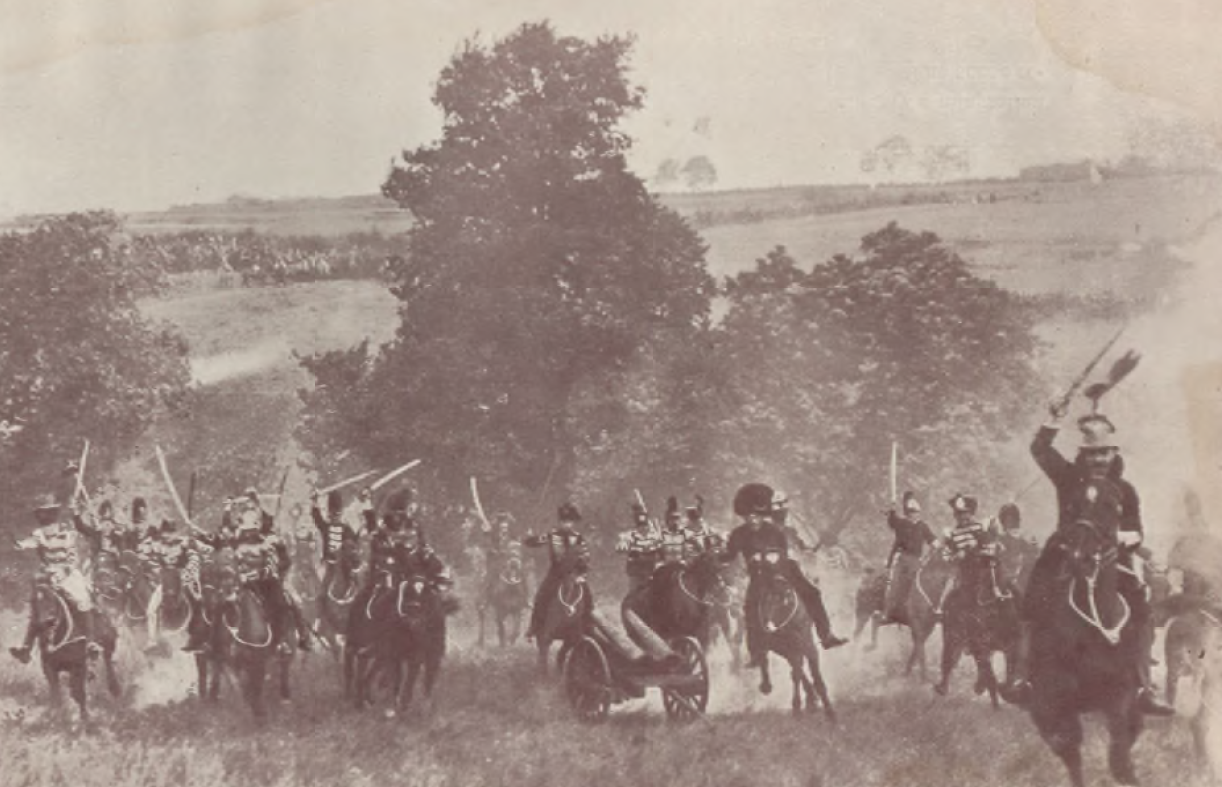
Still from the Battle of Waterloo, 1913
It might of course also continue as a live theatre, and the Chorlton Pavilion Theatre Co Ltd, may have been a subsidiary of Chorlton Entertainments Ltd who had opened the building in 1910.

Or they may have been separate companies.  At present I haven’t been able to locate a history of either.

What I do know is that our own Chorlton Operatic Society used the building for performances of their production Dorothy in the April of 1914.

Still from the film, Sixty Years a Queen, 1913
Sadly, two years later the building was up for sale again during the summer of 1916 and despite several attempts the sale was withdrawn in the September of that year.

The rest as they say is unclear.  At some stage it was part of the cinema chain owned by H.D. Morehouse, but I don’t know when that was.

It maybe that the alterations in 1912 were to adapt it to cinema use.

All of which means that there will have to be many hours spent in Central Ref looking through the entertainment’s pages of the local newspapers for references to the cinema.

I thought it had closed in the 1930s but according Edward Hollingworth, it had gone by 1924 to make way for the garage and petrol station owned by Edward’s father who had lost a leg aged just 20 in the Great War.

Along with the petrol station there were a set of lock up garages running along the railway fronting Buckingham Road and both the lockups and the petrol station had been built by Edward’s grandfather.

Still from the film Tess of the D'Ubervilles, 1913
The business was sold in 1951 but the original 1920s building was still there eleven years later and looking at that 1962 picture it is possible to pick out evidence of the old theatre which judging from more recent photographs was a very substantial building.

And that I thought was that, but as you do, just as I was finishing the research, I came across one last little story, concerning the Boys’ Highland Company who appeared at the Pavilion I the November of 1907.

The troupe consisted of 16-18 boys, who despite their name all came from the Nottingham area and during their period of engagement in Chorlton had stayed in B&Bs in the township.  Five had resided with a Mrs. Shaw in Cheltenham Road who reported the children for being “infested with vermin”.

 At the subsequent court case brought by the Society for the Prevention of Cruelty to Children, the troupe’s manager was found guilty of neglect and was fined £5 and costs. ****

Leaving me to ponder on what to say next.

Location; Chorlton

Pictures; The Chorlton Pavilion and Winter Gardens, circa 1910, from the Lloyd Collection, remaining pictures from films showing in 1913, from The Kinematograph Year Book, Program Diary and Directory for 1914

*The Stage, March 31, 1910

**Chorlton Entertainments Ltd, Manchester Guardian, July 14, 1910

***The Kinematograph Year Book, Program Diary and Directory for 1914

****A Boys’ Band Singular Charge of Child Neglect, Manchester Guardian, November 13, 1907


Friday, 8 October 2021

The Arts in Chorlton-cum-Hardy ...... another story from Tony Goulding

As a celebration of the recent Chorlton-cum-Hardy's Arts festival, I decided to investigate some of the area’s past artistic connections. 


As I have previously written here (1) of Thomas Mostyn’s art school (now the Buddhist’s World Peace Café) and the three Knowles siblings, artists who lived in the house which is now Our Lady and St. John’s Parish Centre on the corner of High Lane and Chequers Road.

 I have also written of The Oaks Music School on Wilbraham Road run by the Haigh family (who, coincidentally were related by marriage to the Knowles’s) (2) 

Knowles's residence on High Lane

This time I have decided to look into the area’s theatrical heritage.

Picolo Theatre 

"Chorlton-cum-Hardy" Con Club

The Picolo Theatre was a short-lived theatre company which, aided by a grant from the Arts Council, performed a number of plays at Chorlton-cum-Hardy's repertory theatre (3) based in the public hall on the upper floor of the Conservative Club on Wilbraham Road in 1954

This was a serious professional company as is indicated by the plays they put on that season. 

They opened with “Mistress of the Inn” a comedy by the 18th century Italian playwright Carlo Goldoni. 

Their repertoire also included J. M. Synge’s “Playboy of the Western World”, “The Barber of Seville” by Beaumarchais, Shakespeare’s “Twelfth Night” as well as two somewhat lighter offerings, “Treasure Island” and “Dial “M” for Murder”.

The personnel involved, both acting and off stage included many who became well-known names later in their careers. One of the actors was Patrick Wymark, who played in a starring rôle in two popular T.V. shows of the mid-1960s, “The Plane Makers” and “The Power Game”.  Another was Eric Thompson who found fame as the voice of “The Magic Roundabout” for which he also provided the English commentary. His two daughters also became accomplished actors, the multiple Academy Award winner, Emma, and her younger sister Sophie, also an award winner (Olivier). (4) A third cast member, Mike Morgan, had just had his big break into films, playing alongside Sir Alec Guinness, when near the completion of his second film he was taken ill with meningitis and died tragically young, aged 29.

Design sketch of Manchester Royal Exchange Theatre 1976

The leading female actor was Avril Elgar who was newly-married to fellow member of the company James Maxwell. Avril has been prolific in her appearances on Television over nearly half a century. She passed away, sadly only a few days ago on the 17th September, 2021. Her husband, James, acted too on television and in films but it is his Theatre work which is most well-known particularly in this area. Initially with his work, as both actor and artistic director, with the 69 theatre company based at the Manchester University Theatre and, following the success of that venture, the development of Manchester’s Royal Exchange Theatre, for which he was a co-founding art-director

Another of the co-founding art directors and the designer of the theatre itself was also a former Picolo Theatre member, Richard Negri. All of the company had been trained at the Old Vic Theatre School in London founded by George Devine who was the director of the Picolo Theatre’s first production. A director of some of its later shows was the company’s founder Frank Dunlop; now 94-years-old he has directed in London’s West End, on New York’s Broadway, the opera, Carmen, at the Royal Albert Hall, and for eight years (1984-91) ran the Edinburgh Festival.

 Hon. Secretary of the Chorlton-cum-Hardy theatre club at this time was Cecil Walkley Lloyd of 32, Cavendish Road, Chorlton-cum-Hardy, Manchester. Cecil was born on the 12th February, 1907. However, there is something of a mystery concerning his place of birth, the birth was registered in Hulme, Manchester but the 1911 census shows him as born in the Maida Vale area of London. His family were then living at Ashton Barracks, Ashton-under-Lyne, Lancashire where his father having completed 21 years' service in the army was working as the canteen manager. The family’s residence on the 11th March, 1908 recorded, on his discharge, in his father’s army records was 46, Beresford Road, Moss Side, Manchester

Cecil Walkley, trained to become a teacher at Chester teacher Training College, qualifying in 1927, when he started working, as an assistant master, at Christ Church Boy’s School. He later moved on to Heald Place Boy’s School, then Ladybarn Senior Boy’s School, Withington, Manchester. In the June quarter of 1936, at St Ann’s Church, Tottington Nr. Bury, Lancashire he married Mabel Lois Mary Peachment, the daughter of George Henry, a hairdresser and newsagent and Mary (née Barnes), an elementary school teacher. The couple had two children a son born in Stretford in the March quarter of 1937 and a daughter born in Manchester in the March quarter of 1943. 

On the 21st June, 1949, Cecil Walkley Lloyd applied to Manchester City Council to be registered as a Stage Manager as required by the Theatrical Employers Act of 1925 and its subsequent amendment of 1928. (5) 

Walter Stott – Film maker and Theatre Propriet

Walter Stott was both the manager and one of the directors of Chorlton-cum-Hardy's first cinema. He was also a producer of commercial films for a wide variety of organisations. These ranged from The Mersey Docks and Harbour Board, Henry Bannerman & Sons Ltd. Cotton Spinners and Manufacturers Ltd. to a propaganda film for The Hospital Saturday Fund and even a film of a local football match shown at the Trocadero, Rusholme in October, 1919.

I was having a good deal of trouble tying together various strands of information I had on him until I read Andrew Simpson’s pieces on The Chorlton Pavillion and Winter Garden, one of which provided me with Walter’s address in 1910. Armed with this vital item of data I am now able to tell his story.

Walter was born in Chorlton-on-Medlock, Manchester on the 14th December, 1877. He was the 4th child of Charles Stott, a pawnbroker, and his wife Elizabeth (née Longmore). His mother died, aged just 29, before he had celebrated his second birthday. The 1881 census shows his widowed father at 12, Milton Street, Chorlton-on-Medlock as the lone parent of 4 children all under 10. (Edith (9), Charles (7), William Longmore (5), and Walter (3)). He was aided by a general servant in the household 27-Years-old Elizabeth Eccleston, from Market Drayton, Shropshire. Before the next census was taken, in 1891, Walter had lost his remaining parent too; he had died, aged 39, on the 4th October 1889. Under the provisions of their father’s will Walter and his siblings were placed under the guardianship of their “Auntie” Elizabeth Jennett and her husband, Walter Broadhead Jennett, (6) a fellow pawnbroker, of 37, Union Street, Ardwick, Manchester. However, the 1891 census shows all 4 Stott siblings living with another “Auntie and Uncle”, William, a silk finisher, and Caroline Pearce, both of whom were born in London. They were at 19, Lincoln Street, Rusholme, Manchester together with Mr. & Mrs. Jennett, 4 of their grown-up children and a servant.

Walter’s tragic early life continued as, having already been bereaved of both his parents his step-father William Pearce died in the March quarter of 1894, Walter having just turned 16. 

 He married first Louisa Bell Selby, the eldest daughter of James Selby, the publican of The George Hotel, 67, Clowes Street, West Gorton, Manchester, and his wife Isabella Barlow (née Mills). In the March quarter of 1905, Louisa Bell died very likely due to complications arising from the birth of the couple first child, Nora Louise. Walter and his baby daughter went to live in The George Hotel, where they were when the 1911 census was taken. Also in the household was James and Isabella’s youngest daughter, Edith, an elementary school teacher, who Walter was to make his second wife in the December quarter of 1915

Chorlton Pavilion and Winter Gardens

Walter Stott’s connection to Chorlton-cum-Hardy in the records is in 1910 when he is described as both the manager and a director of the newly opened Chorlton Theatre and Winter Garden in various issues of “The Stage” and “The Era” of that year. This was only one of a number of cinemas he operated as he became a leading figure in the embryonic film industry. Although initially a great success the Chorlton Theatre---- did not prosper long term. The original owners put it up for auction in December 1911, and it was sold again in 1916 by which time it was being “upstaged” by The Palais de Luxe, a purpose-built cinema on Barlow Moor Road, Chorlton-cum-Hardy opened in April, 1914.

Walter Stott’s enterprises were divided between two companies. His cinemas and film distribution business, The National Film Agency, was carried out with his partner, and an old schoolfriend, Frederick White. His partner in his film production company, Manchester Producing Company, was Jerry Somers, a gifted film cameraman.

 As befits an entrepreneur engaged in the highly fashionable and lucrative if sometimes volatile business of the early growth of the film industry, Walter was apparently a “larger than life” character who held positions on several committees and could be relied on to be the life and soul of any gathering. On one particular occasion, in April, 1921, he issued a challenge to his fellows in the cinema industry to consume 12 Eccles cakes at one sitting, a challenge he completed himself the following day. His unconventional behavior did however on one occasion became unacceptable. In September, 1913 he appeared in court in Huddersfield charged with making unwanted sexual advances towards a 16-year-old programme seller in his employ. After a three-day hearing the magistrate dismissed the case through insufficient evidence but in doing so admonished Walter and his fellow defendant saying their behaviour “---- had been disgraceful and reprehensible as regards to their position----”    

Pictures; Knowles's house on High Lane and Conservative club from collection of Tony Goulding , Plans of Royal Exchange Theatre m 06619 Courtesy of Manchester Libraries, Information, and Archives, Manchester City Council, http://images.manchester.gov.uk/index.php?session=pass, Chorlton Pavilion and Winter Gardens from the Lloyd Collection.

Notes: -

1) “The Art Heritage of Chorlton-cum-Hardy" (15th August 2017).

2) “The Haigh Family of Chorlton-cum-Hardy" (23rd January, 2017).

3) Joan Sims one of the stars of the “Carry On” films made her stage debut in this venue in 1950.

4)  Sophie Thompson has been nominated 6 times for an Olivier award but only won it the once in, 1999, for “Best Actress in a Musical” in “Into the Woods”.

5) These acts were introduced to tackle the problem of bogus managers who would “hire” a troupe of performers only to disappear with the theatre’s takings leaving them stranded.

6) The ties between the two families were further strengthened when Charles Stott’s eldest son, Charles Henry, married Walter Broadhead Jennett’s first-born daughter, Amy, on the 4th September, 1901 at St. Thomas’s Church, Ardwick, Manchester.