Showing posts with label Withington. Show all posts

Wednesday, 10 June 2026

Walking Withington’s past …… the new history book

For anyone who lives in Withington, has lived in Withington or is just curious about the place the latest publication from the local Civic Society is essential reading.

Entitled “Withington Village A History walk in south Manchester” by David Rydeheard is an expanded and updated story of the village based on an earlier book from 2014, which in turn was based a series of historical notes compiled by Louise Kane who was an official tour guide for Manchester City Council.

Now I have that earlier “Walk through the history of Withington”. 

It ran to 33 pages and is a fascinating mine of information which is more invaluable because it can be used to walk around the old township.

David’s new edition follows the same format, has grown to 54 pages and reflects the changes to the area over the last 25 years and acknowledges not only Louise Kane but the Withington historians Kenneth Whittaker and Roger Smith.

And like all good history books it contains extensive footnotes, references and further reading marking it out as a serious and scholarly contribution to our understanding of Withington’s past.

That said it is also a history tour allowing you “to start the tour at any place in Withington village [but] starts at Withington Green at the junction of Cotton Lane”.

And it has something for everyone from accounts of buildings, roads, and people to an entry on “Withington walls” featuring some of “the more than 100 artworks that you can see when walking around Withington village and the product of Withington Walls, a pioneering community arts project”. 

As such it is a fine addition to all those volumes dedicated to local history.

Looking back over the previous century and half these books seem to come in batches.  

In the late 19th century Thomas Ellwood in Chorlton and Mrs. W. C. Williamson  of Fallowfield were amongst a group of historians who wrote histories of their neighbourhoods.  

In part this was motivated by a wish to record the traditions and appearances of small farming communities which were being transformed by urban creep and the decline in agriculture.**

So, Thomas Ellwwod recorded the recollections of the oldest inhabitants of Chorlton-cum-Hardy who in turn drew on the collective memories of parents and grandparents which quickly took the story back to almost the time when the old King George lost the American colonies. 

His articles included accounts of bull baiting on the village green, lost rural traditions like May Songs, the Rush processions, and the Easter enactment of St George and the Dragon with the practice of “lifting” and the sometime intimidating “Riding the Stang”.


In the same vein Mrs. Williamson wrote about the last handloom weavers in Fallowfield, Burnage, and Didsbury in the middle decades of the 19th century.

Fast forward to the 1960s and 70s, and there was another clutch of history books  written for a new audience as the life styles of the early decades of the 20th century vanished under the impact of  changes in transport, consumerism and popular entertainment along with the advance or residential spawl which all but eliminated the last vestiges of the countryside.

In 1970 John Lloyd published his still popular history of Chorlton, a year before Ivor Million wrote his book on Didsbury, Kenneth Whittaker his account of Withington and there were other publications on places like Stretford, and Urmston.

All of which makes David’s book a timely addition in the 21st century to our knowledge which sits with others by Andrew Simpson on Chorlton and Michael Billington on Urmston, Flixton and Daveyhulme and a wealth of electronic descriptions from the internet.

Location; Withington, a suburb of Manchester and a former agricultural township

Pictures; extracts from David’s new book, 2026

* Withington Village A History walk in south Manchester David Rydeheard, 2026, Withington Civic Society, www.withingtoncivicsociety.org.uk 

**Ellwood, Thomas L, History of Chorlton-cum-Hardy, 1885-1886, South Manchester Gazette,  Williamson, Mrs W.C. Sketches of Fallowfield and Surrounding Manors, Past and Present, 1888.


Tuesday, 14 April 2026

An afternoon in Chorlton …… with a history of Withington

It was another of those well attended meetings at Chorlton Good Neighbours* and we were not disappointed by David Rydeheard’s talk on the history of Withington.

It started with maps which as everyone knows is a jolly good way of walking through the past, and we had four, covering the periods from 1820 through to 1934.

There at the start in 1820 was a very rural Withington which as David showed in subsequent maps was transformed by the march of urban development ranging from the grand properties of the people of plenty to the humble homes of the artisans.

And star of the presentation was the story of Withington swimming baths from its ambitious plans to the cut down version built by the City Council.

That said the finished product with its impressive, patterned windows and tiled walls is still a gem, and a gem which might have been demolished but for a community campaign which matched demonstrations with a carefully worked out business plan which did the trick.


The Baths were saved and today are the centre of a heap of community events as well as a place to enjoy a splash in the pools.


Nor was that al because David drew much social history from the provision of first- and second-class pools, and the limited access for women to the absence of a public laundry which were a feature of swimming baths in the poorer districts of the city.

Not content with the talk we had the opportunity to buy David’s book on the History of Withington Baths**, and the delightfully illustrated book A Bigger Splash, Withington Baths: Ten Years as a Community-Run Leisure Centre by the artist Len Grant***.


Pictures; An afternoon in Chorlton …… with a history of Withington, 2026, from the collection of Andrew Simpson


*Chorlton Good Neighbours, https://chorltongoodneighbours.org/

**Withington Baths, David Rydeheard, 2025, available from Withington Civic Society, www.withingtoncivicsociety.org.uk

***A Bigger Splash, Withington Baths: Ten Years as a Community-Run Leisure Centre, Len Grant, 2025 £15


Saturday, 10 January 2026

Who laments the passing of the old milk machine?


It is as much a piece of history as the Penny Farthing bike or the old fashioned tram.  

I am trying to remember when I would have used one.  I suppose it would have been after the pub in those years when I was a student and living in a bed sit in Withington.

There used to be a milk machine by the Scala Cinema which in turn was beside the White Lion. And I guess it would have been that bit of forward thinking about milk for breakfast which would have got me using it.

But then without a fridge and with most shops having closed by nine in the evening buying your emergency milk from a machine made sense.

Of course getting the cartoon open was another matter.

All of which  got me thinking about the age of the vending machine which I assumed came along in the 19th century.

And there I was wrong, there is a reference to one in the first century when Hero of Alexandria came up with a machine to dispense holy water.*

The first modern one was introduced onto a London street in the early 1880s and sold post cards.  For me the first I really remember were the Five Boys Chocolate bars usually on railway stations and which could be guaranteed to deliver slightly dry flaking chocolate which had gone white at the edges. There were also the polo mint machines and the chewing gum ones.

Along with the cigarette machines they were just one of those bits of street furniture you took for granted.  I don’t really remember when they began to disappear to be replaced by the giant all glass fronted multipurpose dispenser.

As for the milk vending machine I rather think they began to vanish in the 1970s, possibly in the wake of the supermarket revolution along with cheap fridges.  For who would want to stand at what was often a shabby and knocked about machine, fumbling for the sixpence only to discover the coin had got stuck, the machine refused to accept it or worst still there were no cartoons left?

This one was on on Shude Hill and was photographed in the March of 1960 which may have been at the height of their popularity.

I suppose they fitted into that new high tech way of life that was the late 1950s and 60s, and I have to say that thinking back to the period it does look ultra modern and there was something novel about getting your milk this way instead of from a milkman.

Not of course that the milkman visits many houses anymore and I hear today that one more newspaper is about to turn itself over to an electronic version.

As someone who grew up in the 50s thinking that milk delivered to the door step along with a daily newspaper was the hall mark of civilized life this all seems a little sad.

And if  I don’t stop I am in danger of sounding like my uncle who still could not bring himself to accept the fall of Constantinople.

Pictures; vending machine on Shude Hill taken by L Kaye, March 1960, courtesy of Manchester Libraries, Information and Archives, Manchester City Council, m59879, m59878, m5987, http://images.manchester.gov.uk/index.php?session=pass


Wednesday, 23 July 2025

What was lost is found …………. the buried object from Withington Workhouse

A little bit of Withington Workhouse came my way recently.

It is a round metal disk, measuring just over 2 cm, and bears the name Chorlton Union Workhouse on one side and has a small ring fastener on the back.

It was found by Frances Farrow on her allotment just off Nell Lane and was about 80 centimetres below the surface.*

There is no date on the disc, but it will date from between 1837, when the Chorlton Union was established, and 1930, when the workhouses were abolished.

And I think we can narrow that timeline, because from 1837 the Union’s workhouse was situated in Hulme, until it was replaced by the new one on Nell Lane in 1855.

Of course it might have originated in Hulme, and was dropped on the site of the future allotment, or might even have found its way there in a consignment of night soil, but given that the new Workhouse was very close to where it was found I rather think we have a window of time from 1855 onwards.

I thought that at first it might be a token, which could be redeemed for poor relief.

Such tokens were widely in use in the early years of the 19th when there was a shortage of currency, but had become illegal after 1814.

It might just have been customized with the ring on the back so that it could be worn on a bracelet or necklace, but I doubt anyone would want to be reminded of the Workhouse.

All of which just leaves me to think it might have belonged to an inmate or an official out on business. And it might be a button given its size from a workhouse uniform.

Those with a gruesome turn of mind will immediately point out that the burial ground of the old workhouse was close to where the disc was found …… but not close enough.

That burial ground was situated on the north eastern side of Nell Lane at the junction of what was Princess Parkway, and part of it was taken over when the road was widened, while the allotments are further north along Nell Lane.

So, it is a bit of a mystery, but one that someone will have an answer too.

I contacted Mr. Peter Higginbotham, who is one of the leading authorities on the Poor Law and Workhouses, and I can confirm that it is a button which he replied "do turn up sometimes".  So mystery solved and I can now just fall back on the disc itself and ponder what secrets it might hold.**

Location; Chorlton

Pictures; the Workhouse disc, 2020, found by Frances  Farrow, and the old burial ground, 1950, from the OS map of Manchester & Salford, 1956

*Plot  40A, Southern Allotments, Nell Lane, Frances Farrow and Akram Dadafarid

**The Workhouse; http://www.workhouses.org.uk/

Sunday, 20 July 2025

Withington Hospital ....... sixty years ago

 This is Withington Hospital in 1965.

Withington Hospital from Cavendish Road, 1965
And it’s a lesson in how quickly we forget.

The image was taken from Cavendish Road and shows the rear of the complex, with the large field in between.

I must have passed it heaps of time but when confronted with the picture I was puzzled, and it took a few minutes rummaging through old maps and even older photographs to fix the place.

The view along with the hospital have long gone.

Interestingly the caption of the colour slide offered up the title “Union Workhouse”, which of course is what it was.

The hospital and field, 1956

Built in the early 1850s by the Chorlton Union, it replaced the smaller workhouse in Hulme and remained as such till the 1930s.

The hospital and field, 1935
Today some of the hospital buidlings have been converted into residential use and apart from a property in Styal, the only surviving building from the age of the Workhouse in south Manchester is the former offices of the Chorlton Union in All Saints.

In its day the offices administered the work of poor relief across south Manchester and early in its history added an infirmary to the workhouse.

The infirmary was requestioned during the Great War and served as a hospital catering for casualties from the battle front and some of those who died are buried in Southern Cemetery.

I rather think the recovering wounded in their “hospital blue” uniforms may have made good use of the field.


There are a few images from Manchester Library’s archive of images which show the field but none that I can find which places it beside the hospital.*

So perhaps a unique image.

Location; Withington Hospital

Picture; “Withington Hospital, former workhouse, seen from behind”, 1965, The 1965 Collection, the hospital and field  1956, from the OS Map of Manchesterster & Salford, 1956, hospital & field, 1935, m53369, courtesy of Manchester Libraries, Information and Archives, Manchester City Council, http://images.manchester.gov.uk/index.php?session=pass

* Manchester Libraries, Information and Archives, Manchester City Council, http://images.manchester.gov.uk/index.php?session=pass

Wednesday, 11 June 2025

Hough End Hall …… from the unseen collection of Chorlton pictures

It is easy to miss Hough End Hall.

It is partially hidden by two rather ugly office blocks, has a school and carpark to the rear and can only be glimpsed from the main road which nearly caused its destruction.

Many people will automatically assume it is part of Chorlton, and it does lookout on Chorlton Park, but it was once the home of the Lords of Withington, it’s inhabitants were listed in the census returns for Withington and it was built by an Elizabethan businessmen who had bought up into the connection with Withington.

The hall was built in 1596 by Sir Nicholas Mosley, passed into the estate of the Egerton family in the 18th century, and from then on was variously a farmhouse, restaurant, set of offices, and after an uncertain period when it was empty and waiting a buyer, it became an Islamic Centre.

All of which brings me to the picture postcard, which is one of six, dating from sometime in the 1930s, and were marketed by the Rapid Art Photography Company.

The Hall in the picture is in its last phase as a farmhouse, and by the time the photograph was taken, the land around the farmhouse had shrunk from 250 acres in the 1850s down to just three.

By 1940, the tenancy passed to the Bailey family who were just across the road and worked the three acres in conjunction with their own farm.

In the 1960s, the bailey’s sold the hall and plot to a developer. And later in the century it became a restaurant.

Since the beginning of the 20th century the hall, has seen off plans to demolish it for a road widening scheme, been the centre of a series of creative idea to transform it into an art gallery and community hub and is now an owned by an Islamic group.

What I like about the picture, is not only the image of the hall, but the surrounding detail, like the farm cart casually left in the garden, the outhouses and the glimpse of the fields in the distance.

Which just leaves me to close with the book on the hall, which I wrote with Peter Topping back in 2015.

It tells the story from when Sir Nicholas splashed out some of his money made in London to replace a much older family home, which was no longer to adequate to showcase the family's success.

The book covers the tops turvey history of the Mosley family, its time as a farmhouse, spanning 250 years and its time as a restaurant, containing many old black and white photographs, a series of original paintings by Peter, and contemporary accounts as well as my stories.

Location; Hough End Hall


Picture; Hough End Hall, circa 1930s, from a picture postcard, courtesy of Jennie Brooks

*Hough End Hall The Story Andrew Simpson & Peter Topping, 2015

Friday, 25 April 2025

Reverends Strong, Grogan, and Muzzell …another story from Tony Goulding

 I was going to wait before I composed this follow-up story of Withington rectors. 

However, encouraged by how well the initial story about St. Paul’s Church, Withington was received I have decided to not wait.

Trinity College, Dublin
The first of the three outstanding rectors of St. Paul’s first 100 years was Rev. William Heny Strong. Born in Dublin, Ireland in 1814, William Henry trained for his ministry at Trinity College in that city (1)                                                             

According to the “Alumni Dublinenses”of 1924 he commenced his studies there as a 17-years-old on 20th October 1831 his entry also confirms his place of birth and records that his father, George, was a “Ludimagister” (a schoolmaster). He was awarded his initial B.A. degree in the spring of 1837 later attaining an M.A. 

 William Henry was ordained a priest in 1839 and was given a curacy in the parish of Letterkenny, Co. Donegal, Ireland where he remained until moving to Lancashire in June 1842. (2)   In Lancashire he was initially an assistant minister at St. Peter’s, Preston before being appointed to a curacy in Blackburn in December 1842. Rev. Strong married Grace (née Carr) in Blackburn Cathedral on 25th January 1844 by which time he had become the incumbent of St. George’s Church, Chorley, Lancashire.


St, George's Church, Chorley.
The 1851 census reveals that Rev. Strong had moved to - 35, The Lord Mayors Walk, St. Giles, York.  A letter he wrote to the local paper, “The Yorkshire Gazette” appearing on 11th December 1852 reveals that he was the vicar of St. Olave’s church in the city.  William Henry and Grace had at least 3 children two sons, Charles Thomas  and William Henry (3) and a daughter Frances Mary.  

His daughter was born in York on 15th July 1856 by which time Rev, Strong had returned to Lancashire to the parish of Newchurch Kenyon, Nr. Leigh, Lancashire. In June 1862 he became the fourth rector of St. Paul’s, Withington in what was effectively an exchange of 'livings' with Rev. Robert William Burton M.A. He remained in Withington until 1872, when he resigned and moved to Somerton, Somerset where he was the vicar for more than 25 years. Rev Strong died at “The Lynch”, Somerton on 30th March 1899 finally having retired the previous year. His estate was valued at a modest £50 -10s -7d (= £5,474 today)         which he left to his second wife, a solicitor’s widow, Eleanor Parsons (née Eastment); his first wife, Grace, previously dying on 27th December 1883 at the vicarage in Somerton.

 Rev. Strong was succeeded as Rector of St. Paul’s, Withington by another Irishman, Rev. George William Grogan, a son of John Grogan and his wife Sarah (née Medlicott), who was born in Dublin during 1819.  An older brother, Edward served as the M.P. for Dublin City for more than two decades and was created a baronet in 1859.

George William also attended Trinity College, entering on 4th July 1836. The Alumni Dublinenses also records that his father, John, was a “causidicus” (barrister) and that he obtained his B.A. in spring 1841 and an M.A. in 1849. The following year he was ordained in Norwich Cathedral on Sunday 10th November 1850. An incumbency of nearly a decade at St. Mathew’s, Thorpe Hamlet, Nr. Norwich, Norfolk was followed by a much shorter one in Stoke Newington, London. Then after a brief return to Norfolk, as the vicar of Clenchwarton, Nr. Kings Lynn, Rev. Grogan was appointed vicar of Somerton, Somerset in which parish he remained until December1872 when in yet another link between the incumbents of St. Paul’s Withington he “exchanged livings” with Rev. William Henry Strong.

While he was in Thorpe Hamlet, George William married a fellow clergyman’s daughter, Helen Isabel Maria Graham at St. John’s Church, Bedminster, Bristol on 15th October 1856. The couple had at least nine children, one of whom, Marian Dora, died aged just 15 in March 1878 and is buried in St. Paul’s churchyard, Withington.

Rev. Grogan was the rector of St. Paul’s for nearly twenty years. He resigned in April 1892; retiring from active ministry he moved in retirement to Nr. Cheltenham, Gloucestershire. He died at “The Priory”, Prestbury, Nr. Cheltenham on 14th February 1902.

The final one of St. Paul’s first half-dozen rectors was the very long serving Rev. William Muzzell; incumbent from 12th September 1892 until his retirement in 1938/9.

William Muzzell was born on 7th September 1848 in Kelshall, Hertfordshire. He was the second son of Peter  Muzzell (4) and his first wife Mary (née Allen). Shortly after the 1851 census the family relocated to Yorkshire. William’s mother died while he was still an infant in August 1852; she was buried on 31st August in the parish of The Holy Trinity, Kingston-upon-Hull, Yorkshire (East Riding). Just 9 days after his wife's burial William’s father buried his 2-years-old daughter, Elizabeth. (5)

Soon after this double tragedy the family moved again, this time to the city of York where Peter Muzzell remarried at St. Mary’s Church, Bishophill Junior on 30th July 1855 to Rachel Mercer, a labourer’s daughter working as a maid in a clergyman’s household.

William attended the York Training College Model School (6) from May 1860. After leaving school he initially followed in his father’s footsteps and became a scripture reader; the 1871 census records him as such while lodging with a farm servant John W. Maxey and his wife Betsy at Wistow Gate, Cawood, Selby, Yorkshire (West Riding).

Muzzell family grave in St. Paul’s churchyard, Withington.
Rev. Muzzell later trained for the priesthood at St. Aidan’s Theological College, Birkenhead, The Wirral, Cheshire and was ordained on Sunday 23rd September 1877 in Chester Cathedral by the Bishop of Chester, Rt. Rev. William Jacobson. His first appointment was a curacy in the parish of Ince-in-Makerfield, Lancashire. He moved from there to the St. Philip’s, Bradford Road, Ancoats, Manchester, being appointed as the “curate-in-charge" of a portion of that parish in need of a new church. Initially holding services in a mission hall, Rev. Muzzell was appointed as the first rector of the new church of St. Mark’s, Holland Street, Ancoats. He remained in this post until his arrival in Withington.

 While he was still studying at a St. Aidan’s William married Hannah Johnson by license on 29th October 1873 at Christ Church, Ince, Wigan, Lancashire. William and Hannah had just one child, a daughter, Mary Elizabeth, born on 27thJuly 1874.

Rev. Muzzell died at his home in retirement 111, Wellington Road, Fallowfield, Manchester on 29th August 1940 and is interred in this grave in St. Paul’s Churchyard as is his wife Hannah who pre-deceased him on 27th October 1924. Their daughter, Mary Elizabeth (Lily) died on 22nd June 1947 and joined them in the churchyard.

Pictures; Trinity College, Dublin by John Brady - John Brady local guide works, CC0, 

Muzzell family grave in St. Paul’s churchyard, Withington.
https://commons.wikimedia.org/w/index.php?curid=162739159

Others from the collection of Tony Goulding.

Notes: - 

1) Rev. Strong was the third of four successive rectors of St. Paul’s to do so.

2) On his departure from Letterkenny, Rev. Strong received a gift and a glowing testimonial letter.  

3) William Henry was born on 23rd November 1845 and after an education at Rossall School near Fleetwood, Lancashire and Wadham College, Oxford he mirrored his father and was ordained a priest at Peterborough Cathedral on Sunday 24th September 1871. He served briefly as a curate in Leicestershire parishes Ashby-de la-Zouch cum Blackfordby  (from his time as a deacon) and Bringhurst cum Great Easton. However, during breakfast at the Tuebrook Lunatic Asylum, Liverpool on Tuesday 6th October, 1874, he killed himself by cutting his own throat. A charge of negligence was brought against one of the asylum’s attendants, Mr. James Dent who was subsequently cleared of any criminal behaviour.

4) Peter Muzzell ‘s occupations --- originally in 1851 census described as a “gardener” given he was living in rural Sussex this probably meant he was working in a market garden. His job as a ‘scripture reader’ may have been combined with other work as in the 1881 census he is recorded as Life Assurance Agent.

5) William’s only other full sibling, his elder brother, Jesse James, died during the March quarter of 1862 while one of his half-brothers John Mercer Muzzell also became a church of England vicar in Lancashire. He was for many years in charge of Christ Church, Bolton having previously served curacies at St. Peter’s, Ashton-under- Lyne, and Salford’s Christ Church. While at Ashton he was charged with a sexual assault, the case being dismissed.

6) “Model Schools” were established to provide opportunities for teachers in training to observe “model” classrooms and thereby acquire best practices with the aim of producing a more professional teaching body.


Tuesday, 15 April 2025

All you might ever want to know about Withington Baths …. and more

It’s perhaps a bold statement by me but having just read the draft of “The story of an Edwardian public swimming baths in south Manchester”, by David Rydeheard I think it’s justified.

The varied roof-scape of Withington Baths
So, to use a line from an old advert “its got the lot” with chapters covering its history from 1904 to its proposed closure in 2013, the campaign to save it  and its renewal under the stewardship of “Love Withington Baths”, which has a dual status as a private limited company and a charity.

There is a fascinating chapter on its engineering history and another by Simon Green on the restoration of the building, as well as a section which describes other swimming baths in the area and has an extensive set of references.

But for me as a social historian I was drawn to the chapter on the place of the baths in Withington community which includes the memories of people who used the place, as well as period newspaper reports and photographs with pictures of the restored bits from tiles to windows and the original 1910 design plans.

The chimney of the Baths, 2025

David tells me that the book “will be going to the printers this coming week, and will then be available for purchase, online at Withington Civic Society (contact@withingtoncivicsociety.org.uk) or at our outlets, including Withington Library.

Withington Walls, Details from a mural by Skeg, at the rear of the Baths
So, that is it.  

Looking forward to its publication and the offical launch of the book which will be  at the 10th birthday party of the new Baths managmement, over the weekend of the 14th-15th June.


Location; Withington Swimming Baths

Pictures; from the collection of David Rydeheard

Friday, 21 March 2025

St. Paul’s Parish Church, Withington ........... another story by Tony Goulding

It is a couple of years since I took these photographs of St Paul’s Church on Wilmslow Road in Withington, Manchester. 

St. Paul's, Withington – January 2023

The Lych-Gate
I was drawn at the time by its impressive clock tower and the lych gate which mirrors  Chorlton-cum-Hardy's own on Chorlton Green.

Neither of these features were part of the original church building from October 1841. The Clock, an illuminated electric one, was an addition to the tower to commemorate the coronation of King George V and Queen Mary on 22nd June 1911 whilst the lych-gate only dates from December 1894. It formed part of a new boundary wall and was gifted to the parish by Mr. James Clayton Chorlton, a woolen and cotton clothing manufacturer, of Didsbury Priory, Wilmslow Road, Didsbury.

The founding of the church was largely financed by Wilbraham Egerton, of Tatton Hall, the M. P. for Cheshire who donated the land and £400 towards its construction. His son William Tatton Egerton who was created the 1st Baron Egerton following in his father’s footsteps gave the land on which the new St. Clement's Church was built in Chorlton-cum-Hady, also making a sizeable subscription towards its building fund. The Holy Innocents church in Fallowfield also benefitted from the Egerton family’s largesse. 

The church was fitted with a fine new organ built by the royal organ builder, Henry Cephas Lincoln on Friday 17th March 1843. It is believed that the great composer and organist Dr Felix Mendelssohn once played the instrument in one of his visits to South Manchester as he is recorded as playing a similar instrument in St. Luke’s Church in Cheetham Hill, Manchester on Wednesday 21st April 1847.

The BBC also made use of the fine instrument broadcasting a service from St. Paul’s on several occasions.

Dr. Felix Mendelssohn

In its first century, St Paul’s was served by only six rectors, the initial one being the extravagantly named Rev. Webster Frederic Henry Hooper. Rev. Hooper was born in Colchester, Essex where he was baptized on 9th June 1816 at St. Leonard’s Church. His parents were Henry Hooper, the Lieutenant Colonel of the 84th Regiment of Foot, and his wife, Caroline. 

Webster Frederick Henry Hooper died at his father-in law’s house, Mauldeth House, (1) Heaton Norris, Lancashire on 4th July 1849 while he was still the incumbent of St. Paul's and was interred in its churchyard. He left a wife, Mary (née Wright) whom he’d married on Tuesday 1st August 1843 at St. James’s Church, Didsbury, Lancashire, and two young children a 4-year-old son Edmund Huntly and a daughter Mary Blanche, who was only 18 months old. (2) 

Mauldeth Hall, 2008
The second rector of St. Paul’s was an Irishman, Theophilus Bennett who was born in “Bellwood”, Templemore, Co. Tipperary, Ireland in 1823. His father, Thomas was a local landlord recorded as “Generosus” in his university record. He was a student at Trinity College, Dublin from 2nd July 1841 where after first gaining a B.A. degree in 1845 he was conferred with a Master of Arts degree on 20th February 1849. He was ordained a priest by the Bishop of Manchester at Lancaster on Sunday 1st October 1848 in a ceremony said to be the first of its kind in the town’s parish church.

Appointed in September 1849 Rev. Bennett remained at St. Paul’s until he resigned in October 1855 enabling his acceptance of the Rectorship of All Saints church in Gordon Square, St. Pancras, London. Shortly after arriving in London, he met and married a local young lady, Emily Ivens Harris Bevan one of the nine children and the eldest daughter of John Connell De La Rue Bevan an oil seed broker of Byng Place, Gordon Square, St. Pancras.

The wedding was conducted by a canon of St. Paul’s Cathedral in Rev. Bennett’s own church on February 14th 1857. Despite the auspices of it taking place on Valentine’s Day, the marriage was not to be a happy one. Within a year of his marriage Theophilus was transferred to Kilsallaghan, a parish near Dublin, Ireland where two sons, Alfred Ormond Theophilus and Ernest Emilius, were born to the couple. There was a considerable age gap between the man and wife, and it is not altogether surprising that Mrs.  Bennett eloped with another man. This led to quite a sensational court case as the man in question was Count Frederick Ernest Charles Spiridon von Lusi, a Prussian aristocrat with Greek ancestry. (3) 


St. Basils Church, Toller Fratrum, Dorset

Rev. Bennett was granted a decree nisi on Wednesday 15th February 1865 at The Court of Divorce and Matrimonial Causes, Westminster, London. A full summary of the case was printed on the following Friday in the Dublin Daily Express. By this time, he had left Ireland and was a curate at All Saints Church in Hertford before moving to become the Vicar of Christ Church in Plymouth, Devon in August 1865. Whilst in Plymouth Theophilus married a local doctor’s widow Caroline Ann Soltau (née Hawker). Showing no sign of superstition, the wedding was performed in his own church on Valentine’s Day 1868. 

 Throughout the rest of his life Rev. Bennett moved parishes quite regularly. In order, briefly at the combined tiny Dorsetshire hamlets of Toller Fratrum and Winford Eagle with its ancient stone church, then for almost a decade, Eastrington in Yorkshire (East Riding).

In the 1881 census, he is recorded as the vicar of Brownsea Island in Poole Harbour, Dorsetshire, living with his wife Caroline and his youngest son Ernest Emilius who had just embarked on a career as an army veterinary surgeon. Later still he served as the “curate in charge” of Chudleigh in South Devon from July 1883 before his final appointment, on 9th July 1885 as the rector off Newton Hall, Stocksfield, Nr. Hexham, Northumberland. Whilst in this post he was also licensed to the Chaplaincy of Ospedalliti, Nr. San Remo, Italy.

Rev. Theophilus Bennett died at Hove, Brighton, Sussex on 20th November 1893.

The next rector of St. Paul’s, Withington was Rev. Robert William Burton M.A. who came via “an exchange of benefices” with Rev Bennett on Tuesday 18th December 1855. He remained in office until resigning in May 1862. Rev Burton was also a native of Ireland born in Co. Dublin in 1806 he too was a student at Trinity College being admitted as a 16-years-old on 3rd June 1822. He obtained a B.A. degree in the spring of 1828 and was awarded his M.A. in November 1832.

 The 1861 census record shows him as “a landed proprietor and rector of Withington” married to Elizabeth with 8 children, 3 sons and 5 daughters. The various place of births of this offspring reveals he also moved parishes regularly. His first child, Elizabeth was born in Ireland in 1838 a year later, Ellen arrived in Bath, Somerset. Two more daughters, Isabella and Anna followed in Clifton, nr. Bristol, Gloucestershire in 1843 and 1844 respectively. Rev. Burton’s first son, Arthur Thomas was born in 1849 in Harrow Middlesex as was a year later another daughter, Emily Adelaide. His last two children were twin boys Albert and Hubert born in Willesden during the June quarter of 1853. After leaving Withington Rev. Burton was for a short while Rector of Newchurch, Culcheth, nr Leigh, Lancashire (replacing Rev. William Henry Strong who in turn succeeded him at St. Paul’s) before returning to his hometown, Dublin; taking over the parish of Raheny.

Rev. Robert William Burton died at Barton Villas in Dawlish, Devon on 16th October 1885. He left £7,252 (= £790.000 today) in his estate, his solicitor son Arthur Thomas being one of his executors. 

    The remaining three incumbents of Withington St. Paul's first 100 years were

       Rev. William Henry Strong (1865-1872)

       Rev. George William Grogan (1872-1892)

       Rev. William Muzzell (1892-1937)

     Their stories will appear in a subsequent post.

Pictures:   St. Paul’s Church, and its Lych-Gate, Wilmslow Road, Withington (January 2023) from the collection of Tony Goulding, Mauldeth Hall By Trevor Harris, CC BY-SA 2.0, https://commons.wikimedia.org/w/index.php?curid=13648576  Dr. Felix Mendelssohn, by Eduard Magnus - Berlin State Library, Public Domain, https://commons.wikimedia.org/w/index.php?curid=5854375 St. Basil's Church, Toller Fratrum, Dorset by Chris Downer, CC BY-SA 2.0, https://commons.wikimedia.org/w/index.php?curid=12978976 St. Basil's Church, Toller Fratrum, Dorset by Chris Downer, CC BY-SA 2.0, https://commons.wikimedia.org/w/index.php?curid=12978976

Notes: -

Mauldeth Hall was built in stages between 1832 and 1882 and the 1840s became the home of Edmund Wright a very wealthy calico printer of the firm Wright & Lee. The house in the 1851 census accommodated Edmund his wife, Mary, his two orphaned grandchildren, Emund Huntly and Mary Blanche, a nephew John Wright and no fewer than 13 servants. Interestingly also in the household recorded as a visitor was Rev. Bennett. Appropriately given its prior connections to the church on Edmund Wright’s death in 1852 Mauldeth Hall became the home of the first Bishop of Manchester, The Right Rev. James Prince Lee D.D.  It later served as a hospital for incurables. After restoration in the 1990s it became the residence of the Consul General of the People's Republic of China in Manchester. The housing development in the grounds of the property has appropriately, with a nod to history, been named Prince Lee Gardens.

2) The wealth of Rev. Hooper’s family is indicated by the fact that both his children left over £1m in their estates. Edmund Huntly died on 26th June 1931 left £40,764 – 5s –6d (= £2,353, 379 today). Mary Blanche’s estate was £25,302 (= £1,443,340) when she died on 14th September 1938.

3) Although of a similar age Count Lusi was a perhaps a more dashing companion for young Emily Ivens; he was a Prussian Officer, a rider and follower of country sports. He was also the son of a former Prussian Envoy to Greece and a friend of the King of Prussia.

Monday, 17 March 2025

A history of Didsbury in just 20 objects ... number 12 …….Didsbury gets a big new road ….

The story of Didsbury in just twenty objects, chosen at random and delivered in a paragraph or more.


The Manchester and Wilmslow Turnpike Road opened to much celebrations on December 26th 1862, and thereafter became Palatine Road.

That said some in Didsbury may question its appearance here in the story of our township, given that it ran from Withington to Northenden, and “upwards of twenty of the road trustees, with several friends living in the neighbourhood, met at the Red Lion Inn, Withington and went thence in a procession of carriages along the road, [with] a merry peal from the village bells ringing on the occasion, and many of the inhabitants of Withington turned out to watch the proceedings”.

But Didsbury did alright by this new road.  Back in the 1850s apart from Lumn Farm and a few cottages there would have been little to see save fields.

Soon after the new highway had been cut the value of land began to climb and the area to the east of Barlow Moor Road was developed as Albert Park.

To the west hidden by high walls and set back in their own grounds were a selection of grand houses with names like Woodstock, Oakdene and the Headlands.

“The road which is about two miles long, leaves Withington near the White Lion Inn, and, crossing the Mersey on an elegant girder bridge – the only bridge between Cheadle and Stretford, reaches Northern at appoint near the parish church.  It is from ten to fourteen yards wide, is provided with a footpath and will prove of considerable advantage to the traffic between Manchester and Northern, and the places in the neighbourhood”.*

Location; Didsbury

Picture; finger post, minus its fingers, 2020, from the collection of Andy Robertson

*Manchester and Wilmslow Turnpike Road, The Manchester Guardian, December 27th, 1862


Sunday, 26 January 2025

45 Dale Street, Didsbury, a mill in Glossop and that barn in Chorlton

Now 45 Dale Street is one of those buildings which seem to have always been there.

45 Dale Street, 1972
I must have passed it countless times and never given it a second glance which is a shame given that it has a rich history which in its time connects this bit of the city with Didsbury, Glossop and Chorlton.

For most of its history the building has been associated with textiles but go back far enough when this bit of Dale Street was first cut and the site was given over to metal working.

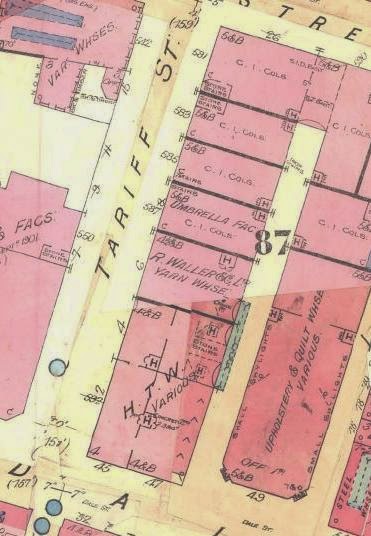
In the late 1840s in to the beginning of the next decade it was a machine shop but sometime around 1858 the building was torn down and redeveloped as the show room and warehouse of Ralph Waller & Co Ltd Cotton Spinners whose factory extended back from number 45 along Tariff Street.

Of course I never made the connection but look closely and the block does show a little of its earlier history.

Not that Mr Waller had begun spinning cotton in Manchester; his first mill was out in Glossop in an 18th century factory which he used for a while in the 1850s before relocating to the city.

Corner of Dale Street and Stanley Street, [Tariff Street], 1849
All of which made sense given that he had set up home in a fine big house in Didsbury and was wealthy enough to contribute a third of the cost of building the new Wesleyan Chapel in Withington.

It replaced an earlier chapel and schoolroom before which “the Wesleyans [had] worshipped God in a cottage.”*

All of which must have made our Mr Waller rather proud and echoes the efforts of other small groups of Methodists in south Manchester at the beginning of the 19th century who were making great efforts to grow their congregations.

Dale Street and Tariff Street, 1901
Most had begun in a similar way with just a handful meeting in a cottage or barn before raising the funds to build their first chapel.

And in one of those odd twists the story of 45 Dale Street, Didsbury and Glossop is also linked to Chorlton.

For like the congregation of Withington and Didsbury the Wesleyans of Chorlton had also met in cottages and barns and built their first chapel just before those of Mr Waller’s congregation.

Nor is that all, because on that August day in 1864 the assembled group went off for a “public tea meeting held in Mr Higginbotham’s barn, and several hundreds were present.”*

Now this might have been Mr Higginbotham who had a farm in Withington or quite equally it could have been old Higginbotham the farmer who lived on Chorlton green, who was himself a staunch Methodist and whose barn had been used for services.

Which in turn is rather neat because 45 Dale Street has become the Tariff and Dale restaurant and bar operated by the team behind The Lead Station in Chorlton.**

45 Dale Street, home to J.P.Hosiery, 1972
But that is as they say in the future, for now I shall return to what was the rest of the story of 45 Dale Street.

Mr Waller died in 1891 and by 1895 the cotton spinning business had shrunk to just part of that building on Tariff Street and while the family retained ownership of the block number 45 had become home to new businesses ranging from a shipping merchant to various manufacturers and by the late 20th century was again a textile warehouse.

Which is almost all there is other than to say like so many of our inner city buildings it did not escape the Manchester Blitz, having taken a direct hit from a fire bomb which resulted in the floor having to be strengthened with new steel supports.

But it is still there and in time I think I will go looking for the chapel Mr Waller helped fund, try and locate the site of his home in Didsbury, and if I feel particularly adventurous go east to Glossop to that first mill of his.

On the other hand I might just wait for the opening of Tariff and Dale.

We shall see.

Pictures; 45 Dale Street, 1972, L Kaye,m01240, m01241, courtesy of Manchester Libraries, Information and Archives, Manchester City Council, http://images.manchester.gov.uk/index.php?session=pass Dale Street, 1844 from the OS Manchester & Salford, 1842-49 and Dale Street. 1901 from Goad’s Fire Insurance Maps, courtesy of Digital Archive Association, http://www.digitalarchives.co.uk/

*Rev Dr Hannah, New Wesleyan Chapel at Withington, Manchester Guardian August 22 1864

** Chorlton's Lead Station to open Northern Quarter restaurant and bar, Emily Heward, MEN February 5 2015, http://www.manchestereveningnews.co.uk/whats-on/food-drink-news/chorltons-lead-station-open-northern-8584538

Monday, 23 December 2024

On Lapwing Lane with a ghost bank

Now here is one of those buildings that I have never given much thought to.

It is the former bank on Lapwing Lane and I must have passed it countless times, and on occasion stared at it from the window of the restaurant opposite.

I did once try to take some pictures but the light was wrong and I gave up which is a shame because I might have been inspired to dig down in to the history of The Mercantile Bank of Lancashire.

Instead I have had to wait till Andy Robertson wandered past took these pictures and set me going.

As yet I haven’t found out much other than it merged with the Lancashire and Yorkshire Bank in 1904 which merged with the Bank of Liverpool and Martin in 1927 which subsequently changed its name to Martins and in turn merged with Barclays in 1969.

But there will be someone out there who knows all about the bank and in time will be in touch.

In the meantime I know that our building dates from 1903, which means it had a brief existence as the Mercantile Bank.

Such are the exciting times of the banking world.

And since I posted this Richard has dug deeper and discovered that the Mercantile Bank Of Lancashire Ltd was "founded in 1890 with a head office at temporary premises in Guardian Buildings, Cross Street, Manchester, with capital of £1m, its early growth reflected the continuing industrial prosperity of Manchester. 


The completion of the Manchester Ship Canal resulted in over 200 new accounts, and on 30 June 1891 the bank reported a net profit of £2,806. 

Several branches were opened in the Manchester area, as well as others across Cheshire, Derbyshire, Staffordshire and Yorkshire. 

In 1900 branches were acquired on the Isle of Man by amalgamation with the Manx Bank. 

Soon after, however, the Mercantile Bank began to run into difficulty, partly due to the effect of the Boer War on investments. 

The board of directors saw that as a relatively small bank, they could only survive by further amalgamation. 

In the early part of 1904, several meetings were held with the Lancashire and Yorkshire Bank, and on 1 July the business of the Mercantile Bank was transferred to the Lancashire and Yorkshire Bank."*

And in turn the Lancashire and Yorkshire Bank merged with he Bank of Liverpool and Martin in 1927.

Pictures; former Mercantile Bank of Lancashire, 1903, courtesy of Andy Robertson, 2015

*Barclays Bank PLC, https://www.archive.barclays.com/items/show/5305

Saturday, 2 November 2024

Dennis and Elaine a mystery revealed part three


I first came across Dennis & Elaine in the summer of 1970. 

Their names appeared on a wall near Withington Library and soon they were everywhere.  Then and now I became intrigued at that simple message of love and partnership, and have continued to wonder who they were.

And almost as soon as the inscriptions appeared they ceased and I was left with nothing more than a memory which I regularly trotted out to anyone who would listen.  It was a nice story but incomplete and even after I had posted a story on the blog* I remained convinced that it was one of those little mysteries with no ending.

But then Elaine made contact and in due course she promised me a photo of the two of them, and here it is.

Nor does the connection stop there because Elaine worked at the old Tommy Ducks which if you are of a certain age you will remember with affection.  In my case it was one memorable evening when I introduced my sister and brother in law up from London to the ceiling of the pub.  


In turn Elaine shared another picture, this time of Tommy Ducks and the coffin which landlord Ken Riggs had brought from the Nags Head which was his previous pub.

Now I can’t remember the coffin in Tommy Ducks but I sat beside it in the Nags Head in the '70s and even went looking for it once.  I couldn’t find it and recently even doubted that I had shared a room and a pint with it.

But now Elaine has managed to bring both memories out of the past and remind me that history is not just about the big events but also the little ones which are more properly about how we lived.

And finally I also have to thank her for starting me on another mystery that of the Ardwick Millionaires but as they say that is another story.

Pictures; from the collection of Elaine Archer.


Thursday, 20 June 2024

A clutch of Manchester poets …. one library ……. and some bittersweet memories

It will be a full 55 years since I first walked into Withington Library and last night I was back in the company of some friends and a clutch of Manchester poets.


The poets meet once a month to share their poems, and I was there to listen to Rod Whitworth who I have known for over half a century.

Back a long time ago we both lived in Ashton Under Lyne, worked together and shared similar politics.

Since then, we have drifted in and out of each other’s lives occasionally meeting up to swap stories of grandchildren, books we have read and where in Manchester to get the best cheese barm.

And it was on one of those encounters that I discovered Rod was a poet, and an accomplished one as many of his poet friends have testified.

His book of poetry “My Family and Other Birds”, came out at the beginning of the year and my copy arrived not long after it was published.*

At which point I could fill the page with reviews but will add just one from Peter Sansom, poet and co-director of The Poetry Business who wrote “it's so compellingly written that it's also that rare thing, a poetry page-turner.  Wonderful."**

So, last night in Withington Library was a bit special, more so because the first part of the evening was given over to seven other poets who offered up a mix of  funny, thoughtful and elegant verse.

It is a long time since I spent the night listening to poetry read aloud and shared with an audience and I enjoyed it.

But the passage of time has done for my ears, and the combination of poor acoustics and gentle voices rendered some of the poems difficult to follow.


It was a bittersweet moment for someone who at the age of 19 could follow the hushed conversations of others across the reference section of Withington Library and made more so by wandering the nearby streets.

They say you should never go back to places and there is indeed some truth in it.

In that half century since I lived on Rippingham Road, so many of the haunts I used have gone, from the Scala Cinema, the White Lion, and the telephone kiosk which was the link with home along with the launderette that haven of wet Sunday afternoons.

That said the house on Davenport Avenue is still there. 

It was home to my friend Lois whose parties were legendary, one of which had me sitting perilously on a low roof in an effort stop Mike and John driving off into the night on a quest to settle a silly disagreement with someone whose name I have forgotten over a quarrel which has faded into the mists.

It could have been the subject of an epic tale of love, angst and alcoholic fuelled evenings to rank beside the Trojan Wars, The Lady of Shalott and the tangled story of Bathsheba Everdene and her suitors in Hardy’s Wessex.

But that would be stretching it.

Best leave such themes to the poets.


Location; Withington Library


Pictures; a clutch of Manchester poets, 2024, from the collection of Andrew Simpson

* My Family and Other Birds, Rod Whitworth, 2024, is available from the author at rod.whitworth@me.com or Vole Books,  https://www.dempseyandwindle.com/rodwhitworth.html

**The Poem Man, https://chorltonhistory.blogspot.com/2024/02/the-poem-man.html