Showing posts with label Dale Street. Show all posts

Sunday, 26 January 2025

45 Dale Street, Didsbury, a mill in Glossop and that barn in Chorlton

Now 45 Dale Street is one of those buildings which seem to have always been there.

45 Dale Street, 1972
I must have passed it countless times and never given it a second glance which is a shame given that it has a rich history which in its time connects this bit of the city with Didsbury, Glossop and Chorlton.

For most of its history the building has been associated with textiles but go back far enough when this bit of Dale Street was first cut and the site was given over to metal working.

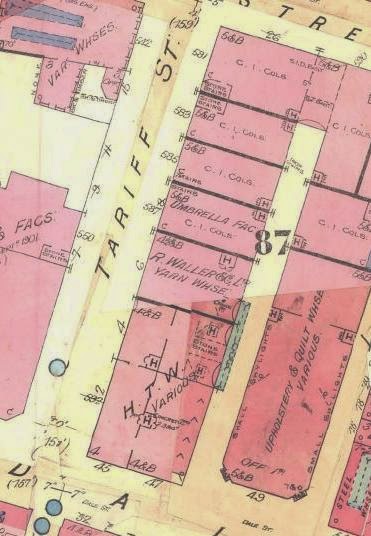
In the late 1840s in to the beginning of the next decade it was a machine shop but sometime around 1858 the building was torn down and redeveloped as the show room and warehouse of Ralph Waller & Co Ltd Cotton Spinners whose factory extended back from number 45 along Tariff Street.

Of course I never made the connection but look closely and the block does show a little of its earlier history.

Not that Mr Waller had begun spinning cotton in Manchester; his first mill was out in Glossop in an 18th century factory which he used for a while in the 1850s before relocating to the city.

Corner of Dale Street and Stanley Street, [Tariff Street], 1849
All of which made sense given that he had set up home in a fine big house in Didsbury and was wealthy enough to contribute a third of the cost of building the new Wesleyan Chapel in Withington.

It replaced an earlier chapel and schoolroom before which “the Wesleyans [had] worshipped God in a cottage.”*

All of which must have made our Mr Waller rather proud and echoes the efforts of other small groups of Methodists in south Manchester at the beginning of the 19th century who were making great efforts to grow their congregations.

Dale Street and Tariff Street, 1901
Most had begun in a similar way with just a handful meeting in a cottage or barn before raising the funds to build their first chapel.

And in one of those odd twists the story of 45 Dale Street, Didsbury and Glossop is also linked to Chorlton.

For like the congregation of Withington and Didsbury the Wesleyans of Chorlton had also met in cottages and barns and built their first chapel just before those of Mr Waller’s congregation.

Nor is that all, because on that August day in 1864 the assembled group went off for a “public tea meeting held in Mr Higginbotham’s barn, and several hundreds were present.”*

Now this might have been Mr Higginbotham who had a farm in Withington or quite equally it could have been old Higginbotham the farmer who lived on Chorlton green, who was himself a staunch Methodist and whose barn had been used for services.

Which in turn is rather neat because 45 Dale Street has become the Tariff and Dale restaurant and bar operated by the team behind The Lead Station in Chorlton.**

45 Dale Street, home to J.P.Hosiery, 1972
But that is as they say in the future, for now I shall return to what was the rest of the story of 45 Dale Street.

Mr Waller died in 1891 and by 1895 the cotton spinning business had shrunk to just part of that building on Tariff Street and while the family retained ownership of the block number 45 had become home to new businesses ranging from a shipping merchant to various manufacturers and by the late 20th century was again a textile warehouse.

Which is almost all there is other than to say like so many of our inner city buildings it did not escape the Manchester Blitz, having taken a direct hit from a fire bomb which resulted in the floor having to be strengthened with new steel supports.

But it is still there and in time I think I will go looking for the chapel Mr Waller helped fund, try and locate the site of his home in Didsbury, and if I feel particularly adventurous go east to Glossop to that first mill of his.

On the other hand I might just wait for the opening of Tariff and Dale.

We shall see.

Pictures; 45 Dale Street, 1972, L Kaye,m01240, m01241, courtesy of Manchester Libraries, Information and Archives, Manchester City Council, http://images.manchester.gov.uk/index.php?session=pass Dale Street, 1844 from the OS Manchester & Salford, 1842-49 and Dale Street. 1901 from Goad’s Fire Insurance Maps, courtesy of Digital Archive Association, http://www.digitalarchives.co.uk/

*Rev Dr Hannah, New Wesleyan Chapel at Withington, Manchester Guardian August 22 1864

** Chorlton's Lead Station to open Northern Quarter restaurant and bar, Emily Heward, MEN February 5 2015, http://www.manchestereveningnews.co.uk/whats-on/food-drink-news/chorltons-lead-station-open-northern-8584538

Tuesday, 1 March 2022

Looking for Mr Waller, wealthy industrialist of Didsbury, benefactor of Withington Methodist Chapel and owner of 45 Dale Street

Groombridge House, 1894
One day I will find an estate agents description of Groombridge House which stood on the site of Christie Hospital.

That said I haven’t yet been able to locate a picture of the place which I guess is not surprising.

It was set back from the main road in spacious grounds with tree lined walks and a fair number of outhouses and was the home of Mr Ralph Waller, wealthy cotton spinner and benefactor of the Wesleyan chapel in Withington.

Now I had promised myself that his would be one of the homes I went looking for ever since I came across his factory and shows rooms which stretched along Tariff Street and on to Dale Street.

I am not quite sure whether Mr Waller built the block but he owned them by 1858 and they were still in the family’s possession over 40 years later.

By then his textile business seems to have shrunk and the showrooms and part of the factory were rented out to other businesses.

But it will have been this textile enterprise which had allowed him to buy and rent out properties in Withington and Didsbury as well as acquiring Groombridge House.

I can’t as yet discover whether he built it or just bought it but it was a striking statement of his prosperity.

It had 19 rooms a rateable value of £230 with an additional assessment of £11 for the surrounding land and dominated the corner of Wilmslow Road opposite the old green.

And it continued to dominate that spot until it was demolished to make way for the Christie Hospital which was “to be built in the grounds of Groombridge House.”*

Withington Methodist Church 2015
All of which means I missed Mr Waller’s house by over 80 years but not to be short changed there is still the church he made a major contribution to.  This is the Methodist Church close by Withington Library which was built in 1865 with a huge contribution from our Mr Waller.

And along with the building there are his reported words made at the laying of the foundation stone in the August of 1864.

His was a long and rather  detailed speech which ranged over all that Britain could be proud of, from the “Queen and our institutions, the civil and religious liberty and impartial administration” down to “our almshouses our infirmaries, our hospitals our mechanical genius our magnificent warehouses and factories” and much more.

But at the heart of the delivery was a strong religious note which focused on “our open bible our Protestant Christianity and the many thousands of places of worship that stud the land.” **

It isn’t perhaps the most fashionable of things to say today but rereading it is to get a sense of the man long after Groombridge House has vanished.

45 Dale Street, 1972
And there are still a few places which bring you close to him.  One is his first textile mill in Glossop which he occupied briefly in the 1850s and is still standing and the other is no 45 Dale Street which for almost40 years was his showroom and warehouse.

I doubt that there is anything left in what was the factory on Tariff Street but I know there could be a few clues in number 45.

And as the building is currently being renovated to reopen later in the year as Tariff and Dale I have the promise of exploring the place while that work is underway.

The owner of the new business who also owns the Lead Station in Chorlton made the offer recently and it will be one I want to take up.

So while I can no longer stand outside his house I might just be able to get a little closer to a bit of history.

Pictures; detail showing Groombridge House 1894, from the OS of South Lancashire 1894, courtesy of Digital Archives Association, http://www.digitalarchives.co.uk/ Withington Church, 2015 courtesy of Withington Methodist Church, http://www.withingtonmethodistchurch.com/ and 45 Dale Street, 1972, L Kaye,m01240, courtesy of Manchester Libraries, Information and Archives, Manchester City Council, http://images.manchester.gov.uk/index.php?

*In Manchester, the Manchester Guardian, May 16 1929.

**New Wesleyan Chapel at Withington, Manchester Guardian, August 22 1864

Friday, 4 June 2021

On Hilton Street …… with one of those buildings with a bit of style and some unexplored history

Numbers 36 and 38 Hilton Street is one of those buildings I have passed countless times, and only vaguely wondered about its history.

That building on Hilton Street, 2021


It’s situated on that bit of Hilton Street which runs out onto the carpark, and is sandwiched between China Lane and Back Chine Lane.


Both lanes are narrow and according to the Pevsner Guide, Back Chine Lane was “a private street for loading with original gates at Nos 56 Dale Street”.*

And the surrounding buildings on both Hilton Street and Dale Street were given over to warehouses, which made perfect sense given that the canal basin for the Rochdale Canal Company once occupied the area adjacent to the two streets.

Added to which, an arm of the canal ran into the warehouse next to 36 & 38 Hilton Street in the 1840s and 1850s, while the site of our building was a timber yard, behind which was a stables, six residential properties and another warehouse which fronted Dale Street.

The area in 1851 showing the arm of the canal 

By 1901 the timber yard had been replaced by an engineering workshop, the stables were described as empty and partly in ruins, while the houses were all vacant and the Dale Street Warehouse had been partly converted into domestic use.

All of which meant that the entire strip from Hilton Street down to Dale Street between the two lanes was ripe for development, which my Pevsner Guide tells me was filled in 1909 by a new substantial building. 

This  was the work of R. Argyle and the Dale Street side “makes the most of its narrow frontage with a lively terracotta façade, sporting a curved oriel window and giant pilasters supporting a segmental pediment”**

The rear of which faced on to Hilton Street which is the building I have passed so many times.

Comparing the two frontages, I have to say that the Hilton Street side is equally impressive and the demolition of the buildings directly opposite for a temporary car park, offers a good vantage point to see the building at its best. 

In 1911 the occupants wee listed as a lithographer, and a General Warehouseman, while the Dale Street side was occupied by the Dailey News Office (Northern Edition).

In time I will trawl the directories to see who subsequent occupiers were, and no doubt someone will tell me who is there today.

Location; Manchester

Pictures, Hilton Street, 2021, from the collection of Andrew Simpson, and the Hilton Street, Dale Street area, 1851, from Adshead’s map of Manchester, 1851, courtesy of Digital Archives, http://www.digitalarchives.co.uk/ 

*Manchester, Clare Hartwell, Pevsner Architectural Guide, 2001, page 220

**ibid, Manchester, page 220


Monday, 27 April 2015

A lost envelope from 1896, Mr Waller's textile factory and Tariff and Dale in the Northern Quarter

It was this old envelope found behind a pipe at 45 Dale Street which set me going.

To Messrs Willcocks and Son, 1896
Now 45 Dale Street had been the showroom and factory of Mr Ralph Waller who was there from the mid 1850s until his death when the building appears to have been sub let to other businesses.*

And this is where William Henry Willcocks enters the story.

In 1893 the London Gazette announced the dissolution of the partnership “between William Henry Willcocks and William Dockray, carrying on business as Merchants at 45, Dale-street, in the city of Manchester, and at 9, Foster-lane, Cheapside, in the city of London, under the style or firm of Willcocks and Dockray.”**

Mr Willcocks continued trading from Dale Street occupying the building with other businesses and in the August of 1896 he received this envelope.  Sadly the contents have long since vanished but it was the start of another little story which took me to Chorlton and back to Dale Street.

Hampton House, 1893
In 1881 William Henry Willcocks was living on Edge Lane and it was there that his son Clarence Smalley married Annie Muriel Kenworthy also of Chorlton in January 1900.

I would love to have been a guest at the wedding which may well have been held at either Hampton House on Edge Lane home to Miss Kenworthy or Edgecombe House also on Edge Lane which was the home of the Willcocks.

So far no references to the wedding have come to light but both houses looked grand places and might well have hosted the reception.

Hampton House was set well back from the main road in its own grounds while Edgecombe had 14 rooms which I suspect hint that neither family skimped on the wedding.

The bale crusher, 2015
And that is not the only connection between 45 Dale Street and Chorlton, because the present owners of the building also own the Lead Station and will be opening a new bar and restaurant in Mr Waller’s warehouse.

It will be called Tariff and Dale and draws from the history of the place as I discovered yesterday when I was invited down to explore the building in its last stages of renovation and conversion.

Now it isn't often that you get to explore a building which is giving up its history.

And as I will never be on the guest list of English Heritage, when you do get a chance to crawl over a mid 19th century textile warehouse and factory in the heart of the city you just have to accept.

The logo, 2015
And there was lot to see from the weighing machine which now stands at the entrance to the bale crusher.

It would have so easy to get rid of these but given that they are part of number 45 it seems fitting that they have been retained.

As have the layers of different paint on some of the walls which tell their own story.

And with one of those nice nod’s to the history of the place, that envelope and the bale crusher have influenced the design of the menu.

But that I shall leave for people to discover when they visit Tariff & Dale which will be open form early May.

Pictures; Mr Wilcox’s envelope and logo 2105, courtesy of Tariff and Dale, detail from the OS for South Lancashire, 188-93 courtesy of Digital Archive Association, http://www.digitalarchives.co.uk/ and the interior 2015, from the collection of Andrew Simpson

*Dale Street, http://chorltonhistory.blogspot.co.uk/search/label/Dale%20Street

**London Gazette, 1893,https://www.thegazette.co.uk/London/issue/26361/page/95/data.pdf


Thursday, 12 March 2015

That building at 45 Dale Street and its surprising conections with Chorlton-cum-Hardy

Now I like the way that when you think you have done with a building and its occupants it bounces back to take you off in new directions.

Dale Street in 2015
In the case of 45 Dale Street it is a place I explored a few weeks back and took me from the Northern Quarter by degree to Glossop, Withington, and finally Chorlton.*

It was owned and may well have been built by Mr Ralph Waller who was a successful textile manufacturer who lived in a fine house in Withington and pretty much paid for the Methodist Church which was opened on Wilmslow Road in 1865.


His first textile mill was in Glossop and the celebrations following the laying of the foundation stone of the church may well have been held in farmer Higginbotham’s barn opposite Chorlton Green.

Nor is that the only connection with Chorlton because the owner of the Lead Station on Beech Road is currently about to open a restaurant at 45 Dale Street.

Dale Street in 1900
And it was Hannah of the Lead Station who first drew me into the history of Mr Waller’s factory and showroom and the design team working on 45 Dale Street who I have to thank for the next twist in the story.**

They uncovered an entry in the London Gazette for 1893 announcing the dissolving of the partnership “between William Henry Willcocks and William Dockray, carrying on business as Merchants at 45, Dale-street, in the city of Manchester , and at 9, Foster-lane , Cheapside, in the city of London, under the style or firm of Willcocks and Dockray.”***

Mr Willcocks was to continue trading from Dale Street occupying the building with other businesses and was still there in 1911.

And that just takes us back to the connection with Chorlton because in 1881 William Henry Willcocks was living on Edge Lane and it was there that his son Clarence Smalley married Annie Muriel Kenworthy also of Chorlton in January 1900.

Hampton House on Edge Lane in 1893
I would love to have been a guest at the wedding which may well have been held at Hampton House on Edge Lane home to Miss Kenworthy or Edgecombe House also on Edge Lane which was the home of the Willcocks.

So far no  references to the wedding have come to light but both houses looked grand places and might well have hosted the reception.  Hampton House was set well back from the main road in its own grounds while Edgecombe had 14 rooms.

In time I think I will go looking for that wedding account but in the meantime I shall be preparing to visit Dale Street where Hannah tells me there are some interesting bits left from the buildings earlier history.

Picture; 45 Dale Street, 2015 from the collection of Andy Robertson, Dale Street, 1844 from the OS Manchester & Salford, 1842-49 and Dale Street. 1901 from Goad’s Fire Insurance Maps, and detail from the OS for South Lancashire, 188-93 courtesy of Digital Archive Association, http://www.digitalarchives.co.uk/


*Dale Street, http://chorltonhistory.blogspot.co.uk/search/label/Dale%20Street

**Tariff and Dale will open for business later this year, Chorlton's Lead Station to open Northern Quarter restaurant and bar, Emily Heward, MEN February 5 2015, http://www.manchestereveningnews.co.uk/whats-on/food-drink-news/chorltons-lead-station-open-northern-8584538

**London Gazette, 1893,https://www.thegazette.co.uk/London/issue/26361/page/95/data.pdf

Tuesday, 17 February 2015

150 years of that Methodist Church in Withington

Now I am not a great one for anniversaries but here is one I think it is worth taking note of because this year is the 150th birthday of the Methodist Church in Withington.

And to celebrate the event Peter Topping painted the church on one of those fine summer days earlier this year.

For me the building is only part of the story but an interesting one.

It was opened in 1865 and was the second chapel built by the Methodists in Withington and continued to serve them well until 1992 when after a survey of the premises, “the church members decided that rather than spend over £100,000 on repairs to the ageing building they would take the bold step of redeveloping the church. 

The redevelopment scheme involved the demolition of ancillary buildings at the rear of the church and the erection of a new floor within the main worship area, to create the space for exciting new projects.”*

And in this respect they were only reflecting the same flexible approach which had led earlier groups of Methodists across south Manchester to worship in cottages barns and even open fields while at the same time working hard to raise the funds to build their first chapels.

In Withington  it all began with “two twelve-year-old girls, Hannah Hesketh and Hannah Langford, who in the 1790s heard the gospel in neighbouring Burnage and asked that a bible class be run for them in 
Withington. From this class held originally in farmhouse kitchens a worshipping community developed who, in 1832, erected a small chapel in old Moat and subsequently built the present building in 1865.”*

A large part of the money for the new church was contributed by Mr Ralph Waller a wealthy industrialist with a factory and showrooms in Manchester. **

He lived at Groombridge House opposite the old green and according to the Manchester Guardian gave a third of the total cost to the building of the 1865 church, which brings us back to that birthday and Peter’s painting.

Painting; Withington Methodist Church, © Peter Topping, 2014, Paintings from Pictures,
Web: www.paintingsfrompictures.co.uk
Facebook:  Paintings from Pictures

* Withington Methodist Church, http://www.withingtonmethodistchurch.com/history.html

**Dale Street, http://chorltonhistory.blogspot.co.uk/search/label/Dale%20Street