Showing posts with label Gateshead. Show all posts

Thursday, 19 October 2023

On finding my uncle …… and losing his wife

Now yesterday I was exploring the story of my uncle, trying to solve several mysteries and reflecting on just how easy it was to disappear in the first half of the last century.*

He was born in 1901, married in 1933 and died in 1953, and for as long as I can remember he was a family secret.

A secret which I only stumbled across when a family tree came to light, after which dad and his three brothers owned up to the story.

Even then they were reluctant to offer much, and for perhaps 30 years I left him in the shadows.

But at 73 I was keen to tie up the loose ends of the family and over the last week I have been searching for him.  A search that took me from Alloa in Scotland to Gateshead and finally a grave in a Birmingham cemetery.

And for now, I think I mined the seam of his life, and while there are still plenty of gaps I am content that I will not find out much more.

The last intriguing piece was the discovery that on the evening of June 19th 1921 he was on holiday in Whitley Bay.  This I know because today I stumbled across an entry in the 1921 census listing him as staying at 26 Marden Crescent in Whitley Bay.

It is a modest looking property just a short walk from the sea and just a tad longer walk to Cullercoats Bay and Long Sands Beach.

He was not alone, for there were five other holiday makers, three of whom were sisters and a couple in their sixties.  Their occupations were as varied as their ages, with a travelling salesman, two teachers a housewife and a Florence Burrows who was listed as doing “House duties”, leaving my uncle who was an apprentice turner for a company in Gateshead.

Their hosts were a Mr. and Mrs. Smith who ran the holiday B&B, and appear to have washed up in Whitley Bay some time during the previous decade. Mr. Smith had been born in Orkney in 1858 and rose in the ranks of the police force before retiring sometime before 1901 and continuing to work as a toll collector.

We will never know whether uncle hit it off with the sisters who were aged between 30 down to 20 and who may have enjoyed the company of this young apprentice.

What is more certain is that his marriage ran into the buffers, and twelve years after he had got married his wife sought a divorce.  She was still in Gateshead, but uncle may already have settled in Birmingham where so far, he has left no record, other than his death certificate and a grave in Yardley Cemetery.

Nor has his wife proved easier to locate.  The marriage certificate allowed me to track her early years and the several homes she grew up in. But apart from that marriage certificate and a court notice referring to the divorce, she has gone missing.

And despite a day looking for her in the 1939 Register and other documents using both her married and maiden name, all has gone silent.

Leaving just one surprise which was that that the young bride lied about her age, which was actually 38 and not 32 as stated on the certificate.

A small deceit perhaps but one which might have been the first step on the road to unhappiness.

I doubt we will ever know.

In the meantime, I shall keep looking.

Location; Whitley Bay, Gateshead and Birmingham

Pictures; family and friends, circa 1920-30s from the collection of the Simpson family.

*Travels with my uncle, https://chorltonhistory.blogspot.com/search/label/Travels%20with%20my%20uncle

Wednesday, 18 October 2023

On losing your uncle …….. travels with a family secret ….the 1921 census part 2

I had hoped that the newly released 1921 census would help with the family secret.

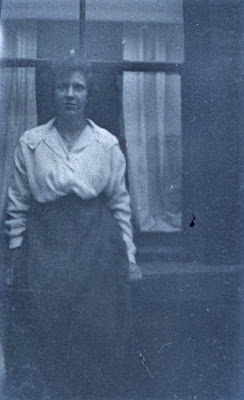
Window girl, date unknown
Most families have one, and we have quite a few, but this one has remained stubbornly in the shadows.

He was one of my uncles who was never mentioned, and I stumbled across him in my 40s, and despite repeated questions to dad and my other uncles little was forth coming.

Father just met my inquiries with a vague comment and quickly changed the subject while Uncle George vouched safe only of a disastrous marriage, and a preventable death in a Birmingham lodging house.

Over the years I have gone looking for the mysterious uncle, and did find references to his marriage in 1933, and his death twenty years later. There are a few photographs of weddings and individuals which may be connected to him, but alas all are undated and unnamed. 

To which uncle George only added that the death could have been avoided if the landlady of the lodging house had been more attentive when his brother contracted an illness.

And that is it, leading to the family speculation that just possibly the marriage was never dissolved and instead he had left the northeast for the Midlands, and his location was never revealed to anyone except the brothers.

For years I have respected that silence, and even now I wonder at invading that closed story, but the 1921 census proved too much.  

After all this census which will be the last till the 1951 census is published has the promise of revealing so much about post war Britain, and especially about the family.

A wedding, date unknown
A decade earlier he had still been living at home, aged ten and was at school, so ten years on I reasoned there might be clues about him, from his occupation and where he might have worked.

But he was no longer in the family home, and so far, appears nowhere else in 1921.

Which is a blow, leaving me just to call up the marriage and death certificate, and hope that I can then follow up on his wife and his final address.

But I suspect he was a man intent on revealing as little as possible.  At present he has evaded electoral registers, directories and even the 1939 Register.

And that in turn makes me think perhaps he has done enough to stay in the shadows.

We shall see.

Location; the Northeast and the Midlands, 1891-1953

Pictures; unknown friends or relatives of the family, dates unknown, from the collection of Andrew Simpson

Tuesday, 17 October 2023

Losing an uncle ……. and discovering much in the search

This is the story of my uncle, and a series of questions which almost 70 years after his death remain unanswered.

The unknown women in the window, undated
At which point I fully accept that one person’s family history is another person’s yawn, but there is enough in the search to find answers which will resonate with others, offer routes to find lost relatives and perhaps make broader comments about the last century.

For most of the time I was growing up I only had a vague knowledge of him, and Dad, and our other three uncles never spoke of him.  And even when quizzed would reluctantly let slide just the briefest of answers and quickly changed the subject.

Later one of them provided a family tree with the “missing” uncle, and another spoke of a disastrous marriage and a death which could have been prevented if his landlady had noticed how ill he had become.

So enough to suggest a few mysterious and pointers to find out more.

He was born in 1901 in Alloa in Clackmannanshire in the Central Lowlands of Scotland, and over the next decade the family moved south, finally crossing the border and settling in Gateshead sometime in the 1900s..

And in that the family were typical, having started their migration south from the east Highlands decades earlier.

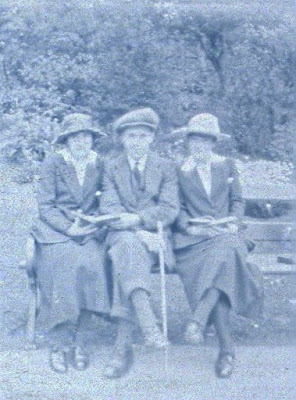
Dad or an uncle with friends, date unknown
But there the trail begins to turn shadowy.  So, while he appears on both the census returns for 1901 and 1911, he is missing from the 1921 census as well as the 1939 Register.  Nor can I find him as yet on any official form, register, directory or newspaper account, until his death certificate dated 1953 issued in Birmingham.

Added to which that death certificate only makes for more mysteries.  It was registered by a Mr. Walter Francis Pountney, who clearly didn’t know our uncle very well, because the age at death was recorded as “about 52” and occupation as “not known”.

And all this despite the fact that Mr. Pountney owned the property.

To be fair it is unclear whether he was living in the house when uncle died.  In 1939 he was registered as occupying the place, but six years later according to the electoral register the house had been given over to multi occupancy, with fifteen residents one of which was his mother.

So, I am not surprised that our uncle ended up in a local cemetery with what appears the cheapest of burial services and no headstone.

Perhaps the brothers only came to know later, which would fit with the little I can surmise, which is our uncle didn’t want to be found.

His wife is recorded in the Manchester Evening News as petitioning for a divorce in the November of 1945  and the official announcement refers to our uncle’s last known address in Gateshead, by which time I suspect he was faraway.  Now whether Birmingham was already that faraway destination is unknown, although I don’t think it was Manchester.

Unknown family friend, date unknown
She was still living in Gateshead and the divorce petition was administered through the Newcastle division of the High Court.

I have her maiden name which was Smith but as yet no date or place of birth, and no parental name.

Those await the arrival of their marriage certificate, ordered up a fortnight ago from the General Registry Office but as yet with postal delays as they are I am still waiting.

So, the trail has gone cold for the minute, leaving just a few observations, starting with the bizarre one that I know more about Mr. Poutney than I do my uncle.

But then this was still a time when it was possible to disappear and pretty much reinvent oneself.  

Apart from a National Insurance Number, there was little to track or identify him.  The requirement to carry or present a National Identity Card had ceased in 1952, and if he avoided hospitals and doctors, he wouldn’t need an NHS number.  

Likewise, if he was careful about the jobs he did, and how he was paid it is doubtful he would have attracted official attention.

And of course, bank cards, online payments and social media were yet to be dreamed up.

Dad, date unknown

So, I think he could have stayed in the shadows, and finding him once he choose to vanish has been difficult.  I know where he lived in Birmingham at his death, and searching for Mr. Poutney took me to the 1939 Register and the house in Birmingham, along with a reference to the electoral register for 1945 living in a street close by to where my uncle had died.  

And armed with that link it was easy to search the same register for the house where uncle was to die in 1953.

All pretty much now hangs on that marriage certificate but that sits somewhere in a sorting office, and until it drops through the letter box our uncle remains in the shadows.

Location; Gateshead, Birmingham

Pictures; unknown family and friends, circa 1920s-30s, from the collection of the Simpson family

Wednesday, 16 February 2022

A photograph ..... a postcard ..... and the search for a sister ....Sidney Albert Taylor ......

This is Sidney Albert Taylor, sometime during the Great War.

Sidney Albert Taylor, 1916

The picture postcard was sent to his sister from the village of Woodbastwick in Norfolk, where he was recovering from an injury, and his message to Ann Isabella was upbeat.

Message home, 1916
And that is pretty much it, but like all young men from that conflict he deserved to come out of the shadows, and in the process the story became not him but the search for him and along the way presented a series of coincidences which brought him closer to me.

So, the starting point for the search was the name and address on the card.

I have to say I had no expectation that 23 Devon Gardens would still exist, but it does, or that it would be so easy to find Ann Isabella.

She was just a set of initials and a surname, which even for the most determined researcher can be a tad daunting.

But the historical records offered her up.  

She was born in Gateshead in 1889, her father was a “boiler man” and for at least the first decade after her birth the family lived on Papermill Square, and by 1911 just round the corner at 84 Victoria Road.

Miss I. A. Taylor, 1916
Sadly, the area has been extensively redeveloped and apart from the Independent Primitive Methodist Chapel there is little that she would have recognized, and today there is every indication that the chapel may not be with us for much longer.

As for their home, this was a 4 roomed property into which squeezed her parents, three siblings, and for a while another brother and sister.  And there amongst her siblings was our Sydney Albert, who had been born in 1894 and at the age of 16 was an apprentice at a paper mill.

I don’t know when he enlisted, but given that the postcard was dated 1916, he may have signed up shortly after the outbreak of war and was possibly one of the Durham Pals.*  Or he may have been a reservist called back to the Colours.

What I can be sure of is that he was not in France in 1914 or 1915, as his medal record show he was not awarded either the 1914 or 1914- 15 Star, and that in 1916 he was still in the Durham Light Infantry, although later in the war he appears to have been transferred to the Nottinghamshire and Derbyshire Regiment.

He survived the war, and was discharged in 1919, with the classification of “Disabled”.

Recovering in Woodbastwick, 1916
The records show that he went back to his old occupation in a paper mill.  In 1922, he was at the Team Valley Paper Mill, and was still there fifteen years later when he gave his occupation as “Paper Bag Machinist”.  

There are at present few details on the Mill but the National Archives** records that company records for 1895 through to 1963 are lodged at the Durham County Record Office.***

For the curious, both his 1922 home at 27 Telford Street, and his 1939 house at 23 Brighton Road have survived. They are located just a short walk from where he had lived before the war. 

I have yet to discover when he married Violet Mabel, who was from Cornwall, and where and how they met may remain a mystery.

I do wonder what he made of his time at Woodbastwick in Norfolk. 

It is a small village which my Wikipedia tells me in the 2001 census had a population of 362 in 157 households,  in 2001, increasing to a population of 399 in 168 households at the 2011 Census.****

I will go looking for where in the village he spent his time recovering from his wounds, but I suspect it has gone.

Woodbastwick Village Green, 2005
Leaving me just to reflect on the way you can be drawn into the story.  

My father was born and grew up in Gateshead not far from where Mr. Taylor lived and remained in the area until the early 1930s, while my maternal grandfather was also in the Nottinghamshire and Derbyshire Regiment during the Great War.

Funny old world.

Location Gateshead, Norfolk

Pictures; Sydney Albert Taylor, and the picture postcard, 1916 from the collection of David Harrop, and Woodbastwick Village Green, Roy Douglas, 2005, This image was taken from the Geograph project collection. See this photograph's page on the Geograph website for the photographer's contact details. The copyright on this image is owned by Roy Douglas and is licensed for reuse under the Creative Commons Attribution-ShareAlike 2.0 license.

* Durham Light Infantry, 18th Battalion (Durham Pals), Durham at War, Durham County Record Office, https://www.durhamatwar.org.uk/story/12528/

** Team Valley Paper Mill, National Archives, https://discovery.nationalarchives.gov.uk/details/c/F176058

*** Team Valley Paper Mill, D/TVP, NRA 35658 Team, Durham County Record Office http://www.durhamrecordoffice.org.uk/

**** Woodbastwick, https://en.wikipedia.org/wiki/Woodbastwick

Tuesday, 28 July 2020

Messages from Germany ….. to Didsbury and Gateshead …… December 1918

We were lucky, of the six members of our family who went off to the Great War, all but one survived.

Crossing the Rhine, December 12th, 1918
And amongst the letters of those that came back is a Christmas card sent to father by his brother in December 1918. 

It is a short letter, reflecting on that first month of peace, and describing the city of Cologne which his regiment was occupying.

 He wrote that “Cologne is a lovely city with some fine cinemas” but they were prohibited from fraternizing with the civilians which for a young man of just 21 was a bit of a bore given the attractive young women he came across.

But duty was never far away and preparations were a foot because “we are crossing the Rhine tomorrow” and there was a determination “to show the rest of the division the way as we proved to be the finest marchers during the trek to Germany.”

Even now that simple message that “we are crossing the Rhine tomorrow” has a powerful effect on me. 

Father's Christmas Card, 1918
Partly I guess, because after four years of fighting he was about to march into the heart of Germany. 

And because my grandmother was also there. 

She was German, had been born in Cologne, and just two years later would marry my grandfather who like Uncle Fergus was a member of the British army of occupation

I doubt I will ever know if the three of then were all in the city on the day my Uncle marched east, but the romantic in me would like to think so.

And in the same way I was moved by reading another message from another British soldier who was part of that occupying force. 

I only know his surname and have as yet no idea of his rank or regiment.  But on December 19th he sent a postcard to his son with the message “Happy Xmas my Little Man with love from Daddy”

Happy Xmas, Lucuen, December 1918
It was addressed to Master Lucien Read, 6 Elesmere Road Fog Lane, Didsbury.

And there for now, the trail ends.

There are a number of possible Mr. Reid’s in Didsbury in 1911, but as yet none that I can identify as the father of Lucien. 

Their home on Elsemere Road was yet to be built, and with out a first name, it has proved impossible to track him amongst the British army records for the Great War.

But, I am confident that one day he will come out of the shadows.

Lucien's German Christmas card
Which just leave me with his card, and the knowledge that he too was a survivor. 

In his case occupying the town of Solingen, which was also on the eastern bank of the Rhine, to the south and east of Dusseldorf, and north of Cologne.

His card is dated just seven days after my Uncle’s letter, so I guess they may have both crossed the river at the same time.

A trawl of the military records for December 1918, will reveal when they crossed and may offer up the regiment Mr. Read was in.

We shall see

Location; Germany, Gateshead and Didsbury

Pictures; letter and card from Fergus Simpson, December 12th, 1918, from the collection of Andrew Simpson, and postacard to Master Lucien Read, December 19th, 1918, courtesy of David Harrop