Showing posts with label International Women's Week. Show all posts

Sunday, 8 March 2026

Working women ......... stories for International Women's Day


Taking a break from The Queen and Pasley 1910
It is just one of those things.

The passage of time has made it certain that I will never know who this group of young people were.

The photograph dates from 1910 and the caption suggests that some of them worked for the Queen and Pasley Laundry on Crescent Road.

And it got me thinking about how their lives would pan out.

Of course the outbreak of the Great War would sweep all of them along and the young man in shirt sleeves would in all probability have volunteered or been called up.

But on International Women’s Day I was drawn to the group of young women.

They would all be in their late thirties or even older when they were able to cast a vote in a parliamentary election.

Their working lives might just stretch to something in town just 4 miles away but otherwise theirs was the laundry or perhaps domestic service.

For their mothers and grandmothers job opportunities were even more limited.

Before the 1850s many would have spent sometime in the fields, either working full time alongside other family members or during key moments in the year like sowing or harvesting.

Of course there was always domestic service which was the second largest source of employment in the township. Like the country as a whole it was mainly an occupation for single working class women. So in the township in 1851 there were 53 female servants, ranging from governesses to housekeepers cooks, maids and nurses.

Domestic service counted for 27% of the labour force of which 68% were woman and of these 81% were unmarried. By comparison just 22% of single women were engaged as washerwomen and laundresses.

But it was not much of an opportunity for local women. Only ten of the fifty three working as servants were born here and just another eleven were from neighbourhoods less than 5 miles away. Sarah Bayley was one of these.

She had worked for the Higginbothams’ at Yew Tree Farm in Withington during 1841 and later moved to work for Daniel Sharp on the Row. Those households with servants would have heard a mix of northern accents including those of Yorkshire and punctuated by voices from Derbyshire and far away Ireland.

Part of the reason for this was a concern that locally employed servants might be tempted to divulge family secrets which could fan out around the township and haunt the household’s reputation for generations.

It followed that anyone wishing to find employment was often forced to look outside the township. In some cases news of vacancies came from family members who were already employed in a household and in other cases from the help of local gentry or clergy who might know of vacancies or were prepared to actively search amongst their friends who might need a servant.

There were also the hiring fairs and newspaper adverts and the workhouse. But the hiring fairs may not have played much of a part in our local economy. Either way our servants came from far and wide.

Cleaning another’s home was not limited to domestic servants. Mary Hesketh made a living as a char woman, which was paid by the week and required her to visit on a daily basis. It was a job which allowed those who were widowed or single a means of providing for themselves.

Taking a break from The Queen and Pasley 1964
So for Mary who was 60 and living alone, charring was an important source of income. Ten years later none of the char woman at the end of March 1851 were married. Most were single in their twenties and living at home.

For many married working women the alternative here in the township was to wash other peoples’ clothes, either by attending at the customer’s house or washing them at home.

There were 23 of them and most were married with some of the younger ones working alongside their mothers. They were by and large concentrated along the Row, up by Lane End and in a cluster by the Royal Oak in Renshaws Buildings.

Adapted in part from The Story of Chorlton-cum-Hardy, Andrew Simpson, 2012, https://chorltonhistory.blogspot.com/2011/11/the-story-of-chorlton-cum-hardy.html 

Picture; by the parish graveyard, 1910 from the Lloyd collection, remaining pictures from the collection of Tony Walker

Monday, 8 March 2021

For International Women's Day ...... Women vs Hollywood .... today on the wireless

Now, here is one to listen to on International Women's Day.

Hattie McDaniel, 1941

Over the next five days on Radio 4, starting at 9.45, Rigorous History, Women vs Hollywood.*

"Film critic Helen O'Hara celebrates Hollywood’s female pioneers - in front of and behind the camera - who fought sexism and the power of the studio system to find their own voices and change film forever.

The dawn of cinema was a free-for-all, and there were women who forged ahead in many areas of film-making. Early pioneers such as Nell Shipman and Lois Weber shaped the way films were made. But it wasn't long before these talented women were pushed aside, and their contributions written out of film history.

Hollywood was born just over a century ago, at a time of huge forward motion for women's rights, yet it came to embody the same old sexist standards. Women found themselves fighting a system that fed on their talent, creativity and beauty but refused to pay them the same money or give them the same respect as their male contemporaries.

The studios gave their stars no choice over the roles they played and invaded the most intimate aspects of their lives, controlling their romantic relationships and forcing them to have abortions. Life was even harder for women of colour.

Olivia de Havilland, 1941

Helen O'Hara celebrates the women who fought back against the system - stars like Olivia de Havilland and Marilyn Monroe who defied the control of the studios, women of colour such as Hattie McDaniel who had to fight to attend her own Oscar ceremony, and pioneering producers such as Dawn Steel and Sherry Lansing who broke the male stranglehold over the film industry.

In this first episode, Helen tells the story of Alice Guy-Blaché, one of the most prolific and successful film-makers in the first years of Hollywood, and how, late in her life, she fought to preserve her legacy.

Helen O’Hara has been working as a film journalist for over 15 years. She is now Editor-at-Large of Empire magazine, and co-hosts the Empire Podcast.

Abridged and produced by Jane Greenwood

Read by Helen O’Hara

A Loftus Media production for BBC Radio"

Picture;  Actress Hattie McDaniel, 1941; Scanned by Myra Wysinger and uploaded. Photo from family photo collection. Autographed copy of Hattie McDaniel's July 10, 1941.Publicity photo of Olivia de Havilland, circa 1945.


*Rigorous History: Women vs Hollywood, https://www.bbc.co.uk/programmes/m000sy4b

Thursday, 21 July 2016

The first statute to a woman in a century .............. a Manchester “woman of significance”

Now there is something really exciting about the plan to unveil a statute to Emmeline Pankhurst in Manchester.

Cll Simcock & Helen Pankhurst, 2016
The original idea came from Councillor Andrew Simcock who last year launched a campaign to identify a Manchester “woman of significance” who would be remembered by a statute.

Andrew asked for suggestions and from the list Mancunians voted for Mrs Pankhurst.

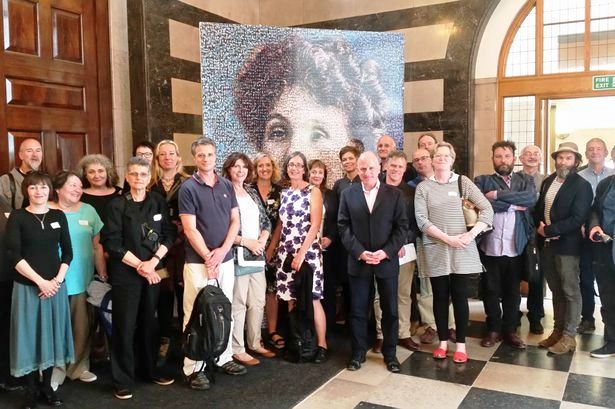
And this week the project took another step forward with the invitation of 19 sculptors to a launch in the Town Hall which was also attended by Helen Pankhurst who is the great-granddaughter of Emmeline Pankhurst.

Between them the 19 have created statues and busts of an array of people including Sir Alf Ramsay, Prince Charles, LS Lowry, Moss Side peace campaigner Erinma Bell, Captain Mainwaring from Dad’s Army, and my own favourite commemorating Sheffield’s Women of Streel.*

Each sculptor will produce a design from which a short list of six will be chosen, and each design will be auctioned at a fundraising dinner next March.

And it is important to stress that the entire cost of the project will be met by voluntary subscriptions and fund raising activities.

As Andrew has said, “fundraising for the statue now begins in earnest as there will be no public money spent on this project. This is particularly important at a time of public austerity and homeless people on the streets.

I would be delighted to hear from any business or individual who would like to sponsor the short listing competition. **

And Andrew has already done his own cycle ride across the country to raise funds.

All of which is consistent with the way that the City has funded public statues over the last two centuries.

The "19" with aAdrew and Helen
What perhaps makes this one a little different is that it is of a woman of whom there are few in the city and more importantly is about the contribution women made to the City.

The original list offered up some fascinating women from Margaret Aston and Mrs Annot Robinson to of course Mrs Pankhurst.

And in the course of the debates about who to choose people explored the lives and contributions of each woman and reflected on their collective role in the history of the City.

Nor will it stop there because during the course of the fund raising there will be fresh opportunities to swop stories and mount all sorts of projects which will culminate with the unveiling of the finished statue in St
Peter’s Square on International Women’s Day 2019.

Picture; the nineteen sculptors, Helen Pankhurst and Cllr Andrew Simcock, in front of the Charlotte Newson portrait of Pankhurst in the Town Hall, 2016 courtesy of Andrew Simcock

* Women of Steel ........... the memorial and a chance encounter with Martin Jenkins, https://chorltonhistory.blogspot.co.uk/2016/07/women-of-steel-memorial-and-chance.html

**Cll Andrew Simcock, cllr.a.simcock@manchester.gov.uk

Friday, 4 March 2016

In advance of International Women’s Week .................... a new set of records on those arrested for campaigning for the vote before 1914

Now as we head towards International Women’s Week it is fitting that a whole new set of records on those that participated in a range of activities that led to their imprisonment are now online.


Ancestry has made available a government data base of those women that had been arrested between 1906-1914.*

“Upon the outbreak of war in August 1914 some of the suffrage societies (but not all) declared a suspension to militant tactics. In response, the government granted an amnesty to all suffrage prisoners. The WSPU was one of the key societies to move away from suffrage campaigns to support Lloyd George’s government in the war effort, though they had fire bombed his house only months before.

At the outbreak of the amnesty the Home Office compiled a list of all suffrage campaigners they were providing amnesty to, and although the document is entitled ‘Amnesty of August 1914: index of women arrested 1906-1914’ it also includes the names of more than one hundred men. 

The Home Office actually began keeping indexes of suffrage supporters (male and female) prior to the amnesty, so that they could trace and link multiple convictions of the same person. 

Originally written on index cards, which were often out of order, in 1922 the records were copied into a book. Each record consists of the name of the person arrested, and the date and place of arrest. 

If a person was arrested more than once, the details of each arrest are documented. In the last half of the book were inserted letters, minutes, reports, and several news articles related to the activities of the suffragists and suffragettes. The value of the index was primarily for day to day office work in the Home Office. 

However, the clerk notes “should the history of the Suffragette Movement ever …. be written in detail, [it] would be a source of information not otherwise obtainable.”


The richness of this source is not in the story of the amnesty and the different reactions to war by many different suffrage societies. 

Instead, it is in the literal wealth of names to be found in the document - over 1000 male and female suffrage campaigners who were at some point arrested. It’s a document that moves away from viewing only the Pankhurst figureheads of the movement to look at the wealth of individuals who, for a cause they believed in, were prepared to risk their jobs, families, and sometimes their health by hunger striking.”*

So there you have it, but I can’t close without reflecting that all of this is only part of the story and in the preoccupation with the women who broke windows and set fire to the contents of pillar boxes another equally important story often gets over looked.

This is the history of those other working women who campaigned in their workplace, their trade union and within the Labour Party for the extension of the franchise to all women, but that is another story.


Pictures; Suffragettes, 1905, m48441, Annie Briggs, Lillian Forrester and Evelyn Manestra. who attacked pictures in Manchester City Art Gallery in April 1913. m08225, and Emmeline Pankhurst and Emily Wolstenholme, date unknown m08239 courtesy of Manchester Libraries, Information and Archives, Manchester City Council, http://images.manchester.gov.uk/index.php?session=pass


* About England, Suffragettes Arrested, 1906-1914, Ancestry.co.uk www.ancestry.co.uk


Tuesday, 10 March 2015

A life rediscovered and the campaign to get women the vote part two

Miss Maxwell, possibly 1867
This is Lily Maxwell and until last year ago I knew nothing of her but she has caught my imagination.

She was born in Scotland in 1801 and died here in Manchester 75 years later.

Her early life is still a mystery but in 1867 she was caught in history because in that year she presented herself at Chorlton Town Hall and voted in a Parliamentary election.

Now given that it would be another half century before some women were given a Parliamentary vote and another decade after that before all women over the age of 21 could vote in a General Election Miss Maxwell’s vote is a significant moment.

Well it would have been if her vote had been allowed but it was over turned by a Court of Appeal on the grounds that she had been wrongly registered and so was not entitled to take part in the by election.

The story was covered by newspaper across the country and Punch even published a poem on the event.

Most of the press led with the story that she had been wrongly registered but that the Returning Officer had little alternative but to let her proceed. It was “it appears that, when a name is on the register, the presiding officer has no alternative but to receive the vote of the person who bears the name when it is tendered...........the name ‘Lily Maxwell’ is registered (No. 12,326) as that of a person entitled to vote for the Parliamentary borough of Manchester.  Possibly the registrar may have supposed it to be a masculine name.”*

Lydia Becker, 1879
And that was pretty much how I read the story until I dug deeper and discovered that the Manchester Society for Women’s Suffrage had been working during 1867 to put women with the requisite property qualification on the electoral register.

The Society had been founded in January of that year and one of its driving forces was Lydia Becker who was made Secretary the following month.

Miss Becker along with another woman had accompanied Miss Maxwell to Chorlton Town Hall in the November when Lily Maxwell exercised her right to vote.

So not a mistake but a carefully calculated part of a campaign to publicise the right of women to the vote, and while Lily was ultimately unsuccessful as were other women the event did gain national coverage.

The Edinburgh Evening Courant reported that “Miss Lily Maxwell and 1100 other women householders in the township of Chorlton –upon-Medlock have sent in claims to be placed on the list of voters for the city of Manchester.”**

And while most were struck off by the Court of Appeal thirteen who had been over looked by the Revising Barrister were still on the Manchester register at the time of the General Election in November 1868, and nine actually cast their votes.

The society remained an important force having joined in a loose federation with societies in London and Edinburgh in November 1867.

It was then known as the Manchester National Society for Women's Suffrage until 1897, when along with about 500 other suffrage societies, it joined the National Union of Women's Suffrage Societies, and became the North of England Society for Women's Suffrage.

In 1911 it changed its name to the Manchester Society for Women's Suffrage, part of the Manchester District Federation of the N.U.W.S.S.”***

Miss Maxwell
Their records are in the Archive and Local History Library so will be available from March 22 when Central Ref reopens.

And all of that brings us back to Miss Maxwell who herself seems no accident of history.

She was quite clearly a “progressive” voting for the Liberal candidate in the 1867 by election and continuing to put herself forward again for inclusion on the electoral register.

We first come across here in 1841 living in a shared house on Broughton Street in Cheetham.  She described herself as a farm servant and while she is lost for 1851 she reappears in Ardwick in 1861 and four years later in Chorlton upon Medlock.

And here we can track her through the Rate Books as the occupier at 25 Ludlow Street and then at 71 Cowcill Street.

Sadly both properties have long since vanished along with the streets themselves.
As for Miss Maxwell she entered the Work house in April 1876 and died in the October and was buried at Bradford Cemetery.

Record of Miss Maxwell's death, October 1876
Bradford Cemetery is now Philips Park Cemetery but I can find no record of her burial.

Of course she may have been buried a pauper and the records long since lost, but I shall continue to search.

After all until recently she was just a name beside a photograph with the slightest of mentions.
I think she deserves more.

Pictures; Lily Maxwell, date unknown but possibly 1867, m08249, and the death entry from the Chorlton Union Workhouse records, courtesy of Manchester Libraries, Information and Archives, Manchester City Council, http://images.manchester.gov.uk/index.php?session=pass, Lydia Becker, 1879, Wikipedia Common,

*Daily News, November 1867

** The Edinburgh Evening Courant, August 14, 1868

***The National Archives, http://www.nationalarchives.gov.uk/a2a/records.aspx?cat=127-m501&cid=0#0


Monday, 17 March 2014

Looking for Lily Maxwell, who voted in a municipal election in 1867

Now I blame Graham, who posted this picture of Lily Maxwell and the accompanying notes

“First woman to record a vote in a municipal election, November 1867

Lily Maxwell was the first woman to vote in Britain in 1867 after the Great Reform Act of 1832. 

The act had explicitly excluded all women from the voting in national elections by using the term ‘male’ rather than ‘person’ in its wording. 

Maxwell, a shop owner, met the property qualifications that otherwise would have made her eligible to vote had she been male. Her name had been added to the election register and on that basis she succeeded in voting (escorted by Lydia Becker) in a by-election – her vote however was later declared illegal.”

And followed it up with an extract from the Daily News dated November 28 1867 which reported on the "record and acceptance of a vote by a lady, at the Chorlton Town Hall [continuing] it appears that, when a name is on the register, the presiding officer has no alternative but to receive the vote of the person who bears the name when it is tendered...........the name ‘Lily Maxwell is registered (No. 12,326) as that of a person entitled to vote for the Parliamentary borough of Manchester.  Possibly the registrar may have supposed it to be a  masculine name.”

And so I was drawn in.

This may have been a mistake but those early campaigners for widening the franchise were quick to seize the opportunity and Lily Maxwell was accompanied by “Miss Becker, the secretary of the Women’s Suffrage Society of Manchester [and Miss Maxwell] voted for Jacob Bright."

Likewise the establishment moved equally quickly and her vote was later declared illegal by the Court of Common Pleas.

All of which made me want to explore the history of Women’s Suffrage Society of Manchester and also to find out more about Miss Maxwell.

Now there is only one Lily Maxwell listed in the official records for Manchester during the period.

She was born in Scotland in 1801 appears on the 1861 and ’71 census and died in the last quarter of 1876.

And that  is almost it.

We can track her to Ardwick in 1861 when she described herself as House Keeper.

Four years later she had moved to 25 Ludlow Street in Chorlton on Medlock and in 1867 was at  71 Cowcill Street.

And it was while she was occupying this property that she was included on the electoral register.

Here she stayed till her death nine years later.

Of her earlier years before 1861 I can as yet find nothing but I travel in hope.

So she remains an intriguing figure not only for what she did but for who she might have been.

Picture; Lily Maxwell, date unknown but possibly 1867, m08249, courtesy of Manchester Libraries, Information and Archives, Manchester City Council, http://images.manchester.gov.uk/index.php?session=pass