Showing posts with label Chorlton History. Show all posts

Friday, 29 August 2025

Mr. Topping paints Eltham Palace …..

 Now, I maintain, and I maintain most strongly that you can never have enough paintings of Eltham Palace.
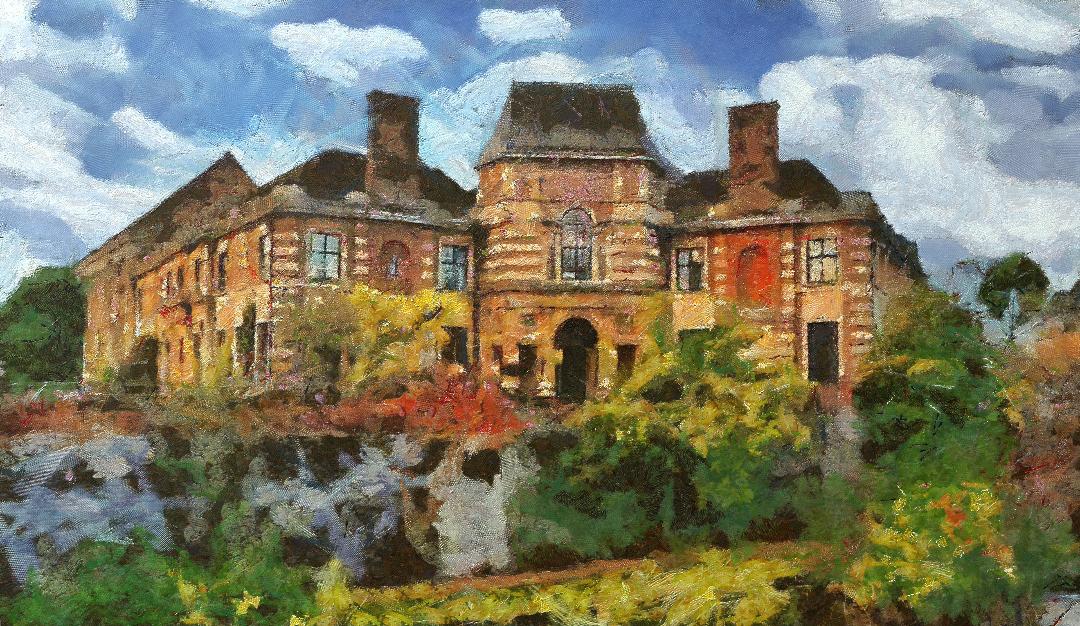
Growing up in Well Hall with the Pleasaunce and the Tudor Barn, that magnificent medieval Palace was always a counter attraction.

True in the 1960s you could only gain access on a Thursday but that was enough and as a kid with a vivid imagination my day would be spent with a host of kings, and barons down to the cooks and servants who waited on. 

Even then I was well aware that had I been in the Palace in the Middle Ages I wouldn’t be giving the orders, instead it would be my task to fetch, obey and generally be the dogsbody.

And then our Jill moved into a house nearby with views up to the Palace and as the book says, “my cup runneth over”.*

All of which made the Palace a perfect topic for a Topping painting and like New York I just had to repeat it.

Location; Eltham Palace

Painting;2024 © Peter Topping Paintings, from Pictures from an photograph by Liz and Colin Fitzpatrick 2015.

Monday, 28 November 2011

Listening to memories ... the work of Chorlton Good Neighbours


All too often in the past the testimony of ordinary people has been ignored. In that top down approach to telling history, the rich, the powerful and the brave have entered the history books to the almost complete exclusion of the poor, the working class and women. And if they did feature it was as a walk on part. I remember one history text book designed for students aged between 13-14 which in its 25 chapters had only one which featured a woman in a leading role and this was Maria Antoinette who was killed off by the fourth page. In the remaining chapters there was just one picture of a woman sitting at spinning wheel.
How refreshing then that Chorlton Good Neighbours have been carrying out a project to record the memories of people who lived here through most of the last century. You can follow them at http://chorltongoodneighbours.blogspot.com/ or in the recently produced collection of their memories entitled Chorlton Memories Project
Picture from the cover page of the book Memories of Chorlton

Thursday, 24 November 2011

Divided Chorlton


It is still possible to talk to people who describe themselves as living in old or new Chorlton. Of course once upon a time there was no old or new Chorlton, just the township of Chorlton-cum-Hardy which in turn was made up of three hamlets of which Chorlton centred on the green and Chorlton Row was the largest. But there was also Martledge to the north which covers the area from the Four Banks along Manchester Road and east towards Stretford and finally Hardy which ran from Chorlton Brook on to the Mersey. Of the three Hardy was not only the most remote but also the least populated. Given that it was often flooded it is not surprising. So apart from three farms, there were few cottages and the last of these was abandoned in the middle of the 19th century after a particularly bad flood.

Now the name Martledge has all but been forgotten and Hardy is rarely used and only then in connection with the townships old title of Chorlton-cum-Hardy. I guess soon the distinction between and old and new Chorlton will also disappear. But for most of the 20th century it was a vivid reminder of how the area had developed. Old Chorlton was the heart of the rural Chorlton and as such was dominated by the green and Chorlton Row which was renamed Beech Road.

New Chorlton was the area which was developed at the end of the 19th century around the Four Banks and the station. Here were the people who by and large did not make a living from the land. They were clerk’s warehouseman and various types of professional and some commuted into the city by train. They may have been attracted by the open fields to the south and east but saw the advantages of what was already fast becoming a suburb of Manchester.
It is perhaps no accident that new Chorlton had the banks while old Chorlton had only a post office and the weekly Penny Savings Bank which met every Saturday between 6 and 7 in the old school on the green. According to the Bank “any sum may be deposited between One Penny and £50. When the account reached £1 it is transferred to the Manchester and Salford Savings Bank “

A lot of research now needs to be done using the census returns to build a profile of the occupations of the residents of the two halves of Chorlton, but in placing the Penny Savings Bank on the green “the Trustees and managers” were clear in their own minds that perhaps this area was more likely “to see a large increase in the number of depositors, and cottager’s domestic servants, and parents on behalf of their children.” After all here were built “the six shilling a week houses” consisting of four rooms with perhaps a small kitchen extension, yard and tiny front garden.
Today that distinction between old and new has faded but ironically with the rise of Beech Road and the green as a place for quirky shops, bars and restaurants and the revamped Horse & Jockey, perhaps there is still something different about one part of Chorlton.

The picture of Chorlton Row circa 1880 showing the smithy about the time Chorlton Station was built, from the collection of Tony Walker

The new Chorlton

When George Whitelegg built Stockton Range on the corner of Edge Lane and Manchester Road in 1860 he included an inside well. Now this made absolute sense when all our drinking water came from wells, ponds and streams.
We were still a small rural community and this is how it had always been. But by the 1880s the wells were getting polluted and the streams and ponds drying up. Moreover in the next two decades the population increased dramatically.
Most historians attribute this to the coming of the railway which arrived in Chorlton in 1880. And it is true that it would now be possible to travel quickly and cheaply into the heart of the city in a little over ten minutes which would allow some to travel home in the dinner hour and be back in work for the start of the afternoon.
But this ignores a more fundamental need for any community to expand, and this put simply is water and land. The ancients had well known that without an adequate supply of clean drinking water and a means of getting rid of waste large concentrations of people was at best going to throw up health problems and at worst was just not going to happen.
So it was that the first mains water supply came through in 1864, delivered by Manchester Corporation along Edge Lane to just eleven subscribers. In the course of the next decade the system was extended till a new supply was brought in along Manchester Road. Likewise the development of a sewage system and the construction of the sewage works on the meadows provided the basics for a healthy and civilized life.
Of course without houses the population expansion was not possible and there had been very little building before the 1870s. The few small parcels of land that had become available were not usually developed despite the attempts by speculators and the newspapers to advertise Chorlton as a desirable place to build.
So it was not till the 1880s that the large landowners began to allow piecemeal development by allowing the builders to acquire the land through an annual chief rent which freed up capital to spend on building the houses.
Much of the development was done by speculative businessmen of whom only a few were builders. These included a farmer, a market gardener and those involved in commerce and the law. Some were local but others were from Manchester or the surrounding townships.
Much of this new development was aimed at the clerical and artisan end of the market. As the Manchester Evening News said in the September of 1901, “The clerk no less than the merchant must be catered for.”
These were the “six shilling a week home’s” which along with the £25-£35 small semi-detached properties made up the bulk of what was being built. Most are still there in the terraced rows behind Beech Road, Sandy Lane and Ivgreen Road and the slightly more impressive houses on Longford, Nicolas and Newport as well Barlow Moor Road, Wilbraham Road and those on Albany.
More than anything it would be this which created a divide between what became known as new and old Chorlton.
Picture of Sandy Lane early 20th century from the collection of Philip Lloyd