Showing posts with label Stories behind a book on the Great War. Show all posts

Tuesday, 3 November 2020

The Red Cross Medal and the lost Dover House on Oxford Road ................ stories behind the book part 1

An occasional series on the stories behind the new book on Manchester and the Great War.*

The Medal, 2016
Now the great thing about any research is that you never quite know where it will take you so when my old friend David Harrop told me that he had just acquired this Red Cross medal for 1916 awarded to a Manchester support worker it was clear that there was a story.

I don't yet know who the medal was given to but already it has opened up a fascinating story.

The inscription on the medal refers to the Manchester War Hospital Supply Workroom at Dover House which was established in the June of 1916 to meet “the demand for hospital requisites of all kinds.”**

There were three workshops which were to produce “surgical requisites and hospital garments.  To each department a separate and beautifully fitted room has been allotted at Dover House.  

There is for instance a room which is devoted to the manufacture of slippers for men who are convalescent and able to be out of bed.  These are made with strong water proof soles in order that the bolder spirits who find their wards too small for them to wander outside without any untoward results-at any rate from the damp!

In another room the workers are justly proud of a new arm sling, known as the ‘Davies sling’ which they have originated; while in yet another bandages, dressings and surgical swabs are being made.”**

The work was undertaken by a group of volunteers  assisted by “girls from the Manchester High School [who] attend each afternoon and do yeoman work service in the way of running errands and generally waiting on workers.”**

The activities of the workshops was vital in plugging the short fall in hospital materials which were being produced by “working parties connected with individual hospitals and by various funds.” 

Dover House, 1956
But despite this by December of the same year there were fears that the workshops would close for lack of funds. ***

All of which seems rather bizarre given that we were now two years into a titanic struggle where the State had undertaken sweeping powers in the direction and control of labour, introduced military conscription and committed the national treasury in pursuit of victory.

And yet much of the medical care for recovery of wounded and sick servicemen was in the hands of the voluntary sector from Red Cross Hospitals to funds and charities designed to assist the families of men at the Front and provide the fighting men with comforts in the field.

Now I went looking for Dover House which was at 315 Oxford Road on the corner with Dover Street, but it has gone.

Just exactly when it was demolished I have yet to find out.  It was there in 1956 and may still have been standing when I made those regular trips up and down the Oxford Road corridor in the early 1970s.

Nor can I be sure when it was built.  It does not show up on the 1849 OS map of Manchester but is there as the Albert Club by 1863 which was a club for German businessmen.

One of its members was Frederick Engels and in time I should be able to track the club’s history.
I know it was till there in 1886 but by 1895 was listed as Owen’s College Refectory and the Geneva Club in 1911.

As such it was just the sort of grand old pile which the Red Cross were given at the start of the Great War.

So lots more still to find out and when the medal arrived at David’s house we might strike lucky and find a name inscribed on the reverse which will take e off on a whole new journey.

We shall see.

Location; Oxford Road, Manchester

Pictures; Red Cross Medal from the collection of David Harrop, Dover House, 1956, F.Hotchin, courtesy of Manchester Libraries, Information and Archives, Manchester City Council, m03869, http://images.manchester.gov.uk/index.php?session=pass

*Manchester and the Great War, Andrew Simpson, was published in February 2017, http://chorltonhistory.blogspot.co.uk/search/label/A%20new%20book%20on%20Manchester%20and%20the%20Great%20War

**Hospital Supplies New Workrooms at Dover House, Manchester Guardian, June 7 1916

***Manchester War Hospital Supply Workrooms, Manchester Guardian December 15 1916

Monday, 19 October 2020

“To our Italian comrades 1915-1918”

I have decided to explore the contribution made to the Great War here in Manchester by the Italian community who lived in Ancoats.

Now I have written about Little Italy but never really focused on the role played by the community in that conflict.

It was prompted  by my friend Sally’s picture of the memorial “To our Italian comrades 1915-1918” which has been reset in front of the Cenotaph at the new site by the west entrance to the Town Hall.

I had already come across this picture of a young man in uniform in 1922 outside Nazaren Bella’s Ice Cream Shop on Jersey Street and now it is time to begin the search for the story.

The starting point will be the excellent book written by Anthony Rea which “paints a picture of Little Italy through [the] anecdotes of its colourful inhabitants [and which] was first published in 1988, at a time when Ancoats had become virtually forgotten.”

But there will be much more.

*Manchester's Little Italy, Anthony Rea, 1988, Neil Richardson

Pictures; Memorial “To our Italian comrades, from the collection of Sally Dervan, 2014, and outside Nazaren Bella’s Ice Cream Shop on Jersey Street, 1922, courtesy of Manchester Libraries, Information and Archives, Manchester City Council, http://images.manchester.gov.uk/index.php?session=pass

Friday, 16 October 2020

Mr Laithwaite’s identity card.............. stories behind the book nu 8

An occasional series on the stories behind the new book on Manchester and the Great War.*

Mr Laithwaite's identity card, 1915
I am looking at the identity card of Mr Joseph Reuben Laithwaite which was issued in the September of 1915.

It tells me that he was a “timekeeper and store keeper for a Bleach and Dyeworks” and that he lived at nu 7 Gibson Street Harpurhey.

And that started me on a search for Mr Laithwaite.

I know that he had been born in Bolton in 1876 and that he married Emily Rushton in the summer of 1907 and that they had a daughter in the late February of 1911.

I can’t be sure how long they had been living at nu 7 Gibson Street but they were there in the April of 1911 and shared the 4 roomed house with Emily’s widowed father.

In time I might be able to locate that bleach and dye works where he was employed.

There were a number of these in the area including a big one just beyond Harpuhey House which would have been a short walk from where they lived.

Gobon Street, 1893
Sadly Gibson Street is no more it was opposite Beech Mount on Rochdale Road and went when the area was redeveloped.

Nor have I found where he was buried.  His name doesn’t appear on the list of burial records for the city so perhaps he lies in Bolton where he had been born.

But at least I know something of the man and that is because of the chance survival of his identity card.

Identities cards were a feature of the Second World War and lasted well into the immediate peacetime period.

Identity card, 1915
I have my own which was issued in 1949.  It recorded my movements across London and beyond from when I was born till the cards were abolished in 1952.

But I was not aware that a similar scheme had operated from 1915.

Of course it should have been fairly obvious.

During the war the Government issued a series of measures which extended their powers to prosecute the war.

It began with the Defence of the Realm Act and the Alien’s Act in 1914, went on with the Munitions Act the year later and was followed by a range of legislation and orders including of course military conscription.

And the identity card was at the heart of that debate on military conscription.

After the first heady rush to join the Colours in 1914 recruitment had fallen away.  In that first few months two million men had enlisted in the armed forces joining the hundreds of thousands of regulars, reservists and territorials but by early 1915 the numbers enlisting each month had levelled out at around 110,000 which was judged to be not enough to keep pace with the casualties on the battlefields.**

As early as August 1914 the height restrictions had been lowered and in the May of the following year the upper age limit was raised from 38 to 40.

Identity card, 1915
It therefore made perfect sense to explore just how many men were out there who were fit for military service and so on July 15th 1915 Parliament passed the National Registration Act which set out the means by which “a register shall be formed of all persons male and female between the ages of fifteen and sixty-five (not being members of His Majesty’s naval forces or of His Majesty’s regular or territorial forces).”***

The registration was to undertaken in a similar way to a census with some 29 million forms issued across England and Wales.

But unlike the census where the householder was responsible for filling in the form under the Registration Act it was the responsibility of each man and women to complete their own form.

The returned forms were collected in mid August and compiled by the local authority that in turn passed on the statistics to the Register General.

It showed there were almost five million men of military age who were not in the forces of which over a million were in scarce or essential occupations.

Knightley Street, Rochdale Road, 1900
And that leads me back to Mr Laithwaite.  His details were transferred from the form to a card index and finally a ledger which I shall go looking for.

As for the identity scheme according to one source**** once it had uncovered the numbers of men available for military service it was sidelined leading the Manchester Guardian to comment in July 1919 that “apparently, National Registration had survived merely in order to be forgotten, and the news that the Government no longer desires that it should be kept up to date sounds rather like reading the funeral service over a mummy.”*****

I doubt that many people chose to keep their card but I am grateful Mr Laithwaite held on to his.

Location, Harpurhey, Manchester

Pictures; Identity card, 1915 from the collection of David Harrop, and Gibson Street, 1893 from the OS of Lancashire, courtesy of Digital Archives Association, http://digitalarchives.co.uk/   and Knightley Street, no 51 - 53,off Rochdale Road, Harpurhey, 1900, A Bradburn  Bradburn, m25097, courtesy of Manchester Libraries, Information and Archives, Manchester City Council, http://images.manchester.gov.uk/index.php?session=pass

*Manchester and the Great War, Andrew Simpson, was published in February 2017  http://chorltonhistory.blogspot.co.uk/search/label/A%20new%20book%20on%20Manchester%20and%20the%20Great%20War

** The National Register: the beginning of the end of voluntary recruitment, https://greatwarlondon.wordpress.com/2015/08/25/national-register/

***First Clause of the National Registration Act 1915.

**** Identity cards in Britain: past experience and policy implications, Jon Agar, November 2005, http://www.historyandpolicy.org/policy-papers/papers/identity-cards-in-britain-past-experience-and-policy-implications

*****The Passing of the National Register, The Manchester Guardian, July 7 1919

Friday, 11 August 2017

“Dear Husband, we are just off to Aunties” .............. a postcard from Oldham in 1915

In age of emails, facebook and the mobile the sending of a message on a picture postcard seems so anachronistic and yet I rather like the idea.

Of course it helped that the frequent collections and deliveries during a day meant that a card sent first thing in the morning might well be on the table by midday.

So this one sent on a Sunday evening in March would in all probability have arrived the following morning and been read by Private Joseph Platt of B Company, the 24th Manchester Regiment later that day.

It is a mix of the usual personal messages.  His wife tells him that she will be sending him “a few things in the morning” and was pleased with  the photos he had sent which “are good ones,  [adding] we are all well and glad you are, it is lovely this morning, with love from all.”

Now I can’t be sure but I think she will be Clara Platt who had been married to Joseph for fourteen years.

In the April of 1911 they had been had been living in the Liberal Chub in Hollinwood, in Oldham where Mr Platt had been employed as the steward and they had a daughter born in 1900 and a son born in 1910.

And I think I have found some at least of his military records.  There is a reference to a Private Joseph Platt of the Manchester Regiment having been awarded the British War Medal and Victory Medal and who was killed on the Western Front in the August of 1918.

In time I would like to dig deeper and see what more I may be able to find out about both Private Platt and his family.

Location; Oldham

Picture; picture postcard, 1915, from the collection of David Harrop

Wednesday, 9 August 2017

Dusting down that china souvenir of the Great War.............. stories behind the book nu 4

An occasional series on the stories behind the new book on Manchester and the Great War.*

I doubt I will ever know who bought this bit of crested china.

It belongs to my old friend David Harrop and when he first showed it to me I thought it might have been bought by someone with a connection to HMS Manchester, but a quick bit of research has revealed that of the five ships bearing the name none served in the Great War.

Now that bold statement opens me up to a challenge but if I have missed a First World War HMS Manchester someone will tell me.

In the meantime I can only assume it was acquired by someone who liked crested china, and apparently there were lots of people who did.

According to one source they “were popular souvenirs with many people who travelled in the years immediately before the First World War, especially at seaside resorts. 

Crested china was typically bought on holidays or day-trips to the places on the crest, and carefully carried home. 

During the First World War, holidays continued to be possible at most coastal resorts, despite defensive works on, in particular, the East and South coasts and the makers began to create designs related to war time."

And David has others in his collection including a fine range of tanks all with the crest of a different place.

So I guess this bit of hollow white crested china which will have been manufactured in thousands was just one of a batch to have Manchester’s coat of arms and would have sat on the shelf with others bearing the names of Liverpool, Glasgow, London and Belfast.

It was made by the Arcadian company of Stoke-on-Trent who in peace time would have turned out figurines, local museum antiques and functional items like ring trees, stamp boxes and pin trays.
Nor were they the only company.  There was also Carlton, Grafton, Shelly, Swallow, Willow, Art and WH Goss.

But despite the huge numbers that must have been turned out I find it remarkable that many have survived the full century.

In our house they may well have had a short life.

The chances are they would have been dropped and broken, or more likely discarded when the war came to an end with just a lingering period having first been consigned to a back bedroom and then by degrees a cupboard before ending in the bin.

I am glad this one survived and with it a reminder of the Great War and I rather think it will takes its place in the book.

Location; Heaton Mersey

Picture; crested souvenir, HMS Manchester, circa 1914-1918, from the collection of David Harrop and first seen on ebay

*Manchester and the Great War, Andrew Simpson, was published in February 2017, http://chorltonhistory.blogspot.co.uk/search/label/A%20new%20book%20on%20Manchester%20and%20the%20Great%20War

**Crested China, Fergus Read, IWM, http://www.iwm.org.uk/history/crested-china


Thursday, 3 August 2017

What were the 3rd Battalion of the Manchester Pals doing at Alex Park in the September of 1914? ........... stories behind the book nu 10

An occasional series on the stories behind the new book on Manchester and the Great War.*

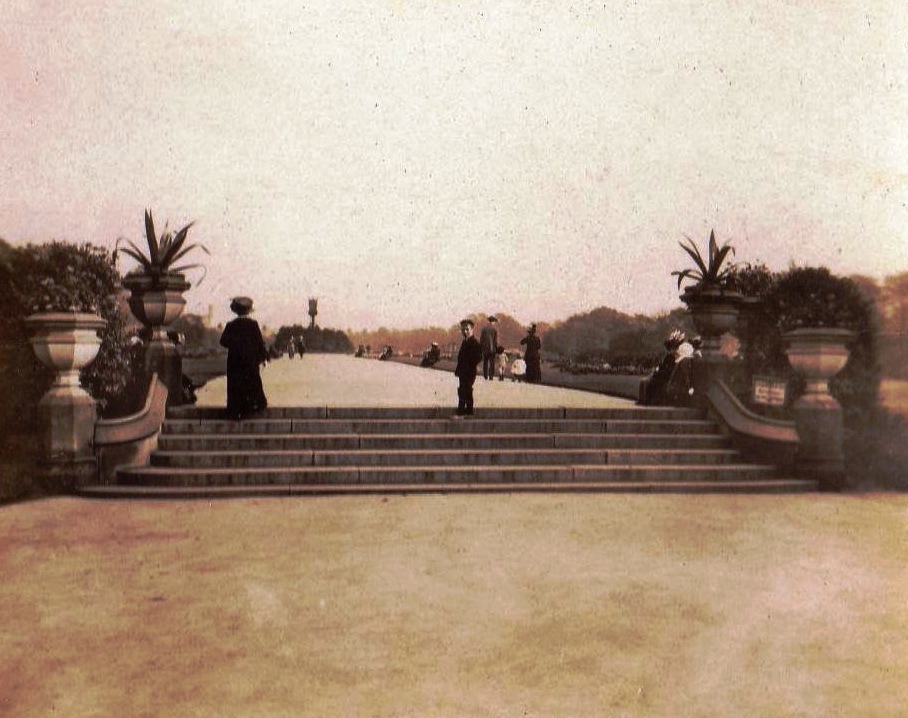
The entrance to Alexandra Park, 1907
Now this is one of those stories that started off full of promise with just a chance that I would uncover a lost part of the Park’s history.

The 3rd Battalion were one of the eight Pals’ Battalions raised in the first few months of the Great War.

The authorities had not quite been prepared for the rush of recruits.

The first two battalions had been raised in a matter of days and by the time the 3rd and 4th were complete there were still no where to put them.

So while the first and second fairly quickly moved to a tent city at Heaton Park, the 3rd was accommodated at White City and the 4th were billeted at home.

And that brings me to the 3rd Battalion and Alexandra Park.

The definitive book on the Manchester Pals* describes how the battalion had been recruited in just three days between Saturday September 5 and Monday the 7th but “unlike the first two companion battalions [it was] initially trained at White City, a sports and racing stadium in the Old Trafford area, and accommodated  there in hastily  erected and draughty constructions.  Before those huts at the White City became available this battalion’s parades were undertaken in the City Hall with route marches to and from Alexandra Park.”**

Heaton Park, 1914
As late as September 26 the Manchester Guardian reported that “the recruiting authorities have in mind the undoubted convenience of being able to billet the men on themselves, in which case they would be in the same position as the men who were recently posted to reserve, though of course their full time would be required in training.”***

Which nicely brings us back to those route marches to Alexandra Park.

I have to confess I had misread the original newspaper entries and made the assumption that they had camped out in the park but no evidence has come forward to support this and so I can only assume that on arriving at the park gates and after a suitable rest they marched away to White City where they were still to be found two month later.

Pictures; entrance to Alexandra Park, circa 1907 courtesy of Ann Love, and Heaton Park, 1914 from the collection of David Harrop

*Manchester and the Great War, Andrew Simpson, was published in 2017, http://chorltonhistory.blogspot.co.uk/search/label/A%20new%20book%20on%20Manchester%20and%20the%20Great%20War

**Manchester Pals A History of the two Manchester Brigades, Michael Stedman, 1994

***ibid, page 25

****City Battalion and Winter Quarters, Manchester Guardian, September 24 1914
Tuesday, 20 June 2017

Four slices of bread a day, giving up the stuff for the war effort .............. stories behind the book nu 9

An occasional series on the stories behind the new book on Manchester and the Great War.*

In Honour Bound, 1917
Now here is a jolly poster I have never seen before.

It dates from March 1917 when food shortages were beginning to get the Government worried.

The official line at the beginning of the year was that there was no problem and even by March Mrs Peel of the Ministry of Food commented that “whilst the food position is serious, there is every reason to hope that if people carry out the recommendations of Lord Davenport we shall come through a very difficult period without anything worse than considerable inconvenience.”*

The recommendations had included an appeal for families to adopt ‘The National Scale of Voluntary Rations’ of 4 pounds of bread or 3 pounds of flour, 2½ pounds of meat and ¾ of sugar per week which was the allowances already in place for people eating in restaurants and hotels.

Queue for potatoes, Manchester, 1914
All houses agreeing to do this received a small placard which proclaimed "IN HONOUR BOUND WE ADOPT THE NATIONAL SCALE OF VOLUNTARY RATIONS."

The campaign had begun in the middle of February and by March 11 leaflets “with useful information on rationing and methods of economy [along with the] cards of honour in red, white and blue,” were being prepared.

I have yet to discover just how successful the scheme was but anecdotal evidence suggests that amongst the middle class who were the targets it did have some success.

The London correspondent for the Manchester Guardian reported that that during the first week “out of the fifteen families of barristers, architects, artists, Government officials, and journalists thirteen were keeping their food consumption within the suggested limits.”**

The long queue, 1914
An observation which was supported later that year in a book on food supply and distribution in which the authors asserted “in the short street in which we lived in London last spring three out of four houses showed the placard.  In a certain village of 25 houses all 25 displayed the card.

Altogether as a result of this appeal and an independent “Eat Less Bread” campaign the Food Controller is able to declare that fifteen per cent less bread was eaten in the United Kingdom in June of this year than in February.

In some of the larger cities the consumption of bread was reduced by as much as 25 per cent to 30 per cent.  Portsmouth reduced its weekly capita consumption to 3lbs. 1 oz and Keighley, the ‘model town’ to 2 pounds 07 oz. ‘It is perfectly safe to say,’ says the Director General Kennedy Jones ‘that an enormous reduction has been effected through the voluntary efforts of the people in the United Kingdom in the consumption of practically all food-stuffs.’” ***

All of which sounds fine and dandy but obscured the fact that shortages had been pushing the price of food up since the beginning of the war causing increasing hardship amongst the poor and the working classes.

The London Vigilance Committee, 1917
The Food Vigilance Committees established by the Labour Movement at the outbreak of the war, continued to highlight the issues of food shortages and price rises and demanded that the production and distribution of food should be taken over by the Government in partnership with the trade unions and Co-operative Societies.

And had also argued for food rationing and even bolder moves to alleviate the problem.  One “very lively conference of working-class women from all parts of London met at Westminster [on February 25] to discuss the voluntary food rationing scheme, with all agreed that the bread rations should be greatly increased ........ a public supply and distribution of milk, and meals for mothers and young children and the establishment of municipal kitchens.”******

The Government however remained  opposed to compulsory rationing despite the growing evidence of shortages and its impact on the poor, with the Food Controller asserting in early November in a Speech at Manchester Town Hall that this was “the voluntary Scheme’s last chance."*******

And that proved to be the case for later in the month the Government gave in and began rationing.

Location, Britain

Pictures; The honour card, 1917 from the collection of David Harrop, extracts from documents from The London Food Vigilance Committee, 1915, courtesy of the Labour History Archives & Study Centre,  at the People’s History Museum, Manchester, http://www.phm.org.uk/ queue for potatoes, 1914, courtesy of Manchester Libraries, Information and Archives, Manchester City Council, http://images.manchester.gov.uk/index.php?session=pass

*Manchester and the Great War, Andrew Simpson, due out at the end of 2016, http://chorltonhistory.blogspot.co.uk/search/label/A%20new%20book%20on%20Manchester%20and%20the%20Great%20War

**Why not official Menus? Food Controller’s Cards of Honour, Manchester Guardian, March 11 1917

***First week of Voluntary Rationing, Manchester Guardian, February 14 1917.

****The Food Problem Vernon Lyman Kellogg, Alonzo Englebert Taylor, Herbert Hoover, 1917, the Macmillan Company New York page 66-67

***** Food Vigilance Committeeshttp://chorltonhistory.blogspot.co.uk/search/label/Food%20Vigilance%20Committees

******Working Women on rationing, Manchester Guardian, Februry 26 1917

Sunday, 11 June 2017

A missing armband and a promise to enlist at a later date .............. stories behind the book nu 11

An occasional series on the stories behind the new book on Manchester and the Great War.*

Voluntary recruitment, 1915
Now I am on the lookout for those arm bands which were issued during the Great War to men who had been wounded and invalidated out of the armed forces and those whose call up had been deferred.

So far I have only come across one and that is not mine to use, but my friend David Harrop is at this very moment looking for an example which I can feature on the blog and in the book.

As the war entered its second year there were those only too keen to point the finger at men who “were not doing their bit.”

So for those who had actually done their bit and returned to civilian life after being wounded an arm band with a silver crown was issued which it was hoped would announce to the world that they had served their country.

And for those men who were prepared to enlist but wanted to defer their call up, the Government established the Group Scheme which was commonly known as the Derby scheme.

It was in some ways a half way house between the voluntary enlistment which had been so successful in the first months of the war and conscription.

After the first heady rush to join the Colours in 1914 recruitment had fallen away.

In that first few months two million men had enlisted in the armed forces joining the hundreds of thousands of regulars, reservists and territorials but by early 1915 the numbers enlisting each month had levelled out at around 110,000 which was judged to be not enough to keep pace with the casualties on the battlefields.

As early as August 1914 the height restrictions had been lowered and in the May of the following year the upper age limit was raised from 38 to 40.

It therefore made perfect sense to explore just how many men were out there who were fit for military service and so on July 15th 1915 Parliament passed the National Registration Act which set out the means by which “a register shall be formed of all persons male and female between the ages of fifteen and sixty-five (not being members of His Majesty’s naval forces or of His Majesty’s regular or territorial forces).”**

The registration was undertaken in a similar way to a census with some 29 million forms issued across England and Wales.

It revealed that there were about five million men of military age who were not in the forces and as a means of reinvigorating recruitment the Derby scheme was introduced which offered the opportunity for men to enlist but defer their call up to a later date.

215,000 men enlisted while the scheme was on and another 2,185,000 chose to delay their enlistment and those who were on the deferred list were given a grey or khaki arm band with a red crown.***

Conscription, 1916
But this still left a large pool of potential recruits who had not shown a willingness to serve, and so in the January of 1916 the Military Service Act was passed introducing conscription.

This required that all men between the ages of 18 to 41 were liable for service in the army unless they were married, widowed with children or in the Royal Navy, a minister of religion or in a reserved occupation.

Later in May 1916 this was extended to married men and two years later the upper age limit was raised to 51.

All of which means that those grey and khaki armbands with the red badge were not in service for long.

Still I would like to see one, and include it on the blog and the book.

Location; Britain

Pictures; recruitment poster for the Derby Scheme, November 1915, Parliamentary Recruiting Committee Poster no 137, Imperial War Museum, Art.IWM PST 5022, originally posted in Derby Scheme, https://en.wikipedia.org/wiki/Derby_Scheme and British conscription poster for Military Service Act, 1916, Parliamentary and Joint Labour Recruiting Committees, originally posted in Military Service Act 1916, https://en.wikipedia.org/wiki/Military_Service_Act_1916

*Manchester and the Great War, Andrew Simpson, was published in February 2017, http://chorltonhistory.blogspot.co.uk/search/label/A%20new%20book%20on%20Manchester%20and%20the%20Great%20War

***First Clause of the National Registration Act 1915.

***Derby Scheme, https://en.wikipedia.org/wiki/Derby_Scheme

Thursday, 1 June 2017

The Manchester Barnardo boy who joined the Canadian Expeditionary Force in 1916 .............. stories behind the book nu 4

An occasional series on the stories behind the new book on Manchester and the Great War.*

William, circa 1916-1918
I first came across William Phillips after I had made an appeal across Canada for stories of men and women who had been born in Manchester but had served in the Canadian army or Red Cross during the Great War.

And almost by return of post Patricia Bronson sent me the story of William Phillips who had been born in Manchester, was sent across the Atlantic by a children’s charity and volunteered for the Canadian Expeditionary Force in 1916.

He had survived the war, returned to Canada, and married Violet.

Patricia remembered them as “a wonderful couple.  They had both come to Canada under the BHC Immigration scheme [and]  lived out their lives in the Village of Bethany, Manvers Township and are buried at St. Mary`s Anglican Church Cemetery, Lifford, Manvers Township.

At this point I do not know the family circumstances that sent them to Canada.”

Between us we had managed to discover that he had been born in Fallowfield in 1897, that his father was widowed and that he had two siblings one of who was living off Cheetham Hill Road in 1916.

Added to which he was one of the 100,000 British Home Children migrated to Canada between 1870 and 1930.

Some had spent their early years in care while others came from abusive or neglected backgrounds and a few were given up by their parents who because of ill health, or poverty were desperate for their children to have a better life.

Violet and William
Overseeing the migration policy were a number of children’s charities often working in partnership with the local Poor Law Unions.

We both knew there would be more but had yet to begin looking and that is where my friend Tricia stepped in and took the story further than I could have hoped.

She had “found that his mother was Elizabeth nee Bradbury who died 1900 and his father James Henry had died in 1903.

So he would only have been six when he was made an orphan which might explain why he entered the orphanage.”***

It is impossible to know whether his siblings joined him.  Barnardos will not divulge their records to non family members but given that in 1903 his sister Elizabeth Alice was14 and Harold 13 I doubt that they would have been in care for long if at all.

In 1911 Elizabeth Alice was staying with her uncle and aunt in Irlam and Harold was married and living in West Gorton.

Leaving for Canada, on the steps of Manchester Town Hall, 1897   
As for William at the age of just nine he was migrated by Barnados to Canada sailing from Liverpool to Quebec in 1906.

It is a familiar story and one that those of us with a BHC relative will readily identify with.

My great uncle went over in 1914, failed to settle on any of the farms he was placed on and ran away to join the Canadian Expeditionary Force in 1915.

Like William he returned safely to Canada but we lose him after 1925.

If he did marry we have yet to find out and I doubt we ever will.

William we know did and it was not uncommon for children migrated to Canada to fall in love and marry a fellow BHC which William and Mary did in 1926.

William's attestation papers, 1916
The romantic in me is pleased that William found Violet and they were well regarded.

Sadly his siblings fared less well.

Harold had also joined up but was killed on the Western Front on August 10th 1918 and is buried in the Allied war cemetery at the village of Rosieries on the Somme.

He died during the successful action to regain the village from the Germans.

Elizabeth married Joseph Harrison in 1919 and died six years later.

They had no children.

But the search is not quite over because Harold and his wife Francis had two children and while both will now be dead there may still be living relatives.

Picture; William Phillips in military uniform,  circa 1915-18,  with Violet, date unknown and his Attestation Papers, 1915, courtesy of Patricia Bronson, Manchester children leaving for Canada in 1897, courtesy of the Together Trust

*Manchester and the Great War, Andrew Simpson, was published in February, 2017, http://chorltonhistory.blogspot.co.uk/search/label/A%20new%20book%20on%20Manchester%20and%20the%20Great%20War

**Patricia Bronson

*** Tricia Leslie

Sunday, 28 May 2017

Looking for Corporal Fletcher and his sister in the spring of 1916 ................. stories behind the book nu 3

An occasional series on the stories behind the new book on Manchester and the Great War.*

Altrincham Street and arch leading to Britain Street, 1960
Now you won’t find Britain Street any more although there are clues to its previous existence.

It once ran from Granby Row to Brierly Street crossing Altrincham Street close to London Road and was swept away the during the extension of the UMIST campus.**

But it is still possible to follow its line of route and the keen street detective just needs to turn off London Road on to Altrincham Street and there to the right is the railway arch and the remnants of one side of Britain Street while directly opposite and running into the university buildings is the continuation of the street.

Letter to Miss Fletcher, 1921
And that feint echo of what once was there is pretty much replicated in the story of Corporal R Fletcher of the Manchester’s who died on April 12 1916 and is buried at the Amara War Cemetery in Iraq.

His story began with the discovery of a letter to his sister which accompanied his war medals “which would have been conferred upon [him] had he lived.”

I would like to know more but the historical records have as yet offered little more.  I know his sister was living at nu 32 Britain Street in 1921 but a search for her or for anything more on Corporal Fletcher has drawn a blank.

Envelope addressed to 32 Britain Street, 1921
There isn’t even a picture of the house on Britain Street which judging from the maps and the remaining evidence was a narrow street of industrial units and residential properties overlooked by the railway line and flanked by the very busy London Road.

Nor do its residents get a listing in the street directories which is odd because by the beginning of the 20th century most people would be recorded from even the most humble of dwellings.

And the houses were occupied.  In 1898 nu 32 was home to W H Worall who along with his nine neighbours paid a weekly rent of five shillings and six pence to Buckley Shaw their landlords and for this they got a six roomed house which by then may well have been over sixty years old.

Britain Street, 1893
All of which means that there is lots more work to do on the Fletcher’s.

Sadly his military records appear to have been destroyed and his sister stubbornly sits in the shadows.

But I am confident I will find them and they will make their way into the book.

Well, we shall see.

Location; Manchester

Pictures; Altrincham Street, W H Beaumont, 1960,  courtesy of Manchester Libraries, Information and Archives, Manchester City Council, http://images.manchester.gov.uk/index.php?session=pass letter and envelope addressed to Miss M E Fletcher, 1921 from the collection of David Harrop, and Britain Street, 1893  from the OS Lancashire, 1888-1893 courtesy of Digital Archives, http://digitalarchives.co.uk/

*Manchester and the Great War, Andrew Simpson, due out at the end of 2016, http://chorltonhistory.blogspot.co.uk/search/label/A%20new%20book%20on%20Manchester%20and%20the%20Great%20War

**University of Manchester Institute of Science & Technology

***Manchester Rate Books, 1898

Thursday, 18 August 2016

The Ration Party at Nell Lane in the September of 1917, a set of slides and an internationally known photographer .............. stories behind the book nu 7

An occasional series on the stories behind the new book on Manchester and the Great War.*

The Ration Party, 1917
Now this is one of those images that you wish you could know more about.

We are at the Nell Lane Hospital in the September of 1917.

The site began as the Withington Workhouse in the 1850s built by the Chorlton Union to replace the smaller one in Hulme and there will be many who remember the hospital wings of the building.

Unknown stories, 1917
If I think hard enough I might be able to remember passing that entrance on plenty of occasions.

Our eldest two were born there and for a while we never seemed to be out of the casualty department with everything from sporting injuries to the repercussions of falling out of a tree.

I doubt that any of the ration party will have been there for long and in time their memories of the place will have faded.

But for each of those ten men in the group along with the soldier and nurse in the doorway there will be a story but they will be stories we can only guess at.

I am drawn to the young man holding something to his eye and to the chap at the back who has lost a leg.

But without names there is no way of revealing their lives.

Edward Ward, 249 Oxford Road, 1911
And so instead I wondered by the photographer who is listed as Ward at 249 Oxford Road.

This was Edward Vincent Ward who operated a photographic studio from Oxford Road.

He died in 1921 and there are some fine examples of his pictures on a site exploring the work of his father. **

In time I shall go looking for Edward Vincent and with luck somewhere I may turn up a catalogue of his postcards.

In the meantime it is his father who has caught my interest.

He was Edward Ward senior who was born in 1844 and died in 1901.

In 1871 he was a travelling salesman and on the night of the census of that year was staying in a
“boarding in Hull, Yorkshire. His wife and 9 month-old daughter were back home in Coventry at 38 Bradford St. 

249 Oxford Road, 1893
Exactly what Ward did while travelling is not known. His obituary indicates that it was connected with his interests in microscopy and photography, so he may have been selling equipment........ At some point between January, 1873, and October, 1874, the Ward family moved to Higher Broughton, Manchester.

By 1879, Ward had opened a shop that specialized in microscope slides, unmounted specimens, and associated apparatus. He was also a distributor for Carl Zeiss’ microscopes and lenses. 

An 1882 advertisement in the Journal of the Postal Microscopical Club indicated that Ward retailed slides of selected and arranged for a minifera produced by Charles Elcock. He was also instrumental in the formation of the Manchester Microscopical Society.”**

Men of the ration party, 1917
And if you want more on this remarkable man I suggest you follow the link to the site.

For now I will just say that he also was engaged in photographing the construction of the Ship Canal which means I am off on another search.

I did go looking for 249 Oxford Road and as you expect it has gone but I will have missed it by no more than a decade if that for the studios were just down from Wilton Street opposite Manchester Museum and is now a grass verge in front of the University buildings.

So less a story of the Great War and more an intriguing new area of research.


Pictures; the Ration Party, September 1917 from the collection of David Harrop, and 249 Oxford Road, 1893 from the OS of Lancashire, courtesy of Digital Archives Association, http://digitalarchives.co.uk/

*Manchester and the Great War, Andrew Simpson, published in 2017, http://chorltonhistory.blogspot.co.uk/search/label/A%20new%20book%20on%20Manchester%20and%20the%20Great%20War

**Edward Ward, 1844 – 1901, Brian Stevenson, http://microscopist.net/WardE.html

Saturday, 20 February 2016

Looking for Mrs Fraser on Seymour Grove in November 1914 .............. stories behind the book nu 6

An occasional series on the stories behind the new book on Manchester and the Great War.*

The Elms, Seymour Grove, 1893
Now there are times when you can feel totally frustrated when a line of research stubbornly refuses to go anywhere.

And that pretty much is where I am with Mrs W A Fraser of the Elms, Seymour Grove, Old Trafford.

In the November of 1914 she appeared in the Manchester Guardian as the contact for sending “gifts of woollen mittens” for men of the 3rd City Battalion of the Manchester Regiment who were based at White City and later also settled in Heaton Park.

They were one of the eight battalions of Pals who were raised between August and November 1914 in response to Lord Derby’s appeal for recruits.

The appeal had made in Liverpool and pretty much immediately across the country there was an overwhelming response.

Here in Manchester the first three City Battalions were each recruited in days.  The first two battalions and the 4th were based in Heaton Park while the 3rd went to White City after what I think may have been a temporary stay in Alexandra Park.

And on November 20 1914 the commanding officer of the 3rd City Battalions made it known that he would be glad to receive those gifts.

The war was characterised by a huge surge in voluntary and charity work with flag days, “comfort drives” for the troops and much more.

So I would like to know more about Mrs Fraser but so far nothing has come to light.

The Elms was there on Seymour Grove by 1891 but I think has now been demolished.

It would have stood somewhere close to Lime Avenue.

Now it may be that it is still there and I have missed it and there may be someone who can offer up information ofnMrs Fraser.

So there is the appeal.

Picture; Seymour Grove showing the Elms, 1893, from the OS map for South Lancashire, 1893 courtesy of Digital Archives Association, http://digitalarchives.co.uk/

*Manchester and the Great War, Andrew Simpson, due out at the end of 2016, http://chorltonhistory.blogspot.co.uk/search/label/A%20new%20book%20on%20Manchester%20and%20the%20Great%20War

Friday, 19 February 2016

Those British Home Children who joined the Canadian Expeditionary Force .............. stories behind the book nu 5

I am beginning to think the story of those young men migrated to Canada who enlisted to fight in the Great War deserves greater attention on this side of the Atlantic.

James Wright; date unknown
Now I am well aware of the prominence given to them within the study of British Home Children in Canada but suspect their contribution has yet to be fully explored in Britain.

To be fair the Together Trust who as the Manchester and Salford Boys’ and Girls’ Refuges has done some excellent work in detailing the contribution of the young men who passed through their care to the war effort. **

And I suspect some of the other charities have done the same.

But I have yet to come across a book which looks at the big picture, exploring why a group of young men who had not always been treated well by their mother country should opt to fight for King and Country.

After all some at least had been migrated because they had been failed by the very society and prevailing ideology they sought to defend.

The Britain of the late 19th century may well have been an improvement on what it had been like in the early and middle decades when the Industrial Revolution was at full tilt, but there was still a huge disparity in wealth and for many a sudden bout of ill health or unemployment could pitch a family into destitution and the workhouse.

My own great uncle had crossed to Canada after years in care and there will many whose own BHC had similar experiences which all goes to ask the simple question why did they then enlist.

For some like my great uncle it was the promise of adventure mixed with a desire to escape the farms he had been placed on.

Thomas Wright, date unknown
For others it will have been a sense of loyalty and duty to their newly adopted country which sat beside that powerful belief that the Allied cause was just and the Central Powers were the aggressors.

I have been reminded of all this while I research the new book on Manchester and the Great War. **
In the course of which I have started to read not only the military records of my own family but also those young men who having crossed the Atlantic to start a new life after Britain had failed them went onto enlist in the C.E.F., and by degree found themselves back in the home country.

In the case of my own great uncle this was in a training camp close to the home of his father who had apparently shown no interest in him and his siblings.

Now I have no way of knowing whether Private William Phillips of Manchester ever made his way back to his home city.  He had been migrated in 1906 aged just nine, enlisted in 1916 and fought on the Western Front.

And as yet I know very little about James and Thomas Wright who arrived at Fairknowe Home, Brockville, in Ontario in 1910 and joined up six years later.  Their story belongs to Margaret Roper who kindly shared her photographs of James and Thomas.

Location Ontario, Canada

Pictures; James and Thomas Wright, date unknown courtesy of Margaret Roper

*Getting down and dusty,  http://togethertrustarchive.blogspot.co.uk/

***Manchester and the Great War, Andrew Simpson, due out at the end of 2016 http://chorltonhistory.blogspot.co.uk/search/label/A%20new%20book%20on%20Manchester%20and%20the%20Great%20War

Tuesday, 9 February 2016

William Phillips of Fallowfield and the Canadian Expeditionary Force .............. stories behind the book nu 2

An occasional series on the stories behind the new book on Manchester and the Great War.*

William Phillips, second from left, circa 1916-1919
Just over a week ago I made an appeal across Canada for anyone who might have had a relative born here in Manchester who served in the Great War in the Canadian Expeditionary Force.

Plenty of young men will have crossed the Atlantic in search of a new life and then volunteered when war broke out.

One of these was William Phillips who like my own great uncle had been migrated by a children’s charity.

Some had spent their early years in care while others came from abusive or neglected backgrounds and a few were given up by their parents who because of ill health, or poverty were desperate for their children to have a better life.

From the 1870s onwards some of these young people were migrated by charities and the Poor Law Unions to start a new life in Canada, Australia and other bits of the old British Empire.

Today they are known as British Home Children and their history and the history of the policy of migration is being rediscovered.

Detail from his Attestation Paers, 1916
I am not sure what happened to William Phillips, according to his relative he was “a native of Manchester, who was emigrated to Canada as a Barnardo Home Child.

He settled in Manvers Township, Province of Ontario.   At this point I do not know the family circumstances that sent him to Canada.

I knew William Phillips and his wife Violet as they were my Aunt's in-laws.

A wonderful couple to know both William and Violet Phillips came to Canada under the BHC Immigration scheme.

William and Violet, date unknown
They lived out their lives in the Village of Bethany, Manvers Township and are buried at St. Mary`s Anglican Church Cemetery, Lifford, Manvers Township.

What would be interesting is if we could connect with the family of William`s sister Alice who may still live in the area of Fallowfield, High Town, Manchester."**

William had been born in 1898 in Fallowfield and that is pretty much all there is.

His father worked in a warehouse and was widowed and this may be the clue to what happened to William who was the youngest of three children.

It was not uncommon for a single parent to seek support from one of the charities and agree to the migration of the children and so it may well be that this is what happened to William.

Detail from Attestation Papers, 1916
We do know his elder sister either stayed in Britain or if she was migrated returned because in 1915 she was living in St James Road in Hightown off Cheetham Hill Road.

Now I think there is a story here but one which will be a bit difficult to unpick.

Getting to see the records of the charity will be all but impossible for a non relative while many of the relevant records will not be accessible given the hundred year rule.

William Phillips, cirv 1916-1918
That said his Canadian military records can be seen and it may be that there are still living relatives here in Manchester.

All of which means this search has just begun and in the fullness of time we may discover that Mr Phillips returned to Manchester during or after the Great War.

Location; Manchester, & Ontario


Picture; William Phillips in military uniform, second from left, circa 1915-18,  with Violet, date unknown and his Attestation Papers, 1915, courtesy of Patricia Bronson

*Manchester and the Great War, Andrew Simpson, due out at the end of 2016, http://chorltonhistory.blogspot.co.uk/search/label/A%20new%20book%20on%20Manchester%20and%20the%20Great%20War

**Patricia Bronson