Showing posts with label Eltham Trams. Show all posts

Saturday, 16 May 2026

Lost scenes of Well Hall

Now this will be the last for a while of pictures of Eltham trams taken from that wonderful book on Eltham and Woolwich Tramways.*

But that said given that there are equally fascinating pictures of Woolwich, Charlton and Lee Green I reckon I will be back.

And one of the reasons is that each of the pictures reveals a lot about how we lived back nearly three quarters of a century ago.

So here is one that will be familiar to many.
We are on the platform of the old Well Hall Station looking down on the parade of shops and taking in the that climb up to the Woods.

It’s a scene I remember very well.

Of course by the time I was making that journey up from the station to 294 Well Hall the trams had long gone but I think the bakery was still there and the scene is not so different today.

That said the last time I looked 24 HOUR MINICABS were now operating from the shop but you can still make out on the side of the building the ghost sign for “Fyson’s Bakery Makers of Daren Bread” which has fared better than the chemist which once occupied the site.**

Or for that matter Daren bread which was a brown loaf popular in the 1930s and 40s which may also have been sold in the old Co-op which is just visible behind the tram.

I missed that Co-op building by a matter of months.  It had opened in 1906 and was demolished in 1964 just as we arrived.

It may still have been there but if so I don’t remember it or its successor being built,

And that is the value of the picture for despite the bits that seem familiar it is a scene which has vanished.

The tram went in the early 50s, the co-op in the 1960s and sadly for me at least the old station two decades later.

Pictures; looking down from Well Hall Station, date unknown, from the collection of E. Course and reproduced from Eltham & Woolwich Tramways, 1996

*Eltham and Woolwich Tramways, Robert J Harley, Middleton Press, 1996, https://www.middletonpress.co.uk

**Ghost signs in Well Hall, http://chorltonhistory.blogspot.co.uk/2015/05/ghost-signs-in-well-hall.html

Friday, 17 April 2026

Painting Well Hall and Eltham ....... nu 7 tram sheds and missing the tram

An occasional series featuring buildings and places I like and painted by Peter Topping.

The Tram sheds, 2017 painted from a photograph, 1977
Now I always took the bus shelters for granted after all they had always been there and had always been bus shelters.

But not so.

They had started off as places to wait for the trams which began coming through Eltham at the beginning of the 20th century and which in turn were only made possible by the extension of Well Hall Road.

Neither of which I found out until recently.

LCC tram 1622, 2015
Of course it made perfect sense to extend Well Hall Road up from Sherard Road making a more direct route from Woolwich to the High Street.

And it made equal sense to start a tram service.

If I travelled on the old trams I have no memory, although Dad told me we made a special trip to see the last one arrive at the New Cross depot in 1952.

Sadly I can’t remember, and nor did he take a picture.

All of which just leaves the shelters as a testament to what had once been.

Location; Eltham, London

Painting; the tram sheds Well Hall Road © 2017 Peter Topping from a photograph by Jean Gammons circa 1977

Web: www.paintingsfrompictures.co.uk

Facebook: Paintings from Pictures https://www.facebook.com/paintingsfrompictures

Picture;  LCC tram 1622, 2015, Crich Tramway Village courtesy of Andy Robertson


Monday, 30 March 2026

“A single to Well Hall” ...... travelling the tram in the “Last Tram Week”

History comes in many shapes and sizes, from serious books on great events to the humble object which offers up an insight into how we lived.

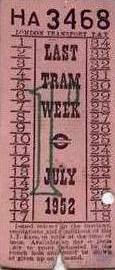
So I am indebted to Lesley, who on the back of a recent tram story told me that she still had a collection of tram tickets her mum bought during the “Last Tram Week in July 1952”.

Now I always get excited about seeing and especially handling bits of our collective past.

Back in the late 1970s I walked away from the excavations at Viking York with a genuine Viking oyster shell.  The archaeologists had unearthed so many that they were being sold in a barrel for 10p each.

On a more studious note, while writing the book on the Story of Chorlton-cum-Hardy in the early 19th century I used the hand written minutes of the local Poor Law Committee.

The volume began in 1834 and ran through to 1852 and I think apart from the chap who wrote up the minutes and perhaps a few others I will have been the only person to turn the pages in almost 170 years.

So looking at Lesley’s tram tickets is a fascinating link with that last week that London Transport ran trams through the city.

I was just short of my third birthday and though there is a family story that Dad took me down to the New Cross Depot, I have no memory of the event.

But like so many people of my generation, those tall stately trams have a lasting romantic pull and have of course now been resurrected by  by fleets of sleek new trams which have returned to many of our cities.

These are more comfortable, and faster but a bit of me would yearn to hop on one outside the old family home on Well Hall Road and rattle up to the High Street and north into Woolwich.

I can’t, so Lesley’s tickets will have to do.

Leaving me just to reiterate that old observation ...... be careful what you throw away for today’s rubbish will be someone’s priceless piece of history in the future.

Location; Eltham

Pictures; tram tickets from “The Last Tram Week”, July 1952, from the collection of Lesley Ross, 2018

Sunday, 8 February 2026

Travelling by tram round the Well Hall Circus

Now I have no idea when this picture was taken. 

I do know that it will date from after 1931 when the roundabout was built which according to Eltham and Woolwich Tramways was constructed as part of the Westhorne Avenue extension.*

And if I wanted to be more specific I guess it can be no earlier than 1938 a date which cinema buffs will confirm.

The Odeon was opened in 1936 and of the two films showing that week The Dark Horse was made in 1932 and I’ll give a million six years later.

I can’t say either would have got me walking down from our house.

The Dark Horse was a political comedy starring Bette Davies and turned on the efforts of Ms Davies and others to find a candidate for Governor at the Progressive Party convention and ran through a series of improbable plot lines.

Not to be out done its running mate that week centred around Warner Baxter who played a millionaire saving a tramp from suicide, and then taking the tramps clothes and disappearing with a rumour that he would give a million dollars to anyone who is kind to a tramp.

But perhaps I am being unfair.  I can sit through endless episodes of Coronation Street, have bought at least two DVDs of Downton Abbey and can pretty much quote James T Kirk word for word in all his Star Trek films and plenty of the TV shows.

And having demonstrated my unnerving attention to detail I can offer up the names of all those who occupied the shops stretching down from the cinema to the Pleasaunce when Ms Davies was at the Odeon.**

But I am on firmer ground with the second which dates from December 29 1948 and I have to say it doesn’t look so different from when I walked up Well Hall Road in the mid 1960s.

From memory the path across the roundabout had gone, along with the tram poles although I suspect under the tarmac still lurked the tramlines.

And for all I know they may still be there.

Like all good stories I learnt something knew because back in the 1940s our roundabout was, according to the London Transport timetable known as Well Hall Circus.

So that is all I shall say, except to thank Middleton Press for giving me permission to reproduce the pictures from their book Eltham and Woolwich Tramways and promise you more later.

Oh and a thank you to Tricia Leslie who first came across the pictures and posted them and then introduced me to the tram book.

Pictures; Arriving at the Well Odeon,  circa 1938, A J Watkins, and Well hall Circus, 1948, H B Priestley reproduced from Eltham and Woolwich Tramways

* Eltham and Woolwich Tramways, R J Harley Middleton Press, 1996, https://www.middletonpress.co.uk/

** A car, a row of shops and a little bit more is revealed about the history of Well Hall Road, http://chorltonhistory.blogspot.co.uk/2015/09/a-car-row-of-shops-and-liitle-bit-more.html

Sunday, 12 October 2025

Uncovering the story of Eltham's trams ........... and a bit more too

I have long had a fascination for trams and I have just bought Eltham and Woolwich Tramways which contains “a wealth of nostalgia with many previously unpublished photographs depicting street scenes from the past.”*

Now I don’t do nostalgia it is a shallow preoccupation which distorts the past and leads you into all sorts of pitfalls.

On the other hand there is nothing wrong in wanting to peel back your own past and match your memories with the historic record and in doing so not only relive a bit of your youth but also learn more about that time.

So it is with trams.  I was just two and bit when the last one London tram trundled into the depot at New Cross and while family legend has it that I was there I have no memory of the event.

Likewise it would be another twelve years before we moved in to Well Hall and so the story of the Eltham and Woolwich trams is all new to me.

Bits of the story I already knew but Mr Hartley’s book is as promised full of some wonderful pictures which offer up scenes of Eltham and Woolwich before I knew them and as you would expect I was more than a little thrilled at getting close to our own house on Well Hall Road.

But it is easy to get seduced by the old pictures and forget the importance of the tram.  It was a cheap and for the time efficient means of transport reflected in the fact that within a few short decades it was adopted by local authorities across the country to replace horse drawn buses and trams.

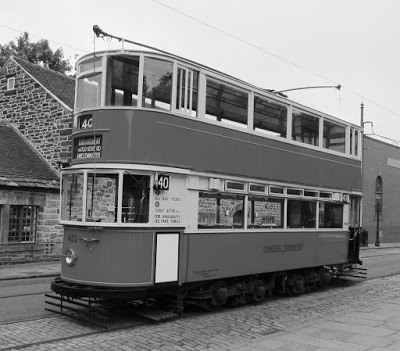
LCC Tam, 1622,  route 40 from New Cross to Westminster, 2015
And because it was cheap and fast it opened up the suburbs by allowing workers to live further away from their work place.

Now to a certain extent the railways had pioneered this development but the tram could do this better.

After all it was far cheaper to lay tram track which had the added advantage that the routes could follow the existing road network.

So when the Government settled on Well Hall for its huge housing estate for the Arsenal workers in 1915 the tram network had already been in place for five years and following the Great War the network was extended to Lee, Lewisham and London.

All of which I suppose could mean that Ruskin’s observation that "Your railroad, when you come to understand it, is only a device for making the world smaller"** could equally be applied to the tram.

And on that note I shall leave off and go back to reading the book with just a thank you to Tricia Lesley who first alerted me to it and pass on a recommendation for the book which will not only delight fellow tram buffs like me but also offer up a snap shot of an Eltham which has pretty much vanished.

Sadly the book is out of print but where there is a will there is a copy and if enough people show an interest perhaps there could be a reprint.

Pictures; cover of Eltham & Woolwich Tramways, 1996, courtesy of the publishers and LCC tram 1622, 2015, Crich Tramway Village courtesy of Andy Robertson***


*Eltham and Woolwich Tramways, Robert J Harley, Middleton Press, 1996, https://www.middletonpress.co.uk/

**John Ruskin 1856

***Crich Tramway Village, http://www.tramway.co.uk/

Wednesday, 27 August 2025

Travelling on LCC tram number 1622 with memories of the Old Kent Road and Well Hall

Now I missed travelling on a tram by just a matter of years, but had I been born a little earlier I might well have been on this one that rattled its way up from the Old Kent Road to Westminster.

And just possibly also taken the 44 and 46 which connected Eltham with Woolwich.

According to family legend I was actually there at New Cross when the last London tram took its last journey in the summer of 1952 but until yesterday I never thought I would come close to one.

Now I know I could visit the London Transport Museum where there is a fine 1910 tram from West Ham Tramways Corporation, but my number 40 which was the one my dad would have used is even closer to home.

It is in the collection of CRICH TRAMWAY VILLAGE just south of Matlock which is no distance for me but I accept is a long way from south east London.

But your loss is our gain and I have planned my visit.

In the meantime I have settled for a picture of LCC number 1622 which plied route 40 from New Cross.

It comes from my old friend Andy Robertson who has been recording the changes to the twin cities of Manchester and Salford and decided to take an afternoon off and visit the museum.

And there is plenty else to see from a Blackpool tram complete with its destination board announcing a Tour of the Illuminations to the Red Lion Hotel which was once in Stoke on Trent and facing demolition was rescued by the museum rebuilt and happily once again serves up a pint.

In his collection of pictures from the day is the sign on a Leeds tram informing passengers that “Spitting is Forbidden” which made sense in an age before antibiotics and the dangers from a range of infectious diseases was all too common.

It is I think Andy's favourite  while for me it will always be the number 40

Which just leaves me to mention Trams in Eltham by John Kennett** and The Campaign To Save The London Trams by Ann Watkins which includes a chapter on that last tram at New Cross.

Picture; trams at the Crich Tramway Village, 2015, from the collection of Andy Robertson, 

* Crich Tramway Village, http://www.tramway.co.uk/

** Trams in Eltham  by John Kennett, Eltham Society, http://www.theelthamsociety.org.uk/publications.php

*** The Campaign To Save The London Trams by Ann Watkins, http://www.kentarchaeology.ac/authors/019.pdf

Friday, 30 May 2025

So what is the story behind the tram on Well Hall Road, one sunny spring day?

Now there is a fine line between nostalgia and remembering the past.

The first pretty much takes you nowhere and often distorts the past by making it seem somehow better than it was.

On the other hand remembering the past can trigger not only a series of memories but leads to wanting to find out more.

It often starts with that simplest of questions was this really how it was? And then takes you off into serious history which involves talking to others, cross checking their memories against research and beginning to record it for others to read.

And that often leads to community projects where memories and memorabilia come out of the cupboards, are dusted down and shared which not only adds to what we know but brings an area together, allowing the not so young to recreate the past for those too young to know what it had been like.

So here we are with one of those classic old pictures of Well Hall from a book on trams.*

There is no date on the picture, and the caption just says “early days on Well Hall Road [showing] that the local children had plenty of space to play.  All they had to do was get out of the way of the trams which plied the route every ten minutes. The ride from Woolwich to Eltham would have cost two pence.”

All of which draws you in and makes the picture worth investigating.

Judging by the trees and the children’s clothes I think we must be somewhere in the 1920s or 30s and taking into account the shadows it will be early afternoon.

Now it could be a Sunday which would explain the lack of traffic or we really are at a point in time when Well Hall Road was far less busy.

What I also find interesting is that the children by and large are ignoring the photographer.

Earlier in the century and certainly in the last decade of the 19th century the appearance of a man with a camera would have attracted the curious, the vain and those with nothing better to do.

You see them on the old pictures staring back at the camera, intrigued, mystified and just nosey.  But not here, which means we are either dealing with some very sophisticated young people or the world has moved on and street photographers were taken for granted.

And that just leaves me that little personal observation that however fascinating this picture is it just leaves off our house for the photographer has positioned himself just a tad further north, missing out 294 by a couple of blocks.

That said if I have got this right I have to satisfy myself with knowing that the corner house with its ever so fashionable lace curtains was the home of Mr and Mrs Burton in 1925.

The Burton’s were there by 1919 which means that Mr Christopher Dove Burton may have been an Arsenal worker, and just as an aside, I know that they were married in 1920 in Lambeth, and that Beatrice’s maiden name was Briant and it was as Miss Beatrice Briant that she shows up on the electoral roll in 1919 sharing the house with Mr Burton.

Now there is a story to follow up.

Pictures; Well Hall Road, date unknown, from the collection of G.L. Gundy, reproduced from Eltham and Woolwich Tramways

*Eltham and Woolwich Tramways, Robert J Harley, Middleton Press, 1996, https://www.middletonpress.co.uk/

Thursday, 22 May 2025

The Last Car from Woolwich ..... Manchester .... Rouken Glen and pretty much everywhere ……. the story with a sad ending

Now this delightful picture postcard was posted by Tricia recently and it is an exact copy of one I have, only the names have been changed to advance the profits of the postcard company.


And to add to the story she addded another from Rouken Glen in Glasgow.

Not that there was anything odd about this. 

All the companies had a batch of general picture postcards which will have been over printed with the names of towns and cities across the country.

So, as such its connection to Woolwich or Manchester is only part of the story and instead the real story is the The Cynicus Publishing Company Ltd of Tayport in Fife, who published our cards. 

It was established by Martin Anderson, who according to one source was “better known by his pseudonym Cynicus, was a Scottish artist, political illustrator and publisher”.*


His early working life involved producing illustrations for a variety of publications, before setting up in his own business in London in 1891, and from there setting up a postcard company publishing his own designs in 1902.

After a promising start his business like many suffered from a fall in the popularity of such picture postcard and the company went into liquidation with his stocks of prints and original work were sold for a fraction of their real worth.


A further attempt at a similar business also met with failure when the market for seaside picture postcards declined with the outbreak of the Great War.

Mr. Martin produced a series of anti war posters and cards, which got him into trouble with the authorities. 

“In 1924 his Edinburgh shop was destroyed by fire, everything inside it was lost, and he did not have the funds to repair and restock it. He retired to his castle-like mansion in Balmullo to live in increasing poverty. A final edition of The Satires of Cynicus was published in 1926.”*

He died in 1932, and was buried in an unmarked grave, without a tombstone, and the final indignity was that his home was extensively vandalised after his death.

So a sad story for what was a very happy looking picture postcard.


Mr. Martin produced a series of anti war posters and cards, which got him into trouble with the authorities. 


Location, Woolwich, Manchester and pretty much everywhere, circa 1902

Pictures; The last car from Woolwich, courtesy of Tricia Leslie, and The last car from Manchester from the collection of David Harrop, circa 1902

* Cynicus, Wikipedia, https://en.wikipedia.org/wiki/Cynicus


Thursday, 5 September 2024

Trams … trolley buses …… and a thank you

I am a fan of those old stately Corporation trams which trundled our towns and cities for almost half a century and were the workhorse of public transport from London to Manchester and onto Glasgow and pretty much everywhere in between.

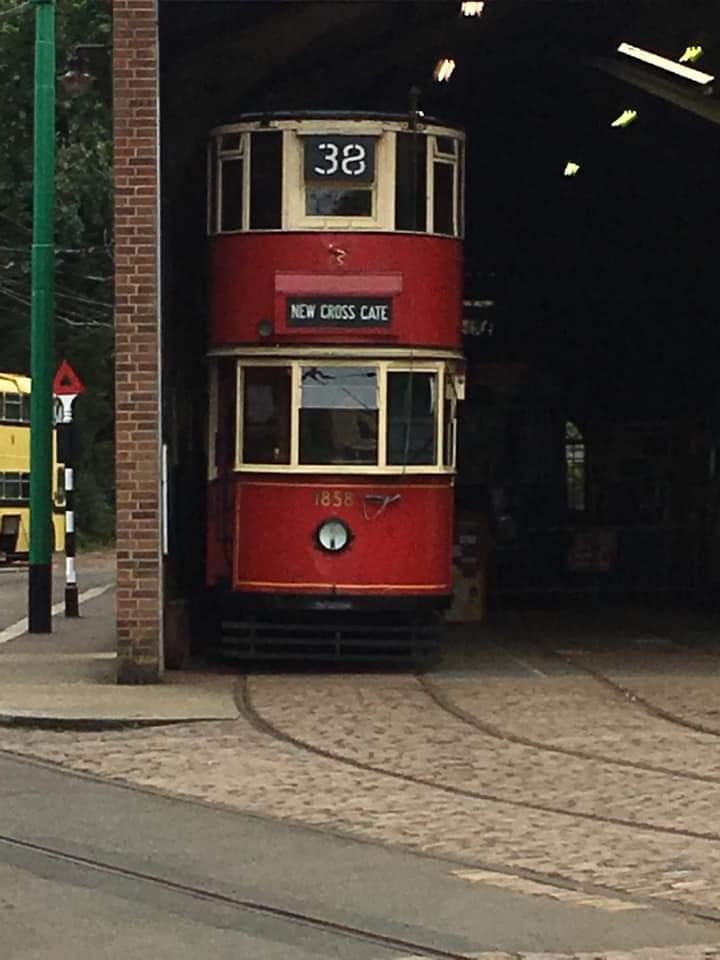
Car 1858, route 38, destination New Cross Gate

I am told I was present as the last London Transport tram finished its last journey and with some ceremony slid into New Cross depot and into history.

Trolley bus route 696  Welling to Woolwich Ferry
I was only three and have no memory of the event, but it is just possible I travelled on one as a passenger on a journey.

That said I can own up to regular trips on a trolley bus which while it looked a bit like a motor bus was powered by electricity from overhead cables.

They were operated by most local authorities, but my experience of them was via Derby Corporation, and consisted of tortuous journeys from the town centre out to the small village of Chellaston.

I have never travelled well in cars or buses, but trips in those trolley buses were infinitely worse.

It may have been the mix of smells from the leather and fabric seats combined with the disinfectant and the heat but I never once escaped feeling sick and to this day that humming, whirring noise the engine or what passed for an engine makes still brings back horrible memories.

The terminus for the trolley bus at Chellaston was Shelton Lock which was a good ten-minute walk from Nana’s house, which gave time for a sort of recovery.

But the dread was always that there would be another journey on another day, on another trolley bus.

Still over 60 years later I can be objective about the trolley bus and recognise its place in transport history, but will always have a soft spot for its predecessor the tram.

All of which brings me to Ron Eaton who posted some wonderful images of a London tram and trolley bus with the message “Hi Andrew thought you might like these”, which of course I do.  

All the news fit to print, on car 1858, r, 
It was on the back of the story “Travelling on LCC number 1622 with memories of the Old Kent Road and Well Hall which appeared yesterday on my blog.

I have yet to ask Ron where he took them and indeed whether I have permission to reproduce them.  But as he sent them via social media, I am guessing it’s ok. 

So thank you Ron, and I hope your trolley bus experiences were better than mine.

And Ron now tells me  'they are all ianEast Anglia Transport Museum well worth a visit".

Location; the days of trams and trolley buses

Pictures; courtesy of Ron Easton, 2024

*“Travelling on LCC number 1622 with memories of the Old Kent Road and Well Hall,  https://chorltonhistory.blogspot.com/2019/11/travelling-on-lcc-tram-number-1622-with.html


Wednesday, 25 March 2020

Trams in Eltham a rattling good read

Trams and I mean those old stately early 20th century trams have a fascination for me.

Sadly I am too young to remember them although it is just possible my father took me to see the last one clattering into the New Cross depot in the summer of 1952.

But I would only have been three so if I was there I have no memory of the event.

All of which is why Mr Kennett’s book on the Trams in Eltham is such a wonderful read.

“For forty-two years from 1910 to 1952 Eltham residents had the benefit of travel by electric tram which was part of a transport revolution that hastened the creation of the London suburbs already given an impetus in the nineteenth century by the coming of the railways.  

The first route to Eltham linked the village with Woolwich and following the First World War direct journeys by tram could be made to Lee, Lewisham and London.”

Now I am hoping that the Eltham Society and Mr Kennett will give me permission to quote from the book and use more pictures in future blogs about Trams in Eltham.

None of which should stop people buying the book itself which costs £4 to members and £5 for non members, plus £1.50 for post and packaging.*

For this you will get an extensive description of the history of trams in Eltham, plenty of memories of travelling by tram and lots of wonderful pictures many of which I have never seen before.

*Eltham Society, http://theelthamsociety.org.uk/