Saturday, 21 November 2026

How long before the last Chorlton farmer has gone? ……….. when things change

“Every year we witness the loss of another field to the onward march of brick and glass, and I truly wonder when all that will be left of the old Chorlton-cum-Hardy will be the memories of those ancient men and women who laboured in the open, brought in the yearly harvest and sent the produce of the land they tilled to market”.

Mr. Higginbotham brings in the harvest, undated
It is a lament for the passing of a rural way of life which might well have been uttered by many here in Chorlton during the last two decades of the 19th century.

From the 1880s through into the 1920s, there was a huge housing boom, extending along Barlow Moor Road, Wilbraham Road and out in all directions.

It had started after the arrival of the railway at Stretford in 1849, gathered pace with the creation of Wilbraham Road in the late 1860s and became a boom in the succeeding decades.

The first new houses were grand mansions set in ample grounds and home to wealthy businessmen, later came the rows of semi-detached and terraced properties occupied by professionals, managers and clerks many of whom worked in town and wanted to retreat to a semi-rural Chorlton.

Ploughing Row Acre, circa 1894
In 1851 there had been just 750 people in the three small hamlets that made up Chorlton-cum-Hardy, and most were engaged in growing crops or the related trades of blacksmith, wheelwright and thatcher.  
Added to which earlier in the century there is evidence of handloom weaving.

And three decades later perhaps 50% of the cottages were still constructed of wattle and daub that mainstay of rural properties.

Mains water only arrived in the early 1860s, followed by gas a decade later along with the first sanitation works, and the railway and later corporation tram network from 1880 onwards.

It was the combination of all these which made possible the housing boom.

Wilbraham Road, circa 1911
Plus, a clever plan by the main landowners to make it easier for speculative builders to engage in building and of course that simple fact that rents from agricultural land were no where near what could be accrued from properties.

All of which brings me back to the opening quotation abhorring that swift spread of urbanization.

And here I have to be honest ….. I made it up, because the opinions of those who worked on the land have not survived.

Thomas Ellwood our own historian did collect the memories of some “old residents” in the course of writing his history of Chorlton-cum- Hardy during the winter of 1885 and the spring of 1886, and they described many of the old rural practices but remained silent on the changes.*

Looking down Wilbraham Road, undated

That said we do know that the area around the former four banks stretching up to the library and out to Longford Hall became known as New Chorlton or the New Village/New Town to distinguish it from Old Chorlton which was the area around the village green and up Beech Road.

And to reinforce that divide New Chorlton had the banks and most of the shops while in the village we had just a post office and the Penny Savings Bank which opened for just a few hours once a week in the school on the green.

But it was a divide which lasted a full century with people still referring to Old and New Chorlton at the turn of this century.

Looking out on Manchester Road from the Sedge Lynn, circa 1880s
Such are the ways we react to change, and it was one of those comments on social media about how much Chorlton had changed and changed for the worse which occasioned this story.

I have been here since 1976 and there has been plenty of change, and some not in my opinion for the best, but it is as well to remember that very few communities stay the same.

And most places are constantly renewing themselves with buildings and with people.

Leading me to smile at those who publish comments about true “Chorltonians” as if there has even been a time.

So going back to 1851, the roads, lanes and fields of our township would have been alive with the accents of people from all over the UK, many of whom were domestic or farm servants. 

The smithy, Beech Road circa 1880
The arrival of the Duke’s Canal in nearby Stretford followed by the railway in 1849 would have opened up Chorlton, as indeed did the itinerant traders who plied their businesses around the villages south of Manchester, and of course the “weekend visitors” from town looking for peaceful country walks or on the “lash” looking for opportunities to drink themselves happily into oblivion in our small pubs and beer shops.

Now “No one expects the Spanish Inquisition” and few in the 1840s and ‘50s would have seen that housing boom coming and just how within a few decades it would transform our small rural community.**

Funny how things change.

Location; Chorlton-cum-Hardy

Pictures; Bringing in the harvest, date unknown,  Ploughing Row Acre before it became the Recreation Ground, 1894 , courtesy of William Higginbotham, Wilbraham Road, circa 1900,  from the Lloyd Collection, Manchester Road from the Sedge Lynn, courtesy of Miss Booth, 1880s, , and the Smithy on Beech Road, circa 1880s, from the Lloyd Collection

*The History of Chorlton-cum-Hardy, Thomas Ellwood, 1885-86, in 26 articles, published in the South Manchester Gazette

**Monty Python's Flying Circus, series 2 episode 2 September 22nd 1970

The George our first pub

Now I went looking for the site of the George on the High Street.

According to that excellent book, Eltham in the Making* it was there in 1605 and was our first pub.

Later in the same century it was joined by the Carpenter’s Arms the White Hart and the Castle.

The George shows up on the 1605 survey of Eltham while the Castles and Carpenters Arms are documented by some fascinating trade tokens which were issued by traders in the absence of low value coinage, a practice which extended into the 18th century.

The oldest dates from 1649 and bears the names of Nathaniel and Tasmin Mercer who were running the Castle, while another from 1667 were issued by Richard Greene of the Carpenters Arms, and as you might expect more have turned up over the years, including three which were unearthed when the old Castle pub was demolished, including one for William Crich of the Grocers’ Arms Deptford dated 1663.

Now the George was on the site of what is now nu 78 and perhaps with some more digging I might be able to discover when it stopped serving.

By the mid 19th century this stretch were private houses but at least I can stand beside the spot and ponder on what the George was like.

Picture; looking down the stretch towards where the George had once stood, the High Street in 1909, Eltham Lodge  from The story of Royal Eltham, R.R.C. Gregory, 1909 and published on
The story of Royal Eltham, by Roy Ayers,http://www.gregory.elthamhistory.org.uk/bookpages/i001.htm

* Eltham in the Making, Volume One Eltham Society, 1990

Miss Rebecca Chapman gets a job on a Salford Tram in 1918 .......... stories behind the book nu 23

An occasional series on the stories behind the my book on Manchester and the Great War*

As the war turned into 1915 the growing demand for women to replace men in the workplace took on a pace during 1915.  In the May of that year Salford Corporation took on 15 women to work as guards on their trams and a few months later Manchester followed suit while the Manchester postal authorities decided to utilise the services of women in the “delivery of letters.”

This had followed an appeal by the Board of Trade in the March for women to register for work at the their local Labour Exchange and in the course of the next three years women were to be found working in heavy industry, as well as on the land, and in offices and on the transport network.

Of course in many respects none of this was new.  For over a century they had worked in textile mills and coal mines, laboured alongside men and children in the fields and done a variety of dirty and unpleasant occupations often for little remuneration.

But the scope of their involvement and the fact that many of these occupations were new to women marked a sea change as did the fact that some of these occupations were far better paid than their previous jobs.

I don’t know what young Rebecca Chapman had dome before she was appointed as “Driver conductor” for the Salford Corporation Tramways but she was sufficiently proud of her job that she retained both the handbook issued to ”Female Conductors” along with her licence and certificate of employment.

She was eighteen years old when she was appointed in the August of 1918 and her handbook records that her “conductor’s uniform number was 98” and she lived at Worthington Lodge, Park Lane in Higher Broughton.

It is a fascinating set of instructions running to 49 pages covering everything from pay “to the collection of fares” safety and the maintenance of the tram car.”

She was expected to be “firm, civil and obliging in the execution of her duty at all times, answer civilly” and was forbidden from accepting any form of gratuity. **

Her pay on appointment was 6.22d rising 7. 33d after four year’s service.

I would like to know more about Ms Chapman and how she had ended up at Worthington Lodge which was a large house with 21 rooms and 12 cellars given that back in 1911 she and had her widowed mother and six siblings were living in a 2 roomed house on Hodson Street in Salford.

The family had not had an easy time.  By 1911 her mother who was 37 had been widowed twice and was bringing up her family on the wages of a charwoman.

A decade earlier they had been living in a slightly larger property in the delightfully names Paradise Row in Greengate which was hard by the the Vapour-Gas Light Company, gas machine manufactures.

All of which may mean that her job on the Salford Trams like those of other women conductors was a significant new occupation.

Not that her appointment was without opposition.  Tram workers in Salford had argued that “the work of a guard is not a woman’s work and that it would be too much to expect that women should take charge of the early workmen’s cars or the late cars which would keep them up until midnight.”***

But I suspect by August 1918 when Miss Chapman began collecting the fares her job was seen as vital, and not without a few dangers. Just a week after she had started she recorded in the back of the handbook that she “had fallen off” the tram at 11.40 on Thursday September 17.

If it happened again she didn’t bother to report it.

And that is where for now I will leave Miss Chapman.  I went looking for after the war and did find that in 1926 a Miss Chapman married a Philip Shuman but there was also another who died in 1924 so we shall have to wait for further research.

In the fullness of time that will happen after all these few items that have survived a century offer a glimpse into life on the Home Front during the Great War, at which point I will thank David Harrop who provided these three from his collection.


Pictures, certificate of employment August 26, 1918 licence September 9 1918 and Instructions to Female Conductors, Salford Corporation Tramways, 1918, from the collection of David Harrop

*A new book on Manchester and the Great War http://chorltonhistory.blogspot.co.uk/search/label/A%20new%20book%20on%20Manchester%20and%20the%20Great%20War

** Instructions to Female Conductors, Salford Corporation Tramways, 1918


*** Woman Tramguards, Manchester Guardian May 29, 1915


Friday, 20 November 2026

How we shopped in 1961 …. from corner shop to supermarket

If you were born in the first half of the last century you will have experienced one of those transformations in how we shopped.

What was the present .... 1962
Long before online shopping, and the big out of town store, there was the appearance of the supermarket which with its self-service and discounted prices squeezed out the traditional small family run grocery shop, and in time also did for the butchers and the greengrocer.

Once upon a time in that age before the freezer or even the fridge, most people shopped on a daily basis at the local parade of shops, or in the market, while for the posh there was still the option to have your order delivered by the “boy on the bike”.

Our local grocer’s was Attins on Queens Road where the selection of food was limited and in the case of cheese stretched to white or red.

But of course for a seven year old there was the attraction of the broken biscuit box in front of the counter, and the fascination of watching the butter and cheese cut to order, as well as the knowledge that because you were known any short fall in the cash you had with you would be subbed by Mr. and Mrs. Attins until your next visit.

What was to be the future ..... 1961
Now we still do have corner shops, they never went away, but even they have gone up market, offer a degree of self -service and as like as not will have food from around the world, sitting beside jars of Branston and Ovaltine.

So, to celebrate both the old and the new, here is the traditional corner shop with its range of things we bought in 1961 and one of Adsega supermarkets which started with one store in Gorton in the early 1960s before expanding to 47 outlets and then being taken over by Tesco in 1965.*

Many will remember them.


Here in Chorlton they had a shop in Manchester Road, and today long after they vanished from our streets they have their own Facebook page.

But what I like about the Adsega store, is that like the traditional shops and the market stalls some of the products were displayed on the street.

Picture; shop fronts, 1961-2, 1962-3782.7, & 1962-3764.1, courtesy of Manchester Libraries, Information and Archives, Manchester City Council, http://images.manchester.gov.uk/index.php?session=pass

* THE STORES THAT TESCO ATE: A LOST PRECINCT NOT SO PERFECT TEN https://mancunian1001.wordpress.com/2017/10/11/the-stores-that-tesco-ate-a-lost-precinct-not-so-perfect-ten/

Unlocking a little of the story behind that picture of the Kings Arms in Eltham

I am back on Eltham Hill at the Kings Arms, sometime at the beginning of the last century.

Now I have written about the pub and one of its landlords already so today I want to focus on what is going on.

We are still early enough in the history of photography for people to stop what they are doing and stare back with curiosity at the camera.

I have no way of knowing who these two men are, but the second with the striped apron is clearly a local shopkeeper personally delivering something to the saddlers.

Hand carts like these and the bigger delivery vans were a common sight and most who could afford expected tradesmen to deliver to the door.

In the same way builders, painters and other craftsmen who could afford it also had their hand carts or horse drawn carts.

I think judging from the shadows it is a summer’s afternoon and not a lot is stirring.

With a little more effort I should be able track down W Collins, along with saddler, and already the Dartford Brewery Company Ltd, date the picture to after July 1897 and 1924 which narrows the search to for W. Collins and Racknall the Sadler.

Location; Eltham


Picture; from the collection of Jean Gammons.

The story of one road in Chorlton ……. a picture

An occasional series exploring the road which was once called Chorlton Row.

This is a familiar enough picture of what is now Beech Road, and it crops up every so often.

John Lloyd offers the date of 1880 which maybe correct.

The wall to the right belongs to what had been Daniel Sharpe’s house, and beside it is the smithy, which from 1860 had been worked by the Clarke family.

Like now, the road snakes off towards Barlow Moor Road, and while there had been some new build along its course, there were still two farm houses and plenty of open land which was still being farmed.

There had been a smithy on the Row from at least 1834, and the magic of “heating and hammering” on this spot would continue well into the 20th century.

The blacksmith was at the heart of the rural community and in 1834 this task was performed by William Davis who  supplied the needs of the village, repairing broken tools, forging new ones and shoeing horses. 

He lived with his family at Black’s cottage on land he rented from Lydia Black and John Brundrett. 

The smithy was well sited.  To the east along the Row were the Bailey and Gratrix farms and around the corner on the green three more.

Little more is known about William Davis, but we know that John Clarke paid £55 for the goodwill and fixtures , including the forge, pigsty and shed, in 1859.
If this picture dates from 1880, it is more than likely that the man in shirt sleeves standing in the doorway is John Smith who would be 50 years of age.

Location; Chorlton

Picture; Beech Road, circa 1880 from the Lloyd Collection

Thursday, 19 November 2026

The Rec in 1933


Long before it was Beech Road Park it was the “Rec” and depending on which name you use marks you out as a newcomer or a local.

 Now we have always called it the Rec and so do all my children which I guess says something about us.

Of all the pictures of the Rec in the collection this is my favourite and I have to own up it’s because it features our house.

The date on the postcard is 1933 and the path running along the inside parallel to Beech Road has long gone.
Otherwise apart from the size of the trees it is a scene not so different from today.

Picture; from the Lloyd collection

Back with the Rising Sun, a new picture and a little bit about Harry & Vincent Nicholl and their Albion Brewery in Lewisham

The Rising Sun circa 1890
The old Rising Sun stood on the site of the present library.

It dated back something like two hundred years and was swept away with the development of the area by the Borough Council shortly after the turn of the last century.

When I wrote the story I fully attended to follow up on finding out more about the landlord who stares back at us in this old photograph, but of course never did, but I shall do so later in the year.

The Rising Sun in 2014
In the meantime here is the new Rising Sun taken by Chrissie a few days ago.

I say the new Rising Sun but that is stretching it a bit for what you see went up in 1904 replacing our old pub which  in the words of our historian R.R.C. Gregory, “was a fair specimen of a village inn.”*

Now as most of you will know I do have a romantic side which is expressed in a feeling of sadness that some of our old buildings have vanished.

I would love to have sat inside and drank a pint of Nicholl’s best bitter.

It would have been made by Harry and Vincent Nicholl who opened the Anchor Brewery on Lewisham Road, and continued to brew under their name till the company was taken over by Whitbread in 1891 when brewing ceased and “the premises were converted into Whitbread’s first branch bottling and distribution centre.**

The landlord of the Rising Sun around 1890 and a promise to find out more
All of which confirms a date for our picture to sometime in or before 1890.

So with that fairly definite date, I see no excuse for not hunting down our landlord and writing something about him.

But in the meantime I shall return to the "new" Rising Sun which is just a century and a bit old today.

I do have a sneaking admiration for the present one.

It is a striking piece of architecture and I have to say I think Chrissie caught it at its best I the fading light of a February day.

Location; Eltham High Street, London

*Gregory, R.R.C., The Story of Royal Eltham, 1909

**H & V Nicholl’s Brewery co Ltd, Anchor Brewery, from  The Brewery Industry: A Guide to Historical Records, P249, L. Richmond & Alison Turton, 1990, Manchester University Press, http://books.google.co.uk/books?id=NB8NAQAAIAAJ&pg=PA250&lpg=PA250&dq=nicholls+brewery&source=bl&ots=Ek0o2INM5m&sig=HcMrTP4FMhZuu2cV2J98SGaMYrg&hl=en&sa=X&ei=Upb8UuHdIOew7Aac14CIAw&ved=0CGwQ6AEwCA#v=onepage&q=nicholls%20brewery&f=false

Pictures; from The story of Royal Eltham, R.R.C. Gregory, 1909 and published on The story of Royal Eltham, by Roy Ayers, http://www.gregory.elthamhistory.org.uk/bookpages/i001.htm  and Chrissie Rose February 2014

Love stories from number 28 Edge Lane

Now here is what looks like a series of love stories featuring no 28 Edge Lane.

But first to the house which for a great chunk of its existence was known as Barway House.

It is still there hidden during the summer by a canopy of leaves but recognisable from this 1958 photograph by A E Landers.

Barway House 28 Edge lane, 1959
It is typical of the sort of house which ran along Edge Lane and dates from the 1880s when it went under the name of Barway Villa.

It seems to date from 1865 and was built by a John M Hazelgrove, who lived there for a year before taking up residence at the Oaks on Edge Lane.

It was then occupied by Mr Arthur Kay Dyson who was in imports and exports with an office at 28 George Street in town.

And in 1881  was the home of Alexander Henry Gilbody and his wife Mary Ellen.

The house in 2018
The Gilbody’s had three children and were cared for by three servants which is what you would expect of a family which appear to have been comfortably well off and living in a 12 roomed house set in its own grounds with a large greenhouse to the south and stables to the rear and a rateable value of £110.

The family were still there a decade and a bit later which neatly offers up the first two love stories.

For on November 8 1891, Philip Matthew Schofield aged 25 married Hanna Crosby from Wales.  She was just 20 and both worked in the house.  Mr Schofield was the coachman and Hannah a servant.

And in the February of the following year Miss Amelia Caroline Sharpe married Harry Wells Currie a hair dresser, both were from Port Maddock.

Barway House on Edge Lane and Barway Road, 1894
Ten months earlier she had been living with her mother and brother at home in Wales and I guess may well have come to Barway House to take the place of the newly married Hannah Schofield.

In time I shall go looking for both couples but for now I shall finish with George Davison who was living at Barway House during the end of 1904 and into the following year.

I did at first think he was lodging there but a little later a George Davison is listed as the caretaker and later still is on the census return.

But this was his father because by then our George had married his sweet heart who he had written to throughout 1904 and 1905.

Some of his courting letters have survived and they are a mix of affectionate comments, concerns about Nellie’s health and descriptions of his studies which take up much of the correspondence

He was set on bettering himself and here are the records of his success in Latin and French along with English and Maths all of which were governed by his desire to do well and offer her a secure future.

From George to Nellie, 1904
But what strikes you more than anything is the frequent reference to the arrangements of where to meet whether it was at the “end of the Grove” or at her parent’s home.

Today all of this would be accomplished by a phone call or a text but back then it was the letter and the postcard which with the frequency of the post meant that arrangements to meet could be made on the same day with the confidence that both would get the message.

By the end of 1905 he was living in Old Trafford and in 1908 the couple were married by which time he was back in Barway House, and from there they started their married life in Hulme.

So perhaps not a tale of great consequences or matters of high politics but just a set of stories of people behind the door of number 28 Edge Lane, a house I have passed countless times but given no thought to.

Pictures; Barway House in North east side, 1958, A E Landers, m17773, courtesy of Manchester Libraries, Information and Archives, Manchester City Council, http://images.manchester.gov.uk/index.php?session=pass extract from the OS map of 1894 courtesy of Digital Archives Association, http://www.digitalarchives.co.uk/ the house in 2018, from the collection of Jonathan Keenan, and letter from George Davison from the George Davison collection courtesy of David Harrop

The story behind the poster ......... Manchester General Cemetery.

Now I am pretty convinced that there is always a story behind whatever you come across.

An important notice in 1958
That said I know I am skirting on the edge of my knowledge with the Manchester General Cemetery.

But that never stopped me and I am more than a happy to accept corrections and additions to the story that sits beside L Kaye’s photograph of this poster which was on display at Harpurhey Baths in 1958.

The City Council had decided to ask permission to prohibit further burials in a cemetery which had taken its first way in 1837.

Back then the cemetery was privately owned and continued so until 1926 when it became the Manchester General Cemetery Ltd.

Eleven years later Manchester Corporation took over control of running the cemetery acquiring the ownership in 1958.

It is one of those places I keep coming across in the course of researching the city and is a place I must visit.


And in 1911
Location; Harpurhey, Manchester


Picture; poster announcing changes to the Manchester General Cemetery, KL Kaye, 1958, m41650, courtesy of Manchester Libraries, Information and Archives, Manchester City Council, http://images.manchester.gov.uk/index.php?session=pass entry from Slater's Street Directory, 1911

* Manchester General Cemetery Transcription Project, http://mgctp.moonfruit.com/#/the-company/4588783015

Wednesday, 18 November 2026

Remembering Byrom Street in Manchester in the 1950s

Byrom Street, 1944
It is easy to over romanticise life in the narrow streets of places like Castlefield, Hulme and Ancoats in the middle decades of the last century.

There was certainly a sense of community and a willingness to stand by each other, but that can’t really compensate for homes which long ago had passed the test of decent places to live, areas dominated by noisy factories and the smell of all sorts of industrial workshops and where there was very little in the way of open spaces, grass and flowers.

Many of us are aware of the awful conditions of parts of Manchester in the 19th century but pass over those middle decades of the following century.

Not only were many of the worst properties still standing but the war had put on hold the slum clearance plans as well as actually creating a housing shortage.

So today I want to concentrate on the memories of Lisa’s mum who was born in 1946 and grew up in Byrom Street just behind Deansgate.

Today it is a mix of new inner city living, and swish office blocks.

Some of the first new residential properties were built at the southern end of Byrom Street in the 1970s soon after the courts and alleys filled with houses from the late 18th and early 19th centuries had been cleared away.

The more elegant town houses of John Street and part of Byrom Street have now all become offices and exist beside new commercial properties which have gone up at the beginning of this century.

Byrom Street, 1965
But back in the 1940s and into the 60s this was still a residential area and even after the families moved out little really changed till the developments of a decade ago.

“My mother was one of 14 children. Mum was born at St Mary’s hospital on 15th November 1948, making her their 9th child.

The family lived in the middle of 3, 3 storey houses on Bryom Street overlooking where the playground once stood on St John’s gardens.

My grandparents lost their first born, a son named Joseph when he fell into the canal close to their home. The child was just 3 years old at the time.

He couldn't be saved as his leg became trapped in some discarded machinery which had earlier been thrown in. My grandma worked as a live out housekeeper for a doctor’s family on St John’s Street & my grandfather worked on the railway.

My mum attended Atherton Street School with some of her siblings whilst the others attended St Marys School.

Life was a struggle so Wood Street mission would invite the family to their Christmas parties where mum & her siblings got a gift from Santa.

My grandfather did like a drink & spent many hours in a pub called the Ox* which I think may still be there. [on Liverpool Road]


Byrom Street, 1947
The family had to move around 1957 when the houses were being pulled down.

Mum said they topped & tailed with 4-6 sleeping in each double bed with my grandparent’s coats as covers. 

The fire would only be in use once my grandfather was home and he was always given the best foods. 

However he did protect each of the children & wouldn't let anyone say a wrong word against them.”

*The Ox was the Oxnoble pub named after the Oxnoble potato which was landed at Potato Wharf close by

Pictures; Byrom Street in 1944, City Engineers Department, m78877, Byrom Street, left hand side, 1965 J Ryder, m00691, and Byrom Street, early Victorian shops, 1947 T Baddeley, m00659, courtesy of Manchester Libraries, Information and Archives, Manchester City Council, http://images.manchester.gov.uk/index.php?session=pass


One place …. just 89 years apart ….. Beech Road 1935 …. 2022

The blog doesn’t usually do then and now pictures.

Beech Road, 1935
But this one which was taken by the sister of Marjorie Holmes is a favourite of mine.

It is a bit blurred but that is what comes with a “snap”, but then the quality of the second is only marginally better.

 The first was taken during the Jubilee celebrations for King George V in 1935 and mine just a few days ago.

I will leave it to others to make the obvious observation and repeat that request for more “snaps” of where we live.

For those interested behind the wall on the left of Marjorie's picture was still a laundry, while what is now Suburban Green, had been variously an ironmonger's, a hair dressers and even a piano shop before settling down to its long association as a bar and restaurant in the mid 1980s.

Beech Road, 2022

The first of which was Café on the Green.

Location; Beech Road


Pictures; Beech Road, 1935, from the collection of Marjorie Holmes, and in 2022 from the collection of Andrew Simpson


Walking Eltham High Street .........1905

Now, I make no apologies about posting this image with little in the way of explanation. 

Eltham High Street, 1905
It comes from that smashing little book Eltham Village published in 1984.*

The caption says "Old Eltham High Street and the Brewery circa 1905.  The stationers, diary and corn chandlers opposite St John’s Church prior to road widening”.

The fun will be taking the names of the proprietors and that of the Rising Sun’s landlord and searching for them on the census records.

But that is for another time.

Location; Eltham

Picture; Old Eltham High Street and the Brewery circa 1905, from Eltham Village.

*Eltham Village,  Gus White, Ian Murdock and Paula Richardson in 1984 and published by G & Pi Publications Eltham


When history collides with the kitchen …… no. 7….. the one that held much promise but achieved only 5/10

You should always be prepared for the meal that disappoints.

And so, it was with yesterday’s dish of cooked lentils, rice and sautéed onions, which is popular across the Middle East.

As recipes go it was so straightforward … cook the lentils, and at the same time caramelize a couple of sliced onions, add these to some rice and let the mix cook away in water.

And that is where I went wrong.  

The recipe called for a tsp of cumin and coriander which are fried for a minute with the onions. Not having either I used a bit of curry powder and being impatient I stopped before the onions were truly caramelized.

The result was OK but will have benefited from a tad more attention to detail and the use of the correct ingredients.

Would I make it again?  

Yes, with the qualification that I was a bit more careful, but then I still have some left over, which will have to be finished first.

So I am guessing the revisit will be a while off.

Picture; from the collection of Andrew Simpson, 2026

Cooking from Home, Food History, Food with stories, When history collides with the kitchen


Tuesday, 17 November 2026

Goodbye to the ABC in the High Street .................. 1972

Now this picture postcard of the old ABC cinema in the High Street has a lot going for it.

For a start there is that simple observation that few of us send picture postcards today.

Mobile phones with cameras which can snap and send an image around the world in seconds have pretty much done for the old picture postcard.

Of course long before this technological whizz the postcard had its day.  The cost of postage and the demise of the frequent postal collection and delivery meant that bit by bit they were used less and less.

Unlike the start of the last century when if you wanted to arrange to meet in the afternoon or tell family you’d be home later that day the postcard was the thing.

And the early 70s I guess was the cross over point when the sale and use of the picture card was in decline.

Not that the Eltham Society thought so when they produced this one which was number 4 in a series on Eltham and may well have been chosen to mark the passing of this picture house which had opened its doors in the August of 1922 and closed half a century later.

I have fond memories of the place, it was after all a safer choice than the Odeon to take a girlfriend given that we lived just a few minute’s walk from the roundabout and you never wanted to encounter family on your first date.

Its passing caught me unawares.  At the beginning of 1972 I went back to College in Manchester and when I returned at Easter it had shown its last film and gone dark.

I can’t now remember if I took in a film at the cinema before I left home but given that the ABC was showing the newly released Steptoe and Son I don’t think I did.

And that may gives us a day in January for when the photograph was taken.

Of course given the large number of young people waiting outside it could be a Saturday but as the film was classified an A and there are plenty of adults accompanying the children it is equally likely that it will be a matinee in what was left of the holidays.

So I guess I shall have to go looking in the local press for January 1972 and in the meantime reflect on the wonderful collection of images held by the Greenwich Heritage Centre, from where I found this one.

Pictures, Eltham ABC, 1972, GRW 1647, http://boroughphotos.org/greenwich/ courtesy of Greenwich Heritage Centre, http://www.greenwichheritage.org/site/index.php

News of bus and transport changes to Chorlton ............ December 1938

Now I make no apologies for the story.

This goes out to Ron who I know will enjoy the story and for all those who have ever wondered about the demise of those Corporation trams which rattled through Chorlton in a time before now.

I have written about them many times on the blog and so today having dug out a picture of tram number 183 by Beech Road, I want instead to bring the news of changes to the bus and tram routes.

To be fair we are talking 1938 which pretty much means that no one will be over bothered this morning in the rush hour at the news.

And that as they say is about it.

But for those who want more.

Tram no. 138 was photographed almost opposite Beech Road.

I don't have a date but it will I think be around 1945, which is as ever a hostage to fortune, and leaves me open to Colin of Cranbourne Road will point out that the date is wrong with a long explanation of why based on the design of the box used for old tram tickets.

Others will want to make a comment on the shop behind.

Well, we shall see

Tomorrow; I will return with the changes to the Didsbury bus service.

Location; Chorlton

Pictures; Bus changes from the Manchester Guardian, December 23 1938 and tram no. 183 circa 1946 from the Lloyd Collection


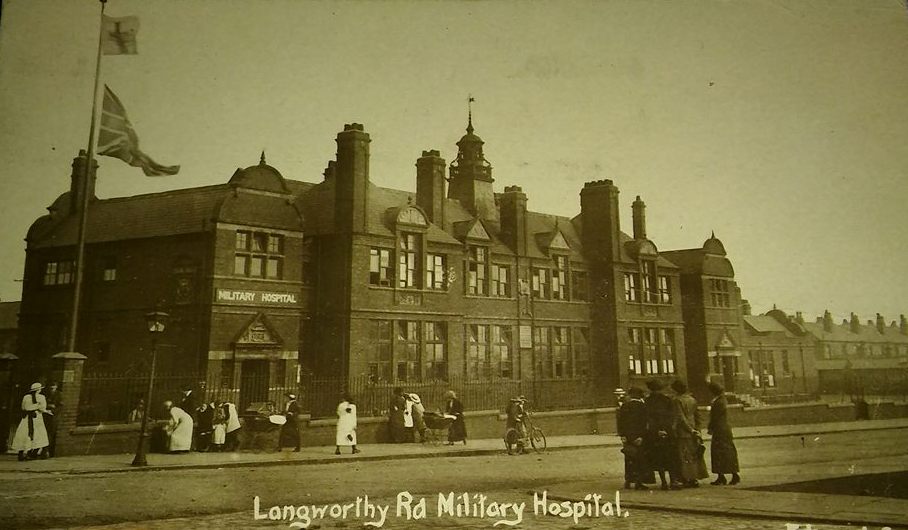
No more school at Langworthy Road ......... and in its place a military hospital

Now if you are seven years old and going to school on Langworthy Road in Salford the only bright bit of news as the Great War rolls into its second year might be that your school was to become a military hospital.

In the March of that year the authorities identified five schools which they thought might be suitable “for new hospital accommodation required by the military authorities.”*

The five were Secondary School for Boys, Leaf Square, Grecian Street Girls and Infants Schools, Halton Bank School, Langworthy Road School and Tootal Road School, with the option to substitute “Leicester Road School for one of the others.”

The attraction of the five/six were that they were all modern school.
In the case of Langworthy it had only been opened five years earlier in 1915 and had a total intake of 376 boys, 376 girls and 442 infants.

By all accounts it would have passed an Ofsted visit with flying colours.  The average attendance was nearly 100% and it was judged good by a report in 1905.

All of which just left the difficult question of what to do with 1,194 students.

The authorities had not fully worked out the answer to that question in the March of 1915 but considered that “There a number of Sunday Schools and halls in Pendleton and Broughton districts which may be utilised and suggestion has also been made that schools in the neighbourhood of the five selected schools should have two courses a day – one from 8 am. To 1pm. and the other from 1pm.to 5 pm., - one for each school."

This half day schooling was also adopted by Manchester where by 1915 the number of schools taken over amounted to eight. The first was the Central High School for Boys and Girls on Whitworth Street which had a thousand students and became the headquarters of the 2nd Western General Hospital.

The following year another seven schools were taken over.

These were Alfred Street in Harpurhey, Alma Park in Levenshulme, Grange Street in Bradford, Lilly Lane in Moston, Ducie Avenue, Moseley Road and Heald Place which amounted to the loss of 3897 places.**

It had resulted in a degree of ad hoc provision for some at least. In the February of 1916 the Manchester Museum reported that it was providing effective instruction for 900 to a 1,000 children per week drawn from the higher standards of the elementary schools.***

A similar scheme was underway at the City Art Gallery, the Whitworth Institute, and “kindred institutes in the city” and had proved so popular that children not only travelled some distance to attend but even brought their parents.

And that pretty much is that.

Location Salford

Picture; Langworthy Road Military Hospital, circa 1915-17 from the collection of David Harrop

*The New Hospitals, Five Salford Schools to be used, Manchester Guardian, March 17 1915

** 2nd Western General Hospital, Manchester, 1914-1919, Margaret Elwin Sparshot

*** War Service in the Museums, Teaching the Half Timers, Manchester Guardian, February 21, 1916

Monday, 16 November 2026

A bottle from Chorlton and the search for Alfred Gordan Fineberg Leech

Now there is nothing more intriguing than a bottle dug out of the ground, which has sat in a disused refuse tip for perhaps a century.

And how much more intriguing when the bottle bears a name and came from Chorlton.

The bottle comes from  the collection of Jay Hurst who also has a number of porcelain jar tops from our own Harry Kemp.

Harry Kemp was a chemist with shops in Chorlton and Stretford, and this glass bottle also originated from a pharmacy, which belonged to Alfred Gordan Fineberg Leech.

But just where in Chorlton his shop was located has so far eluded me and to find it will involve a painstaking trawl of the directories.

I do know that he was born in 1887, that his father died and his mother remarried, and those two events occurred between 1891 and 1901 and like the location of the chemist shops, the exact dates will turn up.

That said I do know he married Hilda Walton in 1928 and died in 1977 in Aberconwy, Gwynedd, Wales, and left a substantial amount of money.

Alas at present that is all I have, except for the picture of the bottle, and a reference to him living in  52 Albert Road, Whalley Range in 1939.

Location; somewhere in Chorlton

Picture; chemist bottle, 2020, from the collection of Jay Hurst

Salford women in uniform nu 3 .......... the inspector of “clippies”

The first clippies were taken on in the May of 1915 by Salford Corporation.

And in the way of things they also employed tram inspectors

Location; Salford


Picture; Salford tramways  inspectors, 1917, m08107, courtesy of Manchester Libraries, Information and Archives, Manchester City Council, http://images.manchester.gov.uk/index.php?session=pass

Remembering Eltham in 1977

Nothing dates more than the recent past.

I am looking at pictures of Eltham taken in 1977 and what strikes me most is how different the place looked just under 40 years ago.

It is a mix of the colour that was used on the prints and the slightly unfamiliar looking clothes.  And of course the absence of some of the buildings which you take for granted.

All the more so when Eltham is no longer your home but just a place to return to.

Which takes me back to the pictures of the Castle in the High Street and the King’s Arms, which are pubs whose names stretch back well into the past.

I can’t say I liked the Castle and only ever went in there once, but in the space of two visits home it had gone and I can’t even remember when.

Likewise the Kings Arms which was for a while was our local is also no more.

Thinking back I am not sure why I did like it, unless it was that tendency in the young to scorn old pubs which had character and interest on their side.

All of which is my loss.  The Greyhound would certainly have impressed my Italian family as did the Rising Sun when I was in there a few years ago.

But we do take things for granted and I suppose don’t even register the changes that are happening.

All of which makes pictures like these wonderful pieces of history.

As always you have to be careful not to descend into nostalgic rubbish.

Places evolve, buildings come and go and not everything that is demolished is worth saving.

Although as I grow older I do rather look on the buildings of the 1950s, 60s and 70s with a bit of a jaundiced eye.

Simple concrete box designed shops and houses lack something of the charm of earlier buildings.  The 1970s Post Office has little to compare with its predecessor

So while I don't mourn the end of the Castle I would hope that its neighbour is still standing in 30 years time.

This is  the old David Grieg building which is a fascinating piece of old Eltham with fine brickwork, balconies and terracotta initials of the company in the gables.

And in turn will write in with their memories of their last pint in the King’s Arms as I  remember eating in the Golden Orient or whatever it had become by the 1990s.

So it matters to keep taking the pictures, saving them and bringing them out every so often to chart the changes which we miss.

Pictures, courtesy of Jean Gammons