Showing posts with label Municipal Socialism. Show all posts

Monday, 8 June 2026

The picture …. the municipal venture ….. and half a mystery solved

Here is a picture I keep coming back to.

At the Electricity showrooms, undated
It is a popular one which keeps cropping up on social media and was recently reposted by my Facebook chum, Christopher Roman.

Alas I have never been able to track a date or a source for the image, but the design of the building and the fashions on display would suggest the 1930s.

This was still the height of municipal socialism which saw local authorities continue to advance their responsibilities in a range of activities.

During the late 19th and early 20th centuries, in the absence of much from central government it was local politicians who were making their towns and cities better places to live.  As Sidney Webb said the “municipalities have done most to socialize our industrial life.” *

And so a resident of Manchester, Birmingham or Glasgow could benefit from municipal supplies of water, gas and electricity, travel on municipally owned trams and buses walk through a municipally maintained park while knowing his children were being educated in municipally run schools.

Electricity Supply Box, 1915
“Glasgow builds and maintains seven public ‘common lodging houses’; Liverpool provides science lectures; Manchester builds and stocks an art gallery; Birmingham runs schools of design; Leeds creates extensive cattle markets; and Bradford supplies water below cost price. 

There are nearly one hundred free libraries and reading rooms. The minor services now performed by public bodies are innumerable.”*

And chief amongst those was the growing push to provide affordable gas and electrical fires, cookers and a range or household appliances which were promoted through local authority showrooms and supported by municipally run classes on how to cook with gas and electricity.

But the "City of Leicester Electricity Service" remained elusive ….. until last night when Tina turned up the story in a matter of minutes eclipsing my long practised historical skills.

It was all there in an article entitled City Hall, from the Story of Leicester.**

I have no intention of lifting other people’s research and so instead if you want to know the history of the service just follow the link.

Electricity Joan? 1938

Not that I am any closer to finding the date or the source, but I think it will be sometime after 1935 when the newly opened "Municipal Offices housed the Leicester Corporation Electricity Department (later the East Midland Electricity Board) and were specially furnished with a model kitchen for 'housewives who are interested in the modern uses of electricity in the home'. 

Exhibition Model Of All-Electric Kitchen, 1935

A special theatre also presented weekly cookery demonstrations and a Service Centre displayed, sold and hired out electrical appliances".**
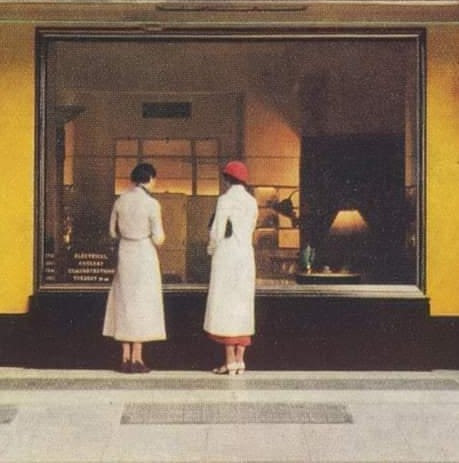
Added to which I guess the picture comes from promotional material issued by the City Council.

Shopping for the new, date unknown
Now that is almost the end of the story but not quite, because after an appeal on the Leicester Old and New site and before Tina’s discovery a heap of people suggested the location for the offices as Charles Street.***

And that placed it almost opposite the air b&b we stayed at in January on one of our visits to see our Josh and Polly.

So as they say ….. it really is a very small world and armed with my newly acquired knowledge I will go and stand outside City Hall next time we are in Leicester.

Pictures; City of Leicester Electricity Service, source, and date unknown Manchester Corporation Electricity Works Supply box, circa 1915, from the collection of Andrew Simpson, advert from Manchester Electric Supply and picture of an all-electric kitchen 1935, Manchester Corporation

*Webb, Sidney, from Historic, Fabian Essays in Socialism 1889


**City Hall, Story of Leicester, https://www.storyofleicester.info/civic-affairs/city-hall/

***Leciester Old and New, https://www.facebook.com/groups/483822492579736/?multi_permalinks=855570792071569&notif_id=1691096569147245&notif_t=feedback_reaction_generic&ref=notif

Sunday, 21 September 2025

Celebrating our Municipal Town Halls part 3 .......... Woolwich Town Hall

It is all too easy to become cynical about public service and the achievements of local government.

Back in the 19th and early 20th centuries local government  more so than Westminster was at the cutting edge of improving the lives of local people.

As Sidney Webb said the “municipalities have done most to socialise our industrial life.”  And so a resident of Manchester, Birmingham or Glasgow could benefit from municipal supplies of water, gas and electricity, travel on municipally owned trams and buses, walk  through a municipally maintained park while knowing his children were being educated in municipally run schools.

“Glasgow builds and maintains seven public ‘common lodging houses’; Liverpool provides science lectures; Manchester builds and stocks an art gallery; Birmingham runs schools of design; Leeds creates extensive cattle markets; and Bradford supplies water below cost price. 


There are nearly one hundred free libraries and reading rooms. The minor services now performed by public bodies are innumerable.”*

And all of that was evidenced not only in the Corporation parks and schools and baths but in the town halls which were solid examples of both civic pride and local democracy.

So here is Woolwich Town Hall built in 1906 and opened by Will Crooks


Picture; Woolwich Town Hall, courtesy of Kristina Bedford*

*Woolwich Through Time, Kristina Bedford, 2014, Amberley Publishing,

Tuesday, 21 January 2014

On London Road at the Fire Station

London Road Fire Station, © 2013 Peter Topping
There are many of us who have a soft spot for the old Fire Station on London Road

It was opened in 1906, designed by Woodhouse, Willoughby and Langham in red brick and terracotta and cost £142,000 to build.

In addition to the police station there were a fire station, an ambulance station, a bank, a Coroner's Court, and a gas-meter testing station.

The fire station operated for 80 years, housing the firemen, their families, and the horse drawn appliances that were replaced by motorised vehicles a few years after its opening.

It remained the headquarters of the Manchester Fire Brigade until the brigade was replaced by the Greater Manchester Fire Service in 1974 and it closed in 1986.

Now I spent three years on doing a degree in History and Government and never made the connection between this fine old building and the subjects I was studying.

The Fire Station circa 1900
And yet here was a history lesson just across the road from where I sat in the Aytoun building of the old College of Commerce.

For in the absence of much from central government it was local politicians who were making their towns and cities better places to live.

As Sidney Webb said the “municipalities have done most to socialize our industrial life.”

And a resident of Manchester, Birmingham or Glasgow could benefit from municipal supplies of water, gas and electricity, travel on municipally owned trams and buses walk through a municipally maintained park while knowing his children were being educated in municipally run schools.

“Glasgow builds and maintains seven public ‘common lodging houses’; Liverpool provides science lectures; Manchester builds and stocks an art gallery; Birmingham runs schools of design; Leeds creates extensive cattle markets; and Bradford supplies water below cost price. There are nearly one hundred free libraries and reading rooms. The minor services now performed by public bodies are innumerable.”*

During the previous half century Manchester and all the great northern towns and cities had grown by leaps and bounds but the vital infrastructure which was necessary for a healthy and civilised life had lagged behind.

So there had been few planning or building regulations to prevent the worst excesses of slum housing, little in the way of clean drinking water and a total absence in some quarters of the city of adequate sanitation.

This picture must be from the first two decades of the 20th century, and like so many in the collection there is so much to focus on.  For me it is the large presence of the horse drawn vehicle.

In the centre of the picture by the Policeman on traffic duty there is a heavy wagon, while just to our right a heavily laden one is emerging from the railway station, and a little further up London Road is the horse drawn taxi.

But there are those motor cars, only two of I grant you but in time this petrol engine vehicle will see off the horses and the tram.

Picture; from the collection of Rita Bishop, courtesy of David Bishop

Painting, London Road Fire Station, © 2013 Peter Topping, Paintings from Pictures,
Web: www.paintingsfrompictures.co.uk
Facebook:  Paintings from Pictures

* Webb, Sidney, from Historic, Fabian Essays in Socialism 1889