Showing posts with label Longford Hall. Show all posts

Sunday, 21 June 2026

Longford Hall and our own Chorlton radical

Here is the story of our own radical who lived on the site of what was Longford Hall at the beginning of the 19th century.

 This I have admit is an odd view of Longford Hall which was built in 1857 and demolished in 1995, but I rather like it, and it does convey something of the grandeur of the old building which Pevsner in 1969 described Longford Hall “as the only surviving example of the Italianate style of architecture in the Manchester district.” *

The Hall was built by John and Enriqueta Rylands as a fitting home to a textile manufacturer who in 1888 employed 15,000 people in 17 mills and factories.**
But before that there was an property known as Longford House which had been the home of the Walker family, of which perhaps the most interesting was Thomas Walker, one time pillar of Manchester society but also a radical politician who campaigned for the abolition of the slave trade, supported the French Revolution and was indicted for treason in 1794.

The family lived at Barlow Hall from the late 18th century spending the summer there before moving back for the winter to their town house on South Parade which faces what is now Parsonage Gardens.  And it was there that a mob attacked Walker who was forced to drive them off by discharging a pistol in the December of 1792.

This was at the height of political debate over the issues of press freedom and the French Revolution.
“Emboldened by drink and fired on by agitators, groups hostile to the radicals began to gather around the city.  Walker was in no doubt that this was pre planned.  ‘Parties were collected in different public houses, and from thence paraded in the streets with a fiddler before them, and carrying board on which was painted with CHURCH and KING in large letters’ 

On four separate occasions a mob gathered outside South Parade, broke the windows and attempted to force their way in.  Supported by friends Thomas Walker was forced to fire into the air to disperse the crowds.  The magistrates did nothing to prevent the events and while a “regiment of dragoons was in town, booted and under arms”    and ready to disperse the rioters no order was given.  As if to add insult to injury the main concern of the magistrates when they finally met Walker was that he should not fire at the crowd again if the mob returned!  These attacks had been matched by similar ones on the home of Priestly in Birmingham and in Nottingham.”***
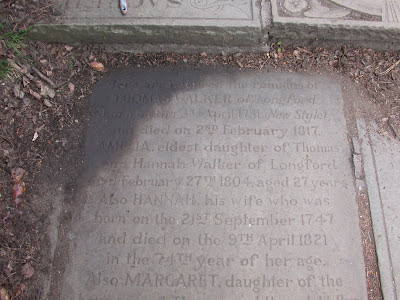
Walker survived both the attacks and was acquitted of treason, after which he retired to the new family home at Longford House where he died in February 1817 and was buried in the parish church on the green.

Pictures; Longford Hall, 1920, Courtesy of Manchester Libraries, Information and Archives, Manchester City Council, m67353, and the Walker family gravestone in the parish churchyard from the collection of Andrew Simpson.


* Pevsner N, The Buildings of England South Lancashire,

** for more on the history of the hall and park visit Friends of Longford Park @ http://friendsoflongfordpark.org.uk/
*** The Story of Chorlton-cum-Hardy, Andrew Simpson, 2012, http://chorltonhistory.blogspot.co.uk/search/label/A%20new%20book%20for%20Chorlton

Monday, 16 March 2026

Longford Hall … The Parsonage and that Didsbury pub ….. three pictures from that remarkable artist Derrick Lea ….. and their stories

I have become a great fan of the artist Derrick Lea who during the 1950s and into the 60s drew and painted many of our iconic buildings across Manchester.

Longford Hall and Park circa 1950s
And given that he lived in Chorlton it is not surprising that some of his work records places around the Township.  

But he also produced images of Manchester, and its suburbs.

All of which is an introduction to three in the collection from Stretford and Didsbury.

The first is Longford Hall which was in the grounds of Longford Park and was commissioned by John Rylands that extremely wealthy industrialist whose commercial interests were global and who was a prime financial backer of the Manchester Ship Canal.

Alas the hall was demolished in 1995, having been acquired by Stretford Council in 1911 and used variously as accommodation for Belgian refugees, a Red Cross hospital, a museum and art gallery.  Added to which in 1977 it hosted the only Royal garden party to be held outside London.

And if that were not enough of a claim to fame it stood on the site of Longford House which at one point was inhabited by Thomas Walker that distinguished 18th century businessman who was the boroughreeve of Manchester, prominent in the campaign to abolish the Slave Trade, and supported the French Revolution which resulted in him being wrongfully  accused of sedition.

Like most people I assumed that Mr. Walker’s house had been torn down to make way for Longford Hall in 1857, but a paper in the bulletin of the John Rylands Library  by Richard Bond argues for a later date.*

It is a compelling argument and along the way offers much detail about the Hall and the architect Philip Nunn.

The Old Parsonage, circa 1950s

Now I know from Mr. Lea’s son that the family lived close to the hall and visited it regularly with Jon telling me that  “we used to go there with Dad for milk shakes, and in cold weather it was hot Vimto.”

In contrast to the grand home of John Rylands Derrick Lea was at home with more modest buildings like The Old Parsonage in Didsbury which he drew sometime in the 1950s.

It is “a Grade II listed building, next to the original village green of Didsbury. The building and gardens were left to the citizens of Manchester by Alderman Fletcher Moss in 1919. The Didsbury Parsonage Trust has provided a thriving community hub for the people of Didsbury and beyond, in a significant and picturesque setting. This historic and much-loved building has been lovingly restored, and the Trust aims to preserve it for future generations”.**

Added to which it is set in a fine and lovingly kept garden with views across to the parish church.

Ye Old Cock, circa 1950s
And after a spell in the gardens there is the Old Cock which I would like to think Mr. Lea could have visited after taking in the Parsonage which backs onto the pub.

It was a place we escaped to during my time on a post grad course at Didsbury College over half a century ago.  At the time and looking back now there was no competition between a couple of pints and an hour and bit listening to a lecture on the Philosophy of Education.

The pub looks old and in 1825 hosted a three day Wakes event which the Stockport Advertiser reported  included “ass-racing for purses of gold, playing and grinning through collars of ale [as well] bag racing for hats; foot racing for sums of money; maiden plates for ladies under twenty years of age for gown pieces and shawls, treacle -loaf eating, wheel barrow racing and bell-racing with balls each evening”.***

I have to say I bet that event would have made a fine picture for Mr. Lea.

Leaving me just to mention  Juliette Tomlinson and her debut novel, "Longford", which charts the lives of John Rylands and his third wife, Enriqueta 

It is the first of a trilogy which will span the decades from 1864 into the twentieth century and on the way offers up glimpses into the lives of the two, set against provincial France and Manchester, with of course sideways looks at Longford Hall, Stretford and other bits of south Manchester.

The second novel called Sunnyside is due out in April of 2026.

Location; Stretford, and Didsbury

Pictures; Longford Hall, The Parsonage and the Old Cock, circa 1950s, courtesy of Jon and Hazel Lea

 *Bond, Richard, Longford Hall Revisited: A New Building Date, and an Architect, Bulletin of the John Rylands Library, Vol 100, No. 1 Spring, Manchester University Press  

**Didsbury Parsonage Charity https://www.didsburyparsonagetrust.org.uk/

***Didsbury Wakes, Stockport Advertiser, August 5th, 1825


Friday, 13 February 2026

Who knew Derrick A. Lea of Illustrations & Design?


I am looking at one of eight illustrations produced by Derrick A. Lea.  

My eight are all greetings cards, some of which have a Christmas message and others with a more general inscription.

Of the eight, five are of Chorlton, one of Longford Hall and another of the Old Parsonage in Didsbury.

Now this does not surprise me over much because Mr Lea gave his address as Rybebank Road, and earlier in the 1950s he had been living on Dalmorton Road which is in between Egerton Road South and Kings Road.

But that is about all I do know of the chap.  So far I have discovered he was born in Bucklow in Cheshire in 1920, got married in 1949 and produced these fine pictures of south Manchester.

My eight belong to Margaret who bought a job lot some years ago using them as cards for friends and relatives.

Luckily for me she retained these last eight.


And the one I have in front of me is one of the lost buildings which only went in the last decade of the last century.

This is Longford Hall “the residence of the late John Rylands, was bought by him in 1855 and acquired by the Stretford Council in 1911.  The park and playing fields were extended by the purchase of additional land from Manchester Corporation and is much used for sport and other social gatherings.”*

Like many people I let this building go by with little thought about what was lost when it was demolished.

So I shall come back to Mr Lea’s Longford Hall in due course, but in the meantime I am still at a loss to know more about the man.

It was drawn in 1957 and some of the others of the eight date from the years around that time. Others have no date but I guess will be contemporary.

What makes them fascinating is that they cover a period when Chorlton was continuing to change.

I can not however date when they were made into cards but some at least have a telephone number containing the old mix of letters and numbers.

Now the switch to all figure dialing began in 1966 and was completed four years later and Manchester was one of the first cities to make the change.

All of which places the cards no later than 1970 and possibly earlier.

Margaret had seen the cards advertised sometime in the mid 1970s by Mrs Lea and went round to the house on Ryebank and bought a selection.  I would like to know more but that at present is all there is

But at least we his pictures.

Picture; Longford Hall, by Derrick A. Lea

*text by Derrick A. Lea

Sunday, 8 February 2026

On Chorlton Green with Derrick A Lea in 1957


We are on the green sometime between 1955 and 1958 outside the Horse and Jockey.

Now I know this because the artist who drew the scene completed a series of pictures of Chorlton during this period.

He was Derrick A Lea and he is one of those local artist who has slipped out of our history.

He lived here during the 1950s through to the ‘70s, and that is about it.  So for now it is his pictures that will have to speak for him.

And today it is this one of the pub on the green.


It is a picture which I like partly because the style reminds me of so many that I grew up with in the 1950s and early 1960s.

Often they were the sort which appeared as adverts in magazines or in prints that were displayed in railway carriages on the trains of the Southern Region.

Most were of the countryside and most showed southern England in full summer.

So this one is somewhat different and what draws me in is not just the wintry scene but the way Mr Lea captures the brisk movement of the couple on the right.  It’s partly their stride as they follow the dog but also the way the woman’s coat spills out covering as it would an equally expansive dress underneath.

This was that period when in direct contrast to the fashions of the war everything was bigger and more showy, as if to say “we are done with rationing and making do.”

And the historian in me is fascinated by the picture of the pub itself which is almost the one we know today but not quite.

In the 1950s it had not extended into the building to right of the entrance below the sign.

This was still a private residence and so had not yet been given the wooden beam effect.  Nor had the top floor of what had once been Miss Wilton’s home been taken down.

But not all in the picture is completely accurate for what looks like a pond in front of the trees is  an invention of Mr Lea’s imagination.

There were village ponds but sadly not here.  There was one further to the south by the Bowling Green Hotel and another on Beech Road stretching from Acres Road up to Chequers Road but not outside the Horse and Jockey.

Not that I am over bothered by the deliberate error.

It remains a pretty neat picture of a moment in the mid 1950s which will be one most of us never knew, and I do like his depiction of the pub and the green on a wintery snowy night.

So it just remains to close by repeating  the image he drew.

Location; Chorlton-cum-Hardy, Manchester


Picture; the Horse and Jockey, Chorlton Green, by Derrick A Lea taken from a greetings card in the possession of my old friend Margaret.


Thursday, 14 August 2025

When a bit of the Ship Canal came to Longford Park ……

This is one of the desks which once belonged to the Manchester Ship Canal.

The desk, 2025
I like the idea that it has come home to Longford Park because one of the prime movers of the Ship Canal project was John Rylands who lived in the big house in the grounds which is now the park.

To be strictly accurate this bit of ship canal history now resides a few yards away in the home of Juliette Tomlinson who has written a fictional account of Mr. Rylands and his wife Enriqueta.

The book, Longford A Manchester Love Story came out last year and has caught the imagination of everyone who has read it.*


And so, it is fitting that the second in the trilogy is being written on that desk and explores his contribution to the Canal and of course to the relationship between John and Enriqueta.

I have to confess that standing in front of the desk this morning, I did what we all would do and “touched a bit of history”.  

Longford Hall former home of John and Enriqueta, 1914
To be very honest while Juliette was out of the room I did more than run my had over the polished surface and sitting at the desk I scribbled a note to myself and pondered on the generations of clerks who will have laboured away writing up minutes, checking receipts and composing letters to long vanished shipping companies.

The romantic in me even whiled away the minutes wondering if the man himself used the desk, but that would be unhistorical tosh, so instead I looked to see if any bored clerk had left their name carved in the wood.

Longford Park, 1914
I didn’t but I will await Juliette to do the full search and report back.

Leaving me just to say it had holes for inkwells and a bank of electric sockets which will have been installed long after the first ships sailed up the canal into the docks.

Pictures, The Ship Canal desk, 2025, courtesy of Juliette Tomlinson, the book Longford, 2024, Longford Hall, 1914 from the series Longford Park, issued by Tuck and Sons, courtesy of Tuck DB, http://tuckdb.org/


That desk, 2025

*Longford A Manchester Love Story, available from Chorlton Bookshop, Waterstones and The Squeeze Press, www.woodenbooks.com


Sunday, 25 May 2025

The forgotten hospital in Longford Hall

 I know l shouldn't be surprised that Longford Hall was given over to use by the Red Cross as an Auxiliary Hospital during the Great War.


Many family homes, along with schools and other public buildings were requisitions or volunteered as hospitals for soldiers  recovering from wounds and illnesses. 

Here in Chorlton l have tracked three with the promise of another, and over the years l have written about more in Didsbury, Whalley Range, Salford and across Manchester and beyond.

I just didn't think of Longford Hall but I should. It was a fine large building, formerly the residence of the  Ryland family and from 1908 it was owned by Stretford.

So at the outbreak of war it became a centre of war activity including its role as a hospital.

After the war most of these hospitals were returned to private use or continued as hospitals. 

The equipment from beds to cooking pans and typewriters were sold off and with two generations their existence had started to fade.

So l am off to do the research, starting with one of those scrap books recording photographs and comments of the hospital.

Location; Longford Hall

Pictures; pictures, undated courtesy of Bill Sumner

Saturday, 1 March 2025

Two chums … Enriqueta Rylands …. and a walk around Stretford’s past

It started with a talk on John and Enriqueta Rylands by the novelist Juliette Thomlinson and finished with some nice surprises.*

Closed entrances, 2025

I knew the talk by Juliette would be good and it was.  Judging by the comments from the packed audience at Stretford Library they thought so with the two infront commenting that the talk was informative and offered an insight into how a novelist works.

What I didn’t expect was to bump into my old Stretford chum Bill Sumner and his wife who is all things history.  And the chance meeting led to him showing me the remains of an old farm minutes from the Library.

Stretford shapes, 2025
Added to that as the talk finished, I bumped into Chris Roman whose photographs I much admire and who I had never met before.

All of which was interposed with a bit of Stretford’s past from the old Robin Hood pub to St Matthew’s Church.

I have a fond spot for the Robin Hood because briefly the name was adopted by one of our first beer shops in Chorlton, which changed its name to the Traveller’s Rest sometime in the 1840s.

It opened at the bottom of Chorlton Row and continued trading into the 20th century

Location; Stretford

Pictures, Stretford on a March Day, 2025, from the collection of Andrew Simpson

* A Manchester Love Story, The Squeeze Press, www.woodenbooks.com


Friday, 28 February 2025

A Manchester Love Story …… John and Enriqueta Rylands .... the talk this Saturday ….

I can think of no better place for Juliette Thomlinson to talk about her debut novel featuring John and Enriqueta Rylands than Stretford Public Library.*


Afterall John Rylands established the first free lending library in Stretford in 1883 and his wife Enriqueta gifted it to the local authority a decade later, following this up in1903 by paying for the structural alterations to the building costing £1,335.

Longford Hall, 1965
Juliette’s talk with be in the present Stretford Library which dates from 1940. 

She tells me that she will be discussing how she came to write the novel, her own personal connection to both Longford Hall and the park as well as a bit about both John and Enriqueta Rylands.

And given that Juliette is an excellent speaker with an engaging manner which does not distract from her knowledge of the Ryland’s we should be in for an interesting afternoon.

Longford: A Manchester Love Story, Saturday March 1st, at 4pm for an hour in Stretford Library, Bennett Street, Stretford, M32 8AP No charge

Stretford Library, 2022

Location; Stretford

Pictures; cover of A Manchester Love Story, courtesy of the author, Longford Hall, 1965 from The 1965 Collection and Stretford Library, 2022, courtesy of Google Maps 

*A Manchester Love Story, The Squeeze Press, www.woodenbooks.com

Tickets for Longford: A Manchester Love Story, available from eventbright https://www.eventbrite.co.uk/e/longford-a-manchester-love-story-tickets-1248215398859?aff=ebdsshsms&utm_share_source=listing_android


Sunday, 23 February 2025

The Stretford I never knew ………..60 years ago

It is 60 years ago that this collection of images was taken.

They cover Manchester, Stretford and out to Chorlton and Wythenshawe and are a mix of industrial scenes, some old historic buildings and more than a few of well-known city centre sites.

What they have in common was the year they were taken and that originally they were colour slides.

The collection was donated to me by the daughter of the photographer, but somewhere along the line their identity was lost, although I am still looking for the letter, email or Facebook message which alerted me to the names of the woman who donated them and the photographer.

I hope by posting them the donor will come forward and I can change the credit from the 1965 collection to a name.

These are image of the Stretford I never knew.

That said the first is vaguely familiar and is the junction of Edge Lane and Chester Road, but with differences.

The second is Longford Hall, which I may just remember, but never really bothered with and then it was gone. 

Like all of the32 I the collection they are a unique record of how things were in 1965.

Location; Stretford

Pictures, Edge Lane and Chester Road, and Longford Hall from the 1965 Collection

Wednesday, 18 September 2024

One book … three events …….. and a heap of history

 The story of John and Enriqueta Rylands is one that I am not really familiar with, other than that the couple lived in Longford Hall and on his death his wife commissioned and built that magnificent library on Deansgate.

Longford House, 1914
So, I have fallen on Juliette Tomlinson’s debut novel, "Longford", which charts the lives of Enriqueta and John before they met and takes the reader on that journey that eventually saw the two of them married.*

It is the first of a trilogy which will span the decades from 1864 into the twentieth century and on the way offers up glimpses into the lives of the two, set against provincial France and Manchester, with of course sideways looks at Longford Hall, Stretford and other bits of south Manchester.

The book came out on September 1st and already there are three opportunities during the month to meet the author and hear about her passion for Enriqueta, how she came to write the book and her plans for the two subsequent books.

The official launch will be in the Horse and Jockey that ancient pub on Chorlton Green on September 19th at 7pm.

I have no idea whether John and Enriqueta visited the place which first opened its doors to paying customers in the 1790s in a building which was already into its second decade when Henry VIII walked down the aisle with Anne Boleyn.

The book signing, 2024

But I bet some of the individuals who walk across the pages of the book will have been familiar with the Holland family who ran the pub from the 1840s into the 1890s.

And after the launch Ms Tomlinson will be at Waterstones in Oldham for the official book signing event from 1pm till 3 on Saturday September 21st.

The novel, 2024
Leaving just an appearance at our own Chorlton Book Festival at the Edge Theatre on Manchester Road on September 27th between 2 and 4 pm.**

That said I know there are other events including one at the Portico and no doubt more will follow as local organizations get to hear of the publication of Longford.

Like all of us who write, I know that the story of John and Enrique has occupied a big chunk of Juliette’s time so much so that last month the family holidayed in the town of Beziers in southern France which is where her novel begins.

Added to which she lives in Stretford, yards from Longford Park, which was a part of her childhood.

 At which point I could include the opening lines of the novel, but I won’t  ….. the book costs £9.99 and is available from Chorlton Book shop, Waterstones, and The Squeeze Press.***

Location; France, Manchester and of course Longford Hall

Pictures; Longford Park and Lake 1914 from the series Longford Park, issued by Tuck and Sons, courtesy of Tuck DB, http://tuckdb.org/, book launch advert, courtesy of Waterstones, and cover of Longford, by permission of the author.

Longford Park and lake, 1914

*Longford, A Manchester love story, Juliette Tomlinson, 2024, The Squeeze Press

**Chorlton Book Festival, All events are bookable through Chorlton Book Festival, https://www.eventbrite.com/cc/chorlton-book-festival-2024-3536319

*** The Squeeze Press, www.woodenbooks.com


Wednesday, 21 August 2024

Chorlton Book Festival is back ……

I say back but that weeklong festival of all things books starts on September 20th and runs through till the 28th in venues across the township.

If I have got my sums right this will be the 20th year when Manchester Libraries have invited heaps of authors to talk about their work and share readings from their books.

I am a great fan, not least because since 2009 I have hosted a history walk and talk during the week.

But to say more would be outrageous self promotion so I will leave a gentle plug for me till the end.

As it is still the middle of August, events and venues are still being finalised.

That said I have already booked tickets for two shows.

On September 21st Brian Groom will be speaking about his new book "Made in Manchester" which is a “A rich and vivid history of Britain's second city through the people who made it.

Long before Manchester gave the world titans of industry, comedy, music and sport, it was the cosmopolitan Roman fort of Mamucium. 

But it was as the ‘shock city’ of the Industrial Revolution that Manchester really made its mark on the world stage. 

A place built on hard work and innovation, it is no coincidence that the digital age began here too, with the world’s first stored-program computer, Baby.

A city as radical as it is revolutionary, Manchester has always been a political hotbed. 

The Peterloo Massacre is immortalised in British folklore and the city was a centre for pioneering movements such as Chartism. Suffragette Emmeline Pankhurst hailed from here and the city still treasures its wilful independence.

Manchester’s spirited individuality has carried through into its artistic output too, bringing the world Anthony Burgess, L.S. Lowry, Jeanette Winterson, Joy Division and Oasis. Mention United or City almost anywhere and you’ll find fans, and opinions.

Until now, this magnificent city did not have its definitive history. From the author of the bestselling Northerners, this work of unrivalled authority and breadth tells the story of a changing place and its remarkable people".

The event takes place at the Chorlton Central Church on the corner of Zetland and Barlow Moor Roads stating at 6.30pm

And having renewed my knowledge of the city’s history, on the 27th I will be in the Edge Theatre to listen to Juliette Tomlinson introduce her debut novel, "Longford", which is set in the year “1864, in the great city of Manchester was Cottonopolis, rising with the sound of industry, and the boom of a hundred mills.

At the heart of its energies was John Rylands. 'the greatest merchant prince the world has ever seen'. 

This is the story of an empire built by a true Manchester man, given meaning and worth by the extraordinary woman who loved him.

Juliette Tomlinson has worked as a bookseller, and then in publishing. 

She lives in Stretford, Manchester, yards from Longford Park, which was a part of her childhood. 

The story will continue in a second book, Sunnyside”.

The talk starts at 2 pm till 4pm in the Edge on Manchester Road.

Which just leave me, and that history walk on Sunday the 22nd.

This year by popular request we will be in the graveyard by the village green exploring the history of the old parish church, and the stories of some who were buried there.

They include Thomas Walker who campaigned against the slave trade, supported the French Revolution and was tried for sedition, along with a mix of the “good, the bad, and the ordinary". 

Together they offer up a rich history of how Chorlton was from the late 18th century into the 20th.

After the talk we will have “light refreshments" at the Edge Theatre.

So there you have it.


All events are bookable through Chorlton Book Festival, https://www.eventbrite.com/cc/chorlton-book-festival-2024-3536319

Location; Chorlton

Pictures; book covers by permission of the authors, Chorlton graveyard, 1978 and 2008 from the collection of Andrew Simpson


Sunday, 15 March 2020

Longford Park, the bandstand and a fine collection of photographs from Jack Kennedy

Now this image has already brought back a flood of memories when it was posted by Dave Kennedy on facebook recently.

It comes from a wonderful collection of photographs which were taken by Jack Kennedy and which his son Dave has posted on flickr.*

This is one of my favourites because it includes a view of Longford Hall and that bandstand.

Now every good park should have a bandstand.

They were after all the centre of many parks in the late 19th and early 20th centuries which reflected both civic pride and that long history of listening to music in the open air.

I remember the one in Telegraph Hill Park which by the time I knew it had become a sad and forlorn thing.

It had long ago lost its cast iron pillars and roof and was pretty much just an abandoned lump which you past on the way through the park to school.

But here Jack caught the bandstand in Longford Park when it was still pretty impressive and out there in the distance is the hall which I should remember but sadly don’t.

It was a place I have written about, and must have passed plenty of times but just stubbornly refuses to be remembered.**

So I shall close with a thank you to Dave for allowing e to share it and suggest you look at the rest of the photographs in the series.*


Picture; Longford Hall and bandstand, date unknown, courtesy of Dave Kennedy

*jack kennedy black & white photography https://www.flickr.com/photos/8188211@N02/sets/72157647573263194

**Longford Hall, http://chorltonhistory.blogspot.co.uk/search/label/Longford%20Hall

Thursday, 20 February 2020

Longford Park and Lake in 1914

Now this is an open invitation to anyone who knows Longford Park to make a comment on this picture postcard from 1914.

Picture; Longford Park and Lake 1914 from the series Longford Park, issued by Tuck and Sons, courtesy of Tuck DB, http://tuckdb.org/

Thursday, 6 February 2020

The last pictures of Longford Hall ........... September 1994


Now I can’t be sure that these are the last pictures to be taken of the hall but they will be amongst the last.

They were taken by Andy Roberston who recorded them shortly before the place was finally demolished in 1995.

The story of the hall has been well covered elsewhere and my own interest is really in the house that it replaced.  This had been the home of our Thomas Walker, who moved there from Barlow Hall and was buried in our parish churchyard.

Thomas Walker, one time pillar of Manchester society but was also a radical politician who campaigned for the abolition of the slave trade, supported the French Revolution and was indicted for treason in 1794.

The family lived at Barlow Hall from the late 18th century spending the summer there before moving back for the winter to their town house on South Parade which faces what is now Parsonage Gardens.  And it was there that a mob attacked Walker who was forced to drive them off by discharging a pistol in the December of 1792.

His family continued to live at the house after his death in 1819 until they sold it to the Rylands in 1855 who demolished it for the hall.

Back in 1994 I have to admit I was only vaguely aware of Longford Hall.

It was that place you saw when you ventured out with the kids into Longford Park and its demolition passed me by.

So I am indebted to Andy who lent me these pictures and gave me permission to use them.

I also have to say that he has a fine collection of photographs which record bits of lost Chorlton, but also east Manchester just before the Commonwealth stadium was built and some even more powerful images of the city centre just after the 1996 bombing.

And as you would expect he has stories to go with them.

But for now I shall just leave it at these reminders of what Longford Hall was like as the demolition team got going.

Pictures; from the collection of Andrew Robertson


*Thomas Walker, http://chorltonhistory.blogspot.co.uk/search/label/Thomas%20Walker

Saturday, 25 January 2020

The talk: The Rylands Estate by Richard Bond ....today

I have over the years become  very interested in Longford Hall and the talk this afternoon will fill in many gaps in my knowledge.

The talk will follow the AGM of the Manchester branch of the Victorian Society, and will focus on  The Rylands and the Longford Estate which will be given by Richard Bond, at Stretford Town Hall.

"In keeping with our aim of visiting Victorian venues being saved for and used by the community, our next AGM will be held at Stretford Public Hall. 

This hall was built by John Rylands and opened in 1878 for the specific use of the community. John and Enriqueta Rylands lived at the nearby Longford Park. In 2015 Stretford Public Hall was taken over by the Friends of Stretford Hall to restore it and maintain its community use: there is more information about its activities on its website stretfordpublichall.org.uk.

Richard Bond is a retired archivist who worked for twenty years for the Archive and Local Studies Collections of Manchester Central Library. He is now Chair of the Friends of Longford Park and has researched the Park's history extensively. 

The Rylands' home, Longford Hall (demolished in 1995) and estate were sold to the local council and Richard's talk will aim to reveal some of the hidden stories of the Rylands and their estate.

1 45pm for 2 pm

Stretford Public Hall
Chester Road
Stretford M32 0LG

Cost: AGM free; talk £5
No need to book"*

Picture; Longford Hall, 1914 from the series Longford Park, issued by Tuck and Sons, courtesy of Tuck DB, http://tuckdb.org/

* The Victorian Societyhttps://www.victoriansociety.org.uk/site

Monday, 18 November 2013

Longford Hall in the summer of 1914

Now this is another of those usual views of Longford Hall which was built in 1857 and demolished in 1995.

The Hall was built by John and Enriqueta Rylands as a fitting home to a textile manufacturer who in 1888 employed 15,000 people in 17 mills and factories.**

It replaced an earlier property which was known as Longford House and had been the home of the Walker family, of which perhaps the most interesting was Thomas Walker, one time pillar of Manchester society but also a radical politician who campaigned for the abolition of the slave trade, supported the French Revolution and was indicted for treason in 1794.

But I have written about both the Hall and Thomas Walker before, so instead I want to concentrate on the message written on the reverse of this picture postcard which was sent in the July of1914.

It written by John and posted to a Miss Katie Bolebrook of 21 Floatergate, Grimsby.
John was staying in Stretford and the language he uses could come straight out of any parody of the period.

“Dear Katie, I am having an awfully ripping time here and the girls (naughty boy), they are lovely.  Well goodbye, Your friend John.”

I went looking for the delightfully sounding Floatergate.  It was one of those centuries old streets in the very heart of Grimsby and like so many other places in towns and cities across the country it was swept away to be replaced by a 1960s development.  This was the Riverhead Centre and along with Floatergate went the historic Bull Ring.

At least Longford Hall survived it by another thirty years by which time I suspect John and Katie had also passed away.


Picture; Longford Hall, 1914 from the series Longford Park, issued by Tuck and Sons, courtesy of Tuck DB, http://tuckdb.org/

*Longford Hall and our own Chorlton radical, http://chorltonhistory.blogspot.co.uk/2012/07/longford-hall-and-our-own-chorlton.html

Tuesday, 19 March 2013

The Lost World of Longford Park


Never one to miss an opportunity to learn more, I plan to go to "Lost World of Longford Park" tomorrow at  7.15 in Trafford's Local Studies library in Sale.

“Presented by researcher Richard Bond the talk will illustrate how the speaker has recovered the lost history of the park. It will include fascinating photos and maps, including a highly detailed 1881 map, which will show a rare example of the ornamental lake. 

Ahead of the talk, a fascinating photographic exhibition, dating back to the official park opening in May 1912, in the foyer at Sale Waterside, continuing until Thursday, 28 March. 

Anyone wanting more details about the talk or Longford Park can contact Trafford Local Studies by e-mail trafflocals@trafford.gov.uk, via Twitter @TraffordArchive or by ringing 0161 912 3013"

It follows on from the excellent exhibition Richard staged at Chorlton Library earlier in the year.
http://chorltonhistory.blogspot.co.uk/2012/12/a-new-exhibition-on-longford-park-and.html

Picture; Longford Hall and bandstand, TL4411 courtesy of Trafford Local Studies Centre
Sale Library trafflocals@trafford.gov.uk 0161 912 3013

Friday, 7 December 2012

A new exhibition on Longford Park and Hall at Chorlton Library throughout December


I’m looking at a picture I have never seen before of part of Longford Park in 1933.  

It is fascinating for a number of reasons, not least because there in the top right hand corner, beyond the line of trees is the chimney of our own Chorlton brick works.

But for me it is also the detail of the verandahs, which fronted the length of the bowling greens and extended further east, as shown here.

Few now will remember them.  They were cleared away in 1936 to make way for the art deco shelters and cafe.

And so it is timely that there is an exhibition on the history of Longford Park at Chorlton Library which will run for the whole of December.

It is the work of Richard Bond who until recently was head of Manchester Archives and Local Studies and takes the story of the Hall and Park beyond its purchase in 1912 by Stretford Council and nicely brings stories of the estate and our own township together.

As Richard writes, "there are a lot of Chorlton connections with the park. Indeed, much of the area in the 1933 picture was actually part of Chorlton at the time. 

The boundary between Stretford and Chorlton bisected the park running roughly between the two long paths, and then headed to the right of the verandahs. Only in 1993 was the whole of the Park, and the Athletics Stadium incorporated in to Trafford.

The exhibition reveals the Chorlton connections go back a long way. The first prominent resident at Longford was Thomas Walker, who moved there from Barlow Hall in 1787 - shortly before he became Manchester's boroughreeve. 

He died in 1817 and I have located a tombstone in memory of him in old St Clement's churchyard, one of the last stones on the path before exiting at the Bowling Green end. 

The stone also records his son Charles James Stanley Walker, who converted what had been a farm into a hall before selling to John Rylands in 1855 (who then built his own hall). 
  
Moving forward to around 1912, Stretford Council persuaded its ratepayers to agree to purchase the Park on the basis there would be no extra charge, as they would recover costs by selling some of the land for houses. They then tried to sell the 11 acres on the Chorlton side of the boundary for housing but such was Manchester's opposition that this idea was then dropped, and indeed the land is still undeveloped to this day. 
  
Stretford Council quickly adapted the estate as a park but weren't sure what to do with the hall. Following an offer from Mr John Hilditch of Chorlton, an exhibition featuring some of his extensive collection of Chinese and Japanese art was opened in 1914. 

This was seen by 59,113 visitors by the end of October, when it closed as the hall was to be used as a home for Belgian refugees. 
  
The hall later became a Red Cross hospital but when this closed in 1921, the use of the hall was a problem again. In 1926, a Museum and Art Gallery was opened, which again featured Mr Hilditch's collection (who by this time had moved to Crumpsall). He died in 1930, and the Council then discovered he had not left the items to them in his will - as he was said to have promised - as in fact he left no will. “

All of which makes the exhibition an important contribution to our history as well as helping celebrate the centenary of the park this year. The Longford Park history display, at Chorlton Library throughout December

Pictures; the park in 1933, courtesy of Trafford Lifetimes, TL0996, Longford Hall, 1920, courtesy of Manchester Libraries, Information and Archives, Manchester City Council, m67353, and the Walker family gravestone in the parish churchyard from the collection of Richard Bond.