Showing posts with label Stories behind a picture. Show all posts

Wednesday, 7 January 2026

Looking for the Blackheath Hospital ........... and finding it

Now I thought I had found Blackheath Hospital, but alas it is not so.

Nurses, Starting, Green, Leadbetter & Lines, May 1931
For while there is a very impressive private hospital with that name at 40-42 Lee Terrace it is not the one, I am looking for.

It was only opened in 1984, having had a varied history including as a private residency, a school, and old people’s home and even during the Second World War as a fire station.*

And so it cannot be the one where a young Jean Lines trained in 1931.

I must admit I doubted that it would be that easy to find, more so because many of the ways of locating the place are denied to me.

So while I have maps and street directories of Blackheath they do not stretch to the 1930s.

All I have so far is an entry in the 1932 electoral register for Jean Lines who was living at 32 St John’s Park, along with five other women.

This is all the more frustrating given that I have quite a few pictures of Ms. Lines and other members of the family, which come from the family collection of Frances Jones.**

Jean Lines left of centre
Like many such collections they are a mix of professional photographs and snaps.

And of these snaps there are three of Jean Lines and a caption which links her to a hospital in Blackheath where she was training to be a nurse.

Of course, if I were dealing with Greater Manchester I would be confident that I could track it and her down, but alas Blackheath is a long way from where I live.

And my hospital may not even have been called Blackheath Hospital, but it is or was out there in 1931.

That said there will be someone who knows, and can point me in the right direction, which will add to what I know of this young woman.

Jean Lines  (training at Blackheath)

We shall see.

And within minutes of posting the story and the quest to find Jean's hospital, Frances came up with a link to the place I having looking for.  

It comes from that very interesting site, Lost Hospitals of London, which I have used in  the past but had forgotten about, leaving me just to to thank Frances and post the link.

I could of course just lift the information , but that's not how I work.

Location; Blackheath

Pictures; from the family collection of Frances Jones

*Paradise  Tree Care, https://treesurgeonsblackheath.co.uk/blackheath-se3-places-of-interest-hospital-pubs-bars-and-the-royal-standard/

**Stories behind the pictures ………https://chorltonhistory.blogspot.com/2022/06/stories-behind-pictures.html

***Blackheath & Charlton Hospital, Shooters Hill, Blackheath, SE3, Lost Hospitals of London, https://ezitis.myzen.co.uk/blackheathandcharlton.html?fbclid=IwAR02-vedWbKnRmGT0daOLWtxunBcvFXsGHmlvZVtut_XLHJ1PPFnxMu9RtM

Sunday, 16 November 2025

The Last Car from Manchester ……. the story with a sad ending

I like this picture postcard, but have never thought about writing its story.

I suppose that is because it is one of those general picture postcards, which will have been over printed with the names of towns and cities across the country.

So, as such its connection to Manchester is pretty slim, and it just kept getting passed over.

But yesterday I persevered, that said, with no comment on the back, no address and above all no postmark there seemed little to go on.

There was however the name of the company who marketed it, but I didn’t hold out much hope, given that there were countless companies which flourished and vanished during the decades either side of the last century.

But I was wrong, because The Cynicus Publishing Company Ltd of Tayport in Fife, wasn’t any old postcard company it was established by Martin Anderson, who according to one source was “better known by his pseudonym Cynicus, was a Scottish artist, political illustrator and publisher”.*

His early working life involved producing illustrations for a variety of publications, before setting up in his own business in London in 1891, and from there setting up a postcard company publishing his own designs in 1902.

After a promising start his business like many suffered from a fall in the popularity of such picture postcard and the company went into liquidation with his stocks of prints and original work were sold for a fraction of their real worth.

A further attempt at a similar business also met with failure when the market for seaside picture postcards declined with the outbreak of the Great War.

Mr. Martin produced a series of anti war posters and cards, which got him into trouble with the authorities. 

“In 1924 his Edinburgh shop was destroyed by fire, everything inside it was lost, and he did not have the funds to repair and restock it. He retired to his castle-like mansion in Balmullo to live in increasing poverty. A final edition of The Satires of Cynicus was published in 1926.”*

He died in 1932, and was buried in an unmarked grave, without a tombstone, and the final indignity was that his home was extensively vandalised after his death.

So a sad story for what was a very happy looking picture postcard.

Mr. Martin produced a series of anti war posters and cards, which got him into trouble with the authorities. 

* Cynicus, Wikipedia, https://en.wikipedia.org/wiki/Cynicus

Thursday, 21 August 2025

The story behind the story of an Eltham postcard

Now as everyone knows there can always be more than one story behind a picture postcard.

The first is the image on the front which in an instant tells you so much about a place in the past.

And then there is the name, address and message on the back which can be equally revealing.

The skill of the historian is to marry the two sides and tell a story, but just sometimes that story cannot be told and that is what happened to my friend Tricia who found this postcard on eBay back in September.

She told me that having found it “I did a little research on the information on the back and managed to trace the family history of the person it was sent to.”

The research led to a connection with the garage beside the church and a family who had lived in Eltham.

Tricia managed to trace the family, met up with one of them and handed over the postcard.

It would have made a compelling story but given that one of the familiy did not want the details made public Tricia quite rightly chose not to publish it.

But there is always a story in a story and for me the story is less aboutt the family and more about how one postcard in the hands of a skilled researcher can reveal much that might otherwise have been ignored or lost.

It involved Tricia's leap of imagination to use the name and search through social networking sites and then the diligence to match these against people and those listed and  then try and make contact.

And I like the final touch of Tricia's in  choosing to reunite the card with the family a full seventy seventy years after it was sent.

Location; Eltham

Picture; Eltham Church circa 1940s from the collection of Tricia Leslie

Thursday, 17 July 2025

On St Johns Street with a story that crosses continents

Now the way a story comes to light can be as fascinating and revealing as the actual story. 

St John Street showing the home of the Painter family, 2008
So it was when Julie picked up on a post about St Johns Street with the comment that “My great grandfather was David Arthur Keneally. I think it was actually 19 he lived at.” 

And that was how it began.

St John Street dates back to the late 18th century and remains a street of elegant houses which by the late 19th century had become the consulting rooms of fashionable doctors, surgeons and eye specialists.

A few were residents but most lived elsewhere.

Their rooms were on the ground floor and the remaining parts of the houses were let out to a mix of tenants who made their living from a range of occupations from service industries to clerical and industrial enterprises and quite a few working for the nearby railway companies.

There was even a blacksmith and a policeman, which is where our story begins.

Police Constable, Kenally, date unknown
This is Mr Keneally.

I don’t have a date for the picture but given that he joined the Manchester Police Force in the October of 1895 and he has two stripes I would have put the date sometime into the early 20th century.

Those service records also show that he was born in Cape Town in 1868 and had been in the Cheshire Regiment.

And that is a good starting point because although I can’t find any reference to him before 1891 I do know that in the April of that year he was in Salford Barracks on Regent Road.

The army seems to have been a natural career choice given that he was born in King William’s Town and that his father was in the 99th Foot Regiment which served in South Africa from 1865 till 1868 and again in 1878.

All of which explains why he appears to be missing from the records.

Looking down St Johns Street, circa 1900
But those records do throw up a few odd hiccups.  So while his birth was registered as 1866 his police records have him born in 1868 and those same police records describe him as single, when he had married the year before.

The marriage took place in St John’s Church on January 24 and the parish record  is a revealing document.

Mr Keneally was living at number 19 St Johns Street and gave his occupation as "musician" and that of his father as a clerk, while his bride was living two doors down the road at number 23.

She was Mary Ann Cross who was from Ireland and her father is given as James Painter and that of course puzzled me.  But according to Julie Mary Ann’s mother had remarried on the death of her father. “Sarah Myles married William Cross (he was in the Kerry Militia) and they had Marianne (Mary Anne / Marion?).  


Mary Ann Painter gets a present, 1885
William Cross died and Sarah married James Painter who was in the British Army and she came back to England with him.”

And that made the connection with St Johns Street because in 1891 Mr Painter was the caretaker in the Royal Eye Hospital which was situated at number 24, and there too was Mary Ann described as "house keeper.”

Mary Ann appears to have adopted her step father's surname by 1885 when she received a gift from her work colleagues, but gave her name at the wedding as Cross.

Now that will help in the search for her story.

In the meantime the romantic in me likes the idea of David and Mary Ann seeing each other regularly on the street and discovering that they were attracted to each other.

After their marriage they stayed on St Johns Street where they still were in 1901 living at number 23.  By then they had a son and employed young Minnie Day as a servant.

A decade later and they had swapped the imposing house on St Johns Street for the more modest 41 Carleton Street in Rusholme which was a a 4 roomed property close to Claremont Road.

Mr and Mrs Painter with John and Percy circa 1907
And what I like is that both homes are still standing.

There will be lots more research to do.

I know that Mr Keneally died in 1921 and Mrs Keneally in 1937 and  both were buried together in Southern Cemetery, but for now that is enough.

And this was pretty much the end of the story but then having discovered that Mr and Mrs Keneally were buried in Southern Cemetery I asked my friend David to visit the rave and take a picture.

Headstone of Mr and Mrs Keanlly
They were interred block U and it is fitting I think to close the story with his picture of their headstone.

Location; Manchester

Additional research Julie Smith


Pictures; St John Street in 2008 from the collection of Andrew Simpson, St John Street circa 1900, m04502, courtesy of Manchester Libraries, Information and Archives, Manchester City Council, http://images.manchester.gov.uk/index.php?session=pass  the headstone of Mr and Mrs Keneally 2016 from the collection of David Harrop, and family images from the collection of Julie Smith

Thursday, 1 June 2023

Stories behind a Salford postcard ...... from Sue Tydd

It began as a story about a Salford postcard and a question about Gertie and Delia who were mentioned on the back which became the inspiration for Sue to research the family and write the story.

The Salford postcard, circa 1900
John McCabe was baptised at St. Nicholas, Dublin in 1854, he moved to England as a young man firstly to an aunt in Macclesfield and later to Manchester where he married Margaret Maloney a Galway girl in 1875 at St. Wilfred’s in Hulme.

Numerous children came along in the following years the eldest Julia in 1876 followed by John, Margaret,
Frederick, William, Florence, Theresa, Bridget (Delia), Matilda (Tilly), Joseph and Gertrude (Gertie) in 1891.

Quite possibly there were more children (I haven’t found out about ‘Geff’ mentioned by Delia on the postcard to Gertie) born to this Irish catholic family before Margaret’s life was cut short in 1897.
John having been left widowed with children ranging from infants to children of a working age with presumably no family locally had little choice but to admit at least two of his young children into the care of Holly Mount.

Holly Mount, 1894
The orphanage/ school of Holly Mount in Tottington on the outskirts of Bury admitted children from poor catholic families who else-wise were destined for life in the Workhouse.  The establishment was run efficiently by the Sisters of Charity of Jesus Christ a Belgian order of nuns.

A board of guardians administered financial matters.

It would have been a formidable place for the young girls to enter sharing living space with over 200 other young girls.  It was normal for girls to remain here until reaching 13 years of age an acceptable age at the time to begin a working life.

As with other similar institutions the girls were taught numerous domestic duties to equip them for married life and often a life in domestic service.

Not unsurprisingly John still of a reasonable age remarried in 1899 to Emily Roberts and sired at least two children with her and raised her son William alongside them. 1901 the new family  are living in Hulme with only Theresa from his first marriage living amongst them, Tilly and Gertie are to be found on the census for Holly Mount.  John passed away aged 73 years old in South Manchester.

Bridget, fondly called Delia from the postcard married Charles Dunderdale in 1928; a widower 20 years her senior with an already adult family. Passing away in 1941 Charles left a reasonable sum of money to Delia, she herself died in 1963 her probate details her beneficiaries as Matilda Evans and Mary Gertrude Grant widows.

Manchester Royal Infirmary 1950, where John Wilcox was a patient
From searching through local records it is confirmed the ladies are her sisters Tilly and Gertie.
Matilda, (Tilly) had been born in 1887 and as we know from earlier spent some time after her mother’s death at Holly Mount.

She married John Wilcox a Rubber Heel Moulder in 1909, a daughter Lilian was born soon after and as often happened died in infancy.  A son Harold was born in the early part of 1911, by the time the child is one month old John Wilcox is a patient in Manchester Royal Infirmary.

The cause or illness I do not know or in fact if he ever returned home, it is documented  though he passed away in 1913.  One hopes Tilly found happiness again in 1916 when she married James Evans having at least four children with her second husband she passed away in 1975.

Of Gertie as yet I haven’t located her marriage although we do know she married a man with the surname of Grant, perhaps this was also a second marriage and so proving problematic to locate.
Florence married Giovanni Geri and passed away in 1966.

Other siblings I have yet to find in their adult life, I’m sure a bit more digging will unearth more information and I will update accordingly.

What we can learn from this family is life wasn’t always easy or kind in the 19th century or indeed the 20th century and many families were separated due to the death of one or both of their parents at a tender age; including my grandmother who was suddenly orphaned at eight years old, but that’s a story for another day.

© Sue Tydd 2017

Pictures; Peel Park, circa 1900, marketed by Tuck & sons,  from the collection of David Harrop, Holly Mount School, 1894 from the OS map of South Manchester, 1894 courtesy of Digital Archives Association, http://digitalarchives.co.uk/ Manchester Royal Infirmary, 1950 , m52916, courtesy of Manchester Libraries, Information and Archives, Manchester City Council, http://images.manchester.gov.uk/index.php?session=pass


Friday, 1 July 2022

The photographs …… the family ….. and some of their stories ……..

Now anyone who has tracked their family history will know that mix of curiosity, and pleasure at uncovering long lost relatives.

The "Lines" girls, date unknown
In my case it is less how far I can go back into the past and more the stories which can be written about those that went before me.

And the real fun comes in placing them in the context of where they lived and how their stories fit into the national picture.

So, a big chunk of my ancestors were agricultural labourers and with the coming of the Industrial Revolution worked in the new textile mills, or migrated south from the east Highlands, eventually crossing the border at the start of the last century and by degree travelling ever further south before finally ending up in London in the 1930s.

Susan and Jean Lines, date unknown
Nor does that quest “to find out” stop with our family, which brings me to an interesting collection of family pictures sent to me by Frances who wrote “they were my aunt's family, but she was my aunt by marriage, so I don't know any of the people in the photos”.

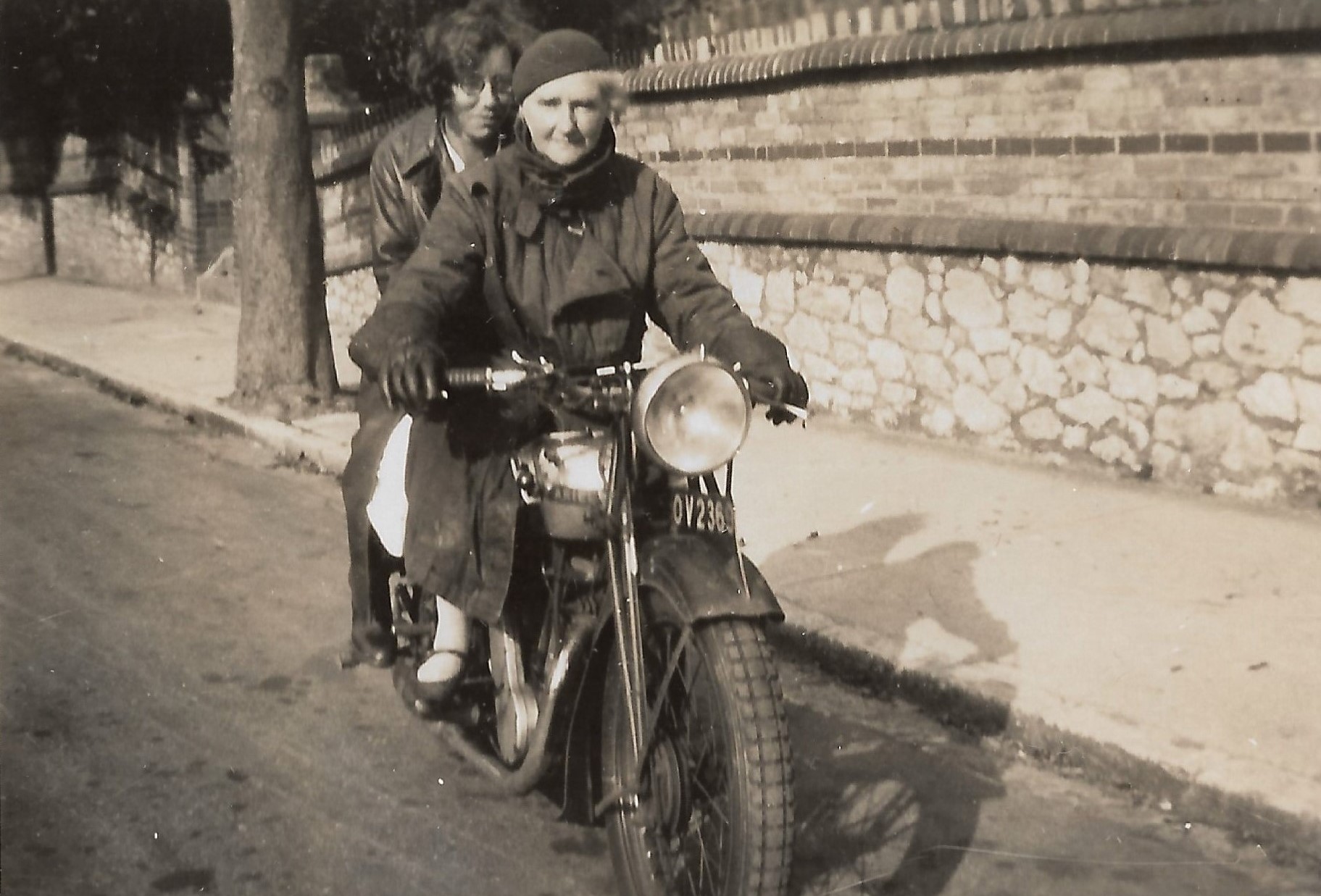
And as you do, I started with the images which I was most drawn to, including two studio portraits, an elderly woman astride a motorbike, along with a mother and baby outside a tent in Blackpool and a young Jean Lines training to be a nurse in Blackheath in 1931.

Susan Eleanor Lines, date unknown

As ever the choice was random, the picture of the elderly woman on the motorbike from the 1920s looked intriguing, while Jean Lines was living and working in a part of south east London I know well because I grew up close by.

Such are the reasons why we get drawn in and once drawn in the exercise to find out more becomes as fascinating as any piece of personal family research.

Major Lines, circa 1914
All of which took me to Major Edward Ellis Lines, his wife, Susan and his daughters.  

All of them feature in the collection but at first the connection seemed tenuous so while some of the photographs carried first names, not all had a surname, and most were undated.

But the key was Major Lines, who was born in 1859 in Dorset and was in the Royal Army Medical Corps, and with him came a series of census returns which offered up the names of his daughters, who were Eleanor, Leonora, Sadie, Phyllis and Marjorie.

The returns also provided a backdrop to his military career which showed that the family had moved around the country and beyond.  

So, sometime around 1902 they were in Hampshire, while between 1905 and 1907 they were in Malta and later still in Darlington, all of which are vouchsafe by the birthplaces of his daughters.

And this transitory life might explain why in 1901 Major Lines was in Weston Super Mare while his wife was on the Isle of Wight and back in 1891 his daughter and two sons from his first marriage were living with their grandparents.

Edward Ellis Lines, date unknown

There is much more to learn about Major Lines, but one thing stands out which is that he rose through the ranks.

Sadie and Leo Lines, date unknown
In 1880 when he married his first wife Cecilia in Somerset he described himself as a “soldier”  living in St John’s Wood in London.

By 1883 at the baptism of their daughter Mabel he had risen to “Staff Sergeant” with the Army Hospital Corps, and in the fulness of time I guess we will track his later promotions.

And in the same way uncover more about his first wife, and their children one of whom served in the Royal Navy.

But for now, it is enough to have found a framework and context for the family photographs and identify the woman on the motorbike as his second wife Susan who may well have been in her 50s when the picture was taken.

Edward Ellis Lines and daughter, date unknown

Of course I may have got bits wrong, as happens with any family research, but I am happy with where we have travelled so far.

Location; all over

Pictures; from the family collection of Frances Jones

Wednesday, 29 June 2022

Stories behind the pictures ………

Now I never tire of looking at other people’s family pictures.

Mrs Wyatt, Kathleen and Mrs. Lines, date unknown
More so when they stretch back to the beginning of the last century and include just enough clues to set me off looking for the story behind the photograph.

And so, I was very pleased when Frances offered to share some from her family album., which “were of my aunt's family, but she was my aunt by marriage, so I don't know any of the people in the photos”.

All of which presents the challenge and that wish to bring them back out of the shadows.

At which point I do have to say that “bringing them back out of the shadows” seems a tad pretentious and raises the question of whether they want to be brought out and can be argued is an unwarranted intrusion.

Unknown woman, undated

But then that has never stopped me.

So, to the pictures of which there are many.

Susan Line, & Jean, Torquay, date unknown
Some are very formal, taken by a professional photographer and made into picture postcards, while others are the classic snap, taken in the moment and then forgotten.

Luckily most of the collection comes with names, locations and even dates, all of which will make it easier to track them back across time.

Added to which some names are repeated and even form part of a wider group of images which show one individual as a child and later training as a nurse in Blackheath.

Nurses, Starting, Green, Leadbetter, & Lines, May 1931, Blackheath

What I particularly like are the unusual shots ranging from an elderly woman on a motorbike in Torquay to a mother and child outside a tent, a scene from the Lido at Lugano and an unnamed, and undated woman in formal pose.

The Lido, Lugarno, unknown date
But what I particularly like is the snap of Mis Wyatt, Kathleen and Mrs Lewis, somewhere in I guess the 1920s and 1930s.

It is the mix of a casual pose, the smile of the woman in middle and those fashionable clothes.

Some of the individuals will be easier to find than others, and the most promising seems to be Jean Lines who appears in several images and was training to be a nurse in Blackheath in southeast London in 1931.

Equally promising might be the picture of Geoffrey H. E. Lines, aged just 6 months “at Blackpool, 1917, outside Father’s tent”.  

It should be possible to find him in the record but raises tantalizing questions about the woman.  Was she, his mother, and why were they staying in the tent?

Geoffrey H. E. Lines, aged just 6 months at Blackpool, 1917

We shall see.

Location; all over

Pictures; early 20th century, from the collection of Frances Jones

Tuesday, 24 May 2022

Somewhere in Greece, sometime in the 1980s ............. a lesson in dating and describing holiday snaps

Now here is an objective lesson for all historians and anyone who wants to remember events people and places.

We are in Greece, sometime in the 1980s, but exactly where and when is now pretty much lost forever.

Like most people old summer holidays fade and merge into that mix of fond memories and the odd disaster.

Now for most of the time the unknown picture is just that not very important, but when it is a family member or a place with some personal significance, it does matter.

So there you have it, always write something on the back.

Picture; Greece in the 1980s, from the collection of Andrew Simpson

Sunday, 13 June 2021

Who were these unknown men of the Great War?

This is another of those pictures whose story I doubt I will ever know.

It is from the collection of David Harrop, and is undated and comes with no clue as to where it was taken.

Now there will be somebody out there who can help.

The men are wearing spurs and bandoliers which suggest they were a cavalry unit or from the Royal Artillery.

There may also be something in the design of the train carriages which I think varied from railway company to railway company.

So find which company and we may be able to identify a location.

The original photograph was in a poor state but with the help of David’s friend Bernard we have a clearer image and so it would be nice to know more about these men and their eventual destination.

Picture; unknown unit of British soldiers, sometime during the Great War somewhere in Britain, courtesy of David Harrop

Saturday, 12 June 2021

From Finland ........ with a story

Now, all too often old family photographs have lost the story that gives them a purpose.

Usually it is simply that there are no names on the back, the date has been omitted and there is no reference to where the picture was taken.

All of which means that within two and certainly three generations the people and the event has been lost forever, and the picture runs the risk of being thrown away.

But not so with this one.

It was sent to me by Andy Robertson who wrote “I am sending this picture because I think you may like it. It is of Percy Albert Sharples (1857-1915) and family in their house in Tampere, Finland.

My wife's great great great grandfather was John Sharples (1814-1876).  He was an overlooker in a mill around Ashton/Stalybridge in 1841. 

Between 1844 and 1847 he, his wife Mary and young family migrated to Tampere, Finland where he became the weaving and spinning master at the rather impressive Finlayson mill.  I suspect he probably ran the show on the shop floor.

John and his growing family remained in Finland but rather surprisingly by 1861 his two eldest surviving sons Solomon my wife's great great grandfather who was born in 1837 and Arthur born five years later were back in Manchester living with family members. 

By 1871 the third son John Edwin who had been born in 1849 was also back in Manchester, leaving the fourth surviving son Percy Albert 1857) and the Sharples’ three daughters in Finland.”

It is a remarkable story and points to the willingness of people to migrate to follow work and better their position.

Usually we assume the migrations were to the Americas, Australasia or Africa while places closer to home were ignored.

But given that countries across the mainland of Europe were also going through their own industrial revolutions, it made perfect sense for Mr Sharples to settle in Finland, leaving me only to wonder if he was invited or went off his own volition.

The picture is also a fine introduction into furniture and fittings of a home middle class home in Finland at the beginning of the 20th century.

I particularly like the ornate design of the piece of furniture behind them along with the wall paper.

But I could't leave the story without returning to John Sharples and his wife who had worked in the mills of Lancashire and settled for a new life in Finland.

I don't have a date but here are pictures of both John and his wife which will have been taken in Finland.
Location; Finland

Picture; in Finland circa 1905 from the collection of Andy Robertson


Friday, 11 June 2021

The story is simply that there is no story …….. the Victorian family

We will all have some family pictures with faces whose names are lost in time.

"Uncle Bob and Aunty Jean and mother"
And even if there is a name, the family connection has been severed leaving just a host of questions.

So, who were Uncle Bob and Aunty Jean? Their names are recorded on the back of this picture postcard along with the comment that “mother is on the left”.

But just who they were, or when and where the picture was taken were never added.

I wish there were more.

Of course, the fashion historian will be able to suggest the decade the picture might have been taken, but alas I am not qualified to pass such a judgement.

But at least the three are young enough to be wearing clothes from the time they sat for the photo shoot.  With older people there is always that danger that they are wearing the fashions of their youth, which might stretch back into the past.

Sadly, there is no clue from the backdrop or from the objects held by the two women which in probability were also photographic props, and the name of the studio is absent from the back of the card.

Head and shoulders
So, I am forced back on the questions I know there are no answer to.

What special occasion might have warranted the visit to the studio and why is only one of the three staring directly at the camera?

And am I the only one who thinks there is something slightly amiss with the three heads, as if they have been superimposed?

Unknown
But then perhaps that is what comes of staring at a picture for too long, looking for something significant which offers up clues to the picture’s story.

I have Tony Goulding to thank for the picture, which he spotted in the local Oxfam shop, which begs another question, of how it got to be donated, and whether there is a connection between it and the other one he sent me of a young girl.

It would be easy to fall back on speculation, which can be fun but is not very historical, so I shall close with the thought that whoever the four were, at least they have come out into the daylight for a short while.


Location; unknown

Picture; the 3 and the one, dates unknown

Friday, 4 June 2021

The photograph which begs a story

I have no idea who this woman is or where and when the picture was taken.

But that doesn’t diminish my interest in the photograph.

It comes from David Harrop who has kindly given me access to what is a fascinating collection of letters, postcards and photographs spanning the late 19th century to the present.*

At the core of the collection are a priceless array of material from the two world wars which provide an insight into how people got on with their lives during these conflicts.

And so back to the photograph which shows a woman working in a back yard.

She could be a servant which is a reasonable guess given that she appears to be wearing a uniform.

But the picture was one of a number of which all the rest showed a young man from the Great War and so I guess she may be his grandmother carrying on a set of domestic chores on a warm summer's day.

Sadly I guess we will never know.

But it remains one of those pictures which draws you in and prompts a whole range of questions which is just as it should be.

Picture; unknown woman, date unknown, from the collection of David Harrop

*David Harrop, http://chorltonhistory.blogspot.co.uk/search/label/David%20Harrop 

Thursday, 25 March 2021

The story behind the picture

Now I have always been fascinated by the stories which sit beside old photographs.

Rarely do you get the full story and more often than not much is left in the shadows.

But not so this picture which is one of the many that are now being revealed for the first time in four decades.

They belong to a huge collection of images that I took in 1978 through into the mid 80s using old fashioned film, smelly chemicals and a dark room.

Most never became prints and for those forty years sat in the cellar as negatives and after the enlarger and chemicals were thrown out remained just negatives.

But now I have one of those clever scanners and the software which do the trick in seconds, and so as you do, I have been playing; selecting strips at random and discovering all sorts.

Many are of London, with a lot more of demonstrations, when a man with a camera was not regarded with suspicion.

And that brings me to the picture.

It will date from 1979 or 1980/81 when some of us seemed constantly to be on a demonstration, be it against cuts in public spending, the rising unemployment figures, or the march of the Far Right peddling their message of racism and intolerance and later the installation of Cruise Missiles in Britain.

This one was Manchester, and it will have been an anti cuts demonstration.

The negative was chosen by chance, but what I was not expecting was that it included a picture of Malcolm selling newspaper.

I first met Malcolm when we were both on the same degree course.

By his own admission he had travelled far, from being a Moral Rearmer in the 1960s to embracing Socialism in the earlier ‘70s.

The journey took him via the Communist Party to the International Socialist Party and by degree into the Labour Party.

We lost touch with each other in the 1980s and only recently did I learn he had died.

Now given that I was born in the first half of the last century losing touch and later learning of the death of friends is becoming commonplace, so I am rather pleased that this image of Malcolm has come to light, leading me to reflect on that friendship which was never dull and more than once filled with a bizarre outcome.

Location; Manchester


Picture; a demonstration; circa 1980, from the collection of Andrew Simpson

Wednesday, 24 March 2021

The band, a demonstration, and a bit of a mystery

I know the name of the band, and am pretty sure we are in Manchester and the date will be sometime in the late 1970s into the ‘80s.

But more than that I am stumped.

They are the Cri De Coeur and given the Salford sign painted on the side of the flat top it will be a demonstration I was on sometime between 1978 and 84.

Now I can be fairly sure of the dates because that was the brief time I took and developed my own photographs.

That said many of those I took were never turned into prints and have sat almost forgotten in our cellar for forty years.

All of which explains why I am hazy about the venue and the date.

As you do I went searching for the group and turned up a short you tube clip from 1988 with the promising comment that they were a punk based band from Lincoln formed in 1986.

Now that doesn't fit with my time line.

By 1984 I had pretty much given up the darkroom with the birth of our first son swapping evenings with smelly chemicals and an enlarger for Thomas the Tank Engine and Lego.

Nor is the location much of a help.  The brick building is tantalisingly familiar, but all the possible venues for where I might have been just don’t match the picture.

I hoped the strip of negatives might help but they don't.

Long ago they got transposed with others which make it almost impossible to check back.

Still someone will know, either because they recognise the site, followed the band or remember the demonstration.

And quick as a flash some has located the spot.

According to Ted it is the site of the old Mabel Tylecote Building on the corner of Oxford Road and Cavendish Street.

I thought we were down in All Saints, and in the original draft said so, but I couldn’t match my pictures with the site today, but that was because I had placed myself round the corner on Higher Ormond Street.

Location; Manchester

Picture; a band, a demonstration and a mystery, circa 1979, from the collection of Andrew Simpson

Wednesday, 27 January 2021

“went down to Jackson’s Boat” ............ Bill's adventure from Altrincham in the March of 1907

Bill's postcard to May, 1907
It is as David Harrop said to me a jolly scene and one that delights me as much as it must have done Bill who sent it to May Campbell in the March of 1907.

The railway line from Altrincham into Manchester was opened in 1849 and its main purpose was to ship agricultural products from Altrincham and stops down the line directly to the Manchester markets.

In this it was a great success, so much so that in the decade after it was opened the amount of produce sent on the Duke’s Canal dropped dramatically.

And on that March day which just happened to be a Sunday Bill and company set off from Altrincham, got off the train at Stretford and “went down to Jackson’s Boat.”

The weather forecast for the day was good, with the Manchester Guardian reporting  there would be “fair, mild weather and light breezes with some mist or fog locally” which was better than Monday when it would be “changeable with some showers.”*

Walking from Cut Hole towards the weir and on to jackson's Boar
Now we will never know their exact route from Stretford to Jackson’s Boat or if they were lucky with the weather.

If I had been them I guess I would have crossed the road from the station and walked along the Duke’s Canal as far as the Cut Hole Aqueduct and then by degree past the old weir picking up the northern bank of the river and continuing till I reached the new bridge that crossed the Mersey at Jackson’s Boat.

Of course that is just speculation and I bet there will be plenty of people with alternative routes.

But while I am on this wave of speculation I would just like to think that when Bill got back to Altrincham he bought the card, wrote the message and posted it the following day.

I had hoped I could find May Campbell but she and her address in Hulme have proved impossible to find either back in 1907 and I think now will have vanished.

All of which just leaves me with the Flyer and that cricket game.

Picture; Our Local Express, 1907, from the collection of David Harrop** and detail of the walk from the OS map of South Lancashire, 1893, courtesy of Digital Archives Association, http://www.digitalarchives.co.uk/

*Manchester Guardian, March 3 & 4, 1907