Showing posts with label the Ottoman Empire. Show all posts

Sunday, 2 March 2025

From Smyrna to Birkenhead …. votes for women … coffee sellers …. and heaps more

I wish I could find out more about Ms Florence Antonitte Barry.

Licking Lloyd George, undated

According to my Wikipedia  she “became active in the women's suffrage movement, and joined the WSPU. In 1912, she became a member of the Catholic Women’s Suffrage Society (CWSS), later known as the St. Joan’s International Alliance, and was appointed the honorary secretary of the Liverpool branch. She held this post for fifty years. 

Also in 1912, she attended the Catholic Congress at Norwich. She would argue against ideas that politics and religion shared no common ground, stating that ‘in the Church we have the corporal and spiritual works of mercy, so surely we should have political works of mercy too.’

Smyrne, 1903
By 1915, Barry had been appointed to the CWSS National Executive Committee.[3][8] In 1927, Barry was amongst the signers of a letter to The Times newspaper supporting the vote for women over the age of 21.

Barry also liaised with international Catholic organisations and women's rights activists on other issues, such as … the 'physical integrity of women," which meant female circumcision (now known as female genital mutilation). She campaigned against "physical violations" of women.'"*

The same article offers seven references all of which offer little more, and so far a trawl of the Manchester Guardian has revealed no more.

Coffee seller, 1900

But then I only came to know of her existence yesterday when my old “posty” chum David Harrop shared a election of picture postcards which had been owned by Ms Barry.

In all there are 90 of them and many were sent from Smyrna where her father had been born.  They were all written in the years directly before the outbreak of the Great War when the city was still part of the Ottoman Empire.

The Grand Mosque, 1902
They show inhabitants of Smyrna, offer up some interesting comments and appear to have been sent by Florence and other members of the family. 

These alone make the collection an interesting insight into a bit of the Ottoman Empire, but there is more including the humorous card directed at Lloyd George.

In time I will get to see all 90, and by then may have found out more about Ms Barry.

Pictures; Picture postcards from the collection of Florence Barry, 1900-15, courtesy of David Harrop

*Florence Barry, https://en.wikipedia.org/wiki/Florence_Barry


Wednesday, 13 November 2024

Back with Pascal Sebah and the lost world of the Ottoman Empire circa 1873

Three men in Kurdish costume, 1873
I am back with Ottoman photographer Pascal Sebah.

He opened his first photography studio in Constantinople specializing in recording the peoples and costumes of the Ottoman Empire.

This proved an astute move given the growing interest in the west to all things from the Middle East and so he had a ready market selling images to tourists, of the city, ancient ruins in the surrounding area and portraits, as well as local people in traditional costumes,

The Ottoman Empire had been a major power controlling much of southeast Europe, Western Asia and North Africa.

It was a multinational, multilingual empire but one which by the 19th century was in decline.

And so his pictures however staged are a fascinating insight into that world.

They remain a powerful set of images, partly because of their historic value and also I think because they were well well composed carefully lit and show a grest attention to detail.

Pictures; three men in Kurdish costume, 1873, by Pascal Sebah

Saturday, 28 October 2023

The Ottomans - East or West on the wireless ... today

This is part one of a series of 3 on The Ottomans - East or West.*

The Invention Of...Turkey Episode 1 of 3

Mehmed the Conqueror enters Constantinople, 1453
'When Mehmet the Conqueror arrived in Constantinople, now Istanbul, he turned the main cathedral into a mosque and threatened to move much further west. Christian Europe was terrified. Misha Glenny travels to Istanbul to reveal how Mehmet's empire expanded over the next 100 years - to Iran, to Egypt, right up to the gates of Vienna too. 

This was the age of mighty sultans, Selim the Grim and Suleiman the Magnificent, who was happy to take the challenge to the catholic Habsburgs. 

But as modern Turkey prepares to celebrate a hundred years without the Ottomans, how is this period remembered under the government of President Erdogan?

This is the fiftieth episode of Misha Glenny and Miles Warde's How to Invent a Country series, which sets out to explain where nations come from, who decides their borders, and what stories the people tell themselves. 

These programmes are recorded on location in Istanbul, Belgrade and Vienna.

"All these sultans, they were mythical creatures for us. I really thought they were part of a fictional world because the real history for us was about Ataturk, and in primary school Ottoman history was a foreign country for us." Kaya Genc, novelist and author of The Lion and Nightingale.

The Ertugrul Cavalry Regiment crossing the Galata Bridge, 1901
Other contributors to the series include Judith Herrin, author of Byzantium; Professor Marc David Baer, author of The Ottomans; senior lecturer at Kadir Has University Soli Ozel; Christopher de Bellaigue, author of The Lion House; and Hannah Lucinda Smith whose most recent book is Erdogan Rising: The Battle for the Soul of Turkey

Presenter Misha Glenny is the author of McMafia and a former Central Europe correspondent for the BBC. The producer in Bristol is Miles Warde'*

Pictures; Mehmed the Conqueror enters Constantinople, and The Ertugrul Cavalry Regiment crossing the Galata Bridge, 1901, painting by Fausto Zonaro. 

*The Ottomans - East or West, https://www.bbc.co.uk/programmes/m001rqxn

Friday, 24 May 2013

A house in Chorlton and a subject of the Ottoman Empire


Three women from Damascus in traditional dress, 1873
Now as stories go it is a short one and as yet has no ending but it says something of what Chorlton was like at the beginning of the 20th century. 

It began with a request to find out what I could about a house and very quickly became a fascinating piece of research which linked the township with Damascus.

The house was one of those big semi detached properties which was built sometime between 1893 and 1901.  It was surrounded by gardens on three sides and had ten rooms spread over three floors with cellars.

On the ground floor there were four large rooms and the kitchen, while on the first floor there were four large bedrooms, a dressing room and bathroom and three more double bedrooms on the second floor.

This was a tall solid property of the sort much sought after by the wealthy business and professional classes.

Chorlton was still on the edge of much open countryside and yet the train from the station could whisk commuters into the heart of the city in just over ten minutes and within a few years of our house being built the Corporation extended the tram service along Barlow Moor Road and by 1913 this had been joined by another route that ran down Wilbraham Road and onto Withington.

Chorlton-c-h 34, from the 1901 telephone directory
Like most of these houses it had its own name carved onto the stone gate post.  Such names are a common enough feature in the township but Damascus House was a little out of the ordinary and was interestingly different to warrant a bit of search which led me to Abdallah Kabbaz who was there with his wife and two siblings from 1901 to sometime around 1911.

Mr Kabbaz had been born in Damascus in Syria and on the census return added that he was “a subject of the Ottoman Empire.”

Woman from Damascus 1873
At one time the Ottoman Empire had been a major power controlling much of southeast Europe, Western Asia and North Africa.  It was a multinational, multilingual empire but one which by the 19th century was in decline.

During the 18th century it was challenged by Russia and through the following century by the emerging nationalism in various parts of its territories.

Mr Abbaz had been born in 1866, just over a decade after Britain and France had fought the Crimean War in an effort to halt Russian expansion into the Ottoman Empire.

Even before that war the Greeks had won their independence from the empire and during the 1860s and 70s parts of the Balkans moved towards semi independence.

So by the time he had arrived here the empire was struggling but it still controlled 28 million people, of whom 15.5 million were in modern-day Turkey, 4.5 million in Syria, Lebanon, Palestine and Jordan, and 2.5 million in Iraq. Another 5.5 million people were under nominal Ottoman rule in the Arabian peninsula.*

Now I don’t know yet when he arrived but by the April of 1901 he was settled in Damascus House and had installed a telephone.  Now this was not as unusual as you might think and a quick glance down the telephone directory and on either side of Mr Kabbaz were several others listed with phones.

It may have been connected with his business which he described as “Agent, Shipping Goods employer” and he and his brother had offices at 21 Cooper Street in Manchester.
Cooper Street once stretched from Peter Street up to Booth Street, but the southern end disappeared under Central Ref and the Town Hall extension and number 21 which was on the northern stretch has long vanished.

A Kabbaz, shipping merchants, 1911
Nor were the Kabbaz family the only residents from the Empire just a little further away on High Lane was Mr Mouradian who had been born in Constantinople and was also in engaged in shipping, while just a few doors down from Damascus House lived Krikor Topalian also in shipping and also from Turkey.

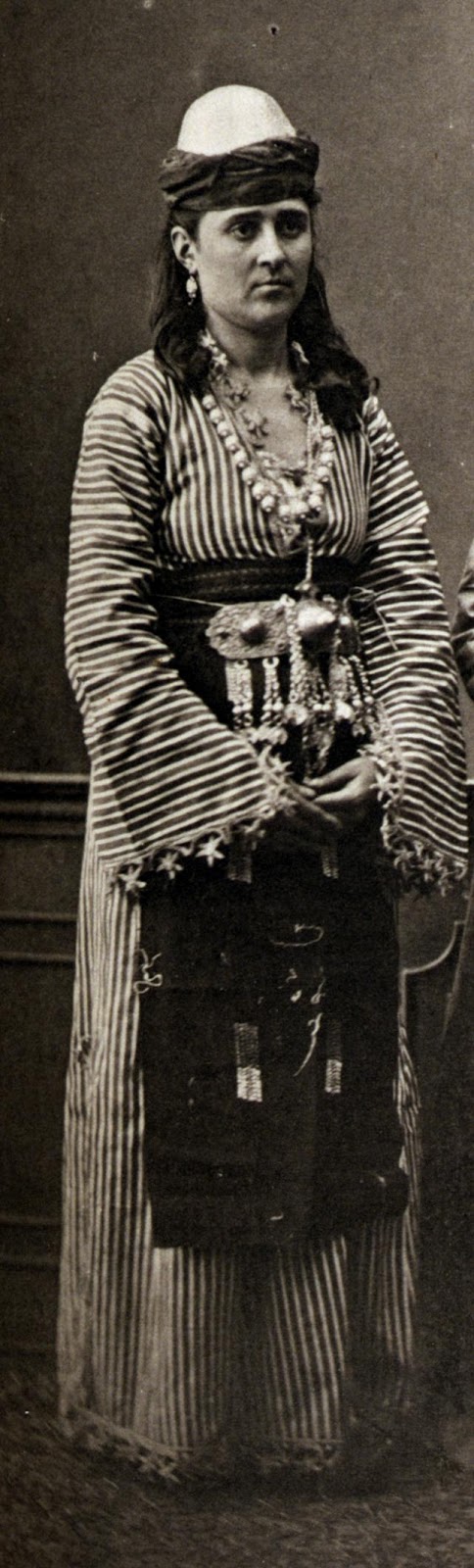
Woman  1873
Now there is nothing particularly unusual about all of this but I wonder how much of this would have been revealed if the name of the house had not survived on the gate post.

But there is much more that has yet to be revealed.  The Kabbaz family had moved by 1911 and so far there is no trace.  The house was occupied by a Mark E. Houldsworth in 1911, but he has proved a little elusive and in the census of that year this fine ten roomed house has but two servants listed in the property.

So Damascus House has much yet to tell us.

Pictures; Kabbaz Brothers, 21 Cooper Street, from Manchester, Salford and Suburban Directory, 1911, Part two, page 487, The National Telephone Company, 1901, three women from Damascus, by Pascal Sebah, 1873


*Ottoman Empire, Wikipedia Common https://en.wikipedia.org/wiki/Ottoman_Empire#Dissolution_.281908.E2.80.931922.29

**Taken from a collection of photographs by the famous photographer Pascal Sebah on the occasion of the universal exposition in Vienna in 1873. The album represents the costumes of the different regions, and ethnic and religious groups of the Ottoman Empire.

On the right: a peasant from the Damascus region.

Center: a Druze of Damascus wearing the Tantur, a cone shaped silver base that is usually covered with a veil.

The Tantur was helpful in exaggerating a woman's height.

On the Left: a woman  from Damascus wearing the qabqab, a wooden sandal with mother of pearl engraving used around the house and in the Turkish bath.” Ottoman Empire, Wikipedia,