Showing posts with label Picture postcards. Show all posts

Saturday, 1 August 2026

The Tale at Eltham …….

Now I really wish I knew just what the “Tale at Eltham" was, but alas it is lost.


Nor I suspect did anyone know just what had gone on in Eltham in the October of 1917 when this picture postcard was sent to Miss Goddard of Sussex.

I can tell you that it was sent at 2.30 in the afternoon, but can’t make out from where it was posted.

Nor can I really be sure that the sender or Miss Goddard had any connection with Eltham, which leave me wondering if it had been the two “young things” that caught the attention of Eliza who sent it.

But then these picture postcards were standard fare, with the company merely over printing different destinations to attract local audiences.

Some where in the collection I have another with a different place name.

The message on the back is difficult to read but hints a at a boat trip and an admonishment that Miss Goddard hadn’t written recently.

So that is it, a little bit of 1917 which might or might not have a connection with Eltham.

Location; Suffolk and maybe Eltham

Picture; The Tale at Eltham, 1917, from the collection of David Harrop


Thursday, 23 July 2026

Looking for Mr. Henry Charles Digby of Eltham ……… you go looking for one …. and you find two

I am the first to say that history is messy and just when you think you have got a story from the past just right, the past throws you a wobbler.

And that is what happened today when I decided to follow up a post from yesterday.

I first came across a picture of the Old King’s Head in the catalogue of Greenwich Heritage Centre, wrote a story on the pub and moved on, fully intending to go back and write some more.

Of course, I never did, but after reposting the story  yesterday, I was drawn back by the name of the postcard publisher, who was a C.H. Digby of Eltham.

Finding Henry Charles Digby proved relatively easy.  He was born in Walworth in 1854, and was living in Camberwell in 1891, working as a clerk.

A full ten years later he was married with a daughter and lived in Beckenham where he worked as a “Printer’s manager”

By 1910 he was on Eltham High Street at no. 31 and from at least 1918 was at no. 6 Glenlea Road where he died in 1936.

All text book research, and the connection with printing, made the story of the postcard publisher.

Except that also in Eltham, at the same time was another Henry Charles Digby.  Both appear on the electoral rolls from the 1919 onwards with the second Mr. Digby living at Footscray Road and later Southwood Road.

What distinguishes them is that my first Henry Charles was married to Rachael, while the second was married to Beatrice Deborah, but both were living in Eltham with their respective wives from 1919

At first I missed the glaring fact that there were two wives, and two different addresses, and only spotted that something was not quite right, when one Henry Charles died in 1936 and the other was still alive two years later.

So, there remains a mystery, but it will be one that someone will help solve, perhaps coming up with more picture postcards, marketed by one of our Mr. Digbys, and locating both on the 1911 census which I have failed to do.

Location Eltham

Picture; the Old Kings Head, High Street Eltham, GRW 276, http://boroughphotos.org/greenwich/
courtesy of Greenwich Heritage Centre, http://www.greenwichheritage.org/site/index.php

Sources; Census records, Enu 11 15 Camberwell, Cambewell, London, Enu 16 51, Beckenham, Kent, Electoral Rolls for Woolwich, 1910-38, Burial Register St John's Eltham, 1936, Directory 1925, Probate, 1936

*At the Kings Arms waiting for Fred Wisdom to pull a pint, https://chorltonhistory.blogspot.com/2020/05/at-kings-arms-waiting-for-fred-wisdom.html?spref=fb&fbclid=IwAR3GYAPWiZaK8PRGUZ0kbHOnpuKKzx3mmp9r52SxI6-alog4zdsJrZeKzHU

Monday, 20 July 2026

“Longing to tell you ‘the Tale’ at Eltham” ……. October 12th, 1917

Now sadly I doubt that the “The Tale” in the picture postcard refers to the short story written in 1916 by Joseph Conrad and published the following year.

Nor did the recipient live in Eltham.

She was a Miss Nell Goddard who lived in Wenhaston, which is a small village of 818 people in north west Suffolk.

The Domesday Book records that the village had a mill, a church and woodland sufficient to feed sixteen hogs.

Wenhaston, briefly had a railway station which was part of the Southwold Railway which opened in 1879 and closed in 1929 and today has a “thriving pig farm industry.” *

But it does have a pre-Reformation panel painting depicting the Last Day of Judgement, which Miss Nell would have known, because the panel was discovered during restoration work to the church in 1892.

All of which is a long way from Eltham and leaves me to think that this was one of those picture postcards produced in their thousands which were over printed with the names of different places.

That said I like it.

And given that we have the name of the manufacturer, who was a W & K Lonson along with a serial number, we might in the fullness of time find out more.

I hope so.

Location; 1917

Picture; postcard, courtesy of David Harrop

* Wenhaston, https://en.wikipedia.org/wiki/Wenhaston


Monday, 29 June 2026

A film star, a fish market and a bit of speedway, Britannia of Billingsgate … 1933

Now we can all have slow days, which is how I came to roam the database of old postcards hosted by Tuck DB.*


And having viewed their selection from Italy, I idly typed in film stars, and was rewarded with a rich collection from the 1930s.

Most I had never heard of and so on a whim I went for Kay Hammond, who was born in 1909 and made a series of films through the 1930s as well as appearing on the stage.  

She played  Elvira Condomine, in Blythe Spirit and acted in her last film in 1961, and featured in 24 films in her career of which 19 were made between 1933 and 1936, and of these the one that caught my eye was Britannia of Billingsgate.


If like me you are both a Londoner and someone who grew up in the 1950s and early 60s, Billingsgate Fish Market will be a special place.  It was located by the Thames, close to the Tower of London and the Monument and I passed it regularly on my way to the Tower.

Even at 10’o clock in the morning, long after the market had all but closed the smell of fish lingered in the air along with the odd remnants of discarded fish parts which had yet to be cleared away from gutters.

So I had no option but to look up Britannia of Billingsgate which was released in 1933, and as you do steal the sleave notes from the BFI’s introduction to the film.

“A star is born (or at least found) in a fish and chip shop, in this effervescent musical comedy that jaunts between the cloth caps of Billingsgate Fish Market and the top hats and heady glamour of the film world. Things have never looked so good for Billingsgate chippy owner Bessie Bolton (Violet Loraine) after she is presented with the opportunity of becoming the singing sensation of the silver screen - Shepherd's Bush style.


Violet Loraine had been a music hall star since the early 1900s, but was here returning to showbiz after a break of more than a decade. The film also features an early role for John Mills. The studio where Bessie gets her big break is the Shepherd's Bush Studios belonging to the production company, the Gaumont-British Picture Corporation. The cinema where Bessie's film is premiered is the Gaumont Palace in Hammersmith - now the concert venue the Hammersmith Apollo”.*


It is a mix of “glamour”, some iffy scenes of working class life, but is still a wonderful watch and is free to see on the BFI web site.

Location; London, 1933

Pictures; Kay Hammond, Violet Lorraine, Gordon Harker, and John Mills, marketed by Tuck and Son in the series A GAUMONT-BRITISH PICTURE, STAR, PLAYER or FILM (scenes from movie), cards numbered 150-199, courtesy of Tuck DB, https://tuckdbpostcards.org/ 

*Tuck DB, https://tuckdbpostcards.org/ 

**Britannia of Billingsgate, BFIPlayer, https://player.bfi.org.uk/free/film/watch-britannia-of-billingsgate-1933-online

Thursday, 12 March 2026

In St Ann’s Square with the Rotary Photo Company …… sometime in the early 20th century

Now if you wanted proof that St Ann’s Square has always been a busy and fussy place, the evidence is here in this picture postcard.

I don’t have a date, but I am guessing we are sometime in the early 20th century, and a bit of detective work using the names of the shops and street directories will get close to when the picture was taken.

Everyone will pick up on some different bit of the picture, from the line of taxis and the cabby’s hut, to the throng of people parading through the square and that female cyclist.

And then there is another story around the company who published the picture postcard.

I had causally thought that Rotary Photo, EC were a Manchester firm, but not so.

According to that excellent site, Graces Guide to British Industrial History, they were a London business with offices at 23 Moorfields London, with works at West Drayton.

They were established in 1901, as The Rotary Photographic Co and “was a huge publisher of real photo postcards. 

One of their unique novelty postcards was a 1¾ inch x 5½ inch (4.4cm x 13.9cm) photo series of bookmark cards. Most seem to have been posted in the 1903-04 period".

Later in the century they amalgamated with other photographic companies and were still in business in 1947.

Location; St Ann’s Square

Picture; St Ann’s Square, date unknown, courtesy of Steve

*Graces Guide to British Industrial History, https://www.gracesguide.co.uk/Rotary_Photographic_Co

Saturday, 28 February 2026

Passing Burton’s on the High Street ...... on a spring day in 1966 ............ with a thank you to Tricia

Now, there will be many people who saw this postcard of Eltham High Street and remembered the scene with fondness.

It belongs to my old friend Tricia who posted it on our “Well Hall in Eltham, its stories and its history” site yesterday.*

And I am one of them. 

What makes it even more special is that it is dated 1966, the year I started at Crown Woods Sixth Form.

The original postcard was undated, but that didn’t stop a few people suggesting dates for the picture.

These tended to use the vehicles as clues, and I suppose with a bit of ferocious detective work it might be possible to track the date of the advert on the side of the bus passing the church on its way down Well Hall Road.

But as it turns out there is a simpler way, because the picture postcard was produced by Judges Ltd, and it just so happens I have a full list of when each of their  cards were issued.

The list is the work of the Judges’ Postcard Study Group and was published in their September 2005 newsletter, and then reproduced in an article by SUSSEXPOSTCARDS.INFO.**

In the case of Tricia’s postcard, the company had included the serial number which according to the list was produced in 1966.

Now, I am not quite sure if the date 1966 was the year the postcard was published or the year the photograph was added to the collection for later use.

I know in the case of the company Valentine, the date refers to when it was added to their catalogue, but I have yet to check on the list for Judges’.

And that will take me back to V & G Harris who have an extensive collection and were most helpful when I was tracking other picture postcards by the company.

But for now, I am just pleased that I can match Tricia’s card with my own trips up to the High Street, with visits to Burtons, Wilcox’s, the Library and lots more places.

Although, I am fascinated by the identity of the three young men standing at the entrance to the church.

Location; Eltham

Picture; Eltham High Street, 1966, from the collection of Tricia Leslie

*Well Hall in Eltham, its stories and its history, facebook

** SUSSEXPOSTCARDS.INFO, www.sussexpostcards.info

Sunday, 16 November 2025

The Last Car from Manchester ……. the story with a sad ending

I like this picture postcard, but have never thought about writing its story.

I suppose that is because it is one of those general picture postcards, which will have been over printed with the names of towns and cities across the country.

So, as such its connection to Manchester is pretty slim, and it just kept getting passed over.

But yesterday I persevered, that said, with no comment on the back, no address and above all no postmark there seemed little to go on.

There was however the name of the company who marketed it, but I didn’t hold out much hope, given that there were countless companies which flourished and vanished during the decades either side of the last century.

But I was wrong, because The Cynicus Publishing Company Ltd of Tayport in Fife, wasn’t any old postcard company it was established by Martin Anderson, who according to one source was “better known by his pseudonym Cynicus, was a Scottish artist, political illustrator and publisher”.*

His early working life involved producing illustrations for a variety of publications, before setting up in his own business in London in 1891, and from there setting up a postcard company publishing his own designs in 1902.

After a promising start his business like many suffered from a fall in the popularity of such picture postcard and the company went into liquidation with his stocks of prints and original work were sold for a fraction of their real worth.

A further attempt at a similar business also met with failure when the market for seaside picture postcards declined with the outbreak of the Great War.

Mr. Martin produced a series of anti war posters and cards, which got him into trouble with the authorities. 

“In 1924 his Edinburgh shop was destroyed by fire, everything inside it was lost, and he did not have the funds to repair and restock it. He retired to his castle-like mansion in Balmullo to live in increasing poverty. A final edition of The Satires of Cynicus was published in 1926.”*

He died in 1932, and was buried in an unmarked grave, without a tombstone, and the final indignity was that his home was extensively vandalised after his death.

So a sad story for what was a very happy looking picture postcard.

Mr. Martin produced a series of anti war posters and cards, which got him into trouble with the authorities. 

* Cynicus, Wikipedia, https://en.wikipedia.org/wiki/Cynicus

Saturday, 27 September 2025

Calling on the past with a package of Manchester stories

I was wearing my light weight raincoat..... I was neat, clean, had my note pad and  two pens and I looked the part.  I was what I should be a dedicated researcher and proud of it.  I was calling on Ron in Central Ref with the promise of some priceless history.

Well as an introduction to a story I think Raymond Chandler did it better in 1939, but then I wasn’t about to unravel some rather unpleasant crimes and equally unsavoury characters.*

Instead I was on a mission to collect some picture postcards from Ron who wanted them to go to a new home.

Now in Raymond Chandler’s novel the prize was four million dollars but I rather think Ron’s picture postcards will do for me.

They are after all a double prize for any historian, offering a picture of a place at some moment in time long before now, and because more often than not there is a fascinating message on the back they offer up names, addresses and events.

All of which can be followed up.

So on an unremarkable postcard of Wilmslow Road, young Bertha Geary had written to her friend “we heard the flying man,” who turned out to be a French pilot taking part in the 1911 Daily Mail All Round Britain Air Race” and because she included her own address I found her.

She had been living on School Lane, was just 13 and that day had set off with her parents for a walk.

But for most of us it will be the picture on the front and for me it doesn’t have to be an image from a century ago.

This one of Piccadilly Gardens from 1970 is as intriguing as any from the more distant past and reminds me of that other much favoured quote “the past is a foreign country they do things differently there.”**

And for many this will be a scene which is so unfamiliar as to be a foreign place, and yet the photograph was taken in 1970 and the gardens only got their makeover very recently.

It is a treasure of an image and makes me wonder what Ron has for me.

Location, Manchester

Picture; Piccadilly circa 1970 from the collection of Sally Dervan

*”I was wearing my powder-blue suit... I was neat, clean, shaved and sober, and I didn't care who knew it. I was everything the well-dressed private detective ought to be. I was calling on four million dollars.”  The Big Sleep, Raymond Chandler, 1939

**“The past is a foreign country they do things differently there."  The Go-Between, L.P. Hartley, 1953

Thursday, 21 August 2025

The story behind the story of an Eltham postcard

Now as everyone knows there can always be more than one story behind a picture postcard.

The first is the image on the front which in an instant tells you so much about a place in the past.

And then there is the name, address and message on the back which can be equally revealing.

The skill of the historian is to marry the two sides and tell a story, but just sometimes that story cannot be told and that is what happened to my friend Tricia who found this postcard on eBay back in September.

She told me that having found it “I did a little research on the information on the back and managed to trace the family history of the person it was sent to.”

The research led to a connection with the garage beside the church and a family who had lived in Eltham.

Tricia managed to trace the family, met up with one of them and handed over the postcard.

It would have made a compelling story but given that one of the familiy did not want the details made public Tricia quite rightly chose not to publish it.

But there is always a story in a story and for me the story is less aboutt the family and more about how one postcard in the hands of a skilled researcher can reveal much that might otherwise have been ignored or lost.

It involved Tricia's leap of imagination to use the name and search through social networking sites and then the diligence to match these against people and those listed and  then try and make contact.

And I like the final touch of Tricia's in  choosing to reunite the card with the family a full seventy seventy years after it was sent.

Location; Eltham

Picture; Eltham Church circa 1940s from the collection of Tricia Leslie

Tuesday, 5 August 2025

In praise of the humble picture postcard …….

 It’s that time of year when stories of holidays would fall through the letter box onto the door mat.

Fishing boats, houses and a sea wall, Mousehole,2025
And leaving aside the saucy cards of inebriated vicars, busty women, and innocent shop girls, the postal service was full of picture postcards with scenes of seaside resorts and city centres.

The golden age ended I suppose in the 1960s, and pretty much has been seen off by pictures sent instantly by mobile phones at no cost.

By contrast sending an old-fashioned picture card today will cost 87 pence along with the price of the card and take days to arrive, and even longer if sent from some holiday destination in Greece.

A century and a bit ago a stamp cost next to nothing and with frequent collections and deliveries it was possible to tell your mum you were leaving on the morning train and be home by teatime.

Twisty street leading nowhere, Mousehole, 2025
Better still you could post early and arrange to meet up later in the day.

Now all of this I have written about heaps of time supported by a collection of picture postcards from the 1880s onwards.

So instead, here are four pictures I took last week, and with the help of technology tried to reproduce that golden mellow look that many picture cards seemed to have in the 1950s and 60s along with those blue tinged ones.

I even tried the really yellow look reminiscent of Eastman colour, but that was a step too far.

Of course, I could have gone for that washed out appearance which I suspect had more to do with the length of the time the cards had sat on those twirling stands in full view of direct sunlight.

And in keeping with the time, the selection ranges from the harbour scene and twisty street to the boring.

Leaving me just to offer up some from the collection spanning the Golden Age of the picture postcard which are available by following the link.*

The boring picture, Bristol, 2025

Two bikes and a heap of boats, Mousehole, 2025
Location; Mousehole, Cornwall, and Bristol 


Pictures; Capturing Mousehole and Bristol, 2025, from the collection of Andrew Simpson

*Picture postcards, https://chorltonhistory.blogspot.com/search/label/Postcards


Friday, 18 April 2025

Easter Greetings from Europe ……… a long time ago

Now, we never sent Easter cards, it wasn’t a family tradition.

Come to think about it I don’t recall seeing them in the shops when I was growing up, but they must have been there, and the practice goes back a long time.

This I know from the card David Harrop sent me today.

It can be dated to the early 20th century, but as it was not sent through the post there is no date, added to which given that there are several European languages on the reverse its origins could be anywhere.

But as David shared it with me, I shall pass it on.

And because l can.


Picture Easter Greetings, date unknown, from the collection of David Harrop, and an adpted  Jewish Greeting card, 1907 from Tuck & Son, courtesy of Tuck db, https://www.tuckdbpostcards.org/

Monday, 20 January 2025

Messages from Le Harve ..... a woman called Gertie ....... and an address on Oxford Road

 I like this picture postcard which was sent from Le Harve in the August of 1915.

And what I particularly like is the way the name has been adapted to include pictures of the town.

Now my Wikipedia tells me that Le Harve “is a port city in the Seine-Maritime department in the Normandy region of northern France. It is situated on the right bank of the estuary of the river Seine” *

So, it is not surprising that many of the individual photographs inside the letters are of ships, the port, and the sea.

And it reminds me of the images that were produced in the 1960s which are a bold mix of lettering with an imaginative way of showing off the images of the town.

In fact, when I first saw it, I assumed it was from that “swinging decade” and here lies an interesting observation in what attracts us to such a picture post card.  For me it was that 1960s connection but for David Harrop who recently acquired it I suspect it will be the Manchester address, which was 1 to 3a Oxford Road.

David has a fine collection of picture postcards, and many are linked to the city.

So having clocked that link I went looking for what I could about 1 to 3 Oxford Road, and the firm Parkinson’s where the card was sent.

Given that the sender omitted his surname I wondered if I could discover his identity by looking for clues to the firm.  

It followed that if Stanley was a serviceman, then he might well have enlisted at the start of the war and could just possibly get a mention in the Book of Honour which was a list of the men who volunteered for the Manchester Pal’s Regiments in 1914.

The book records the men, the companies, battalions and regiments they were assigned to and has a list of the businesses for which they had worked.

Alas Parkinson’s is not there and nor is it listed on Oxford Road in 1911.

All of which leaves me with Gertie Whitehead who was the recipient of the card.

There was a Gertie Whitehead on the 1921 census who was a "Children’s Costume Finisher" employed by Clarkson and Hurst Children’s Costume Manufacturer.

A decade before the firm were based at 43a Granby Row and she was living on Rochdale Road, who ten years earlier had been a boarder in a house in Chorlton Medlock.

There are other Gertie’s but she seems closet to the fit.

Leaving me just to continue to look for Parkinson’s which if it was in anyway connected to the garment trade may fix our Miss Whitehead.

And that is about it.

In 1922 aged 28 she was living with her family on Rochdale Road, while ten years earlier she had been a boarder in a house in Chorlton Medlock.

As for Stanley he remains an enigma.  His message to Gertie spoke of fine weather and the expectation of a letter from her, and was signed “Love Stanley X”

But I doubt that we can read too much into that.

Location, Le Harve and Manchester

Pictures; from the Le Harve picture postcard, 1915 courtesy of David Harrop.

*Le Harve, https://en.wikipedia.org/wiki/Le_Havre


Thursday, 9 May 2024

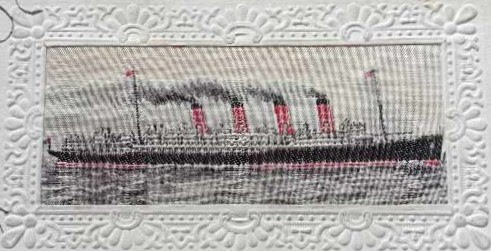
A message from the R.M.S. Mauretania …..

 Picture postcards have been a popular way of messaging friends, sweethearts and family for over 150 years.

And they have come in many different guises, from street scenes and famous landmarks, to the comic, and rude, and still even in the age of the mobile camera and social messaging cling on as a way of sharing a holiday with people back home.

Of all the picture postcards that have been issued my favourite has to the “silk cards”.

These were popular in the early decades of the last century and consist of fabric image.

I first came across them during research for a book on Manchester and the Great War when the silks and popular with troops who often chose a silk incorporating the badge of their regiment.*

But the cards predate the war and lingered on into the 1920s.

All of which is an introduction to this one of the R.M.S Mauretania, which was sent on July 1st 1908, just two years after the ship took to the waves.  

At this point I could launch into its history but that has been done already and I am not one to lift the work of others. So, its story is there if you follow the link.*

Instead, I am more interested in the card, which has been less than forth coming.

I don’t know who sent it and only have the name of the woman who received the card.

I had a momentary flutter when my old friend David “posty” Harrop told me he has just acquired the card and there was an address in the USA.

The potential for a visit to the address via google maps seemed an exciting prospect, but alas the sender just addressed it to Miss. Aileen Roberts, Gary, Indiana, USA.

And that was a long shot given that in 1910 the population of the town was 16,000 and growing owing to the expansion of the steel industry which is how the place came about just 4 years earlier when U.S. Steel chose the site for its new plant.

The works were named Gary Works after the lawyer Elbert Henry Gary, who was the founding chairman of the United States Steel Corporation who generously donated his name to the newly emerging city.*

Now, that’s a long way from a postcard sent form the SS Mauretania, but until I find out more that is it.

Pictures; silk post card,1908, from the collection of David Harrop 

*A new book on Manchester and the Great War, https://chorltonhistory.blogspot.com/search/label/A%20new%20book%20on%20Manchester%20and%20the%20Great%20War

** R.M.S. Mauretania, https://en.wikipedia.org/wiki/RMS_Mauretania_(1906)

***Gary, Indiana, https://en.wikipedia.org/wiki/Gary,_Indiana

Friday, 12 April 2024

Pictures with no stories ........ no 2 .... off in the Chara

I was way too young to have ever travelled on a “chara” but our dad drove one back in the late 20s and early 30s, and we have the pictures to prove it.

And here is another full of smiling holiday makers out on a trip.

There will be someone who can describe the type, make and date of the vehicle and perhaps even suggest a location.

Chara’s were often only brought out in the summer and placed on the chassis which at other times doubled up as a lorry transporting goods.

They were by all accounts pretty uncomfortable things to travel but that said they offered up the promise of fun and new places.

Sadly there in no date on the back or a hint of where our people were and not even a comment.

So that is it.


Location; unknown


Picture; from the collection of Ron Stubley


Sunday, 12 November 2023

Greetings from Naples … another story from Tony Goulding

On the surface this looks like another run-of-the-mill postcard sent by a holiday maker from the Bay of Naples. However, the message on the back makes it a little more intriguing. 

It was dated 27th November 1917 and was sent to a Master Willie Metcalfe of Fairfield, Liverpool by his “Daddy”. 

 Now as the card was posted from a Mediterranean port during the First World War, I was curious to discover whether Mr. Metcalfe was a sailor in the Royal Navy or alternatively a British soldier attached to a unit sent to assist their Italian allies in their battles against the Austro-Hungarian army in the North of the country.

After some research I found “Willie” and his “Daddy” in the 1911 census which confirmed my suspicion that Mr. Metcalfe was indeed a sailor, albeit a Captain in the Merchant Marine, and a Royal Navy Volunteer Reserve (R.N.V.R.) officer (1), employed by the White Star Line. 

In November 1917 George Robert Metcalfe was in command of the 12,268 ton “Canopic”. which had been requisitioned for war service earlier in the year. 

S.S. Canopic

Its Captain was given the rank of Lieutenant-Commander in the R.N.V.R. It is likely that this passenger liner was being used as a troop ship to carry British troops to Italy. According to the Commonwealth War Graves Commission Website, Commonwealth troops served on the Italian front from November 1917 until the armistice the following November and lists 3,809 who did not return.

George Robert Metcalfe was born in Potter Gate, Helmsley in Yorkshire’s North Riding on 28th September 1870, the son of an agricultural labourer, William Metcalfe and his wife Elizabeth (2)

George Robert had at least 3 older brothers, William, Charles, and Joseph plus two older sisters, Elizabeth Ann, and Sarah Frances. In the early summer of 1878, there was a further addition to the household when Elizabeth Ann gave birth to a son, Harold, presumably “out of wedlock” as no father’s name is included in the baptismal record of 6th October 1878.

At the young age of fifteen George Robert left home to, no doubt, seek adventure by pursuing a career on the high seas. 

Initially, he served a four-year apprenticeship under sail with Davis & Co., a shipping line based in Swansea, South Wales which operated between the ports of the Bristol Channel and those of South America’s west coast. 

Obviously, an accomplished sailor he rapidly moved through the ranks, eventually serving as a second and first mate for three years and eleven months with the Gwynedd Shipping Company of Caernarfon, North Wales before, after ten years at sea, joining the White Star Line, on 12th December 1896, as a junior officer, firstly in the cargo fleet. 

Captain Metcalfe remained with the White Star Line for more than thirty years, he was given command of several different liners of their fleet but fortunately for him he was not appointed as an officer on the “Titanic”. 

Fortune also favoured his ship the 20,470 ton “Megantic” (3) in 1915 while it was engaged in trans-Atlantic crossings in the face of threats from German submarines. 

On occasion the “Megantic” was even known to set sail from New York in company with the ill-fated Cunard liner the “Lusitania”. On 30th May 1915, less than a month after the latter was torpedoed and sunk off the coast of County Cork on7th May, Captain Metcalfe’s ship was also confronted by a U-boat but managed to outrun it. 

Earlier in 1915 on 22nd March the “Megantic” took part in a dramatic sea rescue when it went to the aid of an American liner the “Denver” which had sent a distress signal that it was sinking in heavy seas. 

For his involvement in the incident, Captain Metcalfe was presented with a gold medal and chain by the Lord Mayor of Liverpool (Mr. A. S. Mather) on behalf of the President of the United States, Woodrow Wilson, as a sign of appreciation of his efforts. This was the fifth award of its kind he had been given.

 George Robert Metcalfe, who was made the commadore of the White Star Line fleet in January 1925, retired from sea duty due to declining health in September 1928 but remained with the company until its mandatory retirement age on 60th birthday in 1930.

In retirement, Captain Metcalfe settled in Anglesey, North Wales. In the 1939 Register he is shown residing at “Culfor”, Cambria Road, Menai Bridge, where he remained until his death on 2nd February 1945. His estate was valued for probate at £2,396-14s-6d. (equivalent to £85,470 today)

The “Master Willie” to whom the postcard was addressed, was William George Metcalfe who, as stated above, was the son of Captain George Robert Metcalfe. He was born on 8th October 1907 to Elizabeth Metcalfe (née Williams) the captain’s wife whom he had married in the March quarter of 1905 at the church of Our Lady, and St. Nicholas; facing the river Mersey close to the Pier Head it is the parish church of Liverpool but is also known as the “Sailor’s Church”.


Church of Our Lady and St. Nicholas, Pier Head, Liverpool
William George’s mother sadly passed away during the December quarter of 1918 aged just 39 when her son had only just reached his 11th birthday. 

Following this tragic event and with their father away at sea, the Metcalfe children (William George had a younger sister, also Elizabeth, who was born in October 1910) were put in the care of Captain Metcalfe’s niece Florence Ethel, the unmarried daughter of his older brother, William. The 1921 census records them living, with one servant, at 103, Newsham Drive, Fairfield, West Derby, Liverpool.

In the 1939 Register, William George is recorded at 56, Mulgrave Street, Liverpool. 

He was unmarried and his occupation is shown as a motor driver, however the notes next to his entry indicate that he had some experience as a Merchant Mariner. He died in Liverpool during January 1988. (4)

Pictures: - Naples postcard from the collection of Tony Goulding, S.S. Canopic by White Star Line - http://www.esseximages.com/images/steamships/21542Canopic1900.JPG, Public Domain, https://commons.wikimedia.org/w/index.php?curid=8534024, Church of Our Lady and St. Nicholas, Pier Head, Liverpool by Man vyi - Self-photographed, Public Domain, https://commons.wikimedia.org/w/index.php?curid=4643779

Notes: -

1) Captain Metcalfe first joined the Royal Navy Reserve on 24th April 1900 and by the time he retired from the service in July 1922 he had risen to the rank of Lieutenant-Commander.

2) I have not included Elizabeth’s maiden name as the entry on her marriage record was altered with “Cook” crossed through and “Mennel” substituted. Also, there was no entry made for the name and occupation of the bride’s father. A possible explanation of this may be provided by a record in the 1851 census; an unmarried Elizabeth Mennel is shown as residing with her widowed grandmother, Elizabeth Cook in the nearby town of Thirsk, Yorkshire (North Riding).

3) The “Megantic” already had a famous connection as it was in August 1910 the ship in which the fleeing alleged poisoner Dr. Hawley Harvey Crippen was brought back to the U.K. to stand trial at the Old Bailey.

4) There is a record of a William George Metcalfe marrying a Constance Elsie Johnstone at St. Agnes Church, Toxteth, Liverpool in November 1940.  This couple had at least one and possibly two daughters.


Friday, 13 October 2023

The picture postcard from a gentler time

Now long before the camera became the dominant way to reproduce an image for picture postcards, it was down to the artist to do the business.


And so here we have a painting of Giotto's bell tower in Florence.

I have no idea when the artist set about his work or when the picture post card company from Milan began reproducing it for tourists, but I do know that the tower was built between 1334 and 1359.

Now twenty-five years does seem a long time, but to be fair Giotto died in 1337 and there was that little disaster known as the Black Death.

And that is it.

I did go looking for my own pictures taken a few years ago, but alas I have misfiled them, leaving me just this picture postcard which Dad would have bought sometime in his travels working for Glenton Tours.

Location; Florence

Picture; Firenze Campanile di Giotto, date unknown from the collection of Andrew Simpson

Tuesday, 3 October 2023

Bandstands are not just for summer ......

I have always had a fascination for bandstands.

1906
It stems from walking past the one in Pepys park every school day from 1962 till 64, and quite a few play days before that.*

By then it had lost its ornate iron pillars and roof and was just a brick stump.

But it has been restored and now sits in my bandstand collection.

Tony Goulding knows this and so last week sent over a picture of the one at Clacton-on-Sea, adding “Hi, Andrew, Here is a postcard for your bandstand collection - Clacton-on-Sea”.

And as you do I went looking for its history and found a delightful report on the place.*

So that is it.  Other than to record that Tony tells me  "that the card was postmarked  6-30 pm February 8th 1906.

Location; Clacton-on-Sea

Picture; Bandstand and marine Parade, Clacton-on-Sea, 1906, from the collection of Tony Goulding

*Pepy’s Park, Telegraph Hill Park, https://en.wikipedia.org/wiki/Telegraph_Hill,_Lewisham

**Clacton Seafront Conservation Area Character Appraisal and Management Plan, chrome-extension://efaidnbmnnnibpcajpcglclefindmkaj/https://www.tendringdc.gov.uk/sites/default/files/documents/planning/heritage%2C%20conservation%20%26%20trees/Clacton%20Seafront%20CAAMP%20FINAL.pdf

Friday, 29 September 2023

Deltiology …..... another story from Tony Goulding

I have recently become increasingly aware of just how much History can be revealed by the collection and studying of postcards otherwise, “deltiology”.(1)

Two postcards of East London of the Edwardian era

Margate Sands                           Great Yarmouth Pier    
The advance of literacy, a low cost and reliable postal service, with multiple collections and deliveries daily, combined with the yet very limited use of telephones led to the Edwardian era being the heyday of postcard sending

A collection of correspondence of this era between two or more addresses can reveal intimate minutiae of a family’s life.

A card recently received from a friend on holiday in Ireland
A second great source of postcards are those sent from seaside resorts and other holiday destinations., 

These “wish you here” type postcards began in 1894 after a change in Post Office Regulations, increased with the greater availability of leisure time and continue even in this day of E-mails and text messages. 

Other than some bills and “junk” mail, postcards are the only mail I receive regularly apart from Christmas. 

A sub-genre of these “seaside” cards are the saucy postcards produced in their millions from the early 1930s. 

It is interesting how these cards reflect social mores. 

Increasingly popular from the 1930s until changes in attitudes to sexual stereotyping in the 1970s led to their decline. Sales of this type of card dipped significantly during the early 1950s. 

Two Donald McGill “Saucy” postcards.
Several local councils, notably Cleethorpes in Lincolnshire, (2) deemed some of the cards obscene, seized them and had them destroyed. 

Encouraged by the government of the day who were concerned about declining standards, Donald McGill, a leading designer with over 12,000 card designs was prosecuted under the Obscene Publications Act (1857). 

After a trial in Lincoln in1954, he was found guilty and fined £50 with £25 costs. This resulted in a purge of these cards nationally. 

The 1857 Act was repealed and replaced in 1959 by a more liberal one with Donald McGill giving evidence before the House of Commons Select Committee charged with forming proposals for the new legislation. This and the advent of the “swinging sixties” led to a resurgence in the “saucy” cards.

“Paddy The Next Best Thing”, 1924

Postcards have also a long history of being used as a mode of advertising. Here is a typical example from the 1920s with The County Theatre, Reading, advertising the forthcoming production: “Paddy The Next Best Thing” week commencing Monday 11th February 1924 (3)

Hotels and restaurants have even offered to pay for the postage on such advertising cards.

The reverse side of postcards can also be of historical interest. Here are a couple of informative squares I have found recently in the "stamp" corner of two cards.

The U.S. Postage rates are of particular interest in that this is surely dated before the Cuban Revolution of 1st January 1959 after which relations between the United States and Cuba remained strained for more than five decades.


Finally, in closing this look at postcards it would be remiss of me not to give a nod to my maternal grandfather Arthur Harold Clarke who as a professional photographer during the inter-war years made his living by producing a series of Picture Postcards of the Chorlton-cum-Hardy area, examples of which regularly appear on this Blog.

Pictures; All from the collection of Tony Goulding.


Notes: - 

1) “Deltiology” derived from the Greek words “deliton” meaning a small, illustrated tablet or card and “logos” meaning a word, speech, discourse, or reason.

2)  There is a full report of this case in the Grimsby Daily Telegraph of 12th December 1951.

3) Details from the Reading Standard, Saturday 9th February edition.