Showing posts with label Manchester in the 1820s. Show all posts

Tuesday, 3 March 2026

A synagogue ......Mr. & Mrs. Solomon ....... and Manchester's Corporation Street

So long before the construction of motorways and airports wiped out some of our favourite buildings  there was Corporation Street. 

The synagogue on Halliwell Street, 1849
It runs from Cross Street and was cut in the late 1840s, and like all such major developments resulted in the demolition of buildings and the loss of smaller streets.

One of those buildings was the synagogue on Halliwell Street which had opened in 1825.

The inaugural stone had been laid the year before at a ceremony which had started with prayers at the “temporary place of worship on Long Millgate  …. [after which] the reader and congregation walked in procession to Halliwell Street to perform the laying of the first stone of the intended new synagogue when very appropriate and impressive prayers, composed for the occasion were said by the reader, after which thirty persons sat down, at the Wilton Arms to an excellent dinner”.*

Just over a year later in the September the Manchester Guardian reported on the consecration of the new synagogue which it wrote “is in every respect suitable for the performance of divine worship”. *****

It was according to one observer an unpretenious red brick building which replaced a temporary place of worship which had been in Ainsworth Court off Long Millgate.

Access to the Court was through a narrow passage.

Sadly the Manchester Guardian didn’t comment on its closure or demolition but did give a detailed account of the new synagogue on Park Street Cheetham Hill Road on March 25th 1858.**

Halliwell Street on which the early synagogue was built was swept away with the coming of Corporation Street, but the 1851 census provides us with a very clear picture of its inhabitants, including Soloman Philips who was the appointed overseer for the synagogue, along with a Miss Levy who described herself as a Professor of Hebrew.

In all there were seventy four residents living on the street, twenty-one of whom were children under the age of 14. The seventy four had  birth places which ranged from Manchester and Salford to Liverpool, Warsaw and Hamburg. 

Their occupations were varied but erred on the side of skilled artisan, including watchmaker and milliner to a professor of Music and a veterinary surgeon alongside the more humble jobs of launderess, matchmaker and traveller along with the delightful “Ender and Mender”.

Mr. Philips had come from Warsaw, and his wife Sarah from Koosemer in Poland  No pictures have survived of their home on Halliwell Street but it commanded an annual rent of £18  which translated into a weekly rent of six shillings which was above that of properties in the surrounding streets.

And it does appear that their house survived the destruction of the synagogue and part of the road it stood on because in 1861 Philip and Sarah are still here at number 9, which sometime during the decade before had been renumbered as no. 4.

Now that remanent is part of Balloon Street which has also been much truncated, but as Balloon Street it is a reminder of that 18th century pioneer of all things ballons.  

This was James Sadler who according to my Annals of Manchester "ascended in his balloon on May 12th 1785 from a garden behind the Manchester Arms Inn Long Millgate, which was then a private house”***. 

And not content with that seven days later “made his second balloon ascent, but on alighting was obliged to let it drive in the wind”.

Indigo Hotel, Todd Street, 2025
Leaving me just to say that there is a plaque commemorating the synagogue on the wall of the Indigo Hotel on Todd Street, close to where the synagogue stood. The text says, "Manchester's First Synagogue, 1825-1858 stood near this site until its demolition in the construction of Corporation Street".

Location; Shudehill

 Picture; the OS map of Manchester & Salford, 1844-49, courtesy of Digital Archives Association, http://digitalarchives.co.uk/ and Indigo Hotel, 2025, from the collection of Andrew Simpson

*The Manchester Guardian, August 14th, 1824

** The Manchester Guardian, September 10th, 1825

***The Manchester Guardian, March 26th, 1858

****Axon, William, The Annals of Manchester, 1885

***** Davies, Ethan, Manchester's first synagogue recognised with plaque in special ceremony, Manchester Evening News, July 13th, 2022, https://www.manchestereveningnews.co.uk/news/greater-manchester-news/manchesters-first-synagogue-recognised-plaque-24477558


Tuesday, 1 February 2022

"over the Mersey at Jackson’s Boat and on to Baguley Moor and Hale Moss and after having botanized there ....returned to Manchester at dusk, all pleased with our day’s excursion” Richard Buxton in Chorlton

Call me lazy but I have chosen to return to the amazing story of Richard Buxton who was born into a poor rural family, grew up and lived in the equally poor area of Ancoats in the early 19th century and died in very humble surroundings in the shadow of London Road Railway Station.

Close to where Mr Buxton crossed the brook, the meadows, 1963
He was self taught and wrote what still stands as one of those remarkable books on botany. The original posts appeared over seven stories and are all still there to see.

"one of the hottest and driest summers that I can remember, and there had been no rain in the neighbourhood for two or three months; but on the day appointed for our meeting, very heavy rain came on about five in the morning. 

I should not have thought of stirring out of doors; but, having made the appointment, I thought it just possible that my friends might come, and I would not on any account disappoint them. We all went in the rain, through Manchester to Chorlton-cum-Hardy. 


St Clement's, circa 1860
After staying at the last named place sometime the weather changed and a fine day ensued then over the Mersey at Jackson’s Boat and on to Baguley Moor and Hale Moss and after having botanized there ..... returned to Manchester at dusk, all pleased with our day’s excursion” 

It is almost impossible to know when Richard Buxton walked the meadows of Chorlton and botanized the day away with his friends.

But I guess it must have been sometime in the 1820s. We were still a very rural community and there would have been plenty to see and record.

And record Buxton did, for he was one of those remarkable working men who were self taught, became an expert on botany, wrote books and struggled against poverty before dying obscurely. “I am well aware” he wrote “that a narrative of the life of a poor man like myself .... is anything but interesting.” and yet it has proved to be so.

Which is why over the next brace of weeks I want to tell his story. He was born in rural Prestwich grew up in Ancoats just as Manchester was becoming the “shock city of the Industrial Revolution” and died as he had lived in poverty.

The meadows, 2008
I was introduced to Buxton by my old pal David Bishop who is a passionate botanist and has patiently explained nature to me over the years.

It was David who lent me the book Buxton wrote in 1849.

For a self taught man his Botanical Guide to the Flowering Plants, Ferns Moses and Algae found Indigenous within Sixteen Miles of Manchester is both a wonderful record of what there was to see but also a testament to his interest and tenacity.

In a world where reading and writing are taken for granted, it is easy to gloss over the fact that at the age of sixteen he was illiterate, and had to set himself the task of learning to read.

What is all the more remarkable is that having mastered the spelling book and the narrative of the New Testament he realised he needed to know not only how to pronounce the words but their exact meaning. And so
“by this means I was enabled not only to read, but also to understand the meaning of what I read, and to speak it correctly.” All the more remarkable given that his working day lasted from six in the morning till eight or nine at night.

The result is a book that has stood the test of time and one that botanists still use as a hand book.

Picture; Junction of Gore Brook and River Mersey J Montgomery 1963 based on an earlier picture, m8014, courtesy of Manchester Libraries, Information and Archives, Manchester City Council, http://images.manchester.gov.uk/index.php?session=pass St Clements Church circa 1860 from the collection of Tony Walker and the meadows as Buxton would not have known it, December 2008. Courtesy of David Bishop

Location; Chorlton-cum-Hardy

*Richard Buxton, http://chorltonhistory.blogspot.co.uk/search/label/Richard%20Buxton

Friday, 29 November 2019

Lost pubs of Manchester ......... no 15 Swan With Two Necks at Withy Grove

Now I never visited the Swan With Two Necks on Withy Grove and now I never will.

Swan With Two Necks, 1980s
According to one source it had been doing the business of serving up beer from 1795 and certainly twenty years earlier there had been a building on the site.*

By 1821 the landlady was a Lydia Oliver who was still there in 1827 and according to the rate books owned property in the surrounding streets.

The rateable value of the pub was £100 in 1823 and this far exceeded the rates of other buildings on the road and puts the other pub just a few doors down in the shadows.  This was run by Alice Wilmott who is listed as paying just £45 for the front two rooms of no 5 Withy Grove.

Swan With Two Necks, 1851
All of which makes Ms Oliver an interesting person to research, but for now all I know is that she was dead by 1841 because her properties are recorded as being managed by Executors.

There is a reference to a Lydia Oliver who was buried in Cheetham in September 1838 and whose death was registered by the Chorlton Union a few days earlier.

If this is our Ms Oliver, she had been born in 1765 and was 73 at her death.

So I shall return to the pub which vanished only relatively recently and is now the site of a takeaway business.

Swan With Two Necks, 1959
Back in the 1820s the pub was simply known as the Swan and I shall go looking for just when it gained that extra neck but it was trading with that new name by 1844 and in 1911 was run by a the Kinaman family.

Martin Kinaman was 51, and from Ireland and had been married to Clara Ann for twenty one years.

They had five children of whom the eldest Claire Kathleen at 19 was serving as a barmaid and that April of 1911 they shred the six roomed property with Amy Gough who was 31, from Manchester and described herself as a “housekeeper.”

The Swan With Two Necks, 1970
And for those  who want to know more about the pub in more recent times that excellent site Pubs of Manchester has a good description which should be read in conjunction with the four photographs of the pub since 1959 on the local image collection.

These later pictures are themselves facinating for showing the transfoirmation from traditional exterior to one in keeping with the 1970s.


Location; Manchester

Pictures;  Swan with Two Necks, 1980s from the collection of John Casey, the pub in 1959 by H W Beaumont, m50619, courtesy of Manchester Libraries, Information and Archives, Manchester City Council, http://images.manchester.gov.uk/index.php?session=pass and in 1970 by  A Davison, m50620, and map showing the pub in 1851 from Adshead’s map of Manchester 1851, courtesy of Digital Archives Association, http://digitalarchives.co.uk/

*Pubs of Manchester, http://pubs-of-manchester.blogspot.co.uk/2010/01/swan-with-two-necks-withy-grove.html


Saturday, 27 October 2018

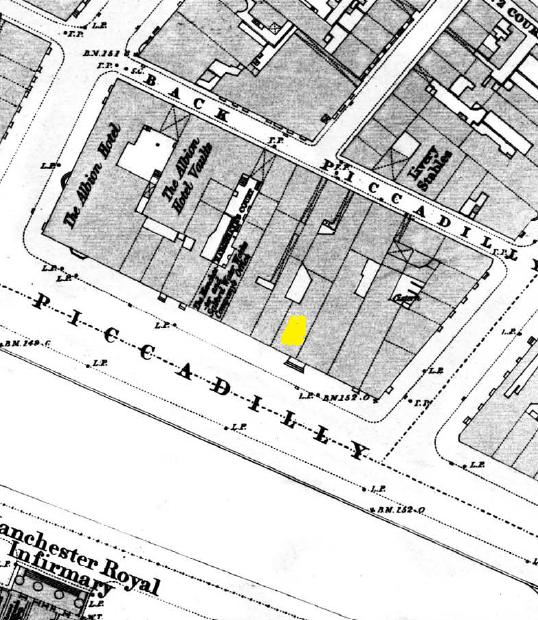
Antonio Peduzzi making what we wanted at 33 Piccadilly in 1824


Antonio Peduzzi was from Lombardy and settled in Manchester around 1810, ran a series of successful businesses, was married twice and ended his days in the Chorlton Workhouse on Stretford New Road where he died in 1846.

It is not much of an obituary for a man who had the courage to leave his native Italy, settle here in Manchester mixing his skill as a craftsman with more than a bit of entrepreneurial verve, loved two women and died insane in the workhouse.

But it is the starting point for a fascinating story which was first revealed by Alex Roe who works in Milan, has a wonderful site offering up all sorts of news about Italy http://italychronicles.com/ and is related to Antonio Peduzzi.

I began thinking about the Italian contribution to the city a few days ago in the story Of Naples in 1961 and Little Italy in Ancoats in 1901 and as you do I was drawn in to the history of those Italians who came over at the beginning of the 19th century, which is the cue for Alex who wrote that

“my very distant relative Antonio Peduzzi died in 1846 after having been certified insane. Antonio’s madness may have been caused in part by the loss of both of his wives. He did not have any children either, poor man.

Prior to his insanity and death, Antonio Peduzzi ran what was by all accounts a successful business which framed and glazed needlework, drawings and pictures; re-gilded and silvered old frames and mirror plates; and made and repaired barometers, thermometers and hydrometers. He had premises in Oldham Street and in Deansgate in the early part of the 19th century.

Antonio Peduzzi’s brother, and my more direct ancestor, was called James. Not a very Italian name, I know. I don’t know whether it was his real name, or one he had chosen to make his life in England a little easier.
James Peduzzi married Elizabeth Ward. The couple had three children, one of whom was Francis who would have been my great, great, great, great, great grandfather. I may have got the number of ‘greats’ wrong! Sorry, but it’s greatly confusing.

James Peduzzi set up in business as a picture frame maker in Spear Street in Manchester and later expanded into the making of thermometers and barometers. After applying for British citizenship, James was able to buy property, which he duly did.

In 1848, James bought a workshop and engine in Foundry Street, off Oldham Road. The property included other small workshops, houses and some shops. James’ business, it seems, flourished which fits in with the family rumour that the Peduzzi’s were quite well-off.

One of James’ sons, born in 1815 was Francis, who along with his younger brother – another James, joined his father in the Foundry Street premises.

Francis left this world in 1866 and his wife took over the business, but, and for reasons unknown, the Peduzzi business ceased trading after Elizabeth’s death in 1870."

33 Piccadilly marked in yellow in 1842
So with Alex’s permission and the help of the Museum of Science & Industry whose collection includes a barometer made by the Peduzzi company I plan to explore more of the life of Antonio and something of the Manchester he knew.

Location; Manchester


Pictures; the buildings opposite the infirmary including the premise of Peduzzi & Co, 1824, m5291, courtesy of Manchester Libraries, Information and Archives, Manchester City Council, http://images.manchester.gov.uk/index.php?session=pass  33 Piccadilly and the Infirmary from the 1844 OS of Manchester & Salford, by permission of Digital Archives, http://www.digitalarchives.co.uk/   and detail of Carvers, Gilders, &c. From Pigot & Dean’s New Directory of Manchester & Salford 1821-22

Wednesday, 22 February 2017

The mystery of the pub with two names and what the archaeologists found on Great Ancoats Street

Now I have to say the stretch of Great Ancoats Street up from Port Street to Dean Street hasn’t had much going for it for years.

The Paganinie, 1851
For as long as I can remember this part of Great Ancoats Street has been a car park which recently was extended with the demolition of the last building in the block.

And now the plot is being redeveloped and will eventually become a mix of residential and commercial properties.

But the foundations of modern buildings go deep and in the process of digging the work uncovered the  site of the Astley Arms which in 1821 was home to Mr Thomas Evans who dispensed beer and cheer to all who fell into his pub.

Currently the site ia an archaeological dig and a fine set of objects have been recovered including a stoneware bottle from J Moorhouse & Co, Hulme; a crockery set bearing the name of the Astley Arms and its first landlord, Thomas Evans and a glass bottle with the logo of a workman's arm.

The full story appeared in the MEN recently and not wanting to steal their thunder I suggest you follow the link where there are details of the finds along with some pictures.*

And that just leave me to puzzle over the name of the pub which as the Astley Arms was selling beer throughout the 19th century and appears so in the street directories, but on the maps of 1849 and 1851 it is recorded as the Paganinie Tavern.

Now there may be a connection with the Italian violinist Nicola Paganini who died in 1840 but the only name for a landlord in the late 1840s and early 50s is a F Webster who to confuse matters doesn’t show up on the rates, still it will all be revealed.

* The forgotten 200-year-old pub discovered under a Northern Quarter building site, September 26, 2016, Katie Butler,  http://www.manchestereveningnews.co.uk/news/greater-manchester-news/port-street-pub-building-site-11221280

Location; Manchester

Picture; the Paganinie Tavern, 1851 from Adshead map of Manchester, courtesy of Digital Archives, Association, http://digitalarchives.co.uk/