Showing posts with label Ashton-Under-Lyne in the 2000s. Show all posts

Thursday, 20 February 2025

Walking away with a bargain ...........in the market in Ashton on a Tuesday in February

I had forgotten how much I like Ashton and in particular the market.

We had taken the tram up from Chorlton on a bright sunny day which was perfect for a wander around the town.

The plan had been to visit the museum down at the Portland Basin and as you do we took a slow walk back along Stamford Street and by degree ended up in the main square.

Now the open air market is still in the process of being redone but there were still plenty of the old stalls along with the temporary pitches for our Jill and Geoff up from London to look for bargains.

And Geoff did just that coming away with two very nice shirts a couple of CDs and something for the kitchen.

Jill had debated on whether to buy a couple of pies from the indoor market but didn’t reckon they would survive the journey back.

So instead we wandered off again and explored some of the streets close by and unlike great chunks of south Manchester there are still lots of small interesting shops which offer everything from balls of wool and knitting patterns to fire grates, and fish food.

Location; Ashton-Under-Lyne, Tameside


Picture; the open air market, 2016, from the collection of Andrew Simpson

Wednesday, 2 November 2022

Looking up the old Corpoartion Baths on Henry Square in Ashton-Under-Lyne

It is one of those simple things that so often you don’t see what is just in front of your eyes, and this pretty much is all I can say about the old Corporation baths in Henry Square.

I must have passed them countless times but never gave them a second glance, and to be honest to my abiding shame knew nothing of their history or their closure in 1975 and it has taken this painting by Peter Topping and a fair bit of coverage in local social media sites to alert me to their story.

According to that excellent site Ashton-Under-Lyne.com, “they were opened in 1870 at a cost of £16,000. 

It was one of the first and largest municipal swimming baths.

The building, designed by Henry Paul and George Robinson, is constructed almost entirely of brick, with some stone decoration. It was built in a Byzantine style and has a 120 feet high tower which housed the flues from the steam boilers and heaters.

Sixty per cent of the building was occupied by the main Swimming Bath. 

The pool was 100 feet long and 40 feet wide and was originally used mainly by male bathers, with a three hour period on Thursdays for ladies.

In the eastern section of the building was a smaller pool, 27 feet long and 15 feet wide, for the use of female bathers. 

During the winter months, when the main bath was closed, the smaller pool was used by men and women at different times. 

There were also private bathrooms and Turkish baths. Part of the building was used as a police station and a station for one fire engine.

When the baths were built, the pools did not have a water filtration system, but were refilled weekly, making use of the water supply from the newly-opened Swineshaw Reservoir. 


The water was replaced on Tuesdays. The charge for swimming was six pence on Tuesday, Wednesday and Thursday, but only two pence from Friday to Monday, when the water was somewhat dirtier! 

A water filtration plant was eventually installed in 1915.”*

And that is all I am going to quote,  because in line with my often rehearsed line on these things if someone else has done the research and written up the story to them goes all the credit  and so if you want more you must visit Ashton-Under-Lyne.com

Painting; Corporation Baths, © 2014 Peter Topping, Paintings from Pictures

Web: www.paintingsfrompictures.co.uk

*Ashton-Under-Lyne.com,
http://www.ashton-under-lyne.com/history/baths.htm

Monday, 31 October 2022

The Britannia Brass Works Ashton Under Lyne ........... a ghost sign that passed me by

Now Hill Street was not a place I ever went to when I lived in Ashton, but we were walking back from the Portland Basin Museum and this was the route we took.

The Brass Works, 2016
I have to say I was impressed with the museum which “is housed within the restored nineteenth century Ashton Canal Warehouse in Ashton-under-Lyne. 

The museum combines a lively modern interior with a peaceful canal side setting. 

It is an exciting family friendly museum, with something for all the family."*

Walking back it would have been pretty easy to miss the Britannia Brass Works which doesn’t much look like the sort of foundry I am used to.

The Brass Works, 1899
So I am hoping that there will be someone out there who can offer up the story of the place and perhaps also something on S Parron.

I know that the Britannia Brass Works was established in 1872 and that just twenty seven years later “Mary Eastwood of Britannia Brass Works Ashton-under-Lyne trading as Walter Eastwood as a Brass Founder and Brass Finisher" had gone bankrupt.**

On a happier note the places was still turning out bits of brass in 1922 when it was "the JUNCTION IRONWORKS CO., Mechanical Engineers, Bentinck Street, Ashton-under-Lyne. T. A.: " Junction Ironworks, Ashton-under-Lyne." T. N.: Ashton-under-Lyne 435. Established 1902. Directors: Fred J. Reed and Harry Jackson.”***

And the rest from 1922 till now will I hope be revealed soon.

Location; Ashton-Under-Lyne

Picture; The Britannia Brass Works, 2016, from the collection of Andrew Simpson

*Portland Basin Museum,  http://www.tameside.gov.uk/museumsgalleries/portland

**London Gazette, November 7 1899

***Whos Who in Engineering, 1922, Graces' Guide to British Industrial History, http://www.gracesguide.co.uk/1922_Who's_Who_In_Engineering:_Company_J

Wednesday, 26 October 2022

Down at the Portland Basin in Ashton-Under-Lyne admiring the Cavendish Mill

Now I collect old textile mills which I am the first to admit is not as easy as stamp collecting.

Cavendish Mill, © 2014 Peter Topping
More so because with every year that passes more of these monuments to our industrial heritage vanish although today there is a growing trend to convertt them in to residential properties which at least preserves them.

My own special haunt is Ancoats but as I lived in Ashton I had to add the Cavendish Mill to the collection.

By one of those rare coincidences we were down at the Portland Basin in the summer and not much later Peter Topping made the same journey and in the process painted this image of the old mill posting on a number of sites, with the accompanying comment that "the Cavendish Spinning Company Limited was registered in 1884 with the sole purpose of building the Cavendish Cotton Mill. 

Taking on a fireproof design it was the first mill in Ashton to have concrete floors and a flat roof. 

On the canal side it is 6 floors high, and 5 floors on the other sides. Its main feature is the octagonal staircase that... But wait a minute... What am I doing writing this!!! As local historian Andrew Simpson says he tells the stories and Peter paints the pictures. So I am going to have to stop there and leave you to look at the painting and soon after Christmas Andrew has promised to tell the story.”

All of which was a challenge I couldn’t refuse.

The mill continued spinning cotton until 1934 but remained in industrial use until 1976 and has now been converted offering a mix of residential commercial and community use.

All of which was information fairly easily available but as ever I wandered off looking for a something more.

And there it was in a directory for cotton mills in Ashton-Under-Lyne for 1891 which told me that had I been in the Royal Exchange in Manchester between 1 and 1.30 each week day I could have met with the agents of the company with a view to buying some cotton.

I may even go looking for the exact spot where I could have done the business because the entry listed them at “No., 10 Pillar” and no doubt I could also have listened as the agents proudly told me that they had "72,000 spindles, 328/408 twist and 168/468 weft.”

Now that is the sort of fascinating detail to add to my collector’s picture.

Painting; Cavendish Mill, © 2014 Peter Topping, Paintings from Pictures

Web: www.paintingsfrompictures.co.uk

Monday, 16 August 2021

Home thoughts of Ashton in the 1970s ..... part 5 looking for the familiar

Now when you have been away from somewhere for a long time it takes a bit of time to readjust and fit your memories to the changed landscape.

I was fully prepared that after nearly 40 years things would be a bit different and as we came in by the tram that vague feeling was confirmed.

And it started with the bus station which was not where I remember leaving it in 1976, quickly followed by the red brick shopping centre and the tall yellowy council offices.

But then with a bit of careful thought it was more that the bus station had one of those make overs which I think have made it a bit better.


That said the Prince of Orange was pretty much as it was when we caught the 218 to Manchester.
It was not a pub we went in often but I remember a fine meal there back in the 1970s and I note that it too has had its makeover.

All of which brings me to Peter’s painting which is part of a series prompted by his recent visit.

And like most of us he fastened on pubs and cinemas, which I guess feature in the memories of most of us.

A few of those I remember well like the Pit and Nelson and the one at the top of Penny Meadow have gone, but then there is the Old Fire Station which was a fire station when I lived here, and more than a few others.

So I suspect Peter will be setting his paint box out pretty much as I finish this.

Painting; the Prince of Orange, Ashton-Under-Lyne,  © 2014 Peter Topping, Paintings from Pictures,
Web: www.paintingsfrompictures.co.uk
Facebook:  Paintings from Pictures

Thursday, 5 August 2021

See better days and do better things ............. the Odeon on Old Street

The Odeon on Old Street has seen better times.  

A story from six years ago


The Odeon, 2015
It was opened in 1920 as the Majestic changed its name in 1946 to the Gaumont and in 1962 to the Odeon.*

And as if a name change could makes things better was renamed the Metro in 1981 before closing in 2003.

But I guess we shouldn’t be too hard on the place, it did after all survive from the silent movies with Tom Mix through to the talkies and in to the age of Star Wars and beyond.

Sadly as Peter’s painting shows it seems to have passed its best and not even the attractions of cheap slot machines could keep its doors open.

The Odeon in happier days
And I have to confess I never helped it along, because we never went there.  Instead we preferred the picture houses of Manchester, which was simply because that was where we worked and a night in the cinema straight from work made sense.

But there will be plenty of people who remember it in its heyday and may well have chosen it over the Roxy on Queens Road or the Odeon at Guide Bridge.

Not to short change the more adventurous who might well have ventured off to Stalybridge, Hyde, or even to the Oxford in Dukinfield.

All of which reminds me just how many palaces of cinematic dreams once flourished across Tameside.

So with that in mind I rather hope Peter goes off looking for more to paint and who knows this may well result in a shed load of memories, pictures and stories of the back rows of darkened picture houses across the Tame valley.

And not to be out done I shall also rise to the challenge and go looking for the Queens Electric Theatre of which there is a 1912 plan on the wonderful Tameside Image Archive**

 Painting; the Odeon Ashton-under-Lyne  © 2015 Peter Topping, Paintings from Pictures,
Web: www.paintingsfrompictures.co.uk
Facebook:  Paintings from Pictures

Picture; the Odeon Cinema, Old Street, Ashton under Lyne, t09070, courtesy of Tameside Image Archive, http://www.tameside.gov.uk/history/archive.php3


*Ashton-Under-Lyne.com,  Ashton-under-Lyne.com http://www.ashton-under-lyne.com/photos/gallery32.htm

*Tameside Image Archive, http://www.tameside.gov.uk/history/archive.php3

Tuesday, 3 August 2021

The Guide Bridge Odeon, the Roxy at Hurst Cross and a social club

Now I have got to say it takes a great leap of imagination to place the old St Pauls Church Centre on Stockport Road as an Art Deco cinema.

What was the Guide Bridge Odeon, 2015
But that was what it had been, opening in 1936 with Bing Crosby in "Anything Goes" and closing just 25 years later with the film "Man in the Moon" starring Kenneth More.

And by most picture houses that was a short run.

According to Lost Cinema Treasures,* it was planned as “the Verona Cinema a project of local builders; P. Hamer, Verona Cinema (Guide Bridge) Ltd ......[but just as] ......... the construction of the cinema was almost completed P. Hamer sold the building to Oscar Deutsch and it opened as one of his Odeon theatres. 
P. Hamer then used the proceeds of the sale to build the Roxy Cinema, at Hurst Cross, which was designed by Drury & Gomersall.”

The Odeon, Guide Bridge, circa 1938
Which as a blog story rather means that you get two for one because the Roxy opened in 1938 only to close in 1960 and has now gone forever marked only a small supermarket on the site and a row of shops bearing the same name opposite.

So far I have only come across one picture of the Roxy and from that I am not sure it matches in grandeur the Odeon at Guide Bridge.

But I know there are people who remember it and some who worked there, but alas I am not one of them.

I can’t even claim to have gone to the Odeon and when I did walk through its doors back in 1975 it was already a social club and that impressive art deco exterior along with some interesting features inside were long gone.

All of which just leaves me to return to that opening night, when cinema goers not only got Bing Crosby in "Anything Goes" but Harold Lloyd in "The Milky Way".

The Roxy, Queens Road, date unlnown
And depending on who you were taking and how far you wanted to impress the person of your dreams, you could have watched Bing and Mr Lloyd from one of the 330 seats in the circle, or the 834 in the stalls.

All very different from what is on offer today.


Painting; St Paul's Church and Centre Ashton-under-Lyne  © 2015 Peter Topping, Paintings from Pictures,
Web: www.paintingsfrompictures.co.uk
Facebook:  Paintings from Pictures


Pictures; the Odeon Guide Bridge, circa 1938 lender Mr Cropper, t09062, and the Roxy Cinema, date unknown t09060, courtesy of Tameside Image Archive, http://www.tameside.gov.uk/history/archive.php3

* Lost Cinema Treasures, http://cinematreasures.org/theaters/22877

Sunday, 1 August 2021

At that big blue store

I wondered how long it would be before the IKEA building made its way into the Tamseide Image Collection.

After all it is not that old and hardly compares with some of the more majestic buildings that are dotted around the district.

But it is there in the collection, which I suppose is as it should be.

It is big, dominates the spot and provides work and a place to go for quite a few local residents.

Do I like it?  Well I am not sure.  It is a bold statement of modern retail practice and does fulfil a role.

Like many people we have wandered its floors, come away with the flat pack stuff along with those odd little kitchen things and spent hours pondering on the easy to assemble instruction sheets.

But do I like it as building?

No I don’t think I do.  It has function and simplicity added to which you get a fair view of the hills from the top car park but it is all too big and brash for me.

That said Peter’s painting gives a sense of its size and purpose.

And I doubt that I am one to pass informed judgments given I was always impressed by the old bus station.

 Painting; IKEA, Ashton-Under-Lyne © 2015 Peter Topping, Paintings from Pictures,
Web: www.paintingsfrompictures.co.uk
Facebook:  Paintings from Pictures

Saturday, 23 June 2018

Home thoughts of Ashton in the 1970s ..... part 6 putting the bits together

Now sometimes one image draws many things together and this is what Peter’s painting of the councils offices have done for me.

The view is from the car park of IKEA and across from Wellington Road is the bus station, the Prince of Orange, and the council offices and all in their way remind me of just how much the town has changed in 40 years.

Of course the hills far off in the distance remain a constant although not quite, because a few years ago I went back to Hartshead Pike looking to show off the Collier’s Arms only to discover that it has gone.

Such is the fate of anyone wanting to relive his past.

That said those council offices were never part of my Ashton.

The decision to build them was taken by the Conservative administration just as I was ready to leave and the building opened in 1980.

So completely are they not part of what I remember that when I first saw them I had to think very hard about what had been there before and I have to confess I can’t remember.

But then someone will tell me.

And now they are about to go after just 35 years.

Already the packing has begun and pretty soon the corridors, offices and in the internal garden will be no more which will just leave the film made by Vanessa Dixon as a lasting reminder of what once was.*

That and of course Peter’s painting.which was painted from that IKEA car park which didn't exist 40 years ago, and takes in a slightly different Wellington Road and bus station, leaving only the hills, the two churches and the Prince of Orange as marker for what I remember.

Painting; Tameside Offices, and Prince of Orange, Ashton-Under-Lyne, © 2015 Peter Topping, Paintings from Pictures,
Web: www.paintingsfrompictures.co.uk
Facebook:  Paintings from Pictures

*Tameside Council Offices, February, 2015, https://www.youtube.com/watch?v=Q2GSuQzsB5g&feature=youtu.be 

Wednesday, 13 June 2018

At the Theatre Tavern In Ashton-Under-Lyne

Now I am a great fan of Andy Robertson’s photographs and here is a story from 2014.

He has been recording the buildings and streets of Manchester many of which will soon be gone swept away by a combination of neglect and redevelopment.

And this week he took the tram out to Ashton-Under-Lyne and a whole new series of pictures and stories will be making their appearance on the blog over the next few weeks.

The Theatre Tavern is the first, a choice made partly because I like these glazed tiled pubs and because in all my days in Ashton it was one of the few I never visited.

I must have passed it countless times back in the 70s and only recently decided to find out a little more about it.

It “began life in 1840 as a combined corner shop and beer house. In 1869 it was named 

The Robin Hood and Little John, eventually becoming known as the Robin Hood. In recent years it changed its name to the Theatre Tavern, being adjacent to Tameside Hippodrome theatre.”*

I have yet to find out about the Gartsides which brewed “Ales and Stouts” other than it was taken over by Bass and was local.

In the meantime I do have this label which comes from a fascinating site, The Labologist's Society.**

I am hoping they may be able to tell me.

And no sooner had this story gone live, than Vanessa Lyn Dixon told me that "Gartsides Brewery was in the West End of Ashton".


Pictures; of the Theatre Tavern from the collection of Andy Robertson, August 2014 and the Gartside Label, courtesy Peter Dickinson/Labologist's Society, http://labology.org.uk/?p=3669


*Ashton Under-Lyne, http://ashton-under-lyne.blogspot.co.uk/2008/04/theatre-tavern.html

**The Labologist's Society, http://labology.org.uk/?p=3669

Sunday, 10 June 2018

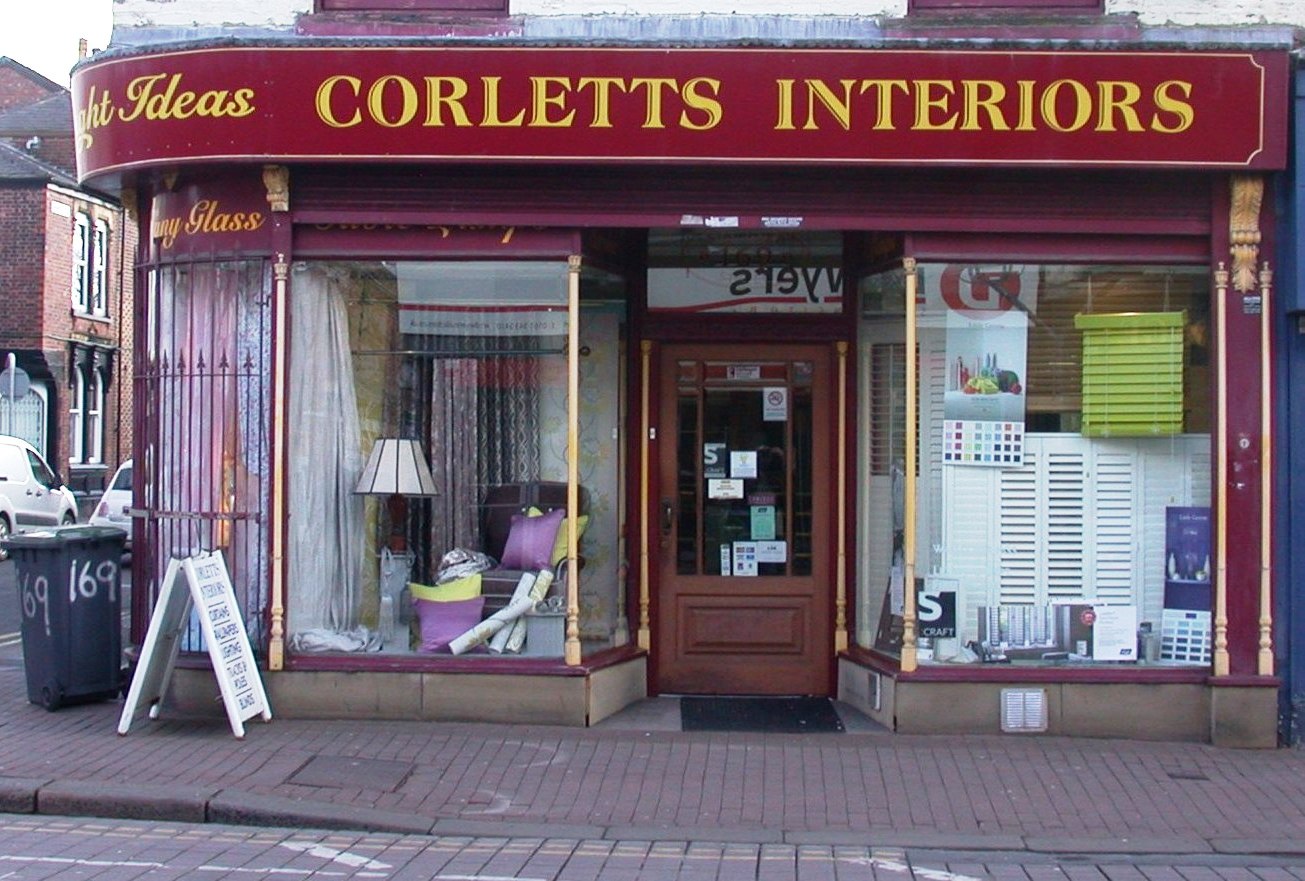
Shop doors I have known ................... Stamford Street Ashton-Under-Lyne

Now shop fronts and their entrances do get rather overlooked, which is a shame, because the old traditional ones which will date back a century or more are vanishing.

I fully accept that back then they were fairly uniform in their design but the move to big glass fronted entrances in the 1950s and 60s did for many of them.

Since then a lot more have vanished as town and city centers get re designed.

All of which makes a visit to Ashton quite rewarding.

Lots of them still exist and unlike their counterparts in south Manchester have not become smart cafes, or wine bars

Instead they are still offering up the sort of things that elsewhere you can only get online of a big supermarket.

Which just leaves me to thank the owners of Corletts Interiors on Stamford Street for letting me take a picture of their shop.

And I rather think I have a new short series in the offing.

Location; Stamford Street, Ashton-Under-Lyne, Tameside


Picture;  Corletts Interiors, Ashton-Under-Lyne, 2016 from the collection of Andrew Simpson

Friday, 8 June 2018

Home Thoughts of Ashton in the 1970s .............. part 7 things you forget

My memories of Ashton are pretty much frozen in time.

We settled down on Raynham Street in the March of 1974 and I left three years later.

I have been back but each time I return the town has changed just a little bit more and it becomes more difficult  to locate places I once knew and in some cases impossible now even to remember what they were called.

One whole strip of shops on Penny Meadow has gone including the newsagents along with the old PSA building round the corner.

And while the Albion warehouse was still there I tried but failed to remember the name of the pub opposite.

It was a place we used sometimes when we couldn’t be bothered to walk the extra distance to the Lord Napier.

Now the Lord Napier usually won out because it had a couple of lava lamps and back in the 70s I was a sucker for a lava lamp.

Sadly the name of that other pub eludes me even now.

I notice that in Andy Robertson’s picture it is called Sullivan’s and back tracking through Google street maps that was its name back in 2008.

And in much the same way that building on the corner of Whiteacre Road and Botany Lane is only a vague memory.

Of course those who still live in Ashton will remember both but I am at a loss, and points to that simple truth that sometimes you should never leave going back to a place for too long.

During the same visit I went looking for the house of Pam and Ian.

Rhey lived in one of those really tall properties looking out on the railway line.

It may have been located on Ashlynne but I can't be sure.  All I do remember is that back when they moved in they made the awful discovery that there was no power to the upper floors of the house.

They thought there was power after all when they viewed it  there were power points but when they came to move in with all that optimism of first time buyers, the power points had vanished leaving only the screw holes and no electricity, and if that were not bad enough the previous owner had taken all the lamp bulbs, which made moving in on a cold Saturday in January no fun.

Our more modest house on Raynham Street proved less of a disappointment but that is another story and leaves me only with the memory of standing outside the Albion waiting for the 153 express into Manchester at 6.30 in the morning, which pretty much meant that during the winter I only saw Ashton in daylight at weekends.

And since posting this this morning someone in Ashton has told me that Sullivan's was the Corporation and with that the memories flood back.

Pictures; of Ashton-Under-Lyne 2105, courtesy of Andy Robertson

Thursday, 7 June 2018

Celebrating our Municipal Town Halls part 2 .......... Ashton Town Hall

Another in the short series celebrating our Municipal Town Halls which focus not only on the grand buildings but also the achievements of local government.

The Town Hall in happier days, 2015
I have always been fond of Ashton Town Hall.  The earliest bits date back to 1840 with an extension added in 1878.

Back in the 19th century when the “Northern Powerhouse” was getting its first airing, and cities like Manchester, Leeds and Newcastle on Tyne were making the country’s wealth, local government was at the centre of improving the lives of local people.

As Sidney Webb said the “municipalities have done most to socialize our industrial life.”  And so a resident of Manchester, Birmingham or Glasgow could benefit from municipal supplies of water, gas and electricity, travel on municipally owned trams and buses walk through a municipally maintained park while knowing his children were being educated in municipally run schools.

“Glasgow builds and maintains seven public ‘common lodging houses’; Liverpool provides science lectures; Manchester builds and stocks an art gallery; Birmingham runs schools of design; Leeds creates extensive cattle markets; and Bradford supplies water below cost price. 
Ron's update, 2018

There are nearly one hundred free libraries and reading rooms. The minor services now performed by public bodies are innumerable.”*

And all of that was evidenced not only in the Corporation parks and schools and baths but in the town halls which were solid examples of both civic pride and local democracy.

Which brings me to Peter’s painting of Ashton  Town Hall which of course now has that excellent museum to the Manchester Regiment and offers three function rooms for hire.

My memories of the place stretch back to watching council meetings and election counts back in the 1970s.

The steps were also where we would arrange to meet in those pre mobile days and I seem to remember many sunny days sitting on those steps waiting with a sneaky sandwich from the Market Hall.

Alas, my friend Ron has burst my bubble, by telling me that, that the building has "been closed to public access for well over a year now and the Museum of the Manchesters is now but a memory".
Ah well I should get back to Ashton more frequently

Painting; Ashton Town Hall, © 2015 Peter Topping, Paintings from Pictures,
Web: www.paintingsfrompictures.co.uk
Facebook:  Paintings from Pictures

Picture; the Town Hall, 2018 from Ron Stubley

* Webb, Sidney, from Historic, Fabian Essays in Socialism 1889

Tuesday, 3 October 2017

Views from around Victoria Bridge ........ the road is open

We will all have our own special bridge across the river that takes you from Salford into Manchester.

I will stand on the fence and just say I like them all, from the old Victorian ones to those exciting swirling footbridges which seem to keep popping up.

That said I do like Victoria Bridge, because it affords pretty impressive views of the new developments on both sides of the water.

Now whatever you think of those new developments they are going up a pace, and while I miss the earlier Victorian and Edwardian ones, some of these had pretty much had their day.

And it is also worth noting that the Victorians showed scant regard for what had been there before.

So here is the first of Andy Robertson’s new series on Views from Victoria Bridge,

Location; Salford

Picture; Greengate and beyond, 2017 from the collection of Andy Robertson

Thursday, 1 January 2015

Down on Henry Square with the old Corporation Baths

It is one of those simple things that so often you don’t see what is just in front of your eyes, and this pretty much is all I can say about the old Corporation baths in Henry Square.

I must have passed them countless times but never gave them a second glance, and to be honest to my abiding shame knew nothing of their history or their closure in 1975 and it has taken this painting by Peter Topping and a fair bit of coverage in local social media sites to alert me to their story.

According to that excellent site Ashton-Under-Lyne.com“they were opened in 1870 at a cost of £16,000. 

It was one of the first and largest municipal swimming baths.

The building, designed by Henry Paul and George Robinson, is constructed almost entirely of brick, with some stone decoration. It was built in a Byzantine style and has a 120 feet high tower which housed the flues from the steam boilers and heaters.

Sixty per cent of the building was occupied by the main Swimming Bath. 

The pool was 100 feet long and 40 feet wide and was originally used mainly by male bathers, with a three hour period on Thursdays for ladies.

In the eastern section of the building was a smaller pool, 27 feet long and 15 feet wide, for the use of female bathers. 

During the winter months, when the main bath was closed, the smaller pool was used by men and women at different times. 

There were also private bathrooms and Turkish baths. Part of the building was used as a police station and a station for one fire engine.

When the baths were built, the pools did not have a water filtration system, but were refilled weekly, making use of the water supply from the newly-opened Swineshaw Reservoir. 


The water was replaced on Tuesdays. The charge for swimming was six pence on Tuesday, Wednesday and Thursday, but only two pence from Friday to Monday, when the water was somewhat dirtier! 

A water filtration plant was eventually installed in 1915.”*

And that is all I am going to quote,  because in line with my often rehearsed line on these things if someone else has done the research and written up the story to them goes all the credit  and so if you want more you must visit Ashton-Under-Lyne.com

Painting; Corporation Baths, © 2014 Peter Topping, Paintings from Pictures

Web: www.paintingsfrompictures.co.uk

*Ashton-Under-Lyne.com,
http://www.ashton-under-lyne.com/history/baths.h

Monday, 4 August 2014

Ghost signs in Ashton Under Lyne

Along Whitelands Road in Ashton in 2014
In the interests of wider participation I open this out to everyone.

Ron was out recently and found these which are some interesting examples of ghost signs

“Here's something from Whitelands Road in Ashton under Lyne to get your teeth into Andrew. 

As far as I can make out, the address in the first picture is 10?/19? Victoria Street Manchester but the main lettering seems to have been done over twice. 


Economisers is definitely the key word as can be seen from one of the other pictures. 

The third (and least distinct picture) appears to read 'Goodbrands special testing machines' and all the buildings in this Industrial Estate seem to have been connected. 

On looking round the rear of the premises which back onto the Huddersfield Narrow Gauge Canal, there are no signs at all. 

Not surprising as this side is south facing whereas the preserved lettering is all on north facing walls. 

Hope this is of interest to you despite being in Ashton.”

Well of course it is just what I like but I fear my knowledge of Ashton is a little hazy these days and so the challenge is out there.

All comments, pictures and research will be added to the story on a rolling programme.

'Goodbrands special testing machines'
Ghost signs like these, especially industrial ones will not be with us for much longer.

A mix of the weather and neglect will see many fade and become too difficult to read while the redevelopment of brown sites will mean many are just lost forever when the buildings are demolished.

And yet for decades and in some cases a century or more they were the names of places which gave employment to thousands but are fast being lost from living memory.

Picrures; ghost signs in Ashton, 2014, Ron Stubley

Friday, 13 June 2014

A ghost sign in Audenshaw, the Bolton Steam Museum and a thank you to Ron

Now here’s another ghost sign.

The once busy works of Scott & Hodgson 
It was found by Ron who says “its hard to discern now but reads Scott & Hodgson Engineers Ltd. 

These premises are in Audenshaw alongside Guide Bridge Station. 

A superb photograph of this location can be found in the Booklaw/Foxline publication - Steam Over Woodhead by E.M.Johnson (p.86). 

There is a fine example of a Scott & Hodgson Engine in a leaflet from the Bolton Museum.”

That 1914 machine on display at Bolton Museum
Scott & Hodgson Ltd, made stationary steam engines at their works and at least one example of a machine they built can be seen Bolton Steam Museum.

This was a 1914  “inverted vertical compound engine with Corliss valve gear made for  Hardman and Ingham's Diamond Rope Works, at Royton.”

Scott & Hodgson were taken over in 1938, by J & E Arnfield Ltd, makers of Mono-Pumps.

All of which just goes to show there is always a story behind every ghost sign.

Picture; Scott & Hodgson Engineers Ltd, in Audenshaw, 2014, courtesy of Ron Stubley and their 1914 machine  courtesy of the Bolton Steam Museum

*The Bolton Steam Museum, http://www.nmes.org/

Thursday, 15 May 2014

Dutton Ales in the Station Hotel Warrington Street a ghost sign

The Station Hoetl today
So here we are with more ghost signs from Ashton, and this has become one of my favourites.

It is of the Station Hotel on Warrington Street, and there hidden for far too long is the name of Dutton’s Ales.

It is there to the left of the entrance

Now Thomas Dutton and his son founded the Salford Brewery on Bow Street in Blackburn in 1799.

The firm traded as Thomas Dutton and Co until 1884  it became Dutton & Co. Dutton’s  Blackburn Brewery Ltd registered in Nov 1897 with 92 licensded houses at a purchase of £740,000.

The Station Hotel in 1986
It expanded during the rest of the 19th and 20th centuries acquiring lots of local north west breweries and then was acquired by Whitbread’s in 1964*

Looking at earlier pictures of the Station sometime in the 1980s if not earlier our sign was hidden under a board which I suppose helped preserve the sign.


Pictures, the Station today from the collection of Mike Calverley and in 1986,  Mr C. Makepeace, courtesy of Tameside Image Archive, t06607,  http://www.tameside.gov.uk/history/archive.php3

* The Brewing Industry: A Guide to Historical Records
 edited by Lesley Richmond, Alison Turton Manchester University Press 1990

Wednesday, 14 May 2014

Ghost signs across Ashton

Now you can wait all year for a Ghost sign and then two turn up at the same time.

And for these I have Mark and Bernadette to thank who went hunting for these signs which start the story of long forgotten shops and businesses.

For that is a ghost sign, the last reminder of a firm which once flourished and has now gone.

They were painted in the sides of buildings and a few can still be seen.  But most are fading fast, weathered by years of rain, sun and neglect.

Some have even been painted over but stubbornly the lettering still forces its way through reminding us of a grocery shop or painting business.

In time I shall go digging into these two signs.

Most will not be with us for much longer, and when they have gone the record of the people who had them made along with their stories will vanish.

And that I think is a shame.

Not least because many of the signs were themselves works of art, carefully planned, beautifully executed and a comment on what we bought and who we employed.

Today the same publicity will appear on facebook sites, pop up in freebie newspapers and community magazines.

Most were for local consumption, becoming house hold names for a few generations.

So they were and are a little bit of our history.

There will be more because others have also kindly sent some in.

Pictures Martin © www.ashton-under-lyne.com & Bernadette Burrows