Seen on a pub wall.

Location; pub wall in Menai Bridge
Picture; Simplicity itself ……….2023, from the collection of Andrew Simpson
Seen on a pub wall.
Picture; Simplicity itself ……….2023, from the collection of Andrew Simpson
Now, l am a baby boomer and l was born just one year after the NHS was established meaning we have been constant companions over the last 73 years.
It has seen me through heaps of minor illnesses, two cancers and looked after my sons and grandchildren, so I have a lot to thank it for.
And to take every opportunity to explore its history.

The event has been organised by The NHS Retirement Fellowship.

Offering social, leisure, educational and welfare activities, the Fellowship has more than 100 branches across England, Scotland and Wales. Established in 1978 with over 8,000 members, we provide a bridge between life in employment and new opportunities in retirement. Members enjoy a range of activities and interests meeting former colleagues and making new friends.
So that is it …. All you have to do is come along and celebrate with us the 75 years of the NHS.
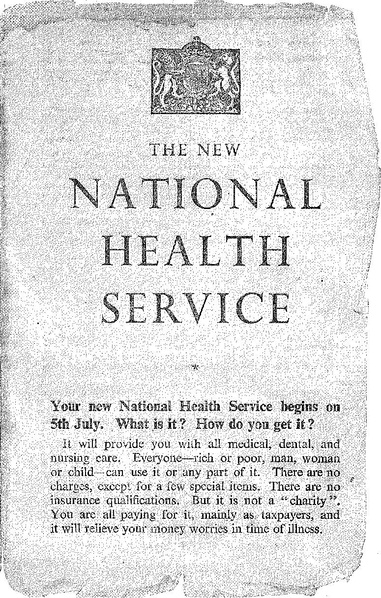
Pictures; Poster for the NHS at 75, NHS Retirement Fellowship, and seen on a pub wall in Meania Bridge, 2023, from the collection of Andrew Simpson
Now I am all for revisiting historical events, people and movements, and explore how modern scholarship and forgotten research can offer up new perspectives.
 |
| Aneurin Bevan, 1952 |
But I have to say I was flabbergasted to day when I came across a timeline for the NHS, which suggested that the Labour politician Aneurin Bevan who is credited with the establishment of the NHS is relegated to a bit player, in advance of Winston Churchill and William Beveridge, who presented a plan during the war to eliminate the “five giants” which would hamper the post war reconstruction of Britain.
These included "Want, Disease, Ignorance, Squalor and Idleness". Beveridge’s proposals to eliminate the five would form the basis for the Welfare State.
So, yes Beveridge along with Bevan should naturally be on the time line, but appearing three times was Winston Churchill, who according to the script was “The Tory PM who commissioned the Beveridge Report. proposed The NHS in his election manifesto and pumped more money in than ever Bevan did”.
 |
| Labour Party Poster, 1948 |
Now it was actually Arthur Greenwood a Labour MP and Minister in the Coalition Government who announced the creation of an inter departmental committee which would carry out “a survey of the existing national schemes of social insurance and allied services, including workmen’s compensation and make recommendations” *
Added to which the idea that there should be a national health system along with a change in the provision of social care had long been advocated by the Labour Movement and had already existed in Wales in the form of the Tredegar Workmen's Medical Aid and Sick Relief Fund, which had been established in 1890, in Tredegar in South Wales.**
And which in return for contributions from its members provided health care free at the point of use.
Interestingly our timeline didn’t mention that the Conservative Party under the leadership of Winston Churchill voted 21 times against the formation of the NHS, including the second and third readings of the bill.
Nor does our timeline recognize that the NHS was established just three years after the war, when there were huge demands for limited resources, which had to be set against the backdrop of food shortages, and a terrible winter.
 |
| NHS spending, 1948-54 |
Nor does the timeline acknowledge the awful state of health amongst the majority of working people.
In its first full year there had been a huge demand in the number of free prescriptions issued for medicine and spectacles and in the rise in the cost of the NHS from £327.8 million in 1948-49 to £430.3 million by 1953-54.***
And that I suspect indicated just how much of a need there was from people who had not been able to afford even basic health care under pre war Tory Governments.
 |
| NHS spending as a % of GNP |
So I rather think our timeline is an attempt to rehabilitate a present Tory Government who has not distinguished itself during the pandemic, and lurches from one crisis to another.
By all means revisit and challenge historical shibboleths, but at least do it honestly.
Picture; Aneurin Bevan and his wife Jenny Lee in Corwen, 1952, Geoff Charles, made available under the Creative Commons CC0 1.0 Universal Public Domain Dedication , Labour Party Poster, 1948
*Summary of the Beveridge Report, presented to the War Cabinet, November 1942, http://filestore.nationalarchives.gov.uk/pdfs/small/cab-66-31-wp-42-547-27.pdf
**Out of Tredegar ...... Aneurin Bevan, 70 years of the NHS and the Welsh health service which preceded it, https://chorltonhistory.blogspot.com/2019/05/out-of-tredegar-aneurin-bevan-70-years.html
***Source Report of the Guillebaud Committee Parliament. Report of the committee of enquiry into the cost of the national health service. (Chairman: CW Guillebaud.) Cmd 9663. London: HMSO, 1956, quoted from National Health Service History, Geoffrey Rivett, http://www.nhshistory.net/Chapter%201.htm#Reviewing_the_NHS
I am looking at a request to renew an annual subscription.

Now there is nothing unusual about such a request, although it was dated October and came with an additional comment in red that “As our financial years closes on the 31st inst., the favour of a remittance during the early part of the month will greatly facilitate the making of our books for the audit”, which would suggest that the Trustees were more than a little late in paying up.
And this would be a particular concern to the secretary a Mr. James Ferguson who was charged with administration of the Hospital for Incurables, whose head office was at 7 St Peter’s Square, and who ran a “Home For In Patients, Mauldeth Heaton Mersey”, a “Branch For Females Only, Walmersley House, near Bury” and a “Dispensary for Out patients, Ardwick Green”.

In the case of the Hospital for Incurables, which had been established in 1872 at Ardwick Green, it “'aimed to give permanent relief 'to such persons as are hopelessly disqualified for the duties of life by disease, accident or deformity'.
The hospital would not take patients who would be taken elsewhere, for example lunatics, blind people or paupers. As its name suggests, the hospital was a regional charity, aimed at all the Northern Counties. However, as the only other hospital of its type was in London, the Northern Counties Hospital took patients from all over England”*.

I could just lift the whole of their description of the charity and the hospital but instead suggest you visit the site by following the link.

This was Mauldeth House, a building which has a long history and which has been researched in some detail by Allan Russell.***
And for those who want to follow up on the Hospital, the archive recotrds are held at the University of Manchester Library, Reference, GB 133 MMC/9/14, formerly GB 133 J b 10 and consist of 9 items covering the years 1872-1934.
Location; Greater Manchester
Pictures; subscription request for Hospital for Incurables, 1894, and Mauldeth House, date unknown, from the collection of David Harrop
* Hospital for Incurables, https://archiveshub.jisc.ac.uk/search/archives/b489e047-e6b1-3992-aaa3-5e40e2147729?component=f9012991-d61a-38aa-b4eb-889fee33e835
** Archives Hub, https://archiveshub.jisc.ac.uk/introduction/
*** Mauldeth Home for Incurables, https://thehistoryofstockportin100halls.wordpress.com/tag/mauldeth-home-for-incurables/?fbclid=IwAR2yBUgR1Tm57OCXAgwW72jKsXJtMGkyG19yR3ypELSZWqxLRcLP1Hpoqa8