Showing posts with label Manchester Buses. Show all posts

Tuesday, 7 July 2026

There is always another on the way …… travelling by bus to Chorlton Station

I have Kevin Barker to thank for this picture.

I am looking at two employees of Manchester Corporation posing for their photograph on route number 9.

It’s a perfect example of how there is always another on the way, which might be a bus or a new picture I haven't seen before.

I think we will be on Edge Lane sometime in the early 20th century.

A quick search of The Manchester Bus by Michael Eyre and Chris Heaps reveals that this is “Daimler NA2687 at Longford Park on the service from Chorlton to the Stretford boundary at that point; it has the first of many bus bodies that would be built by the Car Works. Note the taller bonnet line of the Y type chassis”. 


They date the picture to 1914 and tell me that the bus could seat 38 but in 1923 was rebuilt to increase the number of seats to 44 by extending the upper deck over the driver’s cab.

And that is about it.

Other than to say I have no idea that there was once a bus to and from Chorlton railway station to Longford Park.

The fun will be to identify the back drop and leaving me to thank Kevin for whizzing the picture over today and to Andy Robertson for his indulgence in letting me continue to borrow his bus and tram books on an extended loan which will soon be a decade.


Location; Edge Lane?


Picture; Daimler NA2687 at Longford Park, 1914, courtesy of Kevin Barker

* The Manchester Bus by Michael Eyre and Chris Heaps, 1989


Monday, 6 July 2026

Of trolley buses and a company called SELNEC


The trolley bus never did much for me.

They were much quieter than the bus or the old trams but they always made me feel ill.  I think it was the combination of the heat and the smell of the leather seats with the disinfectant which I found uncomfortable.

Stevenson Square December 1966, the last Manchester trolley bus
But they were a common enough sight in many of our cities to warrant a bit of a story.

I can’t remember using them at home but London Transport operated them for thirty years on 68 routes with 1811 trolley buses.

Here in Manchester the service which began in 1938 covered 9 routes using 189 vehicles.

Ours came off the road in 1966 and this one in Stevenson Square was the last in the December of that year.  Stevenson Square was the terminus of trolleybus services to Audenshaw and Stalybridge.

Piccadilly with an Ashton-Under-Lyne trolley bus, 1960
Nor were we alone in operating trolley buses, and it is equally possible that had you jumped on a trolley bus to Ashton-Under-Lyne it would have been the blue and cream ones operated by Ashton Corporation.

They had been quicker off the mark staring operations in the February of 1925 on five routes with just 19 trolley buses and like Manchester abandoned them in 1966.

This was just three years before I arrived in the city so the sight of this Ashton trolley bus in Piccadilly around 1960 is one lost to me.

But I do just remember the sheer number of corporation bus companies in the city in 1969.

The green livery of the joint Transport and Electricty Board
Along with the disticntive red livery of Manchester and the blue and cream of Ashton there was the green of Salford and the green of the Stalybridge, Hyde, Mossley and Dukinfield Joint Transport and Electricity Board along with the maroon and cream colours of Oldham.

And no doubt if I dug deeper I could come up with the routes of some of the neigboring authorites whoses trams, trolley buses and motor buses entered the city.  All of which came to an end in 1969 with the formation of a unified bus company covering the whole of greater Manchester and initially known as SELNEC, or South East Lancashire North East Cheshire.

A SELNEC bus, 2008
Its orange and white livery would not have been my choice but then having to choose a colour scheme which did not upset the local feelings of the eleven participating bus companies would always have meant coming up with something very different.

This was a huge undertaking, covering a large conurbation and an operation broken down into four divisions, each with their own different coloured logo.

And for those who like these things here are the eleven corporation companies, the number of vehicles they brought to the enterprise and the division they belonged to.


Now that will endear me to some but risk the derision of others who mutter train spotter, which is a little inaccurate given that this began as a story about trolley buses and has gone way beyond that.

So with that in mind I shall take leave of the almost silent successor to the tram.


Stalybridge bus station and the last Ashton trolley bus, 1966
Pictures; Manchester Corporation trolley bus, Stevenson Square 1966, and Ashton-Under-Lyne Corporation trolley bus, Stalybridge bus station, 1966 © Alan Murray-Rust, geograph.org.uk Wikipedia Commons, Ashton-Under-Lyne Corporation trolley bus in Piccadilly, 1960, and Stalybridge, Hyde, Mossley & Dukinfield Transport & Electricity Board motor bus from the collection of J.F.A.Hampson, SELNEC Bus, Mikey from Wythenshawe, Museum of Transport, Wikipedia Commons


Saturday, 4 July 2026

Picking a municipal bus company and travelling across the city in 1963

Cover of Maps of Manchester & District, 1963
Now I am looking at a copy of the 1963 Manchester bus routes which my friend David has passed on to me.

Like me he was one of those that never went to a grammar school and recalled that

“I went to St Gregory's Technical High School in Ardwick Green from 1960-1967.

And because it was over 3 miles from Chorlton I was awarded a free bus pass...Joy of Joys, and could travel freely anywhere I liked in school hours for free.

Not that I did - but it did allow me to experiment with the various routes to Ardwick Green from the stop near Chorlton Baths.

I finally ended up using the fastest way - the 81 or 82 to Brooks Bar, and then the 53,  a great route known as the 'banana' service because " they came in bunches"  and from Greenheys the 123 to Ardwick Green.”

Now all of this reminded me that even the humble guide to the City’s bus routes comes with a story and opens up a fascinating glimpse into that not so distant past.

Back then according to another friend there were bus loads of students crisscrossing the city.

And like David many were in receipt of a free bus pass.  I too briefly had access to the same although in my case it was a season ticket for the train to travel from Well Hall to New Cross and back again.

Of course the sting in the tail was that they could only be used in term time and during school hours which rather limited the opportunity to boldly go and explore to the outer limits of the Corporation’s bus routes.

Detail of bus routes in and around Chorlton
But they were just another part of that welfare provision which some today frown upon.

Looking again at that bus guide is to follow long forgotten routes, and be reminded that the early 60s was still a time when a lot more people relied on public transport or did it themselves on a push bike.

The scenes outside all our big factories at clocking off time were characterised by people cycling home or waiting to catch one of the long line of buses parked up waiting for the evening rush.

And here there was a bewildering choice. Running through Chorlton there was the 80, 81, 82, 85,  and 94 along with the 41 and 43 all of which went into town.

Stevenson Square December 1966
There was also cross routes including the 16, 22, and 62 and it was possible to travel by bus into Chorltonville up to Rye Bank Road and out to Firswood.

The network also provided for more connections and all of this ran alongside a regular train service from Chorlton into Central Station or out to Didsbury, Stockport and the Derbyshire hills.

It was a complex system which involved not only Manchester Corporation buses, but also those of Salford, Oldham, Ashton, smaller local authorities, and the North West Bus and Car Company.

And so beside  the distinctive red livery of Manchester and the blue and cream of Ashton there was the green of Salford and the green of the Stalybridge, Hyde, Mossley and Dukinfield Joint Transport and Electricity Board along with the maroon and cream colours of Oldham.

Piccadilly with an Ashton-Under-Lyne trolley bus, 1960
For those of a certain disposition this was a wonderful cornucopia of municipal transport that made the car less essential and can only be dreamed of today and one that vanished at the end of the 1960s.

Ah I hear you say all of that is fine, but getting in a car at work and driving home with the radio to listen to is far superior than having to wait in the rain at the bus stop, fight for a seat and end up beside that rather boring chap from the end house whose sole topics of conversation revolve around pigeons and the poor performance of Huddersfield F.C.

All of which maybe so but I do miss the ease with which you could move around the city and so I shall revisit David’s 1963 bus route book and plan a few trips of my own, which may or may not have left me at ease in the company of that chap from the end house.

And that just leaves a correction and comment from, John Anthony Hewitt.

"Minor correction Andrew Simpson, the bus company mentioned was North Western Road Car Co., and they were based in Stockport. Other bus companies included LUT (Lancashire United Transport), Walkden and Ribble, Preston. Probably the longest bus route I rode departed from Victoria bus station in Salford, but was operated by MCTD, No.10, I think, to Liverpool via a zig-zag route crossing the East Lancs Road several times - Eccles, Worsley, Walkden, Newton-le-Willows, St Helens and a few other places long since forgotten. Like your friend David, I too had grown up in C-C-H and had a bus pass to St Greg's., 1956 - 1963, but my adventures in Greenheys were courtesy of trolley-bus 213 (later motor bus 123)".


Pictures; Maps of Manchester and District, Manchester Corporation, 1963, courtesy of David O’Reilly and Manchester Corporation trolley bus, Stevenson Square 1966,  © Alan Murray-Rust, geograph.org.uk Wikipedia Commons, Ashton-Under-Lyne Corporation trolley bus in Piccadilly, 1960,  from the collection of J.F.A.Hampson,  Museum of Transport, Wikipedia Commons

Friday, 3 July 2026

How we lived ……………. catching a bus ...... just a quarter of a century ago

Once again, I am looking at a bit of history which for many of us won’t seem like history ………. just a little before now.


And I make no excuses that this appears to be nothing more than a story about a bus timetable, because lurking behind “Your Handy Guide” there is much more, all of which is revealed in the introduction which welcomed travelers “to the first edition of this new handy timetable booklet covering all GM Buses services in the Chorlton area.

Since deregulation of the bus services in October 1986 there have been numerous changes to bus services with the tendering process leading to some routes changing between operators or possibly being run by more than one operator depending on the time of day or day of the week”.


And that gets to the heart of this little bit of history, because before bus deregulation we were served by one operator covering the whole of Greater Manchester and before that by city and district services administered by local authorities.

The creation of an elected authority for Greater Manchester was matched by an amalgamation of all the existing bus providers into SELNEC, or South East Lancashire North East Cheshire, which morphed into Greater Manchester Passenger Transport Executive.

Its demise at the hands of a Conservative Government lead to a plethora of independent bus companies which ran for profit and focused on the routes which offered the most in passengers.

So, the student route along Oxford Road past the university and on through Rusholme, Fallowfield, Withington and Didsbury was awash with buses.

But now we have the expansion of the B Network with the control of key elements of public transport back in the hands of muncipal direction.  Promising an integrated, cheaper and more coherent service. 

And the buses are painted yellow. I like yellow.

Location; Manchester

Pictures; “Your Handy Guide”, GM buses, 1992

Thursday, 2 July 2026

A bus for every occasion .......

The Museum of Transport on Queens Road really does have a bus for every occasion as well as offering examples from all over Greater Manchester, along with "coaches, trams, objects and displays".


Here can be found the Corpi red of Manchester, the green livery of Salford, as well as blue buses, mauve, and of course that odd coloured offering from what was SENEC.

Nor is that all, because  there is a fire engine, a horse drawn vehicle and the opportunity to sit inside a number of those old rear entry buses which those of us of a certain generation remember with affection.

And while those old style buses allowed you to hop on and off and even to chase after them with a view to jumping aboard, they were not user friendly to the disabled and out of reach to anyone using a wheel chair.

Upstairs volunteers are working on the records of the old companies transferring the lists of employees from hard paper to digital which in time will be available to those wanting to study the history of Greater Manchester.

I had never been before and it was a revelation made all the more memorable by the premises which dates back to 1930s and was originally part of the bus garage, which was later used by the G.P.O to service their vans and lorries, before becoming a museum.


It is open on Wednesdays and weekends and attracts a wide range of visitors, from school parties to crinklies like me.


Location; The Museum of Transport on Queens Road


Pictures; wot I saw on my trip to the museum, 2024, from  collection of Andrew Simpson

*Museum of Transport Greater Manchester,  https://motgm.uk/ 


Wednesday, 1 July 2026

The Limited Stop ………….. the only way to travel

Now I remember the limited stop service that Manchester and SELNEC operated with a mix of fondness and frustration.

They were fine if you were at the start of the service and could sail happily through the city streets and on to your destination in half the time.

The 153 from the top of Penny Meadow in Ashton at 6 in the morning would get me into the heart of the city in a fraction of the time the 218 would take.

And if I was lucky, I might catch one of the limited stop buses onto Wythenshawe and work.

But of course, on a cold wet grey day, somewhere on the Ashton Old Road the sight of a limited stop bus was just a frustration as it zipped past without a second thought to those passengers waiting at the bus stop.

I seldom travel on the bus now, preferring the tram, so I am not even sure that the limited stop service still operates.  I could of course go and look, but where would the fun be in doing that?  Instead Reginald of Heald Green will offer up chapter and verse.

And in the meantime, I shall just reflect that Andy Robertson’s trip out to the Museum of Transport Greater Manchester on Sunday provided me with some excellent pictures of buses. *

Here be fine examples of Corpy blue buses from Ashton-Under-Lyne, the brash SELNEC livery and my own favourite, a red Manchester Corporation bus, from 1963.

And here for one moment I must confess I was confused, because I grew up in London with Routemaster buses, and travelled on the 161 from Eltham to Woolwich, and for one moment Andy’s picture took me back 40 years.

But this red Routemaster is a Manchester one, the livery is slightly different and those in the know will point out the technical differences.

All this I know because the Museum has a full list of its collection, and thus I know the details of all those Andy photographed. **

Location; Museum of Transport Greater Manchester

Pictures, from the collection of Andy Robertson

*Museum of Transport Greater Manchester, http://www.gmts.co.uk/index.html

** RM1414 - 414 CLT - AEC Routemaster 2R2RH - Double deck bus, from 1963, Manchester Corporation Transport,
 44 - PTE 944C - Leyland Titan PD2/37 - Double deck bus, from 1965, Ashton-under-Lyne Corporation Passenger Transport, 5871 - KJA 871F - Leyland Titan PD3/14 - Double deck bus, from 1968, Greater Manchester Transport

Saturday, 15 November 2025

Bus tickets through history ..... the story of Greater Manchester in 10 objects ... no.1

Now as everyone knows …….. even the humble bus ticket can offer up a bit of history.

The bus ticket, circa 1969-1971
And so it is with this SELNEC bus ticket

I don’t have  a date for it other than Andy Robertson paid his fare on November 4th and boarded a central SELNEC bus.

The ticket can’t be any older than 1969 because that was the year when a unified bus company covering the whole of greater Manchester was established.

It was initially known as SELNEC, or South East Lancashire North East Cheshire.

A SELNEC Central bus, 1972
Its orange and white livery would not have been my choice but then having to choose a colour scheme which did not upset the local feelings of the eleven participating bus companies would always have meant coming up with something very different.

This was a huge undertaking, covering a large conurbation and an operation broken down into four divisions, each with their own different coloured logo.

And for those who like these things here are the eleven corporation companies, the number of vehicles they brought to the enterprise and the division they belonged to.

The individual bus companies and their fleets, 1969
It is not the first time I have written about SELNEC and it won’t be the last, suffice to say it arrived at the same time I arrived in Manchester in 1969.*

Five years later it became the Greater Manchester PTE  with the newly created county council replacing the joint transport authority.

And since then, privatization changed the landscape yet again.

But for those who remember it, SELNEC remains a fascinating period in the attempt to create a regional bus company.

And the footnote ...... I had assumed the ticket could date from 1969 when SELNEC arrived and 1974 when it became Greater Manchester PTE, but this could not be, because in 1971 Britain went decimal so thank you to anonymous for pointing out my error.

Location; South East Lancashire North East Cheshire

Pictures;
SELNEC, bus ticket, 1969-1971, and Leyland Atlantean Double deck bus, from 1972, operated by SELNEC, from the collection of Andy Robertson

*Of trolley buses and a company called SELNEC, https://chorltonhistory.blogspot.com/2019/10/of-trolley-buses-and-company-called.html

Thursday, 24 July 2025

A day in Chorlton …… sometime between 1979 and 83

There is nothing very remarkable about these three images of Chorlton on a winter’s day.


I can’t even be sure just exactly which year I took them added to which the scenes they show are not so different from today.


Bus experts will offer up details of the vehicles, from the make, and the dates they joined the fleet, while someone will chime in with a piece on SELNEC, the company which preceded Greater Manchester Transport.

I can’t ever remember using the 262 but the 82 was the one we occasionally used to go up to Oldham which terminated at Werneth to visit Lois.

It was a long journey but had the advantage of being almost door to door.

All of that said there will be little things in each of the three which will jog memories and may also be a revelation to those who didn’t know Chorlton back then.


Leaving me just to say I will resist all those usual observations, that there “were fewer cars back then” “less litter”, “better shops”
or even “there were shops back then”.

Location; Chorlton

Pictures; Barlow Moor Road and Wilbraham Road, 1979-83 from the collection of Andrew Simpson


Sunday, 29 June 2025

Catching the 81X from Barlow Moor Road in the summer of 1961

At the bus terminus, July 1961
We are at the bus station on Barlow Moor Road in the summer of 1961, and in front of us is the 81X which ran from Southern Cemetery to Hightown via Albert Square.

Now I can be fairly certain of that because beside me I have the Corporation Maps of Manchester and District for 1963.

With the 81X
Of course there is just the outside possibility that the route of the 81 had changed during the time the picture was taken and the map with its bus routes was published.

And I have no doubt that someone will point out that the 81X had a slightly different route to the 81 but until then I shall continue to assume that our bus followed the 1963 route travelling along Barlow Moor Road, Manchester Road and Upper Chorlton Road into town.

At which point I might just be accused of being a little obsessed by a Manchester bus in the 1960s.

But not so for the picture and the bus map offer up a rich source of history.

It starts with the bus livery which is the red of Manchester Corporation and is a reminder that back then both the cities of Manchester and Salford and the surrounding local authorities ran their own public transport services.

Bus routes through Chorlton in 1963
So on reaching town our passengers could be confronted with the blue and cream buses of Ashton-under-Lyne, the green of Salford, and the green of the Stalybridge, Hyde, Mossley and Dukinfield Joint Transport and Electricity Board along with the maroon and cream colours of Oldham.

What is more these different Corporation buses ran along the same roads and for some way at least shared similar routes.

And like that bus timetable there is much history in the picture.

A lost scene
Those telephone kiosks may have lingered on into the end of the century but most have now gone as have the old style bus sign with its Manchester logo.

That said the small police station has yet to be built and there is a clear view across to the houses on Beech Road which in turn points to the absence of those first two houses on the even side of Beech Road.

So not perhaps a story that encompasses the great dramatic sweep of history but one that lots of people will relate to, and that is good enough for me.

And within a few hours of posting the story, Steven commented

" Lovely! The X usually suggests a shorter route than normal.

 In 1960 the 81 only ran to Albert Square so the extension beyond must have been quite recent. I suspect the bus terminating at Hightown is the reason for the X as the whole route went to Crumpsall Green."

And a late correction to the story Annette Roberts has written in that "the police station was there when I lived in Claude Road from the 1950s. 

My dad was a police constable based for a while at the station and the first few houses on Beech Road behind the station were police houses. 

I used to play with the children who lived there. The station had an air raid siren on the roof which they used to test once in a while. 

Think the picture is N awkward angle as the station would definitely be there in 1961 as I used to go there."

So another piece of collective history.  I just love it.

Location; Chorlton-cum-Hardy, Manchester

Pictures; Chorlton-cum-Hardy bus terminus, 1961 from the collection of Sally Dervan  and Maps of Manchester and District, Manchester Corporation, 1963, courtesy of David O’Reilly 


*Manchester Buses, http://chorltonhistory.blogspot.co.uk/search/label/Manchester%20Buses


Friday, 11 November 2022

Waiting at Stand K ……. Shudehill

Waiting at Stand K for Warrington, Trafford Centre, Hollins Green, and the Glaze Estate.


Location; Shudehill

Pictures; Waiting at Stand K ……. Shudehill, 2022, from the collection of Andrew Simpson

Saturday, 26 March 2022

Back with the 81 …….

Now this is another of those pictures of the 81 Corporation bus, which  George Cieslik, has given me permission to use.

We are on Barlow Moor Road, sometime in the early 1960s, and it perfectly captures a world I remember very well.

There is a distinct period feel to the picture, which is partly that it is in black and white, and because of the now old-fashioned looking clothes people are wearing and the equally dated appearance of the bus and cars.

All of which is to state the obvious, but there is more.

Over to the right is the old Palaise De Luxe cinema, which had opened in 1914, changed its name to the Palace in 1946, and closed in 1957, with Jack Palance in "The Lonely Man" and Fernando Lamas in "Lost Treasure of the Amazon"*

It is a cinema I often write about, and I know plenty of people who remember it with fondness.

It became a Tesco supermarket and later was a Hanbury’s before becoming a Co-op, and now has an uncertain future as the Co-op has decided not to renew its lease.

But its post cinema life was even more varied because in the early 1960s it was the service centre for Radio Rentals, which was a chapter in the cinema’s history which until recently I was not aware.

And I have a confession, which is that I got the date the picture house  opened wrong.

I had always assumed it dated from 1915, but it appears it first threw open its doors in the May of 1914.  Such is the continuing unfolding of scholarship!

Leaving me just to note the old-fashioned bus stop with its route display, listing 11 bus numbers and carrying the logo of the Manchester Corporation, the original cast iron and glass shop canopy, and over in the distance the bus office.

Finally there are those tall cast iron poles which feature on both side of the road, and which at first I thought were the old support pillars which carried the cables powering the trams which had finally vanished in 1949.

But I rather think these would have been dismantled and what we have here are disused street lamps.

To which I leave that last thought to be shot down by an expert.

Location; Barlow Moor Road

Picture; the 81 on Barlow Moor Road, circa early 1960s, from the collection of George Cieslik

*Palace Cinema, Kevin Roe, cinema Treasures, http://cinematreasures.org/theaters/33844

Monday, 1 March 2021

Manchester's Bus Depots …… another story from Tony Goulding

This impressive clock tower in Parrs Wood, East Didsbury is all that remains of the first purpose-built motor bus garage/depot of Manchester Corporation Transport Department. 

“Tesco” Clock

It was opened on the 23rd March, 1926. Mr. Stuart Pilcher, the new general manager of M.C.T.D. was an advocate of bus transport and initial replacement of tram services by buses proved to be more profitable and negated the need for an expensive renewal of obsolete parts of the tram network. (1) 

As the city’s bus fleet steadily increased with the tram network being cut back the tram depots were also converted to garage buses. There were several of these around the city at Princess Road, Moss Side, Hyde Road, Ardwick, Queens Road, Cheetham Hill and Birchfield Road, Fallowfield, needed to house the fleet of Manchester Corporation's buses. 

When the short-lived S.E.L.N.E.C. took over responsibility for running the bus services in 1969, Manchester City Transport  were operating 1,250 vehicles at the hand-over on the 1st November, 1969.

Another purpose-built bus depot was built in Harling Road, Sharston, Wythenshawe. Despite its location, it was known as the Northenden Depot. When completed in 1942 its first use was in the construction and repair of Lancaster Bombers. 

Grade II listed Wythenshawe Bus Depot
Due to its pioneering design by Manchester City Architects Department, (chief architect G. Noel Hill) it has been designated a Grade II listed building. In 1946, the building reverted to its peacetime use of housing up to 100 double-decker buses. 

On a personal note, from 1952 to 1974, it was the home depot of my father working first as a bus conductor and later, after the introduction of driver only operated buses, bus cleaning and general maintenance.

Hyde Road Depot - 1958
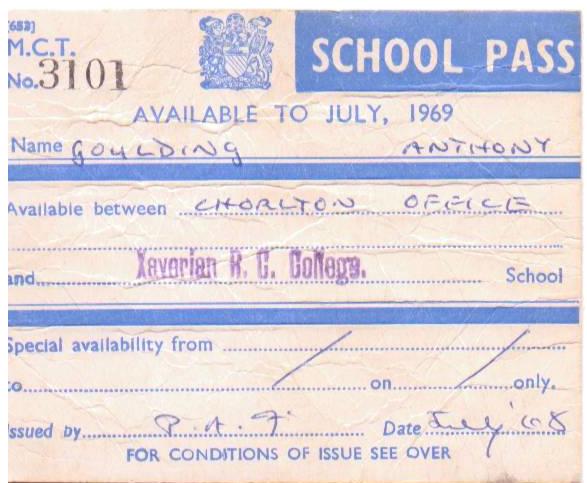
The Hyde Road depot housed the transport department’s lost property office on Devonshire Street North which I had occasion to visit more than once as a schoolchild in order to retrieve a bag or on one occasion a “Scholars Pass”. 

The huge building was very much a local landmark and featured this famous five faced clock!

I also have vivid memories of the large transport depot on Princess Road as it was located on one of the routes, I would take to attend matches at Maine Road in the late 1960s .

After alighting from either the 80 or 88 bus from Chorlton-cum-Hardy Office on Alexandra Road we would skirt the park and cross Princess Parkway by the Y.M.C.A Hostel before continuing down the road at the side of the bus depot. 

My Pass

Hyde Road's famous five-faced clock


I remember being impressed by the size of the walls and the view through the wide entrance into the garage.

Princess Road Depot in 1967

Pictures: - “Tesco” Clock courtesy of Andrea Martinez, School Pass from the collection of Tony Goulding, Princess Road depot 1967 by D. Wildgoose and Hyde Road Depot and clock 1958 by F. Hotchin (m38470 and m27231 respectively) courtesy of Manchester Libraries, Archives, and Information, Manchester City Council http://manchester.gov.uk/index.php?session=pass Wythenshawe Bus Depot: - By KJP1 - Own work, CC BY-SA 3.0, licensed under the Creative Commons Attribution-Share Alike 3.0 Unported license.

Notes: -

1) Manchester was one of the first cities to make the change from an extensive tram network to bus services, some of which in the initial phase were trolley buses which were powered from the overhead power lines but did not run on rails.


Sunday, 7 June 2020

Buses I have known and routes I travelled

I have to say I remain a fan of those old rear loading buses.


Of course they did nothing for those in wheelchairs, or wanting to board the bus with a buggy, or even a shopping trolley, but they were what I grew up with.

Even now the idea of running after the bus and jumping on, or judging the speed and slipping off before it got to a bus stop appeals to me.

To this day I have no idea why I photographed this one in its old Corporation livery or for that matter how I got the shot of the line of buses proceeding down Princes Street.

Given that the pictures date from 1979 when the old council buses departments had been merged to form SELNEC I rather think this might have been part of the steam outing which saw vintage cars buses, and traction engines make their way through the city in a glorious homage to our transport past.

But I could just be wrong, have mixed up the two pictures, and saw no more significance in the first other than back then I regularly caught the 105 along with the 100 and 101 to work.

That said the building behind on the corner of Bombay Street went long ago, replaced by by one with coloured pillars, and bits of ornate ironwork and glass leaving me just  invite  stories about the 53.

And, here is what John Anthony Hewitt sent over,  "Are you sure the line of buses is Princess Street? The street seems too narrow and a railway bridge can be seen behind the buses, which made me consider Sackville Street. 

The street name is Bombay Street that connected both streets - and still does, but with part pedestrian only. The picture of  Velvet House (from Google Maps), does look remarkably similar to the building in your photo - and it stands on the corner of Bombay Street / Sackville Street. 

The line of buses includes a 105 BE... - just behind the lamp post, which just could be the Daimler in your main photo".  And I minded to agree.

Location; Manchester

Pictures; old buses, 1979, from the collection of Andrew Simpson

Monday, 26 March 2018

A bus, a holiday home and a restoration project ........ Manchester Corporation 436

Now I like a good story and so much the better if it has already been written.

So naturally when I saw this one posted by Brian from the Museum of Transport Greater Manchester I just scooped it up.

And the rest as they say speaks for itself.

"One of our most precious buses is Manchester Corporation 436 - it's the only surviving pre-war Manchester double decker bus. 

It's awaiting restoration but we're gradually raising funds and you can donate by texting GMTS01 £5 (or £1, £1, £3 or £10) to 70070.

436 is in a pretty poor state right now, having survived for decades as a static caravan in Shropshire. 


But we know a lot about 436, through its maintenance records. The picture shows the first page of its engine maintenance card and if you take some care to inspect it closely it’s full of information. 

For example, in April 1935 when less than a year old it had 'repairs to auxiliary drive, 2 fan belts. 

1 aluminium fan fitted, Crossley Motors' which shows that Crossley did the work under guarantee. As late as October 1948 it had 'soft liners fitted' – this meant cylinder liners.


It also helps if you know some of the codes that MCT used for repair jobs – 'C1' meant cylinder head changed, 'F' meant work on the fuel pump, 'H' meant work on the vacuum exhauster and 'V' denoted that valves had been ground in.

It’s a fascinating window into the work that went in behind the scenes to keep the wheels turning (and still does to maintain our museum collection)”.

Location; Manchester

Pictures; from the collection of Museum of Transport Greater Manchester

* Museum of Transport Greater Manchester, http://www.gmts.co.uk/