Showing posts with label Chorlton Methodists. Show all posts

Tuesday, 2 September 2025

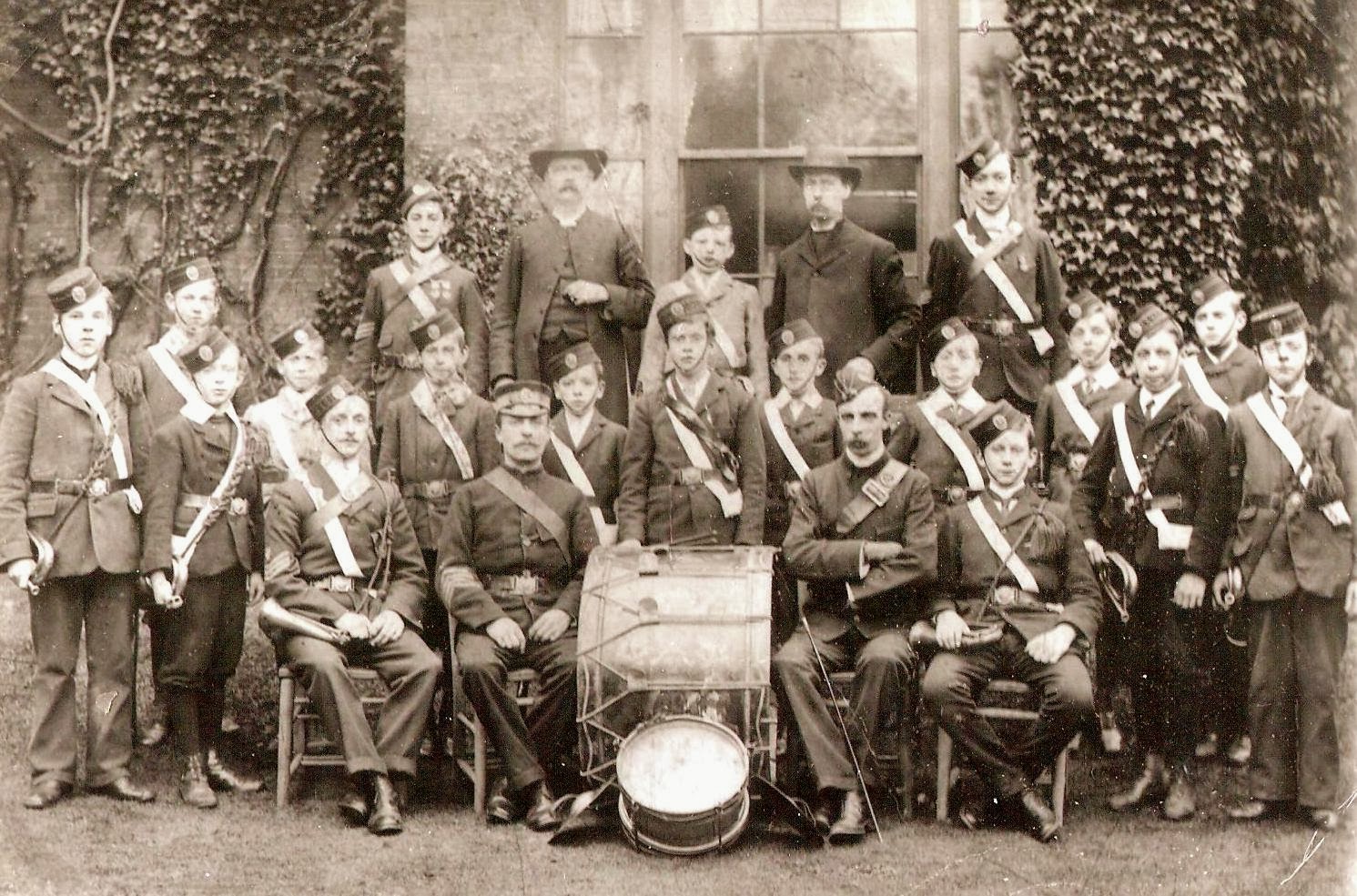
Unknown faces from Barlow Hall sometime at the end of the 19th century

I doubt that I will ever find out much more about these young men.  

The caption just says “a company of the Boy’s Brigade at Barlow Hall.  Believed to be Manchester Road Methodists.”

But the clue might just be in the connection with the Manchester Road Methodists and I am hoping that the archivist at the church will be able to help.

After all for years I had a similar picture of our Brass Band at the hall in 1893, and then by chance the exact same picture came into the collection with the addition of the men’s names, and armed with that information I was able to track down almost the entire band.*

So as ever I travel in hope.

And just as I finished the story my old friend Philip the archivist at the Methodist Church told me that the Boys Brigade had been based at the MacFaydian Church but during a period when the building was undergoing some building work they moved across to Manchester Road.

The Methodist's ran scout and girl guide groups but with a twinkle in his eye Philip commented that the Boys Brigade rather liked their temporary new home but was unable to say whether it became a permanent home.

Location; Chorlton

Picture; courtesy of W. Jackson, from the Lloyd collection, date unknown

*Chorlton brass band, http://chorltonhistory.blogspot.co.uk/search/label/Chorlton%20Brass%20Band

Friday, 7 July 2023

A Sunday School …. Red Cross Nurses …. and the Edge

Last night proved to be an entertaining evening down at the Edge as we watched “Tickle your fancy host a night of exciting turns with something for everyone”.

The Edge and a heap of flowers, 2023

These included Doolally the comedy singing act who compèred the night with their usual mix of comedy, and topical songs, and in between there was a folk group, a poet and a musician along with a comic and actor.

And in the interval, I reflected on the Edge Theatre, its story and the bigger history of the building it occupies.

The Edge on Manchester Road, 2023
The Edge opened in 2011 and remains “Manchester’s Theatre for Participation. Our beautiful venue has entertained, captivated and enthralled audiences with some of the best small scale touring theatre in the country, alongside our own productions made by our wonderful in-house creatives.

Over the years we’ve worked with hundreds of fantastic actors and musicians; many are professional, some have learning disabilities, some have experience of homelessness, some are from our local community and all of them are brilliant!

As theatre makers we delight in creating shows which reflect the world that we live in, even if we’ve set them on the moon. They’re honest, relevant and always full of hope.

As a Manchester Cultural Partner we play a vital role in the cultural offer of the city. As leaders in participation we provide a range of exciting opportunities for people to be creative. At The Edge you can Act, Sing, Dance, play the Ukulele, Write, Paint, Draw or just be. Our café is known as one of the most friendly and welcoming in Chorlton!*

For at least eight of those years it is the final destination for the Library sponsored history walks which are part of Chorlton Book Festival.

And at the end of the walk through Chorlton’s past, Jenine, Dom and their team have offered up a much-needed light meal in the Dressing Room Café.

All of which leads me on to the building which was opened in the 1880s and was the Sunday School for the Methodist Church which was built a decade earlier.

"Wounded Soldiers of the Wesleyan School Hospital Xmas 1917”, 2013

During the Great War the Sunday School was handed over to the Red Cross as a centre for servicemen recovering from wounds, ailments and infections, and was one of three so far identified in Chorlton. The others were the McLaren Baptist Church Sunday School on Edge Lane and a private residence on Wilbraham Road.**

As yet I don’t have any pictures of the nurses, or their patients, but we do have a silver cup, which carries the inscription “Presented to the Wesleyan Church by the Wounded Soldiers of the Wesleyan School Hospital Xmas 1917”, along with a letter sent by a soldier to the children of St Clement’s Sunday School thanking them for the gift of a pillow.

Chorlton Operatic Society, 1920
And in the interval of the show last night I wandered through the corridors and pondered on that period in the story of the building, which with the end of the Great War was soon forgotten.

Less likely to be lost from memory  is the theatre which was built by the Methodists in the upper hall of the Sunday School.  From memory I think it dates from the 1950s or possibly two decades earlier and was still there when the Edge opened.  But by then it was in a poor state and no longer really fit for purpose.

That said it might have hosted performances by our own Chorlton Operatic Society which was active from 1907 through to the mid 1930s, and offers up that sense of historic continuity which links the Sunday School, a heap of Red Cross Nurses …. and the Edge.

Location; The Edge, Chorlton

Pictures; the Edge, 2023, from the collection of Andrew Simpson, picture of the silver cup, 2013, courtesy of Philip Lloyd and the programe of the Chorlton Operatic Society April 1920, donated anonymously.

*The Edge, https://www.edgetheatre.co.uk/

** Red Cross Hospital, https://chorltonhistory.blogspot.com/search/label/Red%20Cross%20Hospitals

***Chorlton Operatic Society, https://chorltonhistory.blogspot.com/search?q=Chorlton+Operatic+Society

Sunshine at the Edge, 2023


Thursday, 10 December 2020

John Wesley and Methodism .. today on the wireless

The story of how Methodism came to Chorlton is an intriguing one and involved a visit from a soldier and his friends to the township in the 18th century. 


Having walked in from Manchester they began preaching and drew an small group of people.  Within a few decades, there were a number of Wesleyan families who worshiped in each other's homes, or in barns in the winter and in the open air in the summer.  They built their first chapel on Beech Road in the 1820s, and were an important part of the community.

So this episode of In Our Time is one I shall listen to with great intrest. 

"Melvyn Bragg and guests discuss John Wesley (1703 - 1791) and the movement he was to lead and inspire. As a student, he was mocked for approaching religion too methodically and this jibe gave a name to the movement: Methodism. 

Wesley took his ideas out across Britain wherever there was an appetite for Christian revival, preaching in the open, especially the new industrial areas. Others spread Methodism too, such as George Whitefield, and the sheer energy of the movement led to splits within it, but it soon became a major force.

With, Stephen Plant, Dean and Runcie Fellow at Trinity Hall at the University of Cambridge, Eryn White, Reader in Early Modern History at Aberystwyth University, and William Gibson, Professor of Ecclesiastical History at Oxford Brookes University and Director of the Oxford Centre for Methodism and Church History.

Producer: Simon Tillotson"

Picture; Wesleyan Chapel, Beech Road, 1908, Wesleyan Bazaar Souvenir Hand book, 1908

*John Wesley and Methodism, In Our Time, Radio 4, https://www.bbc.co.uk/programmes/m000q3m2


Thursday, 23 July 2020

Prominent Methodists of Chorlton-cum-Hardy..... another story from Tony Goulding

Founded in 1881 as “The Manchester Theological College” and renamed in 1906 in honour of Sir William Pickles Hartley, of “Hartley’s Jams” fame, who was among the church's most prominent benefactors; Hartley College was an institute for the training of ministers for the Primitive Methodist Church. 

 Hartley (Primitive Methodist) Training College,1924
Two of the college’s earliest Principals moved to addresses in Chorlton-cum-Hardy on their retirement.

Rev. James Macpherson
   
 Rev. James Macpherson was the Principal of “The Manchester Theological College” for the first eight years of its life (1881-1889).

He also edited the Primitive Methodist’s Magazine - “The Connexional” from 1871 until 1876, during which time, in 1872, he was elected President of the Primitive Methodist Conference.

He was born, in Edinburgh, in 1814.  In the September quarter of 1839, he married Fanny Bishop Buck in Weymouth, Dorset.  The couple produced five children, Christian, Archibald, Sophia, Jessie, and George. All five children were born in the North-West of England; the first three in Rochdale, Jessie near Chester and George in Haslingden, Lancashire.

The geographical range of the civil records of this family does, however, indicate the typical lifestyle of a Methodist minister who would rarely be attached to the same church/chapel for more than a couple of years. In the March quarter 1858, his wife, Fanny, died in Blackburn, Lancashire at the age of just 48. Just over three years later in the September quarter of 1861 he re-married, also in Blackburn, Mary Jane Aspinall.
     
Rev. Macpherson’s daughter, Christian, moved to live in Edinburgh, Scotland where she met Duncan Kennedy, a joiner and builder, who she married in Partick, nr. Glasgow on 13th February, 1873. Later his daughter and her husband returned to Lancashire and settled in the Cheetham area of Manchester.

Rev. Macpherson had by this time acquired a row of houses on Cluny Street, Cheetham one of which was already occupied by his son George with his wife and family. Duncan and Christian moved into an adjoining property with Rev. MacPherson appointing Duncan Kennedy as his agent for the remaining properties.
 
Shortly after the loss of his second wife, who died in South Manchester, during the March quarter of 1888, and his retirement from his post as Principal, Rev. Macpherson continued his ministry in South Manchester living initially at 30, Meadow Street, Moss Side, with his two unmarried daughters, his son and three grandchildren. He spent the final seven years of his life in Chorlton-cum-Hardy, first renting a house at 27, Albany Road from 1894 until 1896. Then in 1897 the rate book shows him as the owner occupier of 23, High Lane, a large newly-built house of 10 rooms, where at the 1901 census he was still living with his single daughters Jessie and Sophia, his widowed daughter Christian Kennedy, and his son George. Adjacent to this new property which he named “Cluny Cottage” there commenced the development of new buildings for the Primitive Methodist Church.


Macpherson Memorial (Primitive Methodist) Church 1959, High Lane
A school / church hall was built in 1896 followed by a church, with services taking place from 1898 and opened fully on the 20th September, 1902. As Rev. Macpherson had by this time passed away at his home on 18th April, 1901 the new church was given the name of “The Macpherson Memorial”
    As of 1900 the Manchester rate books show Rev. Macpherson’s Cluny Street properties alone providing an approximate rental income of upwards of £350. Given this large income his naming of his family home “Cluny Cottage” and the new church being named after him it is perhaps, not too conjectural to conclude that both “Cluny Cottage” and adjacent Primitive Methodist structures were all financed from the Cheetham property portfolio. What can be said for definite is that, in December, 1902, the final sworn assessment of his estate, for probate purposes, was £8,214-1s-0d or just over £1,000,000 at today’s value.

Rev. William Jones Davies
   
Rev. William Jones Davies was for five years from 1908 until 1913 the principal of the renamed Hartley College on Alexandra Road, Whalley Range, Manchester.
Rev. Davies was born in 1851 in Lydham, on the Shropshire/Montgomeryshire, England/Wales border. His parents were Edward, a farmer and Martha (née Jones). William’s younger brother, Edward Robinson, was also a Primitive Methodist minister. Rev. Davies married Emily Jane Bradford in the June quarter of 1883 while he was stationed at Cradley Heath, South Staffordshire.

The couple had seven children including one set of twins, George Denis and Mary Christine, born in the September quarter of 1888 in the Clun district of Shropshire. Sadly, Mary Christine was to die tragically young at just 12 years old while Rev. Davies was serving as a minister in Grimsby, Lincolnshire. Of his other children; one of his remaining daughters, Dorothy Llewella, became a student at Manchester University and he would have witnessed her degree ceremony at the University’s Whitworth Hall on 3rd July, 1915 when she was awarded an Honours Degree of Bachelor of Arts (Class 2:1) in History. His first born, William Claud Howard, followed him into the Primitive Methodist ministry who after his father’s death in 1916 left the Primitive Methodist Church and later became a minister in the Presbyterian Church.
       In retirement, Rev. William Jones Davies lived at 6, Oak Avenue, Chorlton-cum-Hardy, Manchester, where he died on the 21st June, 1916.

6 Oak Avenue, 2020
Rev John Bedford
Rev. John Bedford, a one-time President of the Wesleyan Conference (1868-69), passed away in the early hours of the 20th November, 1879 at his home, 18, Whitelow Road, Chorlton-cum-Hardy.
    He was born on 27th July, 1810 in Wakefield, Yorkshire (West Riding). His father, also named John, died when he was only five years old. After initially working in a solicitor’s office, in Leeds, he became a full-time minister of the Wesleyan Methodist Church in Glasgow, Scotland in 1831. Shortly after becoming a minister he met Maria Gledhill who he married in 1835 and with whom he had two surviving sons William Henry born in Bolton, Lancashire in the December quarter of 1842 and Frederick Samuel who was born in Birmingham in the December quarter of 1850.
     From, 1860 his increasing rôle in the administrative affairs of the Wesleyan conference necessitated his permanent residence in the Manchester area. In this year, 1860, he was appointed to the general chapel committee and soon rose to the position of being its secretary. At the church’s conference in Bristol in 1867, Rev. Bedford was elected to serve as its President for the following year.
Rev. Bedford first settled in the Chorlton-on-Medlock district of Manchester, where he resided for over a decade at 18, Acomb Street before around the time of his semi-retirement from his Secretarial work for the “Conference” he made the move to Chorlton-cum-Hardy.
According to the rate books of the Chorlton-cum-Hardy township this was, from the 6th September, 1872, at Wilton Street, Chorlton-cum-Hardy, where a near neighbour was a young Church of England clergyman; Rev. Hugh Bethell Jones. Somewhat unusually for that time there is some evidence that the two men were on very friendly terms. When in March, 1876 a subscription was raised to present Rev. Bethell Jones with a gift to mark his departure from St. Clement’s, on his appointment to the rectorship of St John the Devine’s, Brooklands, Cheshire, Rev. Bedford contributed one guinea to the collection. Although he was too indisposed to attend the presentation to his fellow cleric at the National School on Chorlton Green on 23rd March, 1876 he did send a very glowing testimonial which was read out at the ceremony and transcribed in the report of the event in the “Manchester Courier and Lancashire General Advertiser” on the 25th March, 1876.
 
40 Whitelow Road, 2020
Although Rev. Bedford died in 1879, his widow, Maria, and son, Frederick Samuel, continued to live on Whitelow Road. Maria died in the December quarter of 1888. Frederick Samuel and his family continued to live on Whitelow Road, however, and at some stage they had moved to number 40 (Although this was possibly due to the houses on Whitelow Road being re-numbered following a new housing development). Even after Frederick Samuel passed away in the March quarter of 1909 his widow Mary Jane remained in the house; she was still recorded living at 40, Whitelow Road in Kelly’s 1933 Directory of Lancashire, Manchester, Salford & Suburbs. In the meantime, two of Rev. Bedford’s grand-daughters Nellie, in 1921, and Ethel Mary in 1922, had held their weddings in the Methodist Church on Manchester Road. Throughout the First World War, Ethel Mary had served as a volunteer of the British Red Cross and in the kitchens and later as a nurse in two of the Red Cross Hospitals in Chorlton-cum-Hardy. One was at a building she would have been very familiar with; the Manchester Road Methodist Sunday School. The other was the Baptist’s Sunday School on Wilbraham Road.
Location; Chorlton

Pictures; Hartley (Primitive Methodist) Training College (1924)
 m 68658 (Unknown), Macpherson Memorial (Primitive Methodist) Church 1959, High Lane, Chorlton-cum-Hardy, m 17904 A.E.Landers, courtesy of Manchester Libraries, Information and Archives, Manchester City Council, http://images.manchester.gov.uk/index.php?session=pass
 6, Oak Avenue, 2020, 40, Whitelow Road 2020

Tony Goulding, © 2020

Sources
 I would like to acknowledge a good  source of data "My Primitive Methodists" website
 E-mail address:-  enquiries@englesbrook.org.uk            
Sunday, 16 March 2014

Goodbye to that College in Didsbury ............ part four a link with Chorlton.

For nearly 70 years the college at Didsbury has been turning out students.

I should know I was one of the class of ’72, newly graduated from Manchester Polytechnic and ready for a year’s teacher training.

The chapel in 1908
Now what I didn’t know at the time was that for a century before it had been a theological college, bought by the Methodists and only vacated by them in 1942.

Nor until recently did I make the connection with Chorlton, which is all the more surprising because there has been a Methodist presence here for a long time.

So the popular story goes Methodism came to Chorlton in 1770 when a soldier and a few companions arrived in the township and began preaching.  The message took hold and by 1800 a Methodist Society had been formed and Wesleyan ministers were visiting each Sunday.

At first they had worshipped on the green and in barns, and then in their chapel on what is now Beech Road.

This was rebuilt in 1826 and later still a new church built on Manchester Road which relegated the old chapel to occasional use.

Rev. James Butterworth
 “Then in 1918 a young student from Didsbury Ministerial Training College, just out of the army, happened to be cycling through Chorlton when he saw this dark and closed building next to a brightly lit and lively public house and thought to himself ‘this is wrong’, he saw in his mind’s eye, the Chapel as warm and inviting as the pub. 

So he went to his tutors and asked permission to start a boys club there, and he and some other students canvassed the roads in the immediate area and had a very good response.

Since then preaching re-commenced in 1921 and the boys’ and girls’ club provided a youthful choir. Fellowship classes were started, the women’s meeting had a membership of 50-60 and there were concerts every Saturday night.

The name of the young trainee minister was Rev. James Butterworth, and having cut his teeth here in Chorlton went on to found ‘Clubland’ in the East End of London, which did mighty work among the poor and dispossessed of that area.”*

Philip first told me the story a few years back and since then has kindly provided me with an extract from an article he wrote on the chapel on Beech Road.

*Philip E. Lloyd, January 2008

Pictures; Wesleyan Bazaar Souvenir Hand book, 1908, and Rev. James Butterworth, Walworth Methodist Church

See also James Butterwoth, Christian youth work work and Clubland, http://infed.org/mobi/james-butterworth-christian-youth-work-and-clubland/