Showing posts with label Lost Chorlton shops. Show all posts

Monday, 18 May 2026

Losing another Chorlton ghost sign …….

I rather think if I go back later this afternoon this ghost sign will have gone.


It was uncovered as work progresses on what was “Close”, the “Male Grooming” shop at 539a Wilbraham Road.

It was doing the business of all things male grooming from 2012 and was still last year.

Now for those who don’t know ghost signs are all that remain of a business, or product that no longer exists, and so here we have two, the former sign high up at the top of the building to Close, and uncovered for a brief while that of "J.M. Trophies, Engraving and Shoe Repairs".

I have a vague memory of the trophy shop, but it is vague and may not be real.

But since I have been in Chorlton for fifty years I might have passed it, which just leaves someone to come forward who used the place.

I know that back in 2008 it was "NV The Dawn of a New Era in Tanning" while in 1969 it was home to the Manchester Corporation Rating Office and before that I have yet to discover.  I know that the building dates from around 1904 but that at present is it.

Not that I shall be deterred from finding out more.  There are the street directories which lists businesses, and the Rate Books so with a bit of research the story of 539a Wilbraham Road will be revealed.

As for its future, a quick loo at the City’s Planning Portal has not shown up anything.

Location; Wilbraham Road

Pictures; ghost signs on Wilbraham Road, 2026, from the collection of Andrew Simpson

Wednesday, 13 May 2026

The Lost Chorlton pictures ......... no 15. .........

 Now I am pretty confident that this one will bring up a rich collection of memories.

It continued trading into the 1980s and was a wonderful place where the chesses were piled high and there was pretty much any cheese you wanted.

And l have been corrected by John Paul Moran who tells me it continued trading well in to the 1990s. Thanks John.

Location; Wilbraham Road


Picture; the bacon and cheese shop, 1979, from the collection of Andrew Simpson

Thursday, 30 April 2026

Looking for a ball of wool, a lb. of apples and much more on Wilbraham Road

I doubt that any one born before 1980 would ever think that the stretch of Wilbraham Road from Albany down to Manchester Road would be populated by a string of fast food outlets, bars and charity shops or that Quarmby’s, Dewhurst’s and Meadow’s would have vanished like snow under a winter sun.

It’s not an original idea I know, but in the space of two decades much traditional retailing has gone.

I miss it, but I recognize that that way of shopping has pretty much gone, and the arrival of the bar culture has at least kept the shops from staying closed.

What follows are two pictures taken some time in the 1950s into the 1960s, of the businesses on Wilbraham Road and Barlow Moor Road.

I could write more, having explored the history of some of the shops, and made comment on the road signs and bus stops, but I won’t.  

However, the challenge is there for anyone what can to trawl their memory and offer up some memories of the shops, or better still some pictures.

Location; Chorlton

Pictures; Wilbraham and Barlow Moor Road’s, circa 1950s/60s. from the collection of Dave King

Thursday, 2 April 2026

The Lost Chorlton pictures ......... no 9. ......... Beech Road

Now I had quite forgotten this picture, which had sat as a negative in the cellar for four decades.

And I am rather pleased it has come to light.

We are on Acres Road and to our right is the box factory which had once been a laundry, and opposite is the hair dressers which was to become Cafe on the Green.

Directly ahead is the pet shop which closed earlier in 2019, and beside it The Village Wholefood Shop.

Back then there was a debate about that bit of open land, with some of the traders urging the Corporation to make it into a car park which the Council agreed to if the traders made a contribution to the cost.

This never happened and what had once been a fine house before it was demolished remain open land for another decade.

Location; Chorlton

Picture; Beech Road, 1979 from the collection of Andrew Simpson

Saturday, 28 March 2026

The Lost Chorlton pictures ......... before the trend

This is Beech Road as it was just forty years ago.

Where today there is a studio, a gallery, and a clothes shop, there was a flower shop which offered a selection of fruit and veg as a side line, an old fashioned hardware store and Dave the Butcher.

Now if you are of a certain age the smell of a hardware shop is a powerful reminder of how we once did things.

The floor was invariably always the bare timbers, and there was that pungent smell of paraffin, and waxed string.

You could buy anything from a small nut and bolt, to sheets of brown wrapping paper and sealing wax.

And had I been on Beech Road a full decade earlier I could have asked Mr Heger, the relative merits of pink paraffin, and just how many nails I would need to fasten down a lose floor board.

That said back then we did have our own photographic shop which traded from what is now Pottery Corner.

So some things haven’t changed.

Location; Chorlton

Picture; Beech Road, 1979 from the collection of Andrew Simpson

Monday, 2 March 2026

A conversation …. the Saturday boy … and heaps of vegetables …. at Muriel and Richard’s on Beech Road

Now Muriel and Richard’s will always have be a special place for me.


Their fruit and veg was always the best, and at Christmas Muriel always did that Nativity scene where local kids were encouraged to make figures for the display.

But above that they were always very kind to me, and during a time when I was juggling work, bringing up three kids and only shopping on Beech Road they could be relied to help out.

In particular Muriel acted as my bank, advancing me cash and letting me run up a tab.

To the consternation of some I would choose the fruit and veg, Muriel would ask if I needed any money and I would leave with assorted apples, pears, potatoes and more, with cash in hand.  To which some muttered that this was not how it was done.

Shops were not supposed to hand out produce and money and wave goodbye to the customer.  But this was Muriel’s and every Saturday the tab was settled.

I shopped there regularly through the 1970s into the 1990s and beyond.

I will have to ask Muriel just when they took over the shop, because I know in 1969 it was a confectioner’s run by a F. Lyth and now it is a letting agency.

Back then at the end of the 60s their shop was flanked by Joan Newman’s hairdressers and Mr. Morgan’s off license.

And a couple of decades later, the cutting of hair would be replaced briefly by a shop selling pianos before it settled on its long and continuing relationship with serving food and alcohol, while after a time as a vacant premises Mr. Morgan’s place became the Italian deli.


And that is about it.

Location; Beech Road

Pictures; Muriel and Richard’s, 1979, & 2002, and Muriel, 2004, from the collection of Andrew Simpson


Sunday, 1 March 2026

When plastic bowls and a picture of San Francisco were a must ........ back at “Kingy”

Now I make no apology at returning to Kingspot.

If you are of a certain age and that pretty much covers everyone in Chorlton, you will remember Kingspot.

And for those who moved in after the shop closed here are two more pictures of what was an institution.

I wrote about it yesterday reflecting that “it was just one of those places we took for granted and long before Pound Shops it was somewhere you could get a bargain.

Here could be found everything from washing pegs, to happy colourful toys and that fabulous print of the San Francisco Bridge at sunset.

Much of what was on offer was plastic and sometimes I wondered whether they had their own plastic factory somewhere east of Hong Kong.


So it was no surprise that Kingspot was always full and getting round the shop could be a challenge which often involved avoiding the buggies, and shopping trollies as you worked you way down the two isles looking for a washing up bowl and ending up instead with two plastic imitation Flying Ducks to hang above the plastic water fountain.

Our kids always seemed to be in their usually when the latest craze for BB guns hit Chorlton which I suspect followed a few days after a new consignment of cheap toys had arrived from China."

And no sooner had I posted the story than  Bernard sent over two of his own pictures adding that "here are a couple of photos of Kingspot I took, I think it was Marhch1998,from data on photo. Maybe you could add them to your Kingspot blog."

Which of course I could and did.

Location; Chorlton

Pictures; Kingspot, 1998, from the collection of Bernard Leach

Saturday, 28 February 2026

The bold and the new …… down on Manchester Road in 1973

Now I am not a fan of just posting an old image and leaving it at that.

Often when I come across these on social media, it is posted with no date, no indication of where it has come from and it stands alone with no additional commentary.

All of which makes it difficult to appreciate its true significance, because without a date and a source, there is no context, other than to reflect that “here is a picture which is different from now, when they did things differently back then”.

Of course, that may sound sniffy, but if you are interested in the past you should always be after finding out as much as you can.

So, having said all of that, here is a picture with little in the way of additional information.

We are on Manchester Road where it joins Upper Chorlton Road, and the year is 1973 and it comes from the City’s Local Image Collection.*

It was one  of a series taken by H Milligan in the 1970s and what I like about the picture is the way that it records, just what a collection of “modern shopfronts” looked like back then.

Today, they look dated and even a bit amateurish but in 1973 they appeared sharp, modern and at the cutting edge of what was thought stylish.

I particularly liked the use of timber cladding seen on the bookie’s and that name which seems to topple down from the top of the sign.
Today I prefer the original shop fronts which are still visible on two of the fronts.

And that is all.

Location; Chorlton

Picture; Manchester Road, 1973, H Milligan, m17964, courtesy of Manchester Libraries, Information and Archives, Manchester City Council, http://images.manchester.gov.uk/index.php?session=pass


Friday, 27 February 2026

A Chorlton revolution ……….. the self service shop


Now we are so familiar with the supermarket and the convenience store, that it takes a moment to  appreciate just how much self service shopping was a revolution in how we bought our groceries.

I am of that generation, who was part of that revolution, and I can remember just how liberating it felt at the time to wander the isles, and touch and choose which apples, tins of vegetables and packets of biscuits to buy.

Today we can be cynical about it all, not least the way it allowed shops to cut costs, and set the customer doing some of the work, but it was I maintain quite liberating.

Here in Chorlton, there is still a book to write about the arrival of those first self service shops, including which were the first and just what people thought about them.

The Co-op  was the first to embrace the new way of shopping, turning a department of its store in Romford over to self service in 1943 and five years later fully converting its premise in Portsea to selfservice.*

And in 1949, The Manchester & Salford Equitable Co-op  began altering its existing stores the following year, with our own Hardy Lane opening in 1959.

Until this week, I didn’t know that the shop on the corner of Manchester and Ransfield roads, was offering its customers, “Self Service” in 1961 and a quick trawl of the directories should pinpoint when the Mark Down began its new venture.
Leaving that aside, it is the shop window which is equally fascinating, offering up a range of products which are still familiar, but at prices which at first glance appear astonishing.

But those prices must be set against most people’s incomes which were of course much lower than today.
The more pertinent question would be to explore and then compare the average food bill in 1961 with today and its percentage of all house hold bills.

All of which is getting too serious and so instead I shall just leave you pondering on the prices, which are expressed in shillings and pennies, which I suspect will be a mystery to any one born just before we went decimal in 1971.

Our own kids look back at me with sheer bewilderment when I explain that 12 pennies made a shilling, that 20 shillings made a pound and that 240 pennies made a pound.  Added to which there was a coins called a threepenny bit, a sixpence, and a half crown, all of which competed with the farthing and the ha’penny.

Added to which the price of posh objects often came as guineas and not pounds.

And that neatly brings me back to self service shopping which predated our decimal coinage by just a few decades.

Location; Chorlton

Pictures, Manchester Road, 1961, A H Downs, m18078 and current prices, Mark Down No. 93 Manchester Road, 1961, , A H Downs, m18080, courtesy of Manchester Libraries, Information and Archives, Manchester City Council, http://images.manchester.gov.uk/index.php?session=pass, and Spotlight on Self Service, from Co-Op First Self Service UK, http://hardylane.blogspot.com/

*Co-Op First Self Service UK, http://hardylane.blogspot.com/

Thursday, 26 February 2026

Hair, .....accesories ..... and sunbeds ....... Stevenson's..... and Chorlton's history through its shopping bags

Now generations of people will remember with fondness the hairdressing business of Stevenson.*

J. R. Stevenson, 1910
For many it was where you went to have your hair done, or buy those must have accessories, and of course it provided employment for lots of young people, from those doing Saturday jobs to those training to be "Stylists to the stars".

It is a place I have written about, and its presence here in Chorlotn pretty much spans the last century, first on Barlow Moor Road and then on Wilbraham Road.

My interest was reignited when Annie Keogh offered up this bag from the shop, which is an appropriate image of where we shopped and kicks off a new series on Chorlton's history through its shopping bags. 

 Now that's a zippy title.

Included in the series will be many of businesses which defined Chorlton, from Kingspot and Hanbury's to the big chains like Liptons and Safeway.

And of course I am always open to more contributions.

Hair, cosmetics and fancy goods, date unknown

Location; Chorlton

Pictures; The shopping bag, date unknow, courtesy of Annie Keogh, and advert for J.R.Stevenson’s, 1908 from the Souvenir of the Grand Wesleyan Church Bazaar, 1908, courtesy of Philip Lloyd

*Almost a century of cutting hair on Wilbraham Road with the Stevenson family, https://chorltonhistory.blogspot.com/2020/04/almost-century-of-cutting-hair-on.html

**"Stylist to the Stars" is a lift from Carol Ardern's shop at All Saints who proudly proclaimed its connection to show business in the 1970s.

Wednesday, 25 February 2026

The Lost Chorlton pictures ......... no 6. ......... across the village green

I doubt that anyone will remember the corner shop across the green when Mr Unsworth sold his meat from the place, and at present I don’t know the history of the shop from 1911 till 1969.


In that year it was J McNicholls, the hairdresser and a little under a decade later I got my haircut by Bob who ran the shop.

Sometime in the 1980s or later Bob sold up and moved to Norfolk.

Location; Chorlton

Picture; the shop, 1983, from the collection of Andrew Simpson

Tuesday, 24 February 2026

A ghost cinema and a family home ……. Barlow Moor Road …. 1962

There will be plenty of people who instantly recognise the scene.

We are on Barlow Moor Road, and for many the large impressive building with its tiled faced will bring back memories of the cinema.

For this was the Palais de Luxe, which was opened in 1914, changed its name to the Palace around 1946, and closed  eleven years later.

After which the building was owned by Radio Rentals, and then sometime before 1969 it was taken over by Tesco and traded as such, until 1974.

This I know because of a reference in the planning records which record “Continuance of use of radio and television service centre as supermarket”.


Now given that it was already trading as a Tesco store, I think this might have been the moment when it was sold on to Hanburys, which was a chain of stores across the north which had its origins, when Jeremiah Hanbury opened a small store in 1889 in Market Street, Farnworth, selling butter and bacon.

Forty years later the business was bought by Bolton wholesale grocers E.H. Steele Ltd, and in 1997 the 31 Hanbury’s stores in the north west were acquired by United Norwest Co-op.

But for many it will always be the picture palace, and carried the distinction of being our first purpose built cinema, having seen off the  Chorlton Pavilion and Winter Gardens on Wilbraham Road, which in turn had done for the Picturedrome on Longford Road.


I missed it by just 20 or so years, but have written about it over the years along with all the Chorlton picture houses, and even uncovered the remains of the plaster features above the screen which still survived in the upstairs area of the former supermarket.*

And there will also be many who can reel off the various retail businesses which inhabited the building to the left, and which was once home to Douglas Cook who lived there in the 1940s and remembers, “living in the detached house right next to the cinema, on the corner of Malton Avenue and Barlow Moor Road, no 477, so the cinema wall formed one side of our garden. I went to the Burnage High School for Boys and also the Wilbraham School of Music in High Lane.”

And that I think is enough for now.

Location; Chorlton

Picture a ghost cinema and a family home, 1962-3801.4, courtesy of Manchester Libraries, Information and Archives, Manchester City Council, http://images.manchester.gov.uk/index.php?session=pass and Hanburys shopping bag, courtesy of Catherine Brownhill


Monday, 23 February 2026

How we shopped on Beech Road in 1969 and thirty years later

First the apology, which is simply I have lost the names of the authors of this shopping survey, but I hope they won’t mind me reproducing.

It was passed to me my Bernard Leech a few years ago, who I hope can supply their names.

But for now, here it is ……… how we shopped on Beech Road in 1969, and 1999.

And today of course a new survey would reveal the massive changes which have seen retailing outlets retreat to be replaced by a mix of bars, cafes, and restaurants with some gift shops and just the odd traditional shop.

Not rocket science, perhaps or even a remarkable set of observations, but still a bit of history.

Location; Chorlton


Picture; shopping survey, Beech Road, 1969 & 1999

Sunday, 22 February 2026

Pictures from Beech Road ……… Buonissimo, Muriel and Richard and the bar with lots of names

Now here's a vanished scene, well  almost.


They must date from before 2000, when I swapped smelly photography for digital.

And as you do the last old fashioned photographs were consigned to that very special box, on the equally special shelf, and promptly forgotten for decades.

In the intervening years, Bob and Del rented out the deli to Marcus who retained the name, but then moved on, which is how we now have that fine Spanish tapas bar, while next door Muriel and Richard retired and the last fruit and veg shop became a letting agency.

Nor was that all, because bit by bit Beech Road, slipped effortlessly into a strip of bars, cafés, restaurants and interesting shops.

All of which might well be summed up by the place on the corner with Acres Road, which I remember as a piano shop and and closed for better things.

And without ever wanting to sound like Methuselah I can claim to have eaten there from when it first opened as Café on the Green, and later when it was known variously as Blue Note, the Nose and Marmalade and the Parlour.

And since the Parlour a heap more


Location; Beech Road

Pictures; Beech Road; sometime before now, from the collection of Andrew Simpson

Saturday, 24 January 2026

A lost Chorlton bottle ….. the Beech Road offi ……… and a trip back to a Dickensian Manchester

It started with the find of a broken bottle in a garden on Wilton Road.

The lost and found bottle, 2023

My friend Declan wrote “Hi Andrew. Neighbours have builders in digging trenches for an extension. They unearthed an old glass bottle, possibly discarded when the houses were being built in the 1890’s?”

The shop on Beech Road, 1900s
It carries the name Mason and Burrows.

Now, I can date the house to between 1894 and 1903 when the property was occupied by a William Simpson.

And it may just be possible that he or a subsequent resident bought the bottle from a branch of Mason and Burrows “grocers & wine & spirit Merchants”.*

In 1895 they had shops on Moss Lane, Great Western Street and  Moss Lane East, and by 1911 had expanded further south to Stockport Road, 23 Wilbraham Road and 46 Beech Road.

The romantic un historian bit of me would like the bottle to have come from the Beech Road offi, which continued selling beer, wine, and tobacco into the 2000s before opening as "Espicerie Ludo, Wine Merchant and Fine Groceries”.

And as you do, I went looking for them.  So far, I have tracked them back to 1886 to Sun Entry, which was a small street off Cock Pit Hill and Bull’s Head Yard which was part of a warren of narrow streets and closed courts bounded by Corporation Street, Market Place and Market Street.

Sun Entry, 1886
They had a Dickensian feel, and non-more so that Sun Entry which snaked down from Cock Pitt Hill towards Market Street becoming progressively narrower till it ended as an enclosed passageway.

The area was already in existence by 1793 and elements show up on Tinker’s map a full 21 years earlier.

There will be a few people who remember the area before its demolition in the late 1960s which was replaced by that modernistic complex which included the Marks and Spencer store with its wavey canopy.

I wish I had known that older Manchester and walked the alleys’ and entrances.

In the 1880s Mason and Burrows occupied a large premises which fronted both Bulls’s Head Yard and Sun Entry and may have shared the “arched beer cellars” which extended down to the small and equally narrow Hopewood Avenue.

Sun Entry from Cock Pitt Hill, 1910

There is more but I suspect the historic record is not up to revealing the secret of the number on the base of the bottle which was 1302. It may be a reference to a batch or to one of the products they sold.

Bottle bottom with a number, 2023
But unless we can have access to one of their catalogues, I fear that number 1302 will remain in the shadows.

Still, I like the way that on a sunny day in Chorlton the story took us back into the late 18th century in one of those lost and now largely forgotten bits of the city.

Location; Wilton Road, Sun Entry and Bulls Head Yard

Pictures; the lost Mason and Burrows bottle 2023, Mason Burrrows shop, Beech Road circa 1900s Sun Entry, 1886, from Goad’s Fire Insurance Maps, courtesy of Digital Archives Association, http://digitalarchives.co.uk/ and Sun Entry, from Cock Pit Hill, City Engineers, 1902,and in 1944, City Planners 05914, courtesy of Manchester Libraries, Information and Archives, Manchester City Council, http://images.manchester.gov.uk/index.php?session=pass

Sun Entry narrows towards, Market Street, 1944

* Mason and Burrows, Slater’s Manchester & Salford Directory, 1895


Thursday, 22 January 2026

Ghosts in Chorlton .... on Wilbraham Road

Now I have Sonoe Shimizu to thank for this picture of what was once the chemist on the corner of Wilbraham and Albany Roads.

Ghost chemist and future coffee shop, 2025
And the ghost sign announcing “Dispensing Chemist” has been hidden for a very long time.

That said the property has always been a chemist dating back to the beginning of the 20th century.

Originally the entire row of shops known as Highfield which runs from Albany Road to Keppel Road had been private dwellings fronted by small gardens with access to the houses by a short flight of steps.

And some of the shops including our chemist were still on two levels with the rear of premises raised above the shop floor.

Mr. Flint's chemist shop, circa 1910
Highfield, I suspect had been planned and built as town houses with an eye to attracting residents who wanted to use the new Chorlton Railway Station which offered a quick service to and from central Manchester.

The first conversions in Highfield from residential to business use were in place by 1903, but the chemists were a little later, and by 1909 it is listed as belonging to “Francis B Flint Chemist”.

Shopping at the chemist in 1935
In its time it has been a Co-op Chemist and briefly one of the Everest chain, but as the new window signage indicates it is to become a coffee shop.

And that really is it, other than to thank Sonoe who sent me the images with the message, "Hi Andrew, I live locally in Chorlton and saw this this morning. It’s opposite Morrisons. Thought you might be interested”, which of course I was.

I too had been following the conversion work but never chose to look up and spot the ghost sign.

So there is a lesson for me.

The promise of change, 2025
The signage is a fine example of how shops once advertised their business and I hope they retain it.

And for those puzzled over the term ghost sign, it refers to products,  descriptions of businesses and individuals which longer exist

Location; Wilbraham Road

Pictures; ghost signs on Wilbraham Road, courtesy of Sonoe Shimizu, and in its former glory around 1910 from the Lloyd Collection and in 1935 A.H. Clarke, m18231 respectively, courtesy of Manchester Libraries, Information, and Archives, Manchester City Council, http://images.manchester.gov.uk/index.php?session=pass


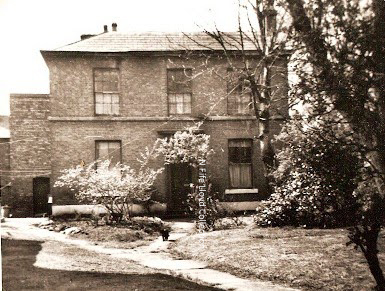
That mystery house on Beech Road ........

Now number 121 Beech Road vanished a long time ago.

Hunts Croft, circa, 1960s
It was one of our more elegant early 19th century properties which was set back from Beech Road, and went sometime in the 1970s.

For a long time after its demolition the land was left an open space, with the occasional suggestion that it could be a car park, a project which came to nought when the Corporation and the local traders couldn’t agree on a funding package.

There will be a few people who remember it, but sadly I am not one of them, which means it had gone before I arrived in 1976 or like so many things I was just not that observant back then.

Either way, there is little to mark its presence, save an entry in the tithe schedule for 1845, the Rate books and official maps.

If I have this right, it was Hunt Croft House and in 1845 was the residence of Thomas White who rented it from the Lloyd Estate.

With a lot of digging it will be possible to track its history through the 19th century till its demolition. I know that in 1969 it was occupied by a Frances. J Casse, and in 1911 by Mr and Mrs Chester, their five children, and a boarder.

Looking into the garden, circa 1970s
The house had nine rooms with a biggish garden at the front, ending in a tallish stone wall which ran along Beech Road.

Back in the mid 19th century it looked at on fields.  From the rear Mr White could look out on a field and orchard, while from his front windows he could gaze across to Row Acre, which stretched up to High Lane.

But by the 20th century the fields had all gone, and on either side of this fine old house were shops.

Beech Road, circa 1970s
And here I must admit my mistake, because for years I had mistaken Croft House for Joel View which stood a little further down the road and had been built in 1859.

Many will remember Joel View as the property owned by J Johnny, which I assumed had been built much later.

I even compounded the mistake by arguing that the stone tablet which carried the  name of Joel View had been salvaged from Mr White’s former home and been added to J. Johnny’s.

Dating the picture
Now, even then I knew that this was pushing it, because our own historian Thomas Ellwood had written that Joel View was one of the new developments in the township at the end of the 1850s.

All of which goes to show that sometimes when it is easy to ignore the obvious and create an elaborate theory which is built on sand and that is really just a lead in to two pictures of Hunt’s Croft sent to me by Roger Shelley who took them sometime in the 1970s and which had lain in his negative box until yesterday.

The two images compliment an earlier one taken by N. Fife for which I don’t have a date for, but maybe from the 1960s.

That said it might be possible to date Roger’s pictures, from the shop which is up for sale.  This had been Mr Westwell’s fruit and greengrocer shop in 1969, but sometime in the next decade became The Village Wholefood Shop.

Hunt's Croft demolished, circa 1979-early 1980s
It was still trading when I took a picture around 1979, showing the shop and the site which had once been Hunts Croft.

So that is it for now, although I am hoping Roger has more pictures.

Location; Chorlton


Pictures; Hunts Croft circa 1960s, courtesy of N Fife, the Lloyd Collection and again circa 1970s from the collection of Roger Shelley, and after it had been demolished circa 1979, from the collection of Andrew Simpson
Wednesday, 21 January 2026

Shopping in Chorlton at Adsega …… which became Tesco and Hanbury’s ……. Supermarkets I have known

Now, I have to admit I never shopped at Adsega in Chorlton, but friends did and have told me so.

Marion Jackson was the first telling me “When Adsega/Tesco opened at Chorlton office my mother carefully obeyed the sign telling her to take a basket. We had it for years!”,

Which was followed by Craig who commented “People don't believe me when I say there was a Supermarket called Adsega. Thank you!!”, and David who added “Remember my mother shopped there when I was young, when she mentioned Adsega some thought she meant Asda".

So, that set me going and the first port of call was Company House, from which I discovered that Adsega was registered in 1959, “to carry on business as wholesale and retail grocers” as well as "producers, manufacturers and importers” of a variety of food". *

It had a short life and its 47 stores were acquired by Tesco in 1965, which I guess was when its shop in the former cinema on Barlow Moor Road became part of the new retail empire before the building was sold on to, Hanbury’s.**

At present I don’t have a picture of the Chorlton Adsega, but I bet someone has a photograph of the shop on Barlow Moor Road, or maybe even other bits of ephemera, from shopping bags, receipts a loyalty card.

In the meantime, I like the way, a little bit of our forgotten past as come out of the shadows.

And it follows on from an earlier story about self service stores in Chorlton, which included the comment that the book on the arrival of supermarkets and how they were greeted has yet to be written.

So, thank you to Marion Jackson,  Craig Henderson and David Wilson with the expectation that this is just the beginning.

Location; Chorlton

Picture; the former cinema on Barlow Moor Road which became an Adsega, m09248, courtesy of Manchester Libraries, Information and Archives, Manchester City Council, http://images.manchester.gov.uk/index.php?session=pass


*Adsega, 

** How Many Companies Does Tesco Own?


*** A Chorlton revolution ……….. the self-service shop


Tuesday, 20 January 2026

101 Beech Road ….. one shop ….. and a heap of stories …….

Now, when Ian Collier posted this picture on social media  of his family outside 101 Beech Road I knew there was a story.

101 Beech Road
Today the premises is Beech Road Pharmacy but in 1901 it was home to Mrs Elizabeth Clayton and her five children. 

Mrs. Clayton described herself as a widow, and her children were variously employed as a “dressmaker”, “Blouse machinist”, and fishmongers.

And it is the 25 year old George Clayton who may well be the tall young man staring back at us with what may be his brother Arthur.

A decade later the census returns record only George, his brother William and sister Ethel in the property, with George describing himself as “Fishmonger” along with William who was a “Fishmonger, Salesman” and Ethel who had given up her job as “Blouse machinist” in return for running the family home.

Fruit, veg and Mr. Clayton
Ian tells me that “the shop was owned by George Clayton, my grandmother's second husband as her first husband, my grandfather was tragically killed by fire shortly after the birth of my father. 

The photo shows my great-grandmother, grandmother and father as a child. I am uncertain how long they stayed in Chorlton as they moved to Bacup after George Clayton died”.

The census record show that by 1921 no. 101 was occupied by Mr. & Mrs. Degman.  He was a hairdresser but gave his work address as 13 Lever Street in town and there is no hint as to who or what the shop was selling.

But in 1929 an Arthur Collier is listed as a greengrocer at the address.

That said Arthur Clayton now aged 44 had own green grocers at 119 Beech Road, which was still trading as such but under a different name thirty years later, and indeed had morphed into a wholesale food emporium in 1979.

Fresh To Day
Leaving aside the story of the Clayton family which I am sure Ian will be able to help piece together I am intrigued by the picture.

I am fairly convinced its dates from after 1903, because in that year a William Henry Bratby is listed as a Cycle agent, next door at 103, but six years later the shop is a drapery run by Mrs. Rosa Wagstaff and there does appear to be clothes in the window of the neighbouring  shop.

All of which just leaves me to reflect on the detail in the picture, from the sign advertising a range of fish, "Fresh Today" to the heap of fruit, veg and more fish on display both inside and outside the shop.


Location; Beech Road


119 Beech Road, 1979


Pictures, 101 Beech Road, circa 1901-1921, courtesy of Ian Collier, and 119 Beech Road, 1979, from the collection of Andrew Simpson