Showing posts with label Chorlton at war. Show all posts

Thursday, 13 August 2026

A history of Chorlton in just 20 objects number 15 a barrage balloon

Continuing the story of Chorlton in just a paragraph. They are in no particular order, and have been selected purely at random.

It was on the Rec not far from where the children’s play area is now located.  Until the late 1980s it was still possible to see the concrete bed which helped secure the balloon.

Picture; from the collection of Allan Brown

Monday, 10 August 2026

A history of Chorlton in just 20 objects number 12 ....... an engraved silver cup 1917

Continuing the  story of Chorlton in just a paragraph. They are in no particular order, and have been selected purely at random.

Presented to the Wesleyan Church by the Wounded Soldiers of the Wesleyan School Hospital Xmas 1917.  I doubt whether many people know that during the Great War we had two voluntary hospitals here in Chorlton.   One was in the Methodist Sunday school building on Manchester Road and the other in the Sunday School of the MacLaren Memorial Baptist Church on the corner of Wilbraham and Sibson Road.  Sadly little has survived in the form of records.  We have a few newspaper references, letters from some of the medical staff and patients, and a contemporary account in a Red Cross book of the work undertaken to care for the recovering soldiers. So this silver engraved cup is an important object recording not only the gratitude of the soldiers but the voluntary efforts of the people of Chorlton.


Picture; courtesy of Philip Lloyd

Friday, 23 May 2025

The Red Cross hospitals of Chorlton during the Great War

G.B.Simpson and friends, circa 1918
The Great War has now passed from living memory. 

A conflict which claimed ten million dead, blighted the lives of millions more, and which is commemorated in towns and villages across the country has now really become a piece of history.

 Here in Chorlton there are a number of war memorials including one in the grounds of the Methodist Church on Manchester Road another in the parish church and a few more including that in Southern Cemetery. 

There are familiar local names and in some cases more than one member of the same family.

Few however now know of the contribution that was made by people in the township to those young men who were wounded and were cared for in Chorlton and Whalley Range.

 Soon after the war began the Sunday school halls at the McLaren Baptist Church on Edge Lane and the Methodist Church on Manchester Road were turned over to convalescent hospitals.

The story of the first year of the military hospital in the Sunday school of the MacLaren Memorial Baptist Church on the corner of Wilbraham and Sibson Road was written up by the East Lancashire Branch of the British Red Cross as part of “An Illustrated Account of the Work of the Branch During the First Year of the War.”*

The McLaren Memorial Church circa 1920
It represented a massive commitment on the part of the 16,000 Chorlton people.

The number of voluntary nurses and orderlies ran to 89 and another 70 worked at some point in the kitchen. 

There were also regular fund raising activities, loans of equipment and twice weekly ward concerts.

 More than anything it shows the level to which the war effort was supported and funded by voluntary actions.

 Like many churches of the period it had a large Sunday school and it was this which was converted into the hospital in November 1914.

 “a ward of 31 beds, kitchens, mess room, bath room, dispensary, pack stores, linen rooms, matrons’ room and office” all of which were on the ground floor.

The building was large enough to accommodate

The Sunday School to the left, converted into a hospital
The original plan had been for 25 beds but in May 1915 an extra six beds were added.

What is astounding is that the cost of equipping the hospital which came to £140 was met by public subscription after an appeal for funds from the local Red Cross, and that this was “in addition to the liberal amount of hospital appurtenances so freely furnished on loan by the public.”

Nor did the generosity stop there. For while the War Office allowance for each man per day was 2 shillings [10p], the average cost for the upkeep per bed was 25 shillings [£1.25p]which again was met by the public through “subscriptions, donations and the proceeds of entertainments.”

Uknown soldier
During that first year of the war 159 volunteers worked at the hospital and all but four came from the township.

There are many familiar names, some whose families had been in the township for generations.

Ann Higginbotham aged 22 was the daughter of Alfred and Emily whose family had farmed by the green since the 1840’s.

There were also newer names like H. F. Dawson and A. H. Dawson or the Kemps. Miss Kemp worked in the kitchen while Harry her father was on the committee. He had two chemists’ shops and would be remembered for over half a century by Kemp’s Corner.

*Chorlton-cum-Hardy Red Cross Hospital, East Lancashire Branch of the British Red Cross Society Sherratt & Hughes, 1916

Pictures; The McLaren Memorial Baptist Church, Edge Lane, from the Lloyd Collection, G.B.Simpson, and friends circa 1918 from the collection of Andrew Simpson

Saturday, 28 December 2024

What did Chorltonville do in the last war?


South Drive, 1913
Now I always thought that Chorlton had by and large escaped the damage done to other parts of the city during the last war.

But that was not so and there is plenty of evidence that we got our fair share.*

Some of that evidence came to light in this edition of the Chorltonville News in the form of a compilation of extracts from the minutes of the Association for the war years.***

"In spite of its peaceful location, Chorltonville did not entirely escape the Second World War.  


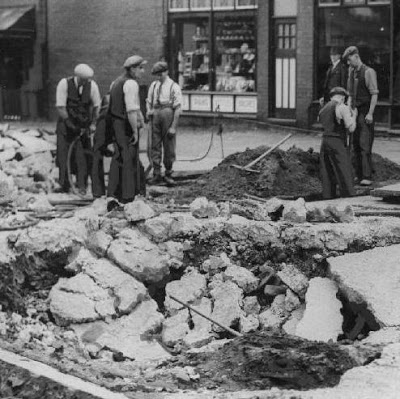
Nell Lane, 1941
In June 1940 one of the estate workers, Pat Carly Jnr, was called up for military service and left.  An entry in 1944 records that he was then serving in Burma, and would like to take up his job “if he is spared to return”.  

Pat’s departure must have hit the family finances, because in July 1940 his father, also Pat Carly, requested a rise in his wages.  

The Committee agreed to an increase of three shillings and sixpence (about 18p) per week.  Mr Carly again applied for an increase in December 1941, due to war conditions.  

He was given an increase of four shillings (20p) per week, but granted it as a War Bonus – maybe so that it could be withdrawn after the war.

Also in 1940, the Committee was chasing up an application to Manchester Corporation for air raid shelters for the estate, “pointing out that no provision whatever had been made by the Corporation in case of emergency”.

Barrage Ballon on the Rec, 1941
Manchester’s Town Clerk was, apparently, not sympathetic.  He declined to provide the shelters, as the policy of the Corporation was to supply protection only for people caught by an air raid on the streets.  

The Clerk said that “each person who can afford to do so is expected by the Government to arrange for their own protection whilst they are at home”. 

The Committee accepted this decision, but protected their position by writing to the Corporation stating “that no responsibility can be taken by the Committee in the event of any unfortunate situation”.


The war evidently affected both finances and availability of people.  At the 1941 AGM, the Treasurer reported that the accounts were “as good as could be expected under current difficulties”, but still showed a deficit of over £37.  

The meeting voted a levy comprising a basic charge of 16 shillings, plus 3½d for each linear foot of frontage - under £1.50 for most houses.  

A deputy Auditor had to be found, as the elected Auditors were unavoidably absent.  The minutes do not say the reason, but one was still on “enforced absence” the following year, so presumably had been called up.

In May 1942 the Army erected Nissan huts behind Chorltonville alongside the cobbled lane by Brookburn School.  The Secretary wrote to the Royal Engineers (at Mayfield Rd in Whalley Range) asking whether the huts were for barrage balloons or gun emplacements, “as the Committee were most anxious that the presence of these things would render the Estate a target for the enemy”.

The Royal Engineers suggested he contact the balloon section, so the Secretary went to the local unit at the Recreation Ground in Cross Rd.  The corporal there had no knowledge of the huts and referred the Secretary to the Manchester RAF.  

The RAF replied with the enigmatic statement that the huts’ presence “does not increase the vulnerability of the estate to enemy air attack”.  The minutes do not say whether the Committee was reassured by this.

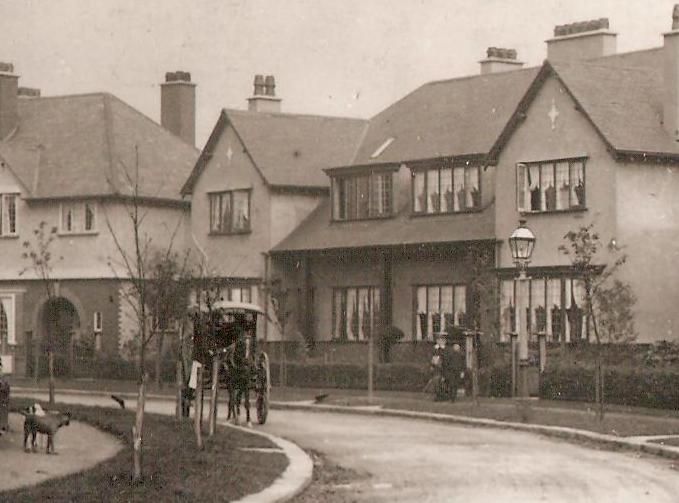
The Meade, 1913
The Committee was more successful in 1943, applying to the Corporation for extra street lights.  

Lamp posts were not in use because of the blackout, but they noted that the Corporation had introduced a modified form of lighting on some roads.  

They requested that these be introduced to Chorltonville, because of the danger to pedestrians using the roads and footpaths.  The Corporation agreed, and added dimmed lighting around the estate.

Interestingly, there is no note in the minutes recording either VE or VJ Day, but at the 1946 AGM, the Chairman tidily summarised:

“he spoke of the work of the past year, carried out under conditions as in the War, though happily the final Conflict had come to an end.  He continued that this Estate had been maintained under very fair conditions, and proposed that the levy stay the same.”

Pictures; Barage Ballon on the Rec, from the collection of Alan Brown detail from bomb damage at Nell Lane, 1940, courtesy of Manchester Libraries, Information and Archives, Manchester City Council, m09736, and pictures of the ville from the Lloyd collection

* http://chorltonhistory.blogspot.co.uk/search/label/Chorlton%20in%20the%201940s

** http://www.chorltonville.org/index.htm

*** reproduced courtsey of Chorltonville News

Friday, 27 December 2024

A story of a night of bombing, and of the casualties and the loss of our post office


On the night of December 24th and into the early morning of December 25th 1940 thirty people died in Chorlton.

They were all victims of the second night of the Manchester Blitz in which an estimated 644 people were killed and another 2,000 injured.

Of the 30 who died here many came from just two roads while the rest were spread out across the township.  Most of the bodies were taken to Withington Hospital, a few to Embden Street mortuary and a few to the Cavendish Road [now Corkland Road] mortuary.

And I suppose it was the fact that the mortuary on Cavendish Road was just round the corner explains why Mr and Mrs Carr were taken there.

They lived at 549a Wilbraham Road* which took a direct hit from a high explosive bomb.  Their home and two others which stood on the site of the modern post office were destroyed.

I would like to write more of Ernest and Gene Carr but so far I have only been able to turn up his death certificate which recorded his death on that December night and that he was just 44 years old.  It isn’t much but it is a start.

So in the meantime I shall concentrate on their home and what happened on the site before and after that night.

Earlier in the century 549a had been one  of three houses which were originally numbered, 3, 5 & 7 Wilbraham Road.

Yesterday I began the story of the three houses which stood on the site. Numbers, 3, 5 and 7 had been built sometime after 1885 and were typical of the new sort of properties that were being built to meet the influx of people to Chorlton.

Many of these were professionals; a few owned their own businesses and a lot more worked in the offices and big shops of Manchester.  They were attracted here by a train service which could whisk them into the heart of the city in under 15 minutes and the fields, farms and open country which for many was even closer.

So along with a surgeon and his family at number 1 the remaining three were the home at various times to a retired cotton merchant, a widow “living on her own means”, Edward Ireland who had  a number of photographic studios in Manchester, and a doctor, dentist and a oil trader.

And the size of the houses reflected the inhabitants.  Number 1 had twelve rooms, 3 and 5 eight rooms and number 7 9 rooms.

Each had cellars, a decent front garden and a longer one at the back stretching down across what is now the sorting office and yard.

But like other stretches of property in this new part of Chorlton they were soon developed with the addition of shop fronts and perhaps with an eye to even greater profits the owners sub divided the shops.

 In 1911 at number 3a there was Harvey Goodwin, confectioner, at number 3 Mrs Ethel May, cycle dealer, while at 5a Stuart Gray ran a tobacconist and in number 5 C. &W. Copping advertised themselves as china merchants.

The last of our three had become the post office in 1901 and remained so until the night of December 24th.

The Chorlton bomb maps show the impact of the high explosive bomb on the three properties and photographs from the late 1950s show the remnant which was the bit that jutted out still in use.

In 1959 it was being used as the Conservative Party Committee rooms.

But the keen eyed will spot that the building which would have been there is missing and eventually even this little left over bit of the old post office was demolished and the site became the forecourt for what has variously been Lipton’s and Ethel Austin.

Now those of you keen on a bit of modern archaeology will be able to see the clue to what had been number 7 and it is the cemented up side of what is now the gable end of the phone shop. Back in the 1950s this was Brighter Homes, the paint and wall paper shop.

Any one growing up in those post war years will remember the gaps in houses and the same raw cement walls where part of the terrace had been demolished.

And looking at the 1959 picture it is just possible to see the space where numbers 3 and 5 had been which in 1961 became our new post office.

It was an obvious place to build it close to the old one and utilising a bombsite.

I did wonder whether there might have been a plaque to record the event of that nights bombing, but then even here in Chorlton there would have been plenty of candidates for such a memorial.

And at the time there would have been plenty who remembered the event and maybe even knew Ernest and Gene Carr.

But what was once a common experience is fast passing out of living memory and soon I doubt that any one will even pass a thought to the odd space that runs from the Gable Nook Nursery to the row of shops by the bus stop.

Pictures; Numbers 1-7 Wilbrahan Road, circa 1891 from the Lloyd Collection, The old Post Office with its front extension circa 1910 from the collection of Philip Lloyd, the remnant of that same post office in 1959, A.E. Landers, m18242, and the modern Post Office and the old, A.E. Landers, 1961, m18511, courtesy of Manchester Libraries, Information and Archives, Manchester City Council


*493a has been number 5 Wilbraham Road in the early early of the last century

Friday, 4 October 2024

William Eric Lunt a soldier of the Great War


William Eric Lunt, was born here in 1895, and died of wounds in the 36th Casualty Clearing Station at the Somme on October 14th 1916.

This was the story I had decided to tell, but sometimes the stories just tumble out, crossing time and connecting the Chorlton of the early 20th century with that rural township I have come to know so well.

And this is what has happened today.  The Lunt family lived in Chorlton and made their living from farming for all of the 19th century.  In 1845 they rented two acres of land off Moss Lane* from the Egerton estate and were market gardeners growing a variety of food for the Manchester markets.

His smallholding was mostly orchard, stretching back from Moss Lane to Rough Leach Gutter and was a smallish amount of land, and like many of our market gardeners Lunt may also have had other jobs as well. And we know that he paid 4s. 7d a week in rent and in that cottage he and his wife brought up six children.


Above; The Lunt home and land on field numbered 18.

Not only this but we can follow him through his activities in the local Methodist church and his participation in our first brass band which started up sometime in the 1820s.

And the Lunt family perfectly reflect the changing nature of Chorlton.  As the 19th century came to a close more and more of the agricultural land was given over to housing. Perhaps the Lunt’s saw it coming and while they may have retained their land they had by 1901 opened a shop at number 60 Sandy Lane selling fruit and young William had chosen to work as a warehouseman apprentice.

Which brings me to where I had intended to start.  William was just 19 when he joined up on September 5th 1914; just one month after the war had broken out.  He was a fit young man weighing 129 lbs and was 5’ 11 inches.  His army records describe his complexion as sallow, his eyes brown and his hair dark, and that at present is all we know of his physical appearance.

In fact that is about all we have, for though there are eighteen military documents, as well his birth certificate and two census returns, none of them shed any light on who he really was, his likes and dislikes, or whether he was serious, humorous or like most of us a bit of both.

He was to become part of that new Kitchener’s army of young idealistic volunteers many of who were to die at the battle of the Somme.  I wish there was more.  I know he had joined up at Ardwick, was assigned to the 8th Battalion of the Manchester Regiment and remained in Britain until the summer of 1916 when he embarked at Folkestone landing on July 27 at Boulogne.

It should be possible to piece together the next few months from the official history of the regiment and from the war diary the unit filled in for every day of the conflict.  But at present perhaps all I can say is that he was caught up in the Battle of the Somme, was wounded on October 12th and died two days later of his wounds.
“The 36th Casualty Clearing Station was at Heilly from April 1916. It was joined in May by the 38th, and in July by the 2/2nd London, but these hospitals had all moved on by early June 1917. .......  There are now 2,890 Commonwealth servicemen of the First World War buried or commemorated in this cemetery. Only 12 of the burials are unidentified and special memorials are erected to 21 casualties whose graves in the cemetery could not be exactly located. The cemetery also contains 83 German graves. The burials in this cemetery were carried out under extreme pressure and many of the graves are either too close together to be marked individually, or they contain multiple burials. Some headstones carry as many as three sets of casualty details, and in these cases, regimental badges have had to be omitted. Instead, these badges, 117 in all, have been carved on a cloister wall on the north side of the cemetery. The cemetery was designed by Sir Edwin Lutyens.  

Mericourt-l'Abbe is a village approximately 19 kilometres north-east of Amiens and 10 kilometres south-west of Albert. Heilly Station Cemetery is about 2 kilometres south-west of Mericourt-l'Abbe, on the south side of the road to Corbie.”**

It is not much of a record for what had been a young life with promise and a future.  And I suppose that is the point.  After almost a century the grief of the death of so many has faded but not I think the sadness that so little is left of who this young man was.

*Sandy Lane

**http://ww1cemeteries.com/ww1frenchcemeteries/heillystation.htm

Pictures; Allied Victory Medal, awarded to servicemen and women who had served between August 1914 and November 1918,detail from the tithe map of 1845 showing the cottage and land of the Lunt’s courtesy of Philip Lloyd, and the Heilly Station Cemetery, Mericourt-l@ Abbe Somme, courtesy of WW1 Cemetries.com http://ww1cemeteries.com/index.htm

Tuesday, 8 August 2023

In search of the barrage balloon on Beech Road


I have never seen a barrage balloon, apart from those in photographs.

They were a common enough sight in urban areas during the war.  As big as a house and filled with inflammable gas they were the last line of defence against enemy bombers.  They floated high above the buildings tethered by steel cables whose purpose was to deter those hostile aircraft.

We had one on the Rec. I was first told the story by my old friend John who on one of our many walks around the recreational ground pointed to the exact spot where the steel cables were fastened to a concrete block.

Years later I went looking for it but it had gone, perhaps during the time they were repairing the Egerton sewer which runs under the Rec and Beech Road before heading off towards the meadows.

In time I even began to doubt that I had been told the story until Alann Brown showed me his picture of the balloon.

Now this is a story I have visited in the past but looking again at Alan’s picture made me reflect that so much of that wartime landscape has vanished or been so altered that what is left is unrecognisable to anyone who did not live through the conflict.

Take for instance the painted sign EWS which could be found on walls and buildings.

The letters stand for emergency water supply and indicated where water supplies could be obtained in the event that the water mains had been damaged and the fire brigade needed to put out fires causes by the bombing.

We had one opposite the family home in London.  It was a brick built water tank, made from excavating the cellars of six bombed out houses.  A thin coat to tar had been added to the cellar floors and the sides bricked up to a height of six or seven feet using the salvaged bricks from the houses.

In Piccadilly in town there were similar tanks beside the bust Station on Parker Street.

Most did survive into the post war period but I doubt that any are still left today.  It will be the same for the EWS signs a few of which can just be made out as feint ghost lettering on walls but the majority have long gone.

So have the air raid shelters and pill boxes which came in many shapes and sizes.  The communal shelters built in the streets were taken down at the end of the war.

 In the same way the Morrison shelter which resembled a cage and was designed to be erected inside the house will have gone for scarp.

But a few of the Anderson shelters linger in back gardens.  These were the dome shaped ones made of six galvanised corrugated steel panels which were bolted at the top.

They were partially buried in the ground and finished off with a coating of soil on top. And properly maintained they have done sterling work as garden sheds for over 70 years.  There is I think one in a garden on Sandy Lane.

Now this is not some sentimental journey.  These things were around because people were being killed and like rationing books, gas masks and the black out when the war came to an end a grateful nation wanted rid of all the things that remotely reminded them of that war.

Although of course rationing along with identity cards did survive into the years of peace.  As did the surplus war material from old service uniforms to decommissioned lorries which found their way into civilian life.

Looking back now nearly 70 years the historian in me worries about the loss of so much of these war time relics.  More so because they can still be matched by the testimony of living people which  of course is rare in archaeology.

How I would love to ask someone just how comfortable it was to sit in the Collosseum in Rome or whether Shakespeare really was as funny in real life as his comic characters and whether Frederick Engels did stand a round of drinks.  But you can’t and that is that.

On the other hand Alan Brown remembered the barrage balloon as did my friend John, and both could walk you to the spot where it was tethered and if necessary explain just what panic was caused when one broke free.  Moreover Alan remembers talking to the team in charge of the balloon.

All of which I suppose is a plea for the careful recording of these war time relics before they all disappear.  So looking agaon at the detail of alan's picture with the Team of men responsible for the balloon, it does not match where John told me it was.  History in the minute perhaps buut still a little frustrating.

Pictures; barrage balloon on the Rec from the collection of Alann Brown, & the EWS sign from a detail from Students Union Oxford Road, 1960, m03829 courtesy of Manchester Libraries, Information and Archives, Manchester City Council, and an old and badly rusted Anderson shelter, that has in it's time been coneverted for use as a garden shed, on display in the courtyard of Bedford Museum, Bedford, Bedfordshire, England,© Simon Speed


Tuesday, 16 May 2023

Chorlton in two World Wars

Celebrating peace on Halstead Avenue, 1945
“Tonight I will go to sleep knowing that everyone I love will be safe.”

Even now that one line entry in a diary has a profound effect on me.

It was written in the late evening of May 8th 1945, at the end of the first day of peace in Europe.*

For some it had been a riotous night of fun, dancing and abandonment, for others a time of quiet reflection on the cost of six years of a hard war.

I don’t know what my parents and grandparents did on that night.  Nana I expect spent some of it thinking of her son who was buried in a cemetery in Thailand and must also have wondered what her native Germany would be like.

She had been born in Cologne a city which like so many was now a desert of rubble, wrecked streets and shattered lives.

Granddad no doubt was in a pub while mum and dad would have been celebrating in their different ways.

It is of course an event fast fading from living memory and will soon join the experiences of those who lived through the Great War as a piece of history only now visited through the films, books, memorials and personal accounts of that earlier conflict.

And our Red Cross Hospitals have done just that but between 1914-18 there were two of them  here in Chorlton operating from the Baptist and the Methodist Sunday Schools and others in Whalley Range.

Silver cup presented by recovering wounded soldiers  1917
Many local people supported them and hundreds of wounded soldiers spent time recovering from battlefield wounds and diseases caught while in action.

We have the names of some who worked in the hospitals, letters written by the troops and this silver cup.

The inscription reads, Presented to the Wesleyan Church by the Wounded Soldiers of the Wesleyan School Hospital Xmas 1917.

Location; Chorlton

Pictures; Victory street party, Halstead Avenue, courtesy of Tom Turner from the Lloyd collection, and the silver cup from a picture in the collection of Philip Lloyd

*Of course it would be another four months before Japan surrendered and the fighting was truly over.


Friday, 22 February 2019

Of bombs, and lost houses and the coming of a new post office


“Tonight I will go to sleep knowing that everyone I love will be safe.”

Even now that one line entry in a diary has a profound effect on me.  It was written in the late evening of May 8th 1945, at the end of the first day of peace in Europe.*

For some it had been a riotous night of fun, dancing and abandonment, for others a time of quiet reflection on the cost of six years of a hard war.

I don’t know what my parents and grandparents did on that night.  Nana I expect spent some of it thinking of her son who was buried in a cemetery in Thailand and must also have wondered what her native Germany would be like.  She had been born in Cologne a city which like so many was now a desert of rubble, wrecked streets and shattered lives.

Granddad no doubt was in a pub while mum and dad would have been celebrating in their different ways.

All of course very different from the winter of 1940 when with the defeat at Dunkirk, and the still real threat of invasion my family went about their lives making do with growing the tightness of rationing and the almost nightly bombing raids.


In Manchester the attacks began in June building up to the horrendous two nights of bombing just before Christmas when late on December the 22nd through to the 23rd and again the following night the raids killed an estimated 644 people and injured over 2,000.

Here in Chorlton 30 people died in the second night of bombing, with 53% of the casualties concentrated on just two roads.

Mrs Reilly living on Oswald Road remembers that
“All the windows at the front of the house were broken and the front door blown open by the blast from a land mine that landed on the allotments at the top of Scott Avenue.  Father reckoned they were aiming for the huge water pipe that crossed Manchester Road.

Houses came down at the top of Scott Avenue and Cheltenham Road, two people were killed and a girl I knew had her face badly scarred by shrapnel as she was standing outside the air raid shelter in her back garden.”

And Geoff Williams recently revisited the spot of St Werburghs where the night before a bomb destroyed three houses and killed an air raid warden.

Now I had not been prepared for the extent of the bombing here in Chorlton, but the bomb maps which were compiled by the Corporation showing the extent of the fires started by incendiary devices and properties destroyed by high explosive bombs.

Today if you look carefully you can match that bomb damage across Chorlton.  In some streets the natural line of late Victorian and Edwardian houses is broken by newer properties some of which only went up in the 1960s.

In other cases they were never replaced.

So it was with numbers 3, 5 and 7 Wilbraham Road.  You won’t find them today.

They went on the night and early morning of December 24th and 25th and in the process eliminated our post office.

It was a direct hit from a high explosive bomb, and the site was left empty till the present post office was opened on the site in 1961.

They look to have been fine houses set back from the road with long gardens stretching down over what is now the sorting office.  Numbers 3 and 5 had eight room and number 7 nine, which made them  attractive family homes.

But sometime not so long after they had been built they were redesigned to include shop fronts leaving only number 1 on the corner of Cavendish Road [now Corkland] as a family home.  

But even here the business potential was not lost on Mr Alfred Mumford M.D., M.R.C.S.A., L.S.A, Surgeon, who in time turned part of his 12 roomed property of Gablenook  in to  a doctor’s surgery.  After all the house which was known as Gable nook, commanded a prominent position on the corner of what was a busy road, facing as did the railway station.

These were developments mirrored opposite where an equally fine row of late Victorian houses running from Albany down to Keppel Road lost their elegant front gardens and became shops. 

And round about the time that Mr Mumford was converting Gable nook into a surgery, Dovedale or number 5 had become a hosiery shop and number 7 the post office, leaving only number 3 with its equally fine name of Mayfield as a private residence.  But not even Mayfield could buck the trend, and a year later two shops had been added to its front which in turn was replicated at number 5.

All of which was fine until the night of December 24th 1940, but that along with a bit of a detective story is for tomorrow.

*Of course it would be another four months before Japan surrendered and the fighting was truly over.

Pictures; Victory street party, Halstead Avenue, courtesy of Tom Turner from the Lloyd collection, Blitz bomb damage, 1941,  courtesy of Manchester Libraries, Information and Archives, Manchester City Council, m8608,8609, http://images.manchester.gov.uk/index.php?session=pass extract from the 1911 directory for numbers 1-5 Wilbraham Road, corner of Cavendish and Wilbraham Roads circa 1890 from the Lloyd collection

Saturday, 5 September 2015

Time for another tram


It’s another tram picture.

I had no idea just how popular the last picture of a tram would be so here we are back by popular acclaim is another.

Now the caption says, “Double-deck, single-truck in’bay’ of the Tram Terminus.  The use of female ‘guards’ indicates that it was taken during the First World War.  It would appear that there are ‘blackout’ curtains at the lower saloon windows."

And it is the detail that helps unlock the past.  Behind the tram you can see the glass and iron canopy which were also a feature on the cinemas of the period and have survived on some of the shopping parades.  While behind the houses on Beech Road have those uniform net curtains whic were a feature of homes across the township.

And then finally if like me you get lost in the detail here is the knowledge that it would have been possible to travel all the way to Newton Heath via Alexandra Park on this number 22 tram.  Now that is a bit of information lost in time.

Picture; from the Lloyd collection

Tuesday, 16 June 2015

Bombs on Egerton Road South memories of Geoff Williams


Revisiting a story.

One of the things I really like about the blog is the way people share their memories with me.

So after I had posted the stories about Chorlton’s bomb maps,* Geoff got in touch and offered up his memories of when the bombs fell across his part of Chorlton.

And here it is.

"Here is a brief account of the bomb that landed in the back garden of 118 [formally 40] St Werburghs Rd early in the evening on 23/12/1940. This is the left of the two houses shown in the photograph.  

The explosion destroyed Nos 118 and 120 also the house behind being the first house on Egerton Rd South, and were all 3 soon to be pulled down.  Nos 116 and 122 were made safe, but were uninhabited until they were repaired after the war, along with the others being rebuilt.  

The Churchill government paid for this.

 I, along with my sister and parents lived at No 116 [38]. The reason we were not at home at the time of the raid was due to my family returning home for Christmas from Tideswell in Derbyshire where I lived as an evacuee.  


We drove into the blitz, and had to break the journey as we neared home and take cover until the bombing eased.  We could see the fires over Manchester in the distance.  We arrived home close to midnight to discover our home had been hit, hence sought shelter across the road in a neighbour’s house.

At the outbreak of the war, my Father built an air raid shelter below the ground in the garden of 116, and 118. The bomb landed at the left hand side and to the rear of the shelter. The air raid warning had not long been sounded.  There were at least 4 occupants in the shelter at the time, No 118 and part of the house in Egerton Rd South collapsed onto same.  

Unfortunately, the resident of 118 had just left the shelter, to commence her duty as an air raid warden, when the blast blew her into the road and she bled to death before anyone discovered her.  She was already a widow [not due to the war] and hence her only son [7] was now an orphan.

As you know, close by there is a bridge over what was the main L.M.S. and L.N.E.R railway. 

Looking along the line from the bridge over Metro station, the line [L.M.S.] goes straight on, but to the left it is now a wide foot or cycle path.  T

his was the main L.N.E.R. line.  We were given to understand, sometime later, the German plane was aiming for the line, or the bridge, together with another bridge by Chorlton station.  

Two bombs were dropped; the other one destroyed the Post Office. [ I discovered this when I was sent to post a letter the next day ] Should you visit the new P.O you will notice this is not as high as the buildings either side."   Geoff Williams

Pictures; from the collection of Geoff Williams

* http://chorltonhistory.blogspot.co.uk/search/label/Chorlton%20bomb%20maps


Thursday, 9 October 2014

One hundred years of one house in Chorlton part 43, listening for the bombs

Looking at the balloon from Beech Road, circa 1941
The continuing story of the house Joe and Mary Ann Scott lived in for over 50 years and the families that have lived here since.*

Now I have no idea of what Joe and Mary did during the last war.

They were both in their 50s which would have made Mr Scott too young to have served in the Great War and too old for the Second World War.

He may have been in the Home Guard and she in the Women Voluntary Service, but if they were there are no records of their contribution and I doubt now that we will ever know.

As a builder much of his time I guess will have been engaged in making repairs to war damaged property.

There is no evidence that he was building new houses.

The one on the corner of Beech and Beaumont Road which he had begun work on just before the outbreak of the war was only completed sometime after 1945.

Like everyone else they would have endured the rationing, the shortages and the bombing.

From the bomb maps we know that Chorlton was hit with a mix of high explosives and incendiaries many falling on the night of the Manchester Blitz.

Just across the road on Beaumont and at the top of Beech Road firebombs had fallen along with others on the tram terminus, and down along Barlow Moor Road as far as the brook and a little beyond.

Manchester Guardian, December 24, 1940
Added to this there had been direct hits with high explosive bombs on the cinema and on Claude Road.

But as terrifying as these were it will also have been the nightly fear that another raid might occur which was reinforced by the presence of the barrage balloon in the Rec directly opposite the house.

I have often wondered if they took in friends or neighbours during the worst of the raids and I suppose there may be records somewhere in the archives.

Sadly there are no diaries, ration books or even old newspapers lurking anywhere in the house.
I suspect both Joe and Mary Ann were far too practical to have bothered with saving such material.

All of which leaves this chapter of the story of the house unrecorded and with the passage of time there are fewer and fewer people left who knew them and even fewer who might be able to tell me about their war effort.

Still I travel in hope and in the fullness of time will go looking in the archives.

Pictures; Barrage Balloon on the Rec, circa 1941, from the collection of Alan Brown 

*The story of a house, http://chorltonhistory.blogspot.co.uk/search/label/The%20story%20of%20a%20house

Monday, 25 November 2013

Chorlton, Manchester and the Great War, reflections on the forthcoming centenary and an appeal for help

William Eric Lunt, aged 10 on Sandy Lane circa 1905
This is William Eric Lunt aged about 10 on Sandy Lane sometime around 1905.

He was born here in Chorlton in 1895 and died of his wounds on the Western Front in the October of 1916.

His family had farmed in the township throughout the 19th century and in all probability into the century before.

I can only begin to sense the loss his parents felt at the death of their son.

But of course this was an ordeal that was endured by so many here and across the world.

And next year we shall be remembering those years and the human sacrifice along with that vast loss of treasure which could have been used to improve the lives of people.

For most of us it will be an intensely moving moment allowing us to look back into our own families and explore their experiences.

In my case I can count six members who participated.

George Bradford Simpson, circa 1918
They included a great grandfather, my maternal grandfather, two great uncles, and two uncles.

Added to this because one of my grandmother’s was German there will be family members who were in the armed forces of Imperial Germany.

All of which is a trailer to the sheer amount of material on the Great War which will come our way next year.

For 2014 will be the centenary of the outbreak of that conflict and we will be deluged by books, documentaries, fictional accounts as well as films, plays and plenty of new specialist web sites.

And if all goes well I may be making my own contribution with a book of memories, photographs and stories from across Manchester covering the years of the First World War.

So this is an appeal for anyone who would like to share their own family history of the war to get in touch, using the comment box, or via my facebook and twitter accounts.

But, and here I can perhaps be accused of hypocrisy I do have a slight nagging doubt about the degree to which the forthcoming event will be driven by financial considerations, and also begs the question of the correctness in digging around in the lives of people who were involved and who should be afforded a degree of privacy.

Unknown British soldier, circa 1918
Added to this is the very real danger that the amount of coverage may just make the public a little tired of the event long before we reach August 2014 which will be a great disservice to the men and women who were swept up by that war.

All of which leads to the simple observation that perhaps less is better than more.

After all that war has passed out of living memory and in its way is now almost as remote to us as are the wars with Revolutionary and Napoleonic France or indeed the Hundred Years War.

That said I think it is important that we should mark the event with an exploration of the people who “did their bit.”  

And I think it should focus more on local communities rather than the big picture which has been visited and revisited by historians since the Armistice in 1918.

Unknown British soldier, circa 1918
So I shall return to young William Eric Lunt and the other men who went to war from Chorlton, along with the families who waved them off, and those who worked the factories ran the essential services and looked after the wounded in the Red Cross voluntary hospitals all over the city.


Picture; the young William Eric Gaunt, from the Lloyd collection, and the photograph of George Bradford Simpson, and the unknown soldiers  from the collection of Andrew Simpson


Thursday, 7 February 2013

Arctic Convoys, Spitfires and the Manchester Blitz – celebrating Chorlton’s World War Two veterans today at St Ninian's Church, 1.30pm


My parents rarely spoke of the last war and only reluctantly would describe their experiences which more often than not were hedged in generalities.

It was a topic which was left to hang in the air.  So my early knowledge was gained mostly from films, ranging from the ultra patriotic produced during the war years and the daring stiff upper lip ones of the 1950s.

The evidence for what had happened was still all around us.  Ranging from the bomb sites to the shelters in people’s gardens and the fading painted signs indicating where to take cover in the event of an araid.  There were also those odd gaps in the middle of a terrace of houses where a bomb had destroyed a home.

But these have all but vanished under the relentless drive of redevelopment which leaves only the oral testimony of those who lived through it.

I thought the other day that just perhaps in the late evening of a November 5th or early the following morning that mix of the smell from bonfires and the thick greyness that comes from the smoke might just provide a tangible sense of the aftermath of an air raid.  But then there would also be the broken glass and the still warm shrapnel underfoot and in the worst hit areas the rubble and broken homes.

All of which leaves only the oral testimony of those who lived through it.

This includes one old friend who told me of the night his wife Margaret went into labour during an air raid and their journey up Barlow Moor Road.  There was no ambulance, and John didn’t have a car so Margaret sat in the pram and he wheeled her through the empty streets from Reeves Road to the hospital.

So I shall be looking forward to today’s Chorlton History group meeting, Arctic Convoys, Spitfires and the Manchester Blitz – celebrating Chorlton’s World War Two veterans

Chorlton Good Neighbours History Group pays tribute to four of our members, all in their 90’s, who served in World War 2 at an event on:

Thursday Feb 7th 2013 1.30pm at Chorlton Good Neighbours,
Wilbraham St Ninian’s Church, Egerton Rd South, Chorlton, Manchester M21OXJ

Bob Cowan, for whom Good Neighbours mounted a successful campaign for an Arctic Convoy medal to be awarded to veterans such as himself and also John Mackay of Chorlton who we recently discovered, is also a veteran of the Arctic Convoys

Alan Wood, fighter pilot, who was once shot down over the North Sea and was adrift in a one-man dinghy for 4 days

Mickie Mitchell, who as a young woman drove army petrol supplies round during the Manchester blitz

Andrei Makarenko, from the Embassy of the Russian Federation in London will be attending to present the two Arctic Convoy veterans with “65th Anniversary of Victory" medals. 

The Arctic Convoy veterans are still not allowed to receive the Ushakov medal from Russia, but this anniversary medal will be an acknowledgement by the Russian government of the high regard they hold for those helped their country by participating in the perilous Arctic Convoys that got much needed supplies through to Russia during WW2

The High Sheriff of Greater Manchester, George Almond, CBE will present all 4 WW2 veterans with plaques from Chorlton Good Neighbours to celebrate the contribution they made to the defence of this country in WW2

Bob, John, Alan and Mickie will all be at the presentation to receive their awards and answer questions

Further information from Bernard Leach m: 07960 888879,  btleach@gmail.com


Pictures; Post war demolition in Manchester, 1945, m75548, Blitz bomb damage, 1941, m8608,8609,courtesy of Manchester Libraries, Information and Archives, Manchester City Council and barrage balloon on the Rec, from the collection of Alan Brown

Saturday, 15 December 2012

New ....... the Chorlton bomb maps of 1940


It’s what I like about history. Out of nowhere forgotten and tucked away for decades comes a wonderful find that sheds light on the past.  

So along with many I was totally captured by the news that during the renovation of Central Ref a comprehensive set of maps has been found of the bombing of Manchester in 1940.  What is more it is now on line.*

And even more interesting is that not only does it cover the city centre but the surrounding areas including Chorlton.

Using the OS for 1933 the Corporation plotted the bomb hits, with red circles for fire bombs, blue for high explosives, pink shading for damaged buildings, and red for demolished buildings as well as green marks for land mines.

Now I had known that Chorlton had taken some hits.  There is anecdotal evidence as well as at least one site map for the area around the station, a few pictures and what can be gleaned from the odd bit of infill building suggesting new properties which replaced destroyed ones.

But the extent of the blue and red circles in Chorlton is surprising even given the fact that we were on the route to and from Trafford Park, the docks and city centre.

Like lots of people armed with the maps I will be exploring the impact of that bombing.  And it comes at a timely moment since I was recently contacted by someone who has memories of the bombing around Whalley Range.

Picture; bomb damage at Nell Lane, 1940, courtesy of Manchester Libraries, Information and Archives, Manchester City Council, m09736

*http://enriqueta.man.ac.uk/luna/servlet/view/all/who/Manchester%20City%20Council%20City%20Architect's%20Department%20(Building%20Surveyor's%20Division)?sort=Reference_Number,Page,Current_Repository

Sunday, 11 November 2012

Chorlton stories from the Great War and other conflicts


Now that the First World War has passed from living memory it seems all the more important to record many of the local men who served and in some cases died and also those who passed through the township and were looked after as they recovered from their wounds.

So on this day I have posted a link to the stories of the men and women who made a contribution in that struggle.*  And during the next few months to those who were involved in the other conflicts.

They include the stories of young men like William Lunt, the work of the Chorlton Red Cross Volunteers, and the words of some of the service men who passed through and were grateful for the care they were offered.

These have survived on our war memorials in the army records and in letters and photographs, and in this silver cup.

The inscription reads, Presented to the Wesleyan Church by the Wounded Soldiers of the Wesleyan School Hospital Xmas 1917.  I doubt whether many people know that during the Great War we had two voluntary hospitals here in Chorlton.

One was in the Methodist Sunday school building on Manchester Road and the other in the Sunday School of the MacLaren Memorial Baptist Church on the corner of Wilbraham and Sibson Road.  Sadly little has survived in the form of records.

We have a few newspaper references, letters from some of the medical staff and patients, and a contemporary account in a Red Cross book of the work undertaken to care for the recovering soldiers. So this silver engraved cup is an important object recording not only the gratitude of the soldiers but the voluntary efforts of the people of Chorlton.*


* http://chorltonhistory.blogspot.co.uk/search/label/Chorlton%20and%20the%20Great%20War
http://chorltonhistory.blogspot.co.uk/2011/12/memories-of-distant-wars-quetta.html

Pictures; from the collections of Andrew Simpson Philip Lloyd and the Lloyd collection.  

George Bradford Simpson and friends date unknown, the silver cup presented to the Methodist Church, and a young William Lunt from Sandy Lane who served in the Great War