Showing posts with label Eltham High Street. Show all posts

Wednesday, 24 June 2026

Looking down on Eltham in the late 1960s

The aerial photograph has got to be one of those powerful ways of capturing a scene.

So here we are flying over Eltham sometime in the late 1960s or early 70s.

Over to our left just below the centre of the image is the parish church and behind it on Well Hall Road and the High Street is Burtons now a fast food restaurant.

Travel up the High Street and on the right at the junction with Passey Place is the old ABC cinema.

Now I could go on but rather think the fun of the picture is about leaving it up to you to wander over the view identifying the landmarks.

Location; Eltham, London

Picture; from Looking At Eltham, Eltham Society, 1970, supplied by the Kentish Times

Tuesday, 23 June 2026

Looking at Eagle House in Eltham High Street sometime in 1874

Eagle House, 1909
Eltham has got to be lucky that so many of its fine houses built in the 18th and early 19th centuries have survived.

Of course as is ever the way the more humble dwellings of the families of agricultural labourers, tradesmen and craftsmen have long since been cleared away.

Many were unfit and will have had their time long before the last century was turned, but it is a shame.

And more so because few historians ever ventured to record what was still in their midst.  In the case of Eltham, the historian R.R.C Gregory makes references to to them and includes photographs of a few which in 1909 was all there was left.

Eagle House, 1874
Now before someone accuses me of wallowing in romantic tosh, no amount of nostalgia can hide the fact that many rural properties along with their counterparts in the cities were badly built, ill maintained and too small for the numbers who were forced to live in them.

Parliamentary reports commented on how the traditional wattle and daub cottages were damp, cold, were a prey to all sorts of vermin and lacked decent sanitation.

So I don’t think we should mourn their passing only wish more local historians had done their best to record them in detail.

Mr Gregory makes a passing reference to Jubilee Cottages and those in Ram Alley and Sun Yard and we know that those in Sun Yard were condemned as unfit at the beginning of the 20th century, but that is about it.

I suppose in their defence our historians took these properties for granted and could see little point in writing about them.

So time I think to draw on another fine house in Eltham.  This is Eagle House which still exists today at the end of the High Street and is now the Presbytery of Christ Church.

Eagle House, 1909
It dates from the 18th century but is in fact two buildings which can be best seen from the rear.

“The house to  the east is redbrick and is 18th century while the house to the west is yellow brick and is early 19th century, at which time the front was unified.”*

And in its time it was a big place, with sixteen rooms and an extensive formal gardens at the rear.

With his usual eye to detail Mr Gregory recorded that

“This is the house which faces Victoria-road and was the residence of the late Mr J A Scrutton.

At the end of the 18th century it was the residence of the Whomes family.  It was subsequently occupied by Mr. H.Latham, Mr. H. Baines, Mrs Lambert, Mr. G J Goschen (afterwards Lord Goshen, recently deceased),  Mrs Walrond, Mr, C Hampshire and Mr. C W Bourne.


Lord Goshen date unknown
The father of the late Lord Goshen Mr J Goshen- lived in the house that stands between Ivy House and the Roman Catholic  Church.  Here the future Lord Goshen spent his childhood.  It was afterwards the residence of Mr Knightly, who kept there a private school for young gentleman.”**

Now both Mr Baines and Mr Goshen rented land in the area around Roper Street and their stories are slowly emerging but more of them later, except to say that Lord Goshen was a Liberal politican who served in the governments of Gladstone.

The house of his youth is still standing and is the St Mary Centre at 180 Eltham High Street which dates from at least 1837.

All of which we shall return to along with Mr Baines, Mr Goshen and others who lived at Eagle House.
*Spurgeon, Darrell, Discover Eltham, 2nd edition, 2000
**Gregory, R.R.C., The Story of Royal Eltham, 1909
Pictures; Eagle House from The story of Royal Eltham, R.R.C. Gregory, 1909 and published on The story of Royal Eltham, by Roy Ayers, http://www.gregory.elthamhistory.org.uk/bookpages/i001.htm detail showing Eagle House and grounds from the OS map for Kent, 1858-74, and Lord Goshen from Wikipedia Commons, http://en.wikipedia.org/wiki/George_Goschen,_1st_Viscount_Goschen

Monday, 22 June 2026

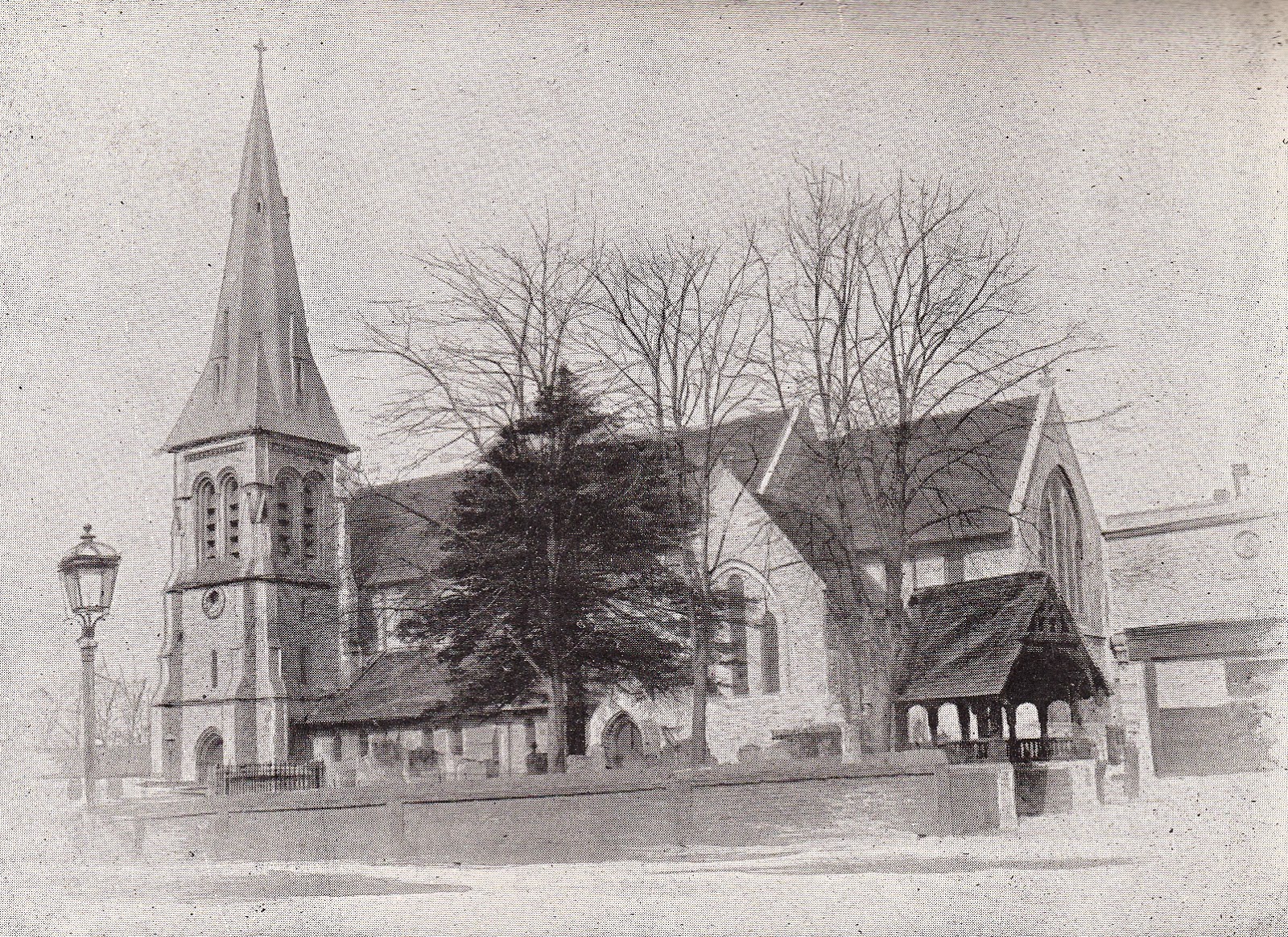
Looking at the parish church from the south in 1903

Now I like this picture of the parish church.  

It dates from around 1903 and comes from Some Records of Eltham 1060-1903 which is a marvellous little book written by Rev. Elphinstone Rivers who was the vicar of St John’s from 1895.*

I have written about our parish church before but what fascinates me about this photograph is that at first glance it looks just as it does today, but then there are the tiny details which I leave you to spot.

For me the added complication is that I was pass by in the summer when the mature trees pretty much obscure the view of the church so this 1903 picture does much to show the place off as it would have looked when brand new.

Picture; the parish church from the south , 1903, from Some Records of Eltham

*Some Records of Eltham 1060-1903, Rev. Elphinstone Rivers, 1903


Tuesday, 2 June 2026

One Acre Allotment and more stories of rural Eltham

One Acre Allotments, 1908
Even in the most built up urban areas there are clues to our rural past.

Here in Chorlton there is still the village green with the old school, the parish graveyard, two old pubs and some former farmhouses along with a barn where the Methodists held services at the beginning of the 19th century.

And Eltham is no different; although I have to say this bit of what was once Kent and is now south east London has managed to retain far more of its old fine houses.

But it is not of fine houses that I want to focus on today but the intriguingly named “One Acre Allotments" which have their story.

They were all that was left of the fields to the north of the High Street beyond the line of buildings and had you had a mind to you could have walked them all the way up to the woods and Shooters Hill.

Our field was known locally as One Acre and was directly behind what is now the school on Roper Street.

One Acre  1844, One Acre  is numbered 251, 
It was meadow land and formed a block of meadows which stretched east across along the present Gourock Road and also included the field that ran along what is now the west side of Roper Street.
and was “often used to accommodate for the night the herds of cattle or flocks of sheep that were being driven out of Kent into the London market.”* 

A practice which seeks to remind us that most of our big cities were supplied with fresh food which before the railway was walked to its destination and joined the livestock permanently kept in urban centres.

In total there were four of these meadow fields and only one is officially listed with a name.  In the 1840s they were farmed by different tenants but three were owned by Sir Gregory Page Turner while that on the western side of Roper Street was Glebe land.

It might not be good history but I do catch myself wandering down the lane which is now Roper Street and heading off onto the footpath where the land finished.  Had I done this in the 1840s there at the end of the lane would have the stile and the start of the footpath.

The Smithy and One Acre Meadow, 1858-74
And  I had a choice, turn east and by degree I would have ended up at Shooters Hill, and if I gone west along what was sometimes called “The Slip” which ran parallel to the High Street I would have reached the parish church.

And if that was not enough choices at both the start of The Slip and at its end there were paths off to Well Hall and Shooters Hill.

Now I rather think there may also be stories about the people who rented these four fields.  Each is known to us, and two appear to have been comfortably off describing themselves variously as Gentleman, Independent or Merchant.

But as ever there seems a little bit of mystery and yes it is our field which the records show was rented by a George Smith snr in 1839, but exactly which George Smith is a problem, for there were three living in Eltham during the 1820s into the next two decades.

The most obvious was George Smith who listed himself as a blacksmith during the period.  He lived in the High Street had a son called George which might explain the description George Smith snr and his smithy was at the bottom of the lane where it joined the High Street.

If this is him the fates were not kind, by 1851 he is in hospital and his son is living with his former wife who had reverted to her maiden name. And like so much of the history I like this just gets a tad messier, because George Smith snr is recorded as renting 40 acres along with a “farmhouse, barn, yard and building” which seems a bit out of the range of a blacksmith.

But we shall see.

*R.R.C.Gregory, The Story of Royal Eltham
Pictures; One Acre Allotments from The story of Royal Eltham, R.R.C. Gregory, 1909 and published on
The story of Royal Eltham, by Roy Ayers, http://www.gregory.elthamhistory.org.uk/bookpages/i001.htm detail of Eltham, and detail of the Smithy and One Acre Meadow,detail of Eltham High Street, 1844 from the Tithe map for Eltham courtesy of Kent History and Library Centre, Maidstone, http://www.kent.gov.uk/leisure_and_culture/kent_history/kent_history__library_centre.aspx and detail of smithy, the lane and the meadow land from the OS map of Kent 1858-74

Saturday, 18 April 2026

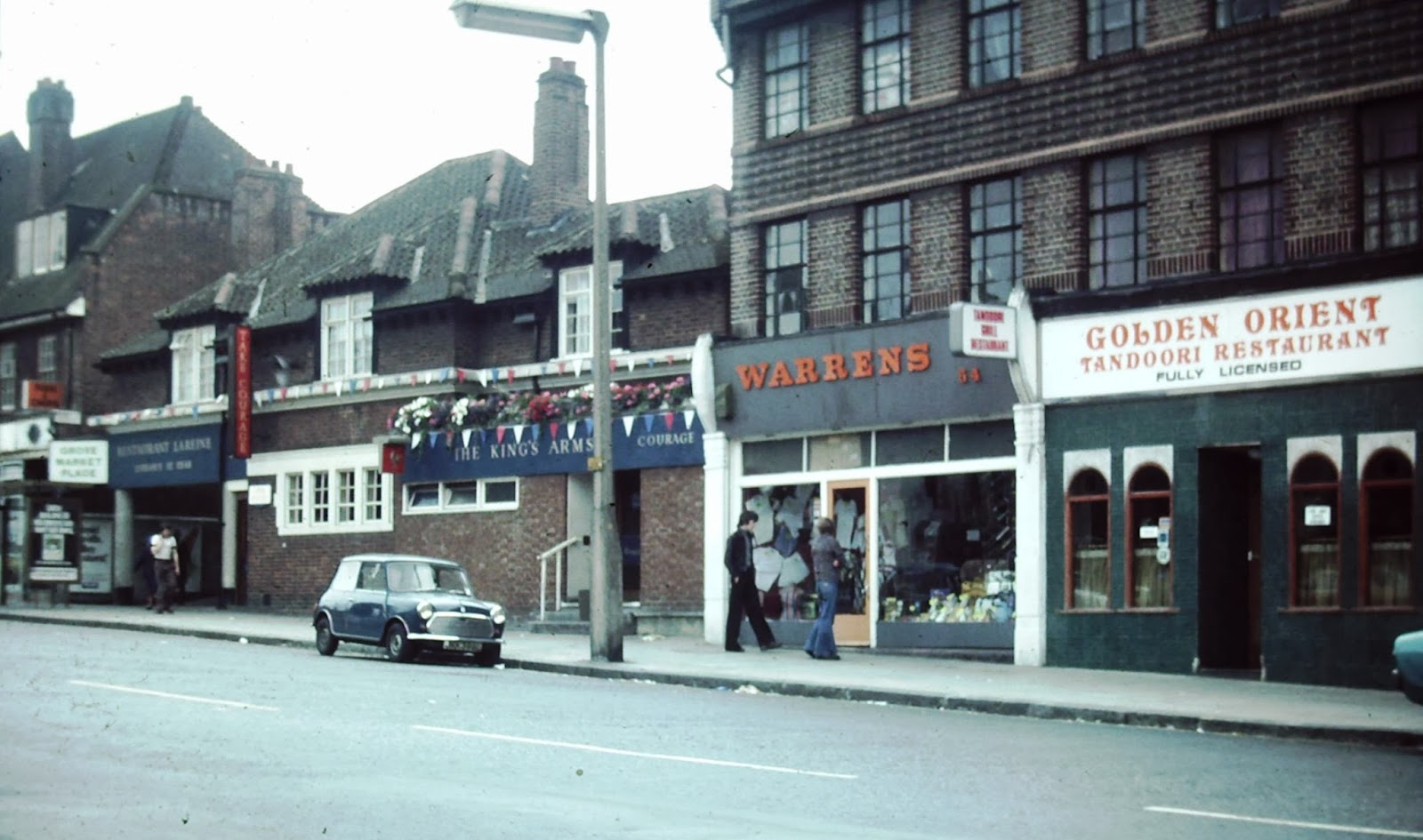
On Eltham High Street in the summer of 1977

Now there is a very obvious appeal about old photographs of Eltham.

Eltham High Street in 1977
The people stare back at you and it is easy to wonder about their lives, their hopes and of course what happened to them.

In the same way we are drawn to the buildings, comparing their appearance then with now or pondering on how the planners could have allowed such a magnificent house to be demolished to make way for an ugly block of flats or an equally drab parade of modern shops.

And the irony is that those 1950s/70s new build rarely have lasted the course.

The grey concrete has stained, the wood panelling has begun to rot as have the window frames and the modern signage is totally out of character.

So it is more pleasant to retreat into the images of a century ago.  All of which is fine but often ignores the more recent photographs, from say the 1970s or 1980s.  These can be just as revealing about how things have changed, with that added bonus that they show an Eltham which is almost as it is now but not quite.

In that sense they seem even more dated.  The fashions look outlandish and the cars comical.  But for the historian these images are just as important.

So in 1977 on this stretch of the High Street the King’s Arms was still serving pints, Warrens and the Golden Orient Tandoori Restaurant were yet to give way to Pat’s Textiles and Spice Island, and the Grove Market was a busy and vibrant place.

So and not for the last time I shall fall back on that old Monty Python quote, "no one expects the Spanish Inquistion" and make an appeal for more of those pictures from the recent past.

Picture; courtesy of Jean Gammons, 1977

Thursday, 16 April 2026

At the Kings Arms waiting for Fred Wisdom to pull a pint

Now this is one of those familiar pictures of the High Street, looking east towards the church and Court Yard some time in 1915.

It comes from an excellent collection from Greenwich Heritage Centre which I discovered recently.

On the surface it is interesting enough but it is the clues it offers up about some of the people who lived along this bit of the High street.

And because Mr Digby who took the picture focused on the Kings Arms I shall start with the pub and its landlord Fred Wisdom.

I can’t be sure when he took over the place but four years earlier he had been running the Railway Bell in Tonbridge.

He lived here with his wife Elizabeth, their two young children and his two nieces who worked behind the bar and described themselves as assistants.

And there is more because I know that Fred was born in 1878, Elizabeth two years earlier and they had been married in 1899.

I doubt we will ever know why they moved to Eltham but they were here by 1914 and were still pulling pints six years later.

All of which came from trawling the street directories and electoral registers which supply the names of the rest of the inhabitants on the block running up to Court Yard.

But for now my attention has been drawn to the big billboard on the gable end.

It is advertising the serialization of a story by Hall Cains who was one of the most popular novelists in the later Victorian and Edwardian period with many of his books being turned into films.

According to one source they were primarily romances, involving love triangles, but also addressed some of the more serious political and social issues of the day.

And as if on cue the book advertised as being serialized in the popular Reynolds’s News was Woman Thou Gavest Me. which I shall go looking for.

But I will just leave you back on the High Street in 1915.

Picture; the Old Kings Head, High Street Eltham, GRW 276, http://boroughphotos.org/greenwich/
courtesy of Greenwich Heritage Centre, http://www.greenwichheritage.org/site/index.php

Wednesday, 15 April 2026

William & Julia Relph of the Rising Sun a promise fulfilled

This is William Relph who ran the Rising Sun on the High Street from sometime in the 1880s till his death in 1909.

Now you can never be certain but it is more than likely that when a photographer turned up in the High Street in the summer of 1890 it will have been the landlord of the Rising Sun who came to the door to see what all the fuss was about.

And so this is William Relph and I have to own up to a mix of quiet satisfaction and fascination that I have tracked him down.

It was a promise I made in earlier stories and have now completed that promise.*

He was born in Greenwich in 1847 and came from a family that ran public houses.

What marks him out as a little special is that William saw his time out in both the old Rising Sun and the new one which still stands on the High Street.

The old pub according to our historian R.R.C Gregory was about 200 years old when it was demolished and replaced by the present pub in 1904.

Nor is that the only thing that intrigues me about William.

I had almost given up hope of finding him and then as you do I came across his widow Julia who was still in charge in 1911, and it was Julia who caught my imagination.

She was born in Cadiz, Spain and of course that raises all sorts of intriguing speculation.

But before I could go off on a flight of fancy I discovered her maiden name was West and like William her father was a publican.

That said her parents were in Spain between the birth of her brother in 1852 and when she was born two years later which may explain why they are missing from the census returns for the middle decades of the 19th century.

So there is more to find out but finding William and Julia of the Rising Sun is enough for now.

Pictures; from The story of Royal Eltham, R.R.C. Gregory, 1909 and published on The story of Royal Eltham, by Roy Ayers,  and Chrissie Rose February 2014

*Eltham’s Rising Sun, http://chorltonhistory.blogspot.co.uk/search/label/Eltham%27s%20Rising%20Sun

Tuesday, 14 April 2026

My Eltham ………… half a century ago

Now, for all of us who left Eltham, and pretty much never really went back finding pictures of the place in the year we left can be bitter sweet.

On the one hand there are those warm nostalgic memories which are dashed by the changes, which just don’t fit with how you remember the place.

In my case it was the Eltham of the 1960s when I was growing up, attending Crown Woods and discovering the joys and pains of my first girlfriends.

And so when I left for Manchester in 1969 I rather thought the place would still be the same when I came back, which for a while it was, but in my absence, they moved the railway station, obliterated the old bus terminus, replaced Wilcox’s with a McDonald’s and over time closed most of the pubs I took my first illicit pints in.

Along the way they even destroyed the small shopping precinct which held the old Midland Bank, where I opened my first bank account.

All of those lost haunts bounced back today when I came across a series of pictures of the High Street from 1970.

The quality isn’t wonderful, but they are my Eltham, frozen in time, and gone for ever.

They come from Man & Town which was a pack of educational source material aimed at getting kids to look at original historical and contemporary documents.

The idea was rather than tell kids what to think, the documents with a set of briefing notes were aimed at getting them to make judgements about past events and present situations.

The packs were produced by Jackdaw Publications and were very popular in the 1970s, and in the way these things go I bet there will be people who remember using them.

In the case of Man & Town the challenge was to trace how towns develop and the decisions town planners might make to manage change.

Not all the documents were about our High Street but enough were, and interestingly mirrored a real exercise by the planners in the Council who were looking at how Eltham could be changed.

And that is it.

I have chosen just three pictures from the High Street collection, and I leave you to wander back the half century.

Leaving me just to say I did go looking for Jackdaw to ask permission to reproduce the images.

Copyright and seeking permission is important to me, having seen my own stuff lifted and paraded across the internet. 

But after an exhaustive search I am not sure they still exist.  There is what I think is an American company with the same name but they do not appear to be connected to the UK company.

Back copies of many of the packs are still available and command prices between £10 and £20.

Location; Eltham High Street

Pictures; Eltham in 1970, from Man & Town No. 80, courtesy of Jackdaw Publications

Monday, 13 April 2026

Looking out on the High Street with memories of past girlfriends

Even on a Sunday in late October our High Street can be a busy place.

And looking out from the parish church I am reminded of the countless times I stood in the shelter of that entrance waiting for a friend.

More often than not it will have been a girl friend although thinking about it there were only three steady ones.

That said the corner of Well Hall Road and the High Street was a favoured place for me and Jenny to meet up.  In term time she lived in the lodge at Crown Woods and if we were going out to the cinema this was a sensible place to meet.

And this was in that pre mobile age when once the choice of where to meet was made you had to stick to it or suffer the consequences of missing each other and trying to second guess an alternative which otherwise meant mutual recriminations on the Monday morning.

So along with the entrance to Avery Hill and the Wimpy bar this place will always have a special place in my memory.

Picture; the parish churchyard, October 2015 from the collection of Elizabeth and Colin Fitzpatrick

Sunday, 12 April 2026

Looking into the future of Eltham High Street in 1975

The High Street in 1910
Now I don’t normally go in for then and now pictures but I have made an exception with these two images from a 1975 document issued by the Council.*

The book was part of a planning consultation and fell through the letter box after I had long left Well Hall for Manchester.

I am not sure what my dad and sister Stella thought of the process, or the ideas but now both the planning exercise and their suggestions  are as much a piece of history as any of the stories I usually write.

The High Street in 1971
So along with the 1970s pictures there is also an insight into how the planners were thinking back then and just how far the bold new world they suggested has come about.

And for me the images have a special connection. Our Stella worked at the library and from 1964 till I left Well Hall in '69 it was a regular venue, along I remember with Marks & Spencer's where I bought my first ever fruit yogurt.

Now that is not only revealing a secret but says so much on the new horizons which were opening up for a lad from south East London.

Pictures; from A Future for Eltham Town Centre, Greenwich Borough Council, Planning Department, 1975

*Of town plans and visions of a future that never quite happened, Eltham in the 1970s and Manchester in 1945.http://chorltonhistory.blogspot.co.uk/2014/10/of-town-plans-and-visions-of-future.html

Saturday, 11 April 2026

On the High Street with Mr Rideway in 1933

I am standing outside numbers 116 & 118 Eltham High Street in 1933.

And this I know because in that year our old friend Llwyd Roberts painted the two properties which were just up from the old Castle pub.

At 118 there was the saddler William Barnes who had occupied the property from at least 1919 while nu 114 was the business premises of Charles Rideway who ran a dairy.

I can track Mr Rideway back to 1901 on the High Street selling his milk and by 1933 he seems to have diversified into sweets, chocolate and tobacco.

His immediate neighbour had been Arthur Moody who in 1919 described himself as a picture framer, and may still have been there when Mr Roberts painted the picture.

All of which just leaves William Barnes who had taken over the business from George French around 1919.

Now I don’t know whether the saddling business of Mr French was not doing so well but sometime between 1901 and 1911 he began renting out some of the building.

In room there was Charlotte Eliza Rose who at 71 described herself as a widow and in another were Mr and Mrs Brading.

So there are a lot of leads to follow up, including when the French family moved on, why Mr Rideway decided to diversify and how long his dairy continued to deliver the milk to Eltham residents after 1933.

I know that he died in 1954 and by then was living in Park View which is now Passey Place and given that he had seven children they may be much more to be revealed.

And the children do help place when the family arrived in Eltham.  The first three were born in Somerset between 1892 and 1896 while their fourth was born in Eltham in 1898.

And the key too much of the research will be the yearly street directories along with the electoral registers which are available down at the Heritage Centre and which will allow us to follow the movements of Mr Rideway, Mr Barnes and Mr Moody.

In the course of which we may come up with advert for Mr Rideway's business.

But for now I am interested in Mrs Charlotte Eliza Rose who was born in Eltham and had been married for 51 years, but that is for another time.

Picture; 116-118 Eltham High Street 1933, Llwyd Roberts.

Source material, census returns, 1901-11, Post Office London Directory 1909, 1919, and Electoral Roll 1932

Friday, 10 April 2026

What a difference a century makes ............. looking down to Eltham Hill in 2015 and 1915

I like this view from St John’s church yard down towards Eltham Hill.

It is one I have taken for granted but nicely shows just how Eltham has changed in a century and reminds me how I have yet to track down the story of Eltham Brewery and the Kenward brothers who were listed as the owners in 1914.

The brewery was originally further up the High Street but so far I haven’t discovered much in the way of any references to either building.

And that is a bit odd given the number of people who will have once worked for the Kenward brothers.

That said I did come across a James Kenward at Rosslyn on Footscray Road in the 1890s but he appears not to have been connected with brewing, so the hunt goes on.

In the meantime I will also go in search of shop keepers who occupied the properties on the south side of the road.


Location; Eltham, London


Pictures; looking down to Eltham Hill, 2015 from the collection of Elizabeth and Colin Fitpatrick,  and the brewery in 1915 GRW 325 in 1917, GRW 215, http://boroughphotos.org/greenwich/ courtesy of Greenwich Heritage Centre, http://www.greenwichheritage.org/site/index.php

Thursday, 9 April 2026

A military academy in the High Street and that other Eltham Lodge

Cliefden House, 1909
Mr Thomas Hopkirk ran his military academy from Cliefden House in the High Street during the middle decades of the 19th century.

This grand 18th century property is still there on the High Street opposite Passey Place.

It was built sometime around 1720 with an eastern addition dating from the mid 19th century.

Now I can’t be exactly sure when Mr Hopkirk opened his doors but it will have been around 1849 for that was the year he and his wife Charlotte baptized their daughter in the parish Church and it may well have been Mr Hopkirk who added the extension.

Together this made for a large 17 roomed house which could accommodate “The Preparatory Military Academy” with its 32 students.

They were aged between 11 and 18 and were from all over England as well as Ireland with a significant group from the empire.  Along with Mr Hopkirk there was another teacher, a cook, a nurse and three house maids.

Originally the house was fronted with a tall wall behind which was a small garden, all of which was swept away when the High Street was widened.

Behind those walls Mr Hopkirk set about the serious business of running “a school for young gentlemen.”*

His reputation may well have been made in the school he ran in Woolwich on Frances Street and with an eye to a good location this first “Preparatory Military Academy” was sited close to the barracks.

There were 500 of these academies in Kent in 1851 with 15,411 students and in the half century before the numbers had waxed and waned, a situation which pretty much carried on during the decade before Mr Hopkirk had established himself in Eltham.**

Now this period is still a little murky but the establishment was listed in Baggot’s History, Gazetteer and Directory for Woolwich in 1847 and it will just be a matter of trawling the directories for the years before that date to determine when it was opened.

What I do know is that six years earlier Thomas had been employed as “the mathematical master” along with a classics teacher and a writing master in a school in Totteridge which was once a village in Hertfordshire and is now part of the borough of Barnet.

Like his own academy this was designed for young gentlemen of whom there were 69 aged between 9 and 17 and all born somewhere else.  Nor were they alone for during the mid 19th century there were two other private schools in the area.

Both Thomas and his colleagues were aged just 20, and there is no indication of who the owner was, nor have I come across any details on his background which makes it difficult to work out how he raised the capital to start his academies.

The west end of the High Street,in 1844,  nu 305 is Cliefden House
As ever the answers will turn up as will the date when he closed the school and moved on.

It was still there in 1861 but had gone by 1871 and it may just be that we can narrow it to sometime between 1865 when he was registered to vote in Eltham and three years later when his address is given on the register as London.

But like all research this has to be qualified with the observation that he is still listed in the Post Office Directory in 1868 on the High Street.

What makes it more difficult is that he and Charlotte are missing from the 1871 census and don’t reappear until a decade later, by which time they are in Dulwich at the appropriately named Eltham Lodge.

Such must have been impact Eltham had on the couple.  It is of course just possible that the house had already acquired the name but I doubt it.

And it was here that Thomas died in March 1881 leaving a personal estate effects valued at under £30,000 and Charlotte in 1912.

All that is left is to record that he in 1865 he voted Tory and that he was a Fellow of the Royal Society of Arts.

Pictures; Cliefden House Eltham from The story of Royal Eltham, R.R.C. Gregory, 1909 and published on The story of Royal Eltham, by Roy Ayers, http://www.gregory.elthamhistory.org.uk/bookpages/i001.htm detail of Eltham High Street, 1844 from the Tithe map for Eltham courtesy of Kent History and Library Centre, Maidstone, http://www.kent.gov.uk/leisure_and_culture/kent_history/kent_history__library_centre.aspx

*R.R.C. Gregory, The Story of Royal Eltham, 1909

**  Census of Great Britain, 1851 Education.  Along with a similar census in religious worship this was undertaken in the April of 1851 with the general census


Wednesday, 8 April 2026

What's in a name? Pound Place by Eltham High Street in the summer of 1909

Looking south into Pound Place, 1905
“Pound Place is the name of the street on the side of the High Street opposite the Public Library.  

It derives its name from the fact that the old Pound occupied the spot where Mr Cook’s shop now stands at the corner near the High-street.  

The latest Pound was at Eltham Green.”*

Most villages had a pound or pinfold.  Any animal left to wander could do a lot of damage and so strays were confined in the pound and the fine to release it matched the seriousness of the offence.

This amounted to 1s [5p] which was paid to the parish constable.   The owner would also be expected to pay for any damage the animal had incurred.

If the animal was not collected in three days it was sold to defray expenses.   Anyone attempting to release the animal without paying was liable to either a fine or imprisonment.

Some of the cottages
All of which is a reminder that names do not come from the minds of city planners or rich landowners intent on lasting posterity but from the experiences of ordinary people.

In the village I now live in the junction of the four main roads was once known as Kemp’s Corner because Harry Kemp set up a chemist shop on one side.

It remained the unofficial name for over half a century and was a recognised meeting place.

And today long after Mr Kemp has all but been forgotten it is now referred to as the Four Banks or Four Banks Corner which is a practical name for a place which does indeed have a bank on each corner and pretty much pushed the official Corporation name of Chorlton Cross into the long grass.

I like this picture which shows Pound Place looking south from the Library.  It is one of two in the collection and dates from before 1909. Judging from the leaves on the trees and the shadows this was taken on a summers afternoon and already a small crowd has gathered to witness the photographer capture the moment.

And as ever amongst the adults there are the curious children drawn by the camera.

Sadly we can not make out the detail on the newspaper posters which would pin down the day and confirm that we are sometime in the summer or early autumn.

The houses were there well before the middle of the 19th century and there was quite a large community living there including Richard White and his family.  Mr White is someone I have featured already.**  He was the village school master and responsible for the collection of the census returns for part of Eltham in 1841.

Mr Cook's shop, 1905
Now I am no romantic and rarely indulge in idle speculation, but I rather think he would have known these cottages and may even have lived in one.

And that is about it although I will go off and hunt down Mr Cook who sold papers from his shop on the corner of Pound Place.

Well almost because Matt K Minch commented, "I have a slightly clearer version of this which says it is 1905, I think the right hand billboard says 'Lord Kitchener' at the top".

And with that kindness that comes from a love of all things Eltham, Matt sent over his image which is far superior to mine and deserves to the centre piece f the story.

But given that the piece has already been written I will add it at the end because as my mother always said ...."leave the best to the last Andrew" and that I have done.

Matt's superior picture, 1905

Picture; Pound Place, 1909,   from The story of Royal Eltham, R.R.C. Gregory, 1909 and published on The story of Royal Eltham, by Roy Ayers, http://www.gregory.elthamhistory.org.uk/bookpages/i001.htm
and Pound Place courtesy of Matt K Minch

Tuesday, 7 April 2026

The lost Eltham & Woolwich pictures ...... no.17 the Rising Sun in pale blue

A short series on the pictures of Eltham and Woolwich in 1976.


For four decades the pictures I took of Eltham and Woolwich in the mid ‘70’s sat undisturbed in our cellar.

But all good things eventually come to light.

They were colour slides which have been transferred electronically.

The quality of the original lighting and the sharpness is sometimes iffy, but they are a record of a lost Eltham and Woolwich.

Location; Eltham

Picture; Eltham, circa 1976, from the collection of Andrew Simpson

Monday, 6 April 2026

A little bit of the High Street in the summer of 1977

There will be quite a few who remember the High Street like this.

It is the summer of 1977, the Silver Jubilee celebrations are still in full swing, and I came back for a brief holiday.

And in that summer of ’77 Eltham looked pretty much as I had left it four years earlier when I finally accepted that Manchester would be home.

Now when I left to go to College I always assumed I would be back, after all Eltham was where I grew up and where I had been very happy.

But the degree led to a job, I was already married and so seamlessly and without really giving it much thought I settled down in the North.

And on those occasions when I did return I noticed the little changes, and then after a longer period away the transformation was pretty dramatic.

The Odeon on Well Hall had closed, the station had relocated and cutting across Well Hall Road was that motorway.

Nor was this all, Willcox’s and Burtons on the corner opposite the church were no more, the Post Office was a pub and somehow a little bit of my childhood was lost.

Still that is the price you pay for moving away.

Not that this is a lament just a recognition that all things must change.

But in the meantime I shall gaze again on the High Street I remember.

Picture; the High Street in 1977 from the collection of Jean Gammons

Sunday, 5 April 2026

One of those scenes of the High Street that has passed out of living memory

This is another of those scenes of our High Street which I suspect has long faded from living memory.

We are standing a little past the junction with Well Hall Road, looking east and the grand house in the centre of the photograph is Sherard House.*

It went in 1923 when the Nat West Bank was built on the site and was followed by the Congregational Church which made way for that large and grand shop which was Burton’s in 1937.


It is a wonderful image because it takes us back to that time when the  big houses of the people with plenty dominated the High Street.

Most have now gone but a few are left, although all have been much knocked about.

*Sherard House and Church Row in Eltham in 1841 and Richard White census enumerator,
Picture; courtesy of Kristina Bedford from her new book Eltham Through Time, Amberley Publishing, 2013,


Thursday, 2 April 2026

One big House on the High Street

2015
Now I have written about Cliefden House on several occasions, and will go back again in due course.

In the meantime here are three photographs over a full century and a bit and each has it’s own story to tell.

The first was taken recentlt by Ryan and despite the changes of businesses it is not so different from Jean Gammon’s taken 38 years earlier.

1977
Step back another 60 years to 1909 and the transformation is pretty stunning.

Back then it was a private residence and in the middle of the 19th century had been a military academy.

It was built sometime around 1720 with an eastern addition dating from the mid 19th century and together this made for a large 17 roomed house.

In the 20th century the front garden and wall were lost when the High Street was widened and more recently with scant disregard for such an elegant old property businesses have set about about adding the most appalling signage to the exterior.

1909


Pictures; Cliefden House, 2015 courtesy of Ryan Ginn, back in 1977 from the collection of Jean Gammons, and in 1909, from The story of Royal Eltham, R.R.C. Gregory, 1909 and published on The story of Royal Eltham, by Roy Ayers,http://www.gregory.elthamhistory.org.uk/bookpages/i001.htm 

Tuesday, 31 March 2026

Eltham and Woolwich ………… 76 years ago
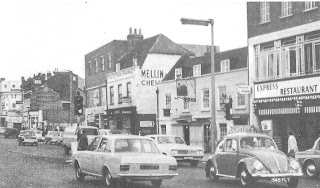
Eltham High Street
The quality of the images is a bit iffy, but that has more to do with me than the originals.  

As our scanner has taken a holiday, I was forced back on taking a picture from a picture, using a camera.

Still they capture scenes which have almost passed out of living memory, because while neither Woolwich or Eltham changed that much during the 1950 and 60s, these three images date from the very early 1950s if not back into the decade before.

And that makes them quite special, but for me there is another reason and that is they come from a book I thought lost.

Hare Street
It is the Official Guide to the Metropolitan Borough of Woolwich, and while there is no date, judging from the images I guess it was produced soon after the last world war.

It is a fascinating book which is now a piece of history.  Along with detailed descriptions of Woolwich, Eltham and Plumstead, there is a wealth of information on the services the borough operated, and a shedload of adverts for firms many of which will have ceased trading ages ago.

These include the Pioneer Bookshop at 3 Woolwich New Road, Court Studio in the Arcade in Eltham, and J.A. Proctor Ltd Builders and Contractors of Plumstead.

Thomas Street
So over the next few weeks I shall be returning to the Official Guide.

Leaving me just to observe that the presence of tram tracks and overhead cables might fix the time to some time before that last tram ran.

Although both rails and cables didn't vanish straight away.

Location; the Borough of Woolwich

Pictures, Eltham High Street, Hare Street and Thomas Street, circa 1950, from the Official Guide to the Metropolitan Borough of Woolwich, Wells of Woolwich

Monday, 2 March 2026

Eltham High Street in the summer of 1915 and again sometime in the 1960s

At first glance it looks familiar enough.  

We are looking at the parish church  on a warm summer’s morning sometime in 1915.

It is a picture I have grown to like and given that I have just bought the postcard I am quite pleased with myself.

Now I say bought, but in fact I have ordered it up and if it hasn’t been sold I shall soon be the proud owner of a little bit of old Eltham.*

So back to the picture which has enough detail to mark it off as an image from almost a century ago.

The tram is about to leave travelling along Well Hall Road which was cut just over a decade before and on the eastern side of the road there are none of the familiar shops while just out of the picture on the extreme right was Eltham’s third Congregational Church.

It was built in 1868 “in a strong Gothic Style with a tall spire and was demolished in 1936.”**

And while I don’t usually do then and now pictures I couldn’t resist adding the second photograph which I guess is from the 1960s.

This is the Eltham I remember.

They say you should never go back and I have to admit the first time I returned after Burton’s had gone, along with the newsagent/bookshop it was rather like a little of my childhood had been consigned to the rubbish bin..

But all of that smacks of nostalgic tosh, and no doubt any youngster who had stood beside the photographer in the summer of 1915 may well have muttered something similar when Burtons opened its grand new shop on the corner of Well Hall Road and the High Street in 1937.

Now I have to confess the shop with its great Ionic columns and pilasters at first floor level still dominates the corner even if the sleek 1960s Italian suits, jackets and ties have been replaced by fast food and soft drinks.

And while I bought my first suit from the shop it will always be the memory of the crowds turning out from the dance hall above the shop on a Saturday night that I remember along with the newsagents which occupied part of the Well Hall side of the building.

It was there that I would buy my Penguin Classics many of which still sit on the bookshelves here in Chorlton.

But again I am in danger of sliding into nostalgia so it’s best to leave these two pictures in the past, until my post card arrives from Mr Flynn which no doubt will set me off again.

And in the meantime I would welcome any images of Eltham which will provide the material for more stories.

Pictures;  Eltham in 1915, courtesy currently of Mr Flynn and Eltham in the 1960s

*MARK FLYNN POSTCARDS http://www.markfynn.com/index.html

**Spurgeon Darrell, Discover Eltham, 2000