Showing posts with label The class of '68. Show all posts

Wednesday, 11 March 2026

A name …… some reports ...... a heap of friends ...... and the memories …… Crown Woods ..... 1966-68

Just what survives from our school days is a lottery.

It’s usually a mix of luck, self-interest, and our parent’s determination to save something of our childhood.

Me …….. I have just five school photos from my days at Samuel Pepys Secondary Modern, nothing from my Junior School and little from my time at Crown Woods.

 And I guess it’s the absence of much from Crown Woods that irks me the most given that they were the happiest of my school days.

Just why they were lost is still a puzzle, but I have rediscovered the reports from our Stella.

All five of us went through its doors, from September 1966 when I was 16 and new to the Sixth Form to my four sisters who attended in the late 60s into the next decade.

The reports span the winter and summer of 1970/1971 and are fascinating on many levels.

First of course they remind me of our sister and that in itself is a bonus.

But then there is the school badge and the names of the teachers including Mrs. Husain who was my first tutor and head of History but who had become a deputy head by 1971.

And there is the style of reporting which I recognise so well from my 35 years of teaching.

Some of the comments are spot on, others very subject specific and some vague and generalized.

All of which I can vouch for over the decades in what I struggled to write about my students, running from the supportive, constructive to the diplomatically critical.

“Always remember” I told myself that “this is a person, not a number on a register who should always be treated with respect”, unlike one poor soul who a colleague of mine in the 1970s summed up as “feeble”, no more no less.

But reports are not all of what lingers with most of us.  For me it is the friends I made, and who I still talk to today fifty-eight years after I met them along witha heap of memories which range from the good to the indifferent and the bad.

In there I include some girlfriends, some impressive teachers and the drama and musical evenings which still live with me.

And now I read that the successor to the Crown Woods I knew is discussing changing the school’s name.

Am I sad? Well, a little, but then the building I knew has already been demolished and it is over half a century ago that I went there.

Added to which of the seven educational institutions I studied at and taught in, only one has survived, and that was Edmund Waller in New Cross. The rest from my secondary school to Crown Woods, the places I did a degree and obtained a Cert Ed along with the schools I taught at ... all have gone. Some are now apartments, or housing estates while one changed its name, was then demolished and is now an academy with a new name.

So, not much to show for the biggest part of my life as a student and teacher.  Still to misquote Rick Baine from the film Casablanca we will always have the memories.*

Location; Eltham

Pictures; report for Stella Simpson, 1971 in the Simpson collection

*“We will always have Paris” Rick Baine, Casablanca, 1942


Tuesday, 10 March 2026

When Crown Woods went vinyl ………………..

I will always be grateful to Crown Woods.

Being 16 and turning up at Crown Woods, 1968
It took a raw sixteen-year-old newly arrived in the September of 1966 and offered up an exciting new world.

My previous five years had been spent at a secondary modern school in New Cross which was the end result for all of us who failed the eleven plus and were judged academically unsuited to the world of Shakespeare, John Donne, and Shelley.

To be fair many secondary moderns did punch above their weight, put students through O and A levels and suggested some of us could walk the hallowed corridors of universities.

That said I had an indifferent five years and was ready for Crown Woods.

And what a revelation it proved to be, from the teachers to the assumption that we would get involved in the drama, and musical productions, while encouraging us to cross the city in search of plays and films just because they were being performed.

crown woods at southwark, 1966

These jaunts included nights at the Old Vic, and Joan Littlewood’s theatre in Stratford as well as tiny amateur presentations of the classics in small smelly venues over the River in obscure parts of north London.

Musical night, 1966
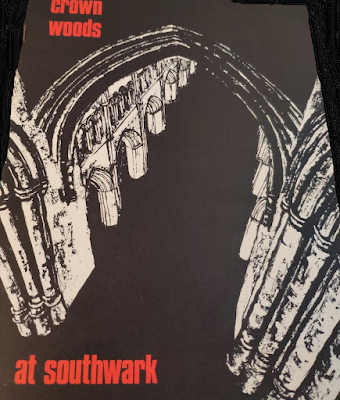
All of which complimented the big inhouse drama productions from the Price of Coal, Crown Woods at Southwark, heaps of music nights and the small intimate evenings hosted by the English Department.

Over the years I have written about those experiences but until yesterday I wasn’t aware that Crown Woods had gone vinyl.*

It was in 1978 and consisted of selections from a series of concerts performed in 1977/78 school year, and the magic is the variety.

Crown Woods went vinyl, 1978
From the classics to items from popular musicals and jazz, and as befitted a comprehensive school the participants were drawn from all age groups.

The magic was in the variety, 1978
My only regret is that I wasn’t there although there will be people who remember those three magic nights and my have participated in one of the concerts. 

But by 1977, I was doing my bit for education in an inner-city Manchester school trying to emulate the spirt of Crown Woods.

That said I came across a copy on ebay for sale at £24.**

It is listed as "CROWN WOODS SCHOOL IN CONCERT   L.P.  EXCELLENT CONDITION. CATALOGUE NUMBER:  SPS130

This brilliant album by Crown Woods was released on a private pressing back in 1979. This copy is in great condition (as described above).  Along with some truly timeless music it has a great sleeve!  RARE !!"

Now I am intrigued that it was a private pressing, and wonder just how many were made.

I am tempted to make a bid but that would involve repairing our record deck, but that might just be the incentive I need.

A different sort of musical event, 1968
For now I will just reflect that Crown Woods did allow me to stage a folk concert which I guess at 17 was something given the artists who turned up.  

With that passage of time I have no idea how much they were paid.

Leaving me just to thank Chris Mentiply for permission to reproduce his copy of the LP and make a story.

And to conclude where I began that Crown Woods did really offer up the lot.

 Location; Crown Woods, Eltham

Pictures; That raw 16 year old, 1966 from the collection of Andrew Simpson, Musical nights at Crown Woods from the collection of Ann Davey 1966, crown woods at southwark, 1968, Margaret Copeland Gain, and Crown Woods, the vinyl from Chris Mentiply

*The class of 68, https://chorltonhistory.blogspot.com/search/label/The%20class%20of%20%2768

**Crown Woods in Concert, https://www.ebay.co.uk/itm/112343918748

Monday, 9 March 2026

The class of ’68 part 8 ……. doing drama the big way*

Now if you went to Crown Woods in the 1960s and into the next decade, chances are you will have been part of the big block buster performances, involving the English, Music and Art departments.*

The Price of Coal, November 1968

And if that performance was The Price of Coal which was performed in November 1968, then you could add the History department to that list.

These were the inclusive productions which set out to include as many students as possible from all age ranges, skills and talents to show case the school and show just what a comprehensive school could achieve.

The Price of Coal, not only brought together the traditional departments but was researched by students doing history, and told the story of the impact of coal mining in the late 18th and 19th century.

It was performed in the same year that Newcastle Playhouse’s production of "Close the Coalhouse Door" which was written by Alan Plater, based on his friend and mentor Sid Chaplin's mining stories, and with music by Alex Glasgow – all three of them born in the County Durham mining area.

I should remember The Price of Coal, and Peter Grimes, because I entered the school aged 16 in the September of 1966.

Peter Grimes, March, 1968
But I did perform in two others which were All that life can afford and Crown Woods at southwark.

These productions were were spoken of with a mixture of pride, but also a nonchalance, based on that confidence that this is what a comprehensive school can do.

I have no doubt that the neighbouring schools of Eltham Green and Kidbrook did the same, but Crown Woods was my school.

And for someone who came from a small all boys secondary modern, on the borders of Brockley and New Cross, Crown Woods was something very different, very exciting and ultimately very rewarding.  

Not only for his academic standing but also because it was a co-educational school and for a lad from a single sex institution that was something else.

But that is for another story, leaving me just to thank Margaret Copeland Gain, who sent over the two covers from the productions of The Price of Coal and Peter Grimes.

crown woods at southwark

Location; Crown Woods, Eltham


Pictures, covers from the productions of The Price of Coal, crown woods at southwark,and Peter Grimes, 1968, courtesy of Margaret Copeland Gain

*The class of '68, https://chorltonhistory.blogspot.com/search/label/The%20class%20of%20%2768

**Close the Coal House Door, Alex Glasgow, https://www.youtube.com/watch?v=YGPSqE74F0Q


Sunday, 8 March 2026

The class of ’68 part 6 a beginning

The class of '68
We were the class of ’68.

Twelve young people from south east London about to leave school for the last time.

It would have been in late June or early July 1968 outside Crown Woods School in Eltham, our exams were finished and we were all preparing for that long hot summer which would end with exam results and the beginning of a new phase in our lives.

And now fifty-eight years later I guess we have all entered another phase which is pretty much about retirement, watching as the grandchildren come along and reflecting a little on the bitter sweet passage of time.

The PYE FBIC Consule retailing at £85, 1951
Not that this will be some nostalgic drivel.  It isn’t that the past was better, the summers hotter or the Waggon Wheels bigger it is just that it was different.

Nor have the changes we have encountered been any less dramatic than previous generations.

My uncle was born in the closing years of the 19th century, lived through the 20th and into the 21st.

During his lifetime he saw and managed a revolution in technology from how we communicated, travelled and saw the world.

Had he lived just a little longer than his 102 years I have no doubt he would have mastered the computer and the internet in the way he had the telephone, the wireless and the TV.

My sons will no doubt grapple with even faster change.

But the class of '68 were no less adept at coping with the new.  We grew up just as the television was beginning and moved into adulthood with the transition from one black and white channel to three, and entered middle age with digital channels.

Mr Therm, 1949
The hand held communicator much loved of science fiction has become the mobile phone and the postcard replaced by the email.

The paths that the 12 of us went down were quite different but what we all have in common is that we are part of what some have called the favoured generation and others “the baby boomers.”

And there is no doubt that we were born in to a world our parents were determined would be better and different.

It was one of rising prosperity, of a welfare system which confidently planned to care for us from “cradle to grave” and as we entered adult hood there was promise of full time employment and the opportunity of a university course which for some of us would be totally free.

There was a dark side to all this. The Korean War had begun just as most of us were coming up to our first birthday, and the ever present threat of nuclear war hovered in the distance, and as if to round off our child hood by the summer of 1968 there was the awful tragedy of the Vietnam War.

All of which is still in stark contrast to the experiences of my parents and grandparents who lived through two world wars and a major trade depression or the uncertain future of my children.

But, and there always is a but I do tire of the shallow analysis and cheap jibes offered up by the unthinking commentators on the baby boomer generation, most of which lacks historical validity and often is a smoke screen to hide the failings of our market economy.

The class of '68 in the summer of 1965
The class of ’68 did not create the present economic situation, and if we are sitting on inflated house values this was not our doing.

Indeed for any one starting out buying a house in the 1970s and ‘80s the constant rise in  inflation made balancing the household budget and meeting the spiralling mortgage costs a real problem.

And I suspect all of us baby boomers now creak a lot and despite those favoured years of full employment we are coping with failing hearing, stronger spectacles and in my case a distinct recurrence of back pain.

Added to which there is that sure fire knowledge that there are fewer years ahead of us than behind.

But if there is a consolation it is that while we may not be any fitter than previous generations the quality of our lives and those of our children are better.  The old killer diseases are held at bay and so are many of the less serious but no less debilitating complaints.

Which brings me back to the beginning and just as 1968 marked an ending, so for the class of '68 the next decade will be full of new beginnings and with it some wry reflections on what has been and what maybe to come.

Pictures; from the collection of Anne Davey and Andrew Simpson

Saturday, 7 March 2026

On going to Crown Woods and attending a Conference at Eltham Green

The class of '68 outside Crown Woods
I went to Crown Woods.

I started there in the September of 1966 as a sixth former having come from a secondary modern school in New Cross.

It was at the time and remains one of the most exciting periods of my life.

Even leaving Eltham for Manchester three years later to do a degree never offered up the same mix of magic, discovery and sheer fun as those few years I spent at the school and so it is something I keep returning to.*

Take one fairly ordinary working class lad with a love of history, provide him with some excellent teachers in a stimulating environment, throw in a mix of fascinating friends and the result is something very special.

This was what learning was all about, and like all good learning it led off in all sorts of directions, from Shakespeare to Marlow and John Donne and onto the machinations of 18th century politics and the grand duels between Disraeli and Gladstone.

Later I was of course to learn that history is more than a few famous individuals, as one of my teachers at the time scrawled on an essay on Italian unification, “forget Verdi and think Marx.”

That said the rest including my love of 17th and 18th century literature, and that understanding that you can’t separate culture, history and economics came from those years at Crown Woods.

All of which says something about both the value of good state education and in particular comprehensive schools which some today would deny ever delivered the goods.

Well I can tell you they did and I am grateful for that.

Nor did it stop at Crown Woods.  Every year Eltham Green that other school just down the road hosted a Sixth Form Conference.  It attracted schools from across London had some pretty impressive speakers.

The year I went there was Arnold Wesker, A. L. Lloyd and Margret Drabble.

There were set piece lectures followed by group discussions and time just to meet other young people some of whom came from the other side of the river.

Of course after 47 years much has now become a blur, but I remember the debate about the role of culture the theme music played throughout the two days.

This was Sgt Pepper by the Beatles which had been released earlier in the month and which by coincidence was the name of the teacher from Eltham Green who organised the event.

I made new friends, sadly none of which lasted the end of the summer, gained in self confidence and felt very special.

Now almost half a century later I look back and I have to say it was a good few years.  I learned a lot, discovered a love of literature and am proud of what these comprehensive schools achieved.
Location; Eltham, London

Pictures; the class of '68, 1968, from the collection of Anne Davey  and the badge of Eltham Green, date unknown courtest of Ryan Ginn

*Crown Woods School Eltham, http://chorltonhistory.blogspot.co.uk/search/label/Crown%20Woods%20School%20Eltham

Friday, 6 March 2026

The class of '68 part 5 teachers and possibilities


Poundswick High School Lower School, 1982
Now most of us can look back on teachers who were very special. 

They come in all sorts of shapes and sizes, from the larger than life and eccentric ones who sweep you along to the quiet and thoughtful who radiate calm confidence and bring that out in you. 

And then there are all the variations in between.  True as the critics of state education delight in shouting there are a few who were unsuitable, some who had no idea how to communicate and one I met who was a downright bully.  But they were the real exceptions.  In thirty-five years of teaching in inner city schools and of course those years when I was on the receiving end all but a handful of the people who chose to stand in front of a class were all that you could want from a teacher.

Some of the Class of '68, 1968
I remember Norman Parry, who left elementary school, spent years in the Direct Works Department of Manchester Corporation before becoming a metal worker teacher at Oldwood Secondary School.  He was much loved by generations of students and by us younger teachers who marvelled at the way he drove his motorbike up and down the corridors of the school with little regard for authority.

Many of his generation who made such an impact on me as I began teaching were men and women who had seen active service in the last world war and were determined that they were going make a difference in the post world war. Men like Austen who had flown fighter bombers off aircraft carriers, ran a very successful part time optician’s business but made his main job that of teaching maths in Wythenshawe.

And a generation later we the class of ’68 were fortunate in having so many at Crown Woods.  My  three history teachers, all of my English ones and many others who came my way were excellent communicators, and caring individuals who unlocked the doors to new worlds and above all gave me a love of learning that I have never lost.

I remained in awe of Mrs Hussein whose rapid delivery of events of the 18th and early 19th century left us tired and desperate fearing not to look out of a window lest we lose fifty years of European history.  All of which was in direct contrast the slow delivery of Mr Levine who would sit and throw out the “big idea” about Gladstone or Disraeli and then seek to weave subtle arguments which while they were entertaining were also powerful examples of how to develop A level history essays. And in amongst all this was the equally powerful presence of Mr Naismith who managed to mix style and delivery with a deep knowledge which always ended with a flourish as he tore up his teaching notes at the end, as if to say “here another original and fresh lecture” which would not be brought out for another trip next year.

Michael Marland
And then there was Michael Marland Head of English and later Director of Studies. His was a dominant presence in my years at the school.  His quiet manner was as effective in one of those last classes with a bottom set Year 9 group on a Friday afternoon as when exploring the comic side of Shakespeare’s Henry IV with his lower sixth on a Tuesday before lunch.

Looking back what I treasure most was his sense that all of us were important and that however ungainly we expressed ourselves and “got it wrong” there was merit in what we said and his job was to take us forward and bring out our talents.

It was a quality which on more than one occasion led him to persuade me in to doing something “dramatic” that at best I was uneasy with and at worst just didn’t want to do.  Like the performance of Pinter’s “The Last to Go” which he and I did at one the evenings of prose and poetry hosted by the English Department.  Now being asked to do the five minute conversation between a barman and newspaper seller in front of an audience was daunting enough, but to actually have to do it with Mr Marland made you feel very special.

Some of the Class of '68, 1965
And when you had been chosen to be part of one these events there was a real sense that there was no way of getting out of it.  I well remember another such evening, which was to be a collection of 18th century readings and music performed at Ranger’s House on Blackheath to  invited audiences.

There was the causal enquiry about  becoming involved, followed by an invitation to his office high up in the school.  The part was outlined to me which I politely declined using a variety of excuses all more desperate than the one before. These were listened to and quietly but carefully put aside with a mixture of humour and a little flattery, before I realised that this was truly what I wanted to do, and I left with script in hand, only to see that there on page one already printed out along with the rest of the cast was my name beside the piece Clever Tom Clinch by Jonathan Swift.

It was something I thoroughly enjoyed and one that I will always be grateful that he pushed that raw 17 year old to do.

But the degree of his standing in my profession only became apparent once I began teaching.  His book “The Craft of the Classroom: a survival guide to classroom management in the secondary school” published in 1975, offered me and many other young teachers the practical side to the job.  I was arrogant enough to think that I had as he said that mix of "a spirit compounded of the salesman, the music-hall performer, the parent, the clown, the intellectual, the lover” but it was the “organiser" that I was lacking.  Simple things like keeping a register and how to start and end a lesson were taken as read by my older colleagues but never imparted to me when I started in the September of 1973.

It is a reputation that went deep and so during a meeting with English teachers in the late ‘80s the fact that he taught me was met with a mix of envy and a series of questions about him.  I have to say I was less than modest and let slip he had once told me I featured in the preface to one of his books. 

Now for me that still ranks as something.

Pictures; from the collection of Andrew Simpson and  Anne Davey.  The photograph of Michael Marland courtesy of CATHERINE SHAKESPEARE LANE   PHOTOGRAPHER, http://www.csl-art.co.uk/index2.htm

Thursday, 5 March 2026

The class of '68 part 4 widening horizons and lots of fun

Few of us get the chance to leave a past life with all its associations and disappointments behind and start out a fresh.

This is pretty much what I did in the September of 1966 when I walked into Crown Woods School.  I left behind an indifferent five years in all boys’ secondary modern school and one real friend.

And in its place embarked on a two year spree of new friends amazing academic challenges and a new confidence about who I was and where I was going.

But enough of the indulgent personal stuff suffice to say that when I sat down in that room on the second floor with a dozen or so complete strangers I took control of who I wanted to be.  There was no one to judge me against the untidy, loud 11 year old afraid of his own shadow of five years earlier.

Here I could be a new me, and it started with walking to school with a rolled umbrella.  A piece of sheer affectation, silly in retrospect but it made me feel different.

So here in this new place everything was possible.  The school had a confidence about itself and you came across it at almost every turn.

The year before the timetable had been collapsed for certain year groups and various departments collaborated on a drama production “The Price of Coal.”

Set in the 19th century it examined the conditions in which children worked in the coal mines...  And so while the History department set to research the story the English and music departments worked on the production and Art created the backdrop.

Nor was the school alone in sending out a message that comprehensives were just as good at offering exciting and innovative experiences.  Just down the road at Eltham Green School their staff and 6th Form hosted major conferences each year where 16-18 year olds could take part in workshops, listen to leading writers, historians, and scientists, meet and debate with each other and just have a good time.

I can’t remember the theme for the summer of 1967, but Sgt Pepper had just been released and by one of those rare coincidences the organiser was a Mr Pepper, and so much of the two days was filled with the sounds of that LP.  What I do remember was listening to Arnold Wesker discuss with others the cost of the Arts.

Back at Crown Woods there was a regular slot where well known writers were invited to come, meet and talk to us.  I am not sure what Margaret Drabble thought of the meal with four Sixth Formers in the Domestic Science rooms or the level of our discussion but for me this was something totally beyond what might have been possible just a few years earlier.

And that was the point.  At that critical moment in growing up I had the opportunity to discover a whole new set of experiences.  So within a year into being there as a few passed their driving tests and were trusted with the family car we were off along the country lanes of Kent hunting out old pubs or just going the three miles to sit beside the Thames on late warm summer nights listening as the tide on the river banged the barges together.

Then there were the theatres, concert halls and art galleries.  For a pretentious 16 year old in love with himself as well as half the girls in the 6th form I just couldn’t get enough of all that was there to see and hear.

It might be the Old Vic with Lawrence Oliver, Joan Littlewood’s theatre at Stratford East, or one of countless small rep companies performing across the capital.

We hoovered them up as if there was no tomorrow.  Most were fun a few were dire and some still resonance today, like the visit to see King Lear at Stratford.  Three of us had travelled in Crispin’s car and while he settled into a bed and breakfast Mike and I camped for the night by the Avon within walking distance of the theatre.  How we got away with that I don’t know but we did and that is about as far as you get from a small secondary modern school in Brockley to all that followed at Crown Woods.

Pictures; from the collection of Anne Davey, Wikipedia Common

Wednesday, 4 March 2026

The class of ’68 part 3 a comprehensive school called Crown Woods

Crown Woods wasn’t the only comprehensive school delivering a fine education but it was the one I went to.

So it is a place I can talk about with confidence and a lot of affection. I arrived aged 16 in the September of 1966 having done five indifferent years at a secondary modern school, which if I am honest were a standoff.

The middle years had been troubled and were not happy ones and while I became more settled I was ready to leave. So nothing quite prepared me for Crown Woods.

Here were two thousand students, half of them girls, a building which was less than a decade old and a dynamic, young and talented teaching staff. This was all state comprehensive education was meant to be.

Every night there was something going on ranging from the usual sporting clubs, and music sessions to poetry evenings and the big set concerts and drama performances. And without much effort you got sucked into it. I performed a piece by Pinter with Michael Marland the head of the English Department, joined a mixed bunch hosting an evening of 18th century readings and music in a fine period house in Blackheath and co produced a radio programme on folk music broadcast to the entire school.

It was also the way you were left to take on bigger things. So when after a few months of going to a local folk group I fancied putting on a concert at school one evening all I had to do was ask. The details are now lost in the fog of the past but we did more than one so I guess it all went well. Then there was the teaching. 

Never had learning been so exciting and meaningful before or since. These were the years of discovering Shakespeare, John Donne, and of watching as 18th century literature opened up the history of the period giving it context and depth.

It seems so obvious now but then the idea that before we read the set A level plays of Henry IV and King Lear we would immerse ourselves in the other great Shakespearian histories and tragedies.

Or that in preparation for the prose and poems of Samuel Johnson the 18th century writer we would look at the rhyming techniques of Alexander Pope and gaze over countless buildings of the century to understand the idea of balance and style.

Now for a working class boy who had just about reached his limit with Ian Fleming this was a revelation and a passport to another world.

And it extended out to theatre visits, from the National and Joan Littlewoods’s Stratford East to countless little rep companies across London. We were not just watching live theatre but for the space of two years were living it.

Amongst all this was a gentle assumption that the natural next step for many of us was University, a path which had only been trodden by one distant cousin in our family.

 Finally there were the friends, some of whom have lasted through the last 55 years and of course the girlfriends none of whom sadly lasted more than a few months.

Now I was just 16 and I  guess the cynical will shrug and dismiss it all as hormones. After all this is or should be when we live life in an intense and uncompromising way.

And there is also that creeping fog of nostalgia which makes the past a series of hot sunny days. But on balance for me and I think some of the other class of '68 this was a fine place to spend two years.

Pictures from the collection Anne Davey 

Tomorrow; widening horizons and lots of fun

Tuesday, 3 March 2026

The class of ‘68 part 1 an ending

We were the class of ’68.

Twelve young people from south east London about to leave school for the last time.

It would have been in late June or early July 1968 outside Crown Woods School in Eltham, our exams were finished and we were all preparing for that long hot summer which would end with exam results and the beginning of a new phase in our lives.

Of the twelve sitting on the car I can easily name seven of the young people staring back at me. I’m there fifth from the left, beside me was my girl friend Ann, and on my right was Anne Davey, David Hatch, and Mike Robinson while perched on the car at the edge of the picture was Crispin Rooney and behind us Karen and Richard Woods. I rather think the chap on the end was Keith Bradbury while my dear friend Anne Davey  has informed me that behind us was Jenny Turner and Ian Curle.

We have become that favoured generation, “the baby boomers”. Not for us world wars or bitter trade depressions.

 We were born in to a world our parents were determined would be better and different.

And we grew up against a backdrop of rising prosperity, looked after by a welfare system which confidently planned to care for us from “cradle to grave” and entered adult hood with the promise of full time employment and the opportunity of a university course which for some of us would be totally free.

Now there was a dark side to all this. The Korean War had begun just as most of us were coming up to our first birthday, and the ever present threat of nuclear war hovered in the distance, and as if to round off our child hood by the summer of 1968 there was the awful tragedy of the Vietnam War.

But that summer was a good one, and I have to say truly it seemed the sun shone all the way through.

 Now I was the late comer to the group along with my friend Bernard, we had washed up at Crown Woods Comprehensive in the September of 1966. Me, from a Secondary Modern School and Bernard from a grammar school.

And Crown Woods was  mixed, which pitched both of us into a series of wonderful new experiences and opened up new friendships that have survived the space of over 54 years.

Of course the intervening years have offered up both triumphs and dismal dog days and along the way some of those twelve have disappeared while we have all had to cope with a mix of disappointments as well successes.

Most stayed in the south with only me washing up in the north and never going back. We did the full range of post school careers, with some of us heading off to pursue a degree and others getting down to it directly in offices and factories.

And now most of us are on the cusp of retiring or have done so with all that that will bring. And as I stare back at the class of 68 I ponder on the stories that we made and the people we touched.

Pictures; from the collection of Anne Davey

Tomorrow, part 2, one of the class of '68 and a secondary modern school

Wednesday, 30 April 2025

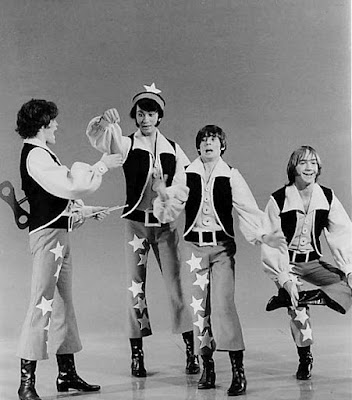
Last Train to Clarksville ....Daydream Believer ..... and a romantic moment accompanied by the Monkees

Now you can be quite sniffy about the Monkees, which were an assembled band for television, and featured as such on NBC television from 1966-1970.

1967
I first saw them sometime around 1966-1967 on the BBC when the show went out on an early evening Saturday slot.

I have to admit to my shame that I publicly followed the line that they were not serious musicians, but secretly I liked them.  Some of the songs have survived the test of time, and are still exciting to listen to while the story lines were funny.

But that is not surprising given some of the songs and scripts were written by accomplished and well known professionals, added to which some of the Monkees themselves became popular musicians.

I suppose my time with them will have been during 1966 and early 1967 when I was dating Jennifer who like me went to Crown Woods.  Jennifer’s father was in the army and she was one of the students who spent term time living in the Lodge which was attached to the school.

1969
So on some Saturday nights we spent a few hours in the common room watching the Monkees and other things before I was banished before lights out ….. or I suspect when she had enough of me.

Such is the twisty turny time of adolescent love.

Even now some of those Monkess songs take me right back to that period of intense emotions with the girl I thought I had fallen in love with in that room.

And in a year and a bit on after we had long parted it was where I sat some of my A levels, and during the efforts to construct an essay on King Lear or Disraeli my mind would wander back to the daft moments with Micky Dolenz, Michael Nesmith and Peter Tork and  Davy Jones of the Monkees and Jennifer.

Location; the 1960s

Pictures, the Monkees, 1967, and 1969, from the collection of NBC


Saturday, 26 April 2025

The class of ’68 part 7 ……. Ranger's House and a folk concert

Now, a little bit of my past has bounced back into my life in the form pf a program and a folk concert ticket.

'....... all that life can afford', 1967
And what follows is less a bit of vanity and more just a comment on how exciting it was to be at one of our big three comprehensives in the late 1960s.

The three were Crown Woods, Eltham Green and Kidbrook, and I went to Crown Woods.

And in the December of 1967 along with some close friends and lots of other people, I took part in two performances of “all that life can afford” at the Ranger’s House in Blackheath.

The house dates from the 1720s and was a fitting venue for a performance of selected verse, prose and music from the 18th century.

The show lasted for two nights, and drew on the writings of Daniel Defoe, James Boswell, Jonathan Swift, Alexander Pope and John Wesley, along with Voltaire, Bernard de Mandeville and the duc de Liancourt.

From the program, cast, writers and researcher, 1967
And dominating the evening was Samuel Johnson, whose throwaway comment that “He that is tired of London is tired of life, for there is in London all that life can afford”, provided the title for the show.

The sequence was in two parts, the first offering up “pictures of the streets [with] gin drinking, poverty and crime and punishment”, and the second exploring “the intellectual and religious life, as well as entertaining in high society, the military and naval activities of Blackheath and Greenwich and the famous Greenwich Fair.” *

The night concluded with the sonnet Westminster Bridge, September 3, 1802 by William Wordsworth, which is near you will get to the perfect piece of praise for the city of London.

I remember I had been less than willing to participate and had a long conversation with Mr. Marland who was Head of English and put forward a series of reasons why I couldn’t take part, each of which was more desperate and unconvincing than the one before.

When finally, I gave in, and agreed, Mr. Marland gave me the script with my name at the top and the part I was to play already identified.

Some of the class of '68, 1968
The two nights were a great success but were only one of a number of different performances which the school had offered up.

These included, The Causian Chalk Circle by Bertolt Brecht, An Enemy of the People by Ibsen, Billy Liar, Antigone, The Peterloo Massacre, and the sixteenth century play Gammer Gurton’s Needle along with other dramatic and musical anthologies.

All of which sat beside regular evenings of poetry, prose and music performed by the staff and students of the English Department.

Ranger's House and Samuel Johnson, 1967
Now I fully accept that similar events went on at Eltham Green and Kidbrook, and I do remember the annual Sixth Form Conferences attended by schools from across the capital which featured some of the best figures from the sciences and the arts who were invited to speak.

The point is that these were put on by comprehensive schools, and not grammar or public schools and in doing so were proudly asserting that they were the equal and perhaps superior to the older and established “places of education”.

Nor did it stop there, because Crown Woods gave us the opportunity to act independently.


In the winter of 1967 Dave Hatch and I were allowed to do our own radio show, featuring folk music, which went out on the internal radio system.

And a little later, when I asked if I could run a series of folk concerts with local singers in the school library, the answer was yes.


Folk at Crown Woods, 1968
I long ago forgot the details and had just a vague memory of who performed, but here Dave came to my rescue again, by telling me “you said that you couldn't remember many details. 

The names of two performers stuck in my mind; Gordon Giltrap, who you recruited one Friday night at the Tigers Head, and Terry Yarnell, who worked with Anne's father in Silvertown at International Paints”.

All these opportunities could be replicated by countless others, but I think there was something special in being at one of the “big three” in Eltham and Kidbrook back then.

Pictures; Crown Woods School in “……. all that life can afford”, the folk concert ticket, and the picture of some of the class of ’68, program courtesy of Anne Davey who kept them in her scrap book and Dave hatch for sending them up to me

*Crown Woods School in “……. all that life can afford”


Sunday, 20 April 2025

The class of '68, part 2 ..... failing the 11 plus or Andrew and Samuel Pepys Secondary Modern School


The one sure certainty of failing the 11 plus was that you went to a secondary modern school.

Not of course that this over surprised me.  My mother had been told by my year 6 teacher back in the January of 1961 “that I was not academic material.”  A sentence that burned deeply into my mother and condemned my father and me to endless evenings of 11 plus tests by the kitchen stove.

All to no avail.  I failed.  But not before I along with all the other also runs had to endure the class interviews where the hopefuls destined for a bright grammar school future would give a presentation to the rest of us, which were really rehearsals for the real thing in front of the head teachers of the local grammar schools.

To this day I remember my first introduction to Vasco da Gamma that Portuguese sailor who boldly went where no European had sailed before.  Even then I wondered why the cabin boy and cook as well as the man steering the ship never got a look in through the entire talk.

Years later teaching year 8s the European voyages of discovery, plunder and much else I was always pulled up by the mention of the said captain and taken back the twelve years to the upstairs classroom of Edmund Waller Junior School and the talk given by Barry Whatshisname.

But enough of such bitter vituperation.  That was what the 11 plus was supposed to do.  Separate the elite from the rest of us, and while they went on to a bright academic environment we were destined for schools which specialized in more practical things, .......woodwork not Wordsworth, technical drawing not Tennyson and so much more.

Added to that our schools were not as well funded and led to one glorious episode where just before my O level history exam in 1966 we were given a world historical atlas published in 1938 which finished with the wonderfully optimistic comment that “it is hoped the leaders of Germany and Italy will see sense and rejoin the League of Nations in a profound desire to solve issues by peaceful means.”  Now today I can see the dark humour in that, but at the time I pondered how we had to use a thirty year old text book which added to everything else got the next ten years of European history so wrong.

But my secondary modern school and many others across the country strived not to give us a second class education.  They were fully aware that a rigid test at 11 did not mean that those who failed to pass were failures.  And so many of us were entered for 0 level exams that badge of so called academic excellence while class mates were given the practical skills which enabled them to become tradesmen in a whole range of occupations.

And these places attracted the talented and committed teachers.  I can remember many who I would have been happy to work beside when I started teaching in 1973.  Indeed in the years after I started I benefited from the advice, good humour and wisdom of those who had been at Oldwood Secondary School here in Manchester before it was merged with the local grammar school to form Poundswick High School.

But despite all their efforts secondary modern schools were just that.  They were a secondary form of education for those who judged unsuitable for the full academic experience.

Today as then selection at 11 has its supporters who in their advocacy of grammar schools focus on the poor records of some comprehensive schools and on a golden age of grammar school education in the late 1940s and 50s.

Now I can be both objective and generous in my recognition of the opportunities grammar schools gave to children of all classes particularly ones who like me came from a working class background.

But I was under no illusion at the time and since that what we who failed that 11 plus were offered was less than best. Not for us that heady excitement of preparing for a new educational world with like minded bright young things.  In the September of 1961 I assembled with the majority of my male ex classmates from junior school in the playground of Samuel Pepys, and apart from the uniform and an absence of girls there was little to mark this off as any different from what I had already experienced.

It would be five years before I had my opportunity to enter a school of all the talents where money and resources were on offer to all of us.   This was Crown Woods School in Eltham, one of three big shiny and exciting comprehensive schools and the place where I really began to feel valued and above all come to love learning.

Tomorrow, part 3 at the centre of something pretty good, ..........Crown Woods School

Pictures; Andrew Simpson aged 16, 1966, and the badge of Samuel Pepys School from the collection of Andrew Simpson, and Oldwood Secondary Modern School, 1956, courtesy of Manchester Libraries, Information and Archives, Manchester City Council m66278