Showing posts with label Manchester Railway Stations. Show all posts

Thursday, 30 July 2026

And if you want a station ….. we’ve got one to spare ….. Manchester Victoria

Now that’s a bit unfair because Manchester Victoria remains a busy and vital part of our rail network.

But during the 1960s it did seem eclipsed by some of the other Manchester and Salford railway stations.

Across the city London Road got a makeover at the beginning of that decade along with a new name and with its fast InterCity express trains seemed to stand for all that was new and exciting about the 1960s.

Not to be outdone Oxford Road got that new frontage which with its sweeping bold timber design looked equally an embodiment of a new age.

Leaving Central and Exchange to roll over, give up the ghost and depart the scene.


And by what seemed a cruel joke both became car parks.

Nor did Victoria escape the retreat from the great days of the railways.  In the 1970s it must be said it was becoming a tad shabby, despite its stunning exterior and equally wonderful interior.

We used it get trains home to Ashton-Under-Lyne some evenings and Victoria was the jumping off place for journeys back to Newcastle.

But there was this sense that it was in decline.  

The much-vaunted Picc Vic Tunnel connecting Victoria and Piccadilly had been shelved, many of the services had been diverted to other stations and only a handful of platforms remained with a chunk of the station sold off for the construction of the Manchester Arena.

All a sad end to what had once been a thriving and important railway hub which in 1909 boasted 17 platforms and that grand exterior.


To which in 1929 was added an extension linking it to Exchange Railway Station.

Back in the 1970s I hardy noticed the poignant war memorials including that discreet sign to the number of wounded men who returned as hospital patients during the Great War.  

And only gave a glance to the magnificent booking hall, the mosaic lettering above the First-Class CafĂ©, or that elegant glass and ironwork at the front of the railway station.  To which can be added the tall tiled map of the destinations which the old Lancashire and Yorkshire Railway Company served back at the beginning of the 20th century.

And today I doubt few using the tram interchange to make journeys out to Bury and Rochdale will ever know of those dreary decades or that some of the railway station is built over part of the cemetery at Walker’s Croft which is believed to contain the remains of 40,000 people, many of whom were paupers.  

Or that later the site of the old workhouse on New Bridge Street was also engulfed by another period of Victoria’s expansion.

It remains one of those rarely talked about stories that the development of many of our railway stations resulted in the clearance of some of our worst inner-city slums.  So, while part of Little Ireland vanished under the Oxford Road railway viaducts, Victoria did for properties in Irk Town which was notorious as an area of poor housing and sanitation.


If I was at all fanciful, I might imagine their collective ghosts wandering the platforms, but if such spirits are a foot they will have to share the space with the heave of passengers who today use Victoria, whether it be using Timmy tram or like me out by train to Walkden.


Leaving me to reflect that it was a jolly good job Victoria didn’t go the way of Central and Exchange.


Location; Manchester Victoria

Pictures; Manchester Victoria, 2025-26, from the collection of Andrew Simpson


Saturday, 30 May 2026

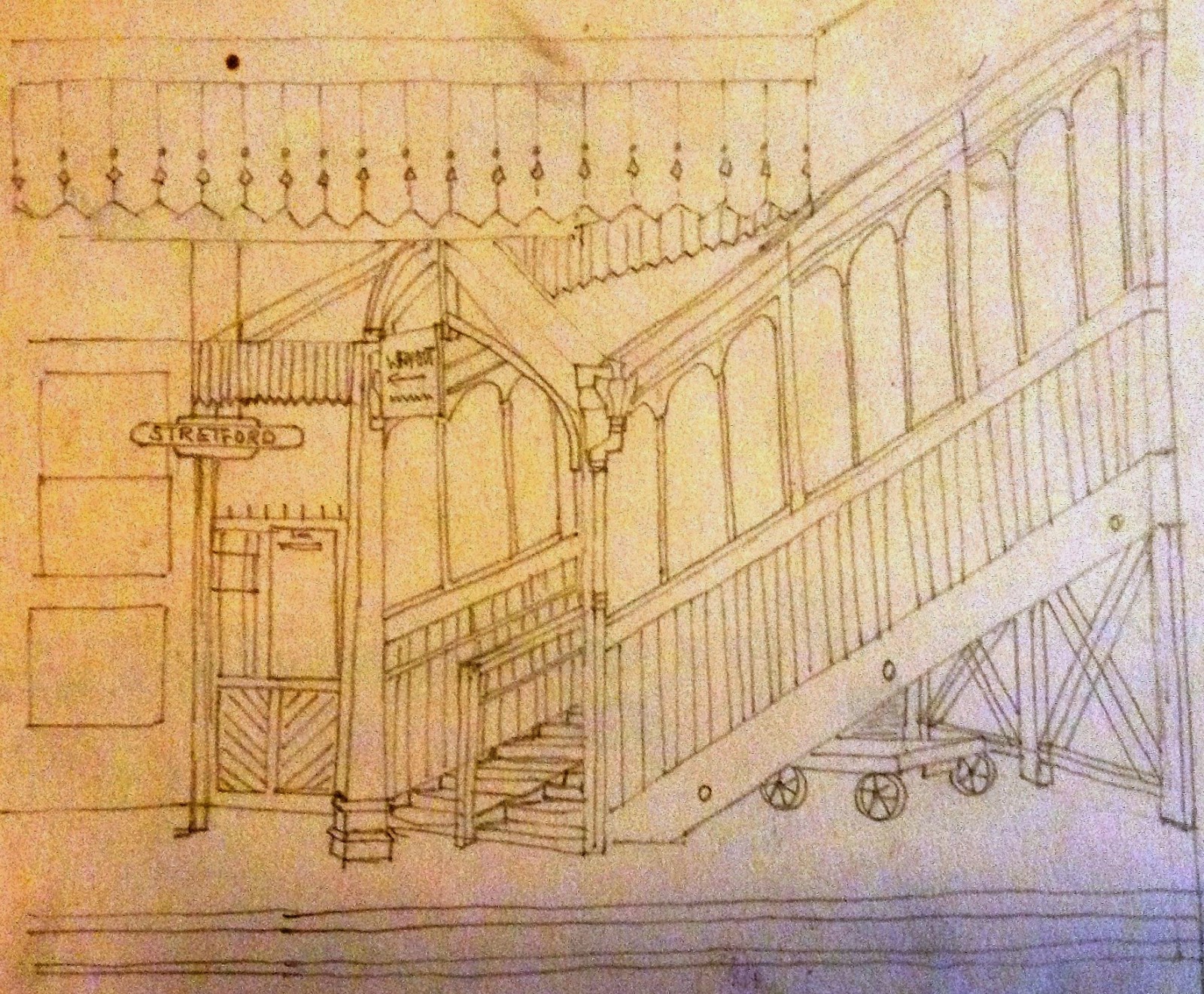
On Stretford Station with a bit of our railway past

It is 35 years since the last train ran from Stretford station which means that memories of a time before the tram will be fading

Stretford Station, April 1961
I briefly used the station back in the 1970s and had no idea of its history or the railway line.

It had been opened in 1849 by the Manchester South Junction and Altrincham Railway and was in part designed to transport food grown in Altrincham and Stretford into the heart of Manchester and in time would challenge the Duke's Canal as the main means of carrying heavy goods in to Manchester.

I have no doubt it would have created quite a stir.

The men who built the line were viewed at best with suspicion and at worst with fear.  They had a well deserved reputation for hard drinking and rough behaviour which is no surprise given the dangers of the work they undertook.

Central Station, April 1961
And there may well have been a few of  our farm a labourers who were taken on to do some of the least skilled work while some of our farmers and market gardeners would have taken advantage of the line to move their crops to the Manchester markets.

But its impact was also to start a wave of house building along Edge Lane.

The train offered the quickest way into town and allowed those who earned a living in the city to escape to what was still the countryside.

Of course by the time I used the train Edge Lane and the surrounding area had long lost any semblance of countryside, but the station still looked like an old fashioned railway, which is where my fiend Ann comes into the story.

She “found these the other day, tucked away. Stretford station in 1961, and Manchester Central, probably a similar date. I used to travel from Stretford to Oxford Road Station, spending my time on the journey drawing the other passengers.”

And so after sixty-two years a little bit of what an old railway station looked like is here to see again.

Now that is not so daft given that Stretford has become a Metro Stop with shiny yellow trams and Central having long lost its trains is now an Exhibition Centre.

Pictures; Stretford and Central Stations, April 1961 courtesy of Ann Love

Friday, 24 April 2026

Waiting on platform 12 at Piccadilly for Royal Mail Parcels ........ 1980

I know I shouldn’t be surprised at just how much of the city has changed over forty years.

Part of that is because I just don’t think four decades have whizzed past.

But then that has encompassed nine General Elections, a brace of American Presidents, the birth of our four children and my gentle passage from a man in gainful employment to one who writes and blogs.

Still I was drawn up with a jolt when I uncovered this picture of platforms, 10, 11 and 12 at Piccadilly Station.

So much so that for a brief while I was puzzled as to which station I had been on.

Logic and the other images in the strip of negatives all pointed to Piccadilly, but the scene is worlds away from that moving staircase, brightly painted columns and air of commuter bustle of today.

I even consulted that old railway buff David Harrop, and he confirmed I was where I thought, on Piccadilly Railway Station a full thirty years before its makeover.

So that pretty much is that.

Location; Manchester

Picture; Manchester Piccadilly Railway Station,1979, from the collection of Andrew Simpson

Thursday, 23 April 2026

London Road …….. January 24th 1959 …………..

This remains one of my all-time favourites from Eddie Johnson’s book on Manchester Railway Termini.*

Until recently I had not got round to asking for permission to reproduce it, but after a nice conversation with Eddie, here it is.

The caption says, "London Road, January 24th, 1959.  This view at London Road presents an almost Christmas card like scene, a splendidly pictorial effect which no doubt had the operating authorities cursing.  The overhead electric catenary reveals this to be the eastern side of the station, at the end of platform 3”.

There is more, but I will leave it at that, and instead just point out for those who do not remember, or never knew, Piccadilly Railway Station was once called London Road.

And the rest is just snow, which at 73 still delights me and makes me a kid again, which of course pictures of steam engines also have the power to do.

Location; London Road, Railway Station, 1959 

Picture; London Road, Railway Station, 1959, M.S. Welch from Manchester Railway Termini

* Manchester Railway Termini, Scenes from the Past: 3 E.M. Johnson, 1987


Wednesday, 22 April 2026

Salford Station ............ the one you miss

It’s the one you miss. Salford Central Station is on New Bailey Street and is set back between two railway viaducts.

So travelling out of Manchester into Salford even on foot it was not the most visible of places.  

Moreover the actual entrance seemed to retreat away from the road and so apart from the station’s name on the wooden canopy there was  really only the sign above the entrance announcing the way “To the ticket office” and the railway timetables which gave a clue as to what was behind the maroon door.

But all that has changed.  The viaducts have been painted and the detail highlighted, as have the pillars and the entrance is now behind a glass wall which draws you into the station itself.

It is one of our oldest stations having been opened in 1838 as the terminus of the Manchester and Bolton Railway and in 1843 the viaduct across New Bailey Street were built to connect with Victoria Station.  Only the Liverpool Road Station is older, but that closed for passengers in 1844 when Manchester Victoria was built.

Of course the purist will point to the fact that I am mixing up Manchester and Salford and treating them as one but I rather think that is being a wee bit pedantic.

The station has had many names.  For the first twenty years it was just plain Salford, was then renamed Salford (New Bailey) until 1865 when it reverted to its original name and in 1988 it was changed to Salford Central.

I suppose the fact that for a long time it was only open at peak times and is closed on Sundays does continue to make it a bit of a forgotten station.  So to bring it back I thought I would include the 1894 painting of the station by H. E. Tidmarsh from Manchester Old and New.


Pictures; from the collection of Andrew Simpson and Manchester Old and New, William Arthur Shaw

Monday, 20 April 2026

Steam fun ……….. London Road ……..

This is another one of my all-time favourites from Eddie Johnson’s book on Manchester Railway Termini.*


Until recently I had not got round to asking for permission to reproduce it, but after a nice conversation with Eddie, here it is.

The caption says, “Happy hours spent train spotting are recalled by Bill Johnson’s superb shot of Coronation Class 4-6-2 No. 46256 Sir William A. Stanier F.R.S with steam issuing on all fronts , including the coal pusher, as she backs down to collect her train………  Popularly known as ‘Duchess’ No ”. 46256 was the penultimate  member of her class, being turned out  from Crewe in 1947 ……..”

There is more, but I will leave it at that, and instead just point out for those who do not remember, or never knew, Piccadilly Railway Station was once called London Road.

Location; London Road, Railway Station, 1959, 

Picture; London Road Railway Station, date unknown, W. Johnson from Manchester Railway Termini

* Manchester Railway Termini, Scenes from the Past: 3 E.M. Johnson, 1987


Monday, 23 March 2026

A day of steam, fun and history ……………The Great Railway Exposition

I have no idea how I ended up on Liverpool Road, forty years ago.


I might have read about the event, or just followed the crowds.

Either way it was a wonderful day of steam, fun and history, and reminded me of growing up in the 1950s, and taking express trains pulled by steam powered locomotives.

Even now that mix of steam, warm oil, and clunking railway wagons is enough to transport me back to rail excursions, when electric and diesel traction was rare on our railways.

I am indebted to Paul Sherlock who sent me this cover of the souvenir booklet, which anchors the moment, because I had long forgotten just when it occurred.

It was an amazing day and left me with a portfolio of pictures.

Location; Manchester

Pictures; The Real Railway Exposure, 1980 courtesy of Paul Sherlock, and moment on the day, 1980 from the collection of Andrew Simpson

Wednesday, 4 February 2026

Travels by train …… Manchester Piccadilly … Manchester Victoria

It was exactly a week ago that the "train took the strain”, or to be more accurate I met our Saul on one railway station and took the train from another to meet up with our Ben in Walkden.

Waiting for the off, platform 11, Manchester Piccadilly, 2026

And that pretty much is that. 

A brace of trains, Manchester Piccadilly, 2026


Ticket Gates, Manchester Piccadilly, 2026


Only to say Manchester Piccadilly is a station I often use, while Manchester Victoria is usually just for the trams.

Moody Manchester Victoria, 2026

But on the Wednesday, we took the train to Walkden from Manchester Victoria and used a platform I last stood on over half a century ago.

Back then it was one of the platforms to catch trains to Newcastle.

Location; Manchester railway stations

Pictures; Manchester Piccadilly and Manchester Victoria, 2026, from the collection of Andrew Simpson


Friday, 23 January 2026

Heaps of cars … missing trains ….. and Central Railway Station in colour

I missed the end of Central Railway Station by just a couple of months, and it was not for another decade that I stumbled across the place.

By then it had become a car park which I suppose was a bit of an insult although I guess most of those who parked up there thought it was a convenient use for that former grand terminus.

I can still remember marvelling at how impressive it still was with that giant wall of glass where the platforms almost ended.

Back then I mostly did black and white pictures and rarely did colour which is why most of my photographs of Central Railway Station are monochrome.


But occasionally I did venture into colour slides and recently began converting them into digital images.

Alas many suffered from over four decades in our cellar and the quality of them is iffy.

But there is enough to bring back to life that time in 1979 when armed with two cameras I wandered along the platforms, looking down on the parked cars and the slowly deteriorating remnants of station offices and other railway furniture.

Now there are plenty of pictures of Central after the trains left, but these are mine.


I have to confess that those I took in black and white are better, but here are some of the lost colour ones.
But  then as you do I decided to throw in some of the others and that really is it.

Location; Manchester Central Railway Station

Pictures; after the trains left, Manchester Central, 1979, from the collection of Andrew Simpson


Sunday, 11 January 2026

The train now arriving is the 13.20 from 1979

I am well aware it isn’t the most original of titles but it pretty much sums up where we are.

At the back of the 1970s I bought a new camera and later added a dark room.

The pictures were all a bit hit and miss because I was a tad lazy with timings for both the developing and printing.

So while some might stand against anyone’s, others are hazy, lack definition and can either be too light or too dark.

That said they are a record of just what things were like as the 1970s pulled to a close.

And so here I was on Piccadilly Railway Station watching a rain arrive.

I have no idea what type of locomotive it is or even where the train had come from.

During the early part of the decade I had regularly travelled south with British Rail but by 1979 this was less frequent.

More recently I was back on the station and was transfixed by the smooth looking locos of today, so in celebration of what we had and what we've got now, here is one I took over 30 years after the first.

Same station, possibly same platform just separated by the decades.

And thirteen years on from that picture of two Virgin trains ...... taking  the strain from Manchester to London it is now as much a part of the past as the train from 1979.

Location; Piccadilly Railway Station

Pictures; Piccadilly Railway Station, 1979, 2013, from the collection of Andrew Simpson

Thursday, 1 January 2026

On Chorlton-cum-Hardy Railway Station with Edwin Casson

Now it is rare that you can identify an individual on a picture like this.

But I know that the man sat down, fourth from left in the middle row is Edwin Casson, who continued to work for the railway company well into the 1920s.

And I know this because yesterday I bumped into Steve Casson who is the great grandson of Edwin and promised to send over a series of family photographs.

I don’t have a date for the picture but I do know that Black and White the photographers, were active in Manchester in the early 20th century.

In 1903, they had studios at 62 Oldham Street, 208 Oldham Road, and 93 Oxford Street.

I can’t be more precise, but they do not appear in either the 1895 directory or the 1909 one, so we have a limited time frame for our picture.

The railway station at Chorlton-cum-Hardy had opened in 1880 and proved very popular, particularly with those who lived in Chorlton and worked in town.

The journey took less than fifteen minutes and so for some it was possible to come home for dinner.

Location; Chorlton-cum-Hardy

Picture; Mr. Edwin Casson, on Chorlton-cum-Hardy Railway Station, circa 1903, from the collection of Steve Casson

Tuesday, 30 December 2025

Waiting for that fast service to Central ................ standing on the platform at Chorlton-cum-Hardy railway station

Now I am part of that generation that grew up with steam locomotives.

And I don’t mean those special heritage steam trains I mean the full on thing, when everything from the intercity express down to sedate suburban commuter links and the humble unromantic goods locos were all steam powered.

All of which makes this picture postcard of our station one to cherish particularly because there are very few of the inside of the station.

I don’t have a date for this one but it will be before 1926 when an aerial picture shows the station without the footbridge which the historian John Lloyd says was removed “to save the expense of maintaining it and the public had to use the road bridge.”**


So we have just 40 or so years to play with because the station was opened in 1880 and judging by  the quality of the picture postcard I am guessing we will be sometime in the early years of the last century.

And that quality allows you to focus in on the detail from the iron work under the bridge to the signs advising passengers to use the foot bridge to cross the tracks which proved particularly relevant after the death of Mary Jane Cockrill of Oswald Road in 1909 who was run down by "a fast train approaching the station."***

I don’t think you have to have an over vivid imagination to put yourself on that platform just over a century ago.

The place is empty save for the staff and the chap in the bowler hat who I suspect runs the kiosk, so we must be in one of those in between moments and given that there are no passenger either a train has just gone through or this is that long wait between the morning commuter rush and the evening return.

And for anyone who has ever been alone on a warm summer’s day waiting for a train the scene will be all too familiar.

There will be that silence punctuated by the odd noise from the road in the distance the clunck of a shunting engine and the sound of the platform clock.

And if you have timed it wrongly there could still be a hint of steam left from the departing train and the last solitary commuter making their way out up the approach path to Wilbraham Road.

Which means that you are left to idle the time away looking at the headlines from the newspaper posters, ponder on the promises being made by the adverts and perhaps spend a penny on that weighing machine.

Location; Chorlton-cum-Hardy, Manchester, date unknown

Picture; Chorlton-cum-Hardy Railway Station, date unknown, courtesy of Mark Fynn***

*Looking Back At Chorlton-cum-Hardy, John Lloyd, 1985

**Woman Killed at Chorlton In front of a railway train, Manchester Guardian, January 11, 1909 although to be accurate her death was a suicide

***Manchester Postcards, http://www.manchesterpostcards.com/index.html, 


Saturday, 25 October 2025

A bold new station for Manchester and the film Hell is A City


This has to be one of my favourite Manchester stations. It is Oxford Road Railway Station.

The original station dates from 1849 and in 1960  was replaced by this one which was listed in 1995 and described by English Heritage as a "building of outstanding architectural quality and technological interest; one of the most dramatic stations in England.”*

I do have to agree with them.  Its glass and laminated wood entrance soars into the sky and on a sunny evening the reflection of the Refuge Building is captured in those high windows.

Now its predecessor was a much more modest affair.  It too was made of wood but was workman like and lacked style and presence.

There are a few pictures of this older station but not many and until recently I had not really given it much thought.

Until I came across a still from the film Hell is a City which was set in Manchester starred Stanley Baker and focuses on the search for a violent criminal.

It was made in 1960 just nine years before I arrived in the city and much of the location shots are ones that I remember well.

And there as Stanley Baker confronts the criminal on the roof tops of the Refuge Building is Oxford Road Station, both the Armadillo roof of the new station, the sweeping concrete wall of the car park and the old station.

It stands at right angles to the new station entrance which was something of a surprise but is logical.

Of course you would have to be over 50 and more likely 60 to have any vivid memories of this building and I doubt that there are that many pictures of the two standing together.

And like all such things the new station has undergone change.

That sweeping concrete wall and the car park it protected has gone.  In its place has come a tall steel structure with stone steps, which on a sunny day are occuppied by those waiting for a train or those catching a bit of sun along with their sandwiches.

And it remains a very busy place both inside and outside the rush hour.


Pictures;Oxford Road Station in 2008 from the collection of Andrew Simpson, still from Hell is a City, 1960, from Graham Gill,


Saturday, 23 August 2025

Saturday August 16th in a railway station

I like railway stations, only bettered by an airport.

10.45 AM and home from the West Country, 2025
It’s that mix of purpose, expectation for those leaving the city, and happiness at coming home.

But unlike a railway station, there is no border control, no losing your luggage to a destination halfway round the world and fewer delays.

Added to which you are more likely to get to seat down.

So, on Saturday while on an adventure I passed through Manchester Piccadilly.

It was busy, interesting and fulfilled that bit about purpose, expectation for those leaving the city,  happiness.

Destinations ... destinations, 2025


Welcome to a crusty baguette, 2025


Shorts, back packs and hats


A brace of Locos, 2025

Location; Manchester Piccadilly Railway Station

Pictures; Passing through, Manchester Piccadilly Railway Station, 2025, from the collection of Andrew Simpson


Sunday, 18 May 2025

Central Station, a bar called Cox’s and a defeat

Now try as I may I have never been able to get a decent picture of G Mex from Peter Street looking down Mount Street.

And there will be plenty who murmur “and you missed the boat with this one too Andrew”.

Which I accept may be true but at least the image recorded the old Central Station and Cox’s Bar, both of which I remember with affection, although in the case of Central it was as a car park and not a place to catch trains, as it had closed just month before I arrived in the city,

Location; Manchester

Picture; Central Railway Station, 1979, from the collection of Andrew Simpson

Saturday, 17 May 2025

On a railway station ......... 1978

It is a scene that was once replicated on countless railway stations with slight variations for over a century and a bit.

We are on Victoria Railway Station sometime around 1978 with me and a Pentax K1000.

It was a smashing camera, so much so that I bought two.

You could take them anywhere, and I did, from Greece to France and plenty of other places.  It didn’t mind the heat survived plenty of rough handling and just bounced when I dropped it.

I had wandered into the railway station looking for the ordinary and humdrum.

Today forty years later, it and the other photographs I took that day seem less humdrum and more a set of images out of a museum.

Location; Manchester

Picture; loading the luggage, Victoria Railway Station, 1978, from the collection of Andrew Simpson

Saturday, 19 April 2025

When G Mex was a car park ......

Now, with the passage of the decades it will become more difficult to find people who parked up in GMex.

In fact even the name GMex will be passing out of the collective memory as the place is now the Manchester Central Convention Complex, which may describe perfectly what the building does, but somehow doesn’t have the same appeal as GMex.

It’s time as a car park was not that long and for most of its existence this was Central Railway Station.

I just missed being able to catch a train from the station which closed in May 1969 just five months before I washed up in the city.

Instead I had to content myself with a visit about ten years later, when instead of trains there were cars.

I took quite a few pictures on that day, of which this is one.

It would be another seven years before I returned by which time work was well underway to transform it from an old railway station/car park into a conference centre but that as they say is another story.

Location; Manchester

Picture; Central Station, 1979, from the collection of Andrew Simpson

Friday, 21 March 2025

Victoria Railway Station ……... the one with the lot

It’s the Manchester railway station that has heaps more than just a set of platforms, some fast food out lets and lots of passengers.*

True Victoria does have all these, but it also has plenty of history on display and more than a bit you can no longer see.

It starts with that bold assertion of just how many places you could travel to back in 1909, all of which are there to see on the sweeping glass and iron canopy at the front of the station.

They were “Leeds, Harrogate, Bradford, York, Scarborough, Newcastle, Hull, Belgium, Liverpool, Southport, Bury, Blackpool, Fleetwood, Goole, Ireland, and Scotland”


And if you want more there is the magnificent, tiled map taking up three quarters of a tall wall which lists the network of towns across the North as well as eleven destinations in Wales and Ireland and twenty-one European seaports and concluding with “and the Continent”.

To which can now be added the stops along the way to Bury, Oldham and Rochdale on the Metro lines.

The station also has the memorial to those men from the Lancashire  & Yorkshire Railway who served in the Great War.  

It is made of bronze I and  lists their names flanked by the effigies of Saint George and Saint Michael with  a smaller plaque to the men from the company’s goods yard who also served.

Less ornate but no less moving is the small plaque beside an arch which once led to a separate platform from which thousands of soldiers departed Victoria during that war.

It is simple but elegant and reads “To the Memory of the Many Thousands of Men Who Passed Through This Door To The Great War 1914-18 And Those who Did Not Return”.

For as long as I can remember the arch was fronted by a wooden door which became more and more dilapidated, doing little for the dignity of the memorial.  But in 2015 the space was filled with a glass panel on which a map records the location of Commonwealth War Cemeteries, to which was added a tiled plinth and lighting.


And beside it there is at present a memorial to those who were killed or hurt by the Arena bombing on May 22nd, 2017, which is matched by the impressive Glade of Light memorial close by.

Each of these memorials are an essential part of the station and are seen by thousands each day.

Less visible are parts of the city which were destroyed or built over during the construction and expansion of the railway station.

These include Cemetry at Walker’s Croft where up to 40,000 were buried, some of whom were paupers and some were Cholera victims.

Nearly 170 years later the lost cemetery became the focus of concerns during the modernization of the railway station with the Manchester Evening News reporting in 2013 that “Human remains lying in a mass pauper’s grave under Manchester Victoria station are to be dug up”**

No less grim and still within the confines of the station is the site of the Manchester Union Workhouse.  It had opened in 1793 and fronted New Bridge Street and Ducie Street.

In the 1850s a new workhouse was built at Crumpsal and part of the Manchester site was sold to the railway company who extended the station in 1875, followed forty-five years later when the remaining buildings were cleared to expand the goods yard.

And the same expansion had seen the demolition of some of the slum properties in Irk Town to accommodate the new viaduct which carried trains out of the station.

At which point I could dig deep into the story of the railway’s presence on the site but it’s a long and a tad bewildering tale involving rival railway companies which regularly merged with others.

Suffice to say that Manchester and more specifically Victoria Railway station were at the heart of railway development. The station was opened in 1844, just fourteen years after the first passenger railway station was opened on Liverpool Road by the Liverpool and Manchester Railway company.

By the mid-1840s six railway companies operated from the station and it was one of the biggest passenger stations in Britain.

But during the 1970s and 80s the station seemed in decline. The much-vaunted Pic Vic Tunnel connecting the two railway stations had been shelved, many of the services had been diverted to Piccadilly and only a handful of platforms remained, with a chunk of the station sold off for the construction of the Manchester Arena.

All a sad end to what had once been a thriving and important railway hub, which in 1909 boasted 17 platforms and that grand exterior façade. 

To which in 1929 was added an extension linking Victoria to Exchange Railway Sation.

But as we know stories can have happy endings, and with the arrival of the Metro the station has had a new lease of life, which has included a new roof, the modernization of the concourse area which has retained the iconic wooden booking hall, and the former First Class buffet and stationer’s.

So yep Victoria has got the lot.

Leaving me just to add in an outrageous way the Station, surrounding area along with Shudehill and Market Street are the subject of our new trams book due out later next month.

It is book three in the series of The History of Greater Manchester by Tram  and will be available like the other books at Central Ref, Chorlton Bookshop, and Waterstones on Deansgate as well as from us at www.pubbooks.co.uk, price £4.99***

Which will be followed by books exploring the metro line across the city to the Etihad Stadium, Salford and Altrincham.

Location; Manchester Victoria Railway Station

Pictures; at the station, 2025, from the collection of Andrew Simpson

*And yes Piccadilly Railway Station was London Road Railway Station with an impressive main entrance which was demolished for its 1960s reicarnation and subsequent makeover at the start of the 21st century, while Oxford Road has reatined its dramatic 1960s "new look" replacing the wooden shack.

**Bainbridge, Peter, A grave undertaking... Victoria Station cemetery is departing from Platform 1, Manchester Evening News, April 9, 2013, https://www.manchestereveningnews.co.uk/news/greater-manchester-news/grave-undertaking-manchesters-victoria-station-2573159 

*** The History of Greater Manchester By Tram, https://chorltonhistory.blogspot.com/search/label/A%20new%20book%20on%20the%20History%20of%20Greater%20Manchester%20by%20Tram