Showing posts with label Eltham in the 1970s. Show all posts

Friday, 17 July 2026

A little bit of our history down at the Co-op

2d token issued by the R.A.C.S., date unknown
It’s so easy to lose so much of our history.

Now the big things like the homes of the great and good, as well as the not so good but still very powerful and rich usually survive, as do their possessions.

In the same way those important papers of State, the letters and records of government from Roman tax records to Magana Carta and much else have come down to us.

Although I do have to concede sometimes it is a dam close thing and often it is down to accident rather than design that these things are still around to tell us something of the past.

Of course in the great sweep of history more rather than less has gone forever.

1£ Co-op book of stamps circa 1970
And amongst all that lost material are the overwhelming majority of everyday objects each with their own unique story.

I could have picked almost anything to explore these vanished objects but in the end choose the humble trading token and its modern equivalent the trading stamp.

It began with a sheet of those Green Shield Stamps posted on facebook which if you are of a certain age will bring back vivid memories of collecting them, then sticking them in books and eventually exchanging shed loads of them for a range of goods.

Co-op stamps, circa 1970
And into the game came the Co-op which had been operating its own reward system since its inception.

This was the dividend which gave every member a share of the stores profits.  All you needed to do was quote your “divi number” and the amount you spent would be recorded.

Talk to many people and they can instantly remember their family number and even quote it back.

Sadly I was never one of them and so for me the introduction of the divi stamp was to be welcomed.  So instead of holding up a line of shoppers down at the Well Hall Co-op opposite the Pleasaunce I could now vanish with the groceries secure in the knowledge that all was well with our divi reward.

A token issued by  Bolden Industrial Co-op, date uknown
“Dividend Stamps were introduced in 1965. 

It was an alternative to the traditional methods of paying the 'divi', and as a response to the adoption of trading stamps by other food retailers like Tesco who adopted the Green Shield stamps scheme. 

Some individual Co-operative societies operated their own stamp schemes but the CWS National scheme was in use from 1969.”*

Running alongside the number and then later the stamps were the old tokens, made of very thin metal.

"Coop members would go into their local society shops to buy the tokens for bread, milk, coal etc. The amount they spent would then be registered for their dividend payments.  The members would then give the token to the milkman, bread man or coal roundsman etc in return for the items they wanted."**

Co-op stamps, circa 1970
In our house some at least never made it back to the Co-op and instead were used as toys and even took the place of playing cards.


So for those who remember them and a lot more who are totally baffled by them here is a selection taken from my friend Lawrence’s blog* and the Bolden History site.*

They were an important part of many peoples' way of budgeting and marked a commitment to a co-operative way of life which I still think is the way forward.

Pictures; Co-op trading stamps, courtesy of Lawrence Beedle, and trading tokens from Boldon History

*Hardy Lane Scrapbook, http://hardylane.blogspot.co.uk/2009/05/co-op-stamps.html

**Boldon History, http://www.boldonhistory.co.uk/Boldon-Colliery-ID11/The%20Co-op-IDI141

Sunday, 19 April 2026

Home thoughts from abroad nu 5 ................ wandering down to Avery Hill on a Sunday

An occasional series on what I miss about the place where I grew up.*

Now when you are 17 and out on that second date and still unsure of what comes next Avery Hill was always a good bet.

The Saturday night had been the pictures and without wanting to push it out too far and mindful that at 17 you didn’t have a lot of cash this was the place to come, check out whether the night before had been a good idea and whether either of you wanted it to go any further.

I remember plenty of such Sunday afternoons and two in particular with girl friends who lived in the lodge at Crown Woods which I fully admit was not pushing the boat out.

Later a full seven years after I first discovered the place I went back with Kay.

We had met in Manchester in 1971, started going out and in the following year spent part of the long summer at 294 Well Hall and later in the North East.

And when we weren’t exploring the centre of London or down at the Park in Greenwich, Avery Hill was somewhere to walk to on a Sunday.

It began with the Pleasaunce and then that long haul through the High Street and down the other side always with a curious look across at Crown Woods.

Not I suppose the most momentous memory but one that stays with me even now.

Location, Eltham London

Pictures; Avery Hill, 2013, from the collection of Jean Gammons

*Home thoughts from abroad, http://chorltonhistory.blogspot.co.uk/search/label/Home%20thoughts%20from%20abroad

Saturday, 18 April 2026

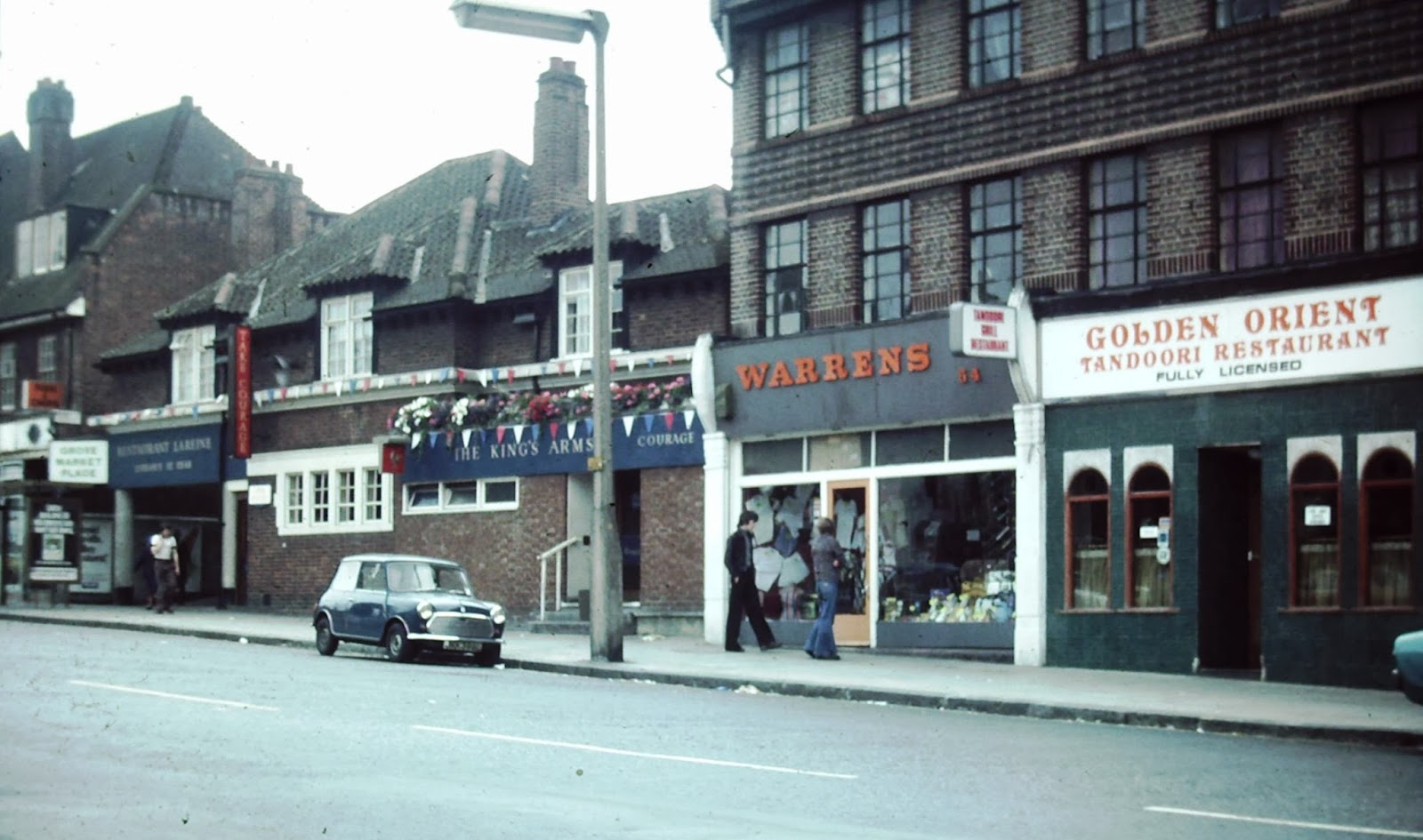
On Eltham High Street in the summer of 1977

Now there is a very obvious appeal about old photographs of Eltham.

Eltham High Street in 1977
The people stare back at you and it is easy to wonder about their lives, their hopes and of course what happened to them.

In the same way we are drawn to the buildings, comparing their appearance then with now or pondering on how the planners could have allowed such a magnificent house to be demolished to make way for an ugly block of flats or an equally drab parade of modern shops.

And the irony is that those 1950s/70s new build rarely have lasted the course.

The grey concrete has stained, the wood panelling has begun to rot as have the window frames and the modern signage is totally out of character.

So it is more pleasant to retreat into the images of a century ago.  All of which is fine but often ignores the more recent photographs, from say the 1970s or 1980s.  These can be just as revealing about how things have changed, with that added bonus that they show an Eltham which is almost as it is now but not quite.

In that sense they seem even more dated.  The fashions look outlandish and the cars comical.  But for the historian these images are just as important.

So in 1977 on this stretch of the High Street the King’s Arms was still serving pints, Warrens and the Golden Orient Tandoori Restaurant were yet to give way to Pat’s Textiles and Spice Island, and the Grove Market was a busy and vibrant place.

So and not for the last time I shall fall back on that old Monty Python quote, "no one expects the Spanish Inquistion" and make an appeal for more of those pictures from the recent past.

Picture; courtesy of Jean Gammons, 1977

Friday, 17 April 2026

Painting Well Hall and Eltham ....... nu 7 tram sheds and missing the tram

An occasional series featuring buildings and places I like and painted by Peter Topping.

The Tram sheds, 2017 painted from a photograph, 1977
Now I always took the bus shelters for granted after all they had always been there and had always been bus shelters.

But not so.

They had started off as places to wait for the trams which began coming through Eltham at the beginning of the 20th century and which in turn were only made possible by the extension of Well Hall Road.

Neither of which I found out until recently.

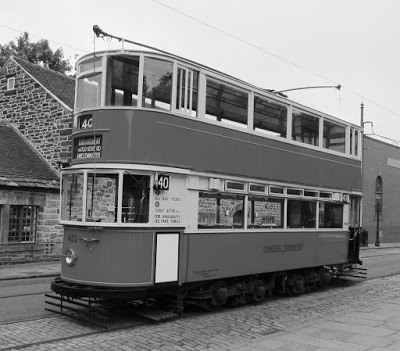
LCC tram 1622, 2015
Of course it made perfect sense to extend Well Hall Road up from Sherard Road making a more direct route from Woolwich to the High Street.

And it made equal sense to start a tram service.

If I travelled on the old trams I have no memory, although Dad told me we made a special trip to see the last one arrive at the New Cross depot in 1952.

Sadly I can’t remember, and nor did he take a picture.

All of which just leaves the shelters as a testament to what had once been.

Location; Eltham, London

Painting; the tram sheds Well Hall Road © 2017 Peter Topping from a photograph by Jean Gammons circa 1977

Web: www.paintingsfrompictures.co.uk

Facebook: Paintings from Pictures https://www.facebook.com/paintingsfrompictures

Picture;  LCC tram 1622, 2015, Crich Tramway Village courtesy of Andy Robertson


Tuesday, 14 April 2026

My Eltham ………… half a century ago

Now, for all of us who left Eltham, and pretty much never really went back finding pictures of the place in the year we left can be bitter sweet.

On the one hand there are those warm nostalgic memories which are dashed by the changes, which just don’t fit with how you remember the place.

In my case it was the Eltham of the 1960s when I was growing up, attending Crown Woods and discovering the joys and pains of my first girlfriends.

And so when I left for Manchester in 1969 I rather thought the place would still be the same when I came back, which for a while it was, but in my absence, they moved the railway station, obliterated the old bus terminus, replaced Wilcox’s with a McDonald’s and over time closed most of the pubs I took my first illicit pints in.

Along the way they even destroyed the small shopping precinct which held the old Midland Bank, where I opened my first bank account.

All of those lost haunts bounced back today when I came across a series of pictures of the High Street from 1970.

The quality isn’t wonderful, but they are my Eltham, frozen in time, and gone for ever.

They come from Man & Town which was a pack of educational source material aimed at getting kids to look at original historical and contemporary documents.

The idea was rather than tell kids what to think, the documents with a set of briefing notes were aimed at getting them to make judgements about past events and present situations.

The packs were produced by Jackdaw Publications and were very popular in the 1970s, and in the way these things go I bet there will be people who remember using them.

In the case of Man & Town the challenge was to trace how towns develop and the decisions town planners might make to manage change.

Not all the documents were about our High Street but enough were, and interestingly mirrored a real exercise by the planners in the Council who were looking at how Eltham could be changed.

And that is it.

I have chosen just three pictures from the High Street collection, and I leave you to wander back the half century.

Leaving me just to say I did go looking for Jackdaw to ask permission to reproduce the images.

Copyright and seeking permission is important to me, having seen my own stuff lifted and paraded across the internet. 

But after an exhaustive search I am not sure they still exist.  There is what I think is an American company with the same name but they do not appear to be connected to the UK company.

Back copies of many of the packs are still available and command prices between £10 and £20.

Location; Eltham High Street

Pictures; Eltham in 1970, from Man & Town No. 80, courtesy of Jackdaw Publications

Sunday, 12 April 2026

Looking into the future of Eltham High Street in 1975

The High Street in 1910
Now I don’t normally go in for then and now pictures but I have made an exception with these two images from a 1975 document issued by the Council.*

The book was part of a planning consultation and fell through the letter box after I had long left Well Hall for Manchester.

I am not sure what my dad and sister Stella thought of the process, or the ideas but now both the planning exercise and their suggestions  are as much a piece of history as any of the stories I usually write.

The High Street in 1971
So along with the 1970s pictures there is also an insight into how the planners were thinking back then and just how far the bold new world they suggested has come about.

And for me the images have a special connection. Our Stella worked at the library and from 1964 till I left Well Hall in '69 it was a regular venue, along I remember with Marks & Spencer's where I bought my first ever fruit yogurt.

Now that is not only revealing a secret but says so much on the new horizons which were opening up for a lad from south East London.

Pictures; from A Future for Eltham Town Centre, Greenwich Borough Council, Planning Department, 1975

*Of town plans and visions of a future that never quite happened, Eltham in the 1970s and Manchester in 1945.http://chorltonhistory.blogspot.co.uk/2014/10/of-town-plans-and-visions-of-future.html

Monday, 6 April 2026

A little bit of the High Street in the summer of 1977

There will be quite a few who remember the High Street like this.

It is the summer of 1977, the Silver Jubilee celebrations are still in full swing, and I came back for a brief holiday.

And in that summer of ’77 Eltham looked pretty much as I had left it four years earlier when I finally accepted that Manchester would be home.

Now when I left to go to College I always assumed I would be back, after all Eltham was where I grew up and where I had been very happy.

But the degree led to a job, I was already married and so seamlessly and without really giving it much thought I settled down in the North.

And on those occasions when I did return I noticed the little changes, and then after a longer period away the transformation was pretty dramatic.

The Odeon on Well Hall had closed, the station had relocated and cutting across Well Hall Road was that motorway.

Nor was this all, Willcox’s and Burtons on the corner opposite the church were no more, the Post Office was a pub and somehow a little bit of my childhood was lost.

Still that is the price you pay for moving away.

Not that this is a lament just a recognition that all things must change.

But in the meantime I shall gaze again on the High Street I remember.

Picture; the High Street in 1977 from the collection of Jean Gammons

Thursday, 2 April 2026

One big House on the High Street

2015
Now I have written about Cliefden House on several occasions, and will go back again in due course.

In the meantime here are three photographs over a full century and a bit and each has it’s own story to tell.

The first was taken recentlt by Ryan and despite the changes of businesses it is not so different from Jean Gammon’s taken 38 years earlier.

1977
Step back another 60 years to 1909 and the transformation is pretty stunning.

Back then it was a private residence and in the middle of the 19th century had been a military academy.

It was built sometime around 1720 with an eastern addition dating from the mid 19th century and together this made for a large 17 roomed house.

In the 20th century the front garden and wall were lost when the High Street was widened and more recently with scant disregard for such an elegant old property businesses have set about about adding the most appalling signage to the exterior.

1909


Pictures; Cliefden House, 2015 courtesy of Ryan Ginn, back in 1977 from the collection of Jean Gammons, and in 1909, from The story of Royal Eltham, R.R.C. Gregory, 1909 and published on The story of Royal Eltham, by Roy Ayers,http://www.gregory.elthamhistory.org.uk/bookpages/i001.htm 

Wednesday, 1 April 2026

Rediscovering our recent past the Coldharbour Estate in Eltham sometime in the 1950s

I rather think that we often overlook our most recent past.

There was one history teacher of mine at Samuel Pepys Secondary Modern School who maintained that if wasn’t at least a hundred years old it didn’t class as history.

Now I know what he was getting at but that ignores so much of ore recent past, a past still vivid in the memories of many people.

So today I have decided to look at the Coldharbour Estate some of which will have clocked up sixty-six years of history which makes it older than even me.

The estate is “a large and spacious estate developed on the site of the Coldharbour Farm by the Metropolitan Borough of Woolwich from 1947.  It is sliced in two by a major road, William Barefoot Drive, where the small shopping centre and community buildings are located.

The estate was planned as a ‘garden suburb’, and there are many attractive greens.  From the open space at the Court there is a magnificent view of Eltham Lodge.”*

And there is the St Albans Church, “a small red brick church designed by Ralph Covell in 1953 it has a nice square tower and gently bowed window, and is linked by an arcade to the original vicarage.”*

The estate was not some where I knew well but only because none of my friends lived there so I had no reason to visit it, and when you are sixteen there are far more interesting places that call you over.

So I never went and now forty-seven years on and 230 miles further north I guess I won’t.
But that is not to say I have ignored the place.

Like many other post war developments it was a part of that determined effort to provide decent housing in pleasant surroundings.

And Coldharbour must have been significant enough a place to warrant a set of postcards by Tuck and Sons Ltd.

My favourite is the one of Witherstone Way mainly because of what was written on the back which announces that “The HOUSE MARKED X IS MY HOUSE. La maison c’est chez moi”

It has been dated to 1976 but the card must be older and is in that tradition of local communities getting their own visual record of what they were like, along with that even older habit dating back to the beginning of post card of marking the spot where you lived.

And reminds us that once the image had been created the company continued using it despite the fact that by 1976 the cars and the fashions had moved on a full twenty years if or more.

Pictures; Witherstone Way and St Albans Church and the Mound, courtesy of TuckDB, http://tuckdb.org/postcards

*Spurgeon Darrell, Discover Eltham, 2000

Friday, 27 February 2026

A golden childhood growing up in Well Hall in the 1960's

Lost in the woods, 1977
Now Eltham was a pretty good place to grow up in the 1960s especially when you had come from Peckham.

It was partly the opportunity to wander over large areas of open and wooded land where you could play, walk and just let your imagination out for the day.

That said I was 14 when we arrived in Well Hall which made some of the “play thing” a little old hat.

But that freedom to set off up into the woods on a warm summer’s morning with no real idea of where you would end up was magic.

Of course the first few times you took off up there it really was discovering new places, and then later it was equally special as you shared it with a girlfriend.

What started out at Well Hall could by degree take you off to Welling via the castle and offer up some stunning views.

And when you tired of trees, solitude and aimless meanderings there was always the Palace and the pleasure of walking along King John’s Walk towards Mottingham.

King John's Walk, towards Mottingham, 1977
Looking back all that didn’t last long, partly I guess because the summers were all too short and soon there were widening horizons and counter attractions.

Never underestimate just how a sixteen your old starting out a fresh at Crown Woods with a whole new set of friends can be drawn away from the simple pleasures of a walk in the woods.

But they never quite went away, after all when you live on Well Hall Road the woods dominated the view from the back window and on those storming summer nights when the sky was lit up with the jagged flashes of lightening it was hard not to be drawn up there.

Not that anyone with any sense would venture there in such a storm.

A much better attraction was the Welcome from where you could sit out the storm with a pint although all too often I was less lucky.  Those storms seemed to pick me out as I was walking back from a Friday night in Woolwich, and later still falling out of the King’s Arms in the High Street.

And now the woods and Well Hall are a long way from where I live and separated by a gulf of time but they still exert a pull and bring back a pretty perfect childhood.

Pictures; the woods and King Jon's Walk, 1977 from the collection of Jean Gammons


Sunday, 23 November 2025

On the High Street back watching the film of your choice

So Eltham has its own cinema again.

For any one who can remember the Well Hall Odeon, the ABC on the high Street and the Gaumont this will be good news.

There may even be those who remember the old Eltham Cinema Theatre which opened in 1913 and was demolished in 1968.

I say remember it but long before it was knocked down it had ceased showing films which just leaves us with the three of which the Odeon renamed the Coronet struggled on the longest, finally become empty in 2000.

Although I do think it provides the image of a closed cinema in that warning about the dangers of film piracy shown at the pictures.

Any way I look forward to how the consultation goes and the prospect that once again on the High Street you will be able to “sit back and enjoy a film.”

In the meantime here is a reminder of how things went during the back end of the 20th century.

This is the ABC which closed its doors in 1972 and was demolished soon after

It had stood on the corner of the High Street and Passey Place for half a century.

It was opened as the Palace Cinema in 1922, showed its first talkie in 1930* and for a few brief years from 1966 to 69 was where I went with first Pamela, then Jenny and finally Ann, but that is a story for another time.

Picture; the demolition of the ABC in the High Street courtesy of Chrissie Rose.


* ELTHAM IN OLD PHOTOGRAPHS, John Kennet, 1991

Saturday, 22 November 2025

Goodbye to the ABC in the High Street .................. 1972

Now this picture postcard of the old ABC cinema in the High Street has a lot going for it.

For a start there is that simple observation that few of us send picture postcards today.

Mobile phones with cameras which can snap and send an image around the world in seconds have pretty much done for the old picture postcard.

Of course long before this technological whizz the postcard had its day.  The cost of postage and the demise of the frequent postal collection and delivery meant that bit by bit they were used less and less.

Unlike the start of the last century when if you wanted to arrange to meet in the afternoon or tell family you’d be home later that day the postcard was the thing.

And the early 70s I guess was the cross over point when the sale and use of the picture card was in decline.

Not that the Eltham Society thought so when they produced this one which was number 4 in a series on Eltham and may well have been chosen to mark the passing of this picture house which had opened its doors in the August of 1922 and closed half a century later.

I have fond memories of the place, it was after all a safer choice than the Odeon to take a girlfriend given that we lived just a few minute’s walk from the roundabout and you never wanted to encounter family on your first date.

Its passing caught me unawares.  At the beginning of 1972 I went back to College in Manchester and when I returned at Easter it had shown its last film and gone dark.

I can’t now remember if I took in a film at the cinema before I left home but given that the ABC was showing the newly released Steptoe and Son I don’t think I did.

And that may gives us a day in January for when the photograph was taken.

Of course given the large number of young people waiting outside it could be a Saturday but as the film was classified an A and there are plenty of adults accompanying the children it is equally likely that it will be a matinee in what was left of the holidays.

So I guess I shall have to go looking in the local press for January 1972 and in the meantime reflect on the wonderful collection of images held by the Greenwich Heritage Centre, from where I found this one.

Pictures, Eltham ABC, 1972, GRW 1647, http://boroughphotos.org/greenwich/ courtesy of Greenwich Heritage Centre, http://www.greenwichheritage.org/site/index.php

Monday, 8 September 2025

Of town plans and visions of a future that never quite happened, Eltham in the 1970s and Manchester in 1945.


Cover of A Future for Eltham Town Centre, 1975
Nothing dates as much as those planning booklets issued by the Council as part of a brave new consultation process.

Of course at the time they look bold innovative and exciting, but go back to them 30 or 40 years later and many of them frankly just look embarrassing.

In most cases the plans never came to anything, or they didn’t work or worse still they did but time has over taken them and a new plan is called for.

But in their way they are as much a history book and a comment on past times as any learned piece of original research.

All of which was prompted by A Future for Eltham Town Centre, which fell through dad’s door sometime in 1975.  It was produced by Greenwich Borough Council and invited residents to “make your views known to the Council.”

Back of A Future for Eltham Town Centre
Like all such documents it rehearsed the problems, speculated on how these might develop and offered possible solutions.

As ever “increased trade has brought pedestrian/ traffic conflict and parking pressures and a growing interest by multiple chain stores accompanied by a reduction in the smaller family business.”*

Added to this were issues of parking, demand for more office space, a need to accommodate more community services, while recognising that it was desirable "to promote the provision of residential development, some small service industry and some open space within Eltham town centre.”

It is a litany of concerns which could apply to many urban areas and no doubt our own planners in the town hall wrestled with similar issues here in Chorlton.

And like everywhere many of the opportunities for change were constrained by the amount of space, lack of money and other priorities.

But the planners did their best offering ideas to retain and plant more trees and improve the green spaces on the north side of Eltham High Street and suggesting a multi story car park down Orangery Lane as well as developing the reservoir.

Plan for the top of wel Hall Road
My own favourite was the idea of a small Town Park “on the disused part of Eltham Cemetery and a community centre beside the parish church, which would involve moving the public lavatories “when an opportunity occurs.”

Like so many planning ideas it would seem that the opportunity never did occur.

But I think I may be a little unfair on the planners given the constraints they faced.

So how much more of a problem was it for the town planners here in Manchester in the closing stages of the last world war?  They too were well aware of what they could do, but at the same time were galvanised by the issues of a tired looking city where many of the inner city  residential areas were no longer fit for purpose and some of the commercial areas showed the effect of haphazard development during the past century.

Trinty a new station for Manchester,  1945, from the Manchester Plan
Of course what they had in their favour was the wide open spaces which had been made by enemy action and a will shared by both politicians and planners to do something decent for the city.

Theirs was a bold plan which envisaged broad new avenues, People’s Places and rationalization of work, traffic and leisure along with new social housing.

The 1945 Plan for Manchester fitted an optimistic age fired by that post war belief that this time things had to be made to better.

Each time I go back to it I still get excited but do have to admit that I am pleased that not all of it came to pass, for while the slums would have been banished, new pleasant public places would have replaced the twisting dark courts and alleys, we would also have lost many fine Victorian buildings.

The People's Place, All Saints, 1945, from the Manchester Plan
Some still went under the commercial projects of the late 1950s and 60s but many more have survived.

The 1945 plan no less than the consultation document for Eltham in 1975 may not have gone the wayt he planners wanted but they do take me back to another time.


*A Future for Eltham Town Centre
** The 1945 Plan for Manchester, http://chorltonhistory.blogspot.co.uk/search/label/The%201945%20Plan%20for%20Manchester

Pictures; from A Future for Eltham Town Centre, Greenwich Borough Council, Planning Department, 1975, The 1945 plan for Manchester, Manchester Corporation, 1945


Monday, 25 August 2025

Remembering Eltham in 1977

Nothing dates more than the recent past.

I am looking at pictures of Eltham taken in 1977 and what strikes me most is how different the place looked just under 40 years ago.

It is a mix of the colour that was used on the prints and the slightly unfamiliar looking clothes.  And of course the absence of some of the buildings which you take for granted.

All the more so when Eltham is no longer your home but just a place to return to.

Which takes me back to the pictures of the Castle in the High Street and the King’s Arms, which are pubs whose names stretch back well into the past.

I can’t say I liked the Castle and only ever went in there once, but in the space of two visits home it had gone and I can’t even remember when.

Likewise the Kings Arms which was for a while was our local is also no more.

Thinking back I am not sure why I did like it, unless it was that tendency in the young to scorn old pubs which had character and interest on their side.

All of which is my loss.  The Greyhound would certainly have impressed my Italian family as did the Rising Sun when I was in there a few years ago.

But we do take things for granted and I suppose don’t even register the changes that are happening.

All of which makes pictures like these wonderful pieces of history.

As always you have to be careful not to descend into nostalgic rubbish.

Places evolve, buildings come and go and not everything that is demolished is worth saving.

Although as I grow older I do rather look on the buildings of the 1950s, 60s and 70s with a bit of a jaundiced eye.

Simple concrete box designed shops and houses lack something of the charm of earlier buildings.  The 1970s Post Office has little to compare with its predecessor

So while I don't mourn the end of the Castle I would hope that its neighbour is still standing in 30 years time.

This is  the old David Grieg building which is a fascinating piece of old Eltham with fine brickwork, balconies and terracotta initials of the company in the gables.

And in turn will write in with their memories of their last pint in the King’s Arms as I  remember eating in the Golden Orient or whatever it had become by the 1990s.

So it matters to keep taking the pictures, saving them and bringing them out every so often to chart the changes which we miss.

Pictures, courtesy of Jean Gammons

Saturday, 23 August 2025

Images of old Eltham and a warning for the future

Just sixty-two years separate these two images of Eltham. 

The first dates from 1915 not long after the southern end of Well Hall Road was cut and the tram service from Woolwich inaugurated.

It is a picture I have featured already but is well worth a second look as I ponder on the future of the photograph as a historical record of a place.*

But first to the pictures.

The first is one of those traditional picture postcards, sent in their thousands every year from the late 19th century well into the middle of the 20th century.  They are a wonderful record of the past and most contain something of interest in the message on the reverse.

And this one is just five years from when the passenger tram service began.

It started on Saturday July 23rd 1910 and according to The Kentish Independent was a great success linking the small communities on the route from Eltham to Woolwich.

During the week the service was every ten minutes with the first leaving Beresford Square for Eltham at 6.40 am and the last at 11.30 pm.

And it cost just two pence to complete the full trip from Beresford Square to Eltham High Street, whilst workmen's through tickets were issued until eight o'clock in the morning at half price.**

Just sixty-two years later Jean took this image of Eltham Hill at the corner of Sherard Road.

At first glance the buildings look familiar but many have changed hands and with that change have come new businesses.

All of which is fertile research for the local historian, but I wonder for how much longer images like these will act as a stimulus to unlocking the past.

For the simple reason is that fewer and fewer of us are now taking pictures which are printed off on card or paper.

The digital camera and phone camera are wonderful tools but I doubt that many of the pictures that are taken with them ever get printed.

Instead they sit on computers which with the advance of technology mean they will not always be accessible to the future.

I trained on the old BBC computer and friends on the Sinclair both are now as much a part of the past as the telegram is to the email.

So I doubt there will be many of these images for the next generation to crawl over.

And in the same way the advent of first the telephone and now the email has pretty much eliminated the old letter, often written by hand and sent by the post.  These too will be lost to the future researcher.

Now I am no luddite and I like my digital camera and emails but I will in the fullness of time deposit some at least of my pictures in the digital record banks.

And of course print a few off.

Picture; Eltham Church and Well Hall Road, 1915, from the collection of Andrew Simpson and Eltham Hill 1977, courtesy of Jean Gammons

Wednesday, 30 July 2025

Along time in the story of a house in Eltham

Cliefden House in 1909
Now I am back at Cliefden House.

This grand 18th century property is still there on the High Street opposite Passey Place.

It was built sometime around 1720 with an eastern addition dating from the mid 19th century.

Together this made for a large 17 roomed house which could accommodate and it has been both a private residence, and a school and now shops and offices.

I have written about it in the past and have decided on a second visit.  Now this is mainly because I want to feature a then and now set of pictures, although strictly speaking they are both then pictures.

The first dates from 1909 and the second from 1977.

Cliefen House in 1977
In the space of that time the front garden and wall have been sacrificed to the widening of the High Street and with scant disregard for such an elegant old property Granada and Frisbys Shoes set about adding the most appalling signage to the exterior.

And we may just have caught the place on a bad year for the front walls look in need of a coat of paint.

So I suppose today we have to be pleased that the present two occupants of the downstairs shops have been a little more subdued with their signs and a fresh coat of paint has been applied.

Pictures; Cliefden House in 1909 from The story of Royal Eltham, R.R.C. Gregory, 1909 and published on The story of Royal Eltham, by Roy Ayers, http://www.gregory.elthamhistory.org.uk/bookpages/i001.htm and in 1977, courtesy of Jean Gammons


Wednesday, 16 April 2025

Revealing the history of Eltham High Street behind its buildings in the summer of 1977

I like this picture which was taken in 1977 of the northern side of the High Street looking down to the parish church.

And the reason why I like it is that it is a good starting point to learning a little of the history of this bit of Eltham.

Of course you have to look and be aware that some of what you see in not what it seems.

So the building which is occupied by the Market, Frisby’s and Granada was built around 1720 with a later addition on its eastern side dating from the mid 19th century.

This was Cliefden House and has been variously a home, a school and now a mix of shops and offices.

According to that wonderful guide, Discover Eltham* “The original upper floor windows remain, apart from the first floor window above the entrance which is modern.  The interior incorporates some 17th century structure, including a fine carved wooden staircase.  Next door at no 103 is the mid 19th century extension”

Until the 1920s it was set back from the High Street behind a wall and front garden, but these vanished I think when the road was widened.

As did the two fine houses which stood a little to the west where the low bungalow shops and the Nat West Bank now stand.

Here were Sherard and Merlewood Houses which in the case of Sherard House dated back to 1634.


Now I am not someone who will defend the retention of every old building which through a combination of age, neglect and size is no longer viable, but the loss of these two seems criminal.

Of the two I suspect Sherard House was the more interesting. It retained many of the original features including “the handsome mantelpieces of carved oak, oak panelling which surrounded the library and the quaint old open fire places. ** 

I would have loved to walk through its 20 rooms and sat in the garden which extended north to the footpath known as the Slip.

But its demolition and replacement by the shops and the bank says much about how Eltham was changing in the early decades of the 20th century which for me was characterized by that big building on the corner of the High Street and Well Hall Road.

Today it is a McDonalds but it was built as a Burtons, dispensing good affordable clothes for men, from readymade jackets and trousers to the “made to measure suit.”

It was opened in 1937 and was about that new style of consumerism which was beginning to make what we now take for granted affordable to a whole new group of people.

And just beyond the shop is the spire of the parish church, pointing us back to Eltham’s rural past.

Picture; Eltham High Street, courtesy of Jean Gammons, detail of Eltham High Street,  1844 from the Tithe map for Eltham courtesy of Kent History and Library Centre, Maidstone, 
http://www.kent.gov.uk/leisure_and_culture/kent_history/kent_history__library_centre.aspx

*Spurgeon, Darrell, Discover Eltham, 2000
** Gregory, R.R.C., The Story of Royal Eltham, 1909

Wednesday, 8 January 2025

Snaps of Eltham nu 1, the High Street in 1977 and an appeal

The High Street, 1977
Now it is one of those things that while we all snap away at places, people and events most never survive.

The pictures came back from Boots in those little envelopes, were handed out for a few days and then carefully put away and  forgotten.

Some will have made it to the photograph album but like as not there will be no date and no logical sequence.

I should know, our house is littered with them.

All of which is an introduction to a new short series on the Snaps of Eltham.

Now unlike the serious photographer most of us snap away at what takes our fancy and in the process capture images which are important to us, often unusual and always an important record of how Eltham has changed.

Tricia, Kath and others have been out over the last months sending me the most wonderful pictures of the town today but I bet out there  will be shed loads of old pictures,ranging  from a afternoon in the Pleasaunce to aunt Vi’s wedding at the church in 1953.

So here is the appeal, if you've got them, want to share them and even better if there is a story please pass them over.

You can get in touch using the comment box, twitter or facebook.

Picture; the High Street in 1977, from the collection of Jean Gammons.

Sunday, 22 December 2024

Who remembers the ABC in Eltham?

Who remembers the ABC in Eltham?

I thought I did, and was more or less certain it was where Pamela and I went for our first and only date in 1966.

It was on the corner of Passey Place and the High Street or I thought it was.
Not that I have given it much thought over the years until recently when I began searching the High Street for it.

And as I drew a blank I slowly concluded that I had imagined the whole thing which is one of the down sides of having been born in the first half of the last century.

You just assume that as the evidence is not there it never happened.  Now that I know is silly because all too often in the course of tracking a story or crawling over my family history I have come across events and places which prove I was right.

And so it is with the ABC, for despite my sisters being unable to remember the cinema, there are a few pictures of the place.

It opened as the Palace Cinema on August 22nd 1922 and closed just fifty years later.  Looking at a photograph of the place from the 1950s it seems much larger than I remember it.

I would like to have more images but so far only a few have come to light and all are copyright.

And that rather highlights one of those real concerns about our more recent past that it is vanishing without trace.

In the later 19th and early 20th century the picture postcard made certain that there was a visual record of almost everywhere.

But as the postcard went into decline so did the visual record of places leaving only the images captured by the amateur photographer whose pictures are all too often confined to private collections and rarely see the light of day.

The result I fear will be that many buildings and events like the old Whit Walks will be lost to future historians.

Now that matters and I rather think we should all do our bit for posterity and snap away, passing on the results to local history libraries and history groups, which is pretty much how Manchester has come to have 80,000 digital images of the city going back two centuries which are freely available for anyone to consult.*

And so I shall now go off and email the Greenwich Heritage Centre to see what they have on the ABC. So far I know that just twelve years after it opened the interior was remodelled and that in 1936 it was taken over by the Union Cinema chain who in turn were absorbed by Associated British Cinemas the following year.

It would be another twenty-seven years before it was renamed the ABC Cinema which was about the time I started going there.

I don’t remember how frequently I walked through its doors, but the Gaumont on Eltham Hill was a bit out of the way and given that I lived just up from the roundabout the Well Hall Odeon was a tad too close.

After all if you are out to impress a new girlfriend you can hardly do it on your own door step.

So I rather think that my date with Pamela and the big screen at Passey Place would have been followed by others with Jennie and Ann all of whom I remember with fond memories if alas the ABC has faded.

Pictures of an older Eltham in the absence of the ABC courtesy of Jean Gammons

*Manchester Local Image Collection, http://images.manchester.gov.uk/index.php?session=pass