Showing posts with label France. Show all posts

Thursday, 25 June 2026

Painting the posh ..... Madam Le Brun ...... on the wireless today

Vigée Le Brun, my Wikipedia tells me "was a French painter who mostly specialized in portrait painting, in the late 18th and early 19th centuries".*

Élisabeth Louise Vigée, Self Portrait, after 1782
And what a fascinating women she was.

Her life and work is discussed on this week's edition of In Our Time.**

"Misha Glenny and guests discuss the French portrait painter Élisabeth Vigée Le Brun (1755 - 1842). 

From her teens she delighted her high society subjects in and around Paris, notably Marie Antoinette who she painted around 30 times, and she invariably found ways to show her sitters at their best. 

Some critics were affronted that she, a young woman, dared paint at all and, when they saw how good her portraits were, some spread a rumour that surely this could not really be her work and she must have had a secret male lover finishing her portraits in a studio. 

The French Revolution forced Vigée Le Brun out of France and so she set off from one European court to another to find more success from Naples to Vienna to St Petersburg and to London, eventually settling back in France. Today her works are on show in major galleries around the world.

With Rosalind Polly Blakesley,Master of Pembroke College and Professor of Russian and European Art at the University of Cambridge, Robert Wenley, Deputy Director of Collections and Research at the Barber Institute of Fine Arts, University of Birmingham, and, Francesca Whitlum-Cooper, Curator of Later Italian, Spanish and French Paintings at The National Gallery, London.

Producer: Simon Tillotson"

Location; In Our Time, BBc Radio 4

Picture; Élisabeth Louise Vigée, Self Portrait, after 1782, National Gallery, Location; room 33, Accession number, NG1653

*Élisabeth Vigée Le Brun, https://en.wikipedia.org/wiki/%C3%89lisabeth_Vig%C3%A9e_Le_Brun

**Vigée Le Brun, In Our Time, https://www.bbc.co.uk/programmes/m002y1gt 

Wednesday, 12 June 2024

Françoise Hardy …….. Les Garçons Et Les Filles

 I was saddened today at the the news of the death of Françoise Hardy.

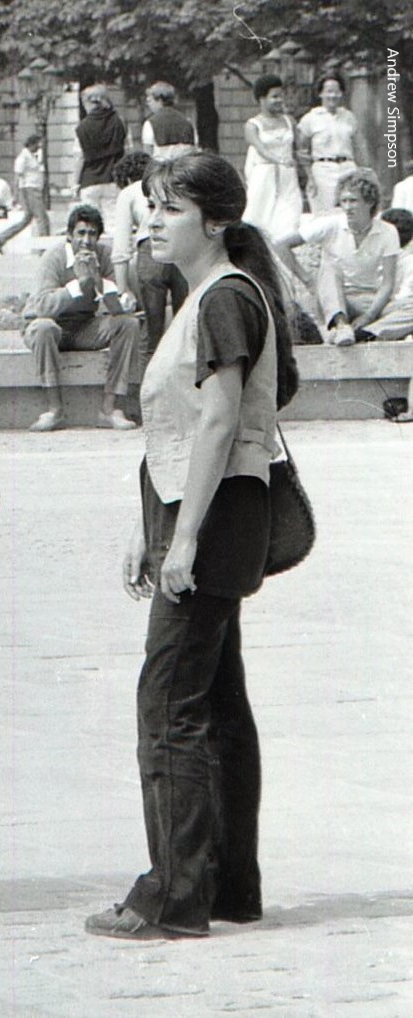
I go alone through the streets, 1980

If you are of a certain age Françoise Hardy will have a special resonance.

In 1962 when I first heard Tous Les Garçons Et Les Filles, I was instantly transported to that Paris of chic fashions, narrow streets and grand buildings but also of teenage romance and angst.

"All the boys and girls my age

Walking down the street two by two

All the boys and girls my age

Know well what it is to be happy

And eye to eye and hand in hand

They leave in love without fear of tomorrow

Yes, but I go alone through the streets, my soul in pain

Yes but I go alone because no one loves me"

And then with the news of her death l began reading about her life and made that uncomfortable discovery that her politics were very different to mine.

She was to the right of the  centre with some questionable positions on eqaulity and antisemitism.

All a bit of a disappointment.

Pictures; Paris 1981, from the collection of Andrew Simpson

*https://www.google.com/search?q=tous+les+gar%C3%A7ons+et+les+filles+paroles+youtube&oq=&gs_lcrp=EgZjaHJvbWUqCQgAECMYJxjqAjIJCAAQIxgnGOoCMgkIARAjGCcY6gIyCQgCECMYJxjqAjIJCAMQIxgnGOoCMgkIBBAjGCcY6gIyCQgFECMYJxjqAjIJCAYQIxgnGOoCMgkIBxAjGCcY6gIyCQgIECMYJxjqAjIJCAkQIxgnGOoCMgkIChAjGCcY6gIyCQgLECMYJxjqAjIJCAwQIxgnGOoCMgkIDRAjGCcY6gIyCQgOECMYJxjqAjIPCA8QLhgDGI8BGLQCGOoCMhEIEBAAGAMYQhiPARi0AhjqAjIRCBEQABgDGEIYjwEYtAIY6gIyEQgSEAAYAxhCGI8BGLQCGOoCMhEIExAAGAMYQhiPARi0AhjqAtIBBi0xajBqN6gCFLACAQ&client=ms-android-samsung-ss&sourceid=chrome-mobile&ie=UTF-8&chrome_dse_attribution=1#fpstate=ive&vld=cid:3bc24f79,vid:XPkBMqehr5k,st:0

Tuesday, 28 May 2024

The multilingual tram …… some confused identity ……and a street grid

So just as you think you are in the French town of Strasbourg, along comes a blue tram with Welcome in Italian embellished on the side.


And to add to the confusion my travelling chum who snapped "Benvenuto tram car 3001" tells me that "here we are in Strasbourg and the trams are mainly white with an occasional blue one".

All of which should not be that confusing to anyone who knows a little of Strasbourg’s history which is a city which has ping ponged between Germany and France.

In the Middle Ages it was governed by the bishops of Strasbourg, and then for four hundred years it was a free imperial city, before being seized by the French in 1681, who subsequently lost it to the newly created Germany in 1871, only to go back to France after the Great War before them briefly being occupied by the Nazis from 1940.

And then after it was liberated by the 2nd French Armoured Division under General Leclerc in November 1944 it was  again a French city.

So some might say my multilingual tram is just covering all the bets, and I have to confess it does in fact have messages in other languages along with the French and German national flags. 

The flags may seem an odd addition given the history but my Wikipedia my Wikipedia tells me that the   service is “one of the few tram networks to cross an international border, [and as well as taking you around Strasbourg will whisk you off] “to  Kehl in Baden-Württemberg, Germany”.

Leaving me just to add "The Strasbourg tramway (French: Tramway de Strasbourg, German: Straßenbahn Straßburg; Alsatian: D'Strossabàhn Strossburi(g)), run by the CTS, is a network of six tramlines, A, B, C, D, E and F . The first tramline in Strasbourg, which was originally horse-drawn, opened in 1878. 

After 1894, when an electric-powered tram system was introduced, a widespread network of tramways was built, including several longer-distance lines on both sides of the Rhine".*

But it wouldn’t be a communication from my travelling friend if I didn’t include one of those cast iron street grids which I delight in collecting.


This one has that romantic and catchy inscription …… "Strasbourg Eurometropole Assainissement" which google translate offers up as …. "Strasbourg Eurometropole Sanitation".

So that is it.

Leaving me just to include  those two trams again .....  if for no other reason than  they also show the tram stops where passengers can shelter, wait for their tram or just take pictures of trams.

And yes I also collect tram stops.


Location; Strasbourg


Pictures, blue trams, white trams and a street grid, 2024


*Strasbourg tramway, https://en.wikipedia.org/wiki/Strasbourg_tramway#Future_extensions


Friday, 8 March 2024

Algeria, ...... French rule ....... and The Mokrani Revolt of 1871 ...... one to listen to

 Now this is one I enjoyed listening to.

The Battle of Somah, 1839
It was part of the In Our Time series on Radio 4.*

"Melvyn Bragg and guests discuss the revolt that broke out in 1871 in Algeria against French rule, spreading over hundreds of miles and countless towns and villages before being brutally suppressed. 

It began with the powerful Cheikh Mokrani and his family and was taken up by hundreds of thousands, becoming the last major revolt there before Algeria’s war of independence in 1954. 

In the wake of its swift suppression though came further waves of French migrants to settle on newly confiscated lands, themselves displaced by French defeat in Europe and the loss of Alsace-Lorraine, and their arrival only increased tensions. 

The Mokrani Revolt came to be seen as a watershed between earlier Ottoman rule and full national identity, an inspiration to nationalists in the 1950s.

With, Natalya Benkhaled-Vince, Associate Professor of the History of Modern France and the Francophone World, Fellow of University College, University of Oxford, Hannah-Louise Clark, Senior Lecturer in Global Economic and Social History at the University of Glasgow, and, Jim House, Senior Lecturer in French and Francophone History at the University of Leeds

Producer: Simon Tillotson."

Picture; The Battle of Somah, Horace Vernet, 1839, Musée Rolin d'Autun, hotographer, Own work Moustachioed Womanizer

*The Mokrani Revolt, In Our Time, Radio 4, https://www.bbc.co.uk/programmes/m001wymz

Friday, 24 November 2023

A bit of 16th century France on the wireless ........ in our house

Marguerite de Navarre was just a name until today when I listened to the latest in the series of programmes from In Our Time.

Marguerite of Navarr, circa 1527
And it was well worth listening to.

"Melvyn Bragg and guests discuss Marguerite, Queen of Navarre (1492 – 1549), author of the Heptaméron, a major literary landmark in the French Renaissance. 

Published after her death, The Heptaméron features 72 short stories, many of which explore relations between the sexes. 

However, Marguerite’s life was more eventful than that of many writers. 

Born into the French nobility, she found herself the sister of the French king when her brother Francis I came to the throne in 1515. 

At a time of growing religious change, Marguerite was a leading exponent of reform in the Catholic Church and translated an early work of Martin Luther into French. 

As the Reformation progressed, she was not afraid to take risks to protect other reformers.

With, Sara Barker, Associate Professor of Early Modern History and Director of the Centre for the Comparative History of Print at the University of Leeds, Emily Butterworth, Professor of Early Modern French at King’s College London, and, Emma Herdman, Lecturer in French at the University of St Andrews

Producer: Simon Tillotson"*

Pictures; Marguerite of Navarr, circa 1527, Walker Art Gallery  

*Marguerite de Navarre, https://www.bbc.co.uk/programmes/m001smk

Saturday, 4 February 2023

The tower by the arboretum ...... and stories of unsettled times ..... the French picture

Now I like Ann’s picture of this 13th century French tower close to where she lives.


Part of the reason is just because I like other people’s pictures, and their insight into what is interesting.

Added to which it is a beautiful photograph, and conjures up a sense of tranquillity which I don’t always feel and according to Ann the tower “is surrounded by an arboretum, which was planted by a wealthy merchant in the 19th century, and is a wonderful place to walk our dog”.

But the details of the tower offer up a far more grim reality, and remind us that across Europe the Middle Ages were an unsafe place.

The windows on the tower are small and the single entrance is equally small and easily defensible.

Many similar fortifications would have had the added precaution of a door way higher up which would haven accessed by a flight of wooden stairs which in an emergency could be destroyed.

So much for tranquillity.

And having read the draft I sent to her, Ann added that this is the Tour du Guesclin, and "When we first came over our French neighbours took great delight in telling us the story that the English, who were in possession of the tower, allowed some French woodsmen in to deliver wood, as they were very cold. 

The French turned out to be soldiers, and slaughtered the English,  and 'there was blood everywhere '! So much for tranquillity.  Time moves on".

Location; France


Picture; Tour du Guesclin, 13th century, 2018, from the collection of Ann Love. 

Saturday, 19 March 2022

Happy in the Hotel de France ….. once upon a time in the 1980s

I like other people’s stories of where they live, and why they chose that location and not another.

And when they add a series of pictures it gets even better.

So, I was very pleased when my friend Ann emailed me with “these drawings and photos of the beloved Hotel de France”

Adding that “basically it was the reason we moved here.

We had been camping, with our three young children, and on the way back to the ferry, decided to stop for a snack. 

We saw a sign for Grand Fougeray, and there, in the square, was this old hotel.


We walked in, to find the family, the owners, sitting down to lunch, after everyone had left.

We apologised for interrupting and asked if it was possible to have a sandwich.  

Jean Pierre, the son, came over, and offered to open the restaurant for us. (3pm in the afternoon!)

We had a splendid meal, very homely, but delicious, with copious amounts of wine.

Afterwards we had a little walk around the town and decided to stay the night. 


We had two rooms, one for the children, one for us, which having spent the last two weeks sharing a tent was a great relief. 

It was quite primitive, the toilet was a bucket in the corner, but it was like something out of a 1950s film.

The family were so friendly and welcoming that we returned, year, after year, until finally, with early retirement, we had the chance to move over. M Victor, the owner actually found our house for us.

We have been here for nearly thirty years, mostly very happy”.


Now anyone who remembers the food programmes with Keith Floyd in the 1980s and 90s will appreciate Ann’s restaurant

Floyd was a wonderful chef, and television presenter, who could be fun, as well as irreverent and a master at making cooking look simply.

I bet he would have picked up on the Hotel’s menus and highlighted it simplicity, practicality pointing out that it did just what it set out to do ………..tell you what you could eat, with no pretension.

I just wish I had come across the Hotel de France.

Location; Grand Fougeray, Brittany

Pictures; Hotel de France; 1983, from the collection of Ann Love

Saturday, 4 December 2021

Twenty years of French history

This poster covers a big chunk of my life and has been with us since before the lads were born.

It dates from 1980 celebrates, twenty years of the French Socialist Party and was brought back from Paris by my friend Glyn Ford.

It has in its time hung in several rooms of the house and now sits in the kitchen, making it one of the first things you see as you walk in through the front door.

Many of the campaigns it features were ones I was involved in while others were happening just on the edge of my awareness of world events.

And that pretty much is that.

The quality of the image is a bit iffy but it captures perfectly two decades of political struggle which were about liberty equality and fraternity.

Location; France

Picture; from the collection of Andrew Simpson

Friday, 5 November 2021

Of wars .... a French epic poem ... and some dodgy history

Now that epic French story of bravery and sacrifice set against invasion is a poem I never read, despite the book having sat on the book shelf for over half a century.

The death of Roland, 1460

I can't say the subject matter ever appealed, but I always knew it was a piece of literature I should get to know.

Instead I listened to The Song of Roland, from the In Our Time series on Radio 4.

"Melvyn Bragg and guests discuss an early masterpiece of French epic poetry, from the 12th Century.

 It is a reimagining of Charlemagne’s wars in Spain in the 8th Century in which Roland, his most valiant knight, chooses death before dishonour, guarding the army’s rear from a pagan ambush as it heads back through the Roncesvalles Pass in the Pyrenees. 

If he wanted to, Roland could blow on his oliphant, his elephant tusk horn, to summon help by calling back Charlemagne's army, but according to his values that would bring shame both on him and on France, and he would rather keep killing pagans until he is the last man standing and the last to die.

With Laura Ashe, Professor of English Literature and Fellow in English at Worcester College, University of Oxford, Miranda Griffin, Assistant Professor of Medieval French at the University of Cambridge and Fellow of Murray Edwards College and, Luke Sunderland, Professor in the School of Modern Languages and Cultures at Durham University.

Studio producer: John Goudie".

Picture; The image above is taken from an illustration of Charlemagne finding Roland after the Battle of Roncevaux/Roncesvalles, from 'Les Grandes Chroniques de France', c.1460 by Jean Fouquet, Bibliotheque Nationale, Paris, Ms Fr 6465 f.113

*The Song of Roland, Radio 4, https://www.bbc.co.uk/programmes/m00114m8


Friday, 14 May 2021

"Bricks I have known and loved" ………… Ann’s story from Brittany ... two bricks and an Emperor

Now, I am not alone in having “a thing about bricks”.

Lots of Ann's brick put to good use, 2021

After all they come in all sorts of shapes and sizes as well as colours, and represents one of the moments in history, when people could escape from living in wattle and daub cottages to something which was more durable and long lasting.

At which point I recognise bricks have been around a very long time and if you lived in the Middle East they were your chosen material to build a home from earliest times.

But not so here, where when the Tudors adopted the brick it was still an expensive way to build a home.

As late as the 1850s, only fifty percent of the houses in the small township of Chorlton-cum-Hardy were made of brick, which I suspect could be matched in the surrounding townships.

So in my time I have collected old bricks, always choosing the hand made ones which date from the early 19th century and back into the 18th.

My favourite is one that came from the Miller Street dig on the site of what is now the new Co-op building.  It dates from the late 18th century, and came from a one up one down back to back property.

Joe and I had been invited onto the dig by one of the archaeologists on a day when the site was closed.  I suspect he took pity on two OAPs out on an adventure, showed us around, and granted our request to take away a brick each.

These were transported across the city in two worn plastic bags, with both of remarking that we had struck gold, but wondered how we would explain them if we were to be stopped by the police.

Some of Ann's bricks which missed the house, 

All of which is an introduction to Ann’s bricks which were in her back garden. Ann lives in France who told me that “the bricks were stamped with the words ‘Chauvin, Sion’, and were made in Sion les Mines, which is 5 k from here, and used to make a decorative edging around some of the Windows.  

They probably date from 1850, but I can't make out the other lettering. 

I used to have about a dozen assorted ones, but they've been used!”.

And for those wanting a bit of contextual French history, they may have been made two years after Louis Napoleon, became President of France, and two years after the said President made himself Emperor, following in the footsteps of his illustrious uncle, Napoleon Bonaparte.

So there you have it … a little bit of French brick history here on the Chorlton blog.

Location; Brittany, France

Pictures; French bricks, circa 1850, from the collection of Ann Love


Tuesday, 5 January 2021

Little bits of history through the post …… letters without envelopes

The continuing series on first day issues, and the history behind them.


Now, this is the last of the series and I have to concede that this story is not about first day issues.

That said the four letters were amongst the collection which our Stella had acquired, and may even have arrived in the same batch as some of the envelopes which have already appeared on the blog.

And while the four do not carry eye catching stamps or colourful “first day envelopes” I rather think they more interesting.


For each is actually just one page of paper which has been folded to form an envelope, containing the message inside and the address on the front, and for added security a wax seal had been attached, which effectively closed the letter and of course was proof it hadn’t been opened.

None of the four carried a postage stamp, although three of the four has a post mark which offer up a location and a date, which in turn indicates that one was sent in July 1849 and another in July 1852.


They were all written in French and one begins “Citoyen”.

In the fulness of time I will scan the message side and share with anyone who can read French.

For now I will just reflect on how once upon a time similar letters would have been sent through Britain in the same postal way, which of course opens up the opportunity for people with far more “posty history” to add a contribution.


Location; France


Pictures;letters without envelopes, mid 19th century, from the collection of Stella Simpson


Thursday, 9 April 2020

Marie Antoinette ..... on the wireless

Now, the history I was taught did not include many women.

Marie Antoinette, aged 13, 1768
There were of course the token few .....Boudicca, the first Elizabeth, Queen Victoria, and Florence Nightingale.

As for the rest they pretty much had walk on parts.  "Bloody Mary" got a mention only to show how her enlightened her half sister was, and Marie Antoinette, just to flaunt the quote about "let them eat cake".

So today, a little later than it was broadcast I shall settle down with Melvyn Bragg and the team of experts to delve deeper into Austrian cake lady.

"In a programme first broadcast in November 2018, Melvyn Bragg and guests discuss the Austrian princess Maria Antonia, child bride of the future French King Louis XVI. 

Their marriage was an attempt to bring about a major change in the balance of power in Europe and to undermine the influence of Prussia and Great Britain, but she had no say in the matter and was the pawn of her mother, the Empress Maria Theresa. 

Maria Antoinette, aged 23, 1778
She fulfilled her allotted role of supplying an heir, but was sent to the guillotine in 1793 in the French Revolution, a few months after her husband, following years of attacks on her as a woman who, it was said, betrayed the King and as a foreigner who betrayed France to enemy powers. 

When not doing these wrongs, she was said to be personally bankrupting France. Her death shocked royal families throughout Europe, and she became a powerful symbol of the consequences of the Revolution.

With, Catriona Seth, Marshal Foch Professor of French Literature at the University of Oxford, Katherine Astbury, Professor of French Studies at the University of Warwick, and David McCallam
Reader in French Eighteenth-Century Studies at the University of Sheffield.

Producer: Simon Tillotson".*

Location; France

Pictures; Marie Antoinette, [Archduchess Maria Antonia of Austria, the later Queen Marie Antoinette of France], 1769, Joseph Ducreux, Collection; Palace of Versailles, France, and Marie Antoinette in Court Dress, 1778, Vigée-Lebrun, Kunsthistorisches Museum, Austria 

*Marie Antoinette, In Our Time, Radio 4, https://www.bbc.co.uk/programmes/m000117y

Tuesday, 24 March 2020

Pictures from a backroom, on a moment of self-isolation ..... two from Ann in deepest rural France

I like the way that the series has gone international and from Chorlton we have zipped across to Italy, moved on to Cyprus and and today are in France.

The added bonus is that we have two pictures, one of Ann's washing and another from her upstairs window.

Wednesday was the "first day I was able to hang out washing out this year!  

Yesterday was glorious sunshine, today it's all grey and cloudy, but lots of spring flowers".

And that is how they do self isolation in rural France.

Leaving me just to add that Ann lives in Southern  Brittany, and that they "are  about half way between Rennes and Nantes.

Our nearest neighbours are about 200 yards away, we wave occasionally!
As we are regarded as 'at risk' we are not, in theory, allowed out of the house/garden, but I do go for a walk around the fields with Sophie the dog.

The spring flowers in the hedgerows are glorious" .

Location; Brittany, France

Picture, Washing line with dog and Morris, and View from upstairs window, 2020, from the collection of Ann Love