Showing posts with label New Cross in the 1950s. Show all posts

Thursday, 28 May 2026

Melting tar …… a busy butterfly ….. and a long lost adventure

Now the thing about getting old is that there seems to be heaps more time for the memories of the past to invade the doings of a busy day.

Shallow ponds and lazy streams, 2018 
And once that flight of nostalgic fancy starts to run its course it is easy to reflect on how your experiences of 60 odd years ago diverge from those of your kids or grandchildren.

I say that, but much of what our sons did when they were younger are only now being revealed as in their own bouts of nostalgia, they share stories of daring dos which they wouldn’t dare to have admitted to when they were 10.

Some of those stories do resonate.  Their adventures on the meadows on long summer days, chime in with my own, when armed with just a warm bottle of lemonade and a day stretching ahead of us, we wandered off in search of adventures in some faraway park, or along a stretch of the Thames.

Often it was at the end of a train journey or the limit of a Red Rover bus pass, and it usually involved a quiet suburban spot, unhindered by other people. 

One such place was at the end of a railway line, and rather than explore we just sat on the platform.  

There were no trains, no passengers and the only sound was that of a lazy insect collecting pollen, mixed with that distinctive smell of mown grass, which competed with the equally powerful smell of the oil-soaked wooden railway sleepers cooking in the sun.

We must have sat there for hours before boredom and the empty bottle of lemonade prompted us to move on.

The spot where we played  with the hot street tar in 1958
These of course can be replicated by our kids, but those of exploring bombsites have gone as is the simple pastime of watching the tar slowly melt on a hot summer’s day sitting on the side of the road and carefully making patterns of the black oozy stuff with a discarded lolly stick.  

Today the street surface doesn’t melt, and the lolly sticks are no longer there in abundance.

And in the same way those Clean Air Acts of the 1960s have happily done away with the heaps of polluted air which in turn gave us the smog’s which meant we got sent home early from school making our way along roads devoid of landmarks.

Nor today are there those thick sooty deposits on trees which when you climbed them left your hands and clothes grubby and grimy.

But enough of such nostalgic tosh.

Smog's and fogs, 1953
Our grandchildren I hope will never have to use bomb sites as playgrounds or come home with soot smeared clothes.

These they can leave to their imagination fed by granddad’s tales of aimless adventures on long ago summer holidays in that place called the 1950s.

I might try and pretend this is all about the historical context, but perhaps it is just a nostalgic wallow.

Location; nostalgia land

Pictures; Shallow ponds and lazy streams, 2018 from the collection of Andrew Simpson, the spot where me and Jimmy O' Donnel played in with the hot street tar in 1958, from the collection of Liz and Colin Fitzpatrick, 2015, and Nelson’s Column during the Great Smog of 1952, N T Stobbs, licensed for reuse under the Creative Commons Attribution-ShareAlike 2.0 license.


Sunday, 21 December 2025

Back with the Eagle in the 1950s

Now if you were born sometime between the early 1940s and the mid ‘50s, the chances are you were a fan of the Eagle comic.

It is a topic I keep coming back to and the reason is that back then it amounted to the best of British comics.

Its appeal crossed class lines as well gender and if my father was anything to go by attracted an older generation as well.

It came out each week and like other comics of the period had its own Christmas annual which was supplemented by books on some of the other leading characters.

But for me the Eagle Annual which first appeared in December 1950 was a must under the tree and it kept me going through the year, because here as well as comic strips were extended stories articles on sport , history science  and nature.

In between there were practical information on how to make a Kite-released parachute, sending secret messages using invisible ink and making your own printing set.

Never being particularly practical most of these DIY projects rated little more than a second glance.

For me it was the sections dealing with history and the stories which drew me in.

And of the stories it was Dan Dare Pilot of the Future who always was my first choice.

At this point I have to say this is no nostalgic trip. Instead is an exploration of how a popular comic managed at the same to introduce a whole pile of educational information which never led you to think you were back at school.

Nor were the books or comics aimed at the middle class, for there was enough here for any lad like me whose highest aspirations seemed to be a secondary modern school and a future mapped out in one of any one of a number of practical occupations.

The activities were all rooted in things any nine year could do and the stories were  in a world I understood.

And when they were based in space the Wild West or North Africa they were believable.

What is more the science of the future was our everyday life just a little different.

So Dan Dare’s spaceship used dial and buttons and levers, the command structure of Space Fleet including the uniforms which  mimicked the armed forces and of course many of the expressions used were rooted in the language of the 1950s.

None of which should surprise us but allowed every nine year old to feel that this imaginary world was not so far off from their own everyday life.

Of course the Eagle was ruthless in its use of its name which was marketed for all sorts of types and products, but again there is nothing new there.

So that said I shall this evening retreat into that world of the Eagle Annual leaving the cares of the 21st century behind.

Pictures; from the collection of Andrew Simpson

*The Eagle, http://chorltonhistory.blogspot.co.uk/search/label/The%20Eagle


Tuesday, 9 September 2025

When a comic story holds more than a truth .............. stories from the Eagle

Now I have no recollection of post war rationing after all I was only four when it was finally abandoned.

But there will be plenty who not only remember it but will have stories of its impact on their daily lives.

Some of them will also have been regular readers of the Eagle comic which began in 1950 and continued into the following decade and here is the connection because running through several of the stories beginning with the first was how at a critical moment the Earth’s government was forced to introduce food rationing.*

Now even though I have read and re-read the stories countless times it never quite occurred to me that older readers of the Eagle would have vivid memories of both wartime and post war rationing.

That first Eagle story  was followed by the Red Moon Mystery when the planet was threatened by a rogue planet which had once destroyed all life on Mars and caused havoc before it was destroyed, which was repeated later by other stories which saw the earth’s population forced to be evacuated from their homes and ultimately  off the planet.

And when it wasn’t a natural disaster of sorts then there were always evil galactic nasties out on inter planetary domination of which the worst was the Mekon a not very nice dictator from Venus and his army of followers whose slavish devotion to their leader and ruthless behaviour would have been all too familiar to a generation that had been children during the last world war.

Of course such events are the stuff of good adventures and in slightly different forms will have appeared before and since but for those of us growing up in the 1950s they were pretty much a backdrop to the real thing.

Location; The 1950s

Pictures; from Eagle Comics in the collection of Andrew Simpson


*The Venus Story, April 14, 1950 – September 28 1951

Friday, 24 January 2025

Waiting for the tally man

There is always a tally man.

The name may change, and so to the description of the business.

We knew it as “tally” but others will remember it as “the never never” or “HP” and today it’s simply  “credit.”

But the process was pretty much the same and consisted of the opportunity to buy goods in advance of the full payment up front.

Now I am not being sniffy about this.

For my family and for many others if we wanted to share in that new consumer boom of the 1950s and 60s, we pretty much were forced into putting down the deposit and paying monthly.

In our case it was a chap with a van who came round each week collected a small regular payment, brought back the shiny catalogue and if mother had decided on something he would bring it out of the said van.

I have completely forgotten the chap’s name which might have been Terry and until recently I had also forgotten the name of the firm which was John Blundell Ltd, but also seems to have traded as Edward Evans and maybe also the Hartlepools Mutual Trading Company Ltd.

But as you do in going through some old family stuff there, dating back to the 1960s were the payment cards.

There are no dates on any of the cards, but we were round 116 and our payment day was “day 6” which I suppose was a Friday and was always in the evening.

The weekly sums paid back range from 4 shillings up to a £1 and mother never seemed to miss a payment which given that a £ in 1964 was still a substantial amount of money was a serious commitment.

I have no idea when it began but Terry or his name sake was already a feature of the weekly routine in the late 1950s when were still in Lausanne Road and carried on when we moved to Well Hall.

From memory Dad always paid on the nail for the big domestic items like the washing machine, telly, and wireless and so the tally man was there for those items of clothes, bedding and shoes.

And these were always in demand given that there were five of us all at school.

The down side of the system was that it was no cheaper than credit today.

So the “Terms” on the card announce that “5p per week for every £1 in value or as arranged, Payments may be used as a deposit on a later purchase [and] Special terms arranged for Furniture and Cycles.”

Added to which of course many of the clothes items may well have been almost worn out before mother had finished paying for them.

But that was the price you paid, and while some more virtuous than me will mutter “we always saved up for and then bought” I have to point out that there was and still is not an option for many.
Not that this is a rant, or a reflection on the power of consumerism, just a reflection on how we lived prompted by the discovery of some old credit card payment books.

Location; Eltham, New Cross, Peckham and pretty much everywhere.

Pictures; tally Payments Cards circa 1964, from the collection of Andrew Simpson

Tuesday, 16 January 2024

Stories of balaclavas and adventures .......... out on the edges of Peckham and New Cross


Now if you have never read The Balaclava Story, and the Christmas Party by George Layton then it’s time to do so.*

They are set in the north of England in the post war period and chronicle the all too funny and at times sad escapades of Norman and his school mates.

I first read them soon after they were published in 1975 and instantly saw a connection with my own childhood in south east London.

I identified then and still do with Norman and the opening lines of The Balaclava Story ..............

“Tony and Barry both had one.  I reckon half the kids in our class had one.  But I didn’t.  My mum wouldn’t even listen to me.

‘You’re not having a balaclava!  What do you want a balaclava for in the middle of summer?’

I must’ve told her about ten times why I wanted a balaclava.

‘I want one so’s I can join the Balaclava Boys ....’

‘Go and wash your hands for tea, and don’t be so silly.’ She turned away from me to lay the table, so I put the curse of the middle finger on her.  This was pointing both of your middle fingers at somebody when they weren’t looking.”*

And many of us growing up in the late 1940s into the 50s will have had similar experiences, although in my case I did get the balaclava.

In fact I pretty much got one every year from when I was four till vanity and the teenage years banished them to the back of the wardrobe.

They were essential wear not only because they kept you warm but once the thing was on your head, you could be Ivanhoe, Lancelot or the good knight who occasionally featured in Robin Hood.

That said sometimes the pattern or mother’s knitting did not deliver which usually meant they were tight to put on or just too loose.

Of the two I could put up with the struggle of pulling it over your head but the loose ones tended to mean that they sagged exposing your chin and made you look daft.

Mine were usually grey or brown wool and because the mail hoods worn by a knight were a metallic colour then grey was always the preferred choice, but never underestimate a mother’s quest for value and quality over historical accuracy.

But at a pinch even a brown one would pass muster on those cold Saturdays when you wandered off in search of adventure and a new park.

There were usually three of us although sometimes the lad that lived in one of the basement flats close to the fire station would join us.

Not that we ever called ourselves the Balaclava Boys, although I did once ask mother to help out with some badges which she did by cutting out round cardboard discs attached by cello tape to safety pins, but they never caught on I suspect because she chose to call us the “Slugs” and emblazoned them across each badge in different coloured ink.

Still the thought was there and unlike the tale of Norman’s balaclava there was a happy ending.

Pictures; cover from the Fib and other stories, George Layton and 'The balaclava helmet' Pattern for a balaclava helmet From Essentials for the Forces Jaeger Handknit 1940s With ear flaps to enable good hearing during telephone operations (or for use with a mobile phone). The Victoria & Albert Museum, circa 1940s, http://www.vam.ac.uk/users/node/14309

*The Fib and other stories, The Balaclava Boys George Layton, 1975

** The Balaclava Story

Sunday, 8 October 2023

Adventures out of Peckham no. 2 ....... Abbey Wood and beyond

I have tried to remember what we did when we got hungry on an adventure, back in that golden time of the late 1950s.

We would have been on anyone of a set of “daring dos” which would have taken us from Lausanne Road up to Nunhead Cemetery, or across to Greenwich Park and in the fullness of time and with the help of a Red Rover out to the far reaches of the city.

Most would have started after breakfast and by the time you have washed up by the Cutty Sark or in deepest Holborn or faraway Abbey Wood, getting back for lunch was not going to happen.

I do have vague memories of the bread loaf and bag of chips, which involved buying a loaf and eating the inside which then became the place to put the chips and a second meal.

But that all supposed we had the money and that there was a chip shop to visit, which was certainly not going to be the case in snooty Holborn or leafy Epsom.

So, in answer to my question I have to say I can’t remember.

That said many of the trips out from Peckham and New Cross are still with me, and none more so than the ruins at Abbey Wood.

We will have done the journey on the bus or buses, and it will have been inspired by Jimmy who always seemed to know of these places, although how we got there could be problematic, but we always got there.

Of the three of us I was most attuned to the history of the site but the challenge of walking the walls, hiding behind the taller ones, and acting out a medieval battle, pretty quickly pushed the serious stuff away.

It always seemed to be that the grass had only just been cut which left us covered in the stuff which stuck like glue.

Eventually a combination of hunger, thirst and boredom would set us off on the way home.

Of course back then most parks and public places still had working water fountains, although one I remember stubbornly refused to yield any water.

It was one of those tall pointed ones made out of brown polished stone, had a plaque proudly announcing its date of erection with the names of those civic dignitaries who attended the opening ceremony but was as dry as the desert.

Its stone trough was full of leaves covered in dust with the odd sweet wrapper and the hint that it had once been home to some furry thing and if it had had drinking cups they were lost a long time ago.

Such setbacks we took in our stride and never mentioned when were asked what we had done that day.

Nor if memory serves me did we vouchsafe what we had eaten

Location; south east London

Pictures; Other Kid's Adventures, Manchester in the 1970s, from the collection of Andrew Simpson

Saturday, 7 October 2023

Just what do you do with an old tin of dried milk and sixty brass rods? .............. back in Dad's cellar in Lausanne Road

It’s odd how little bits of your parents stick to you and become part of how you see the world.

Now I fully except that physical appearance is the luck of the draw and some of us will be the spitting image of Dad while others will provoke jokes about the milkman.

Likewise the politics, music and tastes of our parents often provoke a massive swing in the other direction made more bizarre as the onset of middle age draws you back in part to a consensus.

But for me at 73 it is that tendency to save things which I know “will come in handy” but as yet have no idea exactly what that will be.

So there I was at six this morning emptying the last of a box of cereal into a bowl for Tina and without thinking carefully folded the waxed paper from the inside and set it aside with the card board box.

They will join a shed load of other bits of waxed paper and cereal boxes all neatly stored in a corner of the cellar.

All of which was my dad. He had shelves of old nuts, bolts, screws and nails all carefully wrapped in oiled paper to prevent them rusting and stored in those big tins which once held dried milk and dated from the 1940s.

These I could understand but the sixty copper spikes still in their card boxes from the Anacoda Works in Salford were a bit harder to fathom.

They had been made sometime in the 1920s and were there in Dad’s shed seventy years after they had been packaged and sent south.

But I suppose the answer is simple enough for like my grandparents he came from a time and a class which never threw anything away and who could indeed turn the odd bit of waste into something very useful.

And so with the passage of time I saw the potential for rocket ships made from those cereal boxes which our Ben lovingly played with for hours, never having mastered the word “Blast off” preferring instead “Blist off.”

Nor was he alone for both Josh and Saul in turn enjoyed their own versions of space ships along with powered cars for school projects made from a washing up bottle, some old toy wheels, and an elastic band which drove a big black propeller salvaged from some discarded Christmas gift.

Now I grant you they all looked a tad Heath Robinson but there was a magic in seeing them evolve and somewhere in the cellar a few have survived much to the pleasure of all the lads.

As for the brass rods which were designed as aerials for an early wireless they became in the fullness of time one of the objects I used in teaching history along with the wooden darning mushroom and much else from Dad’s storehouse of “useful things.”


Pictures; darning tool, from the collection of Andrew Simpson, and the tin of National Dried milk by Oxfordian Kissuth, Photographer and columnist, Germany and England. And available at WIKIMEDIA Commons,http://commons.wikimedia.org/wiki/User:Oxfordian_Kissuth

Tuesday, 18 July 2023

The story of one house in Lausanne Road number 50 ............. remembering breakfast

The story of one house in Lausanne Road over a century and a half and of one family who lived there in the 1950s.*

Now I know it had to happen but even so I was not prepared for the day when one of the staples of our breakfast tasted nothing like I remembered them from my childhood.

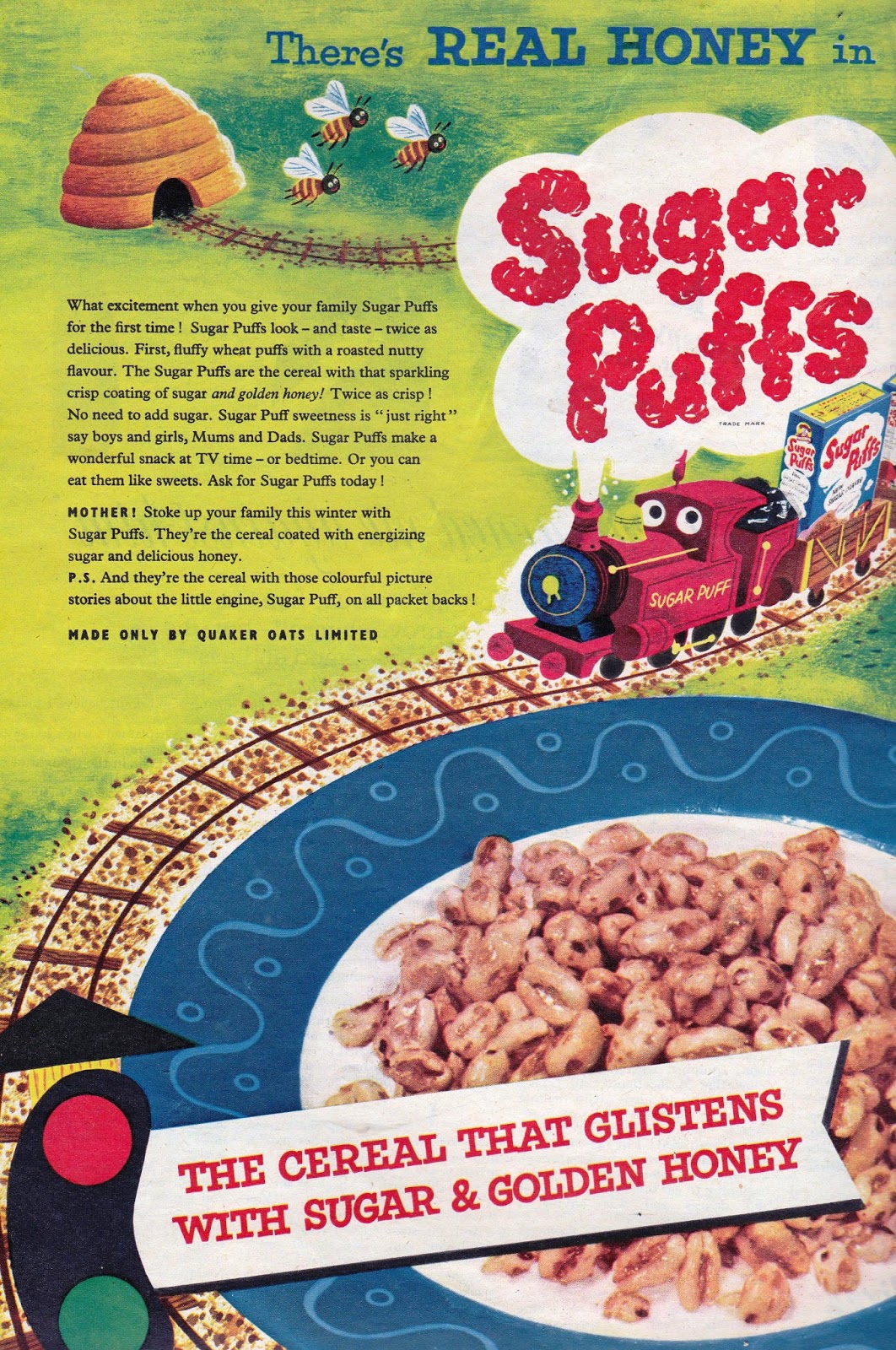
On a whim I had bought a packet of Sugar Puffs and while there was nothing wrong with the product my taste buds refused to recognise them.

Of course there is nothing surprising in that, we will all have had to accept that with the passage of time the food we ate as kids is different.

At which point I won’t fall back on the obvious comment about the size of Wagon Wheels, the failure to find Jublies in the shops or the first time I drank Tizer.

Instead I am reflecting on what I ate for breakfast back in the 1950s and more importantly how it had been influenced by my parents.

Again there is nothing very surprising about that.  As a kid you pretty much ate what you were given, influenced to a degree about by the advertising hypes that came with the television age.

So the attraction of Sugar Puffs was the little products that came with the cereal.  They ranged from tiny plastic racing cars to divers who were supposed to bubble in the fish tank and on one occasion a Sherlock Holmes set of mini detective gadgets.

But even given all that for me breakfast was and is a very personal thing and a meal much influenced by dad.

Long ago he had rejected the habit of eating porridge which as he added salt instead of sugar seemed a pretty sensible thing to leave behind.

Instead it was toast which was left to go cold and hard and eaten with butter or butter and ginger marmalade.

And now seventy or so years after I first ate it like that it’s just how I have my toast which of course raises that bigger point of what we inherit from our parents.

The physical ones are just the luck of the draw but what fascinates me are the habits, mannerisms and cultural outlooks which we absorb.

So from mum I got my politics which had been formed for her in the grim years of the 1930s and grew out of that desperate time of the Means Test, mass unemployment and making do on a pittance.

Along with the politics came a restlessness which expressed its self outlandish projects like the time she decided to breed rabbits and the fish pond she built on her own in the back garden of Lausanne Road.

All of these I have written about in the past and continue to shape who I am.

She too loved writing and had published a series of one and three act plays aimed particularly at women’s groups.

What made mum’s plays just that bit different was that the nature of the groups meant that there had to be few parts for men which added a greater challenge to the plot lines and the writing.

And now like many of my age I have come to reflect on what I have absorbed from mum and dad and conclude that it was far more than I had ever thought.

So breakfast will be toast and ginger marmalade and a day of writing about the past.

As for the Sugar Puffs, they now go under the name of Honey Monster Puffs and the little railway engine pulling its carriages has gone from the packet replaced by a Honey Monster.

There is still the promise of a gift but sadly they no longer taste the same but that will be me.

Location; Peckham, London

Pictures; products from the 1950s, from the collection of Andrew Simpson

*The story of one house in Lausanne Road, http://chorltonhistory.blogspot.co.uk/search/label/The%20story%20of%20one%20house%20in%20Lausanne%20Road

Tuesday, 15 June 2021

Losing Sugar Puffs and remembering Attins on Queens Road

Yesterday I went looking for a packet of Sugar Puffs.

Now this was not out of a sense of nostalgia, but because Tina who is Italian fancied some.

It was seven on a Sunday and with no wish to trudge up to the Co-op and knowing that Morrisons  would still be closed I settled on the corner shop.

Ours began as a newsagents which ran a successful lending library in the middle decades of the last century and then diversified in to everything you might want for breakfast but for forgot to buy.

I guess this side of the business developed as the traditional grocery shops on our road closed down.

That said the shop has traded as a newsagents since it first opened a century a bit ago.

Of course back in the 1950s when we were still on Lausanne Road it was all much simpler.

We got papers from the newsagents on Mona Road, wandered down on to Queens Road to the strip of shops that ran from Lausanne to Dennetts’s  road where there was the butcher's, and from memory two grocer's shops, although the first was limited and really came into its own  on a Sunday when it would sell the things that you needed but couldn't in theory buy because of Sunday trading laws.

So having been sent down for butter I was under strict instructions from the shop keeper not to tell anyone what I was carrying which for added measure had been double wrapped in brown paper.

All of which made me think we were a bit disloyal because for most of the week we fell back on Attins, which was a more up market grocery store.

It had one of those shiny plastic shop signs which was an off white colour with the their name picked out in black and all of the staff wore those old fashioned white coats and in the case of Mr Attins a white hat.

Added to which they had one of those big freezers and it will have been from here that I had my first frozen fish fingers and maybe even one of those TV dinners  which made their way into households at the beginning of the 1960s.

Mother was always up for innovation but the TV dinner phase didn't last long.

If you got it wrong during the reheating bit it offered up warmish veg with roast potatoes which were still cold in the middle and gravy which burnt the mouth along with thin slices of beef which at best tasted bland and at worst were like eating  strips of leather.

But at least you could buy Sugar Puffs at Attins.

Sadly I was unsuccessful down the road,

I was told they were on order and the box the shop had sold an hour before but worse than that it was that the cereal of my youth has been rebranded as Honey Monster Puffs and while the box still shouts out the latest offers and prizes the absence of the little train on the front left me thinking that breakfast cereal was best left alone.

Not that Tina was over bothered by a name change or the loss of the little train.

They tasted she told me like they always had, which I suppose is one up on the Wagon Wheel which seems smaller but which I am told has remained the same size.

All of which just leaves me to reflect that nostalgia ain't what it used to be.

Pictures; Sugar Puffs carton, circa 1956 from the collection of Andrew Simpson and adverts for Pecks product date unknown, taken from Spreading the love for a vintage Australian brand from  Spreading the love for a vintage Australian brand, Taste of General Mills, March 2015, http://www.blog.generalmills.com/2015/03/spreading-the-love-for-a-vintage-australian-brand/

Friday, 7 May 2021

The story of one house in Lausanne Road number 45 ............. the escapologist on Rye Lane .... catching the memory

The story of one house in Lausanne Road over a century and a half and of one family who lived there in the 1950s.*

So there I was possibly aged six or seven watching this man on Rye Lane inside a sack and wrapped in chains make an amazing escape.

It might have been a Christmas Day in which case I think it will be have been 1957 and that is the extent of the memory

It has sat deep down occasionally coming out but with the passage of time I had pretty much decided it was imagined.

And then by chance I came across this picture postcard dated 1955 and my escapologist bounced back at me.

Now this I know isn’t Rye Lane but just a little to the left of the carts was that open space beloved of street vendors and other more dubious characters that existed on a Sunday morning to fleece the unwary tourist.

And yes that was where I remember that other escapologist dressed as they had been in the 19th century in body stocking and fur coat and assisted by a rather odd looking old man with a flat cap which he handed around after the escape.

The crowd was big and me being little I wanted to worm my way to the front but even given the excitement of the moment and my childish curiosity I hung back because I have never forgotten Nana’s warning about being trapped in a crowd.

Sometime around 1900 in Cologne aged I guess about three and attracted by a noisy group beside the canal she too had worked her way to the front only to discover that what had drawn the people was the body of a drowned woman and unable to escape she was stuck at the front.

All of which is daft I know but stuck with me and even now makes me less than happy surrounded by lots of people.

I had to go checking that there was a canal in Cologne which there is and so another bit of a half remembered story was confirmed.

All of which brings me back to that Sunday morning event and the knowledge that mine might well be the last generation to have watched such an event in the open air.

It’s a tradition which will date back to the travelling men at the annual fairs in the Middle Ages and no doubt goes back even further.

But I won’t be alone in remembering him.

Picture; Tower Hill, 1955 Judge Picture postcard, courtesy of Mark Flynn Postcards, http://www.markfynn.com/

*The story of one house in Lausanne Road, http://chorltonhistory.blogspot.co.uk/search/label/The%20story%20of%20one%20house%20in%20Lausanne%20Road


Saturday, 7 July 2018

Drinking Troughs I have known

The drinking trough was one of those bits of street furniture I took for granted.

A water trough I knew .... St Mary's Road, date unknown
Thinking back they were all over the place and given the number of horses in use until the middle of the 20th century that is no surprise.

But they owed their origins as much to cattle as horses.

In the middle of the 19th century  cattle along with other livestock were still being walked into our city centres and while the days of bring them in from the country were over they were still being walked from main railway stations to dairies and abattoirs.

As late as the 1950s my old friend Oliver Bailey had the job of transporting pigs from our local station to his farm through the streets of Chorlton-cum-Hardy and the family still kept a herd of cattle on a patch of land in the heart of the township.

So the water trough during the years I grew up in Lausanne Road was still in use although by then its use was pretty much limited to offering water to the horses pulling the milk floats and the rag and bone man’s cart.

An on Bexley Road a water trough with flowers
And if I think hard enough the one on the corner of St Mary’s Road and Evelina Road was more often dry and a place for us lads to sit in and be silly getting our clothes dusty and a tad grimy from the accumulated muck which was a mix of dried leaves, the odd discarded crisp paper and street grit.

Some troughs can still be found like the one in Eltham, others were taken over as flower beds before finding their way into Corporation Yards and finally broken up as rubble.

Now I have decided to begin looking for them and plotting their presence around the area where I grew up.
And to help me I have fallen back on an excellent set of historical maps of Southwark.*

The trough on St Mary's Road, 1953
They cover the period from 1896-1953 and offer up a fascinating resource more so as the later ones cover my own time in Lausanne Road.

Added to which there is the facility to compare them with modern street maps and switch to contemporary street scenes.

From which I know that my water trough at the top of St Mary’s Road has long gone.
And as you would expect the story behind the maps is a tale in itself.
They were found in a cupboard by Mr Carter in the council offices who decided to have them digitized and made available on line.

That Peckham water trough again
They represent an invaluable resource for any one engaged in family research or like me have been drawn back to write about the place I grew up.

All too often my memory is hazy to the point where I wonder whether they actually happened.
So trying to track where my old friend Jimmy lived proved almost impossible.

I knew it was a street off Queen’s Road between Mona and the fire station.  Sadly google street maps offered no help but there on the 1953 map was the place and by using the electoral roll I found him and his house all over again.

And the same 1953 map offered up the corner of St Mary’s Road with Evelina Road that water  trough which was good because despite Adrian’s picture I had come to doubt that I had ever sat there.

All I have to do is find the rest.

Tomorrow, Ghost signs on Evelina Road .............. along with an old telephone kiosk and much more

Picture; St Mary’s Road with water trough, date unknown supplied by Adrian Parfitt, water trough, Bexley Road, 2015 from the collection of Jean Gammons and detail of St Mary’s Road 1953 historical map extract courtesy of Southwark Council at Historical map extract courtesy of Southwark Council at http://maps.southwark.gov.uk/connect/southwark.jsp?mapcfg=Historical_Selection&style=historical&banner=historical.
 with mapping provided by Landmark Information Group


Saturday, 2 September 2017

Walking down Nunhead Lane on Christmas Day 1958

Now I was reminded of that oft quoted line “you can wait for a 21 from Lewisham and then three come along at the same time” which could apply to any bus anywhere in the world at some point, usually when it’s raining and you are late.

All of which is a contrived way of saying thank you to Adrian Parfitt who sent me  a shedful of new pictures from his mum’s photo album including heaps of Peckham Health Centre, the park at Rye Lane and Austin’s furniture store.

And among them was Banfield’s depot on Nunhead Lane which I had written about only recently and will lead someone to mutter about waiting for a coach garage and finding three in the same day.

Despite lots of thinking I still don’t remember the place although I must have seen it almost every day during the year I was at the annexe on Old James Street.

And I will have passed it on a Christmas Day morning sometime between 1957 and 59.

Now I can be pretty sure of those dates because I remember being fascinated by the newly rebuilt St Anthony’s church which was finished in 1957 replacing the one destroyed in 1940.

Although to be accurate it was the figure of Christ beside the church notice board which attracted me.

Looking back fifty seven years I could of course be mistaken but I am fairly sure that is what I saw.

It is an image that has stayed with me and like so many recently has bubbled up to the surface.

I was with my dad, and Uncle George and I think also my twin sisters who would have been two and it was one of those pre Christmas dinner walks that people went in for at the time.

We will have walked up to Rye Lane Park in the morning after opening the presents and the trip was mother’s way of emptying the house so she could prepare the dinner.

All of which will have placed us at the corner with Carden Road around 11.

Any later and we would not have been back to have settled down had dinner and cleared away ready for the Queen’s speech which I am also fairly confident we would have watched on the telly.

Like so many of the memories from when we lived at Lausanne Road I had begun to think many were just my imaginings but Adrian’s picture has brought it back and confirmed what I thought.

Added to which it also brought back one of those more shameful episodes when not much older and in the company of two friends I shocked an elderly couple on Nunhead Green with a series of foul outbursts which even at the time I knew were wrong and in the face of their disapproval I blushed.

What interests me more than the memories is that simple fact that as more pop up each in turn is confirmed by an old picture or by someone else.

So the cocoa factory on Kender Street, the tally man who called on a Friday and the wool shop on New Cross Road have all been vouched for which means more than a little of my life in Peckham and New Cross really did happen the way I thought it did.

Nor is this some silly little piece of nostalgia because it points to that important lesson in sharing our history especially if that history happened a long time ago and for some of us those memories are separated not just by time but also geography.

We left Lausanne Road in the spring of 1964 and when I returned six years ago much of the area was unrecognisable which I know is only to be expected but I bet with that change much has been lost.

Still that said the clock tower of the garage is still as is the church even if the ownership has changed and that row of houses don’t look so different.

Picture; Nunhead Lane, date unknown, from the collection of Adrian Parfitt

Tuesday, 28 June 2016

Garden sheds I have known and the stories that come with them ........ the figure in the reflection

Now there is a moment in the film Blow Up when a photographer notices something odd and sinister in one of the pictures he had casually taken in a London park in the summer of 1966.

Peter's painting of the shed
In the process of enlarging the shot he notices a body and nearby in the bushes a man holding a gun and from that point the film takes a series of twists and turns.

Anyone of my generation will remember the film and the impact it made on them.

I know I do.  I was 16 and Britain and especially London was experiencing that exciting and wonderful period when the new from fashion to music to ideas and politics looked different and promised a different future.

Figures in a reflection from the photograph
That said I can hardly really admit to being part of it.  In Eltham in south east London it all looked pretty much the same as it had done a decade earlier, and I guess for Peter living in Preston it was much the same.

But the memory of Michelangelo Antonioni’s film never left either of us and my photograph of our old garden shed stirred something in Peter’s imagination.

I long ago had clocked the image in the reflection and then forgot about it but on a slow evening with just repeats on the telly Peter took up the challenge of painting the shed  and Blow Up took over.

And like David Hemmings in the film he began to explore those images and because he does things in acrylic what followed will become a series of paintings each just a little more detailed than the one before.

Standing in front of the main panel was the man with the camera, but behind him was the figure of a woman.


Detail of the reflection from the photograph
Look more closely and she is holding something, ........ enlarge that detail and there is a gun.

Or so it would seem.

Now in my short life in that house my parents shared it with a succession of tenants, from Millie the Mole and her love partner Boy Boy Jones, to a  man with two wives and a couple who met across the upstairs landing.*

He was Polish and she was German, they fell for each other, got married and moved out.

But his parting gift to us was the shed built in the mid 1950s and still standing today long after we left for Well Hall.

As for the story of the shed, well I will leave that to your imagination.

Painting; the shed in the garden of Lausanne Road  © 2016 Peter Topping Paintings from Pictures Web: www.paintingsfrompictures.co.uk

*The history of the shed, https://chorltonhistory.blogspot.co.uk/search/label/The%20history%20of%20the%20Shed


Sunday, 26 June 2016

Garden sheds I have known and the stories that come with them ........ Millie the Mole, and the Polish builder

Now the garden shed is as much a part of the landscape and our history as the stone water trough, red telephone kiosk and the equally loved old fashioned rear entrance double decker bus.*

The garden shed, 2010
Some of these old favourites may now be no longer fit for purpose and some like the double decker were useless if you were in a wheelchair, but the humble garden shed just goes on and each will have a story.

This is ours; built in our garden in Lausanne Road sometime in the mid 1950s by one of the people who rented rooms form my parents.

He was Polish and later became very friendly with another tenant who was German and in the fullness of time they married and moved out to a flat just round the corner.

I think he had replaced Millie the Mole and her boy friend Boy Boy Jones.**

This was the period just after the last world war and housing was still in short supply, with many people living in rented accommodation.

It was the age of the private landlord and “living in rooms” was commonplace.

We were I think unique in owning our own house and most of my friends lived in grand old Victorian houses which long ago had been sub divided in to flats.

Lausanne Road, 2010
I don't remember, Millie the Mole and Boy Boy Jones. He was involved in smash and grab raids which were at the cutting edge of big time crime.

The gang would choose a suitable jewellers and using a brick and pick axe handle smash the window, grab the loot and escape in the waiting car. Boy Boy Jones was the driver.

A career which came to an abrupt end when he drove off during a raid, leaving the gang to struggle along a crowded Peckham High Street, with assorted diamond rings, a necklace and several watches.

Needless to say their progress was somewhat hampered by the loot and the Saturday shoppers and they were caught.

Boy Boy Jones remained free which was not necessarily a good thing for Millie, whose relationship with him was tempestuous at the best of times and led on one occasion to Boy Boy arousing the street as he dangled her out of one of the upstairs windows by her wrists.

And when they moved on it was the Polish chap and his wife who moved in.  To me they were something different. Occasionally I would be invited to share a cup of real coffee and some Polish biscuits which arrived from the “homeland”.

Like so many of the stories I have posted their experiences reflect the awful events of the century they lived in. Theirs were “little lives lived out in a big century.” Both had been victims of the displacement of millions of ordinary people who had been in the wrong place when the war broke out and found themselves part of that tide of homeless refugees in 1945.

Me, a tent and that garden shed, 1957
I don’t know their stories and like many of their generation they didn’t talk about the past. But he was Polish and may have spent time as a Soviet prisoner, which begs the question had he been on the wrong side in the conflict, or just a causality of the Cold War?

Either way there is a lasting testimony to their stay in the house, because the garden shed he built in the late 1950s is still there. I had almost completely forgotten about it.

And then on an impulse while on a visit to London for a family wedding we visited the old house.

It is almost 50 years since we left but there is much about the place that I remember. I am grateful to Rachel and David the new owners who did not mind that we had invaded their Sunday and were happy to show us around.

The garden seemed smaller and more alive with plants than I remember it. The trees had gone but the shed remained.

I rather liked the fact that something from all those people who had passed through had survived.

Location; Lausanne Road, London

Pictures; the shed in 2010 and in 1957 from the collection of Andrew Simpson, Lausanne Road, 2010 courtesy of Elizabeth and Colin Fitzpatrick

*The history of the Shed. https://chorltonhistory.blogspot.co.uk/search/label/The%20history%20of%20the%20Shed

**Millie the Mole, Boy Boy Jones and a garden shed, ............ London in the 1950s, https://chorltonhistory.blogspot.co.uk/2014/06/millie-mole-boy-boy-jones-and-garden.html 

Thursday, 14 January 2016

The lost shops of Queen's Road, New Cross….. more stories from Chris Taylor

In the 1950s, there was a parade of shops along Queen's Road, east and west of its junction then existing with Dennett's Road (which ran southwards, parallel with Lausanne Road).  

Hair tonic advert from the 1950s
Mostly, they were family-run or independent businesses serving regular shoppers from the neighbourhood.

I'll describe the shops as far as I remember from visits with my mother, or later when I myself was a young boy 'running round the corner' from Lausanne Road on a lone errand.  Every shopper took their own shopping bag or basket since shops didn't provide plastic bags (they hadn't been invented).  However, the grocer could find a cardboard box for a larger order and the greengrocer used brown paper bags, plucked off a pack which hung from a nail, especially for tomatoes, fruit and the like.

1. Shops west of Dennett's Road

From the crossroads of Lausanne Road with Queen's Road and Pomeroy Street, walking eastwards, there was a terrace of several large Victorian houses, with long front paths, somewhat elevated from the level of the pavement, remains my impression.

Queens Road, from Lausanne Road to the Fire Station, 1953
The first shop was a dry cleaners with a plain wooden counter and bare floorboards.  I particularly noticed that this shopkeeper pressed very firmly and deliberately with a biro (ballpoint pen) so that his stylish cursive handwriting remained clear on the carbon copy in his ticket or receipt book.  This gentleman informed me that Lausanne was a city in Switzerland and he pronounced it Low-zanne (not Law-sayne, as most locals tended to say).

Next door was a grocer's shop run by a lady called Daisy, so it was known as “Daisy's”.  Owing to Sunday trading laws, on “the day of rest” shops closed or opening hours were restricted and sales of certain items were prohibited.  Woe betide if you needed a toilet roll on the Sabbath: it had to be sold clandestinely (to a trusted customer) and wrapped in newspaper to hide it from the eyes of Big Brother who might be spying in the streets (!)

Lausanne Road east to Dennett's Road, 1953
Mr and Mrs Gregson ran the chemist shop (today's 'pharmacy').  They dispensed the prescriptions of doctors (Dr Purcell's surgery was in Queen's Road), sold over-the-counter medications, toiletries, perfumes (like “Soir de Paris” by Bourjois,) and all the rest of it.  To me at that age, much of the shop seemed occupied by a massive dark wooden counter and matching tall cabinets fitted with glass, on which stood shapely flasks with big stoppers.  A Victorian legacy I suspect, judging by the pharmacy one can see in the slightly obscure medical galleries at the Science Museum, South Kensington.

It may have been just outside Gregson's where the bus stop was formerly located, notably for double-decker route 36 running to Rye Lane, a key south-east London shopping street at that time, with the attraction of Jones & Higgins department store and multifarious retailers.

Silmos Lollies, advert from the 195s
Then there was Larrett's, the butcher's. Mr Larrett was the governor and 'Little' Albert his hard-working assistant.  On a Saturday morning, housewives (for so it was then) queued for ages on the sawdust-covered floorboards, to buy the family's Sunday joint for roasting, weekly wage packets having been received on the Friday.

To rhyme with Larrett's, Garrett's, next door, was a newsagent, tobacconist and confectionery shop.  On a Saturday evening, people eagerly awaited the arrival of the so-called “pink” newspaper which contained the 'classified' football results for checking pools coupons if you were not checking the readout on the 'wireless'.  News stories of the decade that stood out for me were the launch (October 1957) of the Soviet's artificial satellite “Sputnik” and, the following month, the loss of the space dog “Laika”.  Fantasies from “The Eagle” comic and the Space Age were starting to align.

And so to the corner.  A new-fangled establishment, a Launderette with large plate glass windows, was installed on the north west corner of Dennett's Road with Queen's Road.  Inside were dozens of large front-loading Bendix washing machines with rows of fixed seats in front.  The washing cycle needed to be monitored so that, at the lighting of an indicator, you would open the flap in the top and pour in a measure of powdered detergent.  Curiously, some people's washing sudsed up more than others.  Service washes by an attendant were also available at extra cost.  For many, it was a regular Saturday morning chore, but easier than washing, rinsing and wringing by hand as few had machines at home.  And there were tumble driers.

According to Prime Minister Harold Macmillan, in 1957, we'd “never had it so good”.  The modern age was evolving in the post-war decade, but the sea-change of the Swingin' Sixties had yet to burst upon us.


Dennett's Road east to the Fire Station, 1953
2. Shops east of Dennett's Road

The shops in this parade stood back from the pavement, so may have been converted from residential properties with their front gardens paved or covered over.

On the north eastern corner of Dennett's Road with Queen's Road was Hargreaves, the greengrocer.  Each shopper announced their requirements, such 3lb of King Edward's – big ones (for roasting) please; a cauliflower, etc, and the shop-staff picked out, weighed the produce and loaded it into the bag you'd brought along with you.  Sixty years on, we've reinvented the conventional shopping bag owing to the environmental damage caused by decades of too many plastic bags.  Progress.

Attan's (or Atten's?), a grocer's shop had glass counters either side of a central aisle for the customers.  Large tins of biscuits ranged along the front of one counter; many biscuits were dispensed loose in a paper bag. We had Commonwealth butter from New Zealand.

In this parade, was a small General Post Office (GPO).  Outside, there was a coin-slot machine which regurgitated postage stamps in vertical strips.  As a budding schoolboy philatelist, I was excited to discover that this machine had became stocked with graphite-lined varieties and I squirrelled away several examples hoping they'd have a premium value one day.  In a feeble attempt at saving pocket money, I had a savings account book with about one shilling and sixpence (1s/6d) on deposit.

Further east, Mr and Mrs Barnes had their own confectioner's and tobacconist shop, later extended to toys stored in a converted back room.  Formerly, I heard, Mr Barnes had been a racing driver.  Before they gave up the shop, they kindly treated me to an ice show in Brighton and we three (on the bench seat) hurtled down the A23 in Mr Barnes' small but stylish Nash Metropolitan, which was some ride.


New Cross Fire Station, 2015
Finally, by a kind of yard, a hardware shop sold general household goods and paraffin by the gallon (you took along a jerry can).  Brands were Esso Blue or Aladdin Pink to fuel the indoor paraffin heaters that people resorted to in place of coal fires.  The Clean Air Act 1956 brought in smokeless zones to lessen the smogs (smoky fogs) which had crippled traffic flows and human lungs alike.   In such smogs ('pea-soupers') you could barely make out the next lamppost or the house across the street.

By way of context, a little further to the east, 266 Queen's Road, SE14, is the ornate building of the long-established New Cross Fire Station (1894).

Apart from the new Launderette, none of these shops was self-service; supermarkets were only just beginning to be set up.  Shoppers queued patiently to be served individually by the shopkeeper or assistant in each type of shop.  They called out their lists item by item as the shopkeeper gathered each product from their stock and placed it on the counter. Typically, the items were totted up in the head or pencilled on your shopping list or a paper bag with the total rung up on the massive cash registers, in pounds, shillings and pence (£.s.d.).  You paid in cash, cheques were unusual and credit cards non-existent.


Text © Chris Taylor, 2016

Pictures; Pictures; detail of Queen's Road, 1953, historical map extract courtesy of Southwark Council at Historical map extract courtesy of Southwark Council at http://maps.southwark.gov.uk/connect/southwark.jsp?mapcfg=Historical_Selection&style=historical&banner=historical.
 with mapping provided by Landmark Information Group, adverts from the 1950s from the collection of Andrew Simpson,  and New Cross Fire Station, from the collection of Chris Taylor

Links:

https://en.wikipedia.org/wiki/Sputnik_1

https://en.wikipedia.org/wiki/Laika

https://en.wikipedia.org/wiki/Graphite_lined_stamp

https://en.wikipedia.org/wiki/Nash_Metropolitan

https://en.wikipedia.org/wiki/Smog

https://en.wikipedia.org/wiki/Cash_register

https://historicengland.org.uk/listing/the-list/list-entry/1406834


Tuesday, 12 January 2016

Dennett's Road, SE14 ................ another story from Chris Taylor

In the 1950s, Dennett's Road ran continuously from its then junction with Queen's Road, southwards and parallel with Lausanne Road, to Mona Road and on up to Arbuthnot Road.  I say “up” because of the slight incline leading towards the increasingly steep Telegraph Hill beyond.

Dennett's Road, 1953
It was a residential street of Victorian terraced houses as far as I can recall, except that halfway “up” on the left hand (eastern) side lay a sweet shop and a barber's shop.

The sweet shop had a central door leading into a small interior and the customary counter across.  Behind, on shelves, was the stock of sweets in big glass screw-top jars from which they would be weighed out by the shopkeeper onto manual scales.

You might buy 2oz (two ounces) or a 'quarter' (of a pound) of the sweets of your choice.  For modern metric folk, there were 16 ounces to one pound (1lb) being 453.6g.  Typically, there were Dolly Mixtures, Jelly Babies, Cough Candy, Buttered Brazils, Murray Mints, Mint Imperials, and so on and so forth, all served to you loose in a white paper bag.  The unwrapped sticky sweets were a problem when they congealed together or with the bag itself so that you prized them apart and teased or sucked off the paper as necessary.  Rowntree's fruit gums and pastilles, Polo Mints and suchlike were packaged in proper rolls.

This shop also sold bottles of soft drink (fizzy pop), notably the reddish “Tizer” (the Appetizer) and R White's “Cream Soda” and “Lemonade”.  When you returned the empty bottle you'd get back 3d ('thruppence').  However, out of your pocket money you could be poured a penny (1d) or tuppenny (2d) glass of pop.  The glasses were rinsed out after use and placed back on a tray on the counter ready to be charged again.  So refreshing after a day of lessons at school.

The barber's shop would place a stout board across the arms of the adult chair to raise small boys up to a convenient height for hair cutting with hand-operated clippers and scissors.  Brylcream appealed as a slick finish to one's hair but was discouraged by my sensible mother.   Another barber's shop was to be found in Besson Street, towards New Cross Gate.

The Rising Sun, 2014
On the corner with Rutt's Terrace (cul-de-sac) was “The Rising Sun” PH.

Laying back on a wide pavement from the junction of Dennett's Road with Mona Road, before Dennett's Grove and behind a public telephone box - I think it must have been a dairy (possibly a Welsh dairy?), that is to say a shop selling milk, dairy products and groceries.  In particular, I remember its delicious cheese straws.

The next turning south, Walsham Road led to an entrance to Edmund Waller Primary School (infant school end), before the end of Dennett's Road at Arbuthnot Road.

Text © Chris Taylor, 2016

Pictures; detail of Dennett’s Road, 1953, historical map extract courtesy of Southwark Council at Historical map extract courtesy of Southwark Council at http://maps.southwark.gov.uk/connect/southwark.jsp?mapcfg=Historical_Selection&style=historical&banner=historical.
 with mapping provided by Landmark Information Group and   the Rising Sun, Dennett’s Road, 2014, courtesy of Transpontine, http://transpont.blogspot.co.uk/?m