Showing posts with label Oldham. Show all posts

Monday, 13 July 2026

Route 356 …. if you ever plan to travel east ……

Well, if you ever plan to travel east, take my way, it's the highway that's the best and get your kicks on route 356.

Route 356, 2025

It runs from Oldham, up to Denshaw, down to Delph and all the way to Ashton.

The Angel Hotel, Ashton, 2022

Taking in stunning landscapes, and heaps of places from Dobcross, to Diggle, to Upper Mill, Greenfield, Grasscroft, Miclehurst, Mossley, always heading south, until it twists west from Stalybridge to end 80 minutes later after 14 major stops at Ashton Under-Lyne.

Now, I think there is a book to be written which tells the story of this part of Greater Manchester by bus, with tales from all 14 stops, with pictures, maps and some original paintings by Peter Topping.

So, I am throwing down the challenge. “Peter meet me in Oldham on a day and time of your choosing and we’ll motor south, stopping off as we choose and like Toad of Toad Hall discover adventures along the way”.

The White House, Ashton, 2022


Market Place and Town Hall, 1950s
And because we can we will do it for free, courtesy of that nifty little concessionary bus pass.  

Other bus tickets are available, but none will cost more that £3.

Leaving me just to say that other seats will be vacant but we will have nabbed two at the front on the top deck.

And … dear reader you have been present at the dawn of another great Simpson Topping idea.

Pictures; Route 365, courtesy of Google Maps, The Angel Hotel and The White Horse, Ashton-Under-Lyne, 2022, from the collection of Andrew Simpson, Market Place and Town Hall from the series Ashton-U-Lyne, issued by Tuck & Sons, courtesy of TuckDB,  http://tuckdb.org/history

Wednesday, 3 July 2024

Mrs Sykes, the Diggle Hotel and more than a bit of complicated history

I am still looking for a photograph of Mrs Sykes of the Diggle Hotel, if only to identify a young man from a picture postcard dating to 1910.

The Diggle Hotel, 2015
But what started as a story about that picture postcard, has by degree turned into a quest to uncover the life of Lauretta Lilla Sykes, and in the process plunged me deep into the history of Diggle in the 19th and early 20th centuries, and by extension drawn me back the Diggle Hotel.*

And as they say this is one of those stories which will run and run.

Away from Diggle, 1910
The postcard is unique in that it shows a group of Volunteers from the 6th Manchester’s at a training camp in the spring of 1910 and amongst them is Gordon Radcliffe Sykes aged 21, son of Mrs Sykes and the nephew of Frederick Radcliffe.

And because it was addressed to Mrs Sykes at the Diggle Hotel that seemed a good place to start.

Mr and Mrs Sykes were there running the pub from 1891 and I rather think from a little before that.

They had been married in the November of 1887 and may have there well into the middle of the last century.

James Sykes died in 1939 and Lauretta in 1951 and with a bit more digging it should be possible to find out when they gave up running the pub.

The Diggle Hotel, date unknown
What I do know now is that her connection with the Hotel goes back to 1861 when aged just 9 months she was living there with her mother who was the sister of Frederick Radcliffe who the licensee.

And it becomes even more complicated because a decade later Lauretta was living with her parents close by in the home of James Broadbent whose sisters were working in the Hotel in 1861 and in 1881 she is listed as a householder sharing her home with her servant Amy Sykes aged 62.

With Janmes and Lauretta in 1900
At which point I shall pause and ponder on the connections between the Radcliffe, Platt, Broadbent and Sykes’ families and  just how much each of these families are embedded in the story of Diggle.

But that is for another time and while I am still no nearer knowing what Mrs Sykes looked like I am a bit closer to the business they ran because there on the walls of the pub are some posters from the 1900s.

They were sent to me by Lynn Shaw who along with her husband and family have been running the Diggle Hotel since September.**

Picture: the Diggle Hotel, 2014 and poster advertising the place in 1900 courtesy of Lynn Shaw and detail from the picture postcard, the 6th Manchester's 1910 at West South Downs Camp, from the collection of David Harrop

* Mrs Sykes, her son in the 6th Manchester's and the Diggle Hotel ....... part 1 a picture postcard,http://chorltonhistory.blogspot.co.uk/2015/12/mrs-sykes-of-diggle-her-son-in-6th.html

**The Diggle Hotel, Station Houses, Diggle, Oldham, Lancashire OL3 5JZ, 01457 872741
Local family takes over historic Saddleworth pub thanks to funding from RBS,  Aimee Howarth, Saddleworth Independent,  HTTP://SADDIND.CO.UK/LOCAL-FAMILY-TAKES-OVER-HISTORIC-SADDLEWORTH-PUB-THANKS-TO-FUNDING-FROM-RBS/


Friday, 23 December 2022

Nothing to do in Oldham ……..

So there are possibly 96,420 people who I could offend with this picture postcard, which dates from the early 20th century. *

To which I could add heaps more who now live elsewhere, or passed through on a sight seeing tour, or like me visited occasionally to call on my friend Lois.

But a picture postcard dedicated to shrubbery and a set of gates is fair game.  

The commercial photographer who wandered into Alexandra Park sometime in the 1900s seems to have lacked a  bit of imagination, given that there are heaps of things he could have photographed.

And even more today which Oldham Council proudly declare is “Alexandra Park is a Victorian town park, which was built by the people of Oldham during the cotton famine sparked by the American Civil War, which prevented the export of raw cotton from America to Oldham. Small areas of clough woodland can be found at the southeastern end of the park.  There is a woodland walk adjacent to Queen’s Road.

From Alexandra Park there are marked paths leading into Snipe Clough, Brushes Clough and to Park Bridge Heritage centre and beyond".** 

And the attractions include a "Heated conservatory, Boating lake, Fishing club, Boathouse with cafe, 7 free tennis courts, 3 crown green bowling greens, Children’s play area, Sand pit, Toilets (when the gardeners are on site), Ornamental gardens, Herbaceous borders and shrub beds, Car parks. Alexandra Park is also the home of the 'Lion’s Den' a public shelter which has been recreated from an original design, and now forms the focal point along the promenade.”

All of which makes the park a fascinating place to visit and leaves me to point out that the picture postcard doesn’t do the place justice.

Even if this card is typical of many produced across the country.

That said it does anticipate that popular series of books produced by Andrew Simpson and Peter Topping which goes under the name of nothing to do in Chorlton.***

Location; Oldham

Pictures; Oldham Park, undated, courtesy of Tony Golding


*2012 census

**Alexandra Park, https://www.oldham.gov.uk/info/200393/parks_countryside_and_canals/676/alexandra_park

***A new book on doing nothing in Chorlton, https://chorltonhistory.blogspot.com/search/label/A%20new%20book%20on%20doing%20nothing%20in%20Chorlton

Thursday, 5 May 2022

Playing a good tune with the Oldham P.S.A. Orchestra ..... sometime around 1913

 I am looking at this picture of the Oldham P.S.A Orchestra, which I think dates from sometime around 1913.

Now I had come across the P.S.A. or the Pleasant Sunday Afternoon Brotherhood back in the 1970s in Ashton Under Lyne.

They were what they said they were an organization designed to provide a pleasant afternoon with a Christian slant on a Sunday.  

The first seem to have sprung up in the mid-1870s and their first national conference was in London in 1906.

Over the years I have written about them and now I have come face to face with a group of them.*

So far, I have yet to track down the Oldham orchestra, but it will only be a matter of time, although it will involve a trawl of local newspapers for the period.

That said I have come across a reference in the Manchester Guardian for 1896 for a meeting in Manchester of the Federation of P.S.A. Organisations in the Lesser Free Trade Hall at which “selections were given during the evening by the United P.S.A. Orchestra, conducted by Dr. H. Watson and Mr. Rushton gave the solo ‘For Behold the Darkness,’ with Mr. R.W. Cunliffe accompanying on the organ”.**

The romantic in me wonders if any of the men in the photograph attended that evening, while the historian in me has made note of the name on the card, which is a G E Rowland of Oldham.

In 1911 a George Rowland was living with his mother and two sisters at 80 Market Street, Shaw in Oldham.  The family ran a greengrocer business, and it is just possible that selling and perhaps even producing picture postcards was a side line.  

If so, he must have been a busy chap given that at 21 he was working for the local Co-operative Society in their Grocery and Provision department.

And that just leaves me Dr. H. Watson Mr. Rushton and Mr. R.W. Cunliffe  who may prove promising leads.

There will be more, but sadly not yet.

Location; Oldham

Picture; the Oldham P.S..A Orchestra, circa 1913, courtesy of Tony Goulding

* The Pleasant Sunday Afternoon Brotherhood https://chorltonhistory.blogspot.com/search/label/The%20Pleasant%20Sunday%20Afternoon%20Brotherhood

**Federation of P.S.A. Organizations: Meetings in Manchester, Manchester Guardian, November 16th 1896


Wednesday, 4 May 2022

When Oldham had the lot …….

Who could not be enticed to Oldham with the offer a “pull on the Lake”, half an hour playing bowls, followed by a walk through trees and flowers ending with the promise of the Aviary?

Oldham Park, circa 1913
And to that enticement the picture postcard company featured all these and more on their Oldham Park card.

This particular one was sent in 1913, and was one of a pair sent to a Mr. Foster of 263 Back Market Street in Whitworth, and what makes the two that bit more interesting are the messages on the back which comment on the forthcoming visit of King George V and Queen Mary to Oldham.

I can’t be sure if the sender was Mr. Foster’s son or daughter, but they were concerned that if he did come he might struggle given that there would be no where for him to sit and he might not cope with standing for a long time.

The second card was posted at midday on July 12th just a few hours before the King and Queen arrived in Oldham from Ashton-Under-Lyne.  The visit was part of a month long trip through Lancashire which had started on July 2nd and concluded on the 14th in Manchester.

This Royal Tour was part of an extensive series of visits across the country including the Potteries and Cheshire.

The King and Queen in Oldham, 1913
And we know the detail of their Oldham trip which began with the Town Hall passed "through the Market Place, and down the steep descent of Manchester Road [before] the cars left the highway for a few minutes’ drive through Werneth Park ……. Where on the grass slopes were about 18,000 children [who] cheered enthusiastically and little Union Jacks over their heads”.*

From there the Royal Party “pad a visit to the great textile machinery works of Messrs. Platt Brothers, where some twelve thousand people find employment”.*

Now what intrigued me about this report is the journalist’s fascination for the fact that because the visit was on a Saturday, the mills, and furnaces were shut down “and there was no smoke drifting over the town from the high mill chimneys.  The King and Queen therefore did not see Oldham as Lancashire people know it best.  

In its brief intervals of rest and atmospheric cleanliness Oldham loses some of its impressiveness.  It ceases to convey the sense of force and energy and of a kind of mercenary romance which the visitor feels as, on a working day under a sky degraded and darkened by the smoke of a hundred factory chimneys he makes his way through streets, passing now and again some great shell of a building which hums and vibrates with machinery”.

Walking through Whitworth, circa 1913
Of course, those mills and the smoke of their chimneys were evidence that the town’s prosperity and the livelihood of the cotton hands was based on that “force and energy” as well as grime and noise, but I bet there were times when Oldham’s residents yearned for a quieter and cleaner place to live.

And that takes me back to the picture postcards because the author of the messages admitted she couldn’t go, leaving me just to wander off and look for pictures of that visit and wonder where the family chose to stand to see the passing royal car.

A search has so far offered up several Mr. Foster’s in the area for 1911 which means I have drawn a blank as to his identity.

But out there someone can help.

Leaving me just to thank Tony Goulding who came across the cards at the charity shop which reminds me of just how useful such shops can be for providing bits of our past.

Picture; Oldham Park, 1913, courtesy of Tony Goulding

*Visit to the Platt Works, Manchester Guardian, July 14th, 1913


Friday, 3 September 2021

So who knows the history of Park Lane House in Royton?

Someone will know all there is to know about Park Lane House in Royton which I know is not an encouraging introduction to a story about an old property.

Park Lane House, 2021

But there you are, Royton is outside my comfort zone, and despite a morning wandering through a heap of historical documents, including maps, directories and census returns I am no further forward.

It stands at the junction of Rochdale Lane, and Park Lane, and dates from 1812.

It looks to have been a “comfortable” house, with two large rooms with equally large windows either side of the front door which sported an elegant canopy supported on two columns.

It still retains a small front garden, enclosed by a low stone wall and the tradesmen’s entrance faced onto Rochdale Lane.

Photographs from 2008 give a hint at how attractive that front garden might have been.  Back then the stone wall was topped by well-trimmed hedges which hid a neatly laid out set of flower beds.

Dating the house, 1812

To the rear, there is a large extension which was no doubt added when the house was converted into “a Home for the Elderly”

According to one review “Park Lane House provides care and support for17 older people. On the ground floor there is a large lounge and a dining room and a small garden area for people to sit out in. Bedroom accommodation is provided on the ground and first floor. A passenger lift is available”.*

The entry must date from sometime before 2013, because at the end of that year it closed, and then briefly caught the headlines when the Oldham Evening Chronicle reported that there were plans to house a group of asylum seekers in the former care home.**

Park Lane House, 1854

Today it is in a sorry state, as Andy Robertson’s photograph testifies, with windows broken and boarded up and a pile of rubble strewn across the front garden.

None of which helps with the story of the house, which, I am guessing was built for a member of the gentry, and would once have commanded fine views down Sandy Lane towards Royton Hall.

That  said by 1854 that view had been compromised by a series of cotton mills, a foundry and domestic properties, to which fort years later had been joined by a colliery, timber yard, and saw mill.

So perhaps even by then the house had started its decline from fine home to “other uses”.

We shall see.


Location; Royton

Pictures; Park Lane House, 2021, from the collection of Andy Robertson, and Park Lane House, 1854, detail of Manchester Road from the OS for Lancashire 1854, courtesy of Digital Archives Association, http://www.digitalarchives.co.uk/

*MostRecomenndeded//Care, https://www.mostrecommendedcare.co.uk/north-west-england/lancashire/oldham/royton/park-lane-house-8909146

**Secret asylum house sparks local concern, Alex Carey & Lucy Kenderdine, Oldham Evening Chronicle, August 6th, 2015, https://www.oldham-chronicle.co.uk/news-features/8/news-headlines/93346/secret-asylum-house-sparks-local-concern

Saturday, 28 March 2020

A little bit of Kent in Oldham in the October of 1911

Now I know there is a story here but it has yet to reveal itself.

The caption on the postcard just says In a Kentish Lane and given that it is part of the collection of material I am looking at from the Great War I assumed it would have been sent from Kent.

I doubt I will ever know where in Kent the picture was and as I read the address and the message on the back it became apparent that Kent had nothing to do with the story that was beginning to unfold.

The card was was sent to Mrs S H Wood by her mother and Mrs Wood was in the Strinesdale Sanatorium at Moorside in Oldham.

Her mother was unable “to visit tomorrow” as Nellie was ill but planned to come next Saturday.

It was sent on a Tuesday afternoon and before 4pm and with the more frequent delivery service I suspect Mrs Wood had the card that evening or very certainly the next morning.

That should be about it.

I went looking for Mrs Wood in the Oldham area for 1911 but came up almost nothing.

All I do know is that the Strinesdale Sanatorium was for people with TB which in the age before antibiotics
was still a very dangerous disease and one in which recovery to full health could take a long time and essentially involved bed rest.

Strinesdale opened in 1895 and closed in 1960.

I guess the records have long since been destroyed  but given that some for Manchester Hospitals have survived I think it may be worth trying to find them.

All of which just leaves why her mother chose a picture of Kent and that I guess we will never know.

Picture; from the collection of David Harrop

Friday, 22 November 2019

Back with Mrs Sykes looking for a story

Now the trail has gone cold on Mrs Sykes and the Diggle Hotel

Her connection with the Hotel goes back to 1861 when aged just 9 months she was living there with her mother who was the sister of Frederick Radcliffe the licensee.

A decade later she was living with her parents close by in the home of James Broadbent whose sisters were working in the Hotel in 1861.

And sometime during the middle of the 1880s she had married and was herself settled as landlady in the Diggle Hotel.

Hers will be a fascinating story to explore, more so because it will bring in the Radcliffe, Platt, Broadbent and Sykes’ families who she was related to and all of whom were embedded in the story of Diggle.

I had meant to go looking for the story earlier in December but got waylaid by other projects, but Peter’s painting of the Diggle Hotel has set me off again, and who knows maybe someone in Diggle will be able to help.

Painting; the Diggle Hotel © 2015 Peter Topping 

Web: www.paintingsfrompictures.co.uk

Facebook: Paintings from Pictures https://www.facebook.com/paintingsfrompictures

Tuesday, 19 November 2019

Mrs Sykes, her son in the 6th Manchester's and the Diggle Hotel ....... part 1 a picture postcard

I am pretty sure that one of these young men staring back at us will be Gordon Radcliffe Sykes, aged 21 of the Diggle Hotel, Diggle.

I just don’t know which one.

But in the fullness of time I might just be able to identify him because I have tracked his parents back to the Diggle Hotel which they were running by the 1880s and in one of those remarkable strokes of luck the present owners have pictures of Mr Sykes on the pub wall.

All of which promises a trip up to Diggle to meet Mr and Mrs Shaw who took the place over in September.*

Already Lynn Shaw has promised to copy some of the photographs and send them down, which will be a start, and will also lead to a whole series of stories about the pub and Mr and Mrs Sykes who were married in 1887.

And that as they say will be the start of a new friendship.

In the meantime I am intrigued by the picture, partly because of the detail and the freshness of the image but also because there is a story here.

When I first saw the card I assumed that here were group of men from the 6th Manchester’s sometime during the Great War but not so for although the inscription on the front carries the title 6th Manchester’s, on the back the location is West South Downs Camp and the postmark on the back dates it to 1910.

And that makes this a photograph of one of the Volunteer Battalions of the Manchester Regiment and suggests they were on a training exercise.

Now I am fully prepared to be corrected on this by someone given that my knowledge of the Manchester’s is still quite limited but if I am right it makes this card quite unique, more so because we can track the Syke’s family and link them to the pub which is still doing the business a century and a bit after James and Lauretta nee Platt were pulling pints in the spring of 1910.

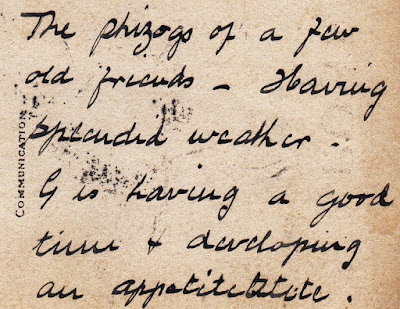
All of which leaves just one last puzzle, because the card was signed S.S.D., and refers to “G having a good time and developing an appatititite.” 

Now I am guessing that G is Gordon who in the spring of 1910 was 21 years old and worked in a machine shop but I have no idea of the identity of S.S.D.

But maybe that trip to the pub will help.

In the meantime I shall have fun reporting back to David Harrop who showed me the card which comes from his extensive collection of memorabilia from the Great War, some of which is on permanent display at the Remembrance Lodge in Southern Cemetery.

Picture: with the 6th Manchester's 1910 at West South Downs Camp, courtesy of David Harrop

*The Diggle Hotel, Station Houses, Diggle, Oldham, Lancashire OL3 5JZ, 01457 872741
Local family takes over historic Saddleworth pub thanks to funding from RBS,  Aimee Howarth, Saddleworth Independent,  HTTP://SADDIND.CO.UK/LOCAL-FAMILY-TAKES-OVER-HISTORIC-SADDLEWORTH-PUB-THANKS-TO-FUNDING-FROM-RBS/

Sunday, 13 October 2019

The Oldham War Memorial ………. a trip to Bell Vue and a mackintosh

Now there is nothing very remarkable about this picture postcard of the Oldham War Memorial.

Instead it is the message on the back, written just two years after the memorial was unveiled in 1923 that caught my attention.

Eva began by asking “Isn’t this a nice picture?  But quickly changed the tone and continued, “Have been thinking since sending the parcel we shall all be at ‘Belle Vue’ on Saturday afternoon so please send my mackintosh etc. to get here Monday or Tuesday, please!”

The card was posted on Thursday morning to Mrs. A Hooks, of 25 Roberts Road, Boscombe, Bournemouth.

Just whether the mackintosh arrived or just what the afternoon at ‘Bell Vue’ was like we shall never know.

Location; Oldham

Picture; Oldham War Memorial circa 1923-25, from the collection of David Harrop

Tuesday, 11 June 2019

That Carnegie Library in Failsworth ……

Now yesterday I revealed that dark secret that Andy Robertson collects police stations, and today I offer up another of his collecting passions.

These are Carnegie Libraries, which were the libraries paid for by the steel magnate Andrew Carnegie in the late 19th and early 20th centuries.

For those of us in south Manchester, we have the one in Chorlton, opened in 1914, Didsbury in 1915, and Withington in 1927.

They were three of the 660 he funded in Britain, 1,689 in the United States, 125 in Canada and more elsewhere between 1883 and 1929.

From humble beginnings he had built up a huge steel business before selling out for an estimated $500 million in 1901 and devoting himself to philanthropist projects. Even before he retired, he had been spending money on all sorts of projects of which the establishment of public libraries was just one.

But there are those who would argue the money was not his to give away, having been made by the men who toiled in the steel plants and who were denied the right to organize collectively in his workplaces. But that is another story.

There will be someone who can offer up the history of Failsworth’s library but so far, I have drawn a blank, leaving me to give them a ring later today.

But that won’t stop me from starting the story, and taking these from Andy’s collectors’ album, which he produced on a walk through the township last week.

I do know that it gained an extension relatively recently.

So, I await Andy to pass over his research notes.

And in the meantime I add this which was contribyed by Mark Gutteridge, "the library moved out of this building in to a then modern building around the corner in the 60’s/70’s and the library was used as council offices for many years and became a bit dilapidated. 

Then about ten or fifteen years ago the council saw sense and it was refurbished, extended and they moved the library back in".

Location; Failsworth

Picture; Failsworth Public Library, 2019, from the collection of Andy Robertson

Sunday, 9 September 2018

Is the Owl to become a flamingo? ......... Oldham in 2018

Now, I thought about that that song by the Oldham Tinkers which laments the passing of an older Oldham, after Andy Robertson sent over some of his latest pictures of the town.

The Star, King Street ...... now a food outlet, 2018
Is the Owl to become a flamingo?,  appeared on their LP, Oldham’s Burning Sands which was issued in 1971, and perfectly captures that sad reflection for what was happening to the town in the late 1960s.

And of course those changes were not just happening to Oldham, because whole swathes of terraced streets, with their mix of 19th century houses, pubs and factories were being swept away in shinny new redevelopment schemes, some of which have also now vanished.

The Buck & Union, Union Street, 2018
The pubs were often the last to go, and even now some still appear as isolated buildings surrounded by open land with new social housing just beyond the grass.

Back in the 1970s when were in Ashton we would sometimes take the bus up the Oldham Road to the town, and more recently I have “jumped” the tram from Chorlton.

And that is what Andy did yesterday, and on a wet miserable, grey day he recorded some of the pubs and some of the former pubs around the metro stop.

George Tavern, George Street, 2018
Leaving me just to mention the link which will take you to the story of the Owl and the flamingo**

Location; Oldham

Pictures; Oldham, 2018, from the collection of Andy Robertson

*Oldham’s Burning Sands LP  TOPIC TSDL206 STEREO, The Oldham Tinkers, Ballads, Songs & Daft Ditties, First published by Topic 1971

 **Is the Owl to become a flamingo?  The Oldham Tinkers, http://www.oldhamtinkers.com/the-owl-of-oldham.html

Friday, 25 August 2017

Some of the men who went to fight from Oldham .......... pictures of the Great War

Now I am at the limits of what I know about this picture.

It is a group of soldiers outside the Oldham Colloseum and comes from the collection of David Harrop.

I don’t have a date and am not sure what they were doing there.

If you look closely some of the men are wearing spurs, one is holding what looks like a harness and most are wearing those leather belts which I always associate with the cavalry.

The posters behind them advertise the Oldham Colloseum but the name of the big star of the week is obscured so it is difficult to get a date from the billing and likewise the announcement of BOXING gives up no other clues.

So there you have it, but I am confident there will be someone who has far more military knowledge than me and will be able to tell us more.

And I would like that if only to provide us with a little more on these men.

Some smile back at the camera, one strikes a defiant pose and a few and they are the older men in the picture look back with sombre expressions which I guess pretty much sums up the range of feelings of men swept up by that conflict.


Picture; from the collection of David Harrop

Tuesday, 15 August 2017

When the story is the address ........ postcards from Oldham during the Great War

Now for some this postcard offers up little in the way of a story.

Silk cards like this one were common both during and after the Great War, and many have survived the century or so since.

Along with ones destined for home and family which, were for “a loving wife” or “dearest daughter” there were those carrying the regimental badge or name of a unit of the British army.

Most of the ones in the collection are for the Manchester Regiment, but there is one for the Post Office Rifles, a few from Canada and this one for the Cheshire Regiment.

All belong to David Harrop who has kindly shared them with me and some appeared in the book on Manchester and the Great War.*

In the case of this one there is a story and it revolves around the address on the reverse.

It was sent by Private James Moseley of the Cheshire Regiment who addressed it from D Company 12 Tent, Chadderton camp, Royton, near Oldham.

Chaderton Army Camp was on land requisitioned by the military at the outbreak of the war and had been part of the estate belonging to Chadderton Hall.

In time I will go looking for Private Moseley but for now it is that address directing the postman to Tent 12 that intrigues me and offers up the start of a story about military training under canvas during the Great War

Location; Oldham during the Great War

Picture; silk postcard, undated, courtesy of David Harrop

*A new book on Manchester and the Great War, https://chorltonhistory.blogspot.co.uk/search/label/A%20new%20book%20on%20Manchester%20and%20the%20Great%20War

Friday, 11 August 2017

“Dear Husband, we are just off to Aunties” .............. a postcard from Oldham in 1915

In age of emails, facebook and the mobile the sending of a message on a picture postcard seems so anachronistic and yet I rather like the idea.

Of course it helped that the frequent collections and deliveries during a day meant that a card sent first thing in the morning might well be on the table by midday.

So this one sent on a Sunday evening in March would in all probability have arrived the following morning and been read by Private Joseph Platt of B Company, the 24th Manchester Regiment later that day.

It is a mix of the usual personal messages.  His wife tells him that she will be sending him “a few things in the morning” and was pleased with  the photos he had sent which “are good ones,  [adding] we are all well and glad you are, it is lovely this morning, with love from all.”

Now I can’t be sure but I think she will be Clara Platt who had been married to Joseph for fourteen years.

In the April of 1911 they had been had been living in the Liberal Chub in Hollinwood, in Oldham where Mr Platt had been employed as the steward and they had a daughter born in 1900 and a son born in 1910.

And I think I have found some at least of his military records.  There is a reference to a Private Joseph Platt of the Manchester Regiment having been awarded the British War Medal and Victory Medal and who was killed on the Western Front in the August of 1918.

In time I would like to dig deeper and see what more I may be able to find out about both Private Platt and his family.

Location; Oldham

Picture; picture postcard, 1915, from the collection of David Harrop

Thursday, 6 October 2016

Growing up in Oldham........... stories from Ron Stubley

My earliest memories were at 99 Abbeyhills Rd, Oldham, the cream fronted house in the picture. 

From the gate at the bottom of the steps, I watched a steamroller laying tarmac over the road's cobbled surface and remember a coal cart sliding down the steep incline at the side one icy winter.

Whilst at 99, I remember my mam spraining her ankle quite badly, necessitating a visit to the doctor and the subsequent bill.      

From there we moved across the road to Prior Cottage, now demolished by a gas explosion many years ago.

No.2 Prior St. had a bath (dad had a dirty job) which was the main reason for our move.

We lived at 2 Prior St. by the side of the Co-op until about 1953 when my dad took a pub in Ashton. We were there in 1944 when a 'doodlebug' claimed 37 lives close by..... but that's another story.

© Ron Stubley 2016

Location; Oldham


Pictures; from the collection of Ron Stubley

Friday, 24 October 2014

Singing Asleep in the Deep with the Oldham P.S.A. on Saturday March 2nd 1907 in Bismark Street

I just wonder how the Tea Party and Concert staged by the Oldham P.S.A. Society went down on Saturday March 2nd 1907 in the Wesleyan School on Bismark Street.

Now I had come across the Pleasant Sunday Afternoon Brotherhood back in the 1970s in Ashton Under Lyne.*

They were what they said they were an organization designed to provide a pleasant afternoon with a Christian slant on a Sunday.

The first seem to have sprung up in the mid 1870s and their first national conference was in London in 1906.

There was a political dimension  “The long standing relationship between political Liberalism and Nonconformity brought active Liberals into the movement. In the early twentieth century key Labour and Trade Union leaders became actively involved in the PSA/Brotherhood Movement. 

Labour MPs Arthur Henderson and Will Crooks, and the Liberal MP Theodore C. Taylor were all present at the founding of the National Association of Brotherhoods, PSAs etc in London in 1906. 

Keir Hardie, was also actively involved, he was a main speaker for a Brotherhood Crusade in Lille in 1910. Arthur Henderson MP was elected National President in 1914. 

The National Adult School Union’s ‘One and All’ journal reported 7 out 9 ‘adult school men’ who stood for parliament were successful in 1910.”***

And so back to that tea party and concert.

Judging by Asleep in the Deep I doubt that I would have been entertained by the afternoon.

The song was written by Arthur J Lamb and composed by Henry W.Petrie and had the rousing chorus

“Loudly the bell in the old tower rings,
Bidding us list to the warning it brings. Sailor, take care! Sailor, take care!
Danger is near thee. Beware! Beware! Beware! Beware!
Many brave hearts are asleep in the deep, So beware! beware!
Many brave hearts are asleep in the deep, So beware! beware!"***

But perhaps I am being a tad harsh.  I dare say I would have been intrigued by the “Humorous Section.”

It was after all a serious attempt to challenge the power of the pub.

And the Oldham P.S.A. at least had an eye to how to get an audience, for the reverse of the card had a very striking image of Miss Nina Severning.

Now she was I think an actress but all I have turned up is another picture postcard sent in 1904, but there will be someone who can offer me some more information.

In the meantime I shall return to that magical afternoon in 1907, and the promise that  I shall go looking for the Oldham P.S.A. and its secretary Mr J Mcintosh.

At least Bismark Street in Oldham is still there.

It is a narrow street off Park Road, close to Alexandra Park and back in 1890 was dominated by the Trinity Chapel.


Picture; Oldham P.S.A. invitation to its Tea Party and Concert, 1907 courtesy of David Harrop

*The Pleasant Sunday Afternoon Brotherhood, http://chorltonhistory.blogspot.co.uk/search/label/The%20Pleasant%20Sunday%20Afternoon%20Brotherhood

** The Early Adult School and Brotherhood Movements in the West Midlands: Adult Education, Evangelism or Social Activism?, European Social Science History Conference, Glasgow, April 14 2012

***Asleep in the Deep, https://www.youtube.com/watch?v=bE7LQv9Gj2w


Saturday, 4 January 2014

On Union Street in Oldham in 1928

Now I wish I knew Union Street in Oldham better because I cannot fix exactly where we are.

The card was sent in 1928 but the image may be a little earlier and none of the usual clues are much help to work out where we are.

It is impossible to decipher the names of the shops, there are no side roads to offer up a location and even the tram running on the number 4 route could be coming from or heading towards Mumps.

The building on the right looks promising and looks to be a snooker hall which may jog someone’s memory

So that just leaves us with the scene itself which has a lot to offer.

It has those wide windows to admit the maximum light and the characteristic coloured glazed tiles which would have brightened up that drab workaday street.

To our right is a milk cart with its single churn and another almost opposite.

Neither horse seems over worried at the approaching tram or the parked cars.

Within a few decades there would very few horses left on Oldham streets and likewise the last tram took its final journey in 1946.

There had been a horse drawn tram service from 1880 but within twenty years this had been replaced by the familiar ones powered by electricity.

But by the 1920s the cost of maintaining the track and replacing old trams led to the use of motor buses on some routes, a policy which began in earnest in 1934.

So our stately tram on its circular route along Union Street in the January of 1928 had but a short time left to run.

And that seems a sensible point to finish, secure in the knowledge that someone will not only know where we are on Union Street but will furnish chapter and verse on the scene in front of us.

But for those who want more on Oldham’s trams there is Oldham Corporation Tramways


Picture; Union Street in Oldham, circa 1928, issued by Lilywhite Ltd, from the series Oldham and district, courtesy of Tuck DB, http://tuckdb.org/


*Oldham Corporation Tramway http://www.birches.plus.com/page148/page151/page231/page231.html

Wednesday, 20 February 2013

Up in Hollinwood in the August of 1938, all shawls, trams and cotton mills


We are in Hollinwood in the summer of 1938.  

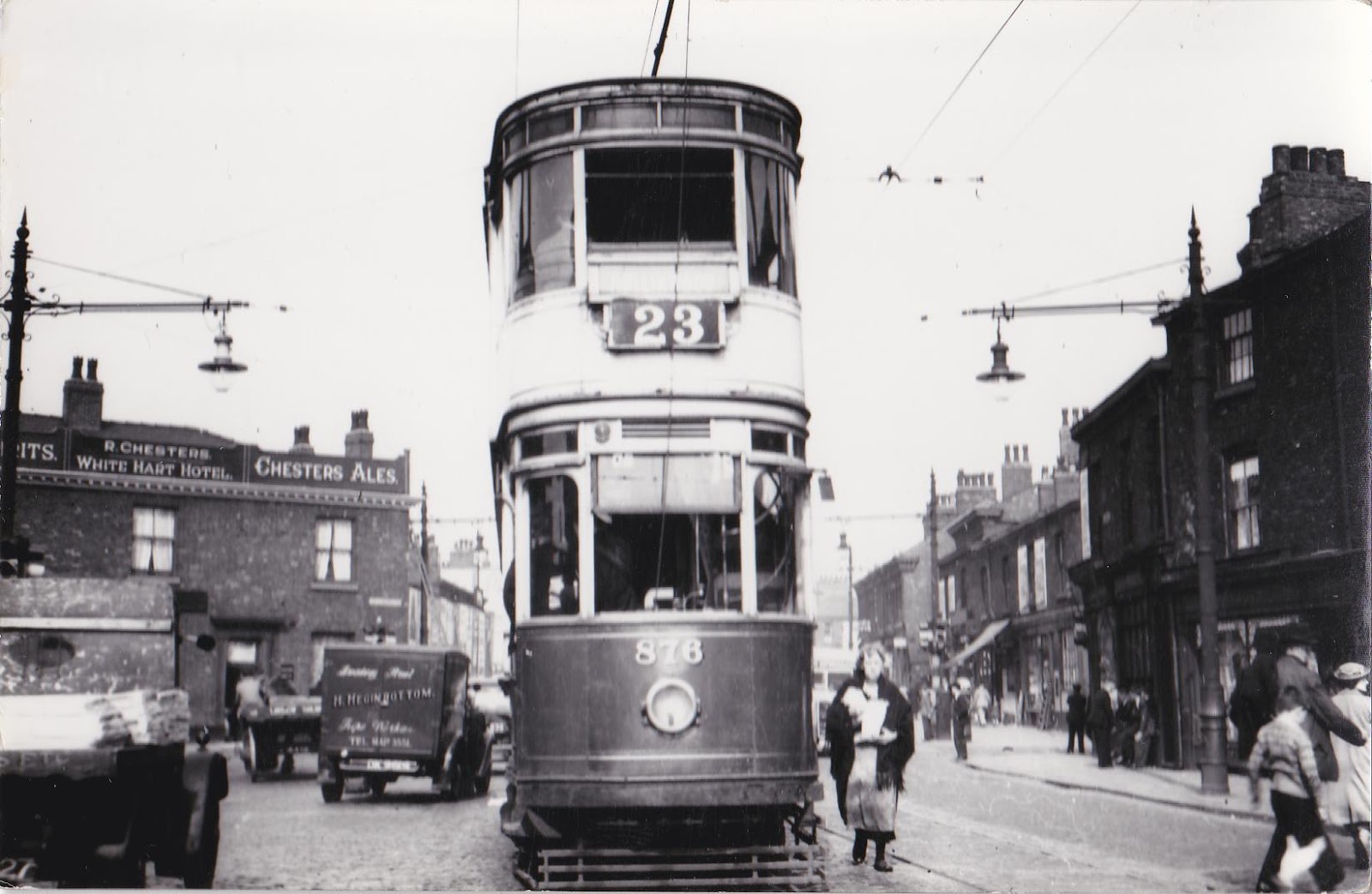
And if I have got this right car 878 is travelling south from Oldham and maybe about to go in to the tram terminus which is off to our left.

Now I have to confess I don’t know Hollingwood but using the picture and the OS map for 1935* I am pretty sure that is where we are.

Now that may well open me up to be shot down within minutes of people seeing the story, but so be it.

“The area was initially largely occupied by workers in Oldham's cotton mills and miners at the large collieries at Oak and Bower, and several smaller ones. Much of Hollinwood's more recent growth was due to the Ferranti factory which produced power transformers in its heyday. Later the factory produced container lifting trucks as the building had the height to do so. The transformer works building, built after the war on the old Bower site, is now used as a newspaper printing plant. A neighbouring, much older, Ferranti factory produced electricity meters. The meter factory was sold to Siemens in the 1980s and became known as FML; Siemens later closed the FML factory.”**

All of which is captured in the detail on the picture.

August 2nd when the photograph was taken was a Tuesday and where we are standing was always a busy spot.

Beyond Oldham Corporation’s Tramway Depot was the large engineering works, while behind the White Hart Hotel was the gas works, the Rose Mill specialising in cotton waste, the Windsor Mill making India Rubber waterproofing and the three cotton mills of Lime Mill, Albert Mills and Hollinwood Mill.

Completing this industrial scene running in from Ashton was the Manchester and Ashton-under-Lyne Canal which terminated at the Bradley Bent Basin a little to the north east of the hotel.

Shawl, apron and that tram
For me as ever it is the detail that brings back that August day 75 years ago when things were different from today.

So despite the growing use of vans and lorries, there were still a reliance on horse drawn vehicles and the old stately rattling tram cars.

These trams would last well into the next decade but by the end of the 1940s they were no more.

In much the same way so would the shawl that all too typical piece of woman's clothing.

And so I am drawn to the women in the shawl and apron.

She would not have looked out of place at any time in the century before the picture was taken but I very much doubt that shawls survived much beyond the end of the last world war on the streets of Hollinwood.

And that pretty much brings us up to date.

The White Hart Hotel is still there, although it has lost its chimneys and the long roof sign advertising its name and the brewery and acquired a white plastered exterior.

But even more than that it stands amongst relatively new social housing which are fronted by wide open green banks and plenty of trees.  What is missing is all that industrial landscape.

Looking at pictures of the place today especially in the sunshine it is hard to make the connection with our grimy busy scene in the August of 1938.

Pictures; from the collection of Alan Brown


*http://enriqueta.man.ac.uk/luna/servlet/detail/maps2~1~1~342544~123252:Manchester-bomb-damage?sort=Reference_Number%2CPage%2CCurrent_Repository

**Wikipedia, http://en.wikipedia.org/wiki/Hollinwood,_Greater_Manchester