Showing posts with label Jackson's Boat. Show all posts

Tuesday, 22 September 2026

Chorlton Brook and the Cliffs at Holland Wood in 1847 ... part two


Holland Wood, by the Cliffs along Chorlton Brook, circa 1907
We are in Holland Wood, sometime at the beginning of the 20th century and according to the caption on the photograph, “on Chorlton Brook between Claude Road and Brook Road, looking from what is now Claude Road Bridge.”

This stretch of the brook was known as the Cliffs and had been well wooded, although by the time of our picture this seems to be less so.

Over the left is Brook Road and in the distance is Brook Farm.


Brookburn Road with Brookburn Farm in the distance, circa 1907
Back in 1847 the radical journalist Alexander Somerville* stopped at Brook Farm and reported his conversation with Lydia Brown the tenant farmer who complained about the ash trees which grew around the fields  “which are not only objectionable as all other kinds are in and around cultivated fields but positively poisonous to other vegetation, and ran through the ground causing much waste of land, waste of fertility, and doing no good whatever.  Squire Lloyd is the landlord.  

Mrs Brown a widow, is the tenant.  She keeps the farm in excellent order so far as the landlord’s restrictions will allow.  But neither herself nor her workmen must ‘crop or lop top’ a single branch from the deleterious ash trees."

He may even have wandered a little further along our stretch of the brook before up to the bridge over the Mersey and a conversation with Samuel Nixon also a farmer as well as the landlord of the Greyhound who was fairly disparaging about news papers and the news that came out of them.

The Brook, looking west
All of which has taken us away from Chorlton Brook which is the most southerly of our water courses It flows from the east into the township by Hough End.

By the time it arrives at this point it is already the product of many smaller streams of which the Gore and Red Lion Brooks are the last joining by Hough End.

For those prepared to leave the township the best glimpse of any of these streams is at Hough End Playing Fields where the Red Lion Brook comes out into the light and crosses the open before flowing underneath Hough End Crescent where it becomes Chorlton Brook.

Like so many of our journeys around the township back in 1847 we would have been surrounded by open fields.

But at the point where the Red Lion and Gore Brooks joined to become Chorlton Brook the landscape changed and the water course ran through an area bordered by trees known as Hough End Clough.

Sadly for the modern traveller the brook is lost again as it runs under Mauldeth Road West before reappearing and flowing past the high school and under Nell Lane.

The Brook with Hough End Hall, circa 1900
And just a little to the west of this point is one of those mystery watercourses, which might be another little stream flowing in an old brick tunnel or it may just have dried up.

But back in the 1840s it was clearly visible, coming in from the south across land farmed by Henry Jackson with field names like Old Marled Field and Great Thick Wood.

It fed into Chorlton Brook just below where the Brook now crosses Mauldeth Road West, through a wooded and wet area with the delightful name of Pitts and Bogs.  In its journey from the south it fed a number of ponds and as it flowed into the Brook it broadened out contributing to the swampy character of Pitts and Boggs.

Tracking it today is difficult and the Environment Agency has no record, but it may have followed a route which took it from the junction of Burton Road and Lapwing Lane, north towards the Brook, passing just east of Weller Avenue.  If so it may well be that the old disused railway line marks its course.

And yet another crossed Chorlton Park from two ponds just a little south and west of Brookfield House which is now owned by the Corporation and is divided between the warden’s office and an upstairs tenant.

The Brook as it flows through Chorlton Park, 2010
From now with just a small break we can walk alongside the Brook as it wanders through Chorlton Park and under Barlow Moor Road.  Back in 1847 the Nell Lane Bridge was a lower structure but still gave good views.
Looking east there was Hough End Hall standing in its own grounds which by then was the home of Henry Jackson and later Samuel Lomas who farmed 220 acres.  Directly south was Brookfield House, commanding fine views across what is now the park.

From here on the brook remains open to the air till it meets the Mersey.  Unfortunately as its route flows through private property there is no access to it till it crosses Brookburn Road.

There is a footpath which ran from Barlow Moor Road skirting Oak House Farm by the modern Oak House Drive and running down behind the gardens on the north side of South Drive and Claude and Brookburn Roads but this fell out of use and is now blocked off and it is very doubtful that it will be reinstated.

This is a great pity because it would allow our modern traveller to walk beside Brook along a steep wooded corridor known as the Cliffs which ran roughly along the route of the footpath.  Here the Brook skirts the edge of the village.  On the south side were Brook Cottage and Brook Farm.

Here to was the village pond which today was where the cark park of the Bowling Green Hotel stands. It stretched back from the lane to include all of the modern bowling green to the edge of Finney Drive and from the Brook to the hotel it contained fish and was rented out to gentlemen.

Once across Brookburn Road the course of the Brook twists and turns before flowing into the Mersey.

The land on either side would have mainly been meadows and running off from the water course would have been the ditches which allowed the farmers regularly water the land.  This as we know was a skilled task.

The Cliffs in 1841
Today while the area retains the popular name of the meadows the land does not resemble the former meadowland.

The scars from the tipping of rubbish are still visible and much of the land had been landscaped with trees artificial ponds and raised banks.

So today where young trees and bushes crowd in on the passer by back in 1847 it would have been more open with trees forming natural boundaries between fields. And not far from the bridge across the brook the land north was covered by an orchard which ran up to and over the old Road to the big pond on Turn Moss.

It was an one of the orchards that fascinated Alexander Somerville, but that is a story for another time.

Extract from THE STORY OF CHORLTON-CUM-HARDY, http://chorltonhistory.blogspot.co.uk/search/label/A%20new%20book%20for%20Chorlton

Pictures; of Chorlton Brook passing through the Cliffs and by Hough End hall from the Lloyd Collection, as it passed through Chorlton Park from the collection of Andrew Simpson, detail of the Brook and the Cliffs from the OS map of Lancahire, 1841-53, courtesy of Digital Archives http://www.digitalarchives.co.uk/

* http://chorltonhistory.blogspot.co.uk/search/label/Alexander%20Somerville

Monday, 6 July 2026

A history of Chorlton in just 20 objects number one ...... a bridge across the Mersey 1816

Now this will be a short series featuring objects which tell a story of Chorlton in just a paragraph and is also a challenge for people to suggest some that are personal to their stories.

They are in no particular order, and have been selected purely at random.

This was the first bridge across the Mersey on the edge of the township.  Samuel Wilton built it in 1816 at a cost of £200, but the ferry and the right to transport passengers across the Mersey were still in place in 1832 when the pub and the surrounding land were put up for sale.

At the time it was the landlord of the pub who benefited from the ferry charges.  The toll of a 1d to cross the bridge was abolished in the 1940s.

Picture; from the Lloyd collection 1865

Wednesday, 11 February 2026

Crossing the Mersey in 1955 to Jackson's Boat


Like many of Derrick A. Lea’s pictures of Chorlton this one was made in the winter.

We are at Jackson’s Boat, that pub across the river and the year is 1955.

Now I have written about Mr Lea already and I keep getting drawn back to his images of Chorlton which were made in the 1950s.

They work for me on a number of different levels.

At its simplest they remind me of the style of pictures I grew up with.

But it is also that you don’t see many drawings, paintings or wood cuts of the township, so these are particularly appealing.

“The pub was built in the 18th century and so might count as the oldest in the township.  It was known variously as the Old Greyhound and the Boat House, before reverting back to the old Greyhound.  Briefly it was called Jackson’s Boat and then the Greyhound from 1834. 

The names may in part be explained by the origins of the site.    At some point a farmer called Jackson farmed the land and kept a boat for ferrying passengers across the river. 

Later still Samuel Wilton built a bridge in 1816 over the river at this point at a cost of £200.  

But the ferry and the right to transport passengers across the Mersey were still in place in 1832 when the pub and the surrounding land were put up for sale. 

The advert throws some light on how the relationship between owner and tenant. The land and pub were owned by John Marsland and tenanted by a George Brownhill who seems to have benefited from the ferry charges.  

The sale in 1832 went to Edmund Howarth who may well have placed Samuel in as tenant.”*

All of which may seem a long way from the picture, but not so.  In 1955 the bridge was free to walk across, but until the late 1940s there had been a toll, which had been there since Sam Wilton’s old bridge in 1816 and was just a continuation of the fee charged to cross the river by the ferry.

The gate was on the south side of the bridge and there are those who can just remember paying the penny to cross over, and one wonderful story of a young girl who chose to chance her luck and crossed by a more dangerous and unconventional way.

She lived in the Block which was a collection of cottages on Hardy Lane, and this seemed a quicker and cheaper alternative to a long walk or the penny payment.

Picture; Derrick A. Lea


Location; Chorlton

*The Story of Chorlton-cum-Hardy, Andrew Simpson 2012, https://chorltonhistory.blogspot.com/search/label/A%20new%20book%20for%20Chorlton

Tuesday, 10 June 2025

That “bright little suburb” ………… Chorlton-cum-Hardy and its pub across the water

Now I can see that attraction of these two picture postcards which were marketed by the Rapid Art Photography Company sometime in the 1930s.

In the previous fifty years, great swathes of Chorlton had been built over, and what had once been fields, farms and market gardens had become rows of terraced and semidetached houses for the middling people who worked in the city and wanted the vestiges of a rural setting when they came home.

And that stretch of land from the old Chorlton village to the Mersey offered just that degree of open countryside, with the added benefit of a pub on the banks of the river.

None of this was lost on the Manchester Guardian which reported on May 10th, 1914, that “Jackson’s Boat is the picturesque connecting link between Chorlton and Sale.  There is no boat there now, whatever there may have been at one time, but there is a half penny toll bridge for foot passengers and a pleasant inn.  You need not pay the half penny if you prefer to take a glass at the inn”.

Concluding that “Chorlton itself is a particularly bright little suburb.  

It somehow has the clean, cheery, holiday aspect of a seaside resort.  

Chorlton has been described as the favourite suburb of newly married couples, and perhaps what one notices is a honeymoon atmosphere”.*

And where better for a romantic stroll than across the Meadows to the pub across the water.

The footbridge dates from the 1880s and replaced an earlier one constructed by Samuel Wilton in 1818, although landlords of the pub continued to retain the right to ferry people across the river by boat and charge a fee well into the 1830s.**

In its time the pub was known variously as the Old Greyhound, the Greyhound and the Boathouse, and dates from the 1780s.

And for the eager tourist wanting to travel out from the city centre, “the tram fare to Chorlton is 1d to Seymour Grove, or 1½d. right through to the village, [while] a third class  railway contract costs 18s a quarter, which works out at about 1s 5d. a week”.

To which I can only add that on the side of the trams and over printed on the railway tickets should have been the simple entreaty “Go South you young couples”.

Location; Chorlton

Pictures; Jackson’s Boat, circa 1930s, courtesy of Jennie Brooks

*Where to Live and when to Buy, The Manchester Guardian, May 10th, 1914

**Jackson’s Boat, https://chorltonhistory.blogspot.com/search/label/Jackson%27s%20Boat

Friday, 2 May 2025

Mrs Cordingley at Jackson’s Boat up in front of the magistrates for “selling beer during prohibited hours” in June 1876

The old bridge and pub, 1881
Now I wonder how Mrs Cordingley felt after the magistrates threw out an alleged breach of the Licensing Act.

It was June 1876 and she had been called up in front of the bench for “selling beer during prohibited hours.”

For any publican this was a serious affair but I suspect a potentially devastating one for  Mrs Cordingley who had been running the pub across the river  with her husband Joseph since at least 1861 and maybe as early as 1857 and with his death would still be pulling pints until she died in 1902.

She had fallen victim to the Sunday Trade out from Manchester.

It was a popular enough event and involved a trip out from the city which on a pleasant summers day was just 3½ miles  out along country lanes with the reward of a pint or two  at the end.

The Manchester Courier, 1872
Some were families escaping for a few hours from those dismal narrow streets and closed courts hedged in by mills timber yards and iron works.

A few like Richard Buxton were out botanizing.**  These were self taught working class men who in the case of Richard Buxton were cataloguing the plant life and would in time produce the definitive book still referred to by many today.

But then there were those less interested in the pleasures of rural Chorlton and more simply for the opportunity to down as pints as possible.

They arrived in ones and twos and sometimes in gangs and could threaten our community with anti social behaviour, vandalism and petty crime.**

So I can understand Mrs Cordingley’s concerns, only a decade and a bit before she settled in the pub large gangs of men were known to assemble in the meadows up by Barlow Farm to watch illegal prize fighting.

The pub, 1881
The attractions were of course the remoteness of the site and this in itself put the Bridge Inn out on a limb which was made worse when Sam Wilton who ran the pub in 1818 built a bridge across the Mersey.

Mrs Cordingley had replaced it in the 1880s and like her predecessor charged a small fee to cross over.

Now the pub dates from the 18th century and for most its history went under the name of the Greyhound or the Bridge Inn.  In the 1840s it was run by Samuel Nixon who described himself as a farmer and whose son ran the Traveller’s Rest on Beech Road.

Old Sam Nixon died in 1857 and this may be when the Cordingley’s took over.

And the story has a happy ending for she was found not guilty and the two chaps who tried to falsely gain a drink were themselves fined 5shillings each.

Strictly speaking neither of them were part of the Sunday Trade, for one was from Chorlton and the other was from Stretford.

Of these James Harris of Chorlton is known to us.  He lived on Beech Road was a painter with a family and more on him later.

Pictures, newspaper account from The Manchester Courier, June 21 1876, courtesy of Brian Robertson, and picture of the pub and bridge  circa 1881 from the Lloyd Collection


*"over the Mersey at Jackson’s Boat and on to Baguley Moor and Hale Moss and after having botanized there ....returned to Manchester at dusk, all pleased with our day’s excursion” Richard Buxton in Chorlton, http://chorltonhistory.blogspot.co.uk/2014/10/over-mersey-at-jacksons-boat-and-on-to.html


**A drunken jolly out from Manchester and stone throwing at Stretford........ petty crime in a rural community
http://chorltonhistory.blogspot.co.uk/search/label/Chorlton%20and%20crime

Sunday, 10 July 2022

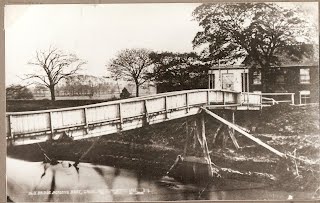
The not so safe bridge over the Mersey circa 1865


The old bridge 1865
This is one of the oldest pictures in the collection and dates from 1865.

We are on the bank of the river Mersey and just beyond the bridge is the pub.

“The pub was built in the 18th century and so might count as the oldest in the township.  It was known variously as the Old Greyhound and the Boat House, before reverting back to the old Greyhound.  Briefly it was called Jackson’s Boat and then the Greyhound from 1834.

The names may in part be explained by the origins of the site.    At some point a farmer called Jackson farmed the land and kept a boat for ferrying passengers across the river.


The pub sometime after 1881
Later still Samuel Wilton built a bridge in 1816 over the river at this point at a cost of £200.  

But the ferry and the right to transport passengers across the Mersey were still in place in 1832 when the pub and the surrounding land were put up for sale.

The advert throws some light on how the relationship between owner and tenant. The land and pub were owned by John Marsland and tenanted by a George Brownhill who seems to have benefited from the ferry charges.  The sale in 1832 went to Edmund Howarth who may well have placed Samuel in as tenant.”*

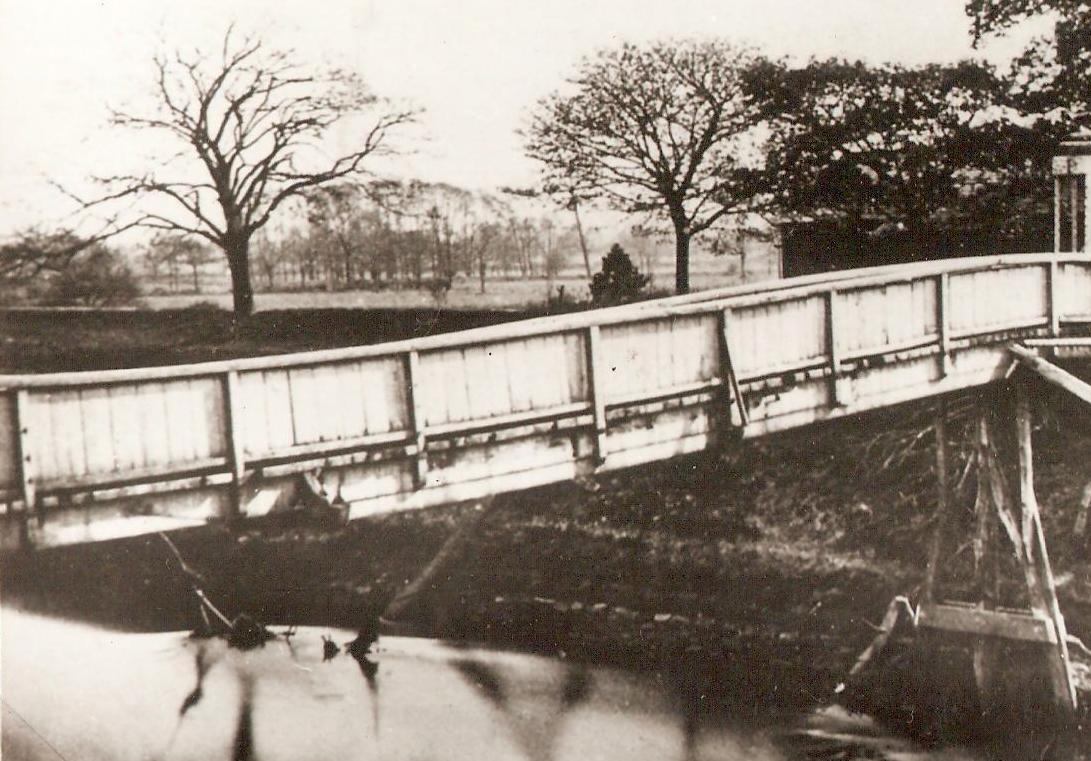
The old bridge and the missing central support 1865
And so back to the bridge which by 1865 was in a pretty poor state.

The central section had been swept away and judging by the way it slops down in the middle could not have made travellers feel particularly safe.

It did however survive until 1881, although the loss of the support on the Chorlton side a year earlier made a new bridge a necessity.

This was opened on October 14th 1881 which was all to the good given that the old one was washed away a few hours earlier.

But the new one like the old one had a secure door at the southern end which the landlord would open only after having been paid the toll.

Pictures; from the Lloyd collection

*THE STORY OF CHORLTON-CUM-HARDY 

Saturday, 14 May 2022

So farewell then to that bridge across the Mersey

No more [maybe] will countless thirsty walkers walk your way.*

Crossing the water, 1960
I have known you for over 40 years

And across your wooden planks 

I have happily sped to that pub over the River.

You date from the 1880s, and replaced

Sam’s Wilton’s wooden bridge of 1816

And both of you made it easier to cross

Making redundant that rowing boat

That countless landlords used to ferry 

Those wanting to cross the Mersey

Who still had to pay a bridge toll to walk over the water till the 1940s

Mr Wilton's bridge, date unknown
But now I read you are deemed unsafe

And “ the Engineers recommendations include 

A permanent repair or bridge replacement

With a review and a decision in due course

A temporary bridge installation would cost in the region of circa £220,000. ”**

I wait to know your fate.

Location; Chorlton

Pictures; the bridge over the water, 1960, Courtesy of Manchester Archives+ Town Hall Photographers' Collection, https://www.flickr.com/photos/manchesterarchiveplus/albums/72157684413651581?fbclid=IwAR0t6qAJ0-XOmfUDDqk9DJlgkcNbMlxN38CZUlHeYY4Uc45EsSMmy9C1YCk and Sam Wilton’s bridge date unknown, from the Lloyd Collection

*In homage to E.J.Thribb, the poet-in-residence at Private Eye. The character was created in 1972 by Barry Fantoni, who wrote the poems until 2010, when he was succeeded by other staff members

**News from Chorlton Park Ward Labour Party, If you would like to get in touch with us directly please feel free to email,cllr.joanna.midgley@manchester.gov.uk, cllr.dave.rawson@manchester.gov.uk cllr.mandie.shiltongodwin@manchester.gov.uk


Sunday, 27 March 2022

Crossing the Mersey at Jackson’s Boat

Now I am pleased the bridge over the river has survived, despite plans to demolish it.

It dates from the 1880s, replaces an earlier wooden one built in 1816, and saved travelers having to call out the landlord of the pub who would ferry them across the water for a small fee.

Not that the erection of the bridges deprived him of the lucrative service of acting as the ferry man, because both bridges could only be traversed by paying a toll which was only abolished in the late 1940s.

I remember being told by a friend that his grandmother had evaded the toll by climbing on the bridge and working her way along by holding on to the girders.


This picture of the bridge is new to me.  It was taken in 1960 and I smile every time I read the notice.

Location; The River Mersey,

Picture; the bridge over the water, 1960, "Courtesy of Manchester Archives+ Town Hall Photographers' Collection", https://www.flickr.com/photos/manchesterarchiveplus/albums/72157684413651581?fbclid=IwAR0t6qAJ0-XOmfUDDqk9DJlgkcNbMlxN38CZUlHeYY4Uc45EsSMmy9C1YCk 


Wednesday, 27 January 2021

“went down to Jackson’s Boat” ............ Bill's adventure from Altrincham in the March of 1907

Bill's postcard to May, 1907
It is as David Harrop said to me a jolly scene and one that delights me as much as it must have done Bill who sent it to May Campbell in the March of 1907.

The railway line from Altrincham into Manchester was opened in 1849 and its main purpose was to ship agricultural products from Altrincham and stops down the line directly to the Manchester markets.

In this it was a great success, so much so that in the decade after it was opened the amount of produce sent on the Duke’s Canal dropped dramatically.

And on that March day which just happened to be a Sunday Bill and company set off from Altrincham, got off the train at Stretford and “went down to Jackson’s Boat.”

The weather forecast for the day was good, with the Manchester Guardian reporting  there would be “fair, mild weather and light breezes with some mist or fog locally” which was better than Monday when it would be “changeable with some showers.”*

Walking from Cut Hole towards the weir and on to jackson's Boar
Now we will never know their exact route from Stretford to Jackson’s Boat or if they were lucky with the weather.

If I had been them I guess I would have crossed the road from the station and walked along the Duke’s Canal as far as the Cut Hole Aqueduct and then by degree past the old weir picking up the northern bank of the river and continuing till I reached the new bridge that crossed the Mersey at Jackson’s Boat.

Of course that is just speculation and I bet there will be plenty of people with alternative routes.

But while I am on this wave of speculation I would just like to think that when Bill got back to Altrincham he bought the card, wrote the message and posted it the following day.

I had hoped I could find May Campbell but she and her address in Hulme have proved impossible to find either back in 1907 and I think now will have vanished.

All of which just leaves me with the Flyer and that cricket game.

Picture; Our Local Express, 1907, from the collection of David Harrop** and detail of the walk from the OS map of South Lancashire, 1893, courtesy of Digital Archives Association, http://www.digitalarchives.co.uk/

*Manchester Guardian, March 3 & 4, 1907


Saturday, 30 March 2013

The pub beyond the river, a ferry and a bridge


Hardy Lane circa 1912
On a warm summer’s evening a walk across the meadows to the Mersey and the pub beyond the river is one of those pleasant things to do.

Although walking back in the dark can be an adventure and one which more than once has left at least one of us down the ditch at the side of the lane.

And I guess it was ever such because the pub has been serving beer from the beginning of the 19th century and most probably before that.

The small community which lived in Hardy and those from the village who fancied a walk out with a drink at the end of it will no doubt have known it well.

But any one drinking there before 1816 would have had to rely on the ferry across the river until Samuel Wilton built his bridge.  Now Sam Wilton was canny and maintained the toll once charged by the ferry man and to ensure he got his money he added a stout door on the southern end hard by the pub.

The old bridge in 1865,  built in 1816
Nor was this charge dropped when the new bridge was erected in 1881 so while the door became an iron gate the toll remained and did so until well in to the late 1940s.

But I suspect the sale of beer was always secondary, and the prime money spinner for the tenant landlord was the land along with the crossing charge.

So Samuel Nixon who was there in the 1840s and 50 described himself as a farmer and according to the tithe schedule of 1845 tended nine acres of orchard and meadow land.

Now nine acres put him amongst the 60% of market gardeners in the township who farmed between one and nine acres of land growing the crops the city wanted to eat.


The old bridge and toll door, 1865
Of course like a handful of others he had diversified into other occupations as well as farming.  In his case this was  the crossing toll and the sale of beer.


I don’t know when Samuel Nixon took over the pub but it may have been when the place was sold in 1832.

He may even have seen the advert which led to Edmund Howarth buying the land, the buildings and of course the right to charge that toll.

It is a fascinating piece of history and well worth reproducing.

“By Mr. Nathaniel Pass, by order of the trustees named by the will of James Marsland, deceased at the house of Mr. George Brownhill, known by the name of Jackson’s Boat in Chorlton-with-Hardy, in the county of Lancaster, on Monday the 5th day of March, 1832, at five o’clock in the evening subject to conditions to be then produced.

The land around Jackson's Bridge 1841-53

The Inheritance in Fee-Simple or and in all that long established  and well accustomed Public-House, known by the name of Jackson’s Boat, aforesaid, with the outbuildings, garden, orchard, and several closes of Land thereto belongings, called the Bank, the Nearer Ford Mouth, Further Ford Mouth, and the Further Field, situto in Chorlton-with-Hardy aforesaid, but lying on the southerly or Cheshire side of the River Mersey, and containing together with the site of the said buildings, by recent admeasurement, 5a.2q. 16p of land, of the Lancashire measurement, or thereabouts.  

Together with the Ferry thereto belonging, and the right and priviledge of carrying passengers over the river Mersey, in the occupation of the said George Brownhill, as tenant.

And also all that Field or Parcel of LAND, called the Boat Field, situate in Sale in the county of Cheshire, containing 3a 0q. 14p. Of land, of the measure aforesaid, or thereabouts, in the occupation of John Marsland, and adjoining the land before mentioned.

The house and land in Chorlton-with-Hardy will be sold subject to an annuity of £26. 13s. 8d., payable during the life of a widow lady, aged 46 in April next.  The buildings are in excellent repair, and the land is of the first rate quality.
The pub circa 1881

The tenant of the public house will shew the premisises; and for further particulars apply to Mr. Marsland, or Mr. Samuel Alderley, of Sale; or to Meesrs. PASS and Shelmerdine, Althrincham.”**

Manchester Guardian February 18, 1832

At the time the pub was called Jackson’s Boat but it had during the early 19th century other names, including the Old Greyhound and the Boat House, before reverting back to the old Greyhound.  Sometime around 1832 it became Jackson’s Boat and then the Greyhound from 1834.

Just another of those wonderful ways history has of surprising you.

*The not so safe bridge over the Mersey circa 1865, http://chorltonhistory.blogspot.co.uk/2013/03/the-not-so-safe-bridge-over-mersey.html


**Manchester Guardian February 18, 1832

Pictures; from the Lloyd Collection and map of the land around Jackson's Bridge, courtesy of Digital Archives, http://www.digitalarchives.co.uk/