Showing posts with label Alternative History. Show all posts

Saturday, 4 July 2026

History on display today ... the Chorlton event not to miss ..... at 11 am at the Co-op on Barlow Moor Road

 History comes in all shapes and sizes and none more so than the Hardy Lane Co-op store here in Chorlton which is just a tad short of celebrating its 100th birthday.

The Hardy Lane Co-op, 1966
That in itself would be worth commemorating, given that the Co-operative Movement was at the heart of providing good quality food and other products at affordable prices with the bonus that its members received a share of the profits in the form of a dividend on all their purchases.

It is a retail model which was already offering an excellent deal before the Rochdale Pioneers opened their successful shop.

At its zenith the movement had shops, factories, and ships providing families with all they could want from food, furniture, clothes and holidays as well as banking and a funeral service.  

It was organised through Co-operative Societies and for many households it was the place you went to for everything.

Household HintsCo-operative Wholesale Society, undated

And so embedded were the societies in the lives of working people that many can recall their “divi” number which customers proffered up every time they bought something.

R.A.C.S token, undated
We were in the Royal Arsenal Co-operative Society which was a vast organization covering all of south London and into the Home Counties, and like other societies had both a political and educational wing through which it promoted the ideals of co-operation and a host of events designed to enhance cultural activities and international understanding.

And here in Manchester was the headquarters of the movement centred around Balloon Street.

What marked out the retail arm of most of the societies were the meeting rooms above the shops which could be hired for community use.

All of which brings me back to the Hardy Lane Co-op which is one of only a few shops which still have a functioning meeting space.

Over the last 97 years its room has hosted everything from the Chorlton and Manley Co-operative Women's Guild to the Woodcraft Folk, meetings of the Co-operative and Labour Parties to cinema nights and Whist events.  

Co-op products, undated
As such it has been at the centre of the community it was opened to serve.

Now I have already written about the Chorlton and Manley Co-operative Women's Guild.*

Yet to be written is the story of Barbara Castle’s visit.  She was a  British Labour Party politician who was a Member of Parliament from 1945 to 1979, making her one of the longest-serving women MPs in British history.  

And with that story should be an account of the Woodcraft Folk’s activities and the many events held to promote Co-operative products and the underlying principles of the Co-operative Movement.

But I will close with the story of the tea trolley.  

It was an essential part of any meeting and would be trundled out at many of the meetings I attended there.  It was not as old as the tea urn or the big brown tea pot but old enough to have clocked up plenty of events.

That tea trolley, 2012

And I suppose in its way is a symbol of all those meetings going back almost a full century when the great business of the day stopped for light refreshments including Co-op tea and co-op biscuits.

Co-op tea, undated
Just leaving me to announce that Chorlton Civic Society in partnership with the Co-operative movement will be unveiling a plaque at the store to commemorate the historic role of the meeting room to the community.**

The ceremony will be on Saturday July 4th at 11 am.

Location;

Pictures; Barlow Moor Road, 1966, courtesy of Manchester Libraries, Information and Archives, Manchester City Council, R.A.C.S., token undated from the collection of Andrew Simpson, remaining images from the collection of Lawrence Beedle http://images.manchester.gov.uk/index.php?session=pass

* On small things history turns …. commemorating the Hardy Lane Co-op https://chorltonhistory.blogspot.com/2026/06/on-small-things-history-turns.html

** Blue Plaque for Hardy Lane Co-op Store https://chorltonhistory.blogspot.com/search/label/Blue%20Plaque%20for%20Hardy%20Lane%20Co-op%20Store


Sunday, 31 August 2025

Demonstrations and lost buildings ……. in Crown Square in 1983

I can’t now remember if the Peace Pledge was the document on the table, or just an application to join CND.

The original Peace Pledge dates back to the 1930s, and it is still there today, with signatories acknowledging "War is a crime against humanity. 

I renounce war, and am therefore determined not to support any kind of war. I am also determined to work for the removal of all causes of war”

That said the outbreak of the Second World War and the imperative to defeat Nazi Germany and later, Fascist Italy and the Empire of Japan placed the idea of renouncing war on the back burner.

But even a cynic will I think accept that working for peace is essential, more so as we enter again a period of uncertainty, with the Super Powers walking away from one Nuclear Arms agreement, new delivery systems for such weapons coming on stream, and growing tensions around the world.

And back in 1983 there was that same feeling that something had to be said against the installation of a new generation of nuclear missiles on the continent of Europe by the Soviet Union and the USA.

The march that started at All Saints and ended in Crown Square, was only one of countless such protests in Britain and elsewhere but it was one I documented.

The much bigger ones in London I also photographed but I have more images for the Manchester one.

In the course of sifting through the images I am surprised at just how many of my friends appeared in the pictures and how much the City has changed in the intervening thirty-eight years, including Crown Square.

Crown Square may have been a planner’s dream, but it was a dismal place where the only features were the weeds growing out of the paving stones, and the litter which fluttered around the benches on a windy day.

And looking at the pictures I had quite forgotten The Victoria, a place I only visited once, which I think was the day of this demonstration.

It was located on the ground floor of what had been the offices of Manchester Education Committee, which of course on that Saturday was closed.

Location; Manchester


Pictures; from a demonstration, October 1983, from the collection of Andrew Simpson

Wednesday, 17 July 2024

The policeman and the bike ....... from Manchester in the 1980s …………….

Now, demonstrations present the photographer with plenty of opportunities to capture the moment.


These come from an Anti-Cruise Missile march which took place in Manchester in the October of 1983.

It started from All Saints when there was still open ground waiting for the developers and made it way through the city ending up at Crown Square.


Location; Manchester


Pictures; from a demonstration, October 1983, from the collection of Andrew Simpson

Sunday, 14 July 2024

Chorlton's own radical ... Thomas Walker

This is the story of Thomas Walker one time pillar of Manchester society but also a radical politician who campaigned for the abolition of the slave trade, supported the French Revolution and was indicted for treason in 1794.

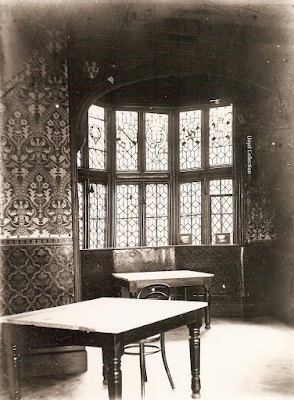
The family lived at Barlow Hall from the late 18th century spending the summer there before moving back for the winter to their town house on South Parade which faces what is now Parsonage Gardens.
And it was there that a mob attacked Walker who was forced to drive them off by discharging a pistol in the December of 1792.

This was at the height of political debate over the issues of press freedom and the French Revolution.
“Emboldened by drink and fired on by agitators, groups hostile to the radicals began to gather around the city.  Walker was in no doubt that this was pre planned.  
‘Parties were collected in different public houses, and from thence paraded in the streets with a fiddler before them, and carrying board on which was painted with CHURCH and KING in large letters’ 

On four separate occasions a mob gathered outside South Parade, broke the windows and attempted to force their way in.  Supported by friends Thomas Walker was forced to fire into the air to disperse the crowds.

The magistrates did nothing to prevent the events and while a “regiment of dragoons was in town, booted and under arms”    and ready to disperse the rioters no order was given.

As if to add insult to injury the main concern of the magistrates when they finally met Walker was that he should not fire at the crowd again if the mob returned!  These attacks had been matched by similar ones on the home of Priestly in Birmingham and in Nottingham.”*
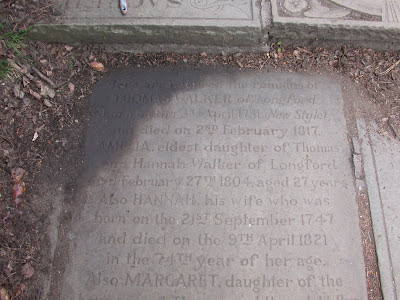
Walker survived both the attacks and was acquitted of treason, after which he retired to the new family home at Longford House where he died in February 1817 and was buried in the parish church on the green.

Location; Chorlton

Pictures;  Barlow Hall, circa 1890, from the Lloyd Collection, and the Walker family gravestone in the parish churchyard from the collection of Andrew Simpson, 2011.

Next; Thomas Walker and the campaign to abolish the Slave Trade

* The Story of Chorlton-cum-Hardy, Andrew Simpson, 2012, http://chorltonhistory.blogspot.co.uk/search/label/A%20new%20book%20for%20Chorlton


Monday, 11 December 2023

Who needs brick dust? ………………

 This will be the last foray into those pennies, half pennies, farthings and shillings which were part of my growing up.*

Half Penny, 1951

And if you were born before 1971 they will have been part of how you paid for things, what you got as pocket money and more recently kept as mementos of your youth.

Most of the ones in my collection came from our Stella and last week I brought them out for a bit of fresh air prompting a series of stories about them, ranging from what a history lesson they offer up to that childhood practice of cleaning them with brick dust and a hankie.

And it was that last story of brick dust, and a hankie which prompted David O’Reilly to comment “Re your brick dust penny blog. Alternatively, you could leave a coin in vinegar over night? Or use a cloth to rub the coin with a mixture of HP sauce and salt !

Queen Victoria, 1865
Miss Rox, my pretty Primary school teacher in 1958 would give you a ‘good’ penny for any ‘bun’ penny you found. (Early Victoria reign impression with her hair tied behind in a bun).

As for childhood games and rhymes……. don’t get me started!

I have the Iona and Peter Opie books and made a lifetime study of it whenever I was on ‘yard duty’."

Now vinegar, HP sauce, and salt were all new to me, and on reflection I wish I had come across them back in 1959 which would have saved my fingers and mum’s handkerchief from the damaging effect of brick dust, not to mention the holes in the walls of Edmund Waller School.

The alternatives remind me also of the questionable practices engaged in to harden conkers before the all-important contests in the playground and in the street from September onto November.

That aside David also reminded me of the work of  Iona and Peter Opie who explored the rhymes and games of children played out in school yards and on the streets.**

Unlike David I never bought into the books although I knew of their work and now, I wish I had.

My own childhood games pretty much centred on playing fag cards which I was never that good at, and the odd game of football and cricket which I was equally lack lustre at, which pretty much left just mooching around.

Edward VII, 1909
The highlight always being wet days when we were kept in and the piles of old comics kept in a cupboard were brought out.

If I am honest I don’t remember many traditional kid’s rhymes which may be because we were from south east London and grew up in the 1950s when those songs and rhymes were on the decline.

The only one that stands out pitched a large number of American television stars  of Westerns into a rhyming story using their names set against a series of adventures.  

It was in its way a kid’s version of of that 1959 song “Delaware” by Irving Gordan and made popular by Perry Commo which referenced 15 US States in the form of puns, "like Della wear, new jersey, Calla 'phone ya, how ar' ya, Missus sip, mini-soda, Ora gone, I'll ask 'er, taxes, Wiscon sin, new brass key, Arkan saw, Tenne see, Flora die and misery".***

I have tried remembering the kid’s version but it has long since been lost from my memory, although if I am honest I was rubbish remembering all the connections back then.

The best I can offer are a selection of children's songs sung by the Clancy Brothers and Tommy Makem, along with some more about Charlie Chaplin by the Oldham Tinkers.

Kids playing on the streets, Hulme, Moss Side circa 1970s

It would have been just three years after the Clancy's and Tommy Makem recorded their melody at Carnegie Hall that I first heard those children's songs and a little later the Oldham Tinkers with a collection of songs about Charlie Chaplin.

And both have stayed with me

And that is about it.  I await the memories of others.

Location; the 1950s

Pictures; coins from the collection of Andrew Simpson, 1865-1951 and Kids playing on the streets, Hulme, Moss Side circa 1970s, courtesy of Roger Shelley

*Coins, https://chorltonhistory.blogspot.com/search/label/Coins

** The Iona and Peter Opie Archive, https://www.opiearchive.org/

***Delaware, https://en.wikipedia.org/wiki/Delaware_(song)

****Children's Medody Live at Carnegie at Nall, November 1963, https://www.youtube.com/watch?v=e5R03zuaRy4

*****Charlie Chaplin, The Oldham Tinkers, Oldham's Burning Sands, 1974, https://www.youtube.com/watch?v=qHm-b99-ER4


Sunday, 10 December 2023

Don’t try this one at home ……………

 This is one of those warnings which extends beyond the home to everywhere and involves an old coin, some brick dust and a hankey.

The penny that escaped the playground, 2023
With the passage of the years, I can’t remember when we used brick dust and a handkerchief to breath life into an old penny.

But it will be around 1959 or 1960 and I would be nine rising ten, and for a while it was all the rage in the playground of Edmund Waller School in New Cross.

At the time it seemed almost like magic.  You rubbed the clothe against the brickwork and then transferred the dust onto the coin and rubbed vigorously and after a while the dirt of decades began to vanish, and the penny took on a bright new appearance.

Preferably the penny couldn’t be too old or the detail on the coin would not benefit from the exercise.

Of course, today I am not surprised that the continued application of an abrasive would do the business.

The downside was that the surface of the penny became pitted, and worse still the practice left dents in the brick work which in some places resembled the craters of the moon.

And over sixty years later I wonder what staff and students make of these circular depressions in the bricks, but I suppose weathering will have probably left our handiwork less obvious.

And Edward VII remained safe, 2023
Why we stopped is a mystery.  There may have been a dictate from on high about damaging the walls of the school, or more likely we just got bored with something which didn’t do much for your hands or the penny, and led to difficult conversations with mother about the state of the hankies.

The disappearance of the old pennies followed by their copper  decimal equivalents will have pretty much killed off the practice, and now as we edge ever closer to a coinless existence few ten year olds will ever feel the need to stand in the playground with a handkerchief and some brick dust.

Cleaning your pennies will have faded into the past along with heaps of old playground games, children’s songs.

One of which I remember pitched a large number of American television stars  of Westerns into a rhyming story using their names set against a series of adventures.  It was in its way a kid’s version of of that 1959 song “Delaware” by Irving Gordan and made popular by Perry Commo which referenced 15 US States in the form of puns, "like Della wear, new jersey, Calla 'phone ya, how ar' ya, Missus sip, mini-soda, Ora gone, I'll ask 'er, taxes, Wiscon sin, new brass key, Arkan saw, Tenne see, Flora die and misery".*

I have tried remembering the kids version but it has long since been lost from my memory, although if I am honest I was rubbish remembering all the connections back then.

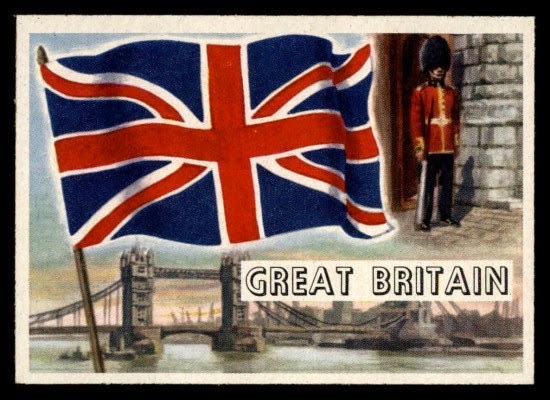
Great Britain Flag no. 26, 1956, Flags of the World

I guess it might well have started life as a skipping song and just transferred from one playground activity to another.

One of which will have been flicking cards, where you put two picture cards against a wall and flicked other ones  towards the two propped up.  

The winner was the first to knock a card down and the prize were the cards already on the floor.  

Originally it would have been cigarette or fag cards which by the 1950s had become the picture cards from boxes of tea bags.

But the favoured cards because they were so much bigger were those from a series called Flags of the World,

Italy, no. 80, 1956, Flags of the World
They came with a disgusting bit of bubble gum, and carried the flags of nations as they were in the mid 1950s and had useful information on the back including each country's currency, population, capital city and a translation of the word hello.

Often the bubble gum had gone hard and brittle, and the cards for ever afterward smelt of perfumed bubble gum.

Such were the things we did in the playground.

Location; in a playground

Picture; 1909 Edward VII penny from the collection of Andrew Simpson and the flag of the Great Britain, no.26 and Italy, no.80, 1956, courtesy of Flags of the World, Dean's Cards,  http://www.deanscards.com/c/716/1956-Topps-Flags-of-the-World

*Delaware, https://en.wikipedia.org/wiki/Delaware_(song)

**Flags of the World, https://chorltonhistory.blogspot.com/search/label/Flags%20of%20the%20World

Saturday, 9 December 2023

Mr. Boulton ….. one of his coins …. and King George III

It isn’t much to look at and until recently I had totally ignored it amongst the coins our Stella collected over four decades ago.

King George III on his Irish half penny, 1806

The image of King George III is almost unrecognizable and if it wasn’t for his name around the rim I would probably have discarded the coin and returned it to the collection.

But given the name I persevered, and scanned both sides which revealed the date 1805, the word Hibernia and a worn but distinct harp and crown.

So clearly there was a story, which involves Matthew Boulton, he of the Boulton and Watt steam partnership, and his Soho works in Birmingham.

My Wikipedia* offers up a fascinating history of the man, who with James Watt took the steam engine to a whole new level of technology and usage and along the way offered up one of my favourite observations about his part in the Industrial Revolution.  Speaking to James Boswell in 1776 at the Soho Works he grandly pronounced “I sell here, Sir, what all the world desires to have – POWER”.

A harp, a crown and the name Hibernia, 1806
It is a simple and powerful statement which has stuck with me ever since I first heard it quoted in an A level history lesson back in 1966 by Mr. Naismith.

And amongst all the things pouring out of the works was this Irish half penny, instantly identifiable by the harp.

And according to Historic Environment Scotland, "The obverse bears the robed and laureate bust of the king with long hair. A crowned harp is at design on the reverse.

The inscription reads ' GEORGIUS III D: G. REX’, on the obverse. 

This translates as: 'George III by the grace of God King'. The legend quotes 'HIBERNIA' on the reverse, which means, 'Ireland'.

In 1805 the Soho Mint struck large quantities of heavy weight copper pennies, halfpennies and farthings, and today these are perhaps the commonest of the older Irish coins still surviving. 

The precision striking and the engrailed edges made them difficult to counterfeit. 

They were the last official copper issue until 1822, but further tokens made their appearance in order to satisfy the public demand".**

All of which makes it far more interesting than the very worn lump of metal would at first seem to promise.

Now I am never over bothered about the value of such things on the open market which are now just part of the family history, but in the course of researching Mr. Boulton’s half penny one site suggested an uncirculated George III Irish half penny might go for £350, while one in “good condition” was worth £1.50, so given the state of ours I doubt I would be booking a luxury cruise on the strength of selling it.

1916 Penny
But as ever it is the stories associated with the coins which make each one interesting, and by extension take you into the very unhistorical temptation to speculate on how it was used and who used it over its long history.  

Daft I know as at the end of the day each was a coin designed to pay someone a wage or to buy a loaf of bread, a pint of beer, or a trip out.

And that leads me to my 1916 penny, less worn on one side than the other and of course issued in the middle of the Great War.

The romantic in me wonders what sort of journey it encountered in its 55 years from when it went into circulation till it was stopped in its tracks by the introduction of decimal coinage in 1971.

The possible uses are endless, but it might have passed over the counter to buy a ticket at one of the new cinemas which were being built, travelled the country or sat in a penny savings box.  Either way it will have seen plenty of use judging by its worn appearance.

A youthful Queen Victoria, 1883
And it fared a little worse than its Victorian predecessor from 1883, which given its age might have taken a lot more wear and tear.  

Queen Victoria still looks relatively youthful despite the fact that by the year of the coins issue she had been on the throne for 55 years.

No doubt someone will walk me through the changes to her appearance on her coinage from the coronation in 1837 to the “old lady” on later issues.

We shall see.

For now, that is it other than to say the small number of coins is strictly speaking not a collection, doesn’t contain anything more valuable than 3 penny bit, and apart from a couple of Roman ones all date from the last two centuries.

A worn Britannia, 1883

Location; 19th and 20th century Britain

Pictures; King George III Irish half penny, 1806, King George IV penny 1916, and Queen Victoria penny 1883, from the collection of Andrew Simpson

*Mathew Boulton, https://en.wikipedia.org/wiki/Matthew_Boulton

** Historic Environment Scotland https://www.historicenvironment.scot/archives-and-research/archives-and-collections/properties-in-care-collections/object/george-iii-irish-halfpenny-1805-modern-edinburgh-castle-48184


Friday, 8 December 2023

Losing your history ……. and finding some stories

If you were born in the first half of the last century the chances are that you carried a little bit of our collective history around with you.

Queen Victoria penny, 1865
It would be there in your pocket, your purse or held for a rainy day in one those small containers which resembled a pillar box or any one of a heap of animals pretending to be a savings bank.

But in 1971 when the country adopted a currency based on decimal units almost all of the existing coinage was junked.  

Out went the old-fashioned penny, the threepenny bit as well as the ha’penny and while some silver coinage lingered on, kidnapped and made to perform a new role as decimal coins they too pretty quickly vanished as the bight new shinny stuff rolled out of the Mint.

And of course, all the new coins bore the head of the reigning monarch, which is how it has been ever since, ensuring that the oldest real decimal coin dated from 1971.

All of which for my generation wiped out the history lesson whereby you might have coins in your pocket stretching back into the mid-19th century, and meant you rubbed hands with effigies of Queen Victoria, Edward V11, King George V and V1 as well as the young Elizabeth.

Reverse of Queen Victoria, penny, 1865
The older the coin the more warn and thin it might have been but it still passed for legal tender, even though there was as ever the temptation to save the older ones for their historic connection.

So while early and mid-Victorian pennies were rare they did turn up, hence this 1865 one, and those of Edward and the two Georges were to pinch the phrase “two a penny”.

At which point I am not making out any great claims that this was much of a history lesson, but it did mean you were vaguely aware of the past stretching out in front of you.

And in another way, it points to the historical continuity which was a currency based on pounds shillings and pennies, where 240 pennies made a pound, 12 pennies made a shilling and twenty shillings made a pound, and along the way introduced to the guinea.

Half penny, 1951

At the time of decimalization great claims were made of how complicated was a currency based on different units, but I doubt many of us were, after all we grew up with it and it was just part of the backdrop of normal life, like steam locomotives, black and white television and bus conductors.

And in Junior school it was just one of the many ways you learnt to add up and subtract along with those more challenging problem solving exercises involving  four men, three women seven apples and the amount of money Eric Braithwaite might make from selling the apples to the people at 2d an apple.

All of which makes me wonder whether Roman school children had to endure the same brain numbing lessons or for that matter the slave sent out into the local market to get the best deals on olive oil and black pepper.

This is no flight of fancy but a very unsubtle way of introducing this Roman coin which along with three others I bought in a small shop behind the British Museum sometime around 1974.

Roman coin, Claudius, 43 -54 AD

At the time I was looking for the odd little teacher resource to make the teaching of Roman history a bit more interesting.

Already I had bought a replica Roman lamp and very shamefully presented an old leather sandal bought in the Eighth Day on Oxford Road as a genuine 1st century piece of Roman footwear similar to those found at Vindolanda along the Wall.

Reverse of the Claudian coin,
The older me shudders at such a breach of historical accuracy while the younger me enjoyed the hushed silence of 30 first year students in room 11 on Portway in Wythensawe.

Now as we are in confessional mood I can’t say this one is part of the four I bought for what amounted £2 new money, and it is possible that it came from a collection of replicas I bought later.

Either way I still find it something to look at, and put with the very real Viking oyster shell I bought in York at the Jorwick archaeological dig in the later 1970s for the price of 10 new pence, there being so many found during the excavation.

The shell I can date to the Viking settlements of York and I think the coin is the Emperor Claudius and the rest as they is another story.

Viking oyster shell, Jorvick
Location; our collection


Pictures; Queen Victoria penny 1865, half penny, 1951, a Roman coin from the era of the Emperor Claudius, [I think] and a Viking oyster shell from Jorvick


Wednesday, 20 September 2023

Wearing the badge ..... making the point

The campaign badge has been around a long time.

1986
It is one of those instant bits of political activity which makes the point cheaply and effectively.

A round bit of cardboard, some sticky tape and a safety pin and you have a badge.

Easier than that and just as effective is coloured ribbon, so loved of election rallies in the early 19th century, and the Suffragettes, and before ribbon there were bits of plant, flowers and bush stretching back into the past all of which were designed to mark out your political preference.

My first was “Lets Go with Labour” which I wore in 1966 but must have been a remnant from the ‘64 election.

It was a shinny plastic badge with a plastic pin which fixed into the back and I wore it throughout the campaign knocking on doors in Well Hall.  I was just 16 and such are the things you cut your political teeth on.

1974
Today the badge machine has made it all the simpler and allows almost anyone to turn them out for next to nothing in just a few minutes.

But for me it will always be those enamelled badges which take pride of place in the collection.  I have a few none of which date back before the 1950s.

Of these the old fashioned Labour Party badge is my favourite with its torch, pen and shovel representing all aspects of the labour movement combined with the torch of progress.

The newer version never really caught my imagination in the same way.
1986

Of the remaining enamelled ones it is that of the Sutton Manor NUM badge which stands out because of the contribution  made by many local people to their struggle during the Miners Strike.

And if like me you bought or picked up badges in support of campaigns they now have a place in our history.

Some were deadly serious, a few used humour and others were celebratory, and many today now seem to belong to a landscape that has long since vanished although that said it always seems that gains made in social progress do sometimes have to be fought all over again.

So for those of us who argued against a divided South Africa, wore  the Anti Apartheid badge can now look back on twenty years of that new rainbow nation.

1977
But other campaigns  like the attempt to save the Greater Manchester County Council failed and many more like Justice for Pensioners and the defence of the NHS remain real issues.

Looking back at my collection I cringe at some of the things I supported in my teens and early twenties, are saddened by those that were defeats but also remember how much I learnt by taking part and of some good friends I made along the way.

So each of the badges does represent an important moment in someone’s history and I think I shall return to some of them and explore their stories in more detail.

1980
Many are almost all that is now left of an impassioned moment when people came together to defend something they thought important.

Long after the paperwork has been lost , the newspaper stories discarded and the memories faded these badges record that moment.

They also point to that other simple observation that history does not always turn out the way you would like.

The years since independence in Zimbabwe have been difficult but I still remember the pleasure many of us felt at its promising start as a new country.

And I bet out there there are lots more badges and even more stories.

Pictures; badges from the  1950s to the 1990s from the collection of Andrew Simpson

Monday, 1 May 2023

October 1980 …………

The early 1980s seemed a scary place.

The two Super Powers had decided that they didn’t like each other all over again, and to add to those tensions there were new nuclear weapons and delivery systems coming on line which were faster and not as easy to detect.

It was as if the Cold War had returned after a brief lull.

Of course, the threat of a nuclear confrontation had never gone away, we just tucked it away in a place where it could be forgotten.

But its return, prompted the British Government to issue a booklet on how to survive an attack, the membership of the Campaign for Nuclear Disarmament rose dramatically, and people took to the streets to protest.

Cynics and those who embraced the idea of nuclear weapons scoffed at the marches and demonstrations, while those who took part felt that they had to do and say something.

Which is why in the October of 1981 I was down at All Saints on a piece of empty land waiting for the march to set off.

And as many of us did I took a camera and recorded the event.  The pictures of that march and plenty of others have appeared on the blog over the years*, but I have always ignored these two.

Looking at them again, almost forty years, later they may appear a bit hammy, but back then they made the point, and in a very uncertain world with new conflicts breaking out across the planet,  I rather think they strike a chord, added to which they are a bit of our history.

Location; Manchester


Pictures; demonstration Manchester, October 1980, from the collection of Andrew Simpson


*Political Protest, https://chorltonhistory.blogspot.com/search/label/Political%20Protest


Saturday, 20 November 2021

Socialism in Suburbia …………. more stories of Chorlton, Withington and Didsbury

Socialism in Suburbia is a slim pamphlet of just fourteen pages and sadly to day is very difficult to obtain.*

Forward The Day Is Breaking, 1910
My copy comes courtesy of Jeff Bridson and is an electronic version of his photo stated pages, which look to have been copied many times.

The original was written by Rhys Davies MP, and published in 1930 by the National Co-operative Publishing Society.

It is a fascinating account of the early years of the Labour Party in the old Withington constituency which included Chorlton-cum-Hardy, Withington, and Didsbury.

Socialism in Suburbia, 1930
At the outset Mr. Davies reflected that this was “suburbia in excelsis; [which] has more rich, petty bourgeoisie within its borders than almost any other part of England”.  Added to which “there is hardly a trade union branch to be found anywhere; there are no industries of any kind within in its confines; it is a residential area throughout.  

But within this vast political province there are hundreds, if not thousands, of trade union officers by the score make their home here.  The Woodworkers Society’s head office is right in the heart of things, whilst the Typographical Association of the National Union of Distributive and Allied Workers, and the Ironfounders’ Society Headquarters are just on its boundaries”.

The story began with a meeting called by the Clarion newspaper in 1906, requesting that “Socialists of the commercialized districts, come together at a meeting at the White Lion”.

A dozen attended and later meetings were held in the home of Mr. C.W. Hunt who became a Labour representative on the local Board of Guardians, and amongst others who regularly attended were Dr. Tom Garrett and Mrs. Garrett who also sat on Chorlton Union Board as socialist Guardians.

At which point it is worth pointing out that here in Chorlton the first socialist society had been formed in 1894, and while the evidence is fragmentary, they were active throughout that decade and into the next. **

R.J. Davies, MP, date unknown
None of which detracts from Socialism in Suburbia which gives a detailed account of those early years including how campaigning was undertaken, the results of municipal and Parliamentary elections, and the difficulty of “converting Withington’s inhabitants to Labour and Socialism”, with Mr. Davies commenting that “The achievement of not losing our £150 deposit in 1929 was regarded as much a victory as winning Ardwick, Clayton Gorton Hulme or Platting would be to Labour adherent’s resident within those constituencies in Cottonopolis”.

Not that he was a stranger to political campaigning.

He was born in 1877 in Wales, began work as a farm servant, before becoming a coal miner for ten years and then a cashier “to a co-operative society in financial difficulties and began at once to organize co-operative employers into a trade union.  

After four years in co-operative service, he was offered a post in the central offices at Manchester of the old Amalgamated Union of Co-operative Employees” ***

R.J.Davies, speaking, 1945
His record in Manchester in the labour movement is impressive, having been President of the Manchester and Salford Trades Council, as well as the Manchester and Salford Labour Party, was a City Councilor for ten years, and then elected as MP for Westhoughton in 1921, a seat he held till his resignation due to ill health in 1950.

Reading his speeches, I am struck with the range of the issues he embraced, as well as his knowledge, passion and commitment.

He campaigned on worker’s rights, the cotton industry, international peace and the welfare of children as well as calling for a national homeland for Jewish people.

Nor was he afraid of criticizing senior Labour members of the wartime coalition government, as well as  voting against the Labour Government in 1947 over the introduction of National Conscription.

But he remained firmly committed to the Labour Party,  taking  great pride in the Labour landside of 1945, and was seen on the first day of the new Parliament “pushing and chuckling his way to the Chamber, calling to a friend “Heavens above.  It might be a Labour party conference’”. ****

Members of Withington CLP circa 1990s
All of which brings me back to his book, and his closing comments that “this Suburbia and home of Manchester’s intelligentsia might well be won for Labour”, which was indeed the case in 1987 when Mr. Keith Bradley took the seat from the Conservatives.

Location; Withington, Chorlton-cum-Hardy, Didsbury

Pictures; Labour Party poster, 1910, front cover of Socialism in Suburbia, 1930, R.J Davies, date unknown, R.J. Davies,MP,  speaking in 1945, and members of Withington CLP, circa 1990s, from the collection of Andrew Simpson


*Davies, Rhys, Socialism in Suburbia, 1930

**Beedle, Lawrence, Chorlton’s Socialist History 1996

***The Staffordshire Sentinel, April 14th, 1925

****R.J. Davies, Manchester Guardian, November 3rd, 1954


Thursday, 18 March 2021

That Manchester envelope ........... and the story of Sir John Elley

 History could have been kinder to John Elley.  


He rose from humble beginnings to become a member of the establishment in the early 19th century, propelled in part by a successful military career.

I am sure there will be an entry in the National Biography, but for now the most accessible account of his life comes from Wikipedia, which records that,  “Lieutenant-General Sir John Elley KCB KCH KMT KSG (9 January 1764 – 23 January 1839) was a British soldier who joined the cavalry as a private, and rose to general officer rank. 

He fought with distinction during the French Revolutionary and Napoleonic Wars, and later served as the last Governor of Galway and as Colonel of the 17th Lancers”.*

There is more, but for that you will have to follow the link and read it, for as ever I do not lift other people’s research, other than to say he “was born in Leeds in 1764. His father ran an eating-house at Furnival's Inn. Apprenticed to Mr. John Gelderd, a tannery owner of the village of Meanwood near Leeds, West Yorkshire, he became engaged to his masters daughter Anne. After her untimely death, he enlisted, in 1789” and saw service throughout the wars with Revolutionary and Napoleonic France.

His rise through the ranks was pretty meteoric and while his courage under fire was recognized, I wonder if in that age when military rank could be bought he had help  from someone.

Still that doesn’t diminish his achievements, I just wish there was more, especially as the one painting of him in the National Gallery according to Wikipedia “one or more third parties have made copyright claims against Wikimedia Commons in relation to the work from which this is sourced”.

So we won’t be going down that route.

Instead I shall just post this envelope, which was sent by Sir John shortly before he died to a D Tait of the 4th Dragoons in Manchester.


I will go looking for D Tait and more on the 4th Dragoons, who may have been stationed in the Cavalry Barracks in Hulme, at a time when the military’s presence was partly linked to the continued social and industrial unrest in the North.

It was acquired by my old friend David Harrop, he of all things posty.

Alas, the contents of the letter are lost, which I suppose fits with that general sense that there history has passed him over.

That said the Wikipedia article does reference several mentions of John Elley in the London Gazette, and I came across more in the Manchester Guardian, so perhaps here is indeed a research project in the making.

Picture; envelope sent by Sir John Elley, 1837, from the collection of David Harrop

*John Elley, https://en.wikipedia.org/wiki/John_Elley


Sunday, 19 April 2020

MY FAMILY AT WAR and post war service .......another story from Tony Goulding

It has been said many times that a picture paints a thousand words and so it is with these few which eloquently detail the lives of my parents both during the 2nd World War and its immediate post war period. 

Mother
They also reveal how their lives converged due to their service to the country.

 My father served in the Royal Navy mostly in minesweepers and here are his mother’s “next of kin” card and the amulet he wore during his war time service including his participation in the D-Day landings in June 1944.

 My mother spent her war years in the centre of Chorlton close to several sites of the fatal bombing incidents of the Christmas Blitz of 1940 and of later raids.

 In 1947 my mother, who at the time was working as a shorthand typist for a textile company in Manchester, answered the call for women to join the Land Army to make up the agricultural workforce depleted by casualties of war and continuing military service.


Dad
She was sent to a farm near Preston, Lancashire were she was to meet my father who had, by then, been “de-mobbed” and was working for the soon to be nationalised British Railways.(1)


At this time the rail network was an essential service to the country as it battled to rebuild its economy.

This was particularly true at the time my parents first met as the winter of 1946/7 had been a particularly severe one.

© Tony Goulding, 2020


Pictures; from the collection of Tony Goulding


Mother's ration card


Land Army certificates


Casualty Card


Dad's amulet


Dad's railway picture
NOTES

1) The rail network comprising the 4 major companies London Midland (L.M.R.), London North Eastern (L.N.E.R.),   Great Western (G.W.R.), and Southern (S.R.), together with several minor railways were nationalised on 1st January, 1948