Showing posts sorted by relevance for query the cenotaph. Sort by date Show all posts

Sunday, 11 October 2020

Mrs Bingle and the unveiling of the Cenotaph in July 1924

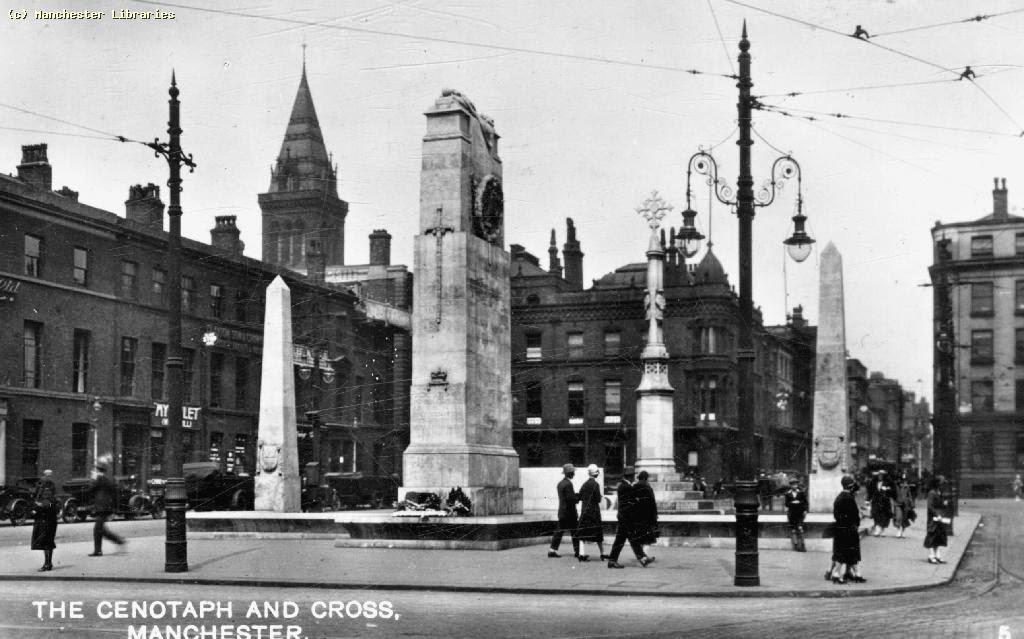
The Cenotaph, 1925
“Before the Manchester Cenotaph was unveiled on Saturday afternoon, the Lord Mayor explained why it was that a great soldier had not been asked to loose the cords.

‘The victorious nation pays as much as the vanquished in the loss of the flower of its population and there are many broken hearts in the conquering country as there are in the conquered.’  

The same idea was uppermost in the character of the ceremony itself.  Mrs Bingle, a citizen of the working class district of Ardwick, whose three sons had been killed in the war assisted Lord Derby with the unveiling”*

All of which I think was a fitting tribute to those who died and to the families left to bear the loss.

Now both of those invited that day to unveil our war memorial are interesting.  Lord Derby had been closely associated with recruiting men for the war and will forever be linked with the Pals battalions which “should be a battalion of pals, a battalion in which friends from the same office will fight shoulder to shoulder for the honour of Britain."**

Rylance Street, 1964
But it will be Mrs Bingle who I think was the more significant choice.

The family were not from Manchester, they came from Stroud in Gloucestershire but had settled in the eastern side of the city by 1899, and in the years before the Great War never seemed to stray far from Rylance Street just off the Ashton Old Road.

Here they brought up eight children in houses ranging in size from 3 rooms up to five.  Mr Bingle was engaged in making umbrellas, their eldest son was a career soldier, another a postman and their youngest son an errand boy.

It was an area of densely packed terraced housing, dominated by the railway depot to the south and surrounded by iron and steel works, the Bradford Colliery and countless smaller enterprises.

In time I will I hope be able to track the lives of Albert and Frances Bingle and their eight surviving children.

The Statue on the "war stone", 1992
But in the meantime it is the loss of their three sons which exercises my thoughts.

History has been capricious with the details of their military careers and so all we know of their eldest son was that he had enlisted by the time he was 18 in 1901 and at his death had reached the rank of sergeant.

 His brother Charles Henry was a gunner and Nelson Allen the youngest of the three was a 2nd Corporal in the Royal Engineers.

That said some of Nelson’s army records have survived and I know that he signed up at Ardwick in the April of 1915 aged 19.

It is so little for what amounted to such a great sacrifice and the enormity of that loss must have been overwhelming, more so because all three died in the final year of the war.

Nelson aged 21 was killed in the March, Ernest Albert the oldest on May 8th and Charles Henry on the 27th.

At the Cenotaph, 1942
Which takes me back to the unveiling when “emotion was gathered up into a sort of climax where state and civic dignitaries stood aside and a stream of women flowed between the obelisks and covered the great expanse of stone with flowers.”***

And that I think this is the moment to close.

But I will return to the story not least to describe the day of the unveiling in more detail perhaps when the Cenotaph is rededicated in its new position in front of the west door of the Town Hall.

And that will also be an appropriate moment to explore the lives of the Bingle family in more detail.

Pictures; The Cenotaph and Cross, St Peter’s Square, Manchester 1925, m52055, Rylance Street where the family were living in 1911, Taken by T Brooks in 1964, m12974, Statue on top of the Cenotaph, St Peter's Square, Manchester Mark Cobley, 1992 m80515, and a service at the Cenotaph in 1942, G Hinks, m09818, courtesy of Manchester Libraries, Information and Archives, Manchester City Council, http://images.manchester.gov.uk/index.php?session=pass

*The Manchester Guardian, July 14, 1924

**Lord Derby speaking in Liverpool in August 1914. The idea had actually been suggested a few days earlier by General Sir Henry Rawlinson  that men would be more inclined to enlist in the Army if they knew that they were going to serve alongside their friends and work colleagues.

He had appealed to London stockbrokers to raise a battalion of men from workers in the City of London to set an example. 1,600 men enlisted in this 10th (Service) Battalion, Royal Fusiliers, the so-called "Stockbrokers' Battalion", within a week in late August 1914.

***ibid The Manchester Guardian, July 14, 1924

Suggested by a story, The Cenotaph is Moving by Ann Beswick, March 17 2014, http://www.manchesterguidedtours.com/blog-news

Wednesday, 4 November 2020

‘War Works’ an exhibition of art by David Dunnico … December 6th and into the new year

So in these uncertain times I was pleased that David Dunico’s new exhibition was going ahead  on November 5th at the AIR Gallery, The Warehouse, 30 Grosvenor Road, Altrincham.


But of course we are now about to enter the November lockdown, with David emailing me "Not surprisingly my exhibition has been postponed because of the lockdown – Assuming it ends on 2nd December, the exhibition will open on Saturday 5th December. 

It will run into January – I haven’t got any more information on exact dates yet".

So in anticipation of the event,  here I shall just lift the exhibition notes which say it better than I could.


“The Cenotaph features in a new art exhibition about remembrance, which appropriately and not without coincidence, opens the week the Whitehall war memorial reaches its Centenary.

Manchester artist David Dunnico’s exhibition is called ‘War Works’ and runs from 5th to 28th November at Air Gallery in Altrincham. It includes prints, video and installations, which take a critical look at how the First World War was memorialised and how this affects the way we look at later conflicts including the ‘war on terror’. 

In 1919, architect Edwin Lutyens was commissioned to design a monument for the route of the Allied Victory Parade which was to march through London. He quickly produced the deceptively simple cenotaph, which was made of wood and plaster and only intended to be in place for a few weeks. 

However, it immediately became the focus for the Nation’s mourning and was replaced in 1920 with the present permanent structure of Portland stone. 100 years on, it is still the most important and well known of an estimated 100,000 war memorials in the UK. 

In the late 19th and early 20th Centuries, there was a craze for collecting ‘Crested Ware’ – small, white porcelain ornaments, decorated with the heraldic crest of a town or city. These were made in simple shapes of familiar objects. During the First World War designs included tanks, battleships and artillery, after the War, the Cenotaph was a popular subject. 

The different towns and cities displayed on these mementos reflects the fact that there was barely anywhere in the country that was not mourning local people who had been killed or injured in the war. 


Dunnico has used over 75 examples amassed from eBay in one installation. They are laid out in the shape of Britain and make a comment about the place war memorialisation has in this country. 

The Cenotaph also features in a large print called ‘Empty Tomb’ the literal translation of the word from the Greek. Other pieces include a video of the Two Minute Silence – which makes you realise how the city is never silent, especially when the gun signaling the start of the Silence sets off car alarms near and far. 

A couple of the exhibits were shown in Dunnico’s ‘Flag of Convenience’ photography exhibition held 

last year at Stockport War Memorial Art Gallery, being shown for the first time is ‘A War Imagined’ – What seem to be granite memorial plaques carved with the names of war dead, which on closer viewing turn out to be acrylic sheets, engraved with the cast lists of British films about the Second World War. Dunnico said: “The Second World War seems central to the English national identity, but people’s understanding of it largely comes from half-remembered movie dramas. History is understood literally and figuratively in black and white”. 

‘War Works’ an exhibition of art by David Dunnico

December 6th 2020- January  2021

AIR Gallery

The Warehouse

30 Grosvenor Road

Altrincham

WA14 1LD

0161 941 1129

info.airgallery@gmail.com

https://www.airgallery.space/

Opening times: Wednesday – Friday: 11am – 6pm 

Saturday: 12noon – 5pm. Free

Because of the COVID restrictions people are asked to book the day before visiting the exhibition through Eventbrite:

https://www.eventbrite.co.uk/e/126246112521

Wednesday, 15 December 2021

Remembering Joseph Thomas from Chorlton who died in the Great War

The replica, circa 1920s
I wonder just how many of these small replicas of the Cenotaph still exist.

They would have been made in their thousands and displayed on mantle pieces and in cabinets across the country.

Some will have evoked proud memories of a war fought well but for many more they must have been a painful reminder of a lost loved one who died on some faraway battlefield or out at sea.

The end of the Second World War may have given them a renewed significance but as we passed into the long years of peace and growing prosperity most will have been consigned to a back room, and finally laid to rest in a suitcase in the attic.

And in the way of these things those that weren’t thrown away will have been given to a jumble sale and by degree made their way into a collection.

Of course the personal story which went with each will have been lost.

Joseph Thomas, circa 1914-15
But not this one.

This one I can trace to a family and the young Joseph Thomas who was born in 1894 and died on the Western Front in 1917.*

Joseph grew up in Chorlton-cum-Hardy and  worked for Richard Haworth & Co Ltd who had offices at 19 Cooper Street.

The building has long gone but it faced the Town Hall close to where the Cenotaph now stands.

And like many other young men working in the offices of the city he enlisted in one of the Pal’s Battalions.

The first had been raised in the August in a few days and Joseph enlisted in the second city battalion that September.

This was the 17th Manchester’s which after basic training left for France in the November of the following year.

I doubt I would ever have come across him had it not been for a picture postcard he sent to his brother.

The post card asked for an advance till pay day and alerted the family that he was coming home on leave.

At that stage all I had was his brother’s name and address but that was enough to begin to uncover the story of the family and shed light on the young man who just signed himself Joe.

By the end of the afternoon his early career was clear along with the details of his enlistment and a photograph of ten soldiers one of whom I guessed was Joseph.

The rest as they say just fell into place.

Within an hour of posting the story Nicola and Steven had been in touch and were able to identify young Joseph which in turn led to a meeting at which they showed me a collection of family material including photographs, certificates and the replica Cenotaph.

And that I think is a good point to close.

Of all the memorabilia I have come across from the Great War this replica Cenotaph brings me very close to the loss the Thomas family must have felt.

Picture; replica Cenotaph circa 1920s from the collection of Nicola O’Niel and detail from the picture postcard showing young Joseph, circa 1914-15 from the collection of David Harrop

*Uncovering the story of Joseph Thomas of Chorlton born 1894, died 1917 on the Western Front, http://chorltonhistory.blogspot.co.uk/search/label/Chorlton%20and%20the%20Great%20War

Tuesday, 31 May 2016

Remembering Joseph Thomas from Chorlton who died in the Great War

I wonder just how many of these small replicas of the Cenotaph still exist.

They would have been made in their thousands and displayed on mantle pieces and in cabinets across the country.

Some will have evoked proud memories of a war fought well but for many more they must have been a painful reminder of a lost loved one who died on some faraway battlefield or out at sea.

The end of the Second World War may have given them a renewed significance but as we passed into the long years of peace and growing prosperity most will have been consigned to a back room, and finally laid to rest in a suitcase in the attic.

And in the way of these things those that weren’t thrown away will have been given to a jumble sale and by degree made their way into a collection.

Of course the personal story which went with each will have been lost.

Joseph Thomas, circa 1914-15
But not this one.

This one I can trace to a family and the young Joseph Thomas who was born in 1894 and died on the Western Front in 1917.*

Joseph grew up in Chorlton-cum-Hardy and  worked for Richard Haworth & Co Ltd who had offices at 19 Cooper Street.

The building has long gone but it faced the Town Hall close to where the Cenotaph now stands.

And like many other young men working in the offices of the city he enlisted in one of the Pal’s Battalions.

The first had been raised in the August in a few days and Joseph enlisted in the second city battalion that September.

This was the 17th Manchester’s which after basic training left for France in the November of the following year.

I doubt I would ever have come across him had it not been for a picture postcard he sent to his brother.

The post card asked for an advance till pay day and alerted the family that he was coming home on leave.

At that stage all I had was his brother’s name and address but that was enough to begin to uncover the story of the family and shed light on the young man who just signed himself Joe.

By the end of the afternoon his early career was clear along with the details of his enlistment and a photograph of ten soldiers one of whom I guessed was Joseph.

The rest as they say just fell into place.

Within an hour of posting the story Nicola and Steven had been in touch and were able to identify young Joseph which in turn led to a meeting at which they showed me a collection of family material including photographs, certificates and the replica Cenotaph.

And that I think is a good point to close.

Of all the memorabilia I have come across from the Great War this replica Cenotaph brings me very close to the loss the Thomas family must have felt.

Picture; replica Cenotaph circa 1920s from the collection of Nicola O’Niel and detail from the picture postcard showing young Joseph, circa 1914-15 from the collection of David Harrop

*Uncovering the story of Joseph Thomas of Chorlton born 1894, died 1917 on the Western Front, http://chorltonhistory.blogspot.co.uk/search/label/Chorlton%20and%20the%20Great%20War

Wednesday, 15 October 2014

What's new in St Peter's Square?

I have got to say I am a fan of the new relocated Cenotaph outside the western door of the Town Hall.

Like many I watched the demolition of the sunken gardens and the surrounding square, tried to gain a glimpse of the work being done behind the huge hoardings and wondered about how it would finally turn out.

For me it does work with the added bonus that from the steps of Central Ref north to the Cenotaph and eventually out across towards One St Peter’s Square there is a brand new open space which affords great views of the  surrounding buildings.

Now compared with many Italian and French towns I do not think we do open spaces particularly well.

Like the old Crown Square they can be dismal windy places offering a few uncomfortable seats, a stretch of uneven paving stones and the odd bit of litter interspersed with a few weeds.

The area around St Peter’s Square is still a work in progress and I am not sure if the enlarged metro stop will encroach on the Cenotaph.

But in the mean time the area shows off those buildings along Princess Street in a way you couldn’t have seen them until recently and in the same way provides new views off across the tram lines down towards Oxford Street.

I still haven't made my mind up about One St Peter’s Square but know that I never liked the previous building and think I can remember what was there before that.

The test for all this new open space will be whether people feel comfortable sitting there.

On Saturday there were indeed lots of people taking in the last of the sun while sitting on the benches, and stopping to photograph the Ref, and the Cenotaph .

It will all have changed again in a matter of months, so with that in mind this was what it all looked like on the Saturday that St Helens played Widnes at Old Trafford and the sun briefly came out.

Pictures; St Peter’s Square and the Cenotaph, October 2014 from the collection of Andrew Simpson

Thursday, 17 November 2022

At the Cenotaph ……….. on the Monday after the Sunday

Now the annual ceremony of Remembrance at the Cenotaph is always a moving event.


But outside that day the memorial and the small plot of land that surrounds it have been a place to sit, reflect on what it represents, and just take time out.

For some the full significance of what is all around them might be lost, but for many thoughts will settle on the sacrifice that is recorded in those monuments.

It is a place that has featured in the blog from the story of "Mrs Bingle and the unveiling of the Cenotaph in July 1924" to the stories of the replicas which were produced and took pride of place in many homes.*

Occasionally I have heard people question its resitting at a busy interchange but that is the point, because it is visible as a permanent reminder.

Location; Manchester

Pictures; At the Cenotaph ……….. on the Monday after the Sunday, 2022, from the collection of Andrew Simpson

*The Cenotaph, https://chorltonhistory.blogspot.com/search?q=the+cenotaph


Tuesday, 16 June 2015

The story of one house in Lausanne Road number 9 ........ that Roll of Honour in Edmund Waller school and George Carly of Lausanne Road

Replica Cenotaph, circa 1920
The story of one house in Lausanne Road over a century and a half, and of one family who lived there in the 1950s.*

Growing up in Lausanne Road in the 1950s was to be untouched by the Great War.

Of course the evidence of the Second World War was still all around us.

Many of the bomb sites had yet to be redeveloped and there were those signs announcing EWS and Shelters.*

Added to which there were plenty of gable ends  which had been cemented over and told of the house next door which had been blown away.

But the Great War was different.  It was rarely a topic of conversation which given the more recent conflict was understandable.

And yet those who had participated in it either as combatants or on the Home Front would still be in their late 50s or early 60s, would yet to have retired and some were not yet grandparents.

But I can think of only one moment when it impinged on me and that was at school at Edmund Waller.

In the upstairs hall on a ledge in a glass case was the Roll of Honour, opened at a particular page with those who had survived recorded in black ink and those who had died in red.

I have often wondered if the pages were turned regularly and more recently whether it still exists in the school and is on display.

Today that conflict is remembered in a way that was not the case when I was growing up.

Rightly so we have come again to recognise the sacrifice of that generation but I think all too often we see them as either young men staring back at us in their ill fitting uniforms or as frail individuals with faltering voices in wheel chairs and forget that when that war was over they settled down to productive lives, raising families with decades ahead of them.

Joseph Thomas, circa 1914-15
And I was reminded of this when I met with Nicola whose great uncle had fought in the war and died aged just 23 on the Western Front in 1917.***

He had been one of those young me who had enlisted in the first few months of the outbreak of war and was in the 2nd City Battalion of the Manchester’s which formed the second Manchester Pals Battalion.

Early in 1915 young Joseph Thomas sent a picture postcard to his brother announcing he was coming home on leave.

The card like many of the time carried an image of a group of young soldiers and after posting the story Nicola got in touch and identified her great uncle.

In the family collection was this replica of the Cenotaph made by Kingsway Art China of London.*

Replica Cenotaph, circa 1920
Once these must have been manufactured in their thousands but I doubt that many still exist and those that do will be in collections whose owners have little knowledge of its personal history.

This one however retains that link with the Thomas family and that young man.

And by extension I wonder how many other very personal memorabilia exist in Peckham and which contain a story.

Yesterday I reflected on the story of young George Carly who had lived in our house.

He was  born in 1894 and died on the Western Front at the Battle of the Somme on September 18 1916 and I rather hope that I will uncover something of his.


Pictures; replica of the Cenotaph, circa 1920s courtesy of Nicola O'Neil and Joseph Thomas circa 1914-15 from a picture postcard, 1915 from the collection of David Harrop

*The story of one house in Lausanne Road, http://chorltonhistory.blogspot.co.uk/search/label/The%20story%20of%20one%20house%20in%20Lausanne%20Road

**EWS Emergency Water Supplies, Shelters Air Raid Shelters

***Joseph Thomas, http://chorltonhistory.blogspot.co.uk/search/label/Joseph%20Thomas


Sunday, 6 July 2014

At the Cenotaph sometime around 1924

Now the Cenotaph is going to be much in the news over the next few years.
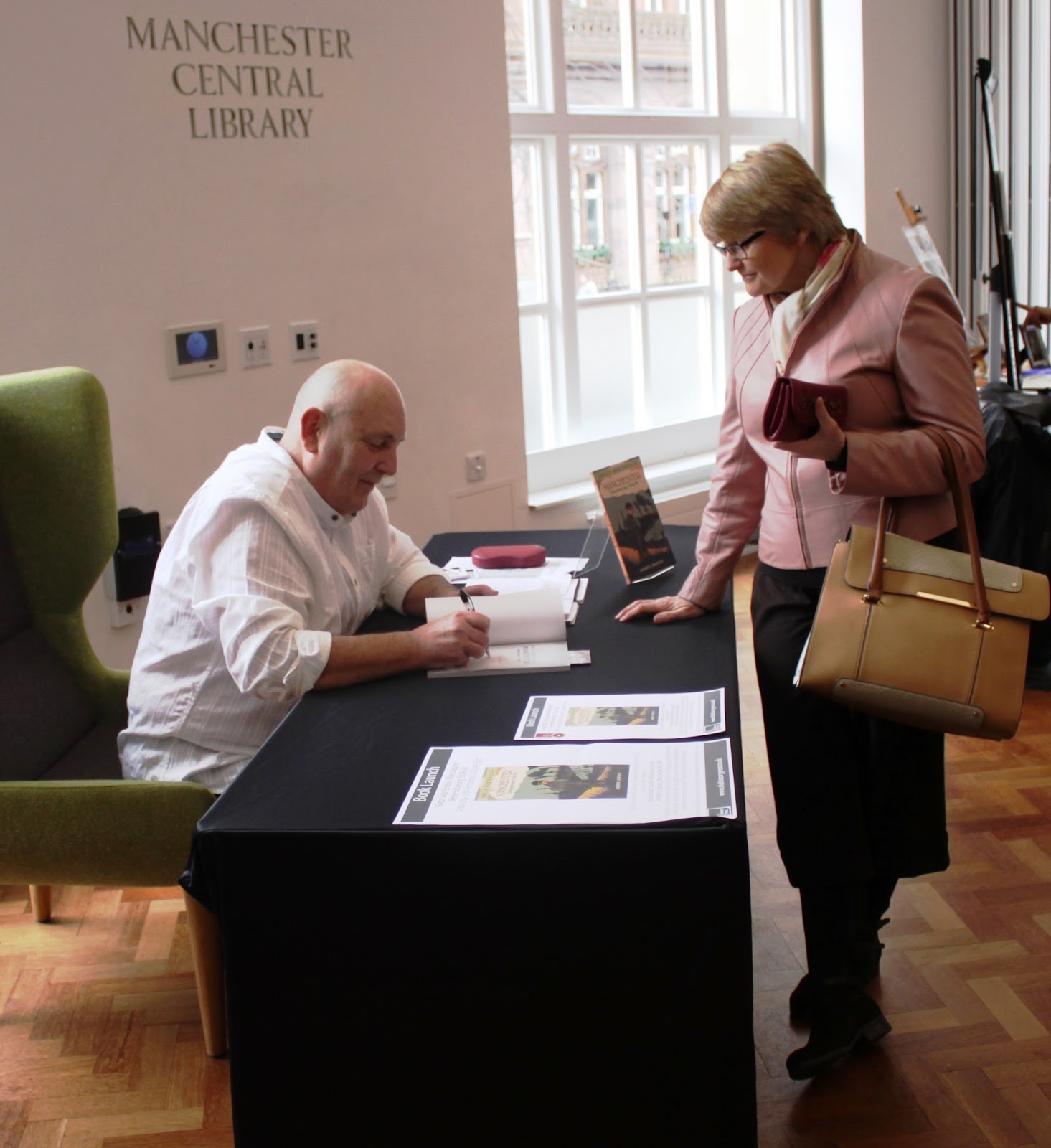
As we move towards the outbreak of the Great War a full century ago it will be a focus for many who want to remember lost family members or just to honour all those who never came back.

And of course the Cenotaph itself will make a little bit of history when it is rededicated on its new site outside the western entrance to the Town Hall.

It was officially unveiled in 1924* by Lord Derby who had been closely associated with recruiting men for the war and Mrs Bingle, “a citizen of the working class district of Ardwick, whose three sons had been killed in the war.”**

So I like this picture which must date from sometime soon after the memorial was erected and will not be the last to appear along with more stories over the coming few months.***

Picture; from the collection of Sally Dervan


*Mrs Bingle and the unveiling of the Cenotaph in July 1924 http://chorltonhistory.blogspot.co.uk/2014/06/mrs-bingle-and-unveiling-of-cenotaph-in.html 

**The Manchester Guardian, July 14, 1924

***The Cenotaph, http://chorltonhistory.blogspot.co.uk/search/label/The%20Cenotaph

Saturday, 15 August 2015

Growing up in New Cross nu 10 ............. that Roll of Honour in Edmund Waller school and George Carly of Lausanne Road

Growing up in Lausanne Road in the 1950s was to be untouched by the Great War.

Replica Cenotaph circa 1920
Of course the evidence of the Second World War was still all around us.

Many of the bomb sites had yet to be redeveloped and there were those signs announcing EWS and Shelters.*

Added to which there were plenty of gable ends  which had been cemented over and told of the house next door which had been blown away.

But the Great War was different.  It was rarely a topic of conversation which given the more recent conflict was understandable.

And yet those who had participated in it either as combatants or on the Home Front would still be in their late 50s or early 60s, would yet to have retired and some were not yet grandparents.

But I can think of only one moment when it impinged on me and that was at school at Edmund Waller.

In the upstairs hall on a ledge in a glass case was the Roll of Honour, opened at a particular page with those who had survived recorded in black ink and those who had died in red.

I have often wondered if the pages were turned regularly and more recently whether it still exists in the school and is on display.

Joseph Thomas circa 1914-15
Today that conflict is remembered in a way that was not the case when I was growing up.

Rightly so we have come again to recognise the sacrifice of that generation but I think all too often we see them as either young men staring back at us in their ill fitting uniforms or as frail individuals with faltering voices in wheel chairs and forget that when that war was over they settled down to productive lives, raising families with decades ahead of them.

And I was reminded of this when I met with Nicola whose great uncle had fought in the war and died aged just 23 on the Western Front in 1917.

He had been one of those young me who had enlisted in the first few months of the outbreak of war and was in the 2nd City Battalion of the Manchester’s which formed the second Manchester Pals Battalion.

Early in 1915 young Joseph Thomas sent a picture postcard to his brother announcing he was coming home on leave.

The card like many of the time carried an image of a group of young soldiers and after posting the story Nicola got in touch and identified her great uncle.

In the family collection was this replica of the Cenotaph made by Kingsway Art China of London.*


Replica Cenotaph circa 1920
Once these must have been manufactured in their thousands but I doubt that many still exist and those that do will be in collections whose owners have little knowledge of its personal history.
This one however retains that link with the Thomas family and that young man.

And by extension I wonder how many other very personal memorabilia exist in Peckham and which contain a story.

Yesterday I reflected on the story of young George Carly who had lived in our house.

He was  born in 1894 and died on the Western Front at the Battle of the Somme on September 18 1916 and I rather hope that I will uncover something of his.

Pictures; replica of the Cenotaph, circa 1920s courtesy of Nicola O'Neil and Joseph Thomas circa 1914-15 from a picture postcard, 1915 from the collection of David Harrop

Monday, 27 April 2026

Bold new plans for four Manchester Squares ………..

It’s just one of those age things that if you can remember cars in St Ann’s Square, you will have had plenty of birthdays.


Today, you can take your pick from a pleasant amble across the square, take in the market stalls which are a frequent feature, or just sit and watch everyone else going about their business.


Just over 40 years ago much of the square was given over to cars, lorries and coaches, and while the pavements were wide this was still a place where you had to be mindful of parked and passing traffic.

There had been moves to pedestrianize the square, and introduce open air cafes in 1962.

But the plans were shelved because of concerns that “congestion would be caused on Market Street and St Mary’s Gate if the square was closed to traffic”.* Four years later the Civic Trust of the North West which had advanced the original plan, tried again with a “New Plan for main squares”.

This proposed “new pedestrian area in four main squares in Manchester,  [suggesting] extra traffic restrictions, so that a new pedestrian route could wind through part of the central shopping area”.


The scheme would have involved changes in St Peter’s Square, Albert Square, St James Square and St Ann’s Square.

In St Peter’s Square, the Cenotaph and cross could be moved and re positioned directly in front of Central Ref, while in Albert Square, the Albert Memorial would “remain in its present place, but other statues would be moved slightly and the lavatories in the square would be removed”.

 A pedestrian route would run from Brazenose Street to connect with St Ann’s Square which would see the church “sit in a pedestrian area as it was originally intended and the whole atmosphere of the square would be changed by the removal of the clutter of cars and parked vehicles and the continuous discordant effect of the traffic slowly meandering through the Square”. 

 Leaving the pavements to be widened on St James Square and “parts of South King Street and King Street would be closed to normal traffic [and] opened only for part of the day for service traffic”.


All of which looked a bold plan, but would be a long time coming.

King Street was pedestrianized in1976, and St Ann’s Square in the early 1980s, leaving St Peter’s Square to be transformed in part by the coming of the Metro in the 1990s and fully transformed by the Second City Crossing, which resulted in an enlarged square, the loss of the Peace Garden and the removal of the Cenotaph to a spot outside the entrance to the Town Hall.

And for those wondering where St James Square can be found, it is the narrow street which connects John Dalton Street with South King Street.


With the passage of time it is difficult now to remember  that there was a time when you had to dodge cars.

 Location; Manchester

Picture; St Ann’s Square,2016, from the collection of Andrew Simpson, and in 1960, 1960 – 3107.3, 3107.4, 3107.1, courtesy of Manchester Libraries, Information and Archives, Manchester City Council, http://images.manchester.gov.uk/index.php?session=pass

 *Manchester shelves plan for St Ann’s Square, Manchester Guardian, December 1962.

 **New Plan for main squares, Manchester Guardian, August 17th, 1966.


Friday, 1 July 2016

Remembering them ...... 100 years after the Battle of the Somme part 8 ...... a moving ceremony in Southern Cemetery

Major Charron salutes the fallen
Today’s ceremony of Remembrance was a moving tribute to the men who took part in the Battle of the Somme and by extension all those who did their bit during the Great War.

It was attended by members of the British Legion, two MPs, three councillors, and young people from local schools as well as  the staff of Southern Cemetery.

And because today is also Canada Day it was fitting that Major David Charron of the Royal Canadian Army had been invited to lay a wreath for those men of the Canadian Expeditionary Force who are buried amongst their comrades from other Commonwealth armies.

Many of those present will have a personal reason for attending the ceremony.

In my case I can count six close family members who served in the Great War, including one who enlisted in the Canadian Expeditionary Force in 1915, as well as others who served in the German armed forces.

Members of the Northenden British Legion
All of mine survived and none are buried in Southern but that does not diminish the power of the service which was conducted by the Reverend Tim Nicholls, and included a reading and prayers, the poem In Flanders Fields and the Kohima Epitaph** and finished with O Canada! And “Dear Lord and Father of Mankind.”

It was an elegant and poignant act of Remembrance made the more powerful by the mix of people who had chosen to attend.

The youngest will have been no more than ten, the eldest well into retirement, along with serving soldiers and ex servicemen and servicewomen as well as politicians and those who maintained the graves.

A moment of reflection
Some may well have gone on to the Cenotaph and in the Cathedral later in the day and will be attending the events in Heaton Park this evening as well as other services across Greater Manchester.

Each will have a part to play in that bigger act of Remembrance.

But for now my thoughts are back in Southern Cemetery with men like of John William Ingham of the 46th Battalion of the Canadian Expeditionary Force.  

He enlisted in 1916 was wounded at Vimy Ridge the following year and was buried in Southern Cemetery.

But he had died of his wounds in Sheffield at the Wharncliffe War Hospital and was brought back to Manchester because his wife lived in Longsight.

Jeff Smith MP and Councillor Mat Strong
And not far away is the memorial to Alleyne G Webber who was killed in action at Bauchops Hill in Gallipoli on August 6th 1915 and was “buried where he fell.”

His brother, Gerard died the following February here in Manchester “of wounds received in action before France on November 14th 1916."

Both men were 27 years old and they were from New Zealand.

Alleyne Webber was a Lance Corporal in the Otago Mounted Rifles which had been formed at the outbreak of the war and left New Zealand in the October for Egypt.

He died on the second day of an operation to capture Chunuk Bair a high point in the Sari Bair mountain range.


Major Charron
His brother who served in the 10th Royal Fusiliers had been wounded on the second day of what was to be the final large British attack during the Battle of the Somme.

Our own family loss came in the Second World War, and involved my uncle who died in a Japanese prisoner of war camp.


He had survived the Fall of Greece, was bombed at Basra and was captured in 1942 in the Far East.

And the twist is that he had been born in Cologne in 1922 two years after my German grandmother had married my grandfather who was a soldier in the British army of occupation after the Great War.

The wreaths
So a mixed day of emotions today in Southern Cemetery.

Location; Southern Cemetery


Pictures; today in Southern Cemetery, July 1 2016, from the collection of Andrew Simpson


*Remembering the Battle of the Somme, https://chorltonhistory.blogspot.co.uk/search/label/Remembering%20the%20Battle%20of%20the%20Somme
**When you Go Home, Tell them Of Us and Say, For their Tomorrow, We Gave our Today


Monday, 20 February 2017

Manchester Remembering 1914-18 .......... just who does turn up at a book launch?

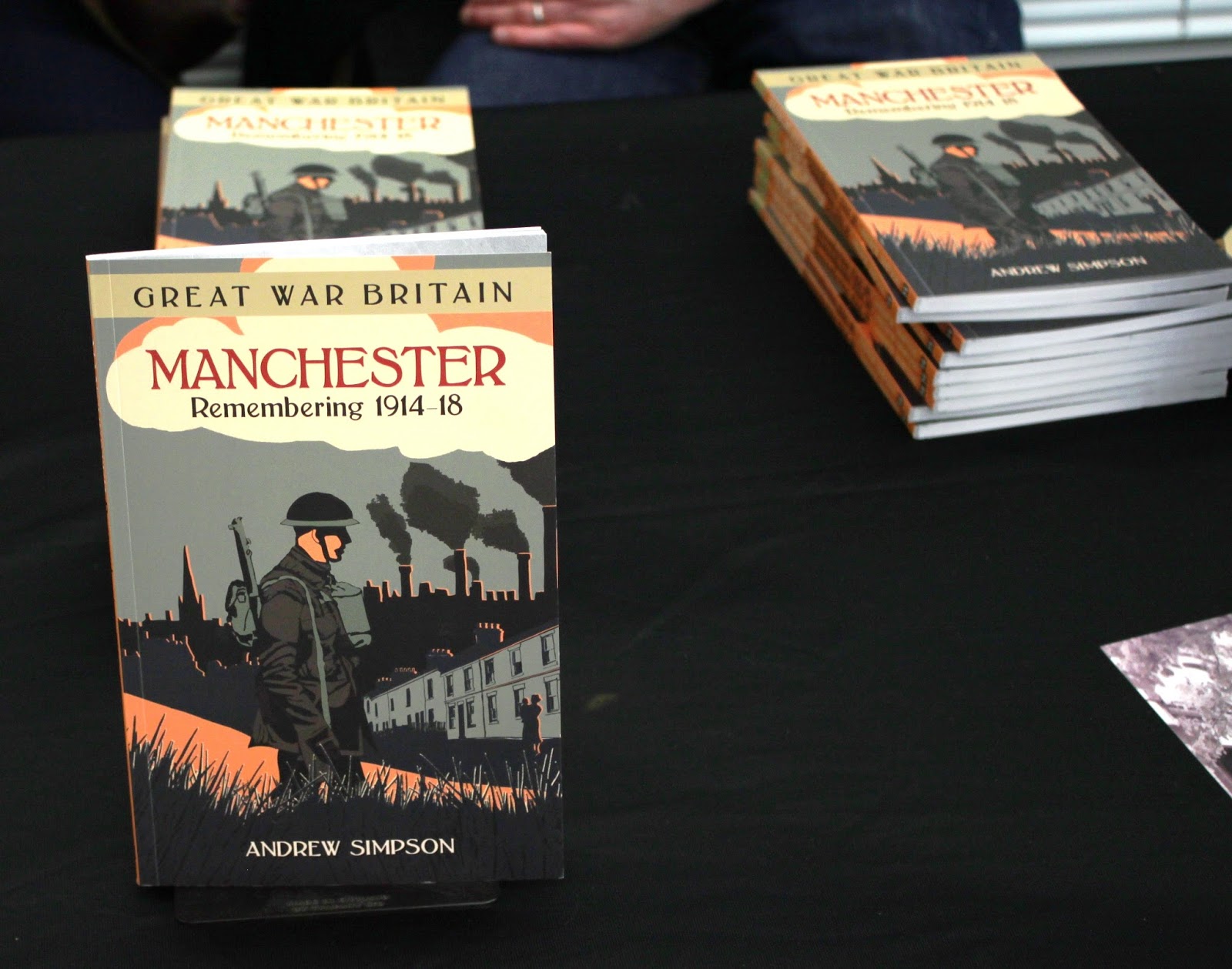
Now as many know Saturday was the official book launch of Manchester Remembering 1914-18 at Central Ref.*

Pat and Dorothy
It was a great success and for that I have to thank David Harrop who supplied much of the memorabilia that went into the book, Dorothea and Helen from the City Council who helped with the event and Chorlton Bookshop who sold copies of the book.

And then there were the people who turned up including old friends like Keith and Rhona, and Tom, Val and Joe who I have known for years and even older friends like Greevz and John Evans who I first met in the early 1970s.

A moment in the powerpoint presentation
Added to these were some newer facebook friends like Bill Sumner and Martin and Tony who write for the blog.

There was even a nice sense of continuity in that Oliver Bailey who supplied some of the original source material for my first book, the Story of Chorlton-cum-Hardy which was published five years ago and now lives in the south pooped in to support the launch.

But what made the event very special was the presence of Pat, Dorothy and Nicola who I invited because members of their family are mentioned in the book.

Pat and Dorothy had travelled down from the Lake District.  Their father was Harold Wild a conscience objector who kept a diary during the Great War which described in detail his opposition to the war, the meetings he attended and his own experiences in front of military tribunals.

"To the Brownhill family"
It remains a powerful insight into how one man viewed the war and the hardships he endured as a result.

And I was equally pleased that Nicola could be there.  She had handed over a whole suitcase of material from her family who lived through the conflict and from that suitcase I used a replica of the Cenotaph which appeared in the book.

I know there will be someone who I have missed out and for that I apologise in advance leaving me just to mention my old friend Lois who is also a writer and was on hand to follow each research hiccup.

And then finally there is my family, who have lived through the endless progress reports and given lots of encouragement and never once said “enough Dad”.

The book, 2017
So to Ben Josh and Saul who listened and to Luca who came along as the “official photographer” a big thank you and an even bigger one to my partner Tina who not only saw the project through with great patience but was there on the day running the event while I sat and signed books.

But I cannot close without mentioning the very people who the book was all about.

Very early on I had decided I wanted to remember them by writing about their lives and in the course of doing so present them to a modern readership, exploring the sacrifices they made, their differing opinions about the war and the many ways they faced the struggle, from brave stoicism, to humour and much more.

George Bradford Simpson, circa 1918
And near the end I chose to include a photograph of my own uncle along with the telegram he received from the Queen on his 100th birthday.

It was a decision based less on the fact that he was my uncle but more because between the picture of this young nineteen year old soldier and the centenarian was a man who had a productive and happy life, lived out over three centuries of which the Great War was just a small part.

Location; Manchester

Picture; George Bradford Simpson, circa 1918 from the collection of Andrew Simpson and pictures from the book launch, 2017 by ALTOSOUNDS


*Manchester Remembering 1914-18 by Andrew Simpson was published by the History Press in February 2017

Order now from the author, or the History Press, http://www.thehistorypress.co.uk/publication/great-war-britain-manchester-remembering-1914-18/9780750978965/ and Chorlton Book Shop, info@chorltonbookshop.co.uk 0161 881 6374

*A new book on Manchester and the Great War, http://chorltonhistory.blogspot.co.uk/search/label/A%20new%20book%20on%20Manchester%20and%20the%20Great%20War

Wednesday, 11 November 2015

He was always part of my life........The Kenora Cenotaph

He was always part of my life. 

He is not laying in repose, nor displayed on bended knee, nor with his head bowed. Instead, he stands atop a roughly sculpted piece of granite, on a base of solid blocks of stone, looking towards the northeastern skies, forever silent, forever vigil.  Wearing a soldier’s uniform and great coat, he stands firm - boldly - a constant reminder of what was and still is.

A list of names, etched on a bronze plaque, is attached to the locally hewn granite.

It is the Roll of Honour: the names of the ninety soldiers from my small home town of five thousand, whose lives were taken in the Great War, in partial payment for the freedoms my country continues to cherish and value.

No other names have since been added, but there could be many, for the fallen from World War II was a much longer list.

This place of remembrance was created by Creber Brothers, of Toronto, Ontario, to the specifications of the Memorial Committee.

The entire cost of $8,000 was raised in less than one year by the townspeople: door to door canvasing, a carnival, teas, bazaars, and musical  performances in the little local opera house. All contributed to this community project.


Ever since that warm autumn day, September 7, 1924, this soldier has stood on the lawn in front of the courthouse in Kenora, Ontario - just one of the many memorials across this nation, dedicated to those who served, but never returned.

His nameless face is gazed upon, and most often remembered, when people gather around him on Remembrance Day, every November 11th.  We have placed wreaths and crosses at his base, said prayers, played The Last Post, and sung the traditional remembrance song, “O God, Our Help in Ages Past.”


I think of those who have died and all who have served in battles, conflicts, wars, and during peacetime.

I think of my relatives who served in World War II: both my parents – my mother in the Canadian Women’s Army Corps, my father with the 8th Canadian Infantry in Italy and, later, Belgium; my aunt, a nurse in France; and, my five uncles, one of whom was severely burned when his plane was downed near the English Channel.

I think of my husband, now deceased, whose sense of duty, commitment, pride and loyalty to his country, were formed in his fourteen years with the Canadian Armed Forces – without a single shot being fired. Like his grandfather before him, Wayne was mustard gassed, but not in the fields of Ypres.  Instead, it was on the training fields in Suffield, Alberta in 1968. The horrors never seem to end.


One monument, this one cenotaph, has been a focus for me but once a year; yet its story, and the memories it evokes, will continue to be a place where I can think upon and express gratitude to those it represents.
“It is not a new bereavement, but one which time has softened. Nature has already decorated their graves with memorials of her love; for over the humblest, she has bidden grasses to grow, poppies to bloom, and the butterfly and the hummingbird to wave their little wings– ancient emblems of immortality.”  Kenora Miner and News, September 16, 1924, p.1.

© Susan (Hillman) Brazeau, Lloydminster, Alberta


Pictures; Cenotaph Photo: By C. Linde, 1924, Lake of the Woods Museum Collection, all other photos from the author’s Family Collection

Tuesday, 15 April 2025

The unpromising picture postcard that offers up a bag of history .....

 As picture postcards go this one of the Midland Hotel wouldn’t win any prizes.


It maybe that the quality was poor to begin with or that repeated “touching up” of the original did not do it any favours, but I can’t say I would be pleased to get this one through the post.

That said it is an interesting one for a number of reasons.

First it postdates 1907, because until that date the church of St Peter had stood on the site of the landscaped area.  Nor can it be after 1924, because there is no evidence of the cenotaph, flanked by the twin obelisks, which was unveiled in 1924.


That said I rather think we are dealing with old stock, because it carries a post mark with the date of April 1925, a full ten months after the cenotaph, and been built

And also carries a stamped reference "London Defended" at the Wembley Stadium.

This was a series aerial displays performed from May 9th to June 1st 1925, by No. 32 Squadron RAF at the Wembley Stadium. 


Similar to the display they had done the previous year, when the aircraft were painted black, it consisted of a night time air display over the Wembley Empire Exhibition flying RAF Sopwith Snipes which were painted red for the display and fitted with white lights on the wings, tail and fuselage. 

The display involved firing blank ammunition into the stadium crowds and dropping pyrotechnics from the aircraft to simulate shrapnel from guns on the ground, while explosions mimicked the effect of bombs being dropped into the stadium.*

Leaving me just to remark that the card was sent to Vienna and the message is in German.

So that pretty much is that.

An old iffy picture postcard, offers up a view of St Peter's Square, long gone with a bit of a story spanning Vienna and London.


The postcard was marketed by Tuck and Sons, under the heading of Manchester, LMS, with the note that “THIS HOTEL IS ONE OF THE "MIDLAND" HOTELS AND IS MANAGED BY ARTHUR TOWLE, CONTROLLER, L.M.S. HOTEL SERVICES, ST. PANCRAS, N.W. 1”

Location; Manchester

Pictures; the Midland Hotel, circa 1907-1924, from Tuck and Sons, courtesy of Tuck DB, https://tuckdbpostcards.org, and poster of London Defended Torchlight and Searchlight spectacle, The Stadium Wembley May 9 to June 1, 1925, Scanned from original document by me Jimmy3d0 (talk) 14:18, 19 June 2010 (UTC)

*British Empire Exhibition, https://en.wikipedia.org/wiki/British_Empire_Exhibition


Tuesday, 26 August 2025

Walking the paths of the remembered …..... the new book from Michael Billington

 Mr. Billington’s new book The Churchyards & Cemeteries of Urmston, Flixton & Davyhulme, is more than just a record of gravestone, memorials and churchyards.


It combines fine scholarship, a fascinating collection of period and contemporary photographs, and is easy to read, all of which marks it out as a book to visit.

St Catherine's Church
And not just if you live or lived in Urmston, Flixton or Davyhulme, because the depth of detail about funeral practices the culture of the dead and the stories behind the gravestones make it a book that many will both enjoy and lean from.

For me it is the little additions that make it more than just a list of who died and when.

So included is a fascinating description of how in the 21st century “the use of hammer and chisel to engrave by hand has been substituted by computerisation”, while peppered through the book are short verses drawn from a collection of writers and more than a few which stretch back in time and are anonymous.

Philip Weisberg

Added to which Mr. Billington has written extensively about Urmston Jewish Cemetery, drawing on his own deep research and assisted by the Jewish Historian and Genealogist Dr Rosalyn Livishin and Dr Sharman Kadish.

As ever it is the stories he draws out that make for riveting reading, so here is a description of the war memorial commemorating the twenty-eight Jewish servicemen who died in the two world wars and is a salutary reminder in a period of rising antisemitism of the contribution they made to the protection of our country.

The window of three Worthington Wright children 
Talking to Michael about the book just before its publication he told me just how moved he was by so many of the inscriptions he encountered in all the graveyards, and particularly the awful record of child mortality.

So included in the memorials is "the stained glass window in the church of three Worthington Wright children who all died during the month of November 1858. The first two died of scarlet fever and measles and the last one just of scarlet fever".

Along with this was his determination to tell all the stories not just of the “great and the good”, but those who history has forgotten and in some cases  who history didn’t even both to notice.  Which is a nice lead into the epitaph of Robert Phillip of Kingsbridge , Devon which Michael includes 

“Here lie I at the chancel door

Here I lie because I’m poor

The farther in more you’ll pay

Here lie I as warm and they”

Leaving me just to include the publisher’s notes 

“The townships of Urmston, Flixton and Davyhulme have a rich and diverse historical heritage. This richness and diversity are reflected in how the townships honour their dead from the burial grounds themselves to the cenotaphs and stained glass windows, and plaques in the churches.

Cenotaph with poppy wreaths, St Mary's Church Davyhulme
This book looks at not only the grand statement tombs of the wealthy but also the final resting places of vicars, churchwardens, sextons, choirmasters, church organists, journalists, actors, teachers, pub landlords, architects, policemen, servants and paupers”.

It costs £16.99 and is available from the author at epona publishing, www.eponarecords,com, J Parkers Garden Centre, Urmston Books, Trafford Local Studies, and Salford Museum and Art Gallery

Location; Urmston, Flixton and Davyhulme

Isaac and Leah Samuels

Pictures; from the collection of Michael Billington, 2025

*Billington, Michael, The Churchyards & Cemeteries of Urmston, Flixton & Davyhulme, 2025

**ibid, page 276