Thursday, 16 April 2015

So it’s goodbye to the Waggon and Horses in Sale ..... closed for a decade and soon to be a hole in the ground

The Waggon & Horses 2014
It was just under a year ago that Andy Robertson wandered in to Sale and snapped the Waggon and Horse.*

It had closed sometime around 2003 and has stood empty ever since.

Now I have yet to track the pub back to its beginning, but it was there in 1875 and just over a hundred years later made a stir by replacing the electric pumps with the traditional hand pumps and barrel and sold real ale.

Both Andy and I pondered on its future.  Its last landlord had confirmed it had been sold to a developer but that was it.

The Waggon & Horses, 2015
Andy passed it yesterday and it was clear something was happening, and not just to the old pub for along the road the same tell tale scaffolding and netting obscured the neighbouring building.

And a search of the Trafford Planning applications revealed that in February of this year there had been an application for the “Demolition of the Waggon and Horses Public House together with Nos. 137-145 Cross Street and all light industrial buildings to the rear.”*

And next door today
Now as yet there is no indication of what will replace the buildings but I guess when Andy next passes there will just be a hole in the ground.

That said not long after I posted the story, someone dug out a planning application from five years ago which applied for the demolition of the existing buildings to replaced by a mix of retail, commercial and residential properties.***

The application was approved in November 2010.


And next door a year ago
So I guess Andy will not have to look at a hole in the ground for long.  On the other hand given that he passes the spot regularly I rather think we may have a new photographic project about to begin as Andy chronicles the development of the site.


Pictures; The Waggon and Horses and neighbouring buildings in 2014 and 2015 from the collection of Andy Robertson


* Thinking about the fate of the Waggon and Horses in Sale a decade and a bit since it stopped serving, http://chorltonhistory.blogspot.co.uk/2014/05/thinking-about-fate-of-waggon-and.html

**84951/DEM/15, http://publicaccess.trafford.gov.uk/online-applications/simpleSearchResults.do?action=firstPage

**6054/O/2010, http://publicaccess.trafford.gov.uk/online-applications/caseDetails.do?caseType=Application&keyVal=ZZZW38QLTA628


Wednesday, 15 April 2015

A story of steam and textiles beside the river underneath the viaduct

Now it is nice when a piece of research by my friends Graham and Neil coincides with a painting from Peter Topping who is also a friend and who I have collaborated with on many projects.

And so with nothing from me here is the story of that mill by the river under the railway viaduct at Stockport .

A collaborative effort which just left me the job of posting the story.

Now that is easy history.

“The first record of a mill on this site was when John Collier, a cotton manufacturer built a mill in 1790. It was water powered. 

The mill probably consisted of two multi-storey spinning mills and attached weaving sheds, one destroyed by fire in 1831 and the other rebuilt in 1884. 

Thomas Fernley bought the mill in 1824, and in 1831 needed to replace one mill with a new one that was of fireproof construction. 

This mill was eleven bays long and six storeys high. The floors were sprung on transverse brick arches supported on cast iron columns. 


It was driven by a beam engine in an internal engine house to the east of the mill. 

It was over this engine house that the Manchester and Birmingham Railway built the Stockport Viaduct in 1840, and again when it widened in 1880. 

The second mill was replaced in 1884, but not the original wheelhouse. 

It is a five-storey, 15-bay mill of fireproof construction with narrow longitudinal vaults springing from iron joints. 

The original weaving sheds have been replaced with two-storey structures, creating a complex site.”*

Wear Mill was listed as a Grade II building on November 4 1996**

Painting;  Wear Mill Stockport,  © 2013 Peter Topping
Web: www.paintingsfrompictures.co.uk
Facebook: Paintings from Pictures https://www.facebook.com/paintingsfrompictures

*Graham Gill

** Neil Simpson, http://www.britishlistedbuildings.co.uk/en-462275-wear-mill-#.VS5je9zF8jF

Monday, 13 April 2015

What did Century House do to so upset people?

All that is left of Century House, 2015
Now I wonder just what Century House on the corner of St Peter’s Square did to upset anybody?

It was a fine neo classical building of Portland stone which fitted nicely across the road from the Town Hall extension and Central Ref.

It was built in 1934 for the Friends Provident Society and for me was everything you could want from a building.

It was elegant and stylish and was not one of those buildings which got in your face or made you feel insignificant as it soared brutally into the sky.

Century House, 1940
Of course there will be those that argue that was exactly why it had to go, and certainly it looked out of place beside that brash structure that has been built opposite the library.

Not that they need to worry.

The artist’s impression shows a big box standing above a glass space.*

And now there is little left of Century House.

It came close to being listed and was described by English Heritage as “a prominent building which is of strong local interest.”**

I am told the new building may be up before the end of the year, and I may change my mind about its design when it is finished.

But in the meantime I look again at the pictures of the building when it was still new and reflect also on the many times that I passed the place and  I rather think that however big shinny and busy its replacement becomes  it will not replace my affection for Century House.
Century House in the sun, 1957

We shall see.


Pictures; Century House, 1940, m56165, and 1957 H Milligan, m04427, courtesy of Manchester Libraries, Information and Archives, Manchester City Council, http://images.manchester.gov.uk/index.php?session=pass and all that is left of Century House, 2015 from the collection of Andrew Simpson

* Done brothers' property firm submits plans for £80m city centre building, Adam Jupp, MEN, May 2013, http://www.manchestereveningnews.co.uk/business/property/done-brothers-property-firm-submits-3662634

**English Heritage Assessment Report no 475783 November 28 2012, quoted from 20th Century Society, News Claire Price, http://www.c20society.org.uk/news/century-house-manchester-threatened-by-demolition/

Adele Bloch-Bower, a Nazi war crime and an art critic

Adele Bloch-Bower, 1907
We went to see Woman in Gold on Saturday.

It is a film about the restitution of stolen paintings by the Nazis from an Austrian Jewish family and as such raises a whole shed full of issues.

First there will be those who question how far a film can ever faithfully reproduce a moment in history.

After all we have all seen films which mix events, telescope whole decades into a single year and both air brush out key historical figures as well as making bits up, all for dramatic effect.

And on reading the life of Maria Altmann who started a legal battle to have her family paintings returned after their confiscation by the Nazis there are a fair few details which did not make it to the film.

More importantly there is that thorny issue of returning art works, which in the case of many great museums and art galleries would mean the loss of exhibits which have come to be seen as national treasures.

From the Elgin Marbles to Egyptian grave goods and African war masks and countless other priceless objects which were spirited away from their place of origin would vanish from where they have sat for a century or more.

In the case of Maria Altmann it was a collection of fine paintings by Gustav Klimt of which the most important was the stunning portrait of Adele Bloch-Bauer which was painted in 1907.

It had belonged to Maria Altmann’s family from when it was commissioned and had the further connection that Adele Bloch-Bauer was Maria’s aunt.

But the painting had also become an important Austrian national art treasure and there hung the issue.

The rest is there to follow in the 109 minutes of the film or in countless articles.

Now we enjoyed the film, and those missing bits from the family history would not have added anything to the story.

As for the issue of the National treasure that was straightforward.

It was a clear case of theft from a family who could still be identified and who had like so many other Jewish families suffered at the hands of the Nazis.

The surprise is that there are so many other items which were stolen and which have yet to be returned and while some will never be able to be claimed others have yet go back to their rightful owners.

All of which just leaves the film itself.  I enjoyed it, not only because of its subject matter but also because I thought it was well acted and had pace humour and depth.

Not so the critics, and not for the first time I had to wonder if I had seen the same film or was just not up to the job of appreciating what makes a good film.

Worse still like so many critics the piece was almost just a vehicle for a clever turn of phrase and less about the film.

But maybe I got that wrong.

What I am sure about is that the film got to the heart of an issue.

Picture; Adele Bloch-Bauer, Gustav Klimt, Wikipedia Commons,The Yorck Project: 10.000 Meisterwerke der Malerei. DVD-ROM, 2002. ISBN 3936122202. Distributed by DIRECTMEDIA Publishing GmbH. 2. Neue Galerie New York

Children, alcohol and the Band of Hope


I wonder how many societies stretching back to the early civilisations could make the claim that they truly treated children properly.

Now before someone makes the observation that it is unfair to judge the past by present standards I fully acknowledge that they did things differently.

And merely citing odd examples out of context is not good history because in isolation such examples tell us very little.

But I don’t think that prevents us from exploring the degree to which the young or at least some of the young were ill treated, abused exploited or exposed to things we regard as inappropriate.

So while parents were no less loving or protective of their own they still set their own to work at any early age which in many cases given the harsh economic system and subsistence farming gave them no alternative. Moreover many lived in communities which saw nothing wrong with the use of child slaves.

In the 19th century we sent them down the mines, made them crawl underneath moving machinery in the textile factories and watched them work in the fields in all weathers.

Despite the efforts of the early labour movement and progressive members of the establishment there remained real opposition to a change in the system and when the first legislation was finally passed restricting the use of child labour it was restricted to the textile factories and was not supported by a rigorous system of inspection.

Later still it was not till nearly the end of the century that serious efforts were made to stop young children hawking in the streets of our cities.

And not till 1901 was it made illegal to sell alcohol to children under the age of 14 and even then it did not apply if the container was in a corked or sealed container. Earlier in the century according to Annemarie McAllister in “The lives and souls of the children”: The Band of Hope in the North West* “A select committee reported that in public houses in Manchester ‘on a single Sunday in 1854 there were 212,243 visits to drink shops and 22,132 of these were made by children, some of whom went to drink on their own account – some to fetch drink.’”

Much the same is evidenced in the engraving Sunday Afternoon in a Gin Palace from the Graphic in 1879 by Charles Green.  Here amongst a collection of drinkers of all classes are two children one of whom is drinking gin and another about to be served.  It is an image as Annemarie McAllister points out that could be seen over a hundred years earlier in Hogarth’s Gin Lane which features children drinking from small glasses.

And gin in a way supplies the context.  It was a real problem and was commented upon by many social observers of the period.  In Manchester while the population had doubled “the consumption of gin and whiskey has quadrupled.......... Drunkenness has infused itself into the bosom of society.  Habit has conquered shame, and that which formerly drew a blush from the men, is now regarded as a daily habit by women and children. ”    **

In 1830 in an effort to break the hold of gin the Government passed the Beer Act which allowed anyone who was a rate payer and could afford the yearly license of two guineas [£2.10p], to brew and sell beer from their own homes without permissions from the Justices of the Peace,.  The beer they sold was stronger but they were not allowed to sell spirits or open on a Sunday.

The result across the country was an explosion in the number of beer shops.  In Manchester just ten years after the Beer Act there were 812 beer shops compared to 502 pubs which rose to 920 in 1843 as against 624 pubs and 31 inns and hotels.   ***  Ten years later there were 1572 beer shops compared to 484 pubs.

The full enormity of this provision can be gauged from taking just four streets in the densely packed warren which ran behind Great Ancoats Street.  In these four streets could be found 90 pubs, taverns and beer shops in the years 1841-50.

And here in Chorlton we had our own fair share, some of which lasted for most of the century while others opened and closed almost overnight.  Most I suspect were not the attractive bright palaces that pubs were to become but as best small rooms in private houses and at worst just a place to buy beer in a jug to take home.

But their potential for social damage led some to advocate temperance and it is this that is explored in some detail in the article and much is made of the movement’s attempts to draw young people in.  So as well “as aiming to reclaim any young drinkers, such organizations acted on the premise that children provided blank sheets  for the temperance message on the principle that ‘if they never use intoxicating drinks, they never will know the want of them’.”*****

And that is about where we started.

Pictures; from The Life and Adventures of Michael Armstrong, Trollope, Frances, 1844, and Victorian Pub, from the exhibition at Salford Museum


*McAllister Annemarie, “The lives and souls of the children”: The Band of Hope in the North West, in Growing Up in the North West, 1850s-1950s, Manchester Region History Review Volume 22 2011
** Faucher, Lean, Manchester 1844 Its Present Conditions and Future Prospects, 1844 Abel Heywood 1969 Frank Cass pages 48-49
*** Ibid Faucher, page 48
**** Eric J. Hewitt A History of Policing in Manchester 1979
***** Gun Street and Henry Street ran parallel behind Great Ancoats Street and crossed Blossom Street and Jersey Street Piggot & Slater’s Directory 1841, Slater’s Directory 1850
***** ibid McAllister Annemarie page 4

Sunday, 12 April 2015

Of Victorian scandals, the fog of morality and the unequal status of women


There is something about the great mid Victorian moralistic paintings which I like.

They tell a story and while I don’t always like what they say there are nevertheless a wonderful insight into a period I write about a lot.

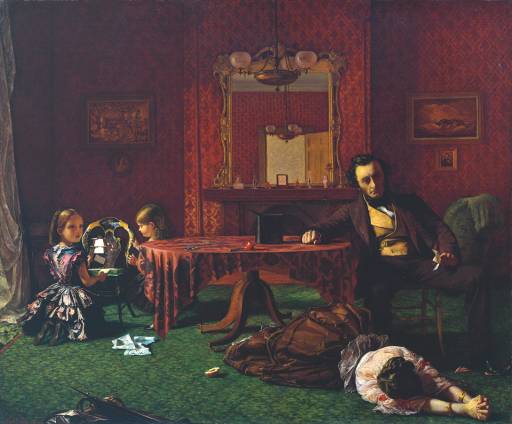
So to the painting or strictly speaking the triptych, painted in 1858 by Augustus Leopold Egg.

It tells the story of a wife’s infidelity and the repercussions on her, her husband and their children.

The title uses an imaginary diary entry, August the 4th - Have just heard that B— has been dead more than a fortnight, so his poor children have now lost both parents.

I hear she was seen on Friday last near the Strand, evidently without a place to lay her head. What a fall hers has been!

The central panel is the moment that the affair comes out into the open while to the left is the fate of the mother and youngest daughter under the arches by the Thames, and to the right the scene of the older children alone in a room consoling themselves in prayer.

Here then are the three key episodes with Misfortune in the centre, Despair to the left and Prayer to the right.

And all three are rich with symbolism if you know what to look for and can make the links.  So while the drama unfolds, two girls are momentarily distracted from the fragile house of cards they are building balanced on a book by the French novelist Honire de Balzac.

A half-eaten apple that emblem of temptation lies near the wife and the remaining half sits on the table by the husband  stabbed through with a knife.  And there is much more on all three paintings.

Now I do not pretend to have picked these details up and came across the references in Mrs Robinson’s Disgrace The Private Diary of A Victorian Lady* which I am rereading after a break of a few years.

It is my beach book for the week and tells the story of woman’s brief affair with a younger man who then runs a mile when the case the aggrieved husband sues for divorce using the new divorce laws.

The 1850s were still very much a period when married woman had few rights. .

 She had “no legal existence, her being is absorbed into her husbands.”**"

She could not undertake legal proceedings or keep her earnings or spend her own money, and “has no legal right even to her own clothes or ornaments; her husband may take them and sell them as he pleases.”***

Divorce had been made easier in 1857 and the new Divorce Act included provisions for the protection of married women’s property, allowed wronged wives to keep their earnings and relaxed the standard of proof for adultery.

It was a step forward and in the first five months of 1858 180 petitions were brought before the Divorce Court. The Lord Chancellor announced himself pleased and commented that “Now all classes of people are placed upon the same footing.”

All of which might have been fine for the Brighton solicitor, but was of little use for the factory hand in Manchester or the agricultural labourer here in Chorlton.

And there is the rub.  The new law continued to reflect the needs and interests of the propertied and moneyed classes.

Not only was a recourse to law still expensive but it remained weighted I favour of men.  “The new law stipulated that to secure a divorce, a husband needed to establish just his wife’s infidelity, where as a woman needed to prove that her husband was not only unfaithful but also guilty of desertion, cruelty, bigamy, incest, rape, sodomy or bestiality.  

Because she might bear another man’s child, the unfaithful wife threatened certainties about paternity, kingship, succession and inheritance, the underpinnings of bourgeois society.”****


Now I will not tell you what happened, mainly because I haven’t finished it but it is as they say a good read.

And for me it is full of references to life in mid Victorian Britain, so in the course of the story you are taken down the medial theories about sexual health, the fad with water cures and much more.  Added to this there are rich references from the writers of the period including Darwin.

And for me it is a perfect balance to the work I have done on the history of our own rural township at the same time.

Pictures; from the triptych, Past and Present by Augustus Leopold Egg, 1858

*Summerscale Kate Mrs Robinson’s Disgrace The Private Diary of A Victorian Lady, Bloomsbury 2012,
**Mrs Norton, Letter to the Queen, 1855
***ibid Mrs Norton
**** ibid, Summerscale, page 123

When you still sent your films off in the post ........... another of those lost ways of doing things

Cherrytree Laboratories, 1979
It’s funny what you find on the cellar floor.  

I must have passed this receipt from Cherrytree Laboratories Ltd a dozen times and never bothered to pick it up.

It will have fallen out of a pile of papers long since deposited down there for safe keeping.

But now it is a little bit of history for I doubt that many people still send films off to be processed and await their return as 9 by 7 paper pictures.

Today the digital camera and the mobile phone have all but made the old fashioned process of using film and chemicals almost a thing as dead as the telegram and the VHS recorder.

I can’t of course now remember what the images were that Cherrytree Laboratories processed for me, but as they were black and white they would have been possibly the first I took using that old reliable camera the Pentax K1000.

Already by December of 1979 I was beginning to develop and print my own black and white pictures but because I never got into the more complicated process of colour development this would have been left to the commercial firms.

Paris 1980
And now like most people I use a digital camera, straight to the computer and all that wait to wonder if the pictures worked has gone, for in an instant it is possible to judge the quality of the shot and decide to take it all over again.

All of which has its advantages but there are of course downsides, not least that simple one that fewer and fewer photographs ever make it to become a paper image.

Instead they are locked in a computer seen by a handful of people and in time are just discarded or lost as operating systems move on.

Not that this is ll doom and gloom, for the very technology that has made digital pictures so popular has also allowed people to post them on the net and social networking sites which will reach thousands in a click of the mouse.

So not all bad then.

All of which brings back me Cherrytree Laboratories Ltd of Union Road, Sheffield.  I went looking for them
but could only come up with one reference in the Gazette for 1980 which recorded that  the Health and Safety Executive had announced that the firm along with a string of others “during the month ending April 30th 1980, has made special exemption orders relating to the employment of women and/or young persons.”

Paris 1981
The particular bit of legislation is dense and so I will leave it to others to work out what was meant.

As for the firm I couldn’t find another reference and a visit to Union Road revealed nothing which looked at all industrial.

Someone will no doubt put me right, but until them this is all I have for Cherrytree Laboratories Ltd and a way of making your snaps into pictures for the album.

But like so many new innovations the demise of the film led to the loss of many jobs.

And so I shall the last word to my friend Debbie who remembered, "the thrill when you came home from work and the bulky envelope was on the mat - with no idea what the photos turned out like.  

On the downside of digital, lots of British jobs lost printing chemicals etc no longer so necessary."

Pictures; receipt from Cherrytree Laboratories Ltd, 1979 and Paris, 1980 & 1981 from the collection of Andrew Simpson

* The London Gazette, May 21 1980, https://www.thegazette.co.uk/London/issue/48190/page/7366/data.pdf