Showing posts with label Stories behind the postcard. Show all posts

Saturday, 1 August 2026

The Tale at Eltham …….

Now I really wish I knew just what the “Tale at Eltham" was, but alas it is lost.


Nor I suspect did anyone know just what had gone on in Eltham in the October of 1917 when this picture postcard was sent to Miss Goddard of Sussex.

I can tell you that it was sent at 2.30 in the afternoon, but can’t make out from where it was posted.

Nor can I really be sure that the sender or Miss Goddard had any connection with Eltham, which leave me wondering if it had been the two “young things” that caught the attention of Eliza who sent it.

But then these picture postcards were standard fare, with the company merely over printing different destinations to attract local audiences.

Some where in the collection I have another with a different place name.

The message on the back is difficult to read but hints a at a boat trip and an admonishment that Miss Goddard hadn’t written recently.

So that is it, a little bit of 1917 which might or might not have a connection with Eltham.

Location; Suffolk and maybe Eltham

Picture; The Tale at Eltham, 1917, from the collection of David Harrop


Sunday, 16 November 2025

The Last Car from Manchester ……. the story with a sad ending

I like this picture postcard, but have never thought about writing its story.

I suppose that is because it is one of those general picture postcards, which will have been over printed with the names of towns and cities across the country.

So, as such its connection to Manchester is pretty slim, and it just kept getting passed over.

But yesterday I persevered, that said, with no comment on the back, no address and above all no postmark there seemed little to go on.

There was however the name of the company who marketed it, but I didn’t hold out much hope, given that there were countless companies which flourished and vanished during the decades either side of the last century.

But I was wrong, because The Cynicus Publishing Company Ltd of Tayport in Fife, wasn’t any old postcard company it was established by Martin Anderson, who according to one source was “better known by his pseudonym Cynicus, was a Scottish artist, political illustrator and publisher”.*

His early working life involved producing illustrations for a variety of publications, before setting up in his own business in London in 1891, and from there setting up a postcard company publishing his own designs in 1902.

After a promising start his business like many suffered from a fall in the popularity of such picture postcard and the company went into liquidation with his stocks of prints and original work were sold for a fraction of their real worth.

A further attempt at a similar business also met with failure when the market for seaside picture postcards declined with the outbreak of the Great War.

Mr. Martin produced a series of anti war posters and cards, which got him into trouble with the authorities. 

“In 1924 his Edinburgh shop was destroyed by fire, everything inside it was lost, and he did not have the funds to repair and restock it. He retired to his castle-like mansion in Balmullo to live in increasing poverty. A final edition of The Satires of Cynicus was published in 1926.”*

He died in 1932, and was buried in an unmarked grave, without a tombstone, and the final indignity was that his home was extensively vandalised after his death.

So a sad story for what was a very happy looking picture postcard.

Mr. Martin produced a series of anti war posters and cards, which got him into trouble with the authorities. 

* Cynicus, Wikipedia, https://en.wikipedia.org/wiki/Cynicus

Sunday, 22 June 2025

A Chorlton mystery under a Spanish sun

Now I have no idea who Mel is or was or when she received this postcard from Chris, but it’s an intriguing little mystery.

I am sure someone will know of Miss M Calderbank who either worked, or lived at the Chorlton Conservative Club.

And maybe even the surname of Chris who confided that “the sea is far to rough for the boat.”

What makes the postcard just that bit more interesting is that it was sent to me by Emma in Spain, which begs the question, of why was it not posted?

Or if it was how did it end up back in Spain?

All very intriguing and within the hour Annette, Della and Marie all replied with memories of Melody Calderbank.  Anntte went to Levenshulme High School with Melody, Della remembered her parents Dick and Mona and Marie told me she would now be in her fifties which might date the postcard to around 1974.

But the best is that Melody's sister has also been in touch commenting that "my sister is 66 now...I'm 56...she married in 1972 when she left the Conservative Club...so post card could be older..."

So not bad as a start and more to come.

Location; Chorlton & Spain

Picture; the postcard, date unknown, courtesy of Emma Gilarranz Gutierrez

Sunday, 25 June 2023

Postcard from Warsaw

Now, sometimes you just get lost in a story.


It seemed easy enough, or so I thought.  

The German on the picture postcard would be easy to translate.

But not so.  

The translation, if I have got it correct reads “Germans innocent in World War”.  The message on the back is undecipherable but I guess will not shed much light on the words on the front.

The post card was sent in the June of 1916 from Warsaw which had been occupied by the German army since the August of the previous year.

And would remain in German hands until November 1918.


I suppose we a dealing with a piece of propaganda but whether this was the message that was intended by the person who sent it is now lost.  

It may be that they were attracted by the lilies which according to one source “portray love, ardor, and affection for your loved ones”.*  An idea reinforced by the words above the portrait of the you women which reads, “Flower language: Lilies”.

Until I can work out the message on the back I am left with  the post marks, one of which appears to be a military one, referring to "Landstr Juf Batl. Burg IV 85", and the other carries the location “Warschau” with the date June 28th, 1916.

There is one last clue and that is the name of the picture postcard company who are listed on the back as R&K, and that this one was 2654/1.  But I fear trying to find information on a German/Polish company a century and bit after the event will lead nowhere.

Location; Warsaw

Pictures; message from Warsaw 1916, from the collection of David Harrop

*Lilies, https://en.wikipedia.org/wiki/Lilium#Symbolism

Saturday, 24 June 2023

A little mystery from West Didsbury ………

I doubt we will ever know who the person was who wrote to Miss Eva Stewart, or for that matter why they had left Ireland, or  the identity of a Mrs. G, who is described as “a lovely person”.


The date the picture postcard was sent is unclear, but I know that the red penny stamp of King George V dates from between 1912 and 1922.*

The message reads, “arrived here alright, and had a good night on boat.  I’m just feeling at home here, Mrs. G is a lovely woman, will write tomorrow”.

The house is still there, and is one of those sturdy but modest family homes, which appears on the OS map of 1894 and maybe older.

I cannot find a reference to a Mrs. G for 1911 on the street directories and for now do not have access to those for the rest of the period up to 1922. A search of the later ones will have to wait till I go into Central Ref.


And that leaves so many questions.  

The correspondent might have arrived from Ireland to take up a post as a domestic servant, but that is sheer speculation and so very unhistorical, and alternatively Mrs. G might have been the landlady.

The next step will be to trawl the 1911 census, but I fear that will yield nothing.

So that is it, leaving me just to comment on the photograph which many will recognise as the hospital of what was still the Withington Workhouse.

The experts might be able to make something of the car and conjure up a date, but I will leave that to them.

Location; West Didsbury

Picture; picture postcard, circa 1912-22 from the collection of David Harrop

*I await the expert to correct my assertion of 1912-22.


Thursday, 1 June 2023

Stories behind a Salford postcard ...... from Sue Tydd

It began as a story about a Salford postcard and a question about Gertie and Delia who were mentioned on the back which became the inspiration for Sue to research the family and write the story.

The Salford postcard, circa 1900
John McCabe was baptised at St. Nicholas, Dublin in 1854, he moved to England as a young man firstly to an aunt in Macclesfield and later to Manchester where he married Margaret Maloney a Galway girl in 1875 at St. Wilfred’s in Hulme.

Numerous children came along in the following years the eldest Julia in 1876 followed by John, Margaret,
Frederick, William, Florence, Theresa, Bridget (Delia), Matilda (Tilly), Joseph and Gertrude (Gertie) in 1891.

Quite possibly there were more children (I haven’t found out about ‘Geff’ mentioned by Delia on the postcard to Gertie) born to this Irish catholic family before Margaret’s life was cut short in 1897.
John having been left widowed with children ranging from infants to children of a working age with presumably no family locally had little choice but to admit at least two of his young children into the care of Holly Mount.

Holly Mount, 1894
The orphanage/ school of Holly Mount in Tottington on the outskirts of Bury admitted children from poor catholic families who else-wise were destined for life in the Workhouse.  The establishment was run efficiently by the Sisters of Charity of Jesus Christ a Belgian order of nuns.

A board of guardians administered financial matters.

It would have been a formidable place for the young girls to enter sharing living space with over 200 other young girls.  It was normal for girls to remain here until reaching 13 years of age an acceptable age at the time to begin a working life.

As with other similar institutions the girls were taught numerous domestic duties to equip them for married life and often a life in domestic service.

Not unsurprisingly John still of a reasonable age remarried in 1899 to Emily Roberts and sired at least two children with her and raised her son William alongside them. 1901 the new family  are living in Hulme with only Theresa from his first marriage living amongst them, Tilly and Gertie are to be found on the census for Holly Mount.  John passed away aged 73 years old in South Manchester.

Bridget, fondly called Delia from the postcard married Charles Dunderdale in 1928; a widower 20 years her senior with an already adult family. Passing away in 1941 Charles left a reasonable sum of money to Delia, she herself died in 1963 her probate details her beneficiaries as Matilda Evans and Mary Gertrude Grant widows.

Manchester Royal Infirmary 1950, where John Wilcox was a patient
From searching through local records it is confirmed the ladies are her sisters Tilly and Gertie.
Matilda, (Tilly) had been born in 1887 and as we know from earlier spent some time after her mother’s death at Holly Mount.

She married John Wilcox a Rubber Heel Moulder in 1909, a daughter Lilian was born soon after and as often happened died in infancy.  A son Harold was born in the early part of 1911, by the time the child is one month old John Wilcox is a patient in Manchester Royal Infirmary.

The cause or illness I do not know or in fact if he ever returned home, it is documented  though he passed away in 1913.  One hopes Tilly found happiness again in 1916 when she married James Evans having at least four children with her second husband she passed away in 1975.

Of Gertie as yet I haven’t located her marriage although we do know she married a man with the surname of Grant, perhaps this was also a second marriage and so proving problematic to locate.
Florence married Giovanni Geri and passed away in 1966.

Other siblings I have yet to find in their adult life, I’m sure a bit more digging will unearth more information and I will update accordingly.

What we can learn from this family is life wasn’t always easy or kind in the 19th century or indeed the 20th century and many families were separated due to the death of one or both of their parents at a tender age; including my grandmother who was suddenly orphaned at eight years old, but that’s a story for another day.

© Sue Tydd 2017

Pictures; Peel Park, circa 1900, marketed by Tuck & sons,  from the collection of David Harrop, Holly Mount School, 1894 from the OS map of South Manchester, 1894 courtesy of Digital Archives Association, http://digitalarchives.co.uk/ Manchester Royal Infirmary, 1950 , m52916, courtesy of Manchester Libraries, Information and Archives, Manchester City Council, http://images.manchester.gov.uk/index.php?session=pass


Saturday, 22 April 2023

News from Huddersfield of Manchester, hot water bottles and much more

Now in the great age of the picture postcard, you could send a card in the morning confident it would be there by later in the day.

All of which made the picture postcard the text message of its time.

In the case of this one which was sent from Huddersfield to Scotland the message and the picture of a Blackcap would have been on the door mat of New Lanark Cottage for breakfast.

It was posted sometime before 8 in the evening of August 24, 1939 by Joe who signed himself “Your obedient husband”.

He had been in Manchester but was glad to be back, and went on to tell his wife that he was about to put the hot bottles in the bed.

And that intrigued me and will prompt me to go looking for the weather report for August 24, 1939 to check out whether it was unseasonably cold that month.

Or perhaps it was just Huddersfield that was cold, or this might just be what they did every night.

We will never know.  That said I do know the bird on the front is a Blackcap which according to the description on the card is   “so called from the glossy black cap.  His song, heard early in spring is very melodious.”

And that is that.

Location; Huddersfield

Picture; postcard 1939, from the collection of Linda Rigby

Saturday, 31 December 2022

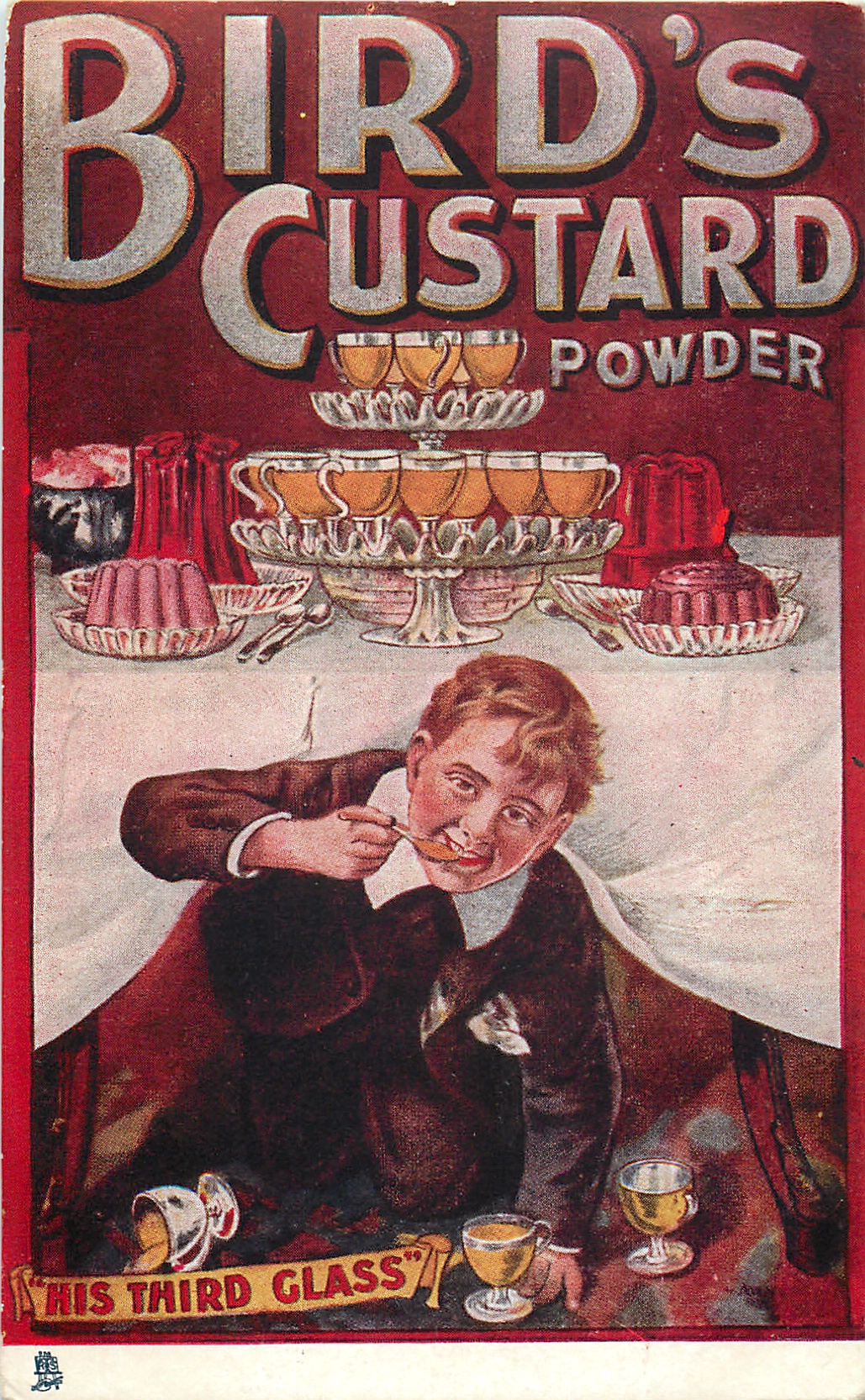
Mr. Bird and his amazing new product ………

Now I think we take advertising posters for granted, and really only get interested when the poster or the advertising campaign draws us in, which of course is what its all about.


Over the years we will all have our favourite, from the Milky Bar Kid, to Esso Blue and Cadbury’s Flake.

All of which leads me to this one which dates from 1904 and a brand which sits with most of us.

According to one source, “Bird's Custard was first formulated and first cooked by Alfred Bird in 1837 at his chemist shop in Birmingham. 


He developed the recipe because his wife was allergic to eggs, the key ingredient used to thicken traditional custard. 

The Birds continued to serve real custard to dinner guests, until one evening when the egg-free custard was served instead, either by accident or design. 

The dessert was so well received by the other diners that Alfred Bird put the recipe into wider production… [and] by 1844, was promoting custard powder nationally. By 1895, the company was producing blancmange powder, jelly powder, and egg substitute. In World War I, Bird's Custard was supplied to the British armed forces.”*


And I suspect its success was due to that simple fact that it was cheap, and required no eggs, which in homes with little money and no means of keeping food from "going of", Mr. Bird's product was perfect.

Leaving me just to make a note to go and find Miss M J Bennet of 14 Percy Street, which was just a short walk from the very fashionable Bedford Square.  I wonder if she was a servant, which might make the picture postcard poster a joke or a suggestion on how to make life easier in the kitche.


We shall see.

Picture; Poster for Bird’s Custard, 1904, marketed by Tuck & Sons in the series Celebrated Posters, reproduced courtesy of Tuck DB, Tuck DB, https://tuckdbpostcards.org/

 *Bird’s Custard, https://en.wikipedia.org/wiki/Bird%27s_Custard


Friday, 9 September 2022

A house in Harpurhey, the holiday in Weston-super-Mare and the start of a story

Now I will have to take advice on this one but I think Beach Lawns at Weston-Super-Mare may be all that is left of a trail I have been on for the last half an hour.

It began and looks as if it will end with the detail in this picture postcard which was sent to Mr and Mrs Turner c/o Mrs Hanman at 15 Oxton Street, Harpurhey in the August of 1933.

Eve wrote to the Turner’s  "Dear Eddie and Bessie.

Having a very nice holiday.  Had a visit from Flo and Frank yesterday.  How’s this for a lovely spot?”

And as you do I went looking for Oxton Street but it has vanished and appears to have had a short existence.  It dates from some time at the beginning of the last century but is now no more.

Nor without a surname will I be able to find Eve or for that matter Fred and Flo, leaving only an outside chance that the Turner’s or Mrs Hanman will turn up in the historical record.

Not that I will be deterred, there are always the city’s burial records, the directories and  the census returns.

The 1939 Register had quite a few Turner’s so with patience and a bit of luck something might come out of the shadows.

So for now I am back with Beach Lawns.  We did Weston some years ago but I have no recollection of this bit so I shall have to ask my friend Lois who has lived there on and off for a long time.

Location; Weston-Super-Mare and Harpurhey

Picture; Beach Lawns at Weston Super Mare, circa 1933 from the collection of Ron Stubley


Tuesday, 26 October 2021

Looking west from those other trenches …… postcards from the Great War ….. no. 1 the uniforms

Now, I say looking west, but these young men may have been destined for the Eastern Front.


But the passage of a century and a bit has made it pretty unlikely I will ever know.


One of the cards bears a Munich postmark and another comes from Warsaw, and both are dated 1916.

There may be someone out there that can recognise details from the uniforms which may offer up a clue to a regiment and hence a destination, but until then I am stumped.

Which just leaves me staring at the men, and in a very unhistorical way wondering about who they were and what happened to them.

Over the years I have studied and used many picture postcards from the Great War, and tried to fit the five men of our family into similar British uniforms.  We do have a picture of my great grandfather who in 1916 was in the West Kents, and one of my uncle George in the uniform of the Black Watch.

But I don’t have any of the German side. Our maternal grandmother was from Cologne and married granddad who was in the British army of occupation in 1920.

Her brothers may have served in the Imperial armed forces of Germany, and she will certainly have had cousins who also fought for “Kaiser and Empire”.


If there were any pictures taken of them they have not survived, so these four are all I have.

And one of these postcards has the name, and address of the photographer on the reverse along with the name Bergez, which I take to be the young man in uniform.

The photographer was a Bernard Koch of the “Art Enlargement Agency, and the address was Tumblingerstrasse, München.

The street is still there just a stones throw from the River Isar.  It is one of those pretty unremarkable side roads you can find in any town or city across Europe, and while some of the building look like that might have been known by Herr. Koch, other look to be very modern.

But there is a building at the end of Tumblingerstrasse, just as it goes underneath the main railway line and marshalling yard which looks like it might have been a military barracks.

And that would have made sense for Herr. Koch to have set up business close.


Certainly, the young man is standing in front of a standard studio background, almost exactly liker the one his British counterparts might have chosen for a backdrop.

Interestingly two of the other images show the soldiers out in the open.  In both cases they are standing in front of a building which bears a resemblance to the one on Tumblingerstrasse, but that may just be me wishing it to be the barracks.

So, there you have it four picture postcards of six men in German army uniforms sometime during the Great War, doing pretty much what soldiers do everywhere before being sent to the Front.

Location; somewhere in Germany

Pictures; German soldiers, circa 1916, from the collection of David Harrop


Sunday, 1 August 2021

“Having a good time, travelled 140 miles today” .......... on holiday in the August of 1931

Now as we move effortlessly into August the season of sending holiday postcards will once have been in full swing..

Not of course that we send as many as we did at the beginning of the last century.

Back then with frequent collections and deliveries, sending a message by picture postcards was as common as texting today.

So with that in mind here is the first of a short series of comic cards.

This one was sent in the August of 1931 from Colwyn Bay to Harpurhey.

Bertha was on a motoring holiday which will in itself make the holiday as something new.

She told Edna and Bert that she had travelled 140 miles that day, seen some “lovely sights” and had been charged “one shilling” to sit in Lloyd George’s chair.”

And for anyone with an interest in the picture, here is one of those hardware shops familiar to anyone born before 1970.

They were an Aladdin’s Cave of hardware opportunities offering everything from paraffin, to waxed string, an assortment of different sized screws, pots pans and paint.

Location; Wales

Picture; comic card, circa 1931 from the collection of Ron Stubley

Monday, 25 January 2021

"Found on the Battlefield" .............. three picture postcards from the Great War

There is always a story behind a picture postcard.

In most cases it is the image which takes you to a place or an event long gone and the interest fastens around matching the scene with a similar one today.

And then there are those family portraits especially popular during the Great War.

If you are lucky the identity of the people will be known and possibly even the fate of the young earnest looking man in his ill fitting uniform.

But equally compelling can be the message on the back revealing much about everyday life at the time the card was sent.

Sometimes both the image and the “sentiment” on the reverse combine like those suggestive seaside postcards with a slightly less but still risqué comment on the reverse.

This one is just a little different.  It was one of thousands which played on those powerful feelings  caused by the separation of loved ones with perhaps also a hint of something else.

It was a popular image and reappears in similar form in two other cards.  All three show the same model in pretty much the same clothes accompanied by a man in uniform.

But what makes all three just a tad different is the message on the back which simply  says “Found on the Battlefield.”

And that sets the imagination going.

They could have just been lost or perhaps thrown away or there might be a more tragic explanation.

Of course we will never know.

They belonged to the grandfather of Bob Jones who may have found them or was given them.

Either way they were never used by the person who purchased them and offer just a hint of mystery.

Picture; La Balance des coeurs, date unknown, from the collection of Bob Jones

Sunday, 24 January 2021

“Having a nice time, sea rough”.............. picture postcards from the 1930

“Having a nice time, sea rough seen some people I know” and with that Betty plunged into a description of the places she had seen and some of the things she had done.

I wonder what Ethel and Bert thought of the card or for that matter the others which they received over the years.

They lived on Church Lane in Harpurhey and the house is still there and although I doubt that they or any of the family are still in the area.

This card along with a large batch of others had been thrown away and were found by someone who passed them on to Ron who in turn has lent them to me.

They are a rich collection spanning the early decades of the 20th century and include family snaps, posed studio portraits and lots of seaside cards.

Ron hoped that we might be able reveal something of the family and also a bit about Betty, which I hope we will.

Which just leaves me to reflect on the gentle humour of the card.

Location; on holiday

Picture; picture postcard circa 1930s from the collection of Ron Stubley

Saturday, 23 January 2021

“Dear Eddie & Bert do you know the Clough?” ............ picture postcards from the 1930s

Now as we remain in winter the season of sending holiday postcards has yet to start up.


So with that in mind here is number two of a short series which will come to an end when either I run out of them or we get more snow.

The humour was sometimes gentle occasionally risqué and at times very funny and very rude.

I suspect Eddie and Bert were of the gentle kind.

Location; on holiday


Picture; comic card, circa 1930s from the collection of Ron Stubley

Monday, 18 January 2021

Doing time for your beliefs ……. a picture post card and a place in Yorkshire

Now, I can’t make my mind up about this picture postcard which was sent in the March of 1911.


The historian in me is drawn into what quite clearly was a political attack on the campaign for the extension of the vote to women.

But as someone who grew up with the  idea of political as well as economic and social equality I am appalled that some one would find it amusing or for that matter an artist and a postcard company could find merit in display a woman in prison who was there because of her beliefs.

And yes I know it “was a different time where they did things differently” but around the world people are still being thrown in prison for trying to exercise even the most basic rights, like that of voting, regardless of gender or nationality.

We will never know just what the person who sent it thought about the campaign for women’s suffrage, or whether they agreed with some of the more violent aspects of that campaign.  The message on the back just says “What do you think of this?”

What I find interesting is that it was sent from Brough in Yorkshire, and while the person who sent it may have obtained it in London, or received it as part of a “batch” of anti Suffragette material, it is equally likely it was on sale in the town.

From which we might assume it was in wide circulation, along with others in the series which have yet to turn up.  The company were B B London, but I doubt there will be much of a trail back to to them, although there are some of their cards for sale from dealers. 

I would be fascinated to know more, and I suspect someone will offer up an insight.


A quick trawl of the postcards of Tuck and Sons, who were an international company, responsible for marketing thousands of cards reveals a collection of postcards which feature the campaign, but none as tacky as this one.

So there you have it ……. answers on a postcard.

Location; Yorkshire, 1911

Picture; This is the House, 1911, from the collection of David Harrop

* Suffragettes, Tuck and Sons, https://tuckdbpostcards.org/search?utf8=%E2%9C%93&q=suffragettes&commit=


Tuesday, 15 December 2020

Five Boys ……. the White Rose of York ……. and a tale from a railway station

I think you will have to have eaten a truck load of Five Boys chocolate bars to remember this poster.


Once a long time ago the five boys were everywhere, often to be seen on enameled metal boards at railway stations.

And it will be on a railway station, that I first had a bar of Fry’s Five Boys.  I can’t remember which railway station or exactly when, but it will have been in the late 1950s and was bought from one of those old fashioned sturdy metal vending machines.

The sort that could double as the design for a battle tank, and despite being in situ for perhaps half a century showed little evidence of wear other than a slight rusting at the edges.


Sadly, the chocolate had not fared so well.  When unwrapped the edges had that whitish appearance and the taste had lost its intensity, all of which suggested its time in the vending machine stretched across the seasons, and it may well have endured more than one winter and a spring, summer, and autumn before I slipped the sixpence in the slot.


Although I doubt that the bar was a contemporary of the picture postcard which was issued by Tuck and Son in the series of “Celebrated Posters” which went on sale in 1904.

Interestingly the majority of the cards were all to do with food, and so to close I have opted for two more chocolate posters, which were from Rowntrees, and another from Fry's

Location; 1904

Pictures; “Celebrated Posters”, 1904, marketed by Tuck and Sons, and reproduced courtesy of Tuck DB, https://tuckdbpostcards.org/


Saturday, 21 November 2020

"Dear Miss J".............. a message from the 8th Manchester’s at Garstang Camp to the City Hotel on Cooper Street ...... June 1911

Now there is a lot going on in this picture.

Church parade with the 8th Manchester's circa 1911
We are at Garstang camp with the 8th Battalion of the Manchester’s which was a Territorial unit based at Ardwick and so I am guessing this must be their annual camp.

According to the notes that a collector has added on the back some of the cap badges belong to the 5th Ardwick Volunteer Battalion of the Manchester Regiment which became the 8th Manchester’s in 1908.

At Garstang
All of which may or may not help with dating the photograph, I know that it was sent as a picture postcard in June 1911 but the picture may have been taken much earlier.

So for now I am more intrigued by the message on the back which was sent to a Miss Johnson at the City Hotel on Cooper Street.

I will never know what she made of it, but the sender wrote, “You will be surprised to receive this.  Hearing you say your Yeomanry friend had disappointed you, I thought I would endeavour to rectify it.”

The romantic in me wonders whether this was the start of a bid for Miss Johnston’s interest.
Sadly I couldn’t find her in the 1911 census and so far the landlord of the City Hotel who was a Bertie Holroyd and has also proved elusive.

Not so the hotel which occupied a fine stone building almost on the corner of Cooper Street where it runs into Princess Street.

The City Hotel, Cooper Street, circa 1900
It is still there and the City Hotel was at number 9 sharing the block with the Free Masons Club and Hall.

Back in 1909 the landlord was a Mr Millard who was there six years earlier but beyond that date I have yet to go.

All of which just leaves me to reflect on the picture postcard and the fascination they offer up for visiting their lives of those from the past.

The messages and the choice of card were a very personal thing and were not meant for anyone other than the person who received it.

I doubt that the postman would have bothered lingering over each one.  On any one round he would have had plenty to deliver.

But of course a century or so later there is a privilege in sharing the sentiments offered up partly because they can reveal so much but also because so many have survived.

Cooper Street, 1911
In most cases we only have the one, but just occasionally there will be a full collection like that of the set of picture postcards sent by the young May Winifred Wareham to her family which include cards sent from across Britain and as far away as Monte Carlo and some which were originally taken as family snaps.

But that as they is for another time.

Picture; picture postcard of the 8th Manchester’s at Garstang camp, circa 1911, from the collection of David Harrop and detail of Cooper Street from Goad's Fire Insurance amps circa 1900, courtesy of Digital Archives Association, http://digitalarchives.co.uk/

*The Wareham Women, a church in Oldham and a unique set of picture postcards sent home to Heaton Mersey, https://chorltonhistory.blogspot.co.uk/2015/11/the-wareham-women-church-in-oldham-and.html

Thursday, 15 October 2020

From the 98th Battalion to Miss Marion Dilnuth of Bermonsey

Now I know I will never find the identity of Rex.

He sent this postcard to Miss Marion Dilnut of 280 Bermondsey Street, south east London and on a whim I went looking for the address.

I grew up not far from Bermondsey but if I walked past Miss Dilnuth’s house I have no memory, added to which this bit of London has changed much and the site of her home looks to be a modern block of flats.

Some of the original residential properties still exist.  They are tall two story properties fronted with shops and it may be that hers was one of these

Her father described himself as a store dealer in 1911 and a decade earlier refers to a shop on the census return.

But for now that is about it.

In 1916 when the card was sent Marion was 17 and still living in the family home and possibly still living with her brother, three sisters and widowed father.

So Rex could be a sweetheart or just a friend but I am confident he wasn’t a brother.

The card suggests he had been with the 98th Battalion, of the Canadian Expeditionary Force, but he says he is no longer with the unit, which leaves many questions.

Some in time I am sure will come to light but others I fear are lost.

Location, Folkestone & Bermondsey

Picture; picture postcard, 1916 from the collection of David Harrop

Monday, 17 February 2020

Hoping "Mother is not so troublesome" .............. stories from a Didsbury postcard

Now there may seem nothing remarkable about number 6 Castle Street in Widnes.  

It looks exactly like the house we bought in Ashton-Under-Lyne in 1973 and could pass for the two up two down that my grandparents occupied for over thirty years.

And Peter’s painting could at a pinch be any of the thousands of such houses built during the 19th and early 20 centuries.

But what is interesting about number 6 is that in 1956 it was the home of Mr and Mrs Edwardson who received this postcard in the summer of that year.

It was sent by Mrs Rye who reported that they “were having lovely weather” in Manchester and hoped “it is the same in Widnes.”

Now what I found a little interesting is that while the card was addressed to Mr and Mrs Edwardson it was written to someone else.

The someone else we will never know but Mrs Rye hoped that “Mother is not so troublesome” and asks “to be remembered to mother.”

All of which makes me want to know much more but stubbornly the message offers no more clues other than that Alex had arrived at her destination and the weather was also fine.

I suppose the preoccupation with the weather is understandable given that this was early July and most people still took their holidays in Britain where the sun and clear blue skies can never be relied on.

The message provoked quite a discussion in the house with a whole set of theories about the identity of the person Mrs Rye was writing to.

These ranged from sister to sister in law and even carer but in the end we were no further forward.

And I suppose that pretty much is that and points to the simple observation that messages like this were too personal for them often to be understood outside the family.

But at least we still have them, unlike today when the text, email or phone message is lost as soon as they are made.

For only a handful of people will keep or transcribe a text message and certainly will not go to the bother of recording the reply.

All of which is a loss, not because I wan’t to pry but these messages are the voice of the past and mixed in with the observations on the weather will be a vast array of comments about all sorts of everyday news.

Sadly not in this case, although it did lead Peter to paint number 6 and that is a little bit of a start.

Painting;  number 6 Castle Street Widnes © 2013 Peter Topping
Web: www.paintingsfrompictures.co.uk
Facebook: Paintings from Pictures https://www.facebook.com/paintingsfrompictures


Picture; Wilmslow Road, circa 1956


Saturday, 28 November 2015

The Wareham Women, a church in Oldham and a unique set of picture postcards sent home to Heaton Mersey

Greetings from Llandudno, 1907
Just occasionally you get the opportunity to pursue a story which you have no idea where it will end up but in the process reveals a fascinating insight into the lives of one middle class family at the beginning of the 20th century.

The story started as so many do with the news that my old friend David Harrop had acquired a set of picture postcards sent by the young May Winifred Wareham to her family.

I have yet to see them but I know that the collection includes cards sent from across Britain and as far away as Monte Carlo and includes a few which were originally taken as family snaps.

Now that alone will make them an interesting piece of social history but so is the story behind the young woman who sent them.

She was born in 1888 into a large family and is buried in the parish church yard in Heaton Mersey.

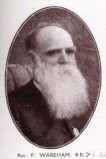
Her father was Frederick Wareham who became vicar of St Paul’s in 1877 and stayed until 1907 when he moved to St John’s in Heaton Mersey serving the community until his death in 1919.

Frederick Wareham circa 1900
So along with the postcards and the messages contained on the back there will be much to find about the lives of May, her parents and siblings and also the two churches which Frederick was associated with.

And it is with St Paul’s that I shall close for now because the church is in the process of restoring its west window which was made to honour his time in Oldham and that window will feature in later stories.

All of which just leaves me to say ............ watch this space.

Pictures; a picture postcard from Llandudno, 1907 from the collection of David Harrop and Frederick Wareham courtesy of St Pauls, Oldham

Additional research courtesy of St Paul’s Oldham, http://stpaulsoldham.org.uk/index.php