Showing posts with label Leicester in the 1900s. Show all posts

Wednesday, 10 June 2026

What Miss Sarah Kate Sloane did in the Great War ..... part 1

Now, I am only at the beginning of the story of Ms Sloane, who was born in 1871 and died in 1965, but already it promises to be a fascinating piece of research.

British War Medal, 1914-1919
She was born and died in Leicester and spent most of her life there, save for those periods when as a Red Cross nurse she served in hospitals across the country and in France during the Great War.

And it was her wartime medals which drew me into her story, and while I have accumulated some biographical details, I know there is much more.

She was awarded The British War Medal, 1914-18, The Allied Victory Medal, 1914-19, The War Medal Medal, 1939-45, and the Defence Medal, 1939-45, and the first two carry an inscription which includes her name and the letters V.A.D, which refer to her role as a member of the Voluntary Aid Detachment.

Members of V.A.D. performed a variety of tasks in Red Cross Hospitals, from nursing to cleaning, washing, and cooking, as well as administration and many also took on fund raising activities in the community.

Ms Sloane came from a medical family and both her father and brother were doctors, which makes her choice of nursing and unsurprising one.

Evington House, 2022, formerly Kighton V.A.D., Hospital
The Red Cross records show she served from 1915 through to 1917, at various Red Cross hospitals, starting at the Knighton V.A.D., hospital close to where she lived.

From 1916 she was at No.2 B.R.C. Hospital in Rouen, followed by Frensham Hill Military Hospital,  and Ullesthorpe Court, & Charnwood V.A.D. Hospitals.

After which she worked for the Discharged Soldiers & Sailors organization, which was part of the Ministry of Labour and focused on finding suitable employment for men no longer in the forces.

So far, I have no pictures of Ms Sloane, but I know where she lived in Leicester, and some at least of the houses are still standing today, as is the Knighton V.A.D Hospital which is now known as Evington House and stands in Evington Park.

Evington House, 2022, formerly Kighton V.A.D., Hospital
The house dates from the early 19th century, and bits maybe much older.  In its time it was owned by one family with links to the campaign against the slave trade, and in 1914 was lent by its then owner to the Red Cross.

There are various accounts of the house including its time as a hospital and many also include a fascinating account of the daily routines by Miss Alice Henderson who was the commandment which appeared in the Wyggeston Girls Gazette in 1919.

I suspect much of what Miss Henderson outlined in the article would have been familiar to Sarah Sloane, and was pretty much the lot of many who worked in Red Cross Hospitals.*

And that at present is pretty much all there is.  I know she arrived back from Algiers in 1931, left over £55,000 at her death in 1965 and lived for 30 years at 8 University Road, in Leicester.

Defence Medal, 1939-45
But I don’t have a clue how she voted, what she thought of the big issues of the day or how she occupied her time after war service.

That said I am confident I will find out more.  There are people who have included her in their own family history records, and I await a reply from the Leicester Records Office so there is much more to play for.

All of which leaves me with that odd reflection that history can be messy and can surprise you.

So, when I started the search for the story of Sarah Kate’s medals, I had no idea that she came from Leicester or that our Josh and Polly would turn out to live just minutes away from both Knighton V.A.D., hospital, and her home on University Road.

But then that’s the fun of the past.

Location; Leicester, and elsewhere

Pictures; Miss Sloane’s medal, courtesy of David Harrop and Evington House, formerly Knighton V.A.D., hospital, from the collection of Josh Simpson

Sources; census records, 1901-1921, Red Cross Records, 1914-1919, Baptismal record, 1871, various street directories  and electoral registers, 1920-1930, Probate Records

* Evington’s VAD Hospital, Evington Echo, December 19th, 2014, https://evingtonecho.uk/evingtons-vad-hospital/

& Evington House, Evington Park, https://storyofparksleicester.com/park-histories/evington-park/#:~:text=This%20house%20is%20said%20to,hunter%20gatherers%20roaming%20over%20it.&text=In%20Roman%20times%20and%20on,have%20been%20a%20Roman%20cemetery

Friday, 1 September 2023

Recycling Leicester’s history ……

For the historian and the curious alike, those old picture postcards showing scenes of where we live are both a wonderful asset and a fascinating link to our past.


And when they are then compared with a modern image a little bit of Leicester’s history is revealed.

That said the purveyors of such cards were less interested in the historical legacy of their photographs and more in just making money.

So, a popular edition will have been reissued, and reissued over the decades and in some cases allowing you to buy a picture of a location long after it had changed.

In some cases, the originals were colourized often blurring the scene in the process. 

In other cases additions were made to ring the changes.

So here is a 1905 picture of the castle gateway which I have featured before, but with the addition of the City’s coat of arms, making it a little bit more attractive than the original which was part of a set of 12 published the year before.

More outrageous was the recycling of a card with the imprint of festive greetings for Christmas and New Year, made all the more silly when the scene displayed was taken in high summer with no effort to add snow or holly.

But then the companies were engaged in making money as were the commercial photographers who along with recording historic Leicester would go down the more refined or attractive streets taking pictures which were the offered to the residents and shop keepers.

All of which must have made New Walk and The Oval popular photographic haunts, witnessed by the number of picture postcards of the fine place reproduced first without and then with the city arms.

I suppose their commercial considerations have left us heaps of old Leicester to stare out and ponder on.


Location; Leicester


Pictures; Castle Gate Way and New Walks, 1905, from Tuck and Sons, courtesy of Tuck DB, https://tuckdbpostcards.org/  and in 2017 courtesy of Google Maps


Sunday, 20 August 2023

Stabling the trams for the night ……. in Leicester ..... where they looked after their trams

Now the inscription on the red plaque beside the entrance pretty much says it all.

“Stoneygate Tram Depot 1904-1922. 

A rare example of a 'District Car Shed’ built to stable and service trams on a newly extended and electrified municipal tram route. 

For Further information visit www. transportheritage.com

And the link offered up that “Red Wheels commemorate Britain's rich and globally important legacy in the development of transport. 

Our aim is to present a comprehensive overview for each site, in a way that will attract a new and wider audience.

The most significant of these locations are marked by erecting a National Transport Trust Heritage Plaque or “Red Wheel” on the physical site. 

You can use the extensive search functions within this website to locate sites of greatest significance. To date we have placed over 150 Red Wheels around the UK”.

And at some point, they got round to placing the plaque on a big brick shed on Leicester’s London Road which is a wide and busy place.

Our Joshua fell across it recently commenting "it’s round the corner from us, an old tram stop I never knew existed".

According to the accompanying notice board Leicester Corporation built the district depot in 1904 at the end of the Stoneygate route.  

“It could house six tram cars [and] was close to the racecourse. On race days up to 30 trams would wait at the terminus to take racegoers back to town.  The depot closed in 1922 when the Central Depot was enlarged.  The last of Leicester’s tram ran in 1949.


Since 1922 the Depot has been used for various purposes including a garage, a wartime fire station and a railway museum complete with full scale locomotives.  And because we all need them the outer building was converted into a public lavatory.”

So that is it.   But I like the idea of stabling the trams.

Location; Leicester

Pictures; Stoneygate Tram Depot, 2022, from the collection of Joshua Simpson

Saturday, 19 August 2023

One clock tower ……..two angles …….. and a century and a bit

I promised myself that I wouldn’t take a picture of the Leicester Clock Tower, mainly because I was unconvinced I could do it justice, added to which heaps of people have already done so.


And that long list included an unknown commercial photographer who sold his image to Tuck and Son the international picture postcard manufacturers, who in turn added it to a series featuring Leicester landmarks in 1902.*

But on the day as we happened on the Tower by chance I snapped away, and since wish I had positioned myself in the exact same spot one hundred and twenty or so years after the original was snapped.

So, we are left with the tower from two different angles, but no matter, it’s the detail that me and the Tuck photographer captured which interests me.

According to the reverse of the 1902 card at the “modern centre of Leicester and the converging point of the main throughfares, is the memorial clock erected 1866 with statutes of four Leicester celebrities – Simon de Montfort the famous Earl of Leicester, William of Wyggeston who founded in 1513 the hospital which bears his name, Alderman Newton who built and endowed the Leicester Green Coat School and Sir Thomas White, Lord  Mayor Of London in 1553 who left money to Leicester and other towns to lend to poor people without interest”.*

Now I know the past is a different place where they did things differently but I won’t be alone in muttering “a clock tower adorned by four men, one of whom was really a French aristocrat and a very nasty antisemite” is hardly an image for a “modern Leicester even in 1866”.

And for those unclear about such things, Simon de Montfort expelled Jews from the city of Leicester; and cancelled debts owed to Jews through violent seizures of records.  A not unsurprising turn of events given that both his parents were equally ruthless antisemites.

To which some will cite his record of challenging Royal power and that heaps of others were equally antisemites.

All of which may be true but shouldn’t expunge his responsibility for what he did.

But hey ho, so far I can report that the other three who each made their wealth from textiles, served as mayors and did “good deeds”, so three out of four ain’t bad.

Although I do await a response from a more knowledgeable reader who knows where the bodies are buried.

And yes, there were women from Leicester of historical interest who predated 1866 of which I can think of Lady Jane Grey and Mary Linwood.

In the case of Lady Jane Grey it is less her ill fated run for the throne which lasted just a few days but more that she was according to one Victorian historian, a woman who had received an excellent humanist education, and had a reputation as one of the most learned young women of her day.**

While Mary Linwood “was an English needle woman who exhibited her worsted embroidery or crewel embroidery in Leicester and London, and was the school mistress of a private school later known as Mary Linwood Comprehensive School. In 1790, she received a medal from the Society of Arts”.***

So, that is it, no doubt on our next visit to the city I will take more pictures attempting to capture every angle of the tower.

Location; Leicester

Pictures; the Clock Tower, 2023, from the collection of Andrew Simpson and in 1902 from Tuck & Sons, courtesy of TuckDB, http://tuckdb.org/history

*Clock Tower, from a set of six, published in 1902, issued by Tuck & Sons, courtesy of TuckDB, http://tuckdb.org/history

** Lady Jane Grey, https://en.wikipedia.org/wiki/Lady_Jane_Grey#CITEREFAscham1863

***Mary Linwood, https://en.wikipedia.org/wiki/Mary_Linwood

Monday, 7 August 2023

A little bit of Leicester a century and a bit ago ..... part two

Now the city of Leicester is somewhere I have only recently discovered.

Belgrave Gate, 1902
And there is till much to explore, so I am pleased I came across a collection of picture postcards of the city at the beginning of the last century.

They were produced by Tuck and Sons, who were one of the leading manufacturers of picture postcards, with offices across Europe and North America.

Their Leicester collection spans the decades either side of 1900, and offers up a variety of scenes, from the market place, to the clock tower and the picturesque New Walk.

Now, anyone in possession of Street Google will be able to look up some of the locations and compare and contrast what they look like today with the past.

Cock Tower, 1902

Many come with the same general description which asserts that “Leicester possess claim to a very ancient history, and has many well known antiquities.  

It is now a thriving town and is well known as the centre of the hosiery trade.  Belgrave Gate is situated in the centre of the town and one of the main thoroughfares.”.

Location; Leicester

Pictures; Belgrave Gate and the Clock Tower, from a set of six, published in 1902, issued by Tuck & Sons, courtesy of TuckDB, http://tuckdb.org/history


Sunday, 6 August 2023

A little bit of Leicester a century and a bit ago

Now the city of Leicester is somewhere I have only recently discovered.

The Market Place, 1902

It is home to the remains of King Richard 111, has some very nice bits, and above all is home to our grandsons.

So, I have been exploring its past and in particular the small area of Knighton.*

And today I have stumbled across a collection of picture postcards of the old Leicester.

They were produced by Tuck and Sons, who were one of the leading manufacturers of picture postcards, with offices across Europe and North America.

Entrance to the Market Place, 1902

Their Leicester collection spans the decades either side of 1900, and offers up a variety of scenes, from the Market Place, to the clock tower and the picturesque New Walk.

Many come with the same general description which asserts that “Leicester possess claim to a very ancient history, and has many well known antiquities.  

It is now a thriving town and is well known as the centre of the hosiery trade.  In the market place is situated the Corn Exchange, a handsome building and a  statue of the 5th Duke of Rutland”.

New Walk, 1902

“New Walk situated at the South east end of the town is a very pleasant promenade greatly frequented by the townspeople.  

It is half a mile in length with a fine avenue of trees.  

The Town Museum founded in 1849 is situated here.  

The building is in classic style and considerable alterations and additions were made in 1891”.

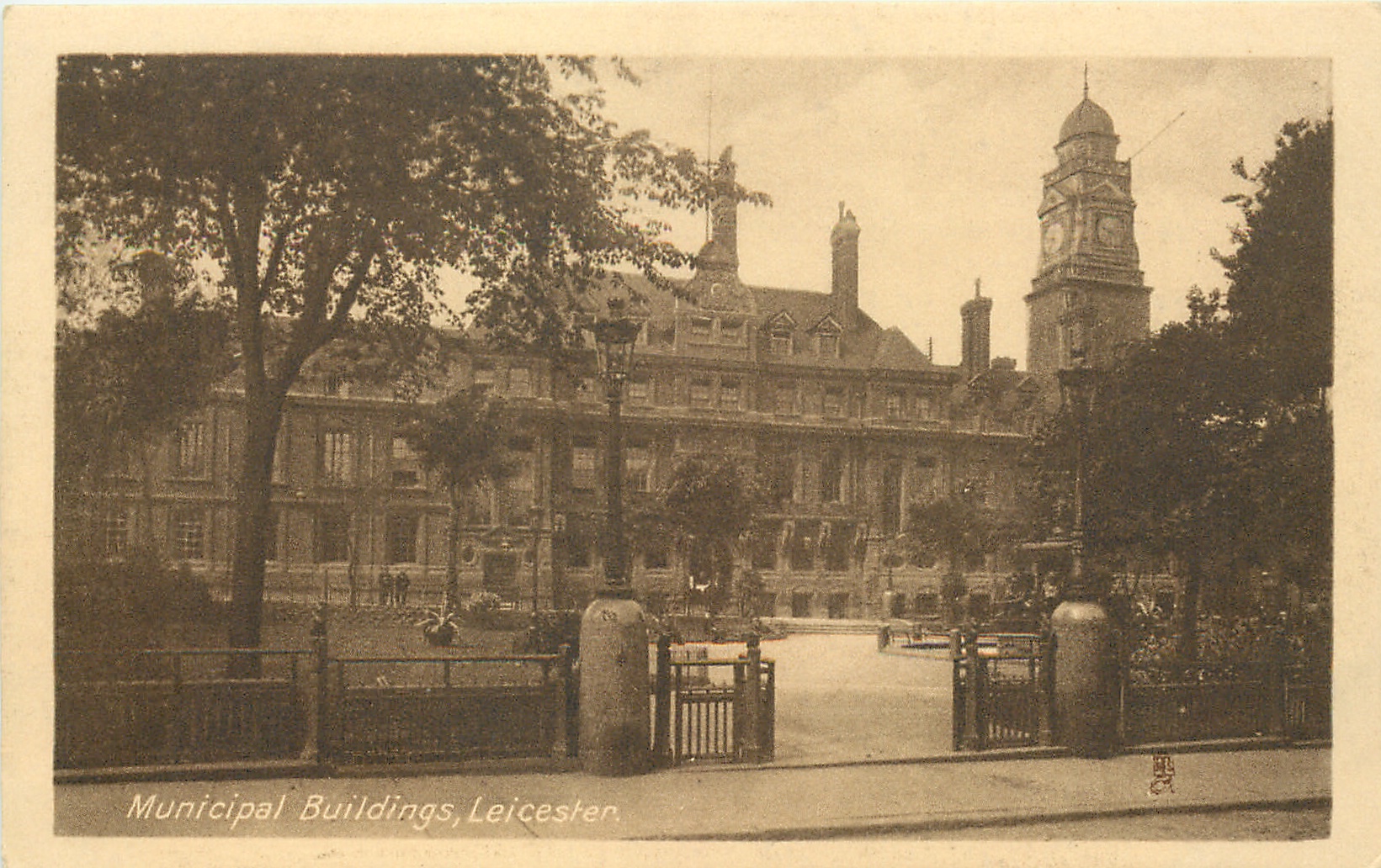
Municipal Buildings, 1902

Now, anyone who can access street google will be instantly able to match these locations with what they look like today, leaving me just to add a picture post card of the Municipal Buildings, which Tuck and Sons described as “a fine building constructed in the Queen Ann style, was begun in 1874 and erected at a cost of £51,000".

Location; Leicester

Pictures; The Market Place, entry to the Market Place, New Walk and Municipal Buildings, from a set of six, published in 1902, issued by Tuck & Sons, courtesy of TuckDB http://tuckdb.org/history

*Knighton, https://chorltonhistory.blogspot.com/search/label/Knighton


**Tuck and Son, http://tuckdb.org/history