Showing posts with label Australia. Show all posts

Saturday, 29 August 2026

Painting Peckham ............. standing in a pub with no beer ....... the Carlton Tavern on Culmore Road

Now it’s just one of those things that “there's nothing so lonesome, morbid or drear than to stand in the bar of a pub with no beer.”*

The Carlton Tavern 2015 from a photograph, 2008
Which I guess might well be the closing words for the Carlton Tavern.

It did the business of pulling and serving pints on Culmore Road from 1867 till sometime around 2011.

But like so many pubs around the country that fateful mix of cheap supermarket beer, changing life styles and the onward march of the bar culture have done for so many traditional drinking places.

So as part of Peter’s ongoing project to paint the pubs of Peckham here is his painting of the Carlton Tavern taken from a 2008 photograph on London Pubology that excellent site for all things to do with London pubs and from where I discovered a little of his history.**

The Carlton tavern, 2015
And by sheer coincidence just a few days earlier Adam Burgess sent me another photograph of the place which he tells me “is now a block of flats but  has still got the advertising for the world cup on the blackboards” and if you look closely there also is the old  sign standing outside.

But for all that it is still a pub with no beer which brings me back to that song which I must have first heard sometime in the late 1950s.

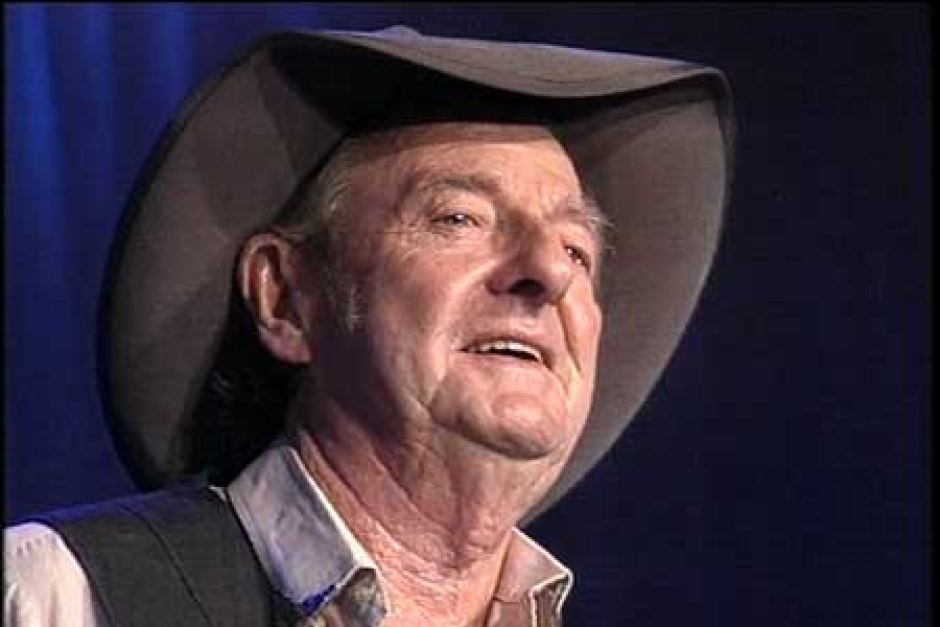
It was adapted by Gordon Parsons from Dan Sheehan’s poem "A Pub with No Beer"  and was made popular by fellow Australian country singer Slim Dusty.

Since then it has been covered by a shedful of singers and has settled so deep into our culture that I assumed it was an old Victorian music hall song.

And along the way it has become the anthem for any one whose pub has temporarily run out of beer which is why it was such a hit in Ontario in 1958 when a strike at of Canadian brewery workers stopped the flow of beer for 48 days.

Slim Dusty
But that like the song is for another time leaving me only to reflect that having spent the last hour listening to the songs of Dusty Slim I have become a fan.***

Not that I suspect I will win many converts in our house for his brand of Australian country music which like all good country music mixes simplicity with a dash of truth and humour.

All of which is a long way from Culmore Road and that pub with no beer.

Location; Peckham, London

Painting; The Carlton Tavern, © 2015 Peter Topping from a photograph, 2008 in London Pubolgy 

Web: www.paintingsfrompictures.co.uk

Facebook: Paintings from Pictures https://www.facebook.com/paintingsfrompictures

Picture; The Carlton Tavern, 2015, courtesy of Adam Burgess and Slim Dusty reproduced from ABC News, 2003


*Slim Dusty sings a Pub with No Beer,  https://uk.video.search.yahoo.com/search/video?p=Slim+Dusty+sings+a+Pub+with+No+Beer&fr=mcafee&fr2=p%3As%2Cv%3Av%2Cm%3Asb%2Crgn%3Atop&ei=UTF-8

** Carlton Tavern, 45 Culmore Road, Peckham SE15
http://pubshistory.com/LondonPubs/Camberwell/CarltonTavern.shtml

***State funeral planned for Slim Dusty, ABC News  http://www.abc.net.au/news/2003-09-19/slim-dusty-hangs-up-his-spurs/1481156


Thursday, 30 November 2023

Peck's Salmon paste ........ spread on bread and a meal in one

Peck's meat and fish pastes were something I grew up with.

They came in small glass jars and offered up a variety of tastes, from fish, salmon, beef and chicken and were spread on bread.

I had all but forgotten them until my friend Lois opened up the flood gates of memory with a story on her blog.*

I did go looking for the story of Peck's a few years ago but the research led nowhere and I gave up.

Now I knew there was an Australian connection because the jars arrived via a friend of mums who was given them at work and she said they were from Australia.

It never occurred to me to ask but I think B worked for a wholesale firm and these came as one of the perks of the job.

You were never quite sure what would arrive and I suspect that was also how it was with B.

I remember they dominated our lives and were a quick meal, although now I have no idea which I preferred.

Looking back now over fifty years I see they sit along with dripping, blancmange and tinned fruit salad as part of our basic diet and would only be replaced by the fish finger, beef burger and instant whip sometime in the 1960s.

Not that any of this helped with Peck's products.

The best I could do comes from the site of General Mills which is a food company based in Minneapolis and which has  factories still producing the pastes in Australia.**

It would appear that Peck's were making their spreads in Britain by 1891 and opened up in Australia in 1904 reaching their highest sales in the 1950s and 60s.

All of which fits and confirmed that I hadn't mistaken our Australian paste jars and of course offers up that simple observation that more often than not childhood memories are more likely to be true than imagined.

And in turn reminds me of that post war period when rationing had ended but the full impact of the consumer revolution had yet to arrive and in the absence of a cornucopia of instant foods, Pecks pastes on sandwiches did the job.

Pictures; adverts for Pecks product date unknown, taken from Spreading the love for a vintage Australian brand

*Paste sandwiches anyone?  http://loiselden.com/2015/04/29/paste-sandwiches-anyone/

** Spreading the love for a vintage Australian brand, Taste of General Mills, March 2015, http://www.blog.generalmills.com/2015/03/spreading-the-love-for-a-vintage-australian-brand/

Wednesday, 29 November 2023

Miss Lydia William Falconar Grant ……… a nurse from the Great War

I never tire of the way that a chance picture of some one long dead sets off a story which goes off in a dozen different directions.


And so, it was yesterday when Tony sent over his photograph of one of the gravestones in Southern Cemetery with the comment, “knowing your interest in the Red Cross I thought you might find this interesting”, which of course I did.

The grave belongs to Miss Lydia William Falconar Grant, who died on April 1st, 1917 at the Ducie Avenue Military Hospital.  

The inscription reads “Lydia William Falconar Grant V.A.D. Member of the Red Cross Society of Australia, born at Falcon Hall, Morningside, Edinburgh and died at Ducie Avenue Military Hospital, Manchester, on the 1st of April 1917, Elder daughter of Peter G. Grant & Emily Grant of Brisbane, Queensland”.

She was born in Scotland in 1880, grew up in Australia, served at a military hospital just off Oxford Road, in Manchester, and died just a year after she was engaged by the Red Cross as a member of the Voluntary Aid Detachment.

This was a voluntary unit of civilians providing nursing care for servicemen in the UK and across the British Empire.

And this was the start of the story.

Falcon Hall was a very large 18th century mansion in Edinburgh, which according to one source belonged to the family.  Her father described himself as a “land surveyor”, and after returning to Australia in late 1880 he appears to have become a police magistrate.


Miss. Grant was educated at the Ladies’ Methodist College in Melbourne, and was living in Brisbane when she volunteered to serve with the Voluntary Aid Detachment.

She left Australia in September 1916, and after four days in London was posted to Manchester, beginning work in December of that year.

According to one press report she  felt the intense cold weather in Manchester but “she was always very happy, and keenly interested in her work.  Her letters showed also that she had met with great kindness from those with whom she came into contact, and found both in sisters and nurses engaged in the same hospital much congenial comradeship”.*

The hospital was the former Ducie Avenue Municipal school, which had been requisitioned in 1916, and consisted of 240 beds, of which 88 were specialists’ ones, and until 1917 it had an orthopedic section.

Sadly, she contracted measles in the late March of 1917, which developed into Septic Arthritis on March 28th, and by the following day she “became unconscious with very little hope of recovery”.


Her funeral was reported in The Searchlight, which was the monthly publication of Second Western General Hospital in May, reporting that "Miss. Grant was one of the first contingent of the Australian Probationer who came to us last November and during her short period of work here and also during her illness, bravely and patiently borne had greatly endeared herself to all she came into contact.

She was laid to rest in Southern Cemetery on April 4th, close to the grave of V.A.D., Nursing Member Pearce, whom we buried only a few weeks ago.  At the request of friends, the funeral was a private one, and the service, which was very impressive, was conducted by the Ven. Archdeacon Aspinall, assisted by Cap, Worseley.  

It was attended by Sargt. C Grant, 1st Australian Division, Capt. Brentnall, R.A.M.C. (T.F.) and a large number of Sisters and nurses of the Second Western General Hospital staff, including seven other members of the Australian contingent”.


I doubt I will ever get to see the letters she wrote home, and so have no way of knowing what she thought of Manchester, but I hope on her days off she got to see something of the city.

There will be more that will come to light about Miss Grant.

For now, we have a photograph, an entry in the book commemorating the work of the 2nd Western General Hospital,*** her Red Cross record card and a handful of other sources.

And I have to thank Bruce Terrell who is a relative and first alerted me to the photograph of Miss. Grant and to Bruce Anderson who gave me permission to reproduce pictures of the Ducie Avenue Military Hospital from his excellent web site, Rusholme & Victoria Park Archive****, and went off and did his own research and coming back with many of the other sources I used, from the Cairns Family History.


Leaving me just to thank Tony Goulding who sent me the picture of the grave and set me on  the story.

Location; Scotland, Australia, Manchester

Pictures; gravestone of Miss Lydia William Falconar Grant, 2020, from the collection of Tony Goulding, cover 2nd Western General Hospital, 1919, courtesy of David Harrop, photograph of Miss. Grant, Women in war, ANZAC Centenary Queensland, 2014-2018, https://anzac100.initiatives.qld.gov.au/remember/women-in-war/index.aspx, Ducie Avenue Military Hospital, 1916-1919, courtesy of Rusholme & Victoria Park Archive, https://rusholmearchive.org/rusholme-military-hospitals-1914-1918

* Cairns Family History, https://cdfhs.org/indexes/cairns-wwi-soldiers/grant-lydia-wilhelmina-falconer/

**The Late Miss Lydia Grant,  V.A.D., Cairns Post May 16th, 1917

*** 2nd Western General Hospital, Manchester , 1914-1919

**** Ducie Avenue Military Hospital, 2nd Western General Hospital, Rusholme & Victoria Park Archive, https://rusholmearchive.org/rusholme-military-hospitals-1914-1918

***** Cairns Family History, https://cdfhs.org/indexes/cairns-wwi-soldiers/grant-lydia-wilhelmina-falconer/

Tuesday, 28 November 2023

Private Ernest Francis Hahn from Australia, who was buried in Southern Cemetery in 1915 aged 22

It began with this simple grave stone in Southern Cemetery to a young man who died far from his home having crossed the world to fight at Gallipoli.

He was Ernest Francis Hahn who had been born in Redesdale in what was then still “the colony of Victoria” in Australia on June 23 1893, and left Melbourne in the December of 1914 ending up on the shores of the Ottoman Empire in the ill fated Gallipoli campaign.

He was wounded in early May with gunshot wounds to his chest and died here in Manchester at the General Hospital of enteric fever on June 25 1915.

It is a story that could be replicated many times but what marks this story out is that David Harrop posted the picture on a social network site in response to a request for information about Private Hahn's grave in Southern Cemetery from a relative and almost immediately he received a reply from Margaret Cooper in Australia, who supplied David with the story of this young man and concluded with that it was “nice to see the photos at Southern Cemetery and that he has such a peaceful resting place.”

And with Margaret's permission I was able to access a wealth of family material  which gave a context to the life of young Ernest who was the son of Heinrich Frederick Hahn who had been born in Germany in 1843, settled in Australia in 1865 and married Jane Rose in 1870.

Mr and Mrs Hahn had fourteen children had worked hard and were well respected in their home town.

Amongst the documents were Ernest's birth certificate, his obituary and his ANZAC medal along with much more about his brothers and sisters.

What also makes this new link with Margaret's family all the more fascinating is the sight of an Australian birth certificate which differs from those issued in Britain and which provided a wealth of additional information not included on our own.

All of which has added to my own knowledge and wish to go looking for my own Australian family.

So we all win and I shall close with Margaret's reply to my last email, "thank you for telling the story of Ernest Hahn in your blog. 

Gradually the stories of the occupants of the lonely graves are being told and it is nice to know people care and remember them and want to record who they were and something about their lives..............I think Australians are surprised at the respect shown by the English towards the war graves."

And here of course I have to mention David and his  unique collection of memorabilia from both world wars, some of which is permanently on show a in the Remembrance Lodge.

Picture; the grave stone of Private E R Hahn, 2015 from the collection of David Harrop, and Private E R Hahn's ANZAC medal courtesy of Margaret Cooper.

Additional material courtesy of Margaret Cooper

Monday, 27 November 2023

Growing up in Australia with no past, no family and just unanswered questions ..... Empty Cradles


The story of the children sent to Canada from the late 19th century into the early 20th has almost passed out of living memory, but those who went to Australia were still leaving our shores in the 1970s.

These Australian stories are no less harrowing than those young people who travelled across the Atlantic.

They bring to the surface all the same feelings of anger and incredulity that someone could think it was a good idea to solve the problems of our homeless, neglected and poverty stricken children by dumping them in other parts of the Empire.

Now before any one accuses me of a lack of historical impartiality I do have to say that like many of the descendants of children sent from Britain to Canada I have been very careful in examining the case for their migration. Some in Canada might even feel that I have been over cautious about coming to a judgement.

Here is it is enough to say that despite some well meaning thinking on the part of some good people and a belief that wide open spaces were a better environment than the streets and dismal courts of the poorer parts of our cities the policy was wrong.

And it was seen to be wrong at the time.  Almost from the onset of the programme people were worried about the lack of supervision and inspection in Canada and had been challenging the very premise upon which the migration was undertaken.

So, that I hope has negated that oft used argument by the apologists of the scheme that we are in  some way judging past actions by  present day sensibilities.   It always was a tired and barren argument but one totally exposed when you consider that the policy was still in full swing in the 1960s and really only came to an end 40 or so years ago.

This was no case of another time and another place, but at a moment when Britain had embraced the welfare state, believed we were advancing to a new bright future which offered new life choices to its entire people and set against full employment and growing prosperity.

And yet the children were still being sent.  In some cases having been told their parents were dead and in almost all cases denied any real knowledge of who they had been or why they were sent.

This shabby little episode, this last flickering of a discredited policy in child care was exposed by Margaret Humphreys, a Nottingham social worker in the 1980s.  Her work in providing a history for all those Australians who grew up with no knowledge of a family in Britain or the circumstances which led to them being sent to Australia is documented in her book Empty Cradles which in turn became the film Oranges and Sunshine.

It is a powerful account of the confusion, hurt and anger felt by many of these young people combined with an insight into the reluctance shown on the part of the charities and government agencies to either help or even admit the extent of the programme.

And this is why I think it is essential reading for all of us engaged in telling the story of British Home Children.

For most of us our own BHC relatives are dead and many of their records are scattered, lost or unobtainable.  Even just identifying the names of the young people is a huge task and some I fear will never emerge from the shadows.

So for most of us looking for family it is a matter of pouring over newspaper accounts, census returns and just possibly if we are very lucky the records of the local work house or children’s charity.

Going the next step and trying to understand the justification for the migrations is wrapped up in dense committee minutes of long forgotten charities or the often vain self congratulatory biographies and autobiographies of the worthies involved.

All of which means our own feelings of anger and disbelief are one step removed.  Mrs Humphrey’s book has the value that here are the voices and experiences of people still alive, still able to recount their stories and give a context to what happened.

In its way the book has done more to make me angry about what went on than the plight of my own great uncle or the stories uncovered by Lori and Norah and the many others committed to telling the story of our Canadian BHC.

But it is also a very revealing insight into how the charities and authorities tried to minimise what went on and in some cases to perpetuate the myth that it was all oranges and sunshine and that they were only doing what was best for the children.

More than once Mrs Humphrey’s was told that her work had caused hurt to those who ran the charities to which her reply was always that she knew of countless other Australians who had been at the receiving end and were also still hurting.

I know there are those who feel that the publicity around the book takes the limelight away from the experiences of our Canadian relatives but I rather think it is the reverse.  Empty Cradles exposed an awful episode in child care, opened up the debate and contributed to national apologies made by the Australian and British Governments.

All of that was a good thing, and will lead I have no doubt to an apology from the Government of Canada.  The work of those promoting the petition along with the growing number of books, exhibitions and research will continue to shine a light on all those young people sent north across the Atlantic.

In the meantime I shall finish the book and order up the DVD of the film.

*Empty Cradles,  was published in 1994. Its sales of 75,000 copies helped to fund the work of the Child Migrants Trust at a critical time when British government grants had been stopped. Empty Cradles has been dramatised as the 2011 feature film Oranges and Sunshine.

The Child Migrants Trust was established in 1987 by Margaret Humphreys CBE, OAM. It addresses the issues surrounding the deportation of children from Britain. In the post-war period, child migrants as young as three were shipped to Canada, New Zealand, the former Rhodesia and Australia, a practice that continued as late as 1970. http://www.childmigrantstrust.com/

Sunday, 26 November 2023

A little bit of Australia in the 1930s


I am in Australia gazing across at the Sydney Harbour Bridge, or at least a bit of it.

The year is 1930 and the bridge has been under construction since 1923.

Now I am indebted to my friend for both the pictures and the story.  June and I first got together when we discovered a common interest in Alexander Somerville the radical journalist who came here in 1847.*

For me he was a fascinating link into the politics of the 19th century and for June a direct descendant, and so we began writing to each other and discovered our joint passion for all things historical.

June has be kind enough to contribute to the blog over the last few months and I am pleased that she done so again with the story of that iconic bridge which along with Opera House features in so many photographs of Sydney.

“The first proposal for a bridge across the Harbour was made in 1815 by the NSW government architect, Francis Greenaway, an ex convict. 

Other crossings were suggested, including a number for a tunnel. A regular ferry service began in 1842 from Dawes Point to Blues Point. 

(There is now a tunnel as well). Work commenced on July 28 1923 and the bridge was formally opened on Mar 19. 1932 by NSW Premier J T Lang, although the ceremony was disrupted by Francis Edward de Groot, a member of the New Guard, who dashed in and cut the ribbon before the Premier could do so!

The steel arch span is not the world's longest, but it was the world's most massive arch. The main span is 503 m long. The top of the arch is 134 m above sea level. In July 1959, two extra road lanes were opened after two tram tracks on the eastern side of the deck were removed. 

Train lines also run over the bridge. We have visited the pylons at the city end of the bridge and these days, for people who don't mind heights, there is a walk up the span to a magnificent view over the Harbour. I hope this information is useful.”

But equally fascinating is the picture of her father’s car.


“This photo was taken by my father in 1930 when he and my mother first visited Sydney in his first car, a Chevrolet tourer, I think it was called. 

It was when the Great Depression first hit Australia and an acquaintance of Dad's had just bought himself a new car and found himself in financial trouble. 

So Dad, a working class man, helped him out by purchasing his car.

It was Dad's pride and joy until 1938 and his children have fond memories of holidays with the car although Dad's justification for buying himself a car was the difficulty of carrying the tools of his trade, brushes, paint and ladders with a motorbike and sidecar.”

So there you have it a glimpse in to the history of a Australia, as ever the blog has got the lot.

Pictures; from the collection of June Pound

*Alexander Somrerville, http://chorltonhistory.blogspot.co.uk/search/label/Alexander%20Somerville


Saturday, 25 September 2021

The goldfields of Australia in the 19th century


It remains one of those rare privileges when a friend shares some of their family stories with me and then agrees to them being posted on the blog.

And this is all the more exciting when the family experiences come from the other side of the world and explore the Australian gold rush.

Now I didn’t know that much about the discovery of gold in New South Wales in the 19th century but like the opening up of the Californian gold fields its discovery led to a similar gold fever.

There had been stories of chance gold finds as far back as 1815, but the first official confirmation came in 1823.  This however was suppressed for fear that it might attract large number of prospectors including runaway convicts and free settlers who would abandon their farms in search of a golden fortune.

But ironically it was the Californian Gold Rush in 1849 which convinced the authorities that in the face of people leaving for the USA the home gold fields should be made known and so pre-empt a local drive for gold.

And so from 1851 into the 1880s parts of Western Australia became the haunt of the hard working, the hopeful, the lucky the unsuccessful.

All of which make June’s ancestors all the more canny because at least one chose to grow the food the gold hunters needed and in turn became more successful than many of those who chased the metal.

"My mother's grandfather, John Templeton, was also a sailor but nowhere near as elevated as Captain Dan.

I think he probably started out on a collier carrying coal out of Whitehaven where he lived as a young man. Possibly he sailed to Liverpool and back although I will never know this for sure.

Somehow he took a position on a ship which sailed to Victoria not long after Victoria separated from New South Wales and then he worked on a coastal ship. He was a sailor working out of Melbourne when he met my great grandmother.

When they married he gave up the sea and started working as carrier, a job which was very necessary in and around Melbourne in those days. Eventually he purchased his own horse and cart and when a family crisis occurred, he packed up the family and headed to Bendigo with the horse and cart.

I believe that he kept the horse and cart whilst he prospected for gold on the Bendigo Creek at what was then known as Kangaroo Gully, now known as Kangaroo Flat.

When it became harder to find gold some of the first miners who had families started reworking the piles of dirt which had been left by other prospectors due to lack of water and also lower yields of gold. These types of miners were known as puddlers.

To extract gold in this way you needed a horse which travelled around and around, processing large amounts of soil. John and his brother-in-law, George Teasdale, who came from Manchester, did pretty well with this.

They were also quite ingenious in that they used the mud which would have clogged up the creek to make mud bricks with which to build their more permanent houses. The government still had not surveyed the land in the area so no land was available then on which to build homes. The miners and their families had to make-do with tents.

However, the large number of puddlers who were working in the gully eventually clogged up the creek and was very unpopular with other settlers and miners. So the government clamped down on the puddlers by charging them a higher licence fee to work their claims making it an unprofitable way of extracting the gold. George then took to being a carter and John moved his family to the site of a new gold rush at Inglewood.  

He later returned to Kangaroo Flat where, with his brothers-in-law John MacPherson and George Teasdale they worked on a deep mine at Diamond Hill using their skills in following likely veins of quartz to open up new leads.

When he died John was a cab proprietor, so he returned to driving horses and a type of cab which carried about 8-10 people. One of the Templeton’s must have taken over the cab business as, when I was about 11 years old, my grandfather took my sister and me out to Kangaroo Flat in a cab. We never knew the significance of this until years later when I took up researching our ancestors! Why did he not tell us, I wonder?"

Pictures; from the collection of June Pound

Monday, 15 March 2021

Out in the Northern Territory in 1984, reflecting on two Irish brothers from Sydney who were looking for land

Welcome to the Northern Territory, 1984
Now the blog knows no boundaries and so here we are in the Northern Territory of Australia.

The pictures date from 1984 when my friend June and her husband visited the Northern territory just as the area was transformed by the Ord River scheme.

“The pictures are of part of a cattle station pioneered by two Irish brothers from Sydney who were looking for land on which to raise cattle in the 19th century. 

The land was arid and was very bad in the dry season but, in the wet, there was plenty of water - sometimes, of course far too much. 


Lake Argyle, 1984
In the 20th Century it was decided to dam the River Ord a project which was known as the Ord River scheme, which was intended to bring the desert country to life. 

We visited this area in 1984 on a trip around Australia in a coach. 

When the dam was completed and started to fill a rescue of wild life marooned by the rising waters was necessary.

We saw it when it was full and there was a lot of cultivation going on. 


"The land was arid and very bad in the dry season," 1984
I know that some people were concerned that the soil was very fragile and that it was being 'overcropped'. In the first photograph you will get some idea of how dry this area is in most parts.”

All of which is a trailer for some stories of Australia in the 19th and 20th centuries.

Pictures; of the Northern Territory, 1984, June Pound

Sunday, 14 March 2021

Mining opals in Australia in the 1890s


I am back in Australia, this time in the 1890s reflecting on the opal mining fields.

And again it is my old friend June who has shared her knowledge of the history of the opal workings along with some wonderful pictures.


"Well Australia is the source of most of the world's opals. Fire opal, the least common, is mined in Western Australia. 

It is almost transparent and has beautiful flashes of red and orange, hence its name. 

Black opal, the most valuable, is not really black but has a dark background with flashes of every colour of the rainbow. I believe that as a gemstone they are an acquired taste. 


Then comes white opal which has a white background with flashes of all colours. 

Because it is not as valuable as black opal it is sold as solid opal but the valuable black opal is sold as doublets or triplets. 

The opal is cut into very thin pieces and glued to what is called potch, a black stone without colour. 

As opal is very brittle, it is sometimes covered with a thin layer of clear white opal or a type of plastic to protect the black opal.

In Australia opal was considered unlucky so it is not particularly popular here. However the Americans love it and whenever they come to Australia they will not go home without buying opal. 

They were our best customers for opal and, even after we closed our business, Frank's cousin, an engineer with General Motors Holden in Australia, who spent four years in Detroit working for the American GM, often had visitors from the US and whenever they came he would ring us and he would come and select some opals already set for his guests to purchase. 


Sometimes they would buy unset opals but it was quickly discovered that our jewellers were more experienced in setting the opals without breaking them.


Almost anyone, when we went to the opal fields, could prospect for opal simply by obtaining a miner's licence. 

Women also mine for opal and there are lots of different nationalities. 

You pick yourself a likely spot, maybe an abandoned mine or completely new ground and start digging! This was in the 60's but things may have changed since then.

The mines are not all that deep; I suppose 

I was lowered about 20' down into a pit and from that pit was a tunnel with lots of lovely colours. 

The walls were, if I remember correctly, of white-ish stone and you could see the veins of colour running through them. 

At the top of the pit, similar to the early gold mines, there was a windlass and a bucket and very necessary tool for removing the dirt as soon as you start burrowing underground. 

Of course you also need a pick and a shovel and I suppose these days they have pneumatic drills. None of the mines I have seen were very deep. 


There are more trees and Lightning Ridge had more facilities than Andamooka which was quite primitive when we visited it. 

Although some of the houses in Lightning Ridge are partially underground, most of the other facilities are normal. Coober Pedy does have a good camping area.

It is very hot on the opal fields and there is also a shortage of water. 

For this reason the houses and other buildings are dug into the ground, in a hillside if there is one. 

In Coober Pedy there are quite large buildings, shops and restaurants, the hospital and the church, all dug into the hill. 


In the photograph I sent you of the church only the doorway and the steeple are above the ground. 

With the hospital the roof and skylights and the upper part of the walls are visible with windows on the upper part of the walls to let in light.

Two ladies dug out the house which is open for tourists in Coober Pedy. 

They say if you run out of cupboard space it is really quite easy to dig yourself another cupboard, so I think the stone must be fairly soft. 


It also appears to be stable unlike the soil in the gold mines which needed to be shored up with wood. I never tried any digging but Frank and his friend, Gerry, an opal dealer, did."

Pictures; from the collection of June Pound

Friday, 6 January 2017

Ghost signs from the other side of the world

Now this picture started me off on a journey.

A friend sent it over this morning from Hobart in Australia with the caption “ghost sign, Hobart”and with little to do I went looking for H T Goulds and Co.

I had expected I would draw a blank or at best discover that the firm had long ago closed for business.

But not so.  H T Goulds and Co had been serving the residents of Hobart from 1881 and are still in business just a few doors down the road from the sign.

All of which raises the question of whether this really is a ghost sign or a shrewd piece of advertising to which I do not know.

So instead I shall concentrate on the business which has been dispensing homeopathetic medicine the late 19th century.

According to one source, "Goulds Naturopathica has a very long history in Hobart. Originally established in the late 1800's, and moved to it's current site nearly 100 years ago, it has become a Hobart institution.

The HomÅ“opathic Pharmacy was originally established in Elizabeth St by Mr F. Styant Browne in 1878. 

Also around this time Dr Harry Benjafield took over a homeopathic practice in Davey Street. Dr Benjafield was passionate about making homeopathy affordable for all, and frequently treated patients for free during the depression in the 1890s. 

Henry Gould came to Tasmania in 1881 after studying pharmacy at the Westminster College of Pharmacy in England, and was registered as a chemist in the same year. 

He joined the practice of Dr Benjafield as his dispensing chemist. Benjafield and Gould were instrumental in the formation of the Hobart Homeopathic Hospital which was opened on Cascade Road in 1899. 

In 1903 Gould took over ownership of Mr Styant Browne’s homoeopathic pharmacy (which was on the corner of Elizabeth and Bathurst Streets). 

When the lease expired in 1914 it was moved to its current location at 73 Liverpool St and opened on December 4th of that year.*

So there you have it.

Location; Hobart

Picture; sign for H T Goulds, 2017

*Goulds, http://www.gouldsnaturalmedicine.com.au/history


Tuesday, 30 September 2014

Back in the Northern Territory in 1984

I am back in Australia just 30 years ago with more pictures of the Northern Territory.

They were taken by June Pound just as the area was being transformed by the Ord River scheme.

This area was home to cattlemen from Sidney who farmed the land here about.  It the summer it was hot arid and unpromising but according to June the winters were full of water.

So hence the scheme to regulate the water supply.


Pictures, from the collection of June Pound


Tuesday, 19 November 2013

Discovering more about those children migrated to Canada and Australia in the 19th century

Extract on the report of Roger Hall, 1915

I doubt that I will ever know the exact course of events that sent my great uncle at the age of 16 to Canada in 1914.

He was one of the 100,000 or so young people who were migrated to Canada during the late 19th and early 20th centuries.

It was a policy which even after Canada stopped, carried on into the 1970s with boat loads of children going to Australia and other parts of the old British Empire.

These were the British Home Children and until recently it was a story shrouded in official amnesia, and compounded by a reticence on the part of those migrated to talk about what happened to them.

The policy was born out of a mix of good intentions cynical self interest and an unwillingness on the part of the authorities to accept its shortcomings.

Extract from the passenger list of the SS Carthaginian, 1914
It is a story I have written about many times* and so today I want instead to reflect on the history of the growing awareness of that migration and the efforts on the parts of academics and family historians to uncover the full extent of what went on.

For many of us it was the chance discovery that a relative had been migrated to Canada which led us into the history of British Home Children.

Many of those who first started to explore the story had little to go on, and in an age before the internet and the digitalization of records were forced to spend long month’s fruitlessly writing to charities and public archives to elicit a few facts.

More recently particularly in Canada self help organistions have sprung up aided by the internet which have made the task easier.

And like all good self help organisations people are keen to share information, links and ideas, all of which is how I like my history.

Boys in the care of the Manchester & Salford charity about to leave for Canada
Only this weekend I took part in a global discussions on the future of one of these organisations run from Canada and called British Home Children Advocacy &  Research Association**

In just the last few years the interest in British Home Children has grown.

In part this reflects the search by relatives for information about their migrated family members, but also has become a serious area of study with an increasing number of books devoted to the subject.

Most of these have been published in Canada, but there are a few on this side of the Atlantic and with them has come specialist sites including that of the Together Trust which was the Manchester & Salford Boys’ and Girl’s Refuges and sent children to Canada from 1870 till 1914.***

What both British Home Children Advocacy &  Research Association and the Together Trust offer are help and links which will assist anyone on a personal search or those interested in learning more about the story.

Manchester Boys in Canada
In the case of the British Home Children Advocacy &  Research Association this includes an extensive and growing data base, articles and links as well as a growing programme of talks across Canada to raise awareness.

The Together Trust has its own archivist who is keen to assist those who may have family members who were cared for  by the charity and wish to know more about their relatives.

Nor should we forget the experiences of those young people sent to Australia.
These young people continued to be sent from Britain well into  the 1970s.

Some of their stories featured in Empty Cradles, which was published in 1994.

Its sales of 75,000 copies helped to fund the work of the Child Migrants Trust which was established in 1987 by Margaret Humphreys CBE, OAM.****

The Trust deals with the issues surrounding the deportation of children to Australia in the post-war period.  Empty Cradles has been dramatised as the 2011 feature film Oranges and Sunshine.

So British Home Children have come out of the shadows in more ways than one and have quite rightly become a serious area of study.

Pictures; of Roger Hall's report and the shipping list of the carthaginian, from the collection of Andrew Simpson, and pictures of Manchester boys of the Manchester & Salford Boys' and Girls' Refuge courtesy of the Together Trust.

*British Home Children, http://chorltonhistory.blogspot.co.uk/search/label/British%20Home%20Children

** British Home Children Advocacy &  Research Association http://britishhomechildrenadvocacy.weebly.com/

***The Together Trust Archive, http://togethertrustarchive.blogspot.co.uk/

**** The Child Migrants Trust, http://www.childmigrantstrust.com/

Friday, 11 January 2013

Oranges & Sunshine the on going story of British Home Children


The story of the children sent to Canada from the late 19th century into the early 20th has almost passed out of living memory, but those who went to Australia were still leaving our shores in the 1970s.

Their stories are still there to listen to and so I am looking forward to watching Ken Loaches’s film Oranges and Sunshine based the true story of Margaret Humphreys, a social worker from Nottingham who has worked tirelessly to reunite members of families who were separated when one or more siblings were sent to Australia.

Oranges & Sunshine Saturday evening 21.45 BBC 2