Showing posts with label Trade Unions. Show all posts

Thursday, 5 June 2025

U.S.D.A.W. in Manchester another story from Tony Goulding

 U.S.D.A.W. (The Union of Shop, Distributive, and Allied Workers) has a long-established connection to the Manchester area.
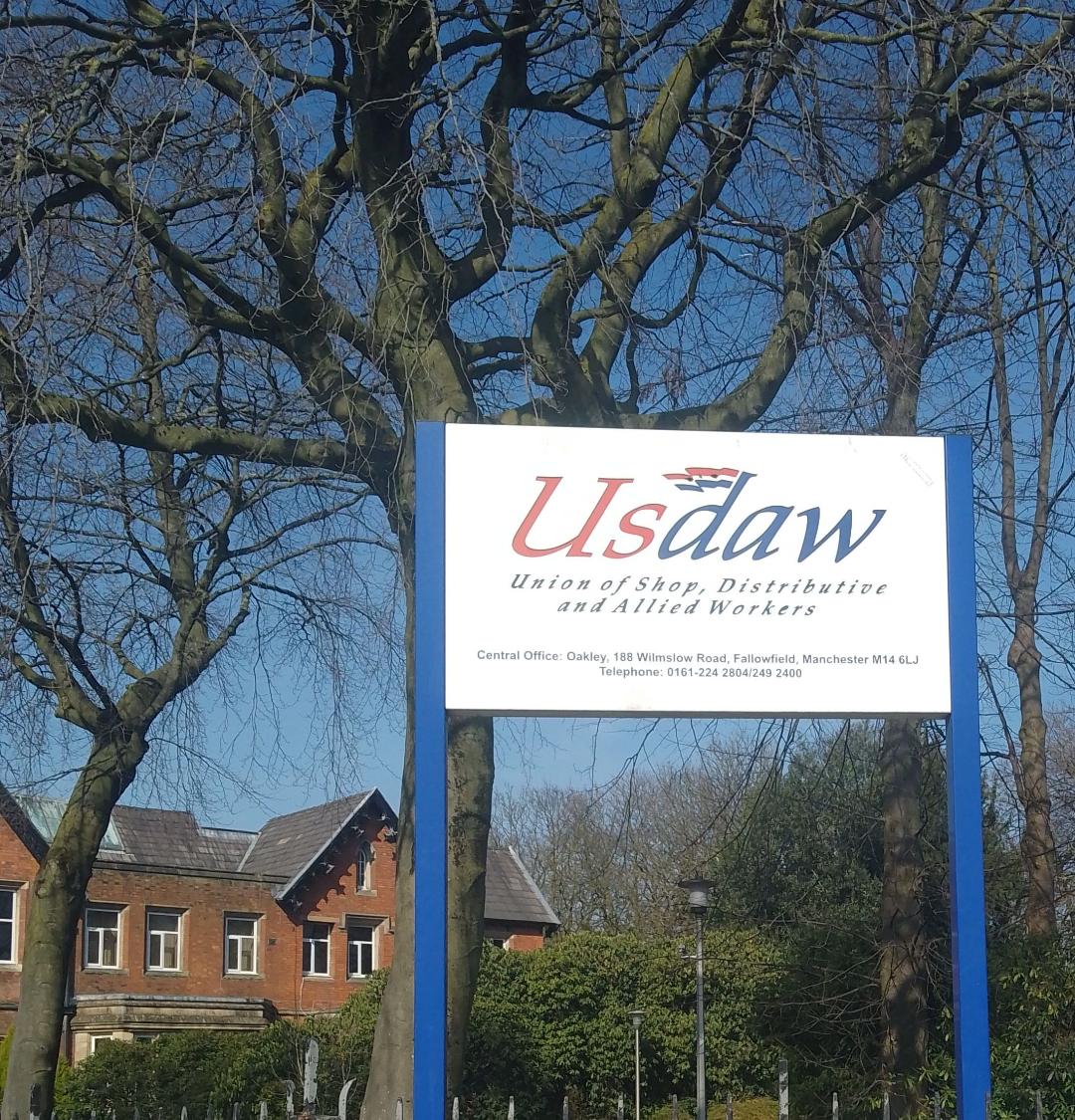
U.S.D.A.W. Sign – March 2025

In its current configuration it dates from 1947 when the Manchester based National Union of Distributive and Allied Workers merged with the National Union of Shop Assistants, Warehousemen, and Clerks which was based in London although one of the smaller unions which pre-existed the consolidated union also had its offices in Manchester. 

As its name indicates it is a major union in the retail trade; currently it represents over 360,000 members and for almost a year in the late 1970’s I was a member when I was working for Lewis's, Manchester.

“Oakley”, Wilmslow Road, Fallowfield

For over a century this house, “Oakley” a Victorian villa, at 122, Wilmslow Road, Fallowfield, Manchester (1) was home to U.S.D.A.W. and its predecessor. Kelly’s 1933 Directory of Lancashire, Manchester, Salford, and Suburbs reveals that the Union’s fortnightly journal “The New Dawn” was produced in the building its editor was Mr. Lewis Lumley.

“The New Dawn” masthead of Vol. 1 number 1 – January 1921
Lewis Lumley was born in Oldham on 4th December 1872. His birth details are shrouded in uncertainty; according to the1881 census he was the youngest child of Lewis Lumley, a joiner and his wife Elizabeth (née Singleton).

However, Elizabeth is recorded on the census return as born in 1828 and other records show she had already given birth to eight children one of whom was also named Lewis. This Lewis was born in Oldham, Lancashire during the September quarter of 1863 then promptly disappeared from all records! The issue is further clouded as one source states that the mother’s maiden name of the Lewis Lumley born in December 1872 was “Lumley”. It is quite possible then that he was the child of an unmarried older “sister” brought up as his grandparents’ child to avoid scandal.

 Lewis (1872 version) began work as a grocer’s assistant but by the 1901 census he had become a manager of a co-operative society’s coal depot. A decade later he was a full-time union organiser with The Amalgamated Union of Co-Operative Employees.

 This union developed from a meeting in Romiley, nr. Stockport in 1891 and was one of the unions which formed the National Union of Distributive and Allied Workers in January 1921.

In Oldham during the December quarter of 1896 Lewis married a United States born, Annie Wood. In the March quarter of 1898 Lewis and Annie had a baby girl, Nora followed on 15th August 1909 by another daughter, Marjorie.

Lewis was struck by a double tragedy in 1920 when his wife Annie died during the June quarter only for his daughter, Nora, to pass away at the young age of 22 the following quarter. In Manchester Cathedral during the December quarter of 1922, Lewis remarried Sarah Urmson; a near neighbour when the family home was on Green Lane, Oldham Garden Suburb.

In the early years of the First World War Lewis settled with his young family in another house in Oldham Garden Suburb, 3, Brae Side. He remained in this house until he died, aged 88, at the Oldham and District General Hospital on 3rd December 1961. His estate was valued at £6,060-2s (=£112,000 today). His 93-year-old second wife, Sarah survived him by just a few months passing away in a nursing home in Saddleworth, Yorkshire on 7th March 1962. Usdaw’s headquarters moved out of the Wilmslow Road property in early 2020 but due to Covid restrictions they didn’t move into their current offices at the Voyager Building, 2, Furness Quay, Salford Quays, Manchester until August 2021.

Tram 3080 Bound for Manchester Airport on Hardy Lane, Chorlton, 2025
Given the unions long association with the area, it is quite fitting that it has chosen to advertise on the livery of Metrolink Trams which it has done intermittently since August 2021. Originally their advert was carried by tram 3064 whilst currently it can be seen on tram 3080.

Pictures: - Masthead of “The New Dawn” courtesy of The University of Warwick’s, Modern Records Centre. 

 http://modernrecords.warwick.ac.uk

Others from the collection of Tony Goulding

Notes: -

1) Oakley House was built circa 1830 according to a report of the 12t July 2022 by the Planning Inspectorate of the Ministry of Housing, Communities, and Local Government regarding an appeal against a refused planning application for a proposed development of the site. As can be seen from the recent photographs the appeal brought by U.S.D.A.W. and the developer Watkin Jones Group Ltd. was unsuccessful.

Immediately prior to it becoming a union headquarters Oakley had been a private hotel operated by George Stephen Simmons. His story and those of the houses previous occupiers may well form the content of a future post.

  Acknowledgements: -

 As well as the value of Find My Past's Newspaper Archive and other records I would also like to acknowledge the British Trams Online for the tram numbering, Martin Sanders of Warwick University' s Archives for permission to use "The New Dawn" masthead, and Clare Jones of U.S.D.A.W. for details of the union’s move from Oakley.


Thursday, 1 October 2020

Griffith James Davies ……. a life coming out of the shadows

Now, I have every confidence I will find out more on the life of Griffith James Davies.


But I suspect it won’t be easy, which is only to be expected of what historian once called “a humble man”, which is to say, a man born into a working class family in 1847, who worked as a carpenter, and lived his entire adult life as a lodger in someone’s else’s house.

I have to admit I hadn’t come  across him until Dave Rawson who is a City Councillor for Chorlton Park, sent over this picture of the gravestone of Mr. Davies, commenting “I came across this headstone in Southern Cemetery recently.

I just wondered if you have seen it or know anything about Brother Davies? 

I do know that the period during which he was a senior union activist with this union, it was involved in bitter in fighting, reconciliation and an exhaustive strike here in Manchester.” 

The inscription recorded that he was born in Wales, and for ten years was the organizer “for the north of England, and until his death [was a] walking delegate of the Manchester and Salford District of the Amalgamated Society of Carpenters and Joiners”.

And that his gravestone was “erected by a few friends and members of the above society”.

Finding him on the census returns was easy. 


In 1861, aged 14, he was still living at home and gave his occupation as a carpenter.

But a decade later he was living in Ordsall in Salford, and until his death in 1903 he rented space in houses across Chorlton-on-Medlock and Hulme.

Remarkably we also have a probate document which shows that at his death he was at 67 Warwick Street in Hulme and that his effects amounted to £979.

The same document records that he was a “Manchester Union delegate”, which along with his inscription set me off looking for the Amalgamated Society of Carpenters and Joiners, which in the middle decades of the 19th century had been an important trade union.

By the 1870s it was based in Manchester, and just seven years after Mr. Davies’s death published a short history of the union.

And there on page 72, was a reference to Griffith James Davies, who stood unsuccessfully in an election for the post of General Secretary, and while he lost, he came a good second, obtaining 2,987 votes against his rival a F. Chandler, who polled 4,599 votes.

But the consolation was that he was elected Chairman and part of his inaugural address was recorded in the book.

Alas, the extract contained no stirring call to action or a proud defence of trade unionism but was a technical speech on changes to the Society’s constitution.

Still they are his words, and in the absence of a photograph it is all we have.


So far that is it, but there will be more to come, and in the process his life will come back out of the shadows.

Leaving me just to reflect on Dave’s reference to the Manchester strike which occurred in 1877, and which Mr. Davies will have played an active part.

It has begun on May 1st and according to the union’s official account “no less than 3,500 joiners turned out owing to the employers’ refusal to concede an advance in wages. ….. The contest was bitter and prolonged lasting twelve months”, and was broken by the employers who brought “into the town some seventeen German workman and about two hundred self styled Americans to take the place of those on strike”.


The strike had also been hampered by the presence of two unions in the dispute of which Amalgamated Society of Carpenters and Joiners was the junior partner.

Just what Mr. Davies did is unknown but given his position as the organizer in the north he will have been in the thick of it.

So I shall go on looking, starting with the newspapers for the period, and later visiting the Working Class Library in Salford, and the Museum of Labour History in Spinningfields, while re-reading the history which is a fascinating glimpse into one trade union during the 19th century.

Location; Manchester

Pictures; the grave of Griffith James Davies, Southern Cemetery, 2020, from the collection of Dave Rawson, and the fronts piece of the Society’s history

* Amalgamated Society of Carpenters and Joiners, History of the Society, 1860-1910, by F. Chandler, 1910