Showing posts with label The story of one house in Lausanne Road. Show all posts

Tuesday, 16 April 2024

The story of one house in Lausanne Road number 33 ............ the works "Jolly" in Brighton, October 1963

Dad and a Glenton's coach circa 1949
The story of one house in Lausanne Road over a century and a half, and of one family who lived there in the 1950s.*

I remember the first time I went to Brighton.

It will have been sometime in the autumn of 1963 and was what has become known as a “jolly” but was officially “the works outing” and amongst my Dad’s colleagues was simply a “Beano.”

Of course these dos weren’t exclusive to work places, many pubs, clubs and institutes would have their day out in the sun with just that right mix of beer, sand, sea and fish and chips.

For Glenton’s it was always the south coast while for Tudor Crisps in Peterlee where I worked briefly it was Whitby or Scarborough and for the countless pubs and factories here in Manchester it was Blackpool.

In many ways the destination didn’t matter, it was the journey which usually involved several pub stops along the way, a “slap up meal” before and after a walk along the front and more pubs and hotels.
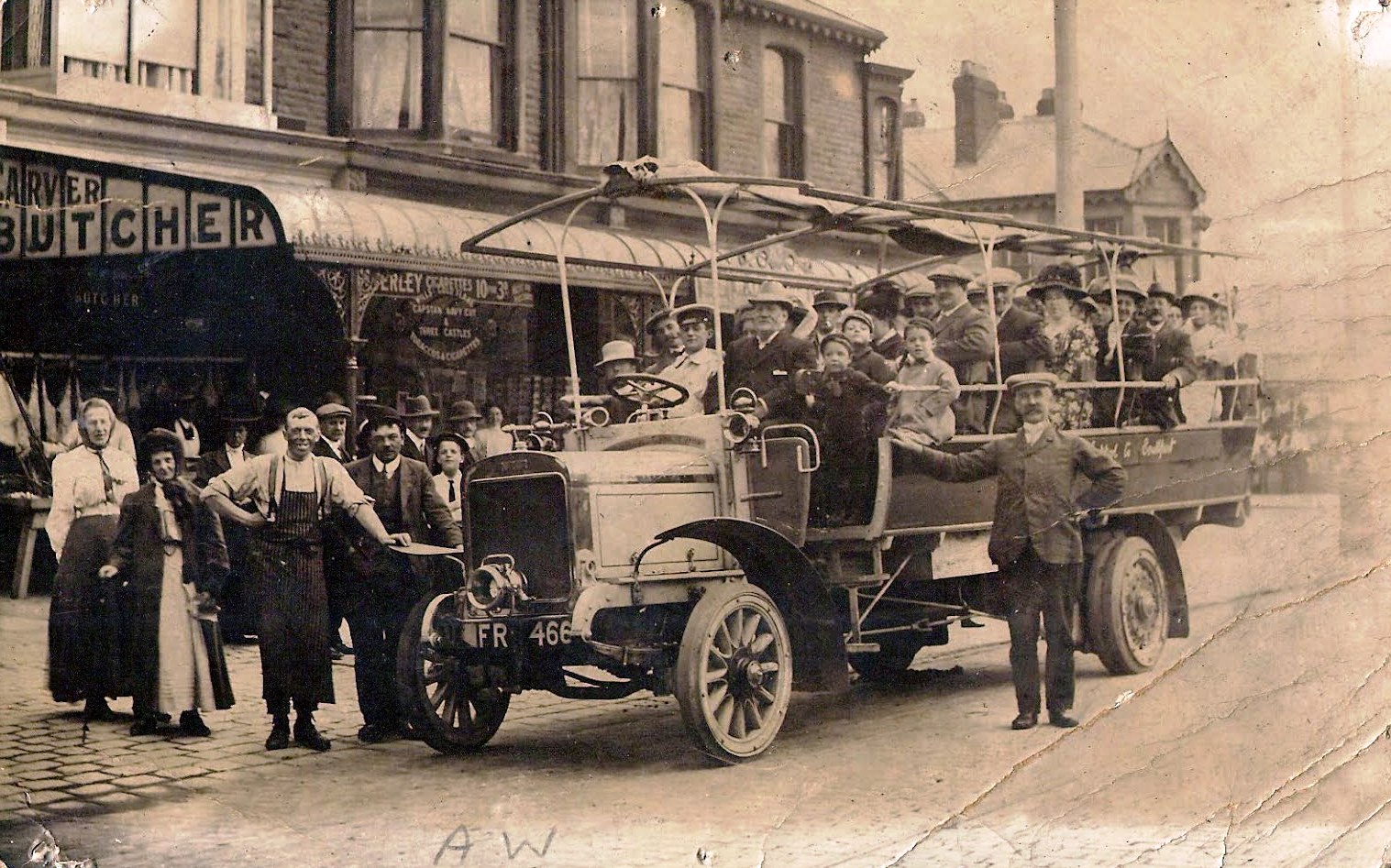
Off on a "chara" early 20th century
Most of those on that Glenton’s do were from the garage although there were a few from the office at New Cross and I think a couple more from Saxton’s the estate agents who owned the coach company.

Unlike most our trip was not in the summer but mid October when the season was over and the coaches parked in the garage and the drivers taking a long well earned rest

Such trips have a long history stretching back to the charabanc which was a horse drawn vehicle used for sightseeing and works outings usually to the countryside or seaside. They were usually open topped and were common in Britain in the early 20th century.

In time the horse gave way to a motorised version which often had a detachable body so that when the summer season was over the vehicle could be used as a flat bed lorry.

Horse drawn "chara", late 19th century
They were not very comfortable and by the 1920s were being replaced by the coach. These might still have a canvas top but were far more comfortable.

And here there is another connection with Glenton’s because for years back in the 1930s a model of Dad's coach proudly sat in the office window at New Cross, and by degree by the 1950s made its way to the back of the office and finally came home to our house where I played with it for years.

It was a beautifully crafted model which in the untender care of a six year old slowly lost much of its finer detail until all that was left was the chassis and four wheels.

All of which is perhaps a lesson on what a five year old should be given as a toy.

As for that day in Brighton it passed well enough.  Dad I think had gone out of duty and perhaps to fill the numbers I was invited along with my friends Jimmy O’Donnell and John Cox.

For me it was a one off and while I have been on work nights out I have never repeated the “Jolly” and have yet to return to Brighton which has along ago reinvented itself, unlike Blackpool which continues to offer that mix of cheap fun by the sea enlivened by the procession of hen night groups.

All a long way from Brighton and that day out with Glenton’s but thinking about it perhaps not.

Pictures; charabancs from the early 20th century, from the Lloyd Collection.

*The story of one house in Lausanne Road,  http://chorltonhistory.blogspot.co.uk/search/label/The%20story%20of%20one%20house%20in%20Lausanne%20Road

Thursday, 1 February 2024

The story of one house in Lausanne Road number 40 ............... "I can see Bognor"

The story of one house in Peckham over a century and a half, and of one family who lived there in the 1950s.*

Today 50 or more years on I have no idea where “I can see Bognor” came from.

All I do know was that we were on some swings somewhere and as the swings went higher and higher that was what we shouted.

But why Bognor is now lost in time.

And those  playground cries were pretty common back then.

Some like Bognor were instantly made up while others were more complicated and inventive.

Of these there was the playground rhyme which told a story using the titles and characters of popular TV Westerns.  It may well have been inspired by that 1959 song Delaware which had references to fifteen states of the United States, beginning with the question “Oh what did Della wear boy? and offering the answer “She wore a bran new Jersey.”

Our TV version may have been a skipping rhyme appropriated by us lads, but as hard as I try I can’t remember any of it.

I have on firmer ground with the games we played which ranged from “fag cards” to marbles and cap bombs.

Most of these had seasons of which conkers was the obvious but marbles and cap bombs and even hoola hoops  seemed to have their moment in the year.

Of course some were tied to that part of the year when it was dry and sunny but most I suspect were dependant on a new delivery from Hong Kong.

Once in the shops they played out their time until they were either broken or replaced with a new fad.

Now of all of these it was “fag cards” that I was most ambivalent about.  It took me time to master the skill but even then I was never that good at flicking them or managing to hit the card which rested on the wall so I tended to lose more than I won.

Added to which I never saw the attraction in collecting the dog eared and grubby cards that had been in half dozen pockets and the subject of endless playground games.

I preferred collecting them as brand new items  and going in for the occasional deal to swap one rare card for another.

I say fag cards but by the 1950s they were mostly from boxes of tea or like Flags of the World bought over the counter from our newsagents on Mona Road.

I can’t remember how much but it was probably a penny for which you got the card and a slice of pink bubble gum.

All very simple activities and ones I tried introducing to my lads when they were young which pretty much made them the only kids growing up in the 1980s and 90s to have lived the 50s.

It worked, although I have to say it ranked a little lower than the fads of the 1980s which saw a certain toy reappear in the 1990s and again just a few years ago.  So like their dad my three have already begun revisiting their youth.

But they were lucky even I drew the line at Bognor.

Pictures; Flags of the World, courtesy of Flags of the World,http://www.deanscards.com/c/716/1956-Topps-Flags-of-the-World, cap bombs taken from http://www.samstoybox.com/toys/CapBombs.html,  and the model of Raphael, Ninja Mutant Turtle from the collection of Josh Simpson

*The story of one house in Lausanne Road, http://chorltonhistory.blogspot.co.uk/search/label/The%20story%20of%20one%20house%20in%20Lausanne%20Road


Tuesday, 30 January 2024

The story of one house in Lausanne Road number 42 ............ the not so rosy glow of memories

The story of one house in Lausanne Road over a century and a half, and of one family who lived there in the 1950s.*

It’s odd what you begin to remember and even more how once you start there seems to be no stopping the memories.

Added to which once they are published they bounce off the collective memory confirming some and bringing forth new ones.

And so it was with The Family of One End Street** which I pretty much devoured at one sitting back in the November of 1961.

It was the story of a dustman’s family set in the late 1930s and told the story of Mr and Mrs Ruggles and their seven children.

Rereading it today bits of it appear a tad sentimental but it struck a chord as a way of life I was familiar with and certainly one my parents would have recognised.

Not that the book or the story is really the point, it is more that this was the year which set me as a serious reader, falling on everything from history to science fiction and the books of Ian Fleming.

I have Mr Rhodes who was my form teacher in my first year at Samuel Pepys to thank for that.

He and later Mr Berry had a simple approach to literature which was let them read what they want and bit by bit they will either move on from science fiction to Shakespeare or they won’t but either way they will have read some books.

In the case of Mr Berry’s class it was a battered old bookshelf at that back of the room filled with whatever he could pick up from second hand book shops.

And in that fourth year of secondary school in Mr Berry's class I worked my way through a lot of science fiction, a couple of ghost’s novels and the odd master piece.

But then not all my reading was the stuff mother would have approved.

For a short while I became hooked by PARADE a magazine I have since seen described “a magazine for men” which at a shilling was a lot cheaper than Playboy but worked on the same principle, mixing pin ups, jokes and “serious” article.  Not that the articles or even the jokes were of much interest to me, nor I suspect to any other young 13 year old back in the 1960s.

Recently I came across some of them on line with their distinctive yellow or blue banner which ran along the top and down the left hand side.

Briefly they had pushed the Eagle comic into touch but it was a short love affair because by the spring of 1964 we were on the move and while some at least of the Eagle collection went with me, Parade with its pin ups and dashing titles like “June is bursting out all over” were not destined to make the journey.

Some ended up behind the garden shed and others were slowly slid one by one through a space into a locked cupboard the key of which I lost.

It is one of the few memories which has never left me and one that even now makes me a tad guilty.

But no one was hurt, and I appear to have got away with it, which is more than I can say for those memories of Edmund Waller School and the class of 4a run by Miss Reeves.

I doubt that either of us would have chosen the other as companion on a desert island and that year of unmitigated failure and humiliation was pretty much laid to rest till Robert posted his school report from 4a at Edmund Waller.

Robert had followed me the following year and like these things are Miss Reeves had taken up the mantle to see another top year 4 class through.

Her signature was there for all to see and for once I rather wish the memory of that year had laid quietly in the past.

Robert went through the year after me but there was that signature of Miss Reeves, which brought back the dismissive words to a mother that "Andrew was not academically minded" a sentence which carried a judgement which had been weighed and delivered but in the long run proved as worthless as those piles of Parade.

Pictures; cover from The Family One End Street, Puffin Edition, 1976, The Great Invasion, Leonard Cotterell, Pan edition 1961and detail from the Eagle Comic, from the collection of Andrew Simpson
.
*The story of one house in Lausanne Road http://chorltonhistory.blogspot.co.uk/search/label/The%20story%20of%20one%20house%20in%20Lausanne%20Road


**The Family of One End Street, Eve Garnett, 1937

Tuesday, 2 January 2024

The story of one house in Lausanne Road number 17 ........ a garden pond and a dustbin,

The story of one house in Lausanne Road over a century and a half, and of one family who lived there in the 1950s.*

Now our pond would not have won any prizes in Home and Garden Magazine, but it was built by my mum and has stood the test of time.

Just why she decided in the summer of 1963 to build it is a mystery but then she was always one for impulsive acts.

The year before she had bought two rabbits from the pet shop in Hither Green fully expecting that within a year we would be making money from selling rabbit meat and fur.

It didn’t happen and the following year they were returned to the said pet shop.

But the pond was different.  She dug it out in the spring, laid the brick walls in the early summer and got the chap from next door who was a plasterer to put a skim of cement over it and in the following March we left for Eltham.

But remarkably it is still there today although like so much of the house and the garden it looks a lot smaller.

What I remember as a long garden full of apple and pear trees has shrunk and is now a mass of interesting bushes flowers and hidden places.

I had always wondered why there were so many fruit trees but given that the area was given over to market gardens before the houses were built it all made sense.

And as the average age of such trees is about 60 to 70 years some of ours must have been coming to the end of their productive life back in the 1950s.

That said some at least would crop so heavily that branches would break under the weight.

Others I now think were showing their age and the fruit was less every year despite their size.

All of which I took for granted as I did the wasps which every year filled the garden drawn by the pears.

We were never scared of them then and still have a healthy respect for them today.

Looking back what surprises me is the lack of a back alley.

Here in the north houses of a certain period were built with an alley and it didn’t matter if they were the basic two up two down with a yard or the homes of more prosperous people who could look out on a garden, there behind was that alley.

They make perfect sense.  Heavy and rather dirty things can be brought into the back of the house without having to be taken through the front door, along the passage and out to the back.

And that of course includes the dustbin.

Today most of us will leave the wheelie bins at the front or the side of house.  But back in the 1950s no one on Lausanne Road would be seen leaving the metal dustbin out the front.

Instead once a week the smelly bit would be humped through the house, and after the dustcart had gone would be taken back after a decent amount of that powered disinfectant had been throw in.

Which brings me back to that pond and the obvious observation that the bricks, the cement and the fish all came though the front door.

Now that is something that the first proud owners might not have been so happy with.

Pictures; the pond and garden in the summer of1963, and in 2012 from the collection of Andrew Simpson.

*The story of one house in Lausanne Road, http://chorltonhistory.blogspot.co.uk/search/label/The%20story%20of%20one%20house%20in%20Lausanne%20Road

Monday, 1 January 2024

The story of one house in Lausanne Road number 51 ............. watching the snow fall

The story of one house in Lausanne Road over a century and a half and of one family who lived there in the 1950s.*

Eagle Annual, 1963
Now most of us will be able to remember where we were when the news broke of some powerful event.

For my generation it will more than likely be the day President Kennedy was shot in Dallas in 1963 or possibly the death of Otis Reading four years later.

For an older generation there is the funeral of Winston Churchill, the death of President Roosevelt or Neville Chamberlain announcing that Britain was at war with Germany while for a younger generation there is that awful car crash in Paris which ended the life of Princess Diana.

But alongside all these for me there is that that day the snow fell from the skies across south east London and ushered in the Great Freeze.

The snow had begun falling on Boxing Day which almost qualified it as a White Christmas, stopped I think the following day and then began tumbling out of the sky on December 29th locking us into nearly four months of ice and snow with the thaw only beginning in March.

Now when you are thirteen you take such events in your stride and after snow ball fights became boring there was always the game of pulling a wooden bench up the hill at Pepys Park and then descending down the slope.

All of which had the added thrill that we might get caught by the park keeper who probably had more sense and was keeping warm in his hut beside a paraffin stove.

Come to think of it I don’t recall ever being challenged by one of the keepers in their brown uniforms as we risked life and limb.

But all of that was in the future, on that day in December I barely gave much of a thought to the snow.
It was late on a Saturday afternoon and already dark which made that swirling storm of snow just that bit more magical.

This I know because I still have the Eagle Annual which I got as a Christmas present and which I was reading in our kitchen as the events unfurled.

Me in 1962
Ours was a big kitchen dominated by the stove in the corner which heated the water as well as the room.

I suspect it was almost as old as the house and had no thermostat which meant that when it had been on all day the water got so hot that dad had to draw some off.

That was a regular occurrence but more than that there was that sizzling noise made from the water in the tank which was one of those reassuring sounds that seemed to guarantee all was well in the house.

That sizzling noise vied with the sound of the wireless which dad would listen to and which marked him off from mum who preferred the front room and the television.

So on cold winter’s nights you could slide down the Arctic like hall into the kitchen and be met by a wall of heat and Dad, which is how I remember that day when the snow began to fall.

Pictures; Eagle Annual 1963 and me in 1962, from the collection of Andrew Simpson

*The story of one house in Lausanne Road, http://chorltonhistory.blogspot.co.uk/search/label/The%20story%20of%20one%20house%20in%20Lausanne%20Road

Sunday, 15 October 2023

The story of one house in Lausanne Road number 34 ............ that lost model shop on Blenheim Grove and model planes, ships and soldiers I have made

The story of one house in Lausanne Road over a century and a half, and of one family who lived there in the 1950s.*

Airfix, 1959
Now it will seem daft but for the last few years I have wasted time looking for the model shop near the station on Rye Lane.

It was one of those powerful childhood memories which wouldn’t go away and that I suspect is because I am part of the Airfix generation.

From when I was about seven for almost a decade I would buy and make up the plastic kits of planes, ships and figures, and as our train set got ever bigger there were all the Airfix railway accessories, from houses, to signal boxes, and of course the station.

And depending on the amount of money I had it might be anything from the simplest of kits to the impressive ones which came in a box and might take days to make.

Looking back I suppose I was part of that last age group who spent hours making things and who on another day might also be collecting train numbers, “fag cards” or hunting out stamp collections.

It was what you did in the 1950s.

Soviet Tank
Nor was it just the simple act of construction, for afterwards came the painting and finally the application of the transfers to the wings and side of the plane or the heraldic design to the sails of the old ships.

It was a painstaking exercise and one that could then be extended by hanging the aircraft from the ceiling or making an elaborate display which combined planes tanks and military figures.

And if I am honest I have never lost that fascination for model making which began all over again when my sons were at an age when I could go into a model shop and not feel a bit of a nerd.

Of course 1940 Spitfires and Hurricanes were later  replaced by War Hammer but the essentials were the same.

They were made of plastic, needed assembling and then had to be painted which meant that  during the 1980s and into the 1990s I found myself thinking again about the model shop by the station.

But its exact location was lost until by chance I shared my search with someone who lived on Blenheim Grove and the rest as say  they became an exchange of memories and of models bought and made.

All of which was a bit reassuring because there is nothing worse than a childhood memory which cannot be verified.  It gnaws away making you begin to doubt a whole set of memories.

So that is one that has been solved and that has let the memories flood back.

On a Saturday afternoon the shop which would be crowded and you had to negotiate the glass cases in the middle of the shop while staring up at the selves and cabinets which ran up to the ceiling all full of made up models.

Model Zone Manchester, 2015
And of course there was nothing like seeing the finished thing to entice you to part with your money.

Over the years I must have made half a dozen Luftwaffe Stuka, Me 109s, along with Spitfires, Hurricanes and a whole host of planes from both world wars and from each of the competing countries.

But as I sit back more than a little pleased at finding that old model shop it is tinged with the discovery that the one here in Manchester that I spent many hours visiting with each of the lads has closed.

So as one set memories resurfaces another batch is lost.

Pictures; Small Airfix models, 1957 by Pantoine (talk | contribs) 2006, Permission is granted to copy, distribute and/or modify this document under the terms of the GNU Free Documentation License, and Airfix model of an unpainted Soviet T-34/85 tank in 1/72 scale, 2008, Wolcott (talk) from Airfix, https://en.wikipedia.org/wiki/Airfix, and Modelzone Deansgate Manchester, 2015 from the collection of Andrew Simpson

*The story of one house in Lausanne Road,  http://chorltonhistory.blogspot.co.uk/search/label/The%20story%20of%20one%20house%20in%20Lausanne%20Road

Tuesday, 10 October 2023

It really did happen ...... Boy Boy Jones and Millie the Mole ........ The story of one house in Lausanne Road no. 52

Now the story of Millie the Mole and Boy Boy Jones has lived with me ever since I was told about the pair.

The back of Lausanne Road, circa 1955
They  lived in our house in the 1950s and according to cousin Mary he drove the getaway car for a smash and grab gang.

I first featured them in The story of one house in Lausanne Road over a century and half, and of one family who lived there in the 1950s.*

I was too young to remember them but they were just some of the people who rented rooms in my parent’s house on Lausanne Road.

Now this was the period just after the last world war and housing was still in short supply, and most people lived in rented accommodation.

It was the age of the private landlord and “living in rooms” was commonplace.

Ours was a tall terraced house built sometime in the last quarter of the 19th century. It had nine rooms spread out over three floors, with cellars and a long garden.

I don’t know how many lodgers we had at any one time, but until the arrival of my twin sisters in 1955, there was just mum dad and me. So after accounting for the three downstairs rooms and the bath room, this still left enough for a collection of paying customers.

The back in 2010
But back dear reader to Millie the Mole and Boy Boy Jones. Now smash and grab raids were at the cutting edge of big time crime.

The gang would choose a suitable jewellers and using a brick and pick axe handle smash the window, grab the loot and escape in the waiting car. Boy Boy Jones was the driver.

A career which came to an abrupt end when he drove off during a raid, leaving the gang to struggle along a crowded Peckham High Street, with assorted diamond rings, a necklace and several watches.

Needless to say their progress was somewhat hampered by the loot and the Saturday shoppers and they were caught.

Boy Boy Jones remained free which was not necessarily a good thing for Millie, who according to cousin Mary their relationship  was tempestuous at the best of times and led on "one occasion to Boy Boy arousing the street as he dangled her out of one of the upstairs windows by her wrists".

From the front, 2007
As stories go it caught my imagination and has fascinated me ever since.

But with all good stories there is always that nagging doubt about the veracity of the tale which with the
passage of over sixty years is now lost in time.

Or so I thought until Gerry responding to the story yesterday commented, "I knew BoyBoy Jones he was my mates older brother their family home was Tustin Street. 

He always drove a big American car. He was the only person I'd ever seen with an old white fiver. 

Wasn't around much as he spent some time at Her Majesty's Pleasure. If it's the same one, and it seems to be, his name was Arthur, I know he was infamous as a getaway driver and he was a nice bloke to us kids ”**

And that is that.

Picture; Lausanne Road circa 1955 and in 2010 and in 2007, from the collections of Andrew Simpson and  Elizabeth and Colin Fitzpatrick

*The story of one house in Lausanne Road, http://chorltonhistory.blogspot.co.uk/search/label/The%20story%20of%20one%20house%20in%20Lausanne%20Road

**Gerry Gough, 2017

Thursday, 24 August 2023

When Peckham had a Health Centre …… and we lived on Lausanne Road

Now if I am accurate, by the time this picture was taken it had ceased to be the Health Centre and was run by Southwark Council as a leisure centre.

Me and Bobby Potts, 1953

And it was there that I went for swimming lessons during my first year at Samuel Pepys in 1961, and where our Elizabeth and Stella went to nursery.

The picture is not the best, but then it is 69 years old and was taken on a camera which long ago qualified as a museum piece.

And that is about it other than to say its story has been told on various sites,* but back in 1954 I doubt me and Bobby Potts had any idea of its existence even though it was there in the top corner of the photograph.

Location; Lausanne Road 

Picture; garden of 26 Lausanne Road, circa 1953, from the Simpson collection

*THE PIONEER HEALTH CENTRE, SOUTH LONDON GALLERY, HTTPS://WWW.SOUTHLONDONGALLERY.ORG/HISTORY-COLLECTIONS/SLG-ARCHIVE/THE-PIONEER-HEALTH-CENTRE/


Tuesday, 18 July 2023

The story of one house in Lausanne Road number 50 ............. remembering breakfast

The story of one house in Lausanne Road over a century and a half and of one family who lived there in the 1950s.*

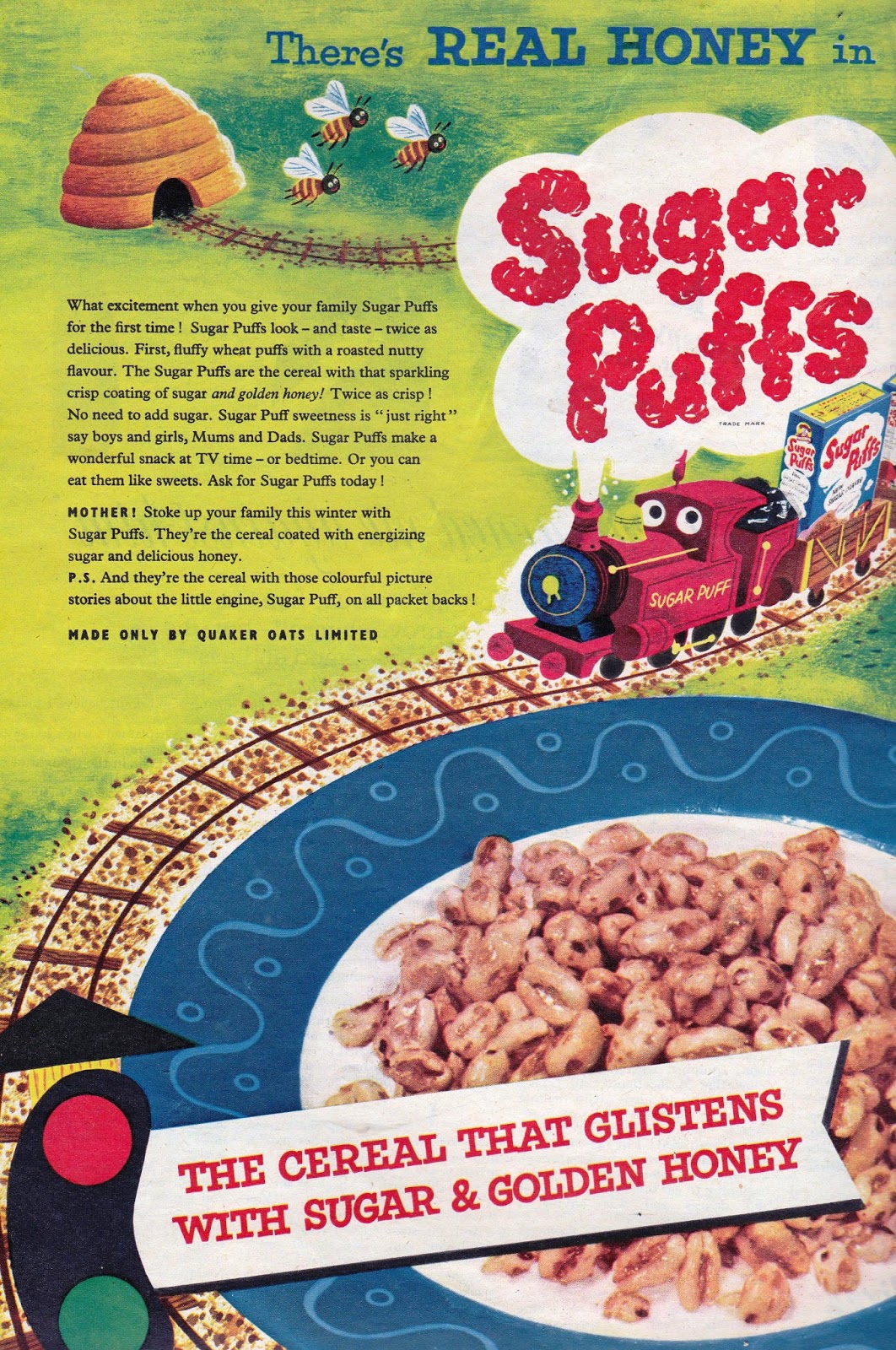
Now I know it had to happen but even so I was not prepared for the day when one of the staples of our breakfast tasted nothing like I remembered them from my childhood.

On a whim I had bought a packet of Sugar Puffs and while there was nothing wrong with the product my taste buds refused to recognise them.

Of course there is nothing surprising in that, we will all have had to accept that with the passage of time the food we ate as kids is different.

At which point I won’t fall back on the obvious comment about the size of Wagon Wheels, the failure to find Jublies in the shops or the first time I drank Tizer.

Instead I am reflecting on what I ate for breakfast back in the 1950s and more importantly how it had been influenced by my parents.

Again there is nothing very surprising about that.  As a kid you pretty much ate what you were given, influenced to a degree about by the advertising hypes that came with the television age.

So the attraction of Sugar Puffs was the little products that came with the cereal.  They ranged from tiny plastic racing cars to divers who were supposed to bubble in the fish tank and on one occasion a Sherlock Holmes set of mini detective gadgets.

But even given all that for me breakfast was and is a very personal thing and a meal much influenced by dad.

Long ago he had rejected the habit of eating porridge which as he added salt instead of sugar seemed a pretty sensible thing to leave behind.

Instead it was toast which was left to go cold and hard and eaten with butter or butter and ginger marmalade.

And now seventy or so years after I first ate it like that it’s just how I have my toast which of course raises that bigger point of what we inherit from our parents.

The physical ones are just the luck of the draw but what fascinates me are the habits, mannerisms and cultural outlooks which we absorb.

So from mum I got my politics which had been formed for her in the grim years of the 1930s and grew out of that desperate time of the Means Test, mass unemployment and making do on a pittance.

Along with the politics came a restlessness which expressed its self outlandish projects like the time she decided to breed rabbits and the fish pond she built on her own in the back garden of Lausanne Road.

All of these I have written about in the past and continue to shape who I am.

She too loved writing and had published a series of one and three act plays aimed particularly at women’s groups.

What made mum’s plays just that bit different was that the nature of the groups meant that there had to be few parts for men which added a greater challenge to the plot lines and the writing.

And now like many of my age I have come to reflect on what I have absorbed from mum and dad and conclude that it was far more than I had ever thought.

So breakfast will be toast and ginger marmalade and a day of writing about the past.

As for the Sugar Puffs, they now go under the name of Honey Monster Puffs and the little railway engine pulling its carriages has gone from the packet replaced by a Honey Monster.

There is still the promise of a gift but sadly they no longer taste the same but that will be me.

Location; Peckham, London

Pictures; products from the 1950s, from the collection of Andrew Simpson

*The story of one house in Lausanne Road, http://chorltonhistory.blogspot.co.uk/search/label/The%20story%20of%20one%20house%20in%20Lausanne%20Road

Monday, 17 July 2023

The story of one house in Lausanne Road number 48 ............. the Evelina Mission Hall, a chair and a promise

The story of one house in Lausanne Road over a century and a half and of one family who lived there in the 1950s.*

The chair, 2015
Now I like the way that what seem to be totally random bits of the past come together to tell a story which in this case brings together a Mission Hall, an old chair and a promise.

What connects them is this chair which I am guessing must be at least a century old and in its time has travelled from Peckham to Eltham and on to Manchester and now resides in our dining room.

As far as I know it began life in the Evelina Mission Hall on Evelina Road close to where dad had worked for forty years.

I don’t remember the hall which was just past the railway arch on your left heading back towards Lausanne Road or when it was built but it will be sometime between 1896 and 1914 which I grant is a  dollop of history but it’s a start.

I know this because while it doesn’t show up on the OS map for 1896 it was there by 1914, listed in the Post Office Directory for that year.

There were plenty of similar halls in the area but by the mid 1960s if not earlier it was struggling for a congregation and closed.

And Dad always scenting a bargain came home with it one winter’s day in 1964.

By then we had moved from Lausanne Road to Eltham but it remains a little bit of the place where I grew up.

Now it may well be that there are people who remember the hall and if I am very lucky will have stories of attending the services there and perhaps even the odd picture.

But I doubt it such bits of our collective history vanish all too quickly although I did find a reference to the hall being bombed on September 7 1940.

According to the official records it took a direct hit from an explosive bomb just before 11 pm which “severely damaged the mission hall.”*


Given the time I doubt that there were any casualties and the hall must have been rebuilt which opens up a fascinating bit of research, all of which is for later.

That said there are so many unanswered questions of which how it survived the explosion, when it was made and by whom will I suspect never been answered.

And I have to say until recently I didn’t even know where the hall was, but guessing it was close to Dad’s garage on Brabourn Grove  it was fairly easy to track down.

The Mission Hall on Evelina Road, 1952
In turn I have to wonder if this was the location for his other great acquisition which were loads of those old wooden blocks which had formed the original road surface back in the 19th century.

Back then there had been a spirited debate about how roads should be surfaced with some favouring wooden blocks which it was argued would be quieter.

What I do know was that when they were finally lifted and arrived in our house in Lausanne Road they offered a superb fuel for the kitchen stove.

All of which may seem a long way from the chair so I shall close with that promise, which was that a long time ago one of my sons made a claim for the chair for the future.  He got in before his brother’s which means that at some point in the future our chair will be on the move again.

But I hope not for some time yet.

Picture; from the collection of Andrew Simpson 2015, and detail of the Mission Hall on Evelina Road, 1952,  courtesy of Southwark Council at http://www.southwark.gov.uk/info/200212/egovernment/1776/old_maps_of_southwark


*The story of one house in Lausanne Road, http://chorltonhistory.blogspot.co.uk/search/label/The%20story%20of%20one%20house%20in%20Lausanne%20Road

**London Blitz 1940: the first day’s bomb attacks listed in full, Simon Rogers, The Guardian Datalog, September 6 2010, http://www.theguardian.com/news/datablog/2010/sep/06/london-blitz-bomb-map-september-7-1940#data


Sunday, 16 July 2023

The story of one house in Lausanne Road number 7 ............ the wine cellar, Glenton Tours and the vanished garage on Brabourne Grove

The story of one house in Lausanne Road over a century and a half, and of one family who lived there in the 1950s.*

Dad and Glenton's circa 1948
Now I took for granted that we had a wine cellar in our house in Lausanne Road.

It was in the small middle room next to the coal cellar and was filled with bottles of Moët Chandon, some from the French German border and I am sure the odd Italian one.

And the reason was that dad was a coach driver who did the seven and fourteen day trips to France, the Low Countries and the Swiss and Italian Lakes.

These were conducted coach trips with specified stops for places of  scenic beauty and cultural interest.

But the firm allowed the drivers the freedom to call in at the odd winery along the way and the perk for Dad was a bottle of what ever they made from a grateful owner who more that recouped the price of that bottle of champagne.

Dad spent his whole working life in the holiday trade taking people of modest means on sightseeing tours of Britain and mainland Europe.

In the age before cheap air travel this was the holiday for those who didn’t want sun and sand or a week at a Butlin’s.

Selling the holiday in 1965
These were all inclusive trips which offered “Your own reserved seat in a special Glenton touring coach, a tour of your choice, hotel accommodation including dinner and breakfast, gratuities to hotel staff, services of an experienced chauffeur-courier and a specially written guide book.”

The tours lasted for anything between 7 and 15 days. For £45 Tour C7 in 1965 offered nine days to the Swiss and Italian Lakes, leaving London on the Saturday, staying in Brussels on the Sunday night and travelling on to Lake Lucerne on the Monday, then later in the week to Lake Maggiore and then in to Switzerland and back via Burgundy to London.

Of course it is easy today to sneer at an experience where everything was provided and if you failed to look out of the window you might miss a country, but in an age before the internet with television still in its infancy this was a relatively cheap way to see places which would otherwise just be a picture in a book. 

And this was value for money given that the national average wage in 1965 was £26.

There are still plenty of travel companies offering this sort of holiday but back in the late 1940’s and ‘50s this was an experience just opening up for thousands who were beginning to enjoy the first taste of consumer prosperity.

Dad and Glenton's in 1965
They are as much an indication of that new Britain as the washing machine, television and motor car.

Now Dad had worked for Glenton's from the 1920s when Mr Saxton who ran an estate agents business at New Cross settled an outstanding bill by accepting a coach and so Glenton Tours was born.**

For me it meant Friday nights when dad having deposited his passengers would call in briefly at home to collect me on the way up to the garage to drop the coach off for serving before going off again in the morning.

It was just simply a treat which mixed seeing dad again, travelling in the coach to the garage and watching the business of preparing the coaches for the next set of trips.

And as you do I went looking for that garage which of course has long gone.

It was off Brabourn Grove but in its place standing on Glenton Mews is one of those neat little developments which the property company advertised as “12 HIGH SPECIFICATION 3 &4 BED TOWN HOUSES WITH GARDENS.***

Nor is that all for the odd lock up which stood at the entrance was transformed into a smart looking house sometime between 2008 and 12.

I wonder what dad along with Frank the manager and Wishy Washy who cleaned the coaches would have made of that.

Pictures, dad with Glenton Tours coaches, circa 1948, 1965 and the 1965 brochure


***Glenton Mews, www.glentonmews.co.uk


Saturday, 15 July 2023

The story of one house in Lausanne Road nu 3 ........... losing a pub, the water tank and discovering my old school

The story of one house in Lausanne Road over a century and a half, and of one family who lived there in the 1950s.*

The garden the tent, and a pram, circa 1958
We don’t have any pictures of the house I grew up in on Lausanne Road.

My parents never thought to take any of either the inside or of the outside and the few that feature me and my sisters just happen to catch the odd glimpse of the place.

But of course back then I doubt many people would waste film on something you knew very well and took for granted.

So you fall back on memories which are notoriously dangerous as sources for information more so because as a 10 year old everything seemed so much bigger.**

Added to which at that age you have no reason to question anything you saw.

So the big emergency water tank opposite our house was just something that had always been there as had the other one at the top of Lausanne just where it joined Evelina Road.

Its tall brick walls hid a pit which had once been the cellars of a row of houses and during the war this pit would have been filled with water.

I can’t remember how we ever got to look in but back in the 1950s it contained just a rusty old pram.

And sometime during the half century since we left it was demolished and became Walter Green House.

With it went the old Baptist Chapel which mother maintained was full of rats which swarmed out of the building in the dead of night and more recently the Swiss Tavern on the corner of Lausanne and Belfort Road.

Now the passing of the water tank and the chapel do not surprise me, but pubs always seemed to survive.

So long after the houses, and little shops had fallen to the grand slum clearance plan the pub on the corner remained.

Not so today with a shed full closing every year I am not surprised the SwissTavern has gone,  only saddened that I never got to go there.

The Swiss Tavern, 2007
During the summer month’s on a Friday night Dad would go in there for a swift half leaving me on the doorstep.

These were the nights he had returned from a trip abroad and having dropped the coach off at Glenton’s garage would call in briefly buying a bottle of lemonade and a packet of crisps for me.

I suppose it just confirms that old observation that you should never go back to where you lived as a child.

The passage of time can become too much of a gulf and you stand on what were once familiar street corners trying to make sense of the present.

But you can still be pleasantly surprised.  There on on Dennet’s Road is the Earl of Derby which Mr and Mrs Potts had taken over when they left the house next to ours in the late 50s.

For a while  afterwards I would go and visit the triplets who were just a couple of years younger than me and marvel at the size of the pub.

I never quite got used to that smell of  stale beer which seemed all the more pungent on a warm summer’s afternoon after closing time when the place was as silent as the grave.

Edmund Waller School, 2007
And those would have been the days when we explored the mysteries of the upstairs function room, which contained a mix of worn leather chairs, a battered table and a large set of ancient cow horns on the wall above which was the sign for the “Ancient Order of Buffalos.”

In time I think I will go looking for the history of the Earl of Derby but for now will content myself with the memory of Edmund Waller School which is still there behind the pub looking pretty much as it did when I left it in the summer of 1961.

Back then six weeks of adventures stretched ahead in to be followed by Samuel Pepys Secondary Modern School for Boys.

Pictures; Lausanne Road in the 1950s from the collection of Andrew Simpson, and Edmund Waller and the Swiss Tavern, courtesy of Colin Fitzpatrick, 2007

*The story of one house in Lausanne Road, http://chorltonhistory.blogspot.co.uk/search/label/The%20story%20of%20one%20house%20in%20Lausanne%20Road

**Peckham, http://chorltonhistory.blogspot.co.uk/search/label/Peckham

Friday, 14 July 2023

The story of one house in Lausanne Road number 19 ............. bold new designs and a bit of Formica

The story of one house in Lausanne Road over a century and a half, and of one family who lived there in the 1950s.*

Now I would just love to know what mum and dad made of the new household designs which were featured in Woman’s Own for January 12 1956.

I can't remember if it ever crossed the front door but they would not have escaped the exciting new ideas for transforming their early 20th century house into one which fitted with the 1950s.

Looking at them today they seem quite ordinary and just a little old fashioned but back then they were at the cutting edge of all that was new and innovative.

The basic designs were all there two decades earlier but were way out of reach of most working people.

But by the mid 50s that was changing.  Mum was already making inroads into our old fashioned house  coming up with the ideas and dad delivering.

It was partly as a result of the growing prosperity, along with new mass produced materials like plastic and Formica and the ever present offer of hire purchase, which meant for a “few pounds down and the rest over easy instalments” bits of the new life could be pretty much within the reach of every one.

All of which marks the 1950s off as more of a mould breaker than perhaps “the swinging 60's.”

Here were bold new colours, exciting fabrics and designs which relegated the old heavy furniture in many peoples’ dreams to a place in a museum along with the odd dinosaur and other ancient relics.

Of course like most families how ever much we may have wanted to embrace modernity it was still the case that much in our house was a mix of the new and much that was old.

The furniture was Utlity, and some at least of the bedding had come down from Gateshead when my grandparents died.

But there was still the striking yellow pine dressing table and the flying ducks, although in our case mum had gone for something slightly up market and the ducks were a tad more robust but they stood on the wall happily facing the old star mirror and the classic print of the Chinese Woman.

Pictures;  adverts  from Woman’s Own, January 12 1956

*The story of one house in Lausanne Roadhttp://chorltonhistory.blogspot.co.uk/search/label/The%20story%20of%20one%20house%20in%20Lausanne%20Road

Thursday, 16 March 2023

What price child care? ……….. Peckham 1959

I can’t be sure just when mum and dad used the P.H.C. Kindergarten, but it will have been sometime in the late 1950s.*

The cost of childcare, circa 1959
We lived on Lausanne Road and my four sisters were all born in quick succession from 1955 through to 1959, and we left Peckham in the spring of 1964.

So, the window will have been short, if that is they ever did use the place.

I have no memory of it, and at one point our Stella and Elizabeth spent afternoons at the nursery in the Peckham Heath Centre on St Mary’s Road.

This I know because it was my job to collect them after school, an onerous task, partly because it deprived me of hanging around with friends  in the playground of Edmund Waller, and also because I had to push the double pram home.

A chore which culminated in me forgetting one day and getting stick from mum

All of which is an introduction to a flier for the “P.H.C. KINDERGARTEN”, which operated from Norfolk House on Queens Road.

It is a fascinating little document, which details the fees charged, the requirements expected of parents, as well as the children, who “must be between the ages of 2½ and 5 years….. the Kindergarten runs from Monday to Friday each week starting at 9.30 a.m. until 12.30 p.m. [and] the cost is 5/6 per week or 6/6 for two children, [which] must be paid each Monday morning, or by the term if preferred. 

Where a child is absent for a complete week fees will be reduced to 3/- per week (4/-)".  

Our Stella, Elizabeth and Jill, circa 1962
An additional charge of "3d per week for Biscuits. Plimsoles or soft shoes must be won, parents are welcome to participate in the kindergarten, and infectious illness must be notified”.

And as you do I went looking for Norfolk House which is still there just two doors down from the corner of Lausanne Road.

It was there by 1872, and maybe before that, and in its 147 years it has been many things, from a residential property to a social club.

I know that just before the Great War, it was empty, and on the outbreak of the next world war, it was occupied by the Brown family.

Mr. and Mrs. Brown recorded their occupations as "Stewards at the Conservative Club and their son was a compositor".

They already had some experience of running a club, having managed the Earl Cowper public house on Ipswich Road in Colchester, where they were pulling pints in 1911.

Just as now working in the licensing trade could be precarious and Mr. Brown described himself as “Publican and Hay Trusser”.

Norfolk House, 2022
There may well be people out there who also used the Kindergarten or will know just what happened to Norfolk House since the last war and when it became a social club.

I searched for the club, found a telephone number and endeavoured to find out its history.

But despite explaining who I was, and what I was trying to do, the chap on the other end of the line put the phone down on me.

I did come across an article in the Peckham Peculiar but alas there was no reference to the Kindergarten and so I will plod on looking for clues.**

Leaving me just to comment that Dad never one to waste paper did a series of sums on the back and down the side of the flier.  

A list of sums, circa 1964
There are few clues as to what the calculations were about other than a reference to"Furniture removal", "Curtains" and "Odds and ends" which came to £544 -14-0, which may be linked to when we left Peckham for Eltham. 

But that is a story for another time.


Location; Queens Road, Peckham

Pictures;  the flier from P.H.C. Kindergarten, date unknown, our Stella, Elizabeth, and Jillian, 1962, from the collection of Andrew Simpson, and Norfolk House, 2022, courtesy of Google Maps

*Searching for the story of Norfolk House on Queens Road ………. stories from the 1950s and 60s, https://chorltonhistory.blogspot.com/2019/03/searching-for-story-of-norfolk-house-on.html

**Welcome to the Club, Peckham Peculiar, July 2nd, 2015, https://peckhampeculiar.tumblr.com/post/123016271414/welcome-to-the-club


Thursday, 31 March 2022

The story of one house in Lausanne Road .... number 52 ..... the neighbours

 The story of one house in Lausanne Road over a century and a half, and of one family who lived there in the 1950s.*

Our house and the one the Pott's lived in, 2017
Now even though we left Peckham almost 60 years ago, I can still remember our neighbours.

Some I admit are now shadowy figures, whose names I had completely forgotten until recently, while others like those who lived in the police flats do occasionally pop back into my memory.

Of all of them it is the Potts family who lived next door who still invade my thoughts from time to time, and that is mainly because three of the children were just a few years younger than me, and in those long hot summers which seemed to stretch on for ever we played together.

They were triplets and if I have got this right were called Susan, Brian, and Robert. There was an older sister, Helen who already was too old to mix with us, although I guess she will have not been more than five years older than me.

I have a few pictures of us together and can remember that they kept chickens and finally moved out to run The Earl of Derby on Dennett’s Road sometime in the late 1950s.

And then a couple of days ago someone posted on social media a picture of the triplets from the Associated Newspapers with the caption, “Circa 1952: Four-year-old Potts Triplets - Robert Susan And Brian - receiving their birthday mail from the postman at their Peckham London home”.** 

Me and two of the triplets circa mid 1950s
It was of course my friends, and it set me off looking for them.  

At first this was only to establish that the date was correct which seemed a little too early, given that I had been born three years earlier, and in 1952 I would only have been three.

So far, I haven’t been able to find a record of when they were born, but the search did lead me to their mum and dad who were married in 1934 in Lewisham.  For a while they lived in Lewisham before settling in Orpington sometime around 1939.

By 1947 they were in Mr. Pott’s old family home on Lausanne Road where he had lived in the early 1930s.

This I now know because he and then later his wife Ellen appear on the Electoral Registers which were compiled every year which allowed me to track them around southeast London.

Added to this there is the 1939 Register which was a mini census, carried out at the beginning of the Second World War.  It remains an invaluable document given that the 1931 census was destroyed and the first post-war one cannot be accessed for another 30 years.

Along with information on dates of birth and occupations it also offers up information on the voluntary activities of people, including their participation in Civil Defence roles.  

Mr Pott’s gave his occupation as a “Bus Driver for London Transport”, and along with Ellen and Ellen’s sister three others are registered.  But these three have been redacted which I suspect means that they were children who might still have been alive when the Register first went live earlier this century.

One of these may have been Margaret Potts who shows up on the 1957 electoral register and may have been one of their older children.  I vaguely remember her in their kitchen from sometime in the mid 1950s.

Me and Helen, circa 1953
All of which is fascinating and has brought me closer to our neighbours.

But the electoral registers also throws light on the dire housing conditions in the immediate post way years.  The houses on Lausanne Road were big and many appear to have had their share of lodgers.  

Our house did, with at least two couples sharing the property at certain periods. Likewise number 28 also had what appear to be non-family members, and while this isn’t the case with the Pott’s house I assume that is because of their larger family.

And that is it ….. I would like to have included the photograph which set me off on the journey but alas I don’t hold the copyright.

Leaving me just one slight niggle, which is that the photograph doesn't quite match with those houses on Lausanne Road, ..... a mystery which someone will offer an explanation

Location; Peckham

Pictures; me, the Pott’s children circa 1950s and our house on Lausanne Road, 2017 from the collection of Andrew Simpson

*The story of one house in Lausanne Road http://chorltonhistory.blogspot.co.uk/search/label/The%20story%20of%20one%20house%20in%20Lausanne%20Road

**I grew up in Peckham, https://www.facebook.com/groups/49819382463

Monday, 16 August 2021

The story of one house in Lausanne Road number 26 .......... Wishy Washy, a wet November playtime in Edmund Waller and a history lesson

Me circa 1956
The story of one house in Lausanne Road over a century and a half, and of one family who lived there in the 1950s.*

Now I often wonder what happened to Wishy Washy.

He worked at Glenton’s on Brabourne Grove and got his nick name because he did the night shift in the summer washing the coaches ready for their turn around in the morning.

I never knew his real name, and doubt that many did.

Only now with the passage of time have I made the connection with the pantomime Aladdin which in 1861 first featured Widow Twankey and her son Wishy Washy who was Aladdin’s brother but had no more than a walk on part in the early shows.

I remember him as a thin man of medium height who lived with his mum off Evelina Road.

But it was his train set that captured my imagination, that and his tendency to take a short cut across the railway track to get home that bit quicker.

Dad took me to see it once and it was magic.  The train set filled a back room of the house and all the accessories from the stations, out houses and landscape had been made by Wishy Washy.

Edmund Waller School, 2007
It had a profound effect on me, but now nearly 60 years later I cannot picture the man, the train set or the house, only that memory of walking to Evelina Road one winter’s night with my dad.

And I suppose that is the trouble with childhood memories, they are at best just a momentary snatch of things, vivid enough at the time to stay with you but too flimsy to tell you more.

Like the day the workmen put in those big heavy metal radiators at Edmund Waller School.

Of course the details are lost but I remember the open fireplaces in the classrooms and one particular wet playtime in late November when I passed the time with a second hand copy of the Eagle comic watching the steam gently rise off the jumpers of some class mates who had been daft enough to get caught in the downpour which had flooded the playground.

Orak Speaks to Andrew, November 1956
The comic was all engrossing but was a one off and it would be another thirty years before I came across the set covering the story and caught up with that moment on a wet day in November 1956 and finished the story.

And it has opened up a shedful of memories of that classroom, a few of the teachers and snippest of lessons long forgotten.

Edmund Waller was a Board School built to a proven design which delivered a building which was warm in winter and cool in summer with windows mounted high enough up the wall to deliver great shafts of sunlight but too high to look out of.

Now that made the school perfect.  As someone who spent his career in schools built in the 1950s I yearned for the solid brick built schools of the late 19th century.

The architects of the post war period may have thought they were doing something bold and new with designs which used masses of glass, but they never had to work in them.  In winter they leaked heat and in summer turned the rooms into infernos which did nothing for concentration.

The Eagle, 1956
Added to which the distractions of a net ball game in the playground proved fatal to an explanation of the causes of the Great War.

But a tleast the classroom walls then and in my time as a teacher were places to advertise the achievements of students, although the walls of class 3b seemed for ever dominated by rows of multiplication tables and key spellings.

Forty years later the fashionable and expensive experts brought into tell us teachers how to do a job we had been doing for twenty years and more hit on the idea of visual learning all of which Miss Prentice had mastered all of those decades ago.

And that in a round about way brings me back to Wishy Washy who like Miss Prentice knew what worked and what would captivate an eight your old.
Pictures;

Pictures; me circa 1956, Edmund Waller School, 2007, Colin Fitzpatrick, and The Rogue Planet, Eagle, May 25 1956 Vol 7 Nu 22, from the collection of Andrew Simpson

*The story of one house in Lausanne Road http://chorltonhistory.blogspot.co.uk/search/label/The%20story%20of%20one%20house%20in%20Lausanne%20Road