Showing posts with label Clocks. Show all posts

Friday, 24 November 2023

Time for Another Clock … another story from Tony Goulding

This clock is a feature of the old St. Mary’s Hospital building on Oxford Road, Chorlton-on-Medlock, Manchester. 

This institution has its origins in the “Manchester Lying-in Hospital and Charity for the delivery of poor women at their own habitations.”, established by Dr. Charles White and Richard and Edward Hall, in 1790. The first buildings used were in Salford, a house on Old Bridge Street and later, from 1795, the former “Bath Inn”, Stanley Street on the banks of the river Irwell. (“Manchester Mercury” 4th August 1795). 

The explosive increase in the area’s population together with an expansion of the services the charity offered, soon meant  it became necessary for larger premises to be sought. After initially moving to 2, South Parade, St. Mary’s Churchyard in 1840 (1) a new purpose-built hospital, designed by the Salford-born architect Nathan Glossop Pennington and funded by Dr. Thomas Radford, was opened on land purchased for £500 by Miss Eleanora Atherton (2) on Quay Street, Manchester in 1856. 

The foundation stone of the new building had been laid by the Bishop of Manchester, the Right Rev. James Prince Lee D.D. on 3rd September 1855. The Manchester Courier and Lancashire General Advertiser carried a very detailed report of the ceremony in its edition of the 8th September. 

This included listing the collection of items enclosed by the foundation stone as a sort of time capsule; a set of newly minted coins, copies of Manchester Newspapers of the day, and a commemorative medal celebrating Queen Victoria’s visit to the city on the 10th of October 1851.  

More interestingly also buried were documents associated with the hospital including a summary of its early history and how the Queen's visit had provided a catalyst for the fund-raising efforts of the ladies of Manchester on behalf of the hospital

 St. Mary’s Hospital Quay Street in 1892 (3)
When this building was built, it was seen to incorporate the latest ideas of hospital design however within three decades the further advances in medical knowledge, in particular advances in the understanding of how infections are spread, it once again became desirable for the hospital to acquire new premises to accommodate this. 

A prolonged fund-raising effort was undertaken from the mid 1880s, but it was not until Monday 9th October 1899 that the foundation stone of a new hospital was laid. The duty was undertaken by the Countess of Derby at noon on that day.  

One of the reasons for the elongated appeal was the complication caused by a proposed amalgamation of St. Mary’s Hospital with Manchester’s “Southern Hospital for Diseases of Women and Children” at 26, Clifford Street, Chorlton-on-Medlock. The long-drawn-out negotiations between the two charities ended in November 1904 when agreement was reached to merge subject to approval by the Commissioners. 

There would still be two separate buildings, however, confusingly both called St. Mary’s Hospital as the combined charity went under the name of “St. Mary’s Hospitals (plural)” Charity. The original St. Mary’s completed the construction of the one started in 1899 on the corner of Oxford Road and what was then Gloucester Street (now Whitworth Street West). 
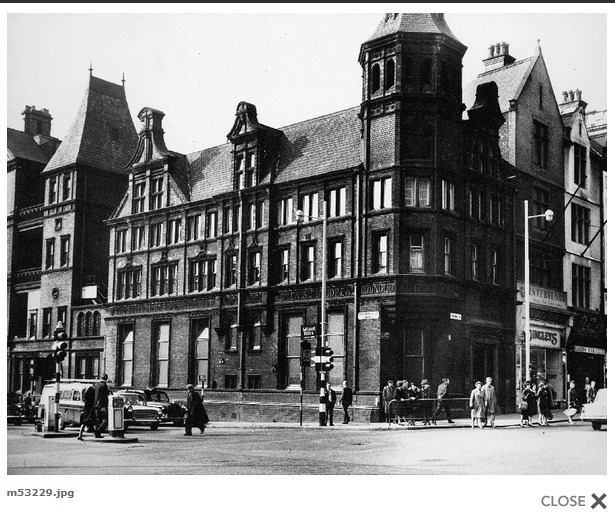
St. Mary’s hospital on Whitworth Street West in 1964 
This was one of the last buildings associated with the prolific architect, the designer of Manchester Town Hall, Alfred Waterhouse and after the two charities combined would be designated as providing outpatient care and beds solely for maternity cases.

On land acquired by Manchester Southern Hospital in the 1890s a new facility was erected further along Oxford Road on the corner of Haversage Road (then called High Street). In due course this was to provide in-patient beds 80 for women and 25 for children The architect appointed was John Ely, who’s designs had also just won the competition for an extension to Salford Royal Hospital.

This building, which is now Grade 11 listed, was built between 1907 and October 1909; the builder being Robert Neill and Sons.   After some delays due to lack of funds, the first patients were admitted in April 1911, however, it was not officially opened until Tuesday 6th February 1912 when Lord Derby, the president of the charity’s board of trustees performed the ceremony.

St. Mary’s hospital building on 15th May 2012
Following the building of a new maternity hospital, which became known as St. Mary’s Tower on Haversage Road in 1969 the site on Whitworth Street was run down and demolished in 1973. (As, subsequently was the “Tower Block”). The building facing Whitworth Park is still being used to provide an N.H.S. service, a Reproductive Medicine Clinic.

Pictures; St. Mary’s clock from collection of Tony Goulding. 

St. Mary’s Hospital, Quay Street, 1892 by S. L. Coulthurst (m53203) and St. Mary’s Hospital, Whitworth Street West, 1964 by W. Higham (m53229) courtesy of Manchester Libraries, Information and Archives, Manchester City Council. http://images.manchester.gov.uk/index.php?session=pass

 St. Mary’s Hospital (1909 building) on Oxford Road, May 2012 Stephen Richards, CC BY-SA 2.0,

 https://commons.wikimedia.org/w/index.php?curid=64788474

Notes: -

1) This building was severely damaged by fire on the morning of Thursday 4th February 1847. Fortunately, the hospital was at that time not admitting in-patients and the three staff and the matron’s two female relatives managed to escape the flames by utilizing the time-honoured method of climbing down knotted bed sheets, as per a report in the Manchester Courier and Lancashire General Advertiser dated Saturday 6th February 1847. Such was the dedication of those associated with its work by the end of March the hospital was again providing aid, all be it in a diminished capacity to the women of Manchester.In passing it is a curiosity to note that for a time prior to his death in 1845, Hugh Hornby Birley (of Peterloo infamy) was the chairman of the hospital’s trustees.

2) Miss Eleanora Atherton was an extremely wealthy woman, the inheritor of a vast amount of wealth from several family members A large sum being derived from sugar plantations in Jamaica previously owned by her slave-owning uncle, William Atherton. She was a noted philanthropist, endowing churches as well as hospitals and supporting the fine arts through her rôle with The British Institution. When she died on 12th September 1870 she left £400,000 (almost £40 million at today’s value) including bequest of £1,000 to St. Mary’s Hospital, one of many such charitable donations).

3) This building was the first to be designated as “St. Mary’s Hospital” as the annual general meeting of the charity’s board on Wednesday 10th January 1855 adopted the name “The St. Mary’s Hospital”.


Acknowledgements: - 

Architects of Greater Manchester 1800-1940 https://manchestervictorianarchitects.org.uk

And Our Manchester https://manchesterhistory.net

As well as usual sources Find My Past’s Newspaper Archive and Wikipedia

Saturday, 19 August 2023

One clock tower ……..two angles …….. and a century and a bit

I promised myself that I wouldn’t take a picture of the Leicester Clock Tower, mainly because I was unconvinced I could do it justice, added to which heaps of people have already done so.


And that long list included an unknown commercial photographer who sold his image to Tuck and Son the international picture postcard manufacturers, who in turn added it to a series featuring Leicester landmarks in 1902.*

But on the day as we happened on the Tower by chance I snapped away, and since wish I had positioned myself in the exact same spot one hundred and twenty or so years after the original was snapped.

So, we are left with the tower from two different angles, but no matter, it’s the detail that me and the Tuck photographer captured which interests me.

According to the reverse of the 1902 card at the “modern centre of Leicester and the converging point of the main throughfares, is the memorial clock erected 1866 with statutes of four Leicester celebrities – Simon de Montfort the famous Earl of Leicester, William of Wyggeston who founded in 1513 the hospital which bears his name, Alderman Newton who built and endowed the Leicester Green Coat School and Sir Thomas White, Lord  Mayor Of London in 1553 who left money to Leicester and other towns to lend to poor people without interest”.*

Now I know the past is a different place where they did things differently but I won’t be alone in muttering “a clock tower adorned by four men, one of whom was really a French aristocrat and a very nasty antisemite” is hardly an image for a “modern Leicester even in 1866”.

And for those unclear about such things, Simon de Montfort expelled Jews from the city of Leicester; and cancelled debts owed to Jews through violent seizures of records.  A not unsurprising turn of events given that both his parents were equally ruthless antisemites.

To which some will cite his record of challenging Royal power and that heaps of others were equally antisemites.

All of which may be true but shouldn’t expunge his responsibility for what he did.

But hey ho, so far I can report that the other three who each made their wealth from textiles, served as mayors and did “good deeds”, so three out of four ain’t bad.

Although I do await a response from a more knowledgeable reader who knows where the bodies are buried.

And yes, there were women from Leicester of historical interest who predated 1866 of which I can think of Lady Jane Grey and Mary Linwood.

In the case of Lady Jane Grey it is less her ill fated run for the throne which lasted just a few days but more that she was according to one Victorian historian, a woman who had received an excellent humanist education, and had a reputation as one of the most learned young women of her day.**

While Mary Linwood “was an English needle woman who exhibited her worsted embroidery or crewel embroidery in Leicester and London, and was the school mistress of a private school later known as Mary Linwood Comprehensive School. In 1790, she received a medal from the Society of Arts”.***

So, that is it, no doubt on our next visit to the city I will take more pictures attempting to capture every angle of the tower.

Location; Leicester

Pictures; the Clock Tower, 2023, from the collection of Andrew Simpson and in 1902 from Tuck & Sons, courtesy of TuckDB, http://tuckdb.org/history

*Clock Tower, from a set of six, published in 1902, issued by Tuck & Sons, courtesy of TuckDB, http://tuckdb.org/history

** Lady Jane Grey, https://en.wikipedia.org/wiki/Lady_Jane_Grey#CITEREFAscham1863

***Mary Linwood, https://en.wikipedia.org/wiki/Mary_Linwood

Thursday, 12 January 2023

Chorlton-cum-Hardy's own clock, another story from Tony Goulding

Having done a literary tour around South Manchester writing about the area’s various clocks I thought it was about time I looked at Chorlton-cum-Hardy's own prominent public clock.

Chorlton-cum-Hardy Conservative Club Clock 
It adorns this substantial building which has been a landmark of Chorlton-cum-Hardy since the latter part of Queen Victoria’s reign. It not only served as the club of the Chorlton-cum-Hardy Conservative Association but also incorporated on its upper floor a public hall which had a separate entrance.  

It was opened on St. George’s Day, 23rd April 1892. 

This was an extremely lavish event (1) with the dual nature of building being recognized by a joint ceremonial opening. 

Firstly, the club was opened, with a golden key provided for the ceremony, by Sir John William MacClure, the Member of Parliament for the Stretford constituency of which Chorlton-cum-Hardy was then a part. Lady Egerton was then given a silver key to officially open the Public Hall.

Chorlton-cum-Hardy Conservative Club Clock 

The building was designed by the Manchester firm of architects Darbyshire and Smith. (Alfred Darbyshire from Salford and Stockport born Frederick Bennett Smith) and constructed on land donated by Lord Egerton. The plans included a clock tower but the clock was not itself fitted until funds had been raised through a further public subscription.   A feature of the clock is how it is positioned at an angle to give a better view of the three faces. Unfortunately, the clock is no longer working and is stopped at 12-28.

The activities of the Conservative Club which included a thriving billiards section may be worthy of further study, for now, however, it is the story of the Public Hall part of the building which is the focus of my attention. In a previous post on this Blog, I have written about some of the political meetings held in the hall including a raucous one in which the Socialist firebrand of the day Victor Grayson was the main speaker. 

I now wish to detail some of the other events which were held in this venue which in its heyday of the late Victorian and Edwardian era was the first and for a time only place of entertainment in the rapidly expanding suburb of Chorlton-cum-Hardy. In spite of its location in the same building as a Conservative club local Socialists of South Manchester often used the Public Hall.  One such use occurred on the 15th October, 1896 when the Hall was the location for “The Greatest Lantern Show on Earth” given by the fabulously named Whiffly Puncto assisted by Barnum 11 and the Clarionettes. This was a magic lantern show staged as part of a nationwide movement inspired by The Clarion newspaper to promote socialist ideas through the conduit of a variety of cultural and sporting activities. The tickets for the event were sold through Mr. Harry Charles David Scott of 47, Keppel Road, Chorlton-cum-Hardy the secretary and former treasurer of the local Socialist Society.

Clarion by Robert Blatchford, 1900

Whiffly Puncto was the pseudonym of William Palmer a multi-talented artist and pioneer Socialist who was one of a group of journalists who in 1891 resigned from their jobs with Edward Hulton’s “Sunday Chronicle” and launched their own weekly paper the socialist leaning “The Clarion” (2) on the 12th December 1891 from a small office on Corporation Street, Manchester.

William Palmer was born in Bury, Lancashire, on the 3rd November 1860 to Walter Palmer, an engineering turner, and his wife Ellen (née Shuttleworth). When he was still only 16-years-old his mother died in 1877.  His father moved to Burnley, Lancashire, his home town, where he remarried before the year was out, Elizabeth Margerison. William who remained in Bury was by then training as an artist and in the 1881 census is recorded living as a lodger of Robert Smith, a master decorator (employing 4 men and 2 boys) and his wife, Amelia, at 14, Haymarket, Bury, Lancashire.

William Palmer married Elizabeth Green during the December quarter of 1887 in the Chorlton registration district of Manchester. The 1891 census records the couple residing at 82, Bedford Street, Moss Side, Manchester with the first two of their three children (all boys) Harry born in 1888 and Robert Alexander (3) born on the 29th November 1890. A third son, William arrived in 1895 and sometime after his birth the family moved to Ashton-on-Mersey, Cheshire. In 1901 they were living on Cross Street, but later moved to 6, Albany Terrace in that town. By 1911 the family had re-located again and 6, Warwick Road North, Old Trafford at which address William remained until his death during the December quarter of 1941. 

William Palmer otherwise Whiffly Puncto was variously described as an “artist”, a “newspaper artist, a “cartoonist”, a “social campaigner”, an “art and literary critic”, and a “lantern lecturer”. He was also for a time the deputy editor of the “Clarion”. In the Edwardian era William moved into the theatre world. He was responsible for the dramatization of Walter Scott’s novel “Ivanhoe” which was staged at the Queen’s Theatre in Manchester in September 1906. He also painted some of the scenery for the show; a task he undertook for a number of other shows.

Towards the end of his working life William worked for 14 years for Co-operative Insurance Society, Manchester before retiring in November 1930 having reached the age of 70.

 Another group which regularly made use of the Chorlton-cum-Hardy Public Hall in its early days were “----Our clever local amateur Thespians, the George Alexander Dramatic Club --”. (4)   They were formed at a meeting on Monday 16th December 1895 at the Forsyth’s Rooms in Deansgate, Manchester. The president Mr. John J. Wood welcomed well over 50 members at this inaugural session. This club was one of a number formed in the late Victorian age in honour of Mr. George Alexander a hugely influential actor/manager and impresario, who was a great champion of the amateur stage. He was the honorary president of this South Manchester based one as well as others in Leeds, London, and Glasgow.

 For more than a decade at the turn of the 19th/ 20th centuries they performed plays at the Chorlton-cum-Hardy Public Hall which received rave reviews from the three main Manchester newspapers of the day: The Manchester Weekly Times, The Manchester Courier and Lancashire General Advertiser and The Manchester Evening News. Interestingly perhaps the most glowing reviews were published in The Manchester Weekly Times, possibly due to the fact the leading female parts in the production were variously portrayed by Mrs. Emma Attwood and Miss Vivien Horsfall Attwood the wife and daughter of the paper’s editor Benjamin Stidstone Attwood.  The family were living at 15, Cavendish (now Corkland) Road, Chorlton-cum-Hardy, Manchester on both the 1901 and 1911 censuses.  By the time of the death of Emma the wife and mother on the 10th March 1920 they were residing at 55, Claude Road, also in Chorlton-cum-Hardy, with Benjamin remaining at this address until he too died on the 18th April 1927. 

Finally, this clock with its connection to the Conservatives had a rival for the pre-eminent clock of Chorlton-cum-Hardy. Further up Wilbraham Road on the corner with Barlow Moor Road stood Harry Kemp’s Chemist’s shop which boasted a large clock. Now Harry Kemp was staunch Liberal and represented the area on the Manchester City Council and he possibly added the clock to his building as a challenge to the Tory one up the road.

A.H. Downes - Harry Kemp’s Clock - April 1959

Pictures: - Clarion by Robert Blatchford, the editor. https://blog.britishnewspaperarchive.co.uk/wp-content/uploads/sites/9/2019/07/Clarion  Public Domain, https://commons.wikimedia.org/w/index.php?curid=119348871 Harry Kemp’s Clock from m 17486 A.H. Downes April 1959 and m 18414 A.E. Landers 1960. Courtesy of Manchester Libraries, Archives, and Information, Manchester City Council http://manchester.gov.uk/index.php?session=pass 

Clock from Wilbraham Road 1960 – A.E. Landers
Chorlton-cum-Hardy Conservative Club Clock from the collection of Tony Goulding.

Notes: -

1) The Conservative supporting “Manchester Courier -------) published a very detailed account of this opening as it had the laying of the club’s foundation stone by Sir William Cunliffe and Lady Brooks almost a year to the day previous on the 25th April 1891. This ceremony included a procession of carriages from the Brooks’s home, Barlow Hall. Interestingly the stone  was vandalised a few days later.

2) Clarion newspaper spawned a number of social and sporting clubs which served to further propagate Socialist ideas; the chief amongst these were the Clarion Cycling Clubs.

3)  Robert Alexander served with the Manchester Regiment during the First World War seeing action in Egypt and on the Western Front and being promoted to the commissioned rank of Second Lieutenant near the end of the war on the 30th October 1918. He later held some high posts in the Co-operative movement and was appointed to the House of Lords by the Labour government of 1945. His final rôle was as the chairman of British Rail’s London Midland Area Board (1955-1960).

4) Quoted from The Clarion’s review on the 15th February 1905 of performances by the club of a farce - “Aunt Jack” by barrister and dramatist Ralph Robert Lumley.