Showing posts with label Chorlton Trams. Show all posts

Tuesday, 7 July 2026

A history of Chorlton in just 20 objects number two ........ the tram terminus 1928


A short series featuring objects which tell a story of Chorlton in just a few paragraphs and  a challenge for people to suggest some that are personal to their stories.

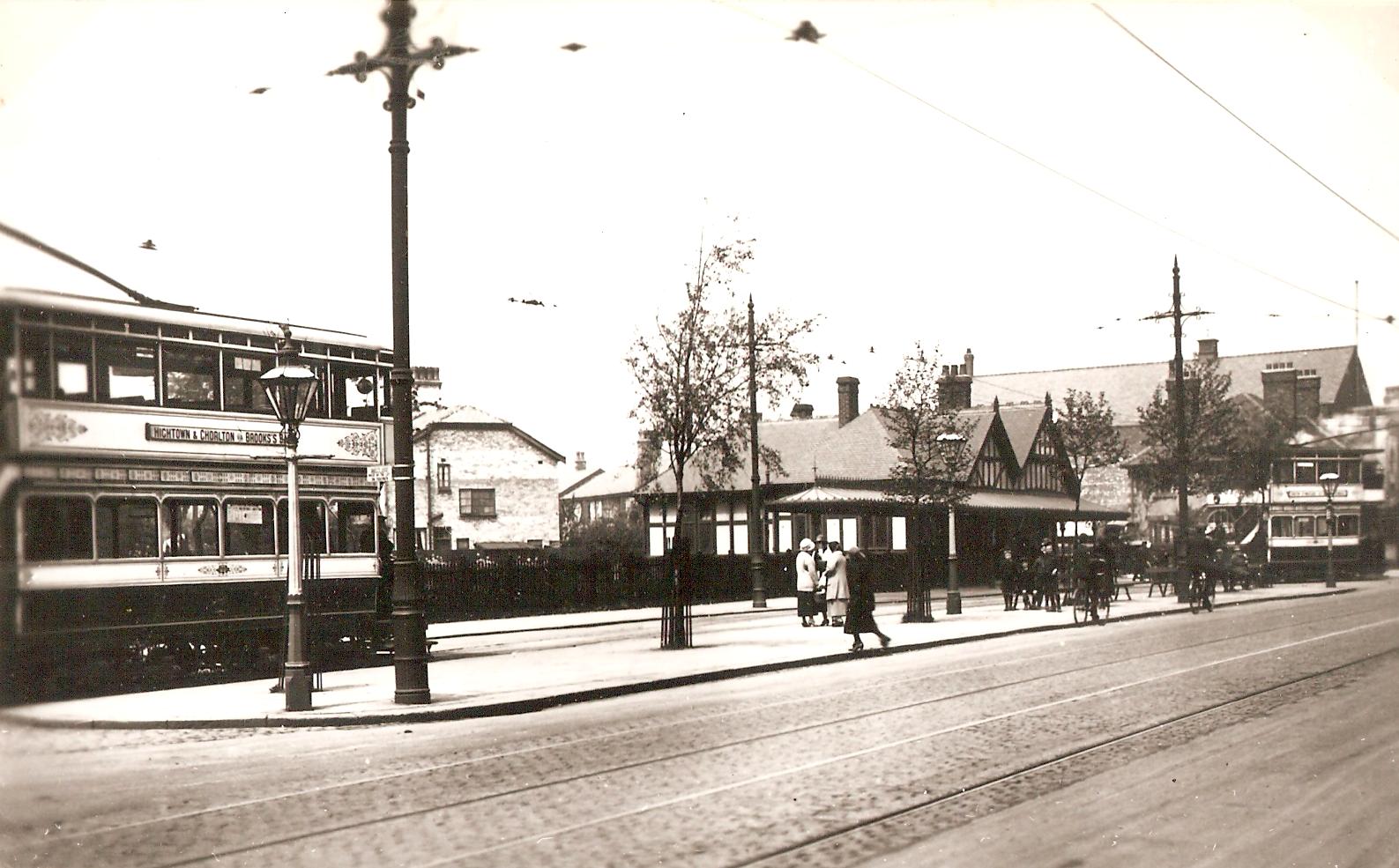
I have chosen the tram terminus sometime around 1928.  Trams took the township out of the era of the horse drawn coach into the 20th century.  In 1903 the route from Belle Vue via Brooks’ Bar and Upper Chorlton Road was extended to West Point at Seymour Grove and four years later was extended again to Lane End,the junction of Sandy Lane and Barlow Moor Road. And in that year of 1928 Manchester trams carried 328 million passengers on 953 trams via 46 routes and along 292 miles of track.  We had indeed become part of the city.

Picture; from the Lloyd collection


Wednesday, 28 January 2026

A tram and the Pleasant Sunday Afternoon Brotherhood


I suppose that old W.C. Fields line, “Never work with children or animals” could be adapted to include never write stories about trams because they have a habit of taking over.

I never realized just how those old bone shakers can still attract people.

The last ran in Manchester in 1949 and the last to clunk and sway its way into the township was even earlier.

But people like looking at them so here is another.

We are at the junction of Barlow Moor Road, High Lane and Sandy Lane sometime in the early 20th century.

A generation or so before and this would have been known as Lane End or by some as Brundrett’s Corner which was its popular name dating back to the grocers shop run by the Brundrett family.

I like these old unofficial names for places which spring from people’s experiences.  If you had taken the tram back down Barlow Moor Road it would have brought you up at Kemp’s Corner named after Harry Kemp who owned the chemists on the corner.

Well into the 1960s it was one of the recognized meeting places in Chorlton, all but forgotten now and superseded by its title of  Four Bank Corner or just the Four Banks, which means more I suspect than the official name of Chorlton Cross.

This picture has all that charm of early photography when people still posed in front of the camera.  But what attracted me to the picture, is the sign in the grounds of the church announcing the business of the PSA Brotherhood.

Now I had come across the Pleasant Sunday Afternoon Brotherhood back in the 1970s in Ashton Under Lyne.

They were what they said they were an organization designed to provide a pleasant afternoon with a Christian slant on a Sunday.  The first seem to have sprung up in the mid 1870s and their first national conference was in London in 1906.

Now this is another of those areas I want to dig deep into.  There was a political dimension  “The long standing relationship between political Liberalism and Nonconformity brought active Liberals into the movement. 

In the early twentieth century key Labour and Trade Union leaders became actively involved in the PSA/Brotherhood Movement. Labour MPs Arthur Henderson and Will Crooks, and the Liberal MP Theodore C. Taylor were all present at the founding of the National Association of Brotherhoods, PSAs etc in London in 1906. 

Keir Hardie, was also actively involved, he was a main speaker for a Brotherhood Crusade in Lille in 1910. Arthur Henderson MP was elected National President in 1914. The National Adult School Union’s ‘One and All’ journal reported 7 out 9 ‘adult school men’ who stood for parliament were successful in 1910.”*

And there appears to be a Temperance aspect so there is a lot to play for and find out.

I had not thought they had a presence in the south of the city but they were here.  Harry Kemp’s Chorlton Alamack for 1910 listed

“The P.S.A. (Men’s Meeting),  Macfayden Memorial Church.  Sundays, 3 p.m. William S Bradshaw, 4, Beechwood Avenue. & P.S.A. (Men’s  and Women Meeting), Wesleyan Mission Hall. Sundays, 3 p.m, Secy., E.H. Astle, 34 Reynard Road.”

And all this and a tram to.  Well worth the read.

* The Early Adult School and Brotherhood Movements in the West Midlands: Adult Education, Evangelism or Social Activism?, European Social Science History Conference, Glasgow, April 14 2012

Picture; from the Lloyd collection

Monday, 21 July 2025

When Stretford removed Chorlton’s tram track ...... municipal manoeuvrings and other tales

Now it seems bizarre that one local authority in dispute with another should take the drastic step of digging up a line of newly laid tram track, but it happened.  

Upper Chorlton Road, 1907, before the extension and the Stretford quarrel
In the winter of 1909 Manchester was in the process of extending a tramway from Brooks Bar to West Point along Upper Chorlton Road, part of which went through Stretford.

This stretch ran for just ten yards but because the Stretford Council had not been asked first, it fired off a flurry of blustering letters threatening to remove the track if Manchester continued.

And when the City laid the offending ten yards of rail, Stretford retaliated, informing Manchester “that a physical disconnection has been made” adding that, “the removed rails were placed behind the seat on the footpath leading to Chorlton-cum-Hardy beyond the [Stretford] district, convenient for reinstatement”.

The underlying reason had more to do with Stretford attempting to get a better deal for electricity it supplied to Manchester to on match days after United had relocated to Old Trafford.

The Bridge at Manchester Road, 1907
Nor was this the only obstacle the city encountered in extending Corporation trams to Chorlton.

Work on the line at Manchester Road was halted after the railway company objected  that the bridge over the railway line was too weak for tramway traffic.

The dispute was finally settled with Manchester paying nine-tenths of the cost of strengthening the bridge.

Such were the problems faced by the Corporation honouring its promise to the rate payers of Chorlton who voted in 1904 to join the city and thought they were getting a tram service.

These are those tiny little stories which don’t count for much in the great sweep of history, but are fascinating none the less.

Car 901 at the tram terminus, date unknown
As is the little known fact that from 1923 until the outbreak of the Second World War there was a facility for late night posting of letters on 14 Manchester and 7 Salford tram routes.

According to A.H. Kirby,  “A posting box was carried on the rear platform of trams timed to reach the City at about 9.30 p.pm; from mid December 1923, these cars were indicated by POST CAR in place of the route number. 

The Chorlton services selected were on route 13, departing from Chorlton due at Albert Square at 9.29 and on route 22 departing Chorlton and arriving Piccadilly at 9.30”, with more being added over the years.*

Car 277 on Barlow Moor Road with the cinema behind, date unknown
Now I thought I knew my Chorlton tram history but Mr Kirby has offered me a fascinating and detailed glimpse into how the trams came to Chorlton and their impact over the 39 years they rattled their way in and out of the township.

And I am indebted to Trevor James who having acquired the two editions of Tramway Review with Mr Kirby’s articles, and thinking of me, scanned and sent them down from Scotland.

I also have to thank Stenlake Publishing who bought The Oakwood Press which published The Tramways of Chorlton-cum-Hardy and gave me permission to reproduce four of the images from the publication.

Location; Chorlton-cum-Hardy


Pictures; trams of Chorlton from The Tramways of Chorlton-cum-Hardy, courtesy of Stenlake Publishing

*The Tramways of Chorlton-cum-Hardy – 2, A.H. Kirby, Tramway Review, Vol 18, Autumn 1989, No. 139, The Oakwood Press. Page 80

** Stenlake Publishing, http://stenlake.co.uk/?page_id=442

Thursday, 10 April 2025

Barlow Moor Road on a sunny morning sometime in the 1930s

We are on Barlow Moor Road sometime in the 1930s on what looks to be a sunny morning.

Of course there is no way of knowing whether it is during the week or the weekend but the awning on the shop by the corner of High Lane is down so I think the shop must be open for business.

The tram is the 46 which was the circular route from town through Chorlton and on to West Didsbury and then back into Manchester.
Picture; from the Lloyd collection

Saturday, 25 May 2024

Tram essentials …..

Now there is nothing more ordinary than the ticket machine and a waste bin.


But they are just two essentials for travelling by tram.

Enough said.

Location; Exchange Square metro stop

Picture; Tram Essentials, 2024, from the collection of Andrew Simpson


Sunday, 21 January 2024

The tram with the start of a story …………………

Now these are two of my favourite pictures of a tram.

It is partly because of the detail, partly because it is still possible to trace its route across the city and finally because of the buildings which are visible in the background.

We are on Barlow Moor Road, and the caption records that this was “one of the last Manchester trams, crossing Beech Road as it enters the bay”, which was the tram terminus.

It is undated, but given the reference to “one of the last Manchester trams”, this would suggests some time after the last world war, but the service was only introduced in the December of 1926, and ceased thirteen years later when the Hightown to Chorlton route was transferred to a bus operations in June 1939.

And that date offers up a glimpse of the properties, which are now Carringtons and Molasses.

In time I will go looking for these houses during the interwar years and see what I can find out about the residents, and just when they ended being entirely residential.

For now, I am happy to track the route of our tram back from Chorlton, via Upper Chorlton Road, Brooks’ Bar, and on to All Saints, Albert Square and High Town.


Picture; tram car no. 0034, date unknown, W.A. Camwell, from the Lloyd Collection

Saturday, 20 January 2024

Rush hour at the Chorlton tram terminus

I like this picture, which I am guessing is the morning rush hour, sometime in the 1930s.

Now I know it can’t be any later than 1938 because route 10 became a bus service in that year, with route 23 following the next year.

And for those wanting to know more, route 10, ran from Cheetham Hill to Alexandra Park via Deansgate, and number 23 went from Newton Heath to Chorlton via Junction and Brooks’s Bar.

I suppose it is just possible that we could be on a weekend in Spring, judging by the leaves on the trees and the number of overcoats.

The nerd in me is fascinated by the detail, which reveals that some of the houses on the corner of Beech and Barlow Moor Road have already become shops while the two two semis at the top of Beech Road have yet to be built.

Added to which there was a still a canopy running along the rear of the terminus.

But what I like most is the sheer volume of people going about their business, which can’t be matched in a rush hour today.

Location; Chorlton

Picture; tram terminus, Chorlton-cum-Hardy, circa 1930s, from the collection of Allan Brown

*Tram Services, Appendix 6, complied by Cliff Taylor, The Manchester Tramways, Ian Yearsley and Philip Groves, 1988

Friday, 1 September 2023

Who took away our bus office? …….

It stood on the corner of Barlow Moor Road and Malton Avenue and had been there from 1914.

Our tram and bus office, circa 1920s-30s
It started as the tram office when according to the Manchester Guardian "The Manchester Tramways Committee have bought a piece of land at the tram terminus in Barlow Moor Road, Chorlton-cum-Hardy, for the purpose of a siding, a veranda and shelter and other convivences"*

And that was what it continued to do well into the 20th century even featuring in a pile of pennies campaign in aid of the Russian Famine Appeal of 1921.**

I doubt it has ever warranted its history being recorded although the blog has gone searching for its story.***

It appears in several photographs and was annually recorded in the street directories until 1969.

Still going as the bus office, 1962
But sometime between then and 1976 it appears to have closed, may have stayed empty for a while and at some point was taken over by the Manchester Diving Group.  I tried calling and emailing the group to ask when they took the site over, but have so far been unsuccessful, but I will try again.

Their site offers up their history but not when they settled in the old tramway office.

I think the end of the office may well have coincided with the reorganization of transport which saw the merger of the corporation bus companies across Greater Manchester into SELNEC in 1969.

My Wikipedia tells me that “SELNEC Passenger Transport Executive, “took over the bus fleets of 11 municipalities, and operationally, the organisation was split into three divisional areas, Northern, Central, and Southern”.****

Now that was a mammoth task and involved the incorporation of the largest bus fleet of Manchester’s 1,500 buses with Ramsbottom’s collection of 12.  

A bus top and former office, 2022
In total there were 2,532 vehicles, and heaps of garages which inevitably led to a series of closures as the Executive sought to rationalise the system.

And I think this may well have been why our office closed.

There will be people who will remember the bus office, and will remember its closure.

Sadly I am not one of them.  It may still have been operational when I washed up in Chorlton in 1976, but I have no memory of it.

So the quest continues to find out just when this happened.

The door to the club, 2022
Answers on a used bus ticket or better still a historic tram ticket and posted to me on facebook, or as a comment.

Location; Chorlton Bus Office, Barlow Moor Road

Picture; the tram office with waiting room, circa 1920s-30s from the Lloyd Collection, Barlow Moor Road, circa 1962 from the collection of George Cieslik, the office 2022, and the door to the Diving Club, 2022, from the collection of Andrew Simpson

A thank you to Tony Petrie who sourced street directories from 1929-63 and Andy Roberston for 1969.

*Tramway Shelters, Manchester Guardian, March 11th, 1914

**Mrs. Clara Nicholson of Chorlton ……. the mile of pennies ……. and a Disaster Appeal, https://chorltonhistory.blogspot.com/2022/10/mrs-clara-nicholson-of-chorlton-mile-of.html

***The tram office ...... a mile of pennies ..... and the story of Sport Diving in Chorlton, https://chorltonhistory.blogspot.com/2022/10/the-tram-office-mile-of-pennies-and.html

****Greater Manchester Passenger Transport Executive, https://en.wikipedia.org/wiki/Greater_Manchester_Passenger_Transport_Executive

Tuesday, 15 August 2023

On Wilbraham Road in the spring of 1913


Now I tried standing in the road at this exact spot yesterday and failed dismally.  

It is that stretch of Wilbraham Road just past the old railway bridge at the corner of Buckingham Road, heading out of Chorlton and yes it is impossible to stand there.

Well I suppose if I had chosen to attempt the task at 4 on a Sunday morning I could have done it but I can think of better things to do at that time.

But if I had been around on a spring day sometime in 1913 I could have happily stood alongside the school boys and been quite safe.

It is another of those remarkable pictures which reminds us just how much has changed.

Apart from the tram on its way into town the only other traffic are the horse and carts.

The terrace of shops and flats that make up Egerton Arcade had only been up for a few years, while the row which now faces it had yet to be built.

And like so many of these early pictures it is the curiosity of the spectators which strikes me most.

 Here are the usual collection of familiar poses, the defiant figure with his arms folded staring resolutely into the camera almost challenging it do its worst, while a little further away a few more look on and in the far distance the workman also pause to stare.

Of course none of the shops have survived, although part of the glass and iron canopy is still in place and I am intrigued by the large lawn roller.

Now from memory there was in the parade up till the late 1980s a hard ware store with its distinctive mix of smells of paraffin and wood and the accumulated pile of odd things including nails, screws and bars of soap.

With a little research I could trace the shop back to 1913 and it is quite possible that the place had neither changed use nor owners.

After all the Lloyd family ran their shop on
Upper Chorlton Road from the beginning of the 20th century well into its final decades.

What was certainly there on that spring day just a little back from the camera and just before Buckingham Road was the old Pavilion theatre, recently renamed the Chorlton Theatre and Winter Gardens.


It was our first cinema and its billboards may well have been a ready source of entertainment for our youngsters before the novelty of the photographer.

Location, Manchester


Picture; from the Lloyd collection

Thursday, 27 October 2022

The tram office ...... a mile of pennies ..... and the story of Sport Diving in Chorlton

So, who would have thought that the waiting room of the Corporation tram office would end up as the home of the Manchester Diving Group?

The door to diving, 2022

I have yet to find out when it stopped its connection with the travelling public, but it may have been in the 1950s when the Manchester Diving Group was set up or a tad later during a rationalization of transport facilities.

That building circa 1920s-30s
As far as I can remember it was no longer the Chorlton Office when I arrived in 1976.

But an email to the Diving Group may reveal the date.

For now, I enjoyed the history of “Sport Diving” from their web site and the story of how Diving came to Chorlton.*

Leaving me to look for when our building was erected, which will be around some time soon after 1914,when according to the Manchester Guardian "The Manchester Tramways Committee have bought a piece of land at the tram terminus in Barlow Moor Road, Chorlton-cum-Hardy, for the purpose of a siding, a verandah and shelter and other convivences"**

Interestingly in 1922, the waiting room of the building featured in a fund raising exercise for the Save the Children Fund in Russia organised by "a committee of Chorlton- cum-Hardy residents who planned to make a mile of pennies on Sunday October 30th."  

"A mile of pennies", 1921

The Lady Mayoress was "to place the first pennies on the line in the middle of our mile which we are making in the tram waiting-room, as we feel this is the most densely populated on a Sunday afternoon between three and four thirty. 

If we complete our mile, we shall be able to send through £220.  

Twenty four pennies will keep one Russian child for a week and so every step in that 'proposed mile' would bring hope and happiness where there is only despair."***

The appeal was made by a Mrs. Nicholson of Gilda Brook, on Edge Lane which I think may prompt more research.

Leaving me just to add that the tram office  the subject of a firebomb on October 9th, 1940

Location; Chorlton

Picture, the door to diving, 2022, from the collection of Andrew Simpson, and Chorlton Office circa 1920s, 30s, from the Lloyd Collection

* Manchester Diving Group, https://www.manchesterdiving.org.uk/

**Tramway Shelters, Manchester Guardian, March 11th, 1914

***From Chorlton-cum-Hardy to the Volga Valley, Manchester Guardian, October 20th, 1921

Wednesday, 12 January 2022

Wilbraham Road sometime in the 1920s


Sometimes you set out to tell a little story and without really making much of an effort a collection of them fall together.  And so it has happened with this short series on Wilbraham Road in the decades after 1913.

This is the row of shops and flats called Egerton Arcade.

Now I don’t have a date for the picture, but I guess it must be late 1920s or perhaps even the early 30s.

And little appears to have changed; the road is still empty and dominated by the tram although the horse and cart have now been replaced by a car.

To our immediate left is the entrance to what had been the Chorlton Theatre and Winter Gardens, but it is unclear whether it is still there.

It had been our first cinema but closed during the inter war years when the first two purpose built and much grander cinemas opened. *

Despite the fact that perhaps only a decade has passed it might well have been longer and it’s the little things that are the clues.  No one now stares at the photographer with curiosity; in fact if anything people just ignore him, while the parade of shops to our right are well established.

Picture; from the Lloyd collection

http://chorltonhistory.blogspot.co.uk/search/label/Chorlton%20cinemas

Monday, 8 November 2021

Forgotten Chorlton ................. nu 3 clocking the changes at the tram terminus on Barlow Moor Road

Now this is the last of the pictures from that excellent site run by Mark Fynn.*

And as a bonus here are two.  I was going to say in the series of then and now, but quite clearly both are from then.

The first will not be that long after the tram terminus was constructed, from what had originally been land belonging to the Holt family who had lived in Beech House from the 1830s till the beginning of the 20th century.

The house and gardens stretched from the corner of Beech Road along Barlow Moor Road to High Lane and then just behind Cross Ross Road.

With the death of Mr Holt the land was sold for development and the Corporation took a strip which became the terminus.

Before that the trams had stopped at Lane End where Sandy Lane and High Lane met Barlow Moor Road.

And with that bit of tram history I will leave you to compare the two pictures, spot the differences that a few decades make to  a scene and take yourself off to the corner of Beech and Barlow Moor Roads and judge how another sixty years have transformed our terminus.

Picture; Barlow Moor Road circa 1900s and again 1950s, courtesy of Mark Fynn

*Mark Fynn, http://www.markfynn.com

Friday, 18 December 2020

Looking for the past ……… amongst the bus stops and shelters

It is a familiar enough place, which before it was the bus terminus was destination of trams and known as Chorlton Office.


And as such dates back to the early years of the last century.

But before that, perhaps for a century this was the eastern end of the garden belonging to the Holt family.

They had taken up residence in the big house in the 1830s, while retaining their business and town house in the fashionable St John Street.

And they were to remain here until the last of the family died in 1908 and the house and its extensive grounds were put up for sale.

Manchester Corporation bought a chunk of the eastern end of the garden in order to widen Barlow Moor Road and build a terminus for its trams.

The rest of the Holt story is here on the blog, including pictures of the house and their town home.


Their's was a large house set in grounds which stretched from Barlow Moor Road to High Lane, down High Lane almost to Cross Road and then south to Beech Road.

Location; Chorlton-cum-Hardy


Picture; the terminus, 2020, from the collection of Andrew Simpson


Tuesday, 19 November 2019

On Barlow Moor Road with tram car 183 and hidden buildings

It’s a tram picture again but with a bit of a difference, because it is the background which interests me more.

We are on Barlow Moor Road just past the junction with Beech Road, I don’t have a date but guess it must be the 1930s or 40s.

Tram car 183 is stationary and is empty.

What fascinate me are the buildings behind the tram.


All of which makes me think I must go and check out all these little bits of detail in the street directories.

In the meantime I have to admit it is a fine picture of car 183 and will no doubt please all the people out there who like these pictures of trams.

Location; Chorlton


Picture; from the collection of Allan Brown, date unknown

Thursday, 2 May 2019

On leaving Didsbury Station with loco 45602 in 1954 and recreating the journey by tram 44 years later


The one I wrote in 2013.

I couldn’t resist another journey on the new tram from Chorlton to Didsbury Village.

Until last week no passengers had travelled the route for nearly half a century.  It had from 1880 taken people from Central Station south out through Chorlton and Didsbury on into Derbyshire.

But the service had closed in 1967 and we have had to wait till now to  do the journey again.

And in one of those classic then and now stories here is the  old Didsbury Station in 1954 as an express train pulled by Locomotive-45602 is passing through.  Michael Baxandale tell me that "the loco is the Stanier Jubilee 45602, British Honduras, 1935-1965, headed in the up direction, that is, south-east.  I (can just about) recall standing on the footbridge when a (steam-hauled) London express came through.  By the time they had reached Didsbury they were going at a hell of a pace.”

Didsbury Station was opened in the January of 1880 and by 1900 over 200,000 tickets were sold from the station while a decade later it was served by 38 trains running south and 40 running north with a frequency of every ten minutes in  peak time.

Now the new metro stop is a little to the south of the  station and lacks some of the elegance of the old place, but then when it comes to steam and railways I am a bit of a romantic.

A flaw which my mother was always quick to point out should be guarded against when it came steam engines, for as she often pointed out “they were smelly dirty and noisy” and woe betide anyone who had put their washing out on the line as an express train went past.  Romance and majesty might be the image as the locomotive swept past but the chances were it had left a calling card of soot on the white sheets.

So I shall just leave you with Peter Topping’s painting of the tram and the unromatic can reflect on the clean quiet journey to be had by tram number 3014 as it gets ready to leave for East Didsbury.

I on the other hand while I travel the Metro with pleasure will lament the loss of loco 45602 as it hauls its way north out of the station  accompanied by the sound and smell of steam doing it magical business.

Pictures: painting of tram at Didsbury Village © Peter Topping 2013 www.paintingsfrompictures.co.uk and Locomotive-45602 and train heading north to Manchester in 1954, m63444, courtesy of Manchester Libraries, Information and Archives, Manchester City Council

Saturday, 17 November 2018

Our tram terminus


It’s a personal opinion but I don’t think our tram terminus has fared so well.

The lavatories are permanently closed the office building looks a little knocked about and it is the sort of place that you hope the bus leaves promptly and you are not waiting there for long.

All of which is a contrast to when it opened back on May 14th 1915 which according to one book was built as "a double track stub-terminal siding, complete with an office building, shelter and toilets,[when it] was opened on the west side of Barlow Moor Road between Malton  Avenue and Beech Road.  Trams entered and all left from the north end; not until 1929 was the south end linked.”*

Now I am not one to wallow in nostalgia but looking at this 1928 picture of the tram terminus, complete with gas lighting I rather think I will wallow for a short while.

Picture; from the Lloyd collection, circa 1920s-30s

Location; Chorlton-cum-Hardy

* Yearsley, Ian  and Groves, Peter, The Manchester Tramways : 90 years of progress 1988, p 80, information supplied by George Turnbull, http://www.gmts.co.uk/

Friday, 16 March 2018

Thirty years in the history of a bit of Wilbraham Road


I have over the last few days been reflecting on the changing views of one small part of Wilbraham Road.  It started with a photograph from 1913 and I want to conclude with two from 1928 and sometime in the 1950s.


They are instantly recognizable as the same place and yet in that few decades there have been some changes which hint at the way things have moved on.

In 1928 the tram still dominated the way people travelled on public transport, and yet within less than ten years the Corporation had decided to progressively phase them out in favour of the bus, and by the 1950s the tram its overhead cables and even the track had gone.

There may have only been two more cars on the road in the later picture but it would not be long before those relatively empty roads would be far busier.

And behind the curtains inside the front rooms of the houses and flats it would have been the television which was about to replace the wireless as the main source of entertainment which might never the less compete for attention with the record player which by the late 50s would be playing the new 45 rpm singles instead of the heavy and out dated old 78s.

But for those on a night out in 1958 the chances were they would be repeating the experiences of their parents thirty years earlier and visiting one of the three cinemas and depending on which one they chose might very well have sat in the same seats.

Such were some of the changes from the late 1920s.

Pictures; from the Lloyd collection

Saturday, 10 March 2018

Watching the trams ...... for the Friends of Hardy Lane and maybe also Mauldeth Road West

Now for no other reason than I can, here are trams 3067 and 3068 on route to and from the Airport.

It was a Friday afternoon and I was sitting on that bench beside the car park of the Co-op.

There will be a few who mutter why two pictures of trams?

And the answer is that they will please the Friends of Hardy Lane, which in turn and set me off thinking about setting up a Friends of Mauldeth Road West.

On that we shall see.

For now, I will leave you with the two pictures, secure in the knowledge that Michael and Andy and others will weigh in with their on tram photos, well I hope so.

Location; Manchester


Pictures; trams 3067 and 3068 passing at Barlow Moor Road, 2018 from the collection of Andrew Simpson 

Tuesday, 20 February 2018

Corporation Tramways Water car No 1 on Brook Bridge 1930, now that's a zippy title

You won’t see one of these on the roads of Chorlton, and yes once they would have been a fairly common sight.

It is a water car and this one was Corporation Tramways Water car No.1 on the Brook Bridge on Barlow Moor Road sometime around 1930.

Now they seem to come in all sorts of designs, size and shape, but they all did the same job which was to clean the tracks.

I have a picture of one from South Shields in front of me as I write and water is cascading from the bottom of the car.  I guess ours worked in the same way. 

And I bet there will be someone out there who either corrects me or supplies further information which I am always happy to have.  

I must admit I have wondered on how many there were in the fleet, how regularly they came round and whether we would have seen more of them in the autumn when the leaves were falling or in the hot summer months when the tracks might have needed cooing down, which just goes to show how little I know.

What I also like about the picture is the hint of other things.  So just to the left of the car and behind the fence can just be made out Oak Farm which was there by the beginning of the 19th century and may be even older.

Location; Chorlton-cum-Hardy

Picture; from the Lloyd collection

Friday, 2 February 2018

Be careful which tram you choose to get home to Chorlton in November 1913

I never tire of this image of Barlow Moor Road sometime just before 1911 and it is one I keep coming back to.

But for now it is the postcard and the company that interest me more.
It is the fourth in the series produced by Tuck and Sons Ltd in 1913 showing scenes from Chorlton.

Each has that distinctive border and continued in circulation well in to the 1920s.  Some I suspect dated more quickly that others as shops changed hands and new buildings replaced old ones.


And what makes it interesting is that it was sent in the November of 1913 just seven months after the tram route from Chorlton had been extended to West Didsbury which in turn meant that there was now a circular route that took the passenger from town through Chorlton and on to Didsbury and hence all the way back into the city. 

This was the Circular route which long after the trams had disappeared still offered you the choice of the short route to Chorlton from Princess Street or the long one down Oxford Road passing through Rusholme, Fallowfield and Withington before turning north for the trip into Chorlton.

Only once did I make the mistake of getting on the 46 and not the 47 which while it gave me the scenic route did little to get me home early.

Perhaps the same thought had occurred to J S who sent the card with the simple message, 45/46 circular routes.


Pictures; Barlow Moor from the series Chorlton-cum-Hardy, issued by Tuck & Sons, November 1913 courtesy of TuckDB http://tuckdb.org/history