Showing posts with label Manchester Bus Stations. Show all posts

Friday, 31 January 2025

At the bus stop in Piccadilly in 1961


It is 5 pm on a sunny afternoon in 1961 and the rush hour is in full swing.

And if you lived in great chunks of Manchester it would be the bus which would be taking you home.

Now it would be a full eight years before I washed up in the city but W.Higham’s picture perfectly captures the bus station I remember.

It is of course a scene that has vanished.  The old glass and steel shelters went a long time ago and the building behind on Portland Street was another of those that I remember but its demolition passed me by.

Behind the bus shelter and the line of commuters the sunken gardens fare better, lasting into this century before they too succumbed to change which I still have doubts about.

Every time I gaze on that great concrete slab I wonder if a more sympathetic device could have been created to screen the busy transport hub from the open spaces of the new gardens. And whether the gardens could just have been tidied up and left as they were rather than creating that wet windswept expanse of tired grass and water feature.

All of which I know opens me up to the criticism that I am wallowing in nostalgia but not so.  The gardens were a pleasant place offering a degree of peace in the heart of the city and a welcome lunchtime break.*

And by extension for those who wanted to miss the rush hour torture they were a pretty good place to sit it out till the buses were half empty.

And that couple of hours between the day time people leaving and the night crowd coming in is still a magical time.

The city seemed to get a wee bit quieter and a little calmer, but you knew it was just a lull before the business of fun took over from that workaday atmosphere.

The gardens were a particularly good place to observe it as were the city centre pubs.  Stay long enough in one of the pubs and you could watch as tired office workers and shop assistants slid away after a few drinks having discussed their day and were replaced by a more energetic and optimistic crowd whose enthusiasm for the night ahead grew as the rounds were bought.

So I still wonder at how many of those at that bus stop waiting in the late afternoon sunshine decided that tea in Chorlton and an evening with Coronation Street, Dick Emery and the Avengers might be less attractive than the call of a few drinks and a film at the Odeon.

*http://chorltonhistory.blogspot.co.uk/2012/05/distant-memories-of-manchester-parks.html

Picture; Piccadilly Bus Station at 5pm, W. Higham, 1961, m56932, courtesy of Manchester Libraries, Information and Archives, Manchester City Council

Sunday, 12 November 2023

At Chorlton Street Bus Station in the summer of 1955


Now I have been on a roll with the bus stations of central Manchester.  

And I have been feeling a little guilty at how harsh I have been about them.

Then I remembered Chorlton Street Bus Station.

It’s not a place I have visited often but on those rare occasions when I have had to see someone off on a coach journey I always came away with an overpowering sense of misery.

It stands underneath a multi-storey car park which made it darker than it should be and always seemed a cold and windy place.

And the tiny snack bar just seemed to add to the gloom.

All of which was in stark contrast to the last two times I saw our eldest off on a coach to Leeds.  The waiting area had been enlarged and enclosed.  It was bright and there were plenty of places to sit and keep warm until the coach was ready for you.  Now the transformation had occurred in 2002 and put a seal on the old station which had been opened in 1967.

What I didn’t know was that this was a 1960s’ make over and that the place dated back to 1950 when it had consisted of three platform islands with long shelters.

And looking back to pictures of the bus station in 1955 I do have to say that this earlier version had more going for it than its ‘60s successor.

True I guess it could still be a cold place but just look at the light and that sense that if you did have to leave the city at least you could see what you were leaving.

Our picture was taken at 2 pm on what looks to be a sunny day and it’s the detail I like.

Away to right are three passengers waiting in the sunshine.

He reads his newspaper and the two women are deep in conversation perhaps discussing the state of the sandwiches and judging by the bags at their feet they may also have been talking about their success at the shops while away to the left  there are men at work on the shelter roof and not a coach in sight.

Now I can't resist adding a bit more history, which in a way takes me back to the grim and miserable tone I opened with.

For here somewhere along Chorlton Street in the June of 1831 Dr Gaulter had attended those infected with Cholera.  In the course of his work he carefully detailed the conditions not only of the victims but of their surroundings.

All four of the Bullock family succumbed and died of Cholera within a few days.  All had been sharing the same bed.  The locality he reported was "crowded and full of filth."*

All of which is a trailer for a series of stories on Cholera in Manchester but as I so often say that is for another time.

In the meantime I wonder if the people captured by W.Higham in his picture  had any inkling of the grim history that surrounded them. I suspect not, and nor I venture to think will any of the countless thousands who pass along Chorlton Street today.

*The Origin and Progress of the Malignant Cholera in Manchester, 1833, Henry Gaulter, M.D

Picture; Chorlton Street Bus Station, W.Higham, 1955, m56903, courtesy of Manchester Libraries, Information and Archives, Manchester City Council, http://images.manchester.gov.uk/index.php?session=pass

Friday, 11 November 2022

Waiting at Stand K ……. Shude Hill

Waiting at Stand K for Warrington, Trafford Centre, Hollins Green, and the Glaze Estate.


Location; Shude Hill

Pictures; Waiting at Stand K ……. Shude Hill, 2022, from the collection of Andrew Simpson


Monday, 5 September 2022

Bus stations I knew and some I wish I had never known


Bus stations don’t do much for me.  

I suppose it’s partly because for a great chunk of my life bus journeys have been something to endure with that ever present threat of feeling ill on one of them.

And trolley buses were far worse.

Even now that smell of warm leather seats, disinfectant and the low hum of the machinery bring back unpleasant memories.

But it’s also that they lack any romance.  Unlike a railway station or even an airport they are just drab work a day places which all too often are pretty smelly.

And the worst example was the one built beside the Arndale in the 1970s.  It was dark, grim and beset with engine fumes.

Catching a bus there was just a practical thing, something you had to do to get somewhere, and the best thing you could say about it was that usually you weren’t in it for long.

Now I can talk from experience.  Over the years I have waited in bus stations in the most boring and ugly places.

All too often they are tucked away behind an office block or the wrong side of a market.  Most are just tolerable in daylight but take on a sinister feel at night.  Not helped by the absence of people which makes the odd passerby take on an altogether unwelcome appearance.  And all of them compete for a wind tunnel award.

But perhaps that is a bit harsh and so I have decided to go in search of the bus stations of the city centre.

Some like Piccadilly, which was once called Parker Street are stilll doing the business, while others, surplus to requirement or just in the way have vanished.

The old Arndale horror and the one down near the Cathedral I remember but others like the ones at Chorlton Street and Lower Mosley Street are places I did not know.

Now I say that but as soon as I started researching the one on Lower Mosley Street I discovered that it closed in 1972 and the site demolished the following year which was a full three years after I had arrived in Manchester.*

So much for the power of memory then, which I guess is one in the eye of those who triumph the power of oral history.  Not that I have anything against oral history it’s just that the memories have to be accurate. And in my case they are so wrong, or at least I should say vague because I cannot remember the bus station or for that matter what took its place.

All of which is a bit embarrassing given that after its demolition in 1973 it served as a car park until the Bridgewater Hall was built on the site. This might seem an easy slip of memory perhaps but one that lasted for twenty years from 1973 till the Hall’s completion in 1996.

The Lower Mosley Street Omnibus Station was opened in 1928 on the corner of Lower Mosley Street and Great Bridgwater Street, and was used by the long distance coach operators.  These were mainly the North Western Road Coach Company and the Ribble Motor Services along with vehicles from Lancashire United, Trent Motor Traction, Northern General, United Yorkshire Woolen District, Yorkshire Traction, Crossville, East Midland, and Midland Red.  And added to this there were also buses from Manchester Corporation and the Stalybridge, Hyde Mossley and Dukinfield Transport Board.

Given that it was opposite Central Station it was one of those examples of integrated transport hubs that are so useful.

None of which excuses the fact that its presence just passed me by.  But then that does raise that interesting observation that we often let history slide by.

At best we take places for granted and at worst do not even clock that they have gone which I suppose is a salutary lesson to anyone interested in history.

All of which just leaves me to reflect that the price of maintaining our past is eternal vigilance, or something like that anyway.

Pictures; Parker Street Bus Station, 1934, A. Dawson, m56922, Parker Street/Piccadilly Bus Station at 5pm, W. Higham, 1961, m56932, Chorlton Street Bus Station, at 2pm W.Higham, 1961, m56889, Lower Mosley Street Bus Station, H. Milligan, 1955 m56903, Lower Mosley Street Bus Station, H. Milligan, 1955 m56905,  courtesy of Manchester Libraries, Information and Archives, Manchester City Council, http://images.manchester.gov.uk/index.php?session=pass


*http://manchesterhistory.net/manchester/gone/mosleybus.html

Monday, 1 March 2021

Manchester's Bus Depots …… another story from Tony Goulding

This impressive clock tower in Parrs Wood, East Didsbury is all that remains of the first purpose-built motor bus garage/depot of Manchester Corporation Transport Department. 

“Tesco” Clock

It was opened on the 23rd March, 1926. Mr. Stuart Pilcher, the new general manager of M.C.T.D. was an advocate of bus transport and initial replacement of tram services by buses proved to be more profitable and negated the need for an expensive renewal of obsolete parts of the tram network. (1) 

As the city’s bus fleet steadily increased with the tram network being cut back the tram depots were also converted to garage buses. There were several of these around the city at Princess Road, Moss Side, Hyde Road, Ardwick, Queens Road, Cheetham Hill and Birchfield Road, Fallowfield, needed to house the fleet of Manchester Corporation's buses. 

When the short-lived S.E.L.N.E.C. took over responsibility for running the bus services in 1969, Manchester City Transport  were operating 1,250 vehicles at the hand-over on the 1st November, 1969.

Another purpose-built bus depot was built in Harling Road, Sharston, Wythenshawe. Despite its location, it was known as the Northenden Depot. When completed in 1942 its first use was in the construction and repair of Lancaster Bombers. 

Grade II listed Wythenshawe Bus Depot
Due to its pioneering design by Manchester City Architects Department, (chief architect G. Noel Hill) it has been designated a Grade II listed building. In 1946, the building reverted to its peacetime use of housing up to 100 double-decker buses. 

On a personal note, from 1952 to 1974, it was the home depot of my father working first as a bus conductor and later, after the introduction of driver only operated buses, bus cleaning and general maintenance.

Hyde Road Depot - 1958
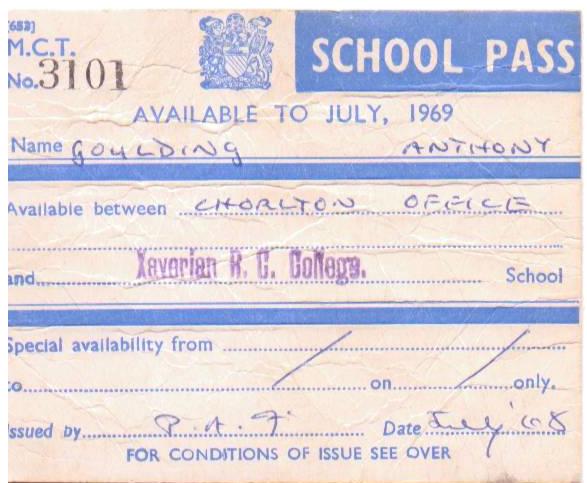
The Hyde Road depot housed the transport department’s lost property office on Devonshire Street North which I had occasion to visit more than once as a schoolchild in order to retrieve a bag or on one occasion a “Scholars Pass”. 

The huge building was very much a local landmark and featured this famous five faced clock!

I also have vivid memories of the large transport depot on Princess Road as it was located on one of the routes, I would take to attend matches at Maine Road in the late 1960s .

After alighting from either the 80 or 88 bus from Chorlton-cum-Hardy Office on Alexandra Road we would skirt the park and cross Princess Parkway by the Y.M.C.A Hostel before continuing down the road at the side of the bus depot. 

My Pass

Hyde Road's famous five-faced clock


I remember being impressed by the size of the walls and the view through the wide entrance into the garage.

Princess Road Depot in 1967

Pictures: - “Tesco” Clock courtesy of Andrea Martinez, School Pass from the collection of Tony Goulding, Princess Road depot 1967 by D. Wildgoose and Hyde Road Depot and clock 1958 by F. Hotchin (m38470 and m27231 respectively) courtesy of Manchester Libraries, Archives, and Information, Manchester City Council http://manchester.gov.uk/index.php?session=pass Wythenshawe Bus Depot: - By KJP1 - Own work, CC BY-SA 3.0, licensed under the Creative Commons Attribution-Share Alike 3.0 Unported license.
Notes: -

1) Manchester was one of the first cities to make the change from an extensive tram network to bus services, some of which in the initial phase were trolley buses which were powered from the overhead power lines but did not run on rails.