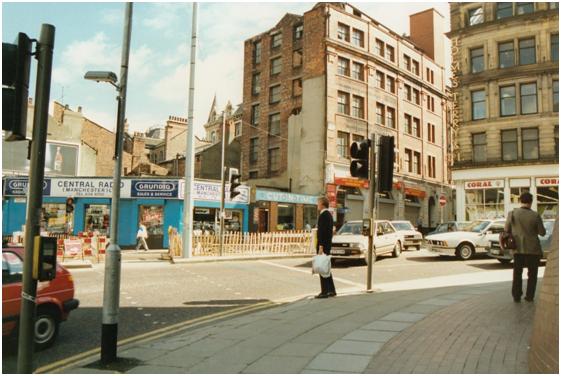
Showing posts with label John Casey. Show all posts

Saturday, 7 March 2026

Gasholders I have known and loved

Now I grant you they may not seem the most compelling things to write about or indeed to asdmire.

But if you are of a certain age and lived close to a city or town centre they will have been part of the landscape.

I grew up near one and lived close to another when we occupied a flat in east Manchester.

Most of us will have taken them for granted and yet in their way they were a marvel of the 19th century and as much an symbol of that period as the steam engine or the dark satanic mills.

Until recently I have no idea there had been one on King Street West near the House of Fraser although I do have a fine picture of the coking room of the one on Rochdale Road.

Once the manufacture and storage of “town gas” was an essential part of each town and city and were just taken for granted.

So here in a new series are two pictures of the one in east Manchester from the camera of John Casey dating from the 1980s.

Be warned ............ more will follow.

Location; East Manchester

Pictures; the gasholder in east Manchester, 1980s from the collection of John Casey

*Gasholders, https://chorltonhistory.blogspot.co.uk/search/label/Gasholders

Sunday, 5 January 2025

A little bit of Manchester nearly 30 years ago ......... building the First City Crossing

I am looking at another one of John Casey’s photographs.

It dates from the very early 1990s when the construction of the First City Crossing was well under way, and this is the section by Victoria Station.

We tend to overlook more recent pictures of the city and yet they can be as revealing as any of those old black and white images from the early 20th century.

And this one is no exception.

It starts with that bus in the distance in the old livery, moves onto the actual track bed being prepared and finishes with those buildings one of which I still remember visiting when it was a Post Office.

In the last year or so they have vanished while the ones to their right behind the bus went in preparation for the construction of the Urbis which is now the National Football Museum.

Equally fascinating are the images of ghost buildings.

John took a series of pictures along the route of First City Crossing and with some stunning ones of Chapel Street around the same time and I am so pleased he has given permission for them to be featured on the blog.

Location; Manchester

Picture; down by Victoria Station circa early 1990s from the collection of John Casey

Thursday, 18 July 2024

Passing through what was to become Exchange Square

Now this is the Corn Exchange sometime in the 1980s.

It was a building I took for granted at the time and never for one minute thought how it would change over the next thirty years.

Or for that matter just how dramatic would be the transformation of the space in front of this Grade ll listed building.

By the time John Casey had taken his picture the building had given up being a Corn Exchange would become the Triangle and went from a place where quirky little businesses did all sorts of interesting sales, to a designer outlet and is now home to a host of restaurants.

And in the wake of the IRA bomb it saw the creation of a new public place which has become a busy tram interchange.

Location; the Corn Exchange,

Picture; Corn Exchange  circa 1980s, from the collection of John Casey

Monday, 15 July 2024

Nicholas Croft ........... another of Manchester in the 1980's

Now this is one of those scenes which hasn't changed much in thirty years but I wonder for how much longer the buildings directly in front of us will survive.

This is  Nicolas Croft and Back Turner Street.

It didn't change until very recently, when Derek the Developer declared war on that block of shops on the corner.

Once it had been a tall Victorian/Edwardian set of offices, reduced to a ground floor and cellar which in the mid 1980s was home to shop specializing in beauty and hair products.
During the course of the last year I have toyed with capturing its transformation, but left it too late.

And so last month as an after thought at the end of the day in town with a camera, I snapped the corner of Derek's achievement.


Location; Nicolas CroftManchester

Picture; Nicolas Croft and Back Turner Street' circa 1980s courtesy of  of John Casey and in 2023 from the collection of Andrew Simpson

Saturday, 6 April 2024

The Vanished Ones ............... no 4 back at Hunts Bank with a favourite

Now I am back by Hunts Bank looking up to the Cathedral and there is that missing building again.

It featured a few days ago when Andy Robertson sent me two pictures of a before and after which were taken a year apart.

The after was dates this year and the before from 2016.

Not to be out done John Casey has shared two more which take the story back a full three decades.

Lots of people were fascinated  by the building which had once been a hotel and dated back into the 19th century.

It had been built between 1837-45 by the Manchester and Leeds railway Company and was actually three buildings.

One section consisted of livery stables and offices, the middle building was offices and shops and the northern section was constructed between 1842-43 as a railway hotel serving Victoria Station.

Later the buildings were turned over to retail use and in 1969 were acquired by Chetham’s School which applied for planning permission to convert the building into classrooms.

And now it has gone.

Back in 2014 the case was made for its demolition which makes interesting reading particularly for the details of the proposed use for the site.*

So that is about it leaving me only to include a second photograph from John showing a but more of that building along with the cathedral and river.

Location; Manchester

Pictures; Palatine Building and Victoria Street, circa 1980s, from the collection of John Casey

*When Demolition Makes Sense:  MCR’s Palatine Building, https://confidentials.com/manchester/when-demolition-makes-sense-mcrs-palatine-building#:~:text=This%20article%20was%20originally%20published,medieval%20buildings%20can%20be%20revealed.

Friday, 26 January 2024

Lost and forgotten streets of Manchester ........ nu 80 Snow Hill

Now I will have passed that entrance between the shop Shudehill Supply and its neighbour countless times and never ventured down to explore what was on the other side.

Had I done so I would have come across Snow Hill which is a name I rather like and which you know must have a fascinating history.

It ran from Shudehill to Bradshaw Street and was there by 1793 and did not change over much until it was swept away during the construction of the First City Crossing.

I say during the building of the tram line but I am not quite sure, but like all these things someone will put me right.

The romantic in me would like to think it was a picturesque place  but what ever its origins by the mid 19th century it was a workaday street home to waste dealers, a bookbinder and a drysalters company and seventy years later while the names had changed the businesses were much the same.

That said on the corner with Bradshaw Street was the Castle and Falcon which was certainly there by 1824 and with a bit of digging should reveal a rich history, but that is for another time.

So having started with that entry I will finish with that other side of the street.

Both pictures were taken by John Casey in the 1980s.

Location; Manchester


Pictures; Snow Hill in the 1980s, from the collection of John Casey

Thursday, 25 January 2024

Lost and forgotten streets of Manchester .......... nu 79 Bradshaw Street

Now you wont find Bradshaw Street although if you are brave enough to stand in the bus lane beside the Metro stop at the Shudehill Interchange you will be close.

Once, and not that long ago Bradshaw Street ran from Shudehill across to Dantzic Street, and on a sunny day back in the 1980s John Casey wandered along and took this picture.

In the distance is ShudeHill with the Abergeldie cafe and the Lower Turks Head just visible.

I don't remember Bradshaw Street, more I suspect because I just took it for granted, and totally missed the opening of the metro stop on the First City Crossing in 2003 or for that matter the opening of the bus and coach station three years later.

All of which makes John's picture a treasure.

Location; Manchester

Picture; Bradshaw Street, 1980s from the collection of John Casey

Tuesday, 3 October 2023

Number 73 Shude Hill sometime around 1984 ...... and the start of a story

Now I don’t remember number 73 Withy Grove and a full 40 years after John took this picture I doubt many will.

It comes from his 1980s collection of photographs of Manchester and Salford and is just the thing to start a story.*

In time I will trawl the street directories for the early 20th century and also ask my mate Andy Robertson to look up numbers 73 and 75 on his 1969 directory and then armed with names go off again to see what I can find.

In the meantime I will let you ponder on what replaced these two.

I know as well as John and Andy.

It is less a quiz and more just a bit of historical fun.

There are no prizes of course but just the pleasure in beating everyone else to the answer.

Location; Manchester

Picture; Withy Grove, Manchester circa 1984 from the collection of John Casey

*John Casey https://chorltonhistory.blogspot.co.uk/search/label/John%20Casey

Tuesday, 4 July 2023

Before the Printworks ......... on Withy Grove with Withy Grove Stores

Now if you are old enough to remember when the Printworks produced newspapers then this stretch of Withy Grove will be familiar.

And of course so will Withy Grove Stores which seems always to have been on the corner with Dantzic Street.

That said there was a time when that corner plot was occupied by Joseph Pattreoiovex tobacco manufacture.

But that was way back in 1911 when Pattreoiovex’s was listed at number 39, and Withy Grove Stores traded from the property next door and was big enough to stretch down to number 33.

All of which takes me back to the picture which John Casey took in the mid 1980s and is well worth close study.

Look down Dantzic Street and the brooding back of the modern Printworks is absent and there is a clear view up to Hanover Street.

Today not only is that scene very different but the sign for the With Grove Store is still bright and fresh looking and opposite was T Stensburg & Co at number 1 Shudehill which sold in antiques and proudly boasted it had been established in 1810 and is now a fast food outlet.

Such is the passage of the decades.

And confirming that throwaway aside, Helen Beesley sent over a picture she took very recently.

"It was", she said,"taken in January 2019 from the window of Waterstones cafe", and perfectly bridges those decades.

Leaving me just to add "compare and contrast" and I hoping it will spark other pictures.

We shall see.


Location; Manchester

Pucture; Withy Grove, 1980s from the collection of John Casey, and Helen Beesley, 2019

Thursday, 6 May 2021

Just thirty years ago on Withy Grove .......... from the new collection

Now I maintain and I maintain most strongly that some of the most fascinating images of the twin cities come from the last four decades.

The old black and white photographs from the late 19th and early 20th centuries are a passport back into a time before now but in their way so are those taken in the last four decades.

They show a Manchester and Salford which is almost like now but not quite and so bits are familiar but others might as well be from 1900.

It is like looking through a dirty window which offers up only half a picture.

All of which is an introduction into a new collection from John Casey which he has been kindly sharing with me over the last few weeks, and as he sends them across I have been featuring them.

Here are two of Withy Grove from the 1980s which will set people going.  For some it will be spotting the buildings they remember and for others it will be a revealing insight into what has gone.

What intrigue me also are the two pubs.  The Lower Turks Head was for a while closed and only reopened recently while the Hare and Hounds had a very different colour scheme.

Many will know that these two along with another seventy six have been close to my heart over the last year as I worked with Peter Topping on the book Manchester Pubs*

I could at this stage make some quite valid links to John’s pictures of the two pubs and what the pubs look
like today as seen in the book.

But that would be outrageous self promotion.

Instead look out for the story on the Swan with Two Necks which never made the book but was caught on camera by John in the 1980s.

Location; Manchester

Pictures; Withy Grove in the 1980s from the collection of John Casey

You can order the book from www.pubbooks.co.uk or Chorlton Bookshop.

*A new book on Manchester Pubs, https://chorltonhistory.blogspot.co.uk/search/label/A%20new%20book%20on%20Manchester%20Pubs

Friday, 26 June 2020

Manchester in the 1980s ......... more from John Casey

Now nothing dates more than pictures of the recent past.

So here is the first of three from John Casey taken in the 1980s.

Location; Deansgate


Picture; looking down Deansgate circa 1980s from the collection of John Casey

Wednesday, 24 June 2020

More of Manchester in the 1980s ......... another from John Casey

Now nothing dates more than pictures of the recent past.

So here is the first of three from John Casey taken in the 1980s.

Location; Deansgate


Picture; looking down Deansgate towards Victoria Street, circa 1980s from the collection of John Casey

Tuesday, 23 June 2020

On Shude Hill remembering the 1980s

Now in the 1980s Manchester cafe society pretty much still just stretched to a couple of tables and chairs plonked down on the street outside the pub or cafe.

And while I may be unfair this picture by John Casey of Shudehill in the 1980s brings it all back.

But at least this was a distinct improvement on just a decade and a bit before when coffee meant a cup of something brown and very milky, you could only get a glass of wine between 11 and 3 in the day and pub food amounted to a pie, a sandwich or a selection of pickled eggs.

This is that bit of Shudehill from Withy Grove up to Thomas Street and while to our right you can still call in at the Lower Turk’s Head and the successor to the Abergeldie Cafe the left side of the road has been transformed by the new Metro and bus station.

Location; Manchester

Picture; on Shudehill in the 1980s, from the collection of John Casey

Wednesday, 22 April 2020

Lost and forgotten streets of Salford ....... nu 30 Chapel Street sometime in the 1980s

This is another of those images from John Casey.


Location; Salford

Picture; Chapel Street, circa 1980, from the collection of John Casey

Monday, 20 April 2020

Lost and forgotten streets of Salford ....... nu 32 the Old Shears Greengate

Now this is a story for which all the credit goes elsewhere.

The picture is another from the camera of John Casey and the description of the pub was taken from that excellent site on the history of Manchester and Salford pubs.

And that is that.

“Described as a dinner time, factory workers type boozer in the 1970s, the Old Shears offered hand-pulled Wilsons plus Carlsberg and Watneys Red for the less discerning drinker. 

The Old Shears on Greengate, just over the River Irwell into the neighbouring city, can be traced back to about 1760.  

The pub was also named the Rising Sun (1805-1809) and the Iron Bridge Tavern (1824). 
Wilsons Brewery took the Old Shears in the 1940s and it thrived until the late 1970s when the nearby bus stations at Chapel Street and under the Greengate arches closed, and the new Trinity Way ring road cut Greengate in half. 

The pub shut for good in 1987 and was derelict and roofless until its demolition in 1993. 
Its location was on Greengate just at the end of New Bridge Street where the car park is now.  

Back in the mid 1800s it would have faced the old Green Gate fruit & veg market here at Salford Cross / Market Cross.”*

Location; Salford

Picture; the Old Shears  circa 1987, from the collection of John Casey


Sunday, 19 April 2020

Lost and forgotten streets of Salford ....... nu 31 the old Ship Inn

This was the very first picture John Casey shared with me.

John took the photograph in the early 1980s and posted it beside a story I ran on the old Ship Inn.

And any one who has recently wandered down this bit of Salford may find the contrast striking.

Location; Salford


Picture; the old Ship Inn, circa 1980, from the collection of John Casey

Friday, 17 April 2020

Lost and forgotten streets of Salford ....... nu 29 Blackfriars Street on a wet day

Now I am indebted to John Casey for sharing some of his wonderful photographs of Salford and Manchester.

They were taken in the early 1980s and are a powerful reminder of just how much the area has changed in a matter of a few decades.

This one of Blackfriars Street on a wet day some thirty years ago is a favourite of mine and pretty much needs no further comment.

Location; Salford


Picture; Blackfriars Street, circa 1980, from the collection of John Casey

Thursday, 2 April 2020

A Salford story from John Casey

Now John’s pictures have been a regular feature of the blog so when he sent over a story to accompany some of the Salford Bridge it was too good an opportunity to miss.

As part of the Trinity Way road scheme a new bridge had to be provided to
cross the river Irwell.

Tuesday 9th September 1986 was the day the first section of a new
road-bridge, over the river Irwell,  was placed in position.

The bridge would be made up of twelve girders placed across the river; two
girders a day being placed in position, finishing on the following Sunday.

The bridge girders were brought to site in sections, three sections making
up one whole girder.

Ten of the girders were put together using nuts and bolts to hold the
joining plates.

Each joint required 340 nuts and bolts and six plates to
complete the joint.

When the three sections were assembled they made up a girder 50 ft / 15.25M long, weighing 65 tons with a built-in upward curvature calculated so when the weight of the road surface was added the girder would straighten to within an accuracy of 0.01 ft / 2 mm.

These ten girders were placed between two girders with welded, instead of plated, joints to give a better cosmetic appearance to the sides of the
bridge.

All 12 girders were allowed to rust to a level where the rust would act as a protective coating.

The outer two girders with the welded joints were  initially sandblasted clean so they would both rust to a nice even colour.

The crane used in placing the bridge girders was, at the time, one of the
largest mobile cranes in Europe.

The main lifting arm was delivered to site in sections on trailers, and the whole thing was assembled in a day.

It was built with the help of a smaller crane which could lift 110 tons. Assembly of the arm was done by using steel pins to fix the sections together. The cable, wound on drums, was lifted into position on the main crane and then pulled off and laced with the help of the smaller crane.

When completed the larger crane was capable of lifting 850 tons but was mainly required for the
long reach it had; this long reach enabled it to stretch out over the river
when placing the 65 ton bridge girders.

As the arm is lowered toward the horizontal its weight, plus the added
weight of the load, tries to tilt the whole structure; to offset this, floor
mounted counter-balance weights automatically come into play to counter this shift in weight.

As these weights are floor mounted, and attached by cables
to the rear of the crane, they have to be disconnected to allow the crane to
rotate and pick up the bridge sections.

These sections were previously placed and positioned by the smaller crane, ensuring the main arm was almost vertical at this point. The weights are only reconnected once the arm is
about to be lowered to place the girder.

In 1986 the cost of hiring this crane was £3,000 per day plus £20,000 for
delivery to site.

© John Casey 2017

Location; Salford

Pictures; the bridge over the Irwell, 1987 from the collection of John Casey

Monday, 10 February 2020

The Mark Addy in happier times ............. pictures from the 1980s

Now here is a place I have fond memories of and I rather think I may well have been in there around the time John Casey took these picture of the Mark Addy.

It may have been one of the new Salford pubs but it had a lot going for it not least because of its beer garne on the river.

We were there with our Jill and Jeff in November 2015.

And then came the floods on Boxing Day.

Pictures in the MEN showed the bar full of river mud and the newspaper speculated that “it might not reopen.”

More recently the paper struck a more optimistic note.

And because I haven’t been down recently I will await the comments of others.

Location; Salford


Pictures; the Mark Addy circa 1980s, from the collection of John Casey

Friday, 29 November 2019

Lost pubs of Manchester ......... no 15 Swan With Two Necks at Withy Grove

Now I never visited the Swan With Two Necks on Withy Grove and now I never will.

Swan With Two Necks, 1980s
According to one source it had been doing the business of serving up beer from 1795 and certainly twenty years earlier there had been a building on the site.*

By 1821 the landlady was a Lydia Oliver who was still there in 1827 and according to the rate books owned property in the surrounding streets.

The rateable value of the pub was £100 in 1823 and this far exceeded the rates of other buildings on the road and puts the other pub just a few doors down in the shadows.  This was run by Alice Wilmott who is listed as paying just £45 for the front two rooms of no 5 Withy Grove.

Swan With Two Necks, 1851
All of which makes Ms Oliver an interesting person to research, but for now all I know is that she was dead by 1841 because her properties are recorded as being managed by Executors.

There is a reference to a Lydia Oliver who was buried in Cheetham in September 1838 and whose death was registered by the Chorlton Union a few days earlier.

If this is our Ms Oliver, she had been born in 1765 and was 73 at her death.

So I shall return to the pub which vanished only relatively recently and is now the site of a takeaway business.

Swan With Two Necks, 1959
Back in the 1820s the pub was simply known as the Swan and I shall go looking for just when it gained that extra neck but it was trading with that new name by 1844 and in 1911 was run by a the Kinaman family.

Martin Kinaman was 51, and from Ireland and had been married to Clara Ann for twenty one years.

They had five children of whom the eldest Claire Kathleen at 19 was serving as a barmaid and that April of 1911 they shred the six roomed property with Amy Gough who was 31, from Manchester and described herself as a “housekeeper.”

The Swan With Two Necks, 1970
And for those  who want to know more about the pub in more recent times that excellent site Pubs of Manchester has a good description which should be read in conjunction with the four photographs of the pub since 1959 on the local image collection.

These later pictures are themselves facinating for showing the transfoirmation from traditional exterior to one in keeping with the 1970s.


Location; Manchester

Pictures;  Swan with Two Necks, 1980s from the collection of John Casey, the pub in 1959 by H W Beaumont, m50619, courtesy of Manchester Libraries, Information and Archives, Manchester City Council, http://images.manchester.gov.uk/index.php?session=pass and in 1970 by  A Davison, m50620, and map showing the pub in 1851 from Adshead’s map of Manchester 1851, courtesy of Digital Archives Association, http://digitalarchives.co.uk/

*Pubs of Manchester, http://pubs-of-manchester.blogspot.co.uk/2010/01/swan-with-two-necks-withy-grove.html