Showing posts with label Deansgate. Show all posts

Friday, 24 July 2026

Looking for the lost 32 cottages and 15 cellars, home to 208 people

Looking down Commercial Street, 2015
Now I first wandered down Commercial Street sometime in the 1980s looking for Omega Street, and its neighbours Alpha Street and Fogg’s Place.

And I must have missed them by just a few years.

That said I don’t think they would have featured in any glossy guide to comfortable inner city living.

In 1853 they had formed a complex of back to back housing consisting of 32 cottages and fifteen cellars inhabited by 208 people.*

Commercial  Omega Street, 1849
Directly opposite was the Egerton Mill, while behind them there were two more and the surrounding area was dominated by more textile mills, a handful of iron works and the Hulme Brewery.

And I doubt even the most optimistic estate agent could gloss over the noise from the nearby railway or the smell from the river Medlock which flowed in a curve close by.

Back in the 1980s you could still see the outline of the house walls in what at the time was a temporary car park but when I returned some 20 years later these had vanished under new tarmac and there was nothing left to show what had once been there.

Looking across to Omega Street from Commercial Street, 2002
Now another eighteen years on and the surrounding buildings had either been demolished or made genteel and the worst I suspect in the form of pollution comes from the noise of loud music in the flats opposite or the conversation of the office workers making their way home.

And even that car park is now boarded up which may soon mean even space inhabited by those three streets and 32 cottages will be lost for ever.

Location, Manchester

Pictures; Commercial Street, 2014 courtesy of Andy Robertson, Omega Street, 2003 from the collection of Andrew Simpson and area in 1849 from the OS for Manchester & Salford, 1842-49, courtesy of Digital Archives Association, http://www.digitalarchives.co.uk/

* Report of the Manchester and Salford Sanitary Association 1853

Tuesday, 31 March 2026

Walking the streets of Manchester in 1870 ......... part 2 ........Deansgate and Davenport’ Court "where scarcely a night passes but some robbery is committed”

Now I have to say the stretch of Deansgate from St Mary’s Gate down to Victoria Street Bridge is dismal.

Looking up Deansgate from Victoria Bridge Street, 1988
It starts with that Italian restaurant but pretty quickly becomes just a wall behind which rises that sloping walkway which now goes nowhere.

And the end of that dismal stretch is just the entrance to a car park.   All very different from the impressive Grosvenor Hotel and the Grosvenor Buildings which occupied the same spot but were demolished in 1972.

A full century earlier and the same site was home to the notorious Davenport Court where according to the Manchester Guardian “scarcely a night passes but some robbery is committed ........ and almost under the shadow of the Cathedral tower.”*

The Grosvenor Hotel, 1959
The court was one of those enclosed ones and “entered only by a narrow passage some four or five feet wide.

At the end of this are two houses, used for the most vicious of all trades, and of course registered as common lodging house.”

It was “well known in the police courts and goal.  

Yet for all these houses are still continued on the register as being well ordered, and go on nightly adding to the long calendar of crime and filling the lock wards of our hospitals.” 

Lock hospitals specialized in treating sexually transmitted diseases,

Ours had opened in 1819 and was replaced a by newer one which opened in 1874 off Liverpool Road, on the corner of Duke Street and Bridgewater Street, and while it postdates the Manchester Guardian description it is worth noting that a decade later it was so strapped for cash that “its walls still remain unpainted.”

But according to Mr Lowndes its “doors are always open in the first instance to anyone suffering from the disease for which it treats, but in order to prevent abuse, and to reserve its benefits for the most deserving, no patient is admitted a second time.”**

One wonders where some of those who needed its services a second time went, not that the journalist from the Manchester Guardian.

Davenport Court, 1849
Instead he continued to paint a vivid if depressing picture of life in Davenport Court, referring to one resident “seated by the kitchen fire of one of these houses who was a low browed short haired man, whose muscles and ferocity seemed well matched and who boasted that he ‘never did a day’s work this many a year, and should consider himself a fool,” with a very appropriate adjective ‘if he did.’”

And there was plenty of evidence of violent behaviour and criminal acts upon those who might stray into the court.  Such victims could not expect any help even though they might cry out and were unlikely to catch their assailant who being familiar with the court could vanish in an instant and be out on Deansgate mingling with passersby.

Added to which “at the corner of the entry. Keeping guard over it is a public house filled full to overflowing with wholly drunken men and semi-drunken women, and hard working labourers who are spending on prostitutes hard-earned money for want of which their wives and children are starving at home. 


Davenport Court and surrounding area, 1849
The whistle which gives token of the approach of suspicious-looking strangers, and the intense silence which succeeds it, indicate alike the commerce and the conversation carried on there.

The intruding and unwelcome visitor is greeted with muttered curses and regarded with furtive looks; he may be a ‘plain-clothes man’ taking stock, and too many know what that means to make his advent welcome.”

The pub was the Llangollen Castle which stood directly north of the court and the area was dominted by textile mills, metal working plant and timber yard.


Of course it may well be that our journalist for all sorts of reasons may have over egged the situation, but I doubt it for there are plenty of similar accounts.

That said I shall away and away and trawl the records for any reference to unruly behaviour in the pub and the court.

Victoria Street, 1988
Location; Deansgate

Coming soon; dark secrets and tragedies in Wood Street


Pictures; Victoria Street, 1988, E. Krieger, m 05447, Grosvenor Hotel and the Grosvenor Buildings, L. Kaye, 1959, m49730, courtesy of Manchester Libraries, Information and Archives, Manchester City Council, http://images.manchester.gov.uk/index.php?session=pass  and Davenport Court, 1849, from Manchester & Salford OS, Digital Archives Association, http://digitalarchives.co.uk/

*In the Slums, Manchester Guardian, March 3, 1870

**Lock Hospitals and Lock Wards in General Hospitals, Frederick W. Lowndes, 1882, pages 12-14

Wednesday, 18 March 2026

Living in a two roomed cottage in a Manchester court in 1851


You won’t find Span Court I know I tried.  But I do know where it was and where it had been when it was home to hundreds of families from about 1780 till sometime after 1965.

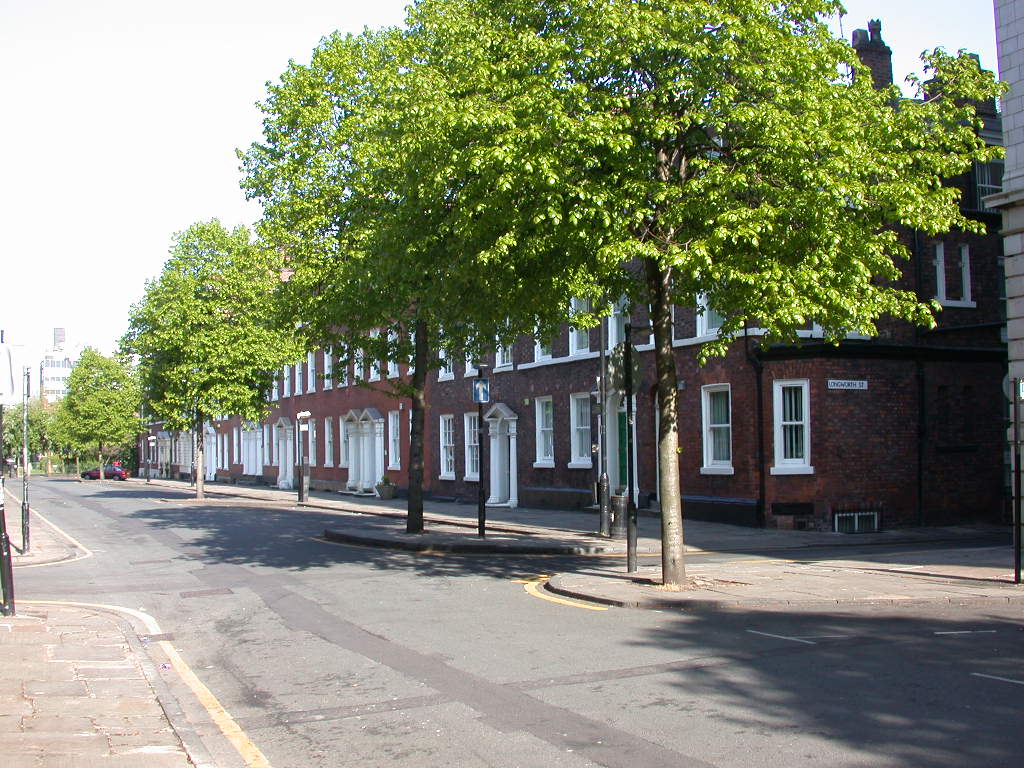
It was one of those bits of infill, the product of speculative builders trying to squeeze as many houses as possible onto a small piece of land.  In this case the plot was off Artillery Street which runs from Byrom Street to Longworth Street behind Deansgate.  Courts like these might hold half a dozen houses which faced each other across an open paved area and in some cases were locked away behind other properties, with access down narrow alleyways.

Many were back to back houses consisting of just two rooms, made from poor quality materials with party walls which were just half a brick thick and floors laid directly onto the bare earth.
My great grandmother grew up in just such a property in Whiteman’s Yard and those in Span Court were little different.  True they had cellars which still in the middle of the 19th century might be occupied by families, but otherwise they resembled the one she was born in.

In 1844 Manchester stopped the building of new houses which did not have running water and a toilet in the house or the yard which meant that no back to back houses or courts were built, although in neighbouring Bradford and Openshaw such properties continued to be constructed.  By 1900 there were only 5,000 back to backs left in the city and these had all been removed or converted  to ‘through’ houses by 1939.*

Span Court consisted of six such properties.  The eastern side of the court backed on to three identical houses fronting Swan Court while the western three were set up against industrial buildings which later became a hospital.

And in those six houses in 1851 lived a total of thirty-three people who made their living from the bottom end of economic pile.  And so while there were 6 power loom weavers and a cooper and dress maker there were also an errand boy, a hawker and one who described himself as a pauper.
Now over the next few weeks I will be delving deeper into Spam Court and trying to tell its story, looking at the people who lived there and the surrounding streets.

*Parkinson-Bailey, John P, Manchester University Press, 2000

Pictures; Span Court in 1965 J. Ryder, m00211, Courtesy of Manchester Libraries, Information and Archives, Manchester City Council, Span Court from the 1842-44 OS map of Manchester & Salford, courtesy of Digital Archives, http://www.digitalarchives.co.uk/ and Artillery Street looking up from Byrom Street with Span Court off to the right,  from the collection of Andrew Simpson

Sunday, 1 February 2026

Deansgate remembered ................ stories from the Fox Inn on Byrom Street nu 1 .... a beginning

For many Deansgate is just a road which takes you from Knott Mill down to St Mary’s Gate.

The Fox Inn, Byrom Street, circa 1914
If you are lucky and the traffic flow is kind you can do the route in minutes.

If like me you prefer to walk it offers up a shed load of interesting buildings from the old public library between Liverpool Road and Tonman Street past the John Rylands and down to the Burlington Arcade.

And if you turn off and stroll down Liverpool Road towards the Duke’s Canal and Castlefield you will be rewarded with a rich lump of history.

Here was our Roman fort and and small town, the Manchester end of the Bridgewater Navigation, as well as the site of the first passenger railway station in the world and heaps more including one of the first recorded Cholera cases back in the 1830s.

Johhny Lee, young Charlie and Joe Gibbons
And it was a place teeming with people making it in the words of the historian Frank Heaton a “Manchester Village.”  It runs down from Deansgate towards the river, bounded on one side by a set of railway viaducts and on the other by Quay Street.

I first became fascinated by it almost four decades ago and keep getting drawn back.

And in those forty years I have researched and written about the area, walked its streets in the company of friends and conducted guided tours of its history.**

So with all of that behind me I was very pleased when Debs got in touch and supplied this picture of the pub her grandmother was born in on August 26 1908.

William Henry Forth, Doris and Florence Forth and Betty Marr
Doris Brack nee Forth grew up in the Fox Inn on Byrom Street and she recorded her memories of the pub and the area in a series of interviews with Mr Heaton who included some of them in his book.

They are a vivid picture of a vibrant working class area in the years after the Great War.

So over the next few weeks with the help of her granddaughter Debs I will be exploring those tapes and piecing together the story of a community.***

It starts with the Fox Inn and this wonderful picture. I know that standing i the doorway beside her father William Henry Forth are Doris and her sister Florence and their friend Betty Marr and Johhny Lee, her cousin Charlie and Joe Gibbons.

Now that’s a good start.

Location Byrom Street, Deansgate, Manchester

Picture; The Fox Inn, circa 1914, courtesy of Debs Brack

*The Manchester Village Deansgate Remembered, Frank Heaton, 1995, Neil Richardson

**Castlefield, https://chorltonhistory.blogspot.co.uk/search/label/Castlefield

***Deansgate, https://chorltonhistory.blogspot.co.uk/search/label/Deansgate

Wednesday, 5 November 2025

In the midst of great wealth ....Span Court and St John's Street


I have been drawn back to Span Court.

It was a collection of six back to back houses in a partially enclosed court off Artillery Street which runs from Byrom Street to Longworth Street behind Deansgate.

They were one up one down with a cellar and did not rate an entry in the street directories which is not unsurprising given that those who lived here were on very modest means and some on the very margins of poverty.

In 1851 in those six houses lived a total of thirty-three people who made their living from the bottom end of the economic pile including six power loom weavers, a cooper, dress maker as well as an errand boy, a hawker and a pauper.

It is very easy to become blasé at the conditions in Span Court, after all historical empathy only goes so far, but this was living at the precarious end.  I rather think that Ann Cass aged 73 who described herself as a pauper had never had an easy life, and now she and her two daughters in their 30s were reliant on their combined wages as power loom weavers and what they got from Annie Harrison, their 38 year old lodger who was a band box maker.


Nor were they alone in taking in lodgers other families in the court were also doing the same and in most cases having to find space in what was at best two rooms and may even have been less, because the majority of  our houses were sublet.  Of the six, five had two families living in them as clearly defined and separate households.  Now these properties did have cellars and there were plenty of people living in the cellars of houses across the city according to the 1851 census.  But usually the enumerator recorded those who lived in the cellars.   But in this case no such records were made, ** which rather suggests that families and their lodgers were living in just one of the two rooms in each of the houses.

And in the case of John and Catherine Pussy it meant finding space for their five children ranging in ages from 20 down to three as well as their 19 year old lodger in what I guess was one room given that the house was shared with another family of four.

Span Court has gone but Artillery Street is still there and you have to walk it to get some idea of how narrow the street was and then try to picture the 83 people who lived mainly in the three courts off it or the 96 who lived on Longworth Street which ran from Artillery Street to St John Street.  The whole census patch amounts to ten streets and their small courts, most not much wider than Artillery Street and bounded by Deansgate and Byrom Street in which crowded a total of 497 people.

But it would be wrong to run away with the idea that this was just a collection of humble streets housing the least well off.  True the majority as the graph below shows  made their living from unskilled or factory work but there were also artisans, shop keepers small businessmen. And almost acting as an island of wealth was St John Street, then as now a place of fine late 18th and early 19th century houses whose residents included accountants, a silk manufacturer and a retired calico engraver and printer.

And it is this last “calico engraver” who I want to finish with as a contrast to Span Court.  James Holt had set up the family business sometime at the beginning of the 19th century had bought and maybe built his double fronted property on St John Street and in the fullness of time retired to Chorlton, leaving his son to run the business and retain in the family home in the heart of Manchester off Deansgate.  This was John Holt who would later in the 1850s move himself to our township.

But the family never gave up their interest in the area surrounding their town home and so by 1912 they owned seven of the fine houses on St John Street as well as shops cottages and a beer shop on the surrounding streets as well as land and the fine estate of Beech House in Chorlton.*

We have rather come to be conditioned by the rich living in gated communities set apart from the less well off and our wealthy families were no different.  Samuel Brooks had established his own estate which would be developed for the well off on the edge of Chorlton, and in the late 1830s Victoria Park Company was set up to “erect a number of dwelling houses of respectable appearance and condition, with gardens and pleasure grounds attached, with proper rules and regulations against damage an nuisances.”**

But the residents of the houses on the north side of St John’s Street backed on to Span Court while the Holt’s own fine house was not only beside a timber yard but its rear windows overlooked a coal yard and the densely packed court of Holt’s Place which consisted of ten small back to back properties.

So Span Court and the poor were never that far from the rich of St John’s Street which I suppose is an interesting take on that much quoted phrase, “the poor are always with us.”

Pictures;Span Court, J.Ryder, 1965, m00212, Courtesy of Manchester Libraries, Information and Archives, Manchester City Council, detail from 1842-44 OS map of Manchester & Salford, Digital Archives, http://www.digitalarchives.co.uk/, other pictures from the collection of Andrew Simpson


*Camp Street, Holt Place, James Place, Longworth Street, Severn Street, Byrom Street, Great John Street, Gillow Street, Lower Byrom Street, Charles Street, Peel Street and City Road

** A Short Account of the Victoria Park Manchester, Manchester Corporation, 1937

Thursday, 30 January 2025

Knott Mill in 1963

I wish I had known Knott Mill in the 1960s.

As it was it would be a full decade later that I wandered down there.

Of course my excuse was that as a student and later working in Wythenshawe this end of Deansgate was a bit off the beaten track.

So to redress that simple omission here is a litho print made by my friend Ann Love in 1963.

Back then she was still at Manchester College of Art, studying Book Illustration and wandering the city for subject matter.

I am rather pleased that she did and moreover that she recorded this bit of Knott Mill.

Picture; litho print of Knott Mill, 1963 courtesy of Ann Love.

Sunday, 6 October 2024

When the skyline had yet to be taken over

It is easy to forget that there was a time and a time relatively recently when the city’s sky line had yet to be taken over by tall developments which reached for the sky.

And as Ian Robertson’s three pictures show that was just a decade and a bit ago.

In 2007 the debate was still raging about the Beetham Tower which had eclipsed the CIS Building as Manchester tallest structure.

So in 2007 and again in 2009 Ian wandered down to that end of Deansgate to record this new “thing”.

Since then, of course he has been back and back again recording the onward march of these tall buildings, which very quickly also came to dominate across the water in Salford and are now out there in Stockport.

All of which makes these images a little bit of history.


Location; on Deansgate, Manchester


Pictures; the Beetham Tower, 2007-09, from the collection of Ian Robertson


Monday, 30 September 2024

“Look on my Works”* ……… and wonder …… a story for Alan

I don’t usually do then and now pictures but sometimes I break the rule, especially when it’s a place I have known for heaps of time.

The Rochdale Canal, 1979

And so, it is with the stretch of the Rochdale Canal from Piccadilly down to Castlefield.

Back in the 1970s I regularly walked it, marveling on how it had survived a combination of neglect and willful vandalism and how it offered up glimpses of what had once been.

The Rochdale Canal, 2023
Like those pipes running along the wall of what had once been part of  St Mary’s Hospital and supplied steam to a host of buildings from the old Electricity  Station.  

Some of the lagging had fallen away and steam rose from the pipes leaving me a tad worried that one day I would cop for a scolding burst.

And further along there were those half sunken boats which were a continuing source of mystery and fed my imagination with possible disasters which had overcome crew and cargo.

The future of the canal always seemed in doubt, and despite its historic significance and its role in shipping water through the city there was always the possibility it would end up being filled in.

But not so and the story of its restoration is there to read. 

Suffice to say it was saved and now boasts plenty of amenities along its towpath of which Deansgate Locks are but one.

And so last Thursday I looked down on that bit of water beside the bars and reflected on the changes on the skyline, which of course is the point of the two pictures, and the rest as they say is for you to "compare and contrast".

Looking down towards Castlefield, 1979

Location; The Rochdale Canal

Pictures, My canal, 1979 and 2023, from the collection of Andrew Simpson

*"Look on my Works, ye Mighty, and despair!", Ozymandias, Percy Bysshe Shelley, 1817 

Saturday, 1 June 2024

On Deansgate where it joins Blackfriars Street in the 1920s

The corner of Blackfriars Street and Deansgate has never been a popular one for photographers.

Now I know this because I have counted just three on the digital archive of the City and can think of just a few others I have seen in various collections.*

So I was pretty pleased when I came across this one which I think must date from the 1920s.

It did present a little challenge at first to identify exactly where it was because the caption just refers to Deansgate.

But the clue was Stewart and Stewart who were tailors, trading at 46 Deansgate which was on the corner with Blackfriars Street.  Theirs was a large enough business to extend from Deansgate along Blackfriars Street.

They were trading there in 1911 and with a bit of research it should be possible to follow them back and forwards through the 20th century.

As for the building I cannot remember when it came down and was replaced with the present red brick one.
I know it survived the Manchester Blitz so I guess it was just one of those that fell to the developers.

This was not the case with the building opposite which went on the night of December 24th along with the entire block stretching up St Mary’s Gate to St Ann’s Square and also included the Royal Exchange.

Happily some of the near neighbours of 46 Deansgate have survived including the building which once housed T. Hayward & Co. Glass & China.

All of which is a lesson in keeping an eye on the buildings we pass and so often take for granted.

Locatiion; Manchester

*Manchester Local Image Collection, http://images.manchester.gov.uk/index.php?session=pass

Picture; Deansgate and Blackfriars Street, circa 1920s, courtesy of Sandra Hapgood

Wednesday, 28 February 2024

The towers of Manchester rise like the trees of the forest

Not the most original title I know, but for anyone who remembers the skyline of the city at the close of the last century it is perhaps apt.

I make no judgement other than that when the height of buildings become such that the individual passer by is reduced to an insignificant presence something of the scale and beauty of the architecture is lost.

And yes, I know the economics of the practice, and its place in the history of the last two centuries of building design but it ain’t for me.

In the past going high was a statement of humanities relationship to a god, the need for protection against an enemy or just a political statement on the part of the owner, and was always limited by technology, but not now.

All of which was occasioned by my old friend Andy Robertson’s latest set of “pictures” which he sent over today.

Andy has been chronicling the transformation of the twin cities, and pretty much the rest of Greater Manchester for three decades and his collection is a remarkable history of the changes.  

More so because he will visit and record a derelict building and go back recording its demolition and the subsequent rise of the new development.


And yesterday on Deansgate he set about recoding just one tall tower from different angles, and then as afterthought threw in another.


Of course, for all those who look appalled there will be those who applaud the new towers as the representation of the age, and a statement of the degree to which the city remains economically vibrant.

I might add that slip back to the first half of the 19th century and much the same opinions can be found amongst those mourning the loss of so many 17th and 18th century properties which were being replaced by dark overpowering textile mills, gigantic warehouses, and the new railway viaducts.

But as someone once remarked ....... if you want to check out the economic prosperity of a place, "just count the number of cranes", which I know is not exactly the same as the level of prosperity or well being of the residents but that disparity has always been there.

So, choose your development and make your point.

Location; Deansgate


Pictures, “Yesterday at Deansgate”, 2024, from the collection of Andy Robertson


Saturday, 14 October 2023

The Gardens they built on Deansgate ……. legacies from the last war

Now Mr. Hitler’s bombs did much destruction, killed lots of people and scarred the city for decades.

Looking across from Deansgate, circa 1945-48
But they also gave opportunities for the cleared spaces left by the destroyed buildings which were used in a variety of different ways.

The most obvious were car parks, which became a necessity as the number of cars grew and more people traveled in to the city by car rather than by train or bus.

But a few of spaces became parks or at least open grassed areas, which for a while offered up a break in the grimy buildings which dominated the city in the immediate post war period.

The view through the empty spaces, circa 1945-48
And that brings me nicely to this picture postcard of the Cathedral and Victoria Gardens, which was was placed in the catalogue of the picture postcard company in 1950.

It is a fascinating image, not only because I suspect few will now know have stood and admired its flower beds, but also because of the views unhindered by buildings across the city.

The open space had been a large building on a triangular plot, flanked by Deansgate, Victoria Street and St Mary’s Gate.

It was Victoria Buildings, and housed shops, offices and the Victoria Hotel.

I am intrigued as to when the Gardens vanished and have set out on a quest to discover how long they occupied the spot.

Victoria Buildings, circa 1900
Today the buildings on the opposite side are the Arndale, and the Gardens contain the new build, created after the IRA bomb, which face Deansgate on one side and New Cathedral Street.

This development replaced that ugly and much unloved complex which while it included the relocated Old Wellington Inn, was a non-descript spot which always seemed windswept and full of litter.

So that might give us a clue to the date when the Gardens were sacrificed to that bold new development.

A report in the Manchester Guardian in 1968 reported that work on the “start on city centre development, was about to begin, which would cost £4 million, cover nearly “7 acres between Market Street and the river Irwell”.

The report continued that “Demolition of old property may start before the end of this year, and the complete constriction of the new development will take about three years.  

There will be a hotel with between 150 and 200 bedrooms, offices, shops, departmental stores, space for a supermarket and an underground route for delivering goods.” *

The Old Wellington Inn, circa 1975
Now, I washed up in Manchester in 1969 and didn’t get down to this bit of the city for another year, so I have no idea if our Gardens have survived that long or had been sacrificed to another car park or temporary buildings.

But someone will know, and in the fullnes of time will let me know.

Looking back at that unloved square, I rather wish Victoria Gardens had been kept.


Those trams and the altered date
Leaving me just to thank Geoff Senior, who spotted the trams in the picture and commented  that, "The top image which you have dated as 1950 cannot have been taken any later than the summer/early autumn of 1948 as there are several trams seen in the shot and the trams were all withdrawn in January 1949".

And that rather narrows the image to sometime around 1945 to 1948.

Location; Manchester

Pictures; The Cathedral and Victoria Gardens, circa 1945-48, from a series of picture postcards by Tuck and Son, courtesy of Tuck DB, https://tuckdb.org/, the Wellington Inn, circa 1970s, from the collection of Rita Bishop and the area between Deansgat and Victoria Street, circa 1900, from Goads Fire Insurance maps, courtesy of Digital Archives Association, http://digitalarchives.co.uk/

*Early start on city centre development, Manchester Guardian, September 4, 1968

Tuesday, 15 August 2023

Changing Deansgate …..

There will be many who were pleased when the Crown on Deansgate reopened.

2019
But for those who haven’t been to the spot for some years there will be a few surprises.

And those surprises will depend on just how long ago the visit was.

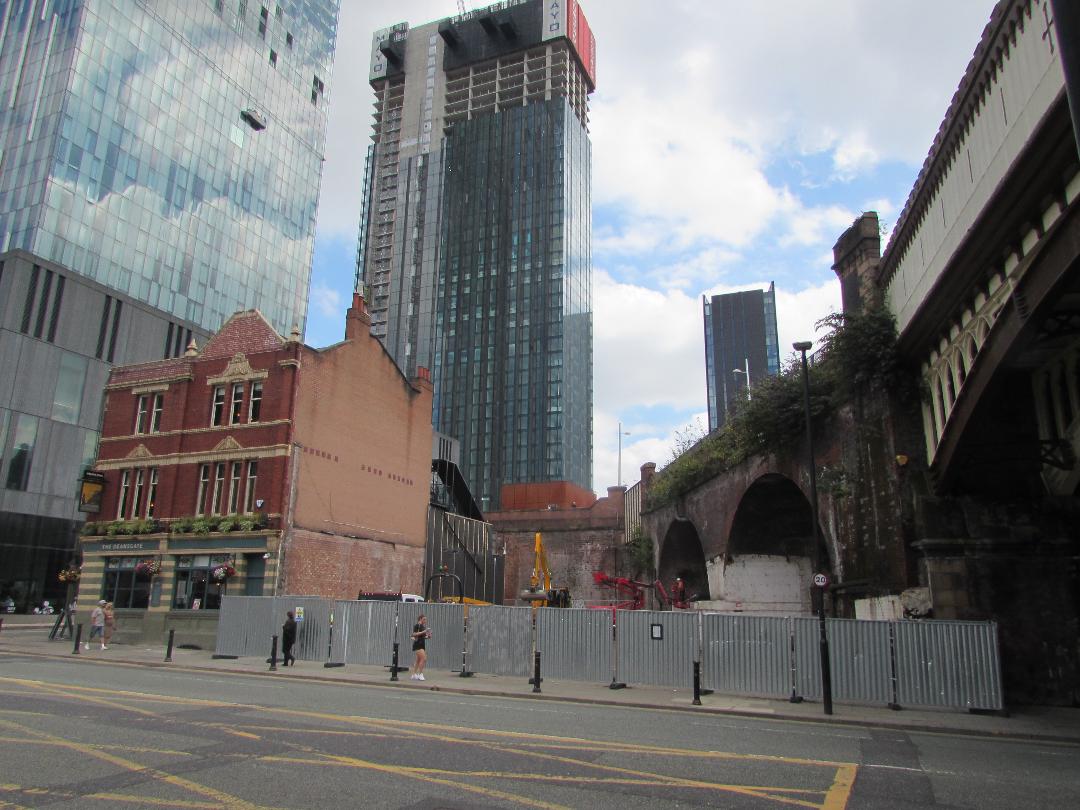
So the old ambulance depot closed along time ago to be replaced by the Beetham Tower and more recently the building which was variously a car show room and Boss Furniture show room, is now an open space.

I will leave you to look up what tall 21st century development will rise from the ground, by checking on the City Council’s planning portal.

2023
But be assured Andy Robertson will be there with his camera to record the progress.


Location; Deansgate

Pictures; Deansgate, 2019 and 2023, from the collection of Andy Robertson


Wednesday, 15 March 2023

Sneaking up on a much-loved building ………

This is the former Congregational Church which has now been eclipsed by the high blocks of offices and apartments which surround it.

The Congregational Church, 2023
At the end of the last century and into the beginning of this one it was an impressive landmark in this part of the city, framed by the railway bridge, the canal network behind and the old Knott Mill Railway Station almost opposite.

Its spire rose upwards unchallenged by other buildings and always made me think it had a fine history.

My Pevsner tell me that it was built in "1858 by Edward Walters, Brick with stone dressing, a design of interpenetrating temple fronts with a tall slender Campanile attached to the s…..The Veneto-Byzantine style campanile has blind arcading to the first stage, with stone arcaded belfry stage and steep concave roof with lucarnes.  It was converted to recording studios in the 1980s and the basement is used as a café bar”.*

Since the Pevsner entry was written the owner of the studios, Pete Waterman sold it in 2006 and it is now a set of offices.

Glimpsed from Deansgate, 2023

Over the years I have photographed it from the road coming into the city centre, from the old canal side and from the platform of the Deansgate Castlefield tram stop.

Lost among the tower blocks, 2023
But yesterday I came across it while wandering around those little streets off the twisty bit of Deansgate.

These include Little Peter Street, Commercial Street and Hewitt Street.

And it is from Hewitt Street that I got the shot, with the railway bridge to my right and I rather like it.

That said this last image is the one most of us see and record.

The elegant church tower looks just an after thought set against the commercial skyline of the 21st century

Location; Hewitt Street and Deansgate

Picture; Sneaking up on the Congregational Church from Hewitt Street, 2023, from the collection of Andrew Simpson

*Manchester, Hartwell Clare, Pevsner Architectural Guides, 2001

Friday, 3 March 2023

Posters from the Past ...... no 21 ....... Deansgate Castlefield ….. Gateway to Manchester

 Now the project is simple, take an image of a building we all love and turn it into the style of poster which was popular in the middle decades of the last century.*

And because so many of us use the tram and will pass through Deansgate Castlefield it seemed a logical choice to use the Metro stop for a poster.

Of course, there will be those from the Friends of the Metro Link who will point out that strictly speaking Cornbrook should be given the title of Gateway to Manchester, Salford and beyond.

It is after all one of the main switching points and I believe is also the hub of the electronic stuff which makes the network function happily.

But I like Deansgate Castlefield better.

Location; Deansgate Castlefield

Painting; Deansgate Castlefield, © 2023 Peter Topping,  Paintings from Pictures, from a photograph by Andrew Simpson, 2023

Web: www.paintingsfrompictures.co.uk 

*Posters from the Past, https://chorltonhistory.blogspot.co.uk/search/label/Posters%20from%20the%20Past


Knott Mill shapes ………

Location; Knott Mill

Picture; The lift at Knott Mill, 2023, from the collection of Andrew Simpson


Tuesday, 28 February 2023

What a difference a street makes ... contrasts in wealth and poverty


Today we are on a journey.  It is a short one in terms of distance just the space between two streets, but in almost every other sense it is a huge one.  

I want to walk from Span Court to St John Street and I have chosen 1851 as our point in time.  Spam Court was a collection of six back to back houses in a partially enclosed court off Artillery Street which runs from Byrom Street to Longworth Street behind Deansgate and I have written about them already.

They were one up one down with a cellar and did not rate an entry in the street directories which is not unsurprising given that those who lived here were on very modest means and some on the very margins of poverty.

In 1851 in those six houses lived a total of thirty-three people who made their living from the bottom end of the economic pile including six power loom weavers, a cooper, dress maker as well as an errand boy, a hawker and a pauper. More over in all but one of the six there were two families, one of which may have lived in the cellar or in one of the two rooms.  These were small houses, and the rooms may have been no more than 3.5 m square.

There would have been little in the way of furniture and the only natural light came from single windows that looked out on the narrow court.  They were not the worst of accommodation that the city had to offer and were perhaps slightly better than what could be found in the countryside but they were pretty basic.  Even in 1965 when the properties had been enlarged by extending back into the houses behind to make four rooms, living here would not have been my choice.

And as if to underline just how basic they were their yard was overlooked by the fine homes of St John’s Street, and it is to that place we shall go next.  Here in very grand houses lived accountants, a silk manufacturer and a retired calico engraver and printer.

The latter was John Holt whose father had made his wealth from making the engraving blocks used for calico printing and had eventually retired to a large estate in Chorlton.   John Holt would follow him sometime soon after 1851 but the family retained their interest in the area.*

Their home was the finest.  It is the only double fronted one on the street and had a huge and impressive bay window at the rear which extended over two floors.  Even today when the property has been turned into consulting rooms something of the style, comfort and good living is apparent. John and Sarah Holt lived here with their four children mother in law and two servants spread out over three floors.

But that fine bay window would have allowed them to gaze out on plenty more mean and basic cottages, for behind them were three small courts all with their own back to back properties which ran out on to Camp Street.

If the Holt’s however found this a little disconcerting they could console themselves with the thought that they owned all 24 of them.

In the midst of wealth there was indeed poverty but it was a profitable poverty for some.

Pictures; Span Court, J. Ryder, 1965 m00211, Courtesy of Manchester Libraries, Information and Archives, Manchester City Council,  detail from the 1842-44 OS map of Manchester & Salford, Digital Archives, http://www.digitalarchives.co.uk/ photographs of 11 St John Street from the collection of Andrew Simpson


*Camp Street, Holt Place, James Place, Longworth Street, Severn Street, Byrom Street, Great John Street, Gillow Street, Lower Byrom Street, Charles Street, Peel Street and City Road

Tuesday, 14 February 2023

The lift at Knott Mill ……

Location; Knott Mill

Picture; The lift at Knott Mill, 2023, from the collection of Andrew Simpson