Showing posts with label One hundred years of one house in Well Hall. Show all posts

Friday, 16 October 2026

One hundred years of one house in Well Hall part 16 ........... the plays wot mum wrote

This is the continuing story of one house in Well Hall Road and of the people who lived there including our family.*

Well Hall Road, 2014
For as long as I can remember our mum wrote plays, short stories and worked on a novel about life in south east London.

She had begun writing in the RAF during the last war when as a typist she had all that a writer could need ........ spare time, a typewriter, and paper.

All of which were the building blocks to give full vent to her vivid imagination.

On those long quiet moments on an RAF station in Lincolnshire she wrote about what she experienced including the loss of life and the fears and triumphs of the air crews and supporting teams.

Mum and friend circa 1942
Later as we were growing up she tried her hand at writing plays discovering there was a market for the three act play which was aimed specifically at women’s groups.

The basic requirement was that most of the parts had to be for women, and while the plot could be anything from a comedy to a murder there had to be opportunities for women of all ages.

I can’t now remember how many she produced but I know it was a fair few, although sadly none of the published plays have survived and as yet I can’t find any reference to them anywhere.

But we do have the manuscript of the book she was writing on along with some short stories.

Looking back we never thought it was unusual and yet here was a woman whose formal education had ended at 14, and who had spoken only German until she was three years old.

She began work in a local silk factory and went onto have a succession of jobs until the war swept her up and deposited her in “bomber county.”

Later after moving to London she began writing again, using at first a battered old typewriter before acquiring a slick “Oliveti” model.

And as someone who uses a computer all the time I marvel at those who wrote using a typewriter which doesn’t allow the instant use of the delete button, the facility to cut and paste, or either a word or spell check.

Mum in 1949
On the other hand it has left me with a collection of paper copies of her literary output.

The manuscripts maybe on flimsy paper, now are over laden with a musty smell and tinged with yellow but they offer up a link to mum, more powerful than an electronic text.

That said the computer and social media have offered up a huge opportunity for people to record and share  their memories, and publish both photographs and paintings which might otherwise never have seen the light of day.

All of which demonstrates the amount of talent there is out there and by extension just how much of that talent in the past never saw the light of day.

By contrast on facebook and other sites people regularly post fine photographs which are as good as any “art work” and write in the most vivid and direct way about growing up and the places that mean so much too them.

And yes I am sure that if mum were still writing today she would have embraced them all.

Location; Well Hall

Pictures; 294, courtesy of Chrissy Rose, 2015, and mum from the collection of Andrew Simpson

*One hundred years of one house on Well Hall Road, http://chorltonhistory.blogspot.co.uk/search/label/One%20hundred%20years%20of%20one%20house%20in%20Well%20Hall

Thursday, 15 October 2026

One hundred years of one house in Well Hall part 10........... from bread and dripping to Museli

This is the continuing story  of one house in Well Hall Road and of the people who lived there including our family.*

Now I suspect pretty much every generation thinks that there’s was the one which has seen the most profound change and I am the first to accept that mine has no monopoly on the new inventions, mould breaking fashions and seminal music.

But there is no doubt that those of us born just after the last war, who started school in the early 1950s and are just beginning to enter retirement have experienced a bewildering revolution in what we eat and how we prepare that food.

I will have been four when rationing was finally abandoned, and in the succeeding decades came to take for granted a huge range of new foods sourced from all over the world and delivered within hours of being harvested.

And of course with all that came a deluge of specialist utensils, ever larger cookers and the microwave.

All of which makes me think back to our tiny kitchen at 294, which was just large enough to take an old battered Cannon gas cooker, and small fridge which nestled either side of the sink.

In their wisdom the architects had provided a largish store cupboard under the stairs and here went the bulk of our dried and tinned food.

And what couldn’t be found the cupboard or the fridge was still bought fresh and eaten on the same day.

But the fridge is the key to the change.

In the 1950s the growing reliance on frozen food would lift some of the drudgery out of preparing food.

Now I still like washing carrots, peeling potatoes and shelling peas but for sheer speed nothing beats opening the packet of frozen peas.

And sixty years ago the adverts for frozen foods focused on that simple message that they were quick to use and because of the way they had been frozen on the day they were harvested were bound to be fresher than the peas and carrots which had made their way from the field via the market to the small greengrocer, whose turn over dictated that the produce might sit for days before it was bought.

Of course few people in 1956 had a fridge let along a freezer which was why the bags of frozen vegetables came in small sizes which were bought and used on the same day.

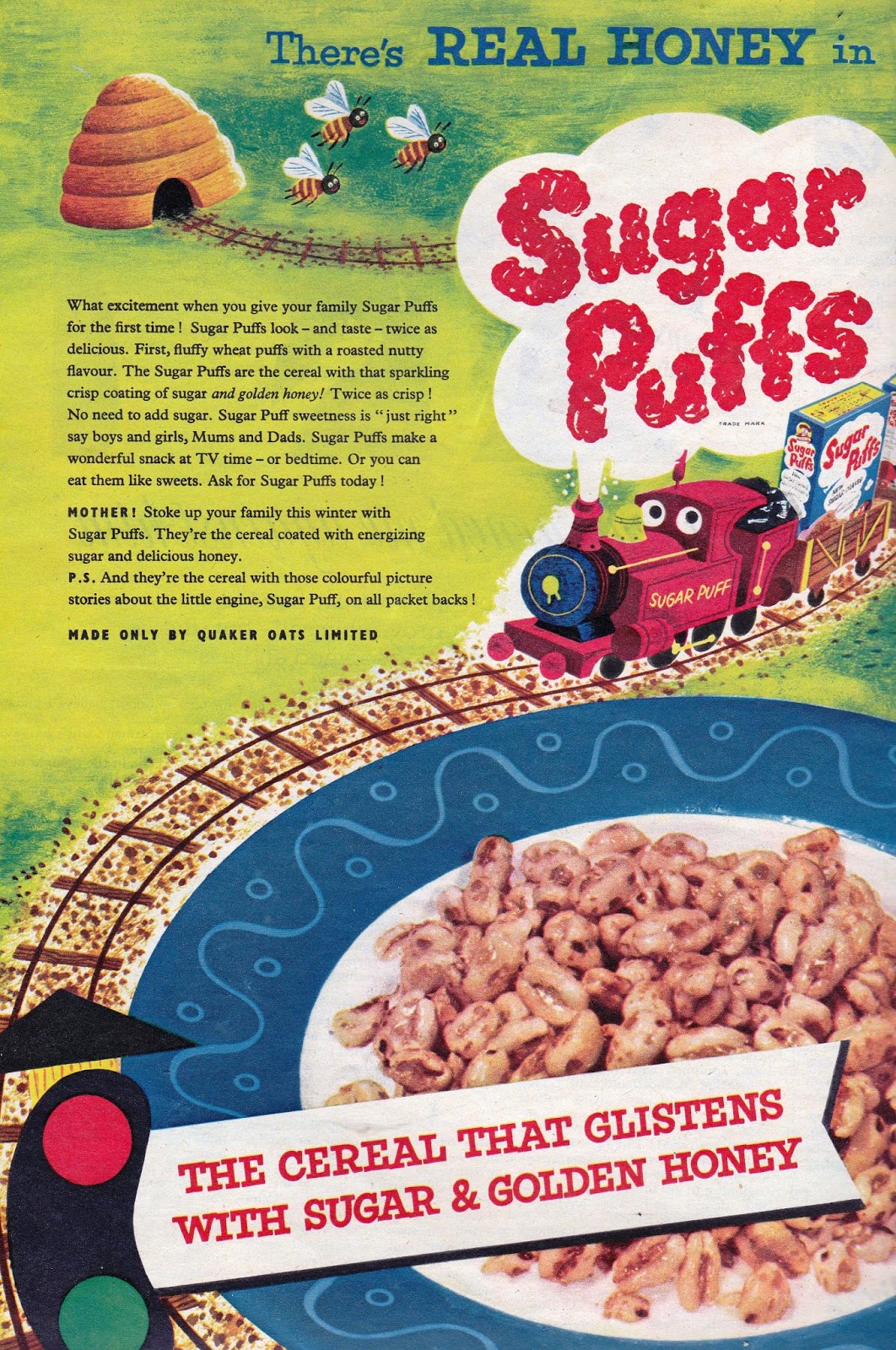
And in much the same way out went the old fashioned breakfast of porridge, eggs, bacon and toast in favour of the breakfast cereal.

Now these had been around since the 1930s, and there are ads in the collection for Corn Flakes and Rice Crispies, but the 50s offered up a new and exciting range, often marketed with a toy or other novelty and clearly aimed at the young.

Mother was quick off the mark to try the "new TV dinners  for one" which came out in the late 50s but equally died a death in our house as too expensive and not that nice.

Instead we reverted to simpler home cooked food but there was no going back on the changes that had happened.

As each of us left to set up our own homes the variety and the quantity of what we bought and ate just kept on growing.

But Dad preferred his tins, and on one memorable evening after I had cooked a pasta dish he smiled and said quietly that "it was good but  didn't really like  food messed about."

Location;Well Hall, Eltham, London


Pictures;  adverts for Birds Eye Foods and Sugar Puffs, from Woman’s Own, January 12 1956

*One hundred years of one house on Well Hall Road, http://chorltonhistory.blogspot.co.uk/search/label/One%20hundred%20years%20of%20one%20house%20in%20Well%20Hall

Wednesday, 14 October 2026

One hundred years of one house in Well Hall part 9........... bold new designs and a bit of Formica

This is the continuing story of one house in Well Hall Road and of the people who lived there including our family.*

I often wonder what  those who lived in our house in the 1950swould have made of the new household designs which were featured in Woman’s Own for January 12 1956.

Of course they may never have taken the magazine but they would not have escaped the exciting new ideas for transforming their early 20th century house into one which fitted with the 1950s.

Looking at them today they seem quite ordinary and just a little old fashioned but back then they were at the cutting edge of all that was new and innovative.

The basic designs were all there two decades earlier but were way out of reach of most working people.

But by the mid 50s that was changing.

It was partly as a result of the growing prosperity, along with new mass produced materials like plastic and Formica and the ever present offer of hire purchase, which meant for a “few pounds down and the rest over easy instalments” bits of the new life could be pretty much within the reach of every one.

All of which marks the 1950s off as more of a mould breaker than perhaps “the swinging 60s.”

Here were bold new colours, exciting fabrics and designs which relegated the old heavy furniture many peoples’ dreams to a place in a museum along with the odd dinosaur and other ancient relics.

And along with all these were those sheets of hardboard, which were cheap and could be applied to everything from period doors to the space in front of ripped out fireplaces.

For a few bob you could obliterate the beautiful features around doors create flat level spaces and add wonders to the fitted kitchens.

In 294 the master bedroom had lost its fire place and in its place a gigantic headboard with drop down drawers and a reddish swirly affect which I thought was the pinnacle of modern design.

But then I was only 14.

Sadly the DIYers responsible had also managed to take out the other upstairs fire places leaving just one small fine cast iron one downstairs.

Now it is pointless to rail against this vandalism.

At the time it seemed new and different and after six years of a bitter and hard war along with the preceding period of grim austerity all this was what we deserved.

And I have to admit I mounted similar attacks in the 1970s on good taste pulling out old features which gave the house its authentic feel and covering the walls with wood chip.

All of which means that I would have been no better in 1956, but just maybe now I might have cherished what was already there and just added the odd new idea.

Location;Well Hall, Eltham, London

Pictures; from Woman's Own, January 12 1956

*One hundred years of one house on Well Hall Road, http://chorltonhistory.blogspot.co.uk/search/label/One%20hundred%20years%20of%20one%20house%20in%20Well%20Hall


Tuesday, 13 October 2026

One hundred years of one house in Well Hall part 6 ........... winter in 294

This is the continuing story  of one house in Well Hall Road and of the people who lived there including our family.*

Now I can’t remember which wintry scene this will have been but I am guessing it will be in the 1970s and because I don’t remember it being taken it might be after 1973.

I did  trawl through the “Monthly Weather Report of the Meteorological Office”** for evidence of snow in London which offered up the news that it had snowed on Christmas day 1970.

But there are a lot of years on either side of 1970 so I shall just leave it.

Instead the picture took me back to living in the house before dad put in central heating.

It was a cold house, that is to say while the gas fire in the back room and the oil stove in the front kept the downstairs warm there was no heating upstairs.

Not that I guess that was any different from many homes at the time and like countless generations before me, going to bed was a quick affair of stripping off and jumping under the covers followed by that frantic effort to heat the bed up by  thrashing around.

Now Dad did go round with hot water bottles but sometimes I missed out and was doomed to the fate of cold bedclothes.

And all the hot water bottles would not prevent the slow but inevitable spread of ice on the inside of the windows which in the really cold winters rarely seemed to budge during the day.

Of course back then that was what you came to expect and pretty much took it for granted.

A few decades earlier and the occupants of our house might just have lit coal fires in the upstairs rooms in the most severe of winters but by the time we moved in the hapless DIYers had taken them out or blocked them up a move which today seems the height of vandalism but back in the 1950s and 60s was the “cool thing” to do.

I doubt that dad would have had truck with the ideas that bedroom fires should only be lit when someone was ill, keeping warm was for him always very important.

So in the fullness of time we got central heating by which time I had gone, moving from one very cold student bed sit to another in the more shabby parts of Manchester where icy windows were but one of the problems.

Of course back then it was all an adventure and which pushed 294 well into the background and it has taken this picture to bring it all back.

It was taken from the small back bedroom which was where dad decided to locate the boiler and which gave a magnificent view of the woods.

But that is for another time.

Pictures; looking out to the woods, circa 1970, from the collection of Andrew Simpson

Location;Well Hall, Eltham, London

*One hundred years of one house on Well Hall Road, http://chorltonhistory.blogspot.co.uk/search/label/One%20hundred%20years%20of%20one%20house%20in%20Well%20Hall   

**“Monthly Weather Report of the Metrological Office”http://www.metoffice.gov.uk/media/pdf/5/3/Dec1970.pdf

Monday, 12 October 2026

One hundred years of one house in Well Hall part 5 living through the Great War

Our house in 2014
The centenary of the Progress Estate has long passed.

Now we can lay claim to about thirty of those 100 years having moved in to 294 Well Hall Road in the middle of 1964 but I gave seldom thought to the history of the house or to the people who occupied it before us.

But now I am drawn to that past and have begun to explore something of what our home would have been like a century ago.*

And because I am deep into researching for a new book on the Great War the events of that year when the Arsenal workers and their families began new lives in Well Hall has special signifigance.

The popular story of how we coped during the four years tends to fasten on the participation of women on the shop floor and in the fields; the impact of Zeppelin raids and the blackout but all too often skips over the huge hike in the cost of living.

As Henry Hyndman the leading socialist pointed out “since the war had begun prices had gone up 22%, so that now the purchasing power of a sovereign was from 13s. 6d to 13s.9d.”**


And this was the context behind the industrial conflicts which rumbled on and which some at the time and since have sought to characterise as greedy workers exploiting a country at war.

The reality was very different as Sam Hague who spoke at a meeting in Manchester was quick to point out, “there never had been a time in the nation’s history when the working classes had so solidly backed the Government.”***

The aims of the committee, 1915
Working hours increased, and under the Defence of the Realm Act 1914 and The Munitions War Act 1915 workers were being prosecuted for absenteeism and striking over wages and conditions.

In Manchester the first prosecutions under the Munitions War Act were held at the Town Hall on Friday July 30 when thirty-two men employed at Craven Bros Ltd Reddish were brought before the Recorder charged with going on strike over wages and working conditions without first submitting the matter to the Board of Trade.

And in response to the rising cost of living the Labour movement set up local emergency war committees and food vigilance committees, which reported to the War Emergency Workers National Committee in London which had come into being on the day war broke out.

The idea of a food vigilance committee seems oddly old fashioned but back in 1915 it was seen by many as an essential way of preventing the  growing practice of adulterating food and the rise in the cost of living.

The London Food Vigilance Committee was a joint body made of the London Joint Committee of Co-operative Societies, the London Trades Council and the London Labour Party.

And cooperating with the Royal Arsenal Co-op in our part of London was Councillor William Barefoot of the Woolwich Labour Party.

These committees set out clear policies on how to manage shortages by insisting that “the Government purchase all essential imported food stuffs, commandeer or control all home grown food products and make effective use of ships and the control of transport facilities” thereby securing both a fair share of what was available and at a controlled price.”****

And a key part of this would be local authorities who should be “power to deal with the distribution of food stuffs and coal, and to establish Municipal Kitchens.”

There will be some who see in this a creeping form of state control but the reality was that war time legislation had already given the authorities sweeping powers but there was a woeful lack of action over the rise in rents, coal and food prices and the lowering of the quality of what was on offer to eat.

The Committees were fully aware that at some point rationing would have to be introduced and it followed therefore that the Co-op and Labour movements should be represented on official committees given that they "had an understanding of the food requirements of the workers.”

All of which brings me back to the Arsenal workers who were beginning to take up residence in their new homes and some of whom will have been actively involved in that committee.

Pictures; our house on Well Hall Road, 2014, courtesy of Chrissie Rose, extracts from documents from The London Food Vigilance Committee, 1915, courtesy of the Labour History Archives & Study Centre,  at the People’s History Museum, Manchester,http://www.phm.org.uk/

*One hundred years of one house in Well Hall,
http://chorltonhistory.blogspot.co.uk/search/label/One%20100%20years%20of%20one%20house%20in%20Well%20Hall   

**Manchester Guardian February 19 1915

*** Free Trade Hall, Manchester February 14, 1915

**** The London Food Vigilance Committee, 1915

Wednesday, 25 February 2026

One hundred years of one house in Well Hall part 16 ........... a revolution on wash day

This is the continuing story of one house in Well Hall Road and of the people who lived there including our family.*

Now this was Dad's welcoming present to 294 when we moved in in 1964.

I say Dad's but the reality will be that it will have been mum who insisted on this piece of cutting edge technology.

And with that "keyplate" which "automatically selects the right water temperature, the right washing action, the right number of rinses and the right spin-drying time for what ever wash you are doing" we could really feel the future had arrived.

And on top of all that here was a front loading machine which was already plumbed in and needed no endless filling of water buckets to put into the machine.

I could also comment on the rather sexist headline but won't.

Location; Well Hall

Picture; advert for the Hoover Keymatic, The Observer Magazine January 30 1966 from the collection of Andrew Simpson


*One hundred years of one house on Well Hall Road, 

Monday, 23 February 2026

One hundred years of one house in Well Hall part 22 ........... wishing for the coal hole

This is the continuing story of one house in Well Hall Road and of the people who lived there including our family. *

294, 1973
Now we didn’t have a coal hole or coal cellar in 294, nor from memory did we ever have an open fire.

When we moved into the house in the early 1960s, Eltham was about to become a smokeless zone, and while we could have burned specially treated fuel mother put her foot down, arguing she had had enough of coal in the old house, which started our long connection with gas fires and paraffin burning stoves.

Of course, the whole Well Hall estate had been built without cellars, and so coal would have been brought round the back and carried through the garden of 296.

The coal bunker was still there when we moved in, and dad added a big tank for the paraffin which I think was delivered by tanker.

A coal hole, 2018
At the time I shared the wisdom of mother’s decision, but now I rather think it was a mistake, not least because we have open fires which are set and lit from autumn through till the end of spring and are cheaper to run than heating the whole house.

True we do use central heating, but it sits on the lowest setting and just keeps the remainder of the place from becoming “ice station zebra”.

And in line with the city’s regulations on burning coal, we have always used smokeless fuel since we reopened the fire places back in the early 1980s.

Sadly, while we have a coal cellar, I have never won the battle about reinstating it, which I confess only plays to my childhood memories of the coal deliveries.

Enoch Royle and son, circa 1930s
They began with that series of distinctive sounds which started with the crashing noise as a full hundredweight of coal shot from the bag into the cellar, followed by the slower and longer sound of the coal settling, and were accompanied by the smell, which took a few minutes to rise from the cellar but then lingered in the house for hours.

And like then, our coal comes from the coal man, once a fortnight on a large flat backed lorry, which long replaced the horse and cart.

Fireplace, 2016
In that respect, the continuity of coal deliveries was broken for just a few years, between the last of the old coal deliveries and our resumption which I suspect is not the case on the Well Hall Estate.

In the case of our house, the fire places were blocked up in the early 60s and a full thirty years later were still closed.

The previous owner had not only closed them off but built elaborate hardboard facades, omitting to insert ventilation panels which as everyone knows are essential.

Back then I thought these facades were the height of modernity, but now I like our open fires, although in our case the search for replacement fireplaces took us out of south Manchester and into the east and north of the city where these reminders of our Victorian and Edwardian past were still being ripped out, only to be snapped up by residents in Chorlton-m-Hardy, Withington and Didsbury.

Fireplace, 2016
All of which leaves me to wonder what happened to the fireplaces of 294, but that I guess is another story for another time.

And conclude with that obvious observation of the destructive impact of the old coal burning fire places on the environment.

Location; Well Hall and Chorlton-cum-Hardy

Pictures; Well Hall Road, circa 1970, a coal hole, 2018, and reinstated fireplaces, 2014, Chorlton-cum-Hardy, from the Simpson collection, Enoch Royle and father on Albany Road, Chorlton, cum-Hardy circa 1930s, from the Lloyd Collection

*One hundred years of one house on Well Hall Road,
https://chorltonhistory.blogspot.com/search/label/One%20hundred%20years%20of%20one%20house%20in%20Well%20Hall


Sunday, 22 February 2026

One hundred years of one house in Well Hall part 21 ........... the unbroken chain

This is the continuing story of one house in Well Hall Road and of the people who lived there including our family.*

Now I think it will be rare that most of us can track all of the people who lived in a house from its construction to the present day.

But after a heap of research that is what we can do for our house in Well Hall.

The house has been home to thirteen families since it was built in 1915 and I know the names of all but one family.

What is all the more remarkable is that we lived there the longest, from the April of 1964 till 1994.

In that time the five of us grew up and eventually all but one of us left home.

It saw the death of mother, our sister Stella, and finally Dad.

But it was also a happy place and one that even now we all think of as home.

And that bond has been strengthened by a link to the present owners who have kindly taken pictures of the house today.

I have to say there is something odd about looking down on our back garden and seeing that the old tree at the back is still there.

It reminds me of the continuity that stretches far beyond our time at 294 and has made me look again at the stories of all the people who called the place home.

Searching for those stories will prove difficult.  The last census return that can be accessed is 1911 and while there are the electoral rolls and lists of births deaths and marriages these give little away.

So I know next to nothing about Mr and Mrs Nunn who lived there from 1915 until 1919 and only that the Rendles who followed them are buried in Sussex having died in 1946 and ‘54.

Slightly more promising were John and Leah Jarvis who occupied the house from 1929 through to 1947.

He was a “technical chemist", born in 1877 and she was ten year younger who gave her occupation in 1939 as “Unpaid Domestic Duties".

There was a son who may been living in Deptford a year earlier but by 1939 was back in 294.

It is a meagre set of information I grant you but in time there will be more.

I am guessing that Mr Nunn worked at the Royal Arsenal but there is no clue as to the occupation of Mr Rendle or Mr Jarvis.

They may have also worked there but the employment records seem lost.

Now that would be a useful piece of information as it would throw light on how long residents of the estate were linked to the Royal Arsenal.

But what we have is a start.

Location; Well Hall

Pictures; us circa 1970, from the Simpson collection

*One hundred years of one house on Well Hall Road, https://chorltonhistory.blogspot.co.uk/search/label/One%20hundred%20years%20of%20one%20house%20in%20Well%20Hall

Saturday, 21 February 2026

One hundred years of one house in Well Hall part 20 ........... completing the picture

This is the continuing story of one house in Well Hall Road and of the people who lived there including our family.*

Now we lived in 294 Well Hall Road for thirty years, and I now know who lived in it back to 1915 when it was built and for most of the years since we sold it.

The story of our house In Well Hall began some years ago and followed on from similar projects on the one that I live in now and one in Peckham.

But Well Hall is special to me and my sisters and I guess for all those who have looked after it for the last century and a bit.

All I need now is to complete the missing years from 1994 to 1999.

I could be accused of just hoovering up names, but not so, because each of the residents will have a story and that story in part will be about the house.

So that is it.

Over the next few weeks I will be going back to the list of those that occupied 294 and exploring their lives.

As ever it will never be intrusive but just add to our knowledge of one house in Well Hall and how it reflects the story of the estate, and the area.

A few years ago the son of the people who sold the house to us made contact from Canada, where they migrated and only yesterday I was talking to the new owners.

It will prove fun to complete the story and on the way I may make new friends and learn more about our house.

Location; Well Hall

Pictures; the front and back garden of our house on Well Hall Road, circa 1970, from the Simpson collection

*One hundred years of one house on Well Hall Road, https://chorltonhistory.blogspot.co.uk/search/label/One%20hundred%20years%20of%20one%20house%20in%20Well%20Hall


Friday, 20 February 2026

One hundred years of one house in Well Hall part 18 ........... driving the coach to the Italian Lakes

This is the continuing story of one house in Well Hall Road and of the people who lived there including our family.*

Now it is that time of year again and we are thinking of a summer holiday.

It’s an attractive thought given that the rain is coming down like stair rods.

Of course not that we ever went far when we lived in Well Hall.

From spring till the end of the summer dad drove coaches across mainland Europe from France to Italy with an option on Belgium, Holland and Switzerland.

It was a job he had dome since the 1920s and from sometime around 1952 began talking discerning travellers on holidays, seeing the sights and getting a flavour of Brussels, Paris and Milan.

I say faraway places but for most people back in the 1950s and early 60s the Italian Lakes was far away.

All of which left me and my sisters with holidays in Derby with our grandparents.

Today, for us Italy has a special place given that half the family are Italian and so it is a natural choice most years as a place to visit.

And that of course got me thinking of the people who also lived in 294 from when it was built in 1915 till we moved settled there in the March of 1964.

The previous owners immigrated to Canada and until I have done lots more research on the other families I think Canada will be the furthest destination for any of the previous occupants.

Not that I am surprised.  Holiday opportunities for most people during the 20th century were limited and it was not till the coming of cheap air flights and package holidays that most of us could contemplate that far away break in the sun.

Location; Well Hall & Chorlton

Pictures;  Il Broletto from the collection of Andrew Simpson

*One hundred years of one house on Well Hall Road,
https://chorltonhistory.blogspot.co.uk/search/label/One%20hundred%20years%20of%20one%20house%20in%20Well%20Hall

Thursday, 19 February 2026

One hundred years of one house in Well Hall part 17 ........... the Gas Board

This is the continuing story of one house in Well Hall Road and of the people who lived there including our family.*


It is funny how the names of things stay with you, long after events have rendered them obsolete and consigned to history.

So, it is with the Gas Board, which was created just a year before I was born, and lasted until I was fully grown.

To be accurate there were twelve gas boards covering the country, and they had been created in 1948 by the Labour Government which nationalized the 1,062 privately owned and municipal gas companies.  They were  the Eastern, East Midlands, Northern, North Eastern, North Thames, North West, Scottish, Southern, South Eastern, South West, Wales, and West Midlands. Each area board was divided into geographical groups or divisions which were often further divided into smaller districts.

Ours was the South Eastern Gas Board, and here is the meter card for our house.

Not that we paid for our gas by slot meter.  Dad had switched to paying quarterly, and so this payment card belonged to one of the previous owners, who was a G. Broome.

That said I do remember the chap who came to read the meter at regular intervals, a practice which lasted well into this century.

After which we opted to read it ourselves and send the reading in online and this in turn was replaced by a device which did it for us, and now by Hive, that box of tricks which pretty much does it all.

Despite all this buzzy technology I have never quite got round to referring to our gas provider by their name, and still talk of the Gas Board.

But then I also still talk about the wireless when everyone else calls it a radio.


Location; Well Hall

Pictures; the Gas Board  Slot Meter Record Card, from the collection of Andrew Simpson

*One hundred years of one house on Well Hall Road, http://chorltonhistory.blogspot.co.uk/search/label/One%20hundred%20years%20of%20one%20house%20in%20Well%20Hall

Friday, 13 February 2026

One hundred years of one house on Well Hall Road, part 4, a bit of idle speculation on what might have been

Gas fitting 1911
This is the continuing story of one house in Well Hall Road and of the people who lived there including our family.*

We moved into 294 Well Hall Road in March 1964 and while us kids slowly moved out over the years it remained my dad’s home till 1994.

Now I pretty much took the place for granted and only recently began to wonder on what t would have been like when it was brand new back in 1915.

Sadly none of the original features had survived by the time we arrived in the house most of the records of the Estate were destroyed in the last war.

All of which led me recently to ponder on what might have been and also to make an appeal for anyone who could supply me with pictures of fireplaces, light fittings and anything else that might still be in their house on the Estate.

And Chrissie has been the first to come forward with a picture of a fireplace similar to one she remembered in her house.

It is not unlike the bedroom fireplaces in our house which date to just five years after the Progress was built and I guess were pretty standard.

According to one history “all the timber and supplied Baths, fireplaces and many other fittings were kept in a large store on the site.”**

Bedroom fireplace, 1915
And this would have included the light fittings which I thought may have been gas.

Ours had long ago disappeared but upstairs there were still the circular wooden blocks in one of the bedroom.

I suspect they were not unlike the one above which was fitted in a house built just four years before 294.

That said I know already I will have fallen into a trap and featured a type of gas fitting which was not used in the south east.  It will be one of those errors that someone will pick up on and quote the exact specification and date.

To which all I can do is invite both the correction and ask for a picture.

But they did have gas lighting which has been confirmed by Chrissie who told me, “we even still have the old gas light pipe up stairs in the bedrooms, where it had been cut off which made a good hook.”

Now in the great sweep of history this is very small beer, but it helps recreate something of that lost house and takes me closer to what it would have been like when the key was handed over to its first resident, just 49 years before we crossed the doorstep.

Picture; of the gas fitting courtesy of Lawrence Beedle and the fire place from Chrissie Rose

*One 100 years of one house in Well Hall,http://chorltonhistory.blogspot.co.uk/2014/04/one-hundred-years-of-one-house-on-well_30.html

** Well Hall Estate, Eltham, S.L.G. Beaufoy, The Town Planning Review Vol. 23, No , July 1952, Liverpool University Press

Thursday, 12 February 2026

One hundred years of one house on Well Hall Road, part 3, looking for the first residents

Our house today
This is where we lived  in for thirty years.

We moved into 294 Well Hall Road in March 1964 and while us kids slowly moved out over the years it remained my dad’s home till 1994.

And so I have decided to explore its history.

I can’t say I have ever thought of the people who lived their lives in our house but now I think it is time to start.

After all we accounted for just under a third of its existence and so I have begun to look for the people who were there before us.

Now  most of the spade work is being done by my friend Jean who has already been down to the Heritage Centre at Greenwich and trawled the street directories from when the estate was built.

And Jean will be back there looking for connections between the first occupants and the personnel records of the Royal Arsenal during the Great War.

The first of those residents was Basil Nunn who lived in our house until 1919 and was followed by Alfred W Rendle who stayed there until 1928.

I have great hopes that much more will be revealed for of course once you have a name then lots follow.  I have already started looking at the electoral registers for the period, and in time there may be the odd newspaper story, baptismal and marriage record and perhaps even someone who remembers them.

Added to this I will be able to conjure up the family who occupied our house and give a different context to the rooms we took for granted including how those rooms looked originally and how they might have been used.

The Bullet Factory, the Arsenal, circa 1916
And not for the first time during the search I have lapsed into a bit of idle speculation, pondering on which part of the Royal Arsenal Mr Nunn and perhaps Mr Randel worked in and whether they took the tram or cycled to Woolwich.

In turn I have thought about what they did to the garden and whether Mrs Nunn or Mrs Randel complained about the steep staircase which runs up the centre of the house, and how many times in a day they had to use them.

But all of that is a flight of fancy and rather stops me from the serious business of finding out more about the house and the first families who lived there.

So while Jean beavers away I shall go digging for any evidence of what the house might have been like when brand new and Mr Nunn moved in.

Research by Jean Gammons

Location; Well Hall, Eltham, London

Pictures; 294 Well Hall Road in 2014 courtesy of Chrissie Rose and inside the Royal Arsenal from the collection of Mark Flynn, The Bullet Factory, W H Kingsway, http://www.markfynn.com/

*One hundred years of one house in Well Hall, http://chorltonhistory.blogspot.co.uk/search/label/One%20100%20years%20of%20one%20house%20in%20Well%20Hall


Wednesday, 11 February 2026

Stories of the Great War from Eltham and Woolwich ............. nu 2 losing your job on the Well Hall estate

Now I wonder how the individual stories of people living on the Progress Estate played out after the Great War*.


The estate as most people are aware was built for Arsenal workers.

The first to move into our house on Well Hall Road were Mr and Mrs Nunn from Ipswich.

He was a blacksmith by trade and in 1911 had been employed in an engineering works.

And it is perhaps easy to see the attractions of their new home over number 56 Rosebery Road in Ipswich which while it had a garden was one of these older mid terraced properties surrounding by similar drab streets.

But in the end it may have just been the work and the Arsenal, because in 1918 with the end of the war and only three years after they settled in Well Hall they left for Ipswich.


Now that isn’t surprising because there were 50,000 men and 25,000 women and girls employed at the Arsenal which was to be slimmed down to just 10,000 men with the Armistice.

Many like Mr Nunn returned to their pre war occupations and some efforts were made to help others including the large workforce of women and girls.

According to one source Miss Lilian Barker who had acted as Lady Superintendant of Ordinance Factories found work for some women and girls “in domestic service, nursing, shirt making and factory work .......Evening classes were opened in conjunction with the L.C.C., concerts, dances sports and entertainments organised by the Borough Council and even holidays at the seaside for both single women and mothers with children.”**

But despite such efforts unemployment rose and men and women who a few months earlier had been in high paid gainful employment were now looking to relief.

The concern and determination to do something was reflected in a variety of ways.  In March 1919 “some of the men discharged from the Arsenal but had not yet moved out of the hutments demanded rent reductions and prevailed on others to join them in a rent strike.”*

While women munitions workers demonstrated at only being given a week’s notice.

All of which begs the question of what happened to all those on the estate?

Unfortunately the census return for the years after the Great War are still closed but the 1939 register offers up some interesting insights into the occupation of those living in Well Hall.

At our house were Mr and Mrs Jarvis who had moved in 1929.  He gave his job as a “Technical chemist, Food and Chemical” which would suggest he was not employed at the Arsenal.

Likewise their near neighbours from 288 Well Hall Road up to 310 were engaged in a whole variety of occupations from clerical and sales work to printing, engineering, carpentry and hairdressing.

With more research it should be possible to get a full profile of the whole estate but that it’s a snap shot a full decade after the war.


Pictures; 294 Well Hall Road in 2014 courtesy of Chrissie Rose and inside the Royal Arsenal from the collection of Mark Flynn, The Bullet Factory, W H Kingsway, http://www.markfynn.com/ 

*One hundred years of one house in Well Hall, https://chorltonhistory.blogspot.com/search/label/One%20hundred%20years%20of%20one%20house%20in%20Well%20Hall

*** The Woolwich Story, 1970, E. F. E. Jefferson.

Tuesday, 10 February 2026

One hundred years of one house on Well Hall Road, part 1, reflections

Well Hall Road and our house 2014
The story of one house over a century and a bit.*

2015 was the birthday of the house we lived in for thirty years.

We moved into 294 Well Hall Road in March 1964 and while us kids slowly moved out over the years it remained my dad’s home till 1994.

So this will be the start of a series of stories about the house which next year will celebrate its centenary.

Now despite spending most days digging deep into the past and uncovering the lives of those who interest me I have to confess that the people who occupied our house for the first forty-nine years are unknown to me.

But their lives will span the two world wars, along with the uncertain years that followed the end of the first war and the growing prosperity that came in the decades after 1945.

In the garden 1964
And more than anything it will be about the house and how it changed from a fairly basic but well built early 20th century property to one which was adapted to the growth in consumer products, central heating and the revolution in leisure.

So when we moved in in 1964, there was still a water heater which had been run off a solid fuel stove, the kitchen possessed just two power points and the windows were the originals that had come with the house in 1915.

The first residents would have gone off to work on the tram, and no doubt welcomed the new Well Hall Odeon which offered up evenings of excitement and was far closer than the first picture house up along the High Street.

And on those fine warm summer evenings there would still have been plenty of open spaces to enjoy.

The real discoveries will also be in just how their lives in the late 1920s and 30s matched and contrasted with those of the people I so often deal with who lived in the north  in the more challenged old industries of textiles, coal mining and ship building.

So it is all there to search out, and on the way I am well aware that George, Jean and Chrissie will be on hand to offer up their memories of their bit of Well Hall and Eltham.

Location; Well Hall, Eltham, London

Pictures; from the collection of Andrew Simpson, 1964  and Chrissie Rose 2015

*One hundred years of one house on Well Hall Road,
https://chorltonhistory.blogspot.com/search/label/One%20hundred%20years%20of%20one%20house%20in%20Well%20Hall

Thursday, 25 December 2025

One hundred years of one house in Well Hall part 18 ........... Christmas 1958

This is the continuing story of one house in Well Hall Road and of the people who lived there including our family.*


Actually it would be another six years before we celebrated Christmas in Well Hall, but why spoil a story?

The weather was less than promising with the Manchester Guardian on Christmas Eve, reporting that it would be “A Very Murky Christmas” with “Fog forecast for much of England and Wales [and] airports closed”.

Going on to comment “Fog to-day, fog to-morrow (though perhaps less) on Boxing Day are the possibilities for the Christmas Holidays in many parts of England and Wales.

Fog yesterday was a certainty,; it affected about thirty counties,  It covered nearly twenty thousand square miles stretching from Bournemouth to Durham.  It closed Manchester, Birmingham and Liverpool airports and last night was seriously upsetting flights into London Airport.”.

But we were not planning to travel far.


Which leaves me trying to remember how we spent our Christmas that year.  I would have been nine my twin sisters just two and a bit and our Jill still a baby.

As happened every year Uncle George would have travelled up from the west country a few days earlier and the day would have unfolded with the presents, breakfast and a walk to Peckham Rye and back, before Christmas dinner and followed by a mix of the telly and board games, of which Monopoly was dominated every Christmas evening.

Like many families we had bought into a television during the 1950s, and while I no longer know when our first one arrived, by 1958 it was an established item.

So that Christmas on BBC we had a series of films, along with variety shows and a ghost tale, which was pretty much replicated by London ITV and Granada.

Setting aside the television that Christmas drew heavily on the traditions experienced by my parents, both of whom were born in the first decades of the last century.


There were still  a mix of oranges and nuts in the Christmas stockings which for us were pillow covers, and 1958 might well have been the first year that coloured lights replaced real candles on the tree, although it would be many years before the paper chains and bright paper trees were done away with.

But as ever the bright but fragile glass baubles survived well into the 1980s and were brought out as they had been done every year, with a few additions to take the place of the broken ones.

As for presents, mine were as traditional as they had been each year, with an addition to the train set, an Eagle Annual and an assortment of sweets.

And while I can’t now remember exactly what those presents were I know that the Eagle Annual was number eight and that the lead story was Dan Dare in Operation Moss.

All of which I think is enough.

Location; Well Hall

Pictures; Christmas decorations; from the collection of Catherine Obi, bought at Oxfam, and the Eagle Annual Number 8, with an extract from Operation Moss

*One hundred years of one house on Well Hall Road, http://chorltonhistory.blogspot.co.uk/search/label/One%20hundred%20years%20of%20one%20house%20in%20Well%20Hall

**“A Very Murky Christmas”, Manchester Guardian, December 24th, 1958

Friday, 24 October 2025

One hundred years of one house in Well Hall part 14 ........... the Mission Hall chair and a promise

This is the continuing story   of one house in Well Hall Road and of the people who lived there including our family.*

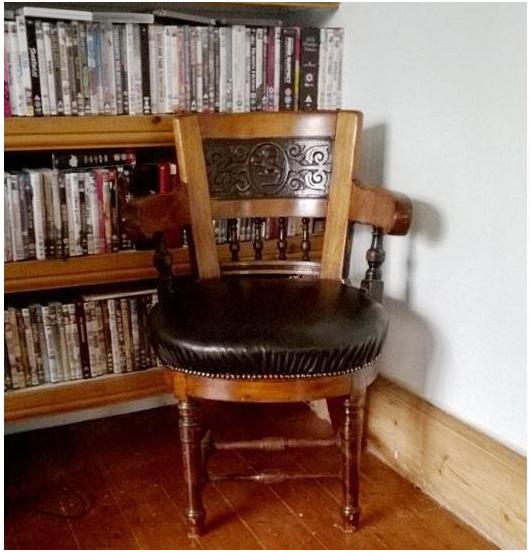
Now I like the way that what seem to be totally random bits of the past come together to tell a story which in this case brings together our family home on Well Hall Road an old chair and a promise.

What connects them is this chair which I am guessing must be at least a century old and in its time has travelled from Peckham to Eltham and on to Manchester and now resides in our dining room.

As far as I know it began life in the Evelina Mission Hall on Evelina Road close to where dad had worked for forty years.

I have yet to discover when the mission hall was built but I know it will be sometime between 1874 and 1914 which I grant is a big dollop of history but it’s a start.

I know it was there by 1914 because the hall is listed in the Post Office Directory for that year.

There were plenty of similar halls in the area but by the mid 1960s if not earlier it was struggling for a congregation and closed.

And Dad always scenting a bargain came away with the chair which from 1964 sat in my bedroom in 294 before eventually coming north.

It is a beautiful chair which always reminds me of my father and as happens has already been promised to one of my sons who got in before the others.

But that is not quite the end of the story because it neatly cements the history of the family home in Eltham with my own house in Chorlton in Manchester.

Both houses were built in 1915 and although they differ in their layout and appearance both have been happy places to live.

I can’t claim that the chair has anything to do with that but it remains a little bit of my history uniting me with Peckham, Eltham and Manchester, and in time will continue to do where ever our Joshua finally settles.

Not bad for one chair.

Location;Well Hall, Eltham, London

Picture; from the collection of Andrew Simpson

*One hundred years of one house on Well Hall Road, http://chorltonhistory.blogspot.co.uk/search/label/One%20hundred%20years%20of%20one%20house%20in%20Well%20Hall


Thursday, 23 October 2025

One hundred years of one house in Well Hall part 11 ........... from the first residents to when we moved in

This is the continuing story  of one house in Well Hall Road and of the people who lived there including our family.*

The estate in 1950
Now the great and the good are able to track their family back through the centuries and can pretty much show which of their relatives lived in the ancestral pile right the way back to when the place was built.

Few of us can do the same but just sometimes with a bit of luck and lot of research it is possible to uncover both the residents and the stories of those who occupied a house from its beginning.

Ours was built in 1915 as part of the estate laid out for workers at the Arsenal in Woolwich and while I knew the names of the first two families to live there the rest were unknown.

But using the directories and the electoral rolls it has been possible to discover the identities of all six families who occupied the house from 1915 through till we moved in during the spring of 1964.

And the importance of such a discovery is that it helps tell the story of Well Hall and of Eltham during the Great War and over the next half century.

The first to move into 294 Well Hall were Mr and Mrs Nunn from Ipswich.  He was a blacksmith by trade and in 1911 had been employed in an engineering works.

And it is perhaps easy to see the attractions of their new home over number 56 Rosebery Road in Ipswich which while it had a garden was one of these older mid terraced properties surrounding by similar drab streets.

But in the end it may have just been the work and the Arsenal, because in 1918 with the end of the war and only three years after they settled in Well Hall they left for Ipswich.

With more research it should be possible to determine how many others of those who moved on to the brand new estate stayed to make Eltham their permanent home or like the Nunn’s left.

And that is where the electoral roll comes into its own for unlike the directories which list just the named house holder the rolls provide the names of all those eligible to vote.

So Mrs Brewer two doors down who I knew only as an old lady  living on her own had been in number 290 since the early 1930s, had lost her husband some time during the war, and shared her home with lodgers, having also lived briefly down at Avery Hill.

What is revealing is that some of the families including those in our house moved out and back in during the course of the 1930s and 50s.  I can’t as yet explain why but of course given that most were still rented it would have been easy enough to do.

Looking north up Well Hall Road, 1950
In time it should be possible to discover more about the six families who inhabited the house, including how they made their living and maybe even what they did with themselves.

And that would have been the end of the story but just as I was finishing I came across what I think is a picture of Mrs Nunn and three of her children.

It dates from a little later than 1918 but there staring back at me is the woman who will have cleaned the windows, looked after the garden and walked up the same flight of stairs as me and that I reckon makes for a powerful continuity.

Location;Well Hall, Eltham, London

Pictures; Well Hall Road in 1950, from Well Hall Estate, Eltham:  An Example of Good Housing Built in 1915, S.L.G. Beaufoy*

*One hundred years of one house on Well Hall Road, http://chorltonhistory.blogspot.co.uk/search/label/One%20hundred%20years%20of%20one%20house%20in%20Well%20Hall

**Well Hall Estate, Eltham:  An Example of Good Housing Built in 1915, S.L.G. Beaufoy, The Town 

Friday, 15 November 2024

One hundred years of one house in Well Hall part 19 ........... the unremarkable

This is the continuing story of one house in Well Hall Road and of the people who lived there including our family.*

Now there is nothing over remarkable about these two pictures of our garden in Well Hall sometime in the 1970s.

The quality is a bit iffy but then they are over 47 years old and were taken with one of those old clunky instamatic cameras, which processed the film straight away and turned out the image in minutes.

The film was expensive and from memory you only got eight or so shots, but there was something magical about the instant nature of the process.

Today the mobile phone or the digital camera will do it equally fast with the added advantage that it can be sent on to family and friends across the planet.

But in 1970 this was pretty neat, and how better to use it than a snap of our back garden.

I doubt any of us will remember who took them but they show the garden just as I remember it.  My sisters, and in particular our Stella laid out the garden and Dad was on hand to do the actual work.

And like all back gardens, there in the corner was the shed, full of all sorts of treasures and a real necessity given we didn’t have a cellar.

Dad put it up around 1964 and a full thirty years later it still had that powerful smell of creosote.

Looking at out garden and across to our neighbours there is nothing remarkable about any of them, but that actually makes the fascinating and in their own way a real history lesson.

Here is how we decided to lay out our small gardens back in 1970.

They may not be much different from the same gardens today or those of the 1950s, but they do offer up a picture of life in 1970, added to which they are our garden, which is enough for me.

Location; Well Hall

Pictures; the back garden of our house on Well Hall Road, circa 1970, from the Simpson collection

*One hundred years of one house on Well Hall Road,
https://chorltonhistory.blogspot.co.uk/search/label/One%20hundred%20years%20of%20one%20house%20in%20Well%20Hall