Showing posts with label Tony Goulding. Show all posts

Tuesday, 4 August 2026

Platt Abbey … another story by Tony Goulding

A friend’s request has prompted me to research the history of this building which stood on the plot of land opposite the side view of Platt Hall now occupied by two tower blocks. 

Platt Abbey 1895
A full history of its residents has not been possible, and in any case the sheer number of them over the house’s 125+ year lifetime meant the story’s length would preclude it. What follows then is a selection of stories associated with the property. 

The first people I found living in Platt Abbey, in 1830, were William Robinson, a wine and spirit Merchant of Exchange Street, Manchester, his wife Lucy and at least three children Charles, Frances, and Harriette Louisa. This information was gleaned from extensive contemporary press coverage of a “shocking murder”. On the night of Thursday 20th May 1830 Charles Robinson was shot and killed on Oxford Road, Rusholme, Manchester whilst he was walking home from a friend’s house. He did not die immediately but shortly after being helped to the residence of a local physician Dr. James Edge Partington, who happened also to be his brother-in-law. (1)

The 1861 census records the occupant off the house as Mr. James Dunn, a commission agent. In the following census of 1871, it was a cotton spinner, Mr. Charles Ogden. However, the next person of note to live in the house was the soldier, author and playwright Ian Hay. (2)

He was born in the house on 17th April 1876 his birth name being John Hay Beith, the son of a cotton merchant and magistrate, John Alexander Beith, and the grandson of a Presbyterian minister, of the same name, who was one of the founders of the Free Church of Scotland. His father was one of the attendees of the meeting on 27th June 1882 at Daniel Adamson’s house, The Towers, Wilmslow Road, Didsbury, to discuss the proposal to construct the Manchester Ship Canal.

Ian Hay (Alias of Major-General John Hay Beith C.B.E. M.C.

The residents of the house recorded in the 1881 census were the Kipping family; James Stanley, a cashier at the Manchester branch of the Bank of England, his wife, Julia (née Duval), (3) four of their children and two servants. One of these children, Frederick Stanley, was recorded as a London University student. An old boy of Manchester Grammar School and Owens Park College, he was to have a distinguished career as an eminent scientist, becoming the professor of Chemistry at Nottingham University.

 Abbey Solicitors April 18th 2026

The Kipping family moved out in March 1888, and the tenancy passed to a succession of a variety of professional people for the 6 decades before the house was demolished in 1949 to make way for the present buildings on the site.     Ernest Crewsdon, chartered accountant; Archibald Donald, physician and surgeon; Lawrence Walker, a printer, publisher, and wholesale stationer and Archie Thornhill another printer. The property also served for a period as a residential hotel.

The earliest residents, following the Robinson family, were all tenants. On of their landlords was Robert Palin who is recorded as the owner in the rate books for Rusholme Township from before 1845 until 1883. He appears to have been an absentee landlord, however, as there are no other records of him in the Manchester area. He does appear in 1881 as the plaintiff in a legal dispute with the defendant John Bebbington which resulted in an order for the sale of the property issued by The Court of Chancery.

Platt Abbey was one of five buildings on the site demolished in 1949 to make way for the two tower blocks

Until recently, it was recalled by this nearby firm of solicitors.

Frederick Stanley Kipping 

Abbey Solicitors 18TH April 2026

Pictures: - Platt Abbey 1895 m38718. Courtesy of Manchester Libraries. Ian Hay Beith – Printed in and scanned from Hay, Ian (1921). The Selected Writings of Ian Hay, Boston and New York: Houghton Mifflin OCLC: 1080341 Public domain. 1080341 Public Domain.

 ttps://commons.wikimedia.org/w/index.php?curid=61676395

Frederick Stanley Kipping by Unknown author - Prabook, Public Domain, https://commons.wikimedia.org/w/index.php?curid=16621622.

Abbey Solicitors from the collection of Tony Goulding.

Notes: -

1) Dr. Partington was married to Charles Robinson’s sister, Frances.

2) Ian Hay’s debut and most successful novel “Pip” was published in 1907. It is a coming-of-age story centred on the schoolboy title character with references to the sporting activities of Edwardian England. Further fiction was less popular and during a distinguished war service, being “mentioned in dispatches” and awarded the Military Cross, he turned to writing of his army life which provided him with a best seller “The First Hundred Thousand”. In the inter-war years, he was a very successful playwright, often in collaboration with other well-known authors: including P. G. Wodehouse, Edgar Wallace and the author of “The Four Feathers” A.E.W. Mason.

3) Frederick Stanley Kipping is best known for his pioneering work on organic compounds of silicon which led to the development of synthetic rubber. He is credited with coining the term “Silicone”. He was the Professor of Chemistry at Nottingham University from 1897 until 1936.


Wednesday, 29 April 2026

Dr. Catharine Corbett M.B. Ch.B. D.P.H...... another story from Tony Goulding

As promised, this is a follow up story featuring the woman who but for her surname being marginally higher alphabetically would have been the first to receive a medical degree at Manchester University.

Graduates of Manchester Medical School –July 1904
Catharine Louisa Corbett was born on 2nd December 1877 in Handforth, Cheshire. She was the second of the two children of Manchester-based architect (1) and surveyor Christopher George Bentham Corbett and his wife Sarah (née Woodhead). 

She had an older brother, John Rooke. (2) In the 1881 census, the family are recorded at 9, Silverwell Yard, Bolton, Lancashire where, very unusually for the time Catharine’s mother was, despite the fact she had two young children, recorded as a “school headmistress”

Both her parents were from established quaker families and as such Catharine benefited from that tradition’s valuing of the education of girls. Her mother, also being a beneficiary of this principle had the distinction of being one of the first three women to pass the Tripos at Cambridge University in 1873; being the very first to do so in Mathematics. These three ladies became known as the Girton Pioneers (3) with their names being celebrated in the that College’s song.

 The 1891 census records Catharine as a pupil of “The Hollies”, Epsom, Surrey, a High School for Girls run by her aunt Caroline Woodhead, who ten years earlier had been her family’s housekeeper.

 Both “Catharine” and “Catherine” qualified as doctors on 28th July 1904 and as opportunities for newly qualified female doctors at the time were very limited the two often found themselves as colleagues and occasionally rivals for the same post. The “Westminster & Pimlico News” reported that on Wednesday 3rd January 1906, whilst both were employed at The Clapham Maternity Home, they attended an interview for a post at the Chelsea Infirmary. On this occasion Dr. Corbett was selected by the appointments board by a vote of eight to three.

 After eighteen months in Chelsea, Dr Corbett was appointed by the West Ham Board of Guardians on Thursday 27th June 1907 to a similar post at the Whipps Cross Infirmary.

The census of 1911 shows she had left London and was living at 35, Wilkinson Street, Sheffield again with her, by then retired aunt, Caroline Woodhead. She had also left hospital work and entered the field of public health, which would be the focus of the rest of her career: working as a school health inspector.

Manchester Babies Hospital, Burnage Lane, Burnage (28/4/1924)
Catharine had returned to Manchester to take on a similar rôle with Lancashire County Council Education Department and assist her friend Catherine Chisholm in the foundation of the Manchester Babies Hospital  when, in February 1915 she volunteered to join a medical unit formed by Scottish members of The National Union of Women’s Suffrage Societies which went to serve in a hospital at Kraguievatz on the Serbian front. At this time, her home address was 12, Birch Polygon, Rusholme, Manchester. In January 1916 she was reported as a prisoner of war. Released after a couple of months of captivity she returned to England and gave a series of lectures trying to raise much needed funds for the hospital. From 30th August 1916 until 24th November 1917, she again served on the Eastern Front treating sick and wounded in Russia and Rumania. Finally finishing the War, working as a surgeon at the County of Middlesex War Hospital. (The former County Asylum and now Napsbury Hospital, London Colney, Nr. St. Albans, Hertfordshire.)

 Following her war service, back in civilian life Dr. Corbett returned to her work for Lancashire County Council and Burnley, Lancashire (4) where she spent the remainder of her career before moving to Bristol, Gloucestershire in her retirement. In Bristol she once again resided with her brother at 1, Falcondale Road, Westbury-on-Trym. Dr. Corbett died there on 22nd June 1960.

   Outside of her medical career Catharine showed her adventurous spirit by being a keen climber and a liking for fast cars. On at least one occasion, she was convicted of speeding. Later while in Bristol she was involved in another traffic incident; that time only as a witness to an accident. She was also a Socialist and a Feminist being a member of both the Fabian Society and the National Society of Women.

In the immediate aftermath of World War 1 she privately published her diary of her time in Serbia and gave several lectures based on it 

Pictures: - Medical graduates Manchester University, 1904, Dr. Corbett is the left one of the two women on the front Row, with the kind permission of The Manchester High School for Girls Archives. Manchester Babies Hospital, Burnage Lane, Burnage Manchester City Council’s City Engineers Department m 52817 images courtesy of Manchester Libraries. Creative Commons Attribution International (CC BY 4.0) licence

Notes:-

1) One of Catharine’s father’s projects was the Barton Arcade between Deansgate and St. Ann’s Square, Manchester.

2) Her brother John Rooke was named after his uncle who had died aged 19 in a drowning accident in the River Irwell at Clifton, Nr. Salford, Lancashire on Monday19th April 1869. He was in a rowing boat with Catharine’s father when it capsized in rough water.

3) One of these “Girton Pioneers”, Rachel Susan Cook later married Mr. C.P. Scott the editor of the Manchester Guardian.

4) The 1921 census record shows Dr. Corbett at 395, Padiham Road, Burnley, Lancashire and again living with her aunt and two servants. By 1939 the family home had moved to 31, Ightenhill Park Lane, Burnley where Catharine’s brother John Rooke, who was a district valuer for the Inland Revenue, joined her and her aunt.


Saturday, 14 February 2026

Uncovering one of our local photographers, A H Clarke .............where local history met family history

Now I have been fascinated by Harold Clarke who was one of our local commercial photographers.*


Barlow Moor Road, circa 1926
During the 1920s and 30s he recorded many scenes of Chorlton and they are a priceless snap shot of the area.

This one was taken by Harold Clarke of 83 Clarence Road Chorlton, and may have been part of a series issued by Lilywhite Ltd, of Brighouse, in Yorkshire.

There are 21 of his photographs in the Greater Manchester County Records collection dating from 1926 through to 1934 and some from 1926 carry a serial number close to the one in the picture.

All of which is an introduction to a story written by Tony Goulding, who has contributed to the blog before.

“Your posts using postcards produced by A H Clarke re-kindled in me an interest in my family history. A  H Clarke was my maternal grandfather. 


Miss Clarke's ration book, 1939
I had previously searched in vain for 83, Clarence Road where my mother was raised, as her ration book shows. 

I had not noticed the name change to Claridge Roadd. 

On a recent walk past the house I realised how close it was to the old brickworks and remembered how my mother had told me how she used to get into trouble for playing around them and the clay pits.

My grandfather was born in Reddith, Worcestershire in 1889, the son of William who owned tobacconist/photographers on the High St. 

His mother Bessie was a member of the Woodfield family prominent in the town both as needle factory owners and in local politics. 

Arthur Harold became a professional photographer. 

In the 1911 census he is recorded as working as a photographer’s assistant in Hitchin, Herts. He later moved back to Redditch, then after the break-up of his first marriage in the early 1920's lived for a little while in Toxteth, Liverpool, where my mother was born in 1927 before settling in  Chorlton in about 1930.


Book marks Central Ref, 1934
He was obviously quite enterprising at this time as can be seen by these bookmarks he produced of the newly opened Central Library.

Sometime in the early 1940's he both re-located the family home and ceased making his living solely from photography as a 1944 wedding certificate shows him as an Inland Revenue clerk residing at 5, Keppel Rd. 

It must remain a matter of conjecture whether this change was for personal reasons or was due to economic pressure on the photographic trade by the advance in camera ownership and the decline in postcard usage as a result of the increased availability of telephones. 

Of course any such difficulties would be exacerbated by war time shortages, rationing, and restrictions.

Finally it is ironic that I haven't got any photos of my grandfather, who died  in 1952; two years before I was born ------a man who must have taken 10's of 1,000's of them in his lifetime.”

And so there you have it a little bit more of the history of those who recorded our history.

© Tony Goulding May 2015

Pictures; from the collection of Harold Clark, Barlow Moor Road, circa 1926, from the Lloyd Collection, and the ration book and book mark courtesy of Tony Clarke.

*Harold Clarke, http://chorltonhistory.blogspot.co.uk/2015/01/travelling-around-chorlton-in-1930s-in.html

Friday, 23 January 2026

Dr. Cathreine Chisholm C.B.E. M.D. F.R.C.P. another story from Tony Goulding

Catherine Chisholm was the first woman (1) to obtain a medical degree from Manchester University which she received on Tuesday 28th July 1904.

Dr. Catherine Chisholm in 1912
She became a major force in the development of children’s medicine, particularly neo-natal care.

Catherine was born on 2nd January 1878 in Radcliffe Nr. Bury, Lancashire and was baptised in the town’s St. Thomas’s Church on 20th February 1878. She was the eldest of the four daughters of Kenneth Mckenzie, a physician and surgeon from Munlochy, Ross-shire, Scotland and his wife Mary (née Thornley) the eldest daughter of a local cotton manufacturer. 

Catherine lived her early life in Pilkington, Bury, Lancashire where her father had a surgery at Rock House, Stand Lane. She entered Owens College, Manchester University in 1895, being granted a B.A. degree in classics before entering the medical school. 

Following her graduation Dr, Chisholm’s found obtaining a post difficult as most hospitals remained reluctant to appoint female doctors. 

As a result, she had to move to London where she worked for a year at the Clapham Maternity Hospital, an institution which employed only women. In 1905 she was briefly the resident medical officer for the Eldwick Cottage Sanatorium for Women and Children, Bingley, Nr. Bradford, Yorkshire (West Riding). During 1906 Catherine returned to Manchester and started her own G.P. practice mainly treating female students at the university.   

Also in July 1908, she was appointed to a new post as Medical Inspector for the Manchester High School for Girls. a position she remained in 40 years. (2) For this purpose, she occupied a building at 339, Oxford Road, Manchester. This was to serve as the family home or the best part of two decades. Catherine lived here with her mother, Mary, (until her death on 6th July 1918) and her only surviving sister Alice Thornley. Her father had died on 23rd October 1902 and both her younger sisters died in infancy; Flora McDonald aged 2years and 6 months in 1883 and Eleanor aged 15 months in 1884.

Manchester Babies Hospital, Burnage Lane, Burnage (28/4/1924)
It was possibly these traumatic events in her early years which prompted her future work on the healthcare of babies and children in general. In any case she was the driving force behind the opening of The Manchester Babies Hospital (3) on 4th August 1914. 

Despite, an inauspicious opening date, the new facility thrived; initially at 77, Clarendon Road, Chorlton-on-Medlock, then on Slade Lane, Levenshulme before moving to accommodate the growing number of patients to larger premises, Cringle Hall, Burnage Lane, Manchester while retaining the original building on Slade Lane.

It was funded in part by Manchester Corporation and fund-raising efforts by local prominent women such as Olga Hertz, Sheila Simon, and Margaret Ashton, the latter being one of the institution’s vice-presidents while Mrs. Simon was the“chairman” of its committee.

Manchester Babies Hospital List of Officers 1916-17

Alongside her hospital work, Dr Chisholm was active in the promotion of the education of young mothers in health and hygiene as a preventative measure. She was also a pioneer in the development of women’s sport, according to her entry on Wikipedia this began when she was instrumental in the founding of the University of Manchester’s Women Students’ and Athletics’ Union in 1899.

Outside of Health, Catherine was also a supporter of women’s suffrage and involved in disarmament campaigns.

Besides addressing various meetings in support of these causes, she variously hosted meetings of the local society of National Union of Women’s Suffrage Societies at her home on Oxford Road in November 1912 and June 1914, assisted in the establishment of a new Suffrage Club in Ancoats,   Manchester, and acted as the co-treasurer of the Manchester group supporting the nationwide “Pilgrimage for Peace” in 1926. 

N.U.W.S.S. Poster 1913
Dr Chisholm made a more direct appeal for peace when she addressed a meeting at Manchester’s Free Trade Hall on Monday 18th October 1920 which was convened to welcome a delegation of British women, including Dr. Chisholm, returning from investigating the impact of the war in Ireland. After the women had reported back on the material damage and some graphic descriptions of the behaviour of Britain’s irregular soldiers (“The Black and Tans”) she proposed the following motion, which was subsequently passed.

 “That this meeting of Manchester citizens urges the government to set free all Irish political prisoners and offer a truce, during which all armed forces shall be withdrawn and the keeping of order be placed in the hands of the Irish local elected bodies- thus creating conditions under which the Irish people may determine their own form of government.”

 Throughout the 1920s and 1930s Dr Chisholm continued to lecture widely on medical issues and speak out on social issues. Her interests were varied, warning against overindulgence in tea and coffee, opposition to aggressive advertising aimed at young men by the brewery industry, promoting the importance of fresh air in the care of babies and exercise for schoolchildren, particularly girls among others. She was particularly keen that girls should be educated about their reproductive system.

  In pursuing these affairs, she was quick to embrace the new opportunity available through radio broadcasts.

 In the George V New Year’s Honours list of 1935, she was awarded the C.B.E. citing her rôle as consulting physician at the Manchester Northern Hospital for Women and Children.

  Also in January 19355, she was one of the inaugural signatories in the formation of a Manchester branch off the National Council for Civil Liberties. She was also a member of the Manchester Gaels and the Soroptimists.

 Catherine was certainly a local celebrity in much demand to appear at fundraising events, especially for child welfare and medical charities. There was, however, a downside to her fame as she became an early victim of “identity theft”. The Manchester Evening News of 11th May 1936 reported the case of an Ardwick woman, Mary Fellows, who was imprisoned for 6 weeks at Manchester Magistrates Court; she had obtained  three meals on credit by pretending she was Dr. Chisholm and saying she was short of cash as she was hurrying to perform an operation. In her evidence Catherine stated that, “she knew Fellows quite well and had had trouble with her for many years, through posing and ordering things in her name.”

Catherine never married and continued living with her sister on Oxford Road before moving to 34, Broadway, Didsbury, Manchester in 1923. She died there on Monay 21st July 1952 and was cremated at Manchester Crematorium on Thursday 24th July. Her sister Alice Thornley predeceased her on 15th February 1945. 

Dr Chisholm’s estate was valued at £17,790 -9s –3d (equal to £449,650 today).

Pictures: -Dr. Catherine Chisholm (1912) portrait, unknown artist m 72643 and Manchester Babies Hospital, Burnage Lane, Burnage Manchester City Council’s City Engineers Departmentm 52817 images courtesy of Manchester Libraries. Creative Commons Attribution International (CC BY 4.0) licence, Manchester Babies Hospital List of Officers 1916-17, 'Image provided by The John Rylands Research Institute and Library, The University of Manchester’  N.U.W.S.S. Poster 1913 in public domain. By NUWSS - Original publication: published by the NUWSS in 1913 in the UK. Immediate source: British Library http://www.bl.uk/learning/images/makeanimpact/suffragettes/large12625.html, Public Domain, https://commons.wikimedia.org/w/index.php?curid=45443664

Notes: -

1) Dr. Chisholm shared this distinction with another woman Dr Catherine Corbett, who herself has a fascinating story which I hope to write of in a future post.

2) Catherine’s sister Alice Thornley was also a member of staff at Manchester High School for Girls; she taught French there for more than twenty years and was also the school’s medical clerk.

3) The Manchester Babies Hospital was renamed The Duchess of York Hospital in 1935. This honour was bestowed after she had opened a new nurses’ home and a medical wing on 10th July 1935. The Duchess, Elizabeth Angela Marguerite Bowes-Lyon soon become George VI's queen consort and on his death was for 50 years simply "The Queen Mother".


Tuesday, 23 September 2025

Miss Olga Hertz another story from Tony Goulding

Last month Andrew Simpson posted a story of the work of this remarkable woman which prompted me to research her background.

Olga Hertz was born in Glasgow on 19th November 1851 the fourth of the four daughters of Theodor Hertz and his wife Mary Amelia (née Steinthal).   Her father was a wealthy iron merchant (1) who was born in Hamburg, Germany; her mother was born in Eccles, Lancashire in 1825, the daughter of German immigrants Ludwig and Ernestine Steinthal. By the mid-1840s the Steinthals had returned to Germany as it was in Hamburg, Germany that Olga’s parents married on 4th March 1846.

Theodor Hertz died in Glasgow on 15th May 1872. Following her bereavement his widow, Mary Amelia returned to her home city of Manchester, with her three unmarried daughters. (2)  In the first instance they lived next door to her brother Henry Michael Steinthal at Oak Mount, Oak Drive, Fallowfield in a property owned by Sir Joseph Whitworth, the fabulously wealthy engineer and philanthropist. In November 1886 the family moved to 49, Palatine Road, Withington, Manchester and this was to remain Olga’s home for the next 60 years. She was still living at this address when she died on 27th December 1946. Her estate was valued for probate at £62,956 -12s- 8d. (the equivalent today would be £2,142,439).

Due to her family’s extreme wealth Olga never had to seek paid employment, however she did work tirelessly on several public bodies. The Manchester Rate books of the mid 1880s record her as the secretary of the Ardwick and Ancoats District Nurses Home on Ardwick Green, Manchester. It was, however, her work as a Poor Law Guardian for the Chorlton Union detailed in Andrew’s piece for which she is best remembered. As part of this work Olga set sail from Liverpool on 3rd June 1909 aboard the Laurentic bound for Montreal, Quebec, Canada to check on the welfare of some of the children sent there by the Chorlton Union as part of the British Home Children scheme. Olga’s feminism was manifested in the demands that women should take full part in public bodies. In this capacity she often shared a platform with Margaret Ashton the first woman to be elected as a councillor for Manchester City Council. The two women likely became friends; the1921 census return further suggests this was the case as it shows Olga as a visitor at Margaret Ashton’s residence, Church Aston Manor, Newport, Shropshire.

  Two of Olga’s maternal uncles remained in England and became prominent Manchester citizens. The already referred to Henry Michael Steinthal was a textile and general merchant with interests in Bradford and Manchester and a director of The Manchester Fire Assurance Company.  He was variously in business partnerships with his brother-in-law Theodor Hertz and both his son Edgar Frederick and his son-in-law Frederick Francis Benjamin Zimmern. In his retirement he moved to Scarborough, Yorkshire where for a time he had a “tile and floor cloth” manufacturing business. He died at Myra Lodge, Alexandra Park, Scarborough on 3rd January 1905.

Henry Michael was also active in public life serving on a variety of civic bodies; he was a "visitor" to the Manchester Royal Infirmary, a member of the Royal Manchester Institution the precursor of the city's Art Gallery and one of the three joint treasurers of Indian Mutiny Relief Fund.

The “Hollies” as a convent school. 1959

His home, “The Hollies”, Oak Drive, Fallowfield, Manchester later became a Catholic Convent School also called “The Hollies”

 The second uncle was Rev. Samuel Alfred Steinthal who as a Unitarian minister was for a time assistant to Rev. William Gaskell (Elizabeth Gaskell’s husband) at the Cross Street Unitarian Chapel, Manchest

The original Cross Street Chapel circa 1835
At the elections for Manchester City Council in October 1908 which saw Margaret Ashton returned for the Withington ward Rev. Steinthal was the seconder of her nomination.

Pictures: - The Hollies 1959 (m65697) from Manchester Libraries, Information, and Archives, Manchester City Council. https://creativecommons.org/licenses/by-nc-sa/4.0/ Cross Street Chapel circa 1835 from Wikipedia in the public domain.

Notes: -

1) The family’s wealth is indicated by their entry in the 1861 census showing they employed 6 servants.

2) Olga’s three older sisters were, Louisa Elizabeth, who married in Scotland prior to the family’s move to Manchester, Alice Ernestina, and Amelia Theresa.

Like Olga neither of the last two ever married.


Wednesday, 13 August 2025

Three Forgotten Graves .... another story from Tony Goulding

This memorial to Helen Richmond Cox is one of three situated alongside a boundary wall of the old St. Clement’s churchyard in Chorlton-cum-Hardy. 

 Memorial to Helen Richmond Cox

All three are to a greater or lesser extent obscured by vegetation. Not that any actually mark their remains nor even the site of their graves. 

All the bodies in the graveyard were exhumed in 1930 and reinterred in Southern Cemetery then in the 1980s when Manchester Council decided that graveyard was in a hazardous state and needed to be landscaped, most of the memorials were removed then either destroyed or haphazardly replaced. 

Esther Floweth’s memorial
Some were laid flat to form a pathway with others replaced as ornamental features.    

One of the other gravestones records the birth and death of another child, Esther Floweth, who died on 1st March 1868 aged just 5 years and 9 months. The third is of Anne Ormrod, who was 80 years old when she died on 9th June 1867 while visiting her daughter on that forgotten road of Chorlton-cum-Hardy, Lloyd Street.

None of these three burials were of a parishioner of St. Clements. Although Ann Ormrod was residing in the parish when she died, she was a native of Bolton, Lancashire. 

Helen Richmond Cox hailed from Stretford, and Esther Floweth lived in Hulme, Manchester. This is not at all unusual, as of the 841 burials recorded in St. Clement’s burial register between 1st January 1851 and 31st December 1876 only 320 show their “abode” as Chorlton-cum-Hardy. 

This comprises just 38% of internments.  However, closer examination reveals that with the expansion of the township’s population the trend from1860 onwards was for a gradual increase in the percentage of “local” burials.

Ann Ormrod’s gravestone
While many of those buried who were not residents of St. Clement’s parish were from neighbouring  townships of Didsbury, Withington, and Stretford the majority were from further afield. Hulme and to a lesser degree Chorlton-on-Medlock were the main areas although, Ardwick, Pendleton, and Salford also featured. There was even a small number whose homes were given as much further away in places like Blackpool and Everton!

The large number of non-resident burials obviously made a substantial contribution to the pressure which forced the Home Office to close the graveyard (1) following an enquiry on 25th November 1881.

It is impossible to know the motives involved in these choices to inter a loved one in Chorlton-cum-Hardy, but it is fun to speculate. One reason could be antagonism towards their local vicar leading them to worship in St. Clement’s. 

It could be a combination of the desire, with the industrial spread of Manchester during the middle of the 19th century, for a more idyllic place to bury loved ones offered by the still rural Chorlton-cum-Hardy and the opportunity for some extra revenue for the parish the burial fees would provide. 

Finally, it has been suggested that in some instances there was either no local church or one with a very limited if any graveyard. Some also will have had relatives buried in St. Clement’s. This was the case with Maria Birley of Southport, Lancashire, the widow of Rev. William Birley who had been appointed St. Clement’s first Rector on 17th February 1843 and served in that post until December 1859. (2)     

In this category also is the burial of Frederick Cope on 26th February 1874 whose home address was by far the most distant. After a successful career as a wine merchant in Manchester, when he resided for a time at Oak Bank, Chorlton-cum-Hardy, he retired to his birth county, Warwickshire, viz, Campion Lodge, Leamington. Following his death there on 19th February 1874 his coffin was brought north, and he was interred in the same grave as his wife Elizabeth and two of his children Emily Simms and Frederick Adam (3)

To conclude, like Ann Ormrod, one of the Blackpool residents, William Hughes, was also a visitor to the area. In his case after attending a sale in Manchester he intended to call at Barlow Hall hoping to get a position there and to look-up some old friends in the area he knew from his previous work as a coachman at the Hall, for Sir William Cunliffe Brooks. 

Barlow Hall - 1910
The unfortunate man was “found drowned” that being the verdict of the inquest into the circumstances of his death held at Jackson’s Boat on 17th December 1864.

The matter was widely reported in the press as he was found in “The Moat” a pit in the garden of the home of a prominent banker Conservative M. P. and a Baronet!

Pictures, Barlow Hall – 1910 by Jenny Wylie http://www.british-history.ac.uk/image.aspx?compid=41427&filename=fig99.gif&pubid=288, others from the collection of Tony Goulding.

Notes: -

1) The order prohibited the opening of new graves and only allowed burials of those with a family plot and only if there was sufficient depth to adequately cover the coffin. The final burial was that of Thomas Caleb Butcher on 25th February 1916. (Blog story 22nd August 2020).

2) Rev. William Birley had become an inspector of schools and was the Rector of St. Stephen’s in Pendleton, Salford when he died on 27th July 1865, he was interred in his previous parish’s graveyard. Interestingly the entry in the burials register of St Clement’s shows that his abode was first entered as Chorlton-cum-Hardy before being amended to Pendleton.

3) Both of Fredericks children buried in this grave died young. His daughter, Emily Simms was just 13 years old when she died in April 1846.  Frederick Adam, his only son, died in a tragic suicide when he shot himself in the evening of Friday 1st July 1853. (Blog story 24th October 2015)


Wednesday, 23 July 2025

Helen Entwistle’s Photograph … another story from Tony Goulding

 This intriguing image of London Road station approach created by Helen Entwistle in November 1895 has already featured on this blog in a story by Andrew Simpson. 

 London Road Approach 

However, it is such a startling picture that I felt it was well worth another visit.

Two parts of the photograph caught my eye and led to some investigation and in one instance an unhistorical conjecture.

This advert for Pears Soap would have been one of thousands of this and similar signs around the country.  A. F Pears and Co. were one of the first to realize the value of mass advertising. 

Wikipedia states that this was the brainchild of Thomas James Barrat, the company’s chairman; later dubbed “the father of modern advertising”. 

The most celebrated campaign made use of “Bubbles” the painting by John Everett Millais. It now hangs in The Lady Lever Gallery in Port Sunlight following its purchase by the Pears Company in August 1890. 

Port Sunlight is the base of Unilever who now manufacture the soap continuing the brands 218-year history. 

Not all the campaigns would be seen acceptable today, in fact several were overtly racist in nature (documented on Wikipedia).

“Bubbles” by John Everett Millais

The other part of the photograph which piqued my interest was the curious individual on the corner. I began considering who he might be and where he had appeared from. 

My first thought was pure conjecture – that he was a railway man and had just visited the railway staff club whose entrance was on Store Street.

 After, some research I concluded that this was unlikely. The British Railways Staff Association was only established by the British Railways Board in 1952 although it is possible the club under Piccadilly / London Road already existed prior to that. 

The club no longer exists being a victim of the privatization of the railways in the early 1990s and the consequent withdrawal of funding; though it was still open at the end of the previous decade when I visited as a member on one of my trips home from London. The decline in the number of rail workers may have also impacted on its viability. 

It is more likely that he was a worker (railway or other) who had possibly just descended the steps which gave access to the station from store street which I vaguely recall using myself on occasion.


Store Street  entrance
Finaly as a tribute to Helen Entwistle whose work this is and is one of over 360 in the Local Image Collection of Manchester Archives, (1) here is what I could find of her story. 

It’s not totally definitive but I believe she was the Helen Entwistle recorded in the 1901 census as an “Art student (painting)” born in  Levenshulme in 1872, a visitor of an oil importer and refiner Walter Taylor and his wife Sarah, at 3, Daisy Bank Road, Victoria Park, Manchester. Helen was actually born in Levenshulme during the September quarter of 1869 to Samuel Entwistle and his wife Hannah (née Jackson). 

The family was solidly middle class; Samuel was a cashier for a stockbroker while her younger brother, William Herbert was a bank clerk. (2) Helen became a schoolteacher as recorded in the census of 1891.

Together with her photography Helen later became a noted miniature portrait artist and is mentioned in the Manchester Courier of 18th September 1906 for an “excellent miniature contribution” to the annual autumn exhibition of local artists at the Manchester Art Gallery. More recently in March / April 2024 one of her miniatures was a lot in an auction in Sale. It was of the renowned Scottish-born Baptist minister who was for 45 years the Pastor of The Union Chapel on Oxford Road, Manchester. 

 Helen married Miles Blundell, a baker of Southport, Lancashire in St. Peter’s, the Parish Church of Fairfield, Derbyshire. The couple most likely met while Helen was visiting again Walter and Sarah Taylor who had moved to the town where they owned a wholesale stationery business.  The 1911 census return confirms her visiting the Taylor’s revealingly it also records Helen’s occupation as none.

Helen died during the June quarter of 1917 in the Abercromby district of Liverpool.

Leo Grindon

Pictures: - London Road Approach and entrance including details (m 63006 and m 63012) plus Leo Grindon (m73273) by Helen Entwistle courtesy of Manchester Libraries, Information, and Archives, Manchester City Council, http://images.manchester.gov.uk/index.php?session=pass, “Bubbles” by John Everett Millais http://en.wikipedia.org/wiki/Image:Bubblesmillais.jpg (uploaded by Paul Barlow), Public Domain, https://commons.wikimedia.org/w/index.php?curid=5139

Notes: -

1) One of Helen’s early photographs was this study of Leo Grindon, the celebrated Manchester educator and botanist who incidentally has also featured in a recent story on this blog. A precursor of her later prowess as a portrait artist.

 2) William Herbert became a bank manager with The Lancashire and Yorkshire Bank in Hyde, Cheshire (at 38, Market Street). His probate record states that he died on 17th February 1947 while residing in Hinton House, Christchurch, Hampshire leaving an estate valued at £30,707 - 7s – 7d. (= £1,040,842 today)

Friday, 4 July 2025

Tragic Loveland Family

This month’s history talk at Chorlton Good Neighbours given by Andrew Simpson explored the subject of British Home Children; a scheme which saw many thousands of destitute children “transferred” from Britain to (largely) Canada between 1870 and 1930. 

Thomas John Loveland’s headstone 

One of these children was Thomas John Loveland who, after the death of his father (1) impoverished his mother with five young children, was, at the tender aged of eight, sent to Canada by the Barnardo Homes. Thomas John later returned to the United Kingdom as a member of the Canadian Expeditionary Force which came to Britain’s aid during the First World War. He was invalided home to Britain, where he died on 6th November 1918. He is buried in Manchester’s Southern Cemetery.  Andrew also mentioned Thomas John’s family which he was separated from as they remained in England and that one of his 4 siblings, his brother Edward, was also a casualty of “The Great War”. In his case dying on 6th August 1917 of wounds suffered while serving as a Gunner / Acting Bombardier with the Royal Field Artillery. He is buried in Lussenthoek Military Cemetery, West- Vlaanderen, Belgium. (2)

Canadians returning from trenches on the Somme, November 1916
I was curious about the lives of the other family members and decided to investigate what became of them.

Starting with the 1911 census I found the mother living with a widower (3) William Smith Fearis, a house painter, at 4a, George Street, Walsoken, Norfolk.

Several factors made further progress a painstaking business. Firstly, although the village is located in the west of Norfolk it adjoins the town of Wisbech, Cambridgeshire which results in a split in the registration of Births, Marriages, and Deaths, with some catalogued as Cambridgeshire events and some Norfolk. Of more confusion however is the fact that although William Smith and Eleanor did not marry until the December quarter of 1915, they had several children between them. Also, I found William Smith’s last name spelt at least three different ways.

The 1911 household then comprised of William Smith and Eleanor living as man and wife, Eliza the 15- years-old daughter (4) of Mr. Fearis’s first marriage, Mary, William and Eleanor’s child and John a child of Eleanor’s first marriage. 

  Following further research in the 1911 census I discovered Thomas John’s two sisters Eliza and Harriet had both remained in London, Harriet who was 15 was living at 100, Leven Road, Poplar, London; a few doors away from where her family were residing in 1901. This was also the address Edward gave on his attestation papers at his enlistment into the army on New Years Day 1915. According to the census return Harriet was living with her aunt, a widow, Eliza Walter however, I have discovered she was more likely her great aunt as in the 1891 census, Harriet’s mother Eleanor (Hawks) was recorded in the Walter’s household. 

 Eliza Loveland, Thomas John’s other sister was, working as a general domestic servant for John Conoley, a beer seller, his wife Minnie and their five children at 5, Crosby Road, Forest Gate, West Ham, London.

The 4 years of the First World War were incredibly tragic for Eleanor Loveland / Fearis as not only did she suffer the loss of two of her sons in the conflict but two of her daughters died within months of each other in 1916, Harriet in Poplar during the June quarter, then Eliza in the December quarter in Hampstead. 

Sadly, she had also previously had to grieve the death, during the March quarter of 1899, of a third daughter, Eleanor Elizabeth who was just seven years old

It is not hard to fathom her feelings then when her remaining son was mobilised into the royal Tank Corps on 27th August 1918. He survived the war and was demobilised on 2nd December 1919 and returned to live with his, by then again widowed, mother in George Street, Walsoken.

Both Edward James and Thomas John were taken into care by Dr Barnardo's Homes, as was their younger brother George, who was born in the West Ham registration district during the December quarter of 1902.  Whilst Edward James was to remain in Britain, George was also a British Home Child. He was one of 195 such children, some as young as seven, who sailed from London on 14th March 1912 onboard the S.S. Corinthian bound for Toronto via St. John, New Brunswick. 

 Interestingly in the 1911 census he is shown as a “boarder” with an elderly couple Henry and Ann Dorsett and their unmarried son Herbert (40) and daughter Matilda (42) on the High Street, Long Crendon, Buckinghamshire. Herbert was a journeyman baker while Matilda is described as a chapel cleaner. One of George Loveland’s fellow boarders, Alfred William Dodson was also a “Barnardo's Boy” and in turn was shipped to Canada in March 1914.

William Fearis died in July 1917 and was buried in Walsoken on 6th July. His widow, Eleanor Elizabeth, remained in Walsoken until at least 1931 largely on her own though both her son John and stepson, George William briefly resided with her on the demobilisations from the army.  When she died in the March quarter of 1937 however, she had returned to Poplar, London.

 Mrs. Loveland/ Fearis had two daughters with William Smith; Mary Elizabeth born on 16th September 1909 and Eleanor E. born June 1911.  Mary Elizabeth went to live with her Aunt Eliza in Leven Road, Poplar; she later married Leonard H.W. Hutchins there in the December quarter of 1932. The 1939 register records her living at 17, Constance Road, Leicester with her half-brother John Loveland and his wife Gladys Ethel (née Cunnington) who were married in Leicester during the December quarter of 1935.

 In 1921 Eleanor E. (Nellie) was recorded as an adopted child of the Coleman family at 19, Nene Parade, Wisbech, Cambridgeshire. The household was a Public House, “The Nene Inn”. The licensee was Henry James Coleman, who was married to Rebecca Ann (née Jackson). Also in the household were two sons and a daughter, one of the sons, George Henry, being married to Nellie’s half-sister Rose Emma.

 Eleanor married William Jackson during the March quarter of 1931 and gave birth to a child in the March quarter of 1933 only for tragedy to strike this extended family yet again. Eleanor at just 24-years-old died in Ipswich, Suffolk in 1936’s March quarter.

Finally, what is evident that in the face of all the hardship and loss this family suffered they steadfastly endeavoured to maintain family connections.  Desperately sad evidence of this can be seen in this request sent by Eleanor to the Army ---

  “---- can son be sent home, on leave, as sister is dying”.

Notes: - 

 “Bow Creek Mystery” -The Echo London 10th September 1903

1) Thomas John’s father Edward Loveland married his mother Eleanor Elizabeth (née Hawks) in the West Ham registration district during the June quarter of 1891.  As this cutting from “The Echo (London)”, dated 10th September 1903, reveals his death was both tragic and mysterious.

2)  Thomas John’s story and that of Arthur Wisdon Ervine, another British Home Child and soldier of the Canadian Expeditionary Force buried in a neighbouring grave in Manchester’s Southern Cemetery are covered extensively in these blog posts. 26th June 2019 and 11th November 2018.

3) William Smith’s first wife, Emma, appears on the 1891 census at 12, Morley Carr, North Bierley, Bradford, Yorkshire. It is likely she is the Emma Feairs who died in Wisbech during July 1897 and buried in the town’s Mount Pleasant Cemetery on 25th July 1897. Despite repeated searches I have found no record of their marriage.

4) Due to the variations in the spelling of William Smiths surname allied to the family moving counties regularly it is hard to be accurate concerning their pre- 1901 history.  The daughters Emma Rose and Eliza were born in Wisbech, Cambridgeshire and Cleckheaton, Yorkshire respectively. Emma Rose on 12th March 1887 and Eliza during the September quarter of 1896.  According to the record of his time as a prisoner-of-war in Soltau, Lower Saxony, Germany George William was born in Sheffield, Yorkshire on 17th August 1891. These detailed and well-preserved German records also state alongside his home address, name, rank, and serial number that he was captured “Nicht verwundet” at Lille on 20th October 1914. However, the birth details shown on them are incorrect as George William appears with his parents on the 1891 census aged 7 months, born in North Bierley, Bradford, Yorkshire (West Riding). 

Pictures: - Thomas John Loveland’s headstone from the collection of Tony Goulding, Canadians returning from the Somme, November 1916 by Castle, W.I. (William Ivor) - Library and Archives Canada -Public Domain, https://commons.wikimedia.org/w/index.php?curid=33407592  “Bow Creek Mystery” -The Echo London 10th September 1903 Content provided by THE BRITISH LIBRARY BOARD. ALL RIGHTS RESERVED. With thanks to The British Newspaper Archive. www.britishnewspaperarchive.co.uk.

Thursday, 5 June 2025

U.S.D.A.W. in Manchester another story from Tony Goulding

 U.S.D.A.W. (The Union of Shop, Distributive, and Allied Workers) has a long-established connection to the Manchester area.

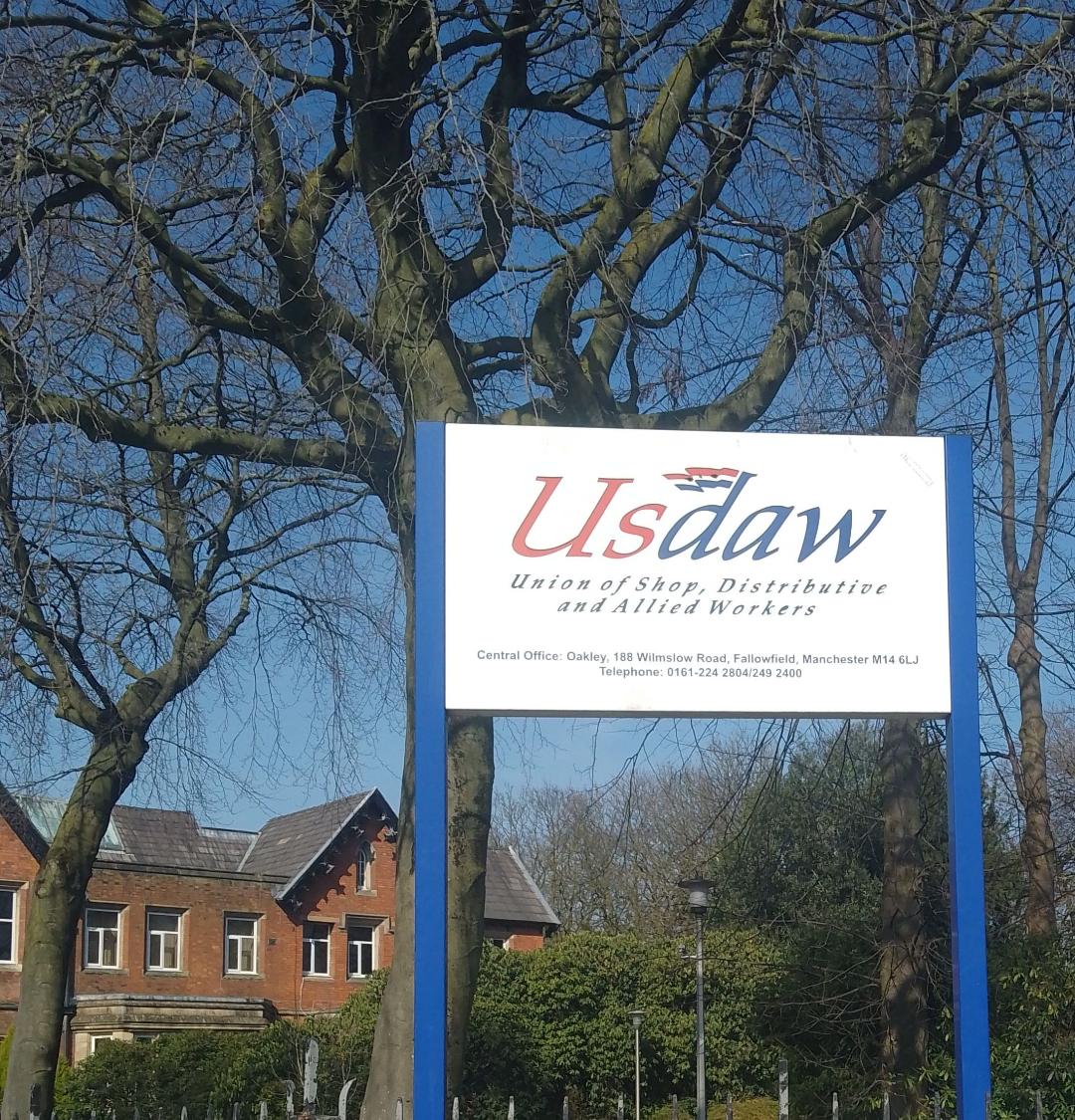
U.S.D.A.W. Sign – March 2025

In its current configuration it dates from 1947 when the Manchester based National Union of Distributive and Allied Workers merged with the National Union of Shop Assistants, Warehousemen, and Clerks which was based in London although one of the smaller unions which pre-existed the consolidated union also had its offices in Manchester. 

As its name indicates it is a major union in the retail trade; currently it represents over 360,000 members and for almost a year in the late 1970’s I was a member when I was working for Lewis's, Manchester.

“Oakley”, Wilmslow Road, Fallowfield

For over a century this house, “Oakley” a Victorian villa, at 122, Wilmslow Road, Fallowfield, Manchester (1) was home to U.S.D.A.W. and its predecessor. Kelly’s 1933 Directory of Lancashire, Manchester, Salford, and Suburbs reveals that the Union’s fortnightly journal “The New Dawn” was produced in the building its editor was Mr. Lewis Lumley.

“The New Dawn” masthead of Vol. 1 number 1 – January 1921
Lewis Lumley was born in Oldham on 4th December 1872. His birth details are shrouded in uncertainty; according to the1881 census he was the youngest child of Lewis Lumley, a joiner and his wife Elizabeth (née Singleton).

However, Elizabeth is recorded on the census return as born in 1828 and other records show she had already given birth to eight children one of whom was also named Lewis. This Lewis was born in Oldham, Lancashire during the September quarter of 1863 then promptly disappeared from all records! The issue is further clouded as one source states that the mother’s maiden name of the Lewis Lumley born in December 1872 was “Lumley”. It is quite possible then that he was the child of an unmarried older “sister” brought up as his grandparents’ child to avoid scandal.

 Lewis (1872 version) began work as a grocer’s assistant but by the 1901 census he had become a manager of a co-operative society’s coal depot. A decade later he was a full-time union organiser with The Amalgamated Union of Co-Operative Employees.

 This union developed from a meeting in Romiley, nr. Stockport in 1891 and was one of the unions which formed the National Union of Distributive and Allied Workers in January 1921.

In Oldham during the December quarter of 1896 Lewis married a United States born, Annie Wood. In the March quarter of 1898 Lewis and Annie had a baby girl, Nora followed on 15th August 1909 by another daughter, Marjorie.

Lewis was struck by a double tragedy in 1920 when his wife Annie died during the June quarter only for his daughter, Nora, to pass away at the young age of 22 the following quarter. In Manchester Cathedral during the December quarter of 1922, Lewis remarried Sarah Urmson; a near neighbour when the family home was on Green Lane, Oldham Garden Suburb.

In the early years of the First World War Lewis settled with his young family in another house in Oldham Garden Suburb, 3, Brae Side. He remained in this house until he died, aged 88, at the Oldham and District General Hospital on 3rd December 1961. His estate was valued at £6,060-2s (=£112,000 today). His 93-year-old second wife, Sarah survived him by just a few months passing away in a nursing home in Saddleworth, Yorkshire on 7th March 1962. Usdaw’s headquarters moved out of the Wilmslow Road property in early 2020 but due to Covid restrictions they didn’t move into their current offices at the Voyager Building, 2, Furness Quay, Salford Quays, Manchester until August 2021.

Tram 3080 Bound for Manchester Airport on Hardy Lane, Chorlton, 2025
Given the unions long association with the area, it is quite fitting that it has chosen to advertise on the livery of Metrolink Trams which it has done intermittently since August 2021. Originally their advert was carried by tram 3064 whilst currently it can be seen on tram 3080.

Pictures: - Masthead of “The New Dawn” courtesy of The University of Warwick’s, Modern Records Centre. 

 http://modernrecords.warwick.ac.uk

Others from the collection of Tony Goulding

Notes: -

1) Oakley House was built circa 1830 according to a report of the 12t July 2022 by the Planning Inspectorate of the Ministry of Housing, Communities, and Local Government regarding an appeal against a refused planning application for a proposed development of the site. As can be seen from the recent photographs the appeal brought by U.S.D.A.W. and the developer Watkin Jones Group Ltd. was unsuccessful.

Immediately prior to it becoming a union headquarters Oakley had been a private hotel operated by George Stephen Simmons. His story and those of the houses previous occupiers may well form the content of a future post.

  Acknowledgements: -

 As well as the value of Find My Past's Newspaper Archive and other records I would also like to acknowledge the British Trams Online for the tram numbering, Martin Sanders of Warwick University' s Archives for permission to use "The New Dawn" masthead, and Clare Jones of U.S.D.A.W. for details of the union’s move from Oakley.


Friday, 25 April 2025

Reverends Strong, Grogan, and Muzzell …another story from Tony Goulding

 I was going to wait before I composed this follow-up story of Withington rectors. 

However, encouraged by how well the initial story about St. Paul’s Church, Withington was received I have decided to not wait.

Trinity College, Dublin
The first of the three outstanding rectors of St. Paul’s first 100 years was Rev. William Heny Strong. Born in Dublin, Ireland in 1814, William Henry trained for his ministry at Trinity College in that city (1)                                                             

According to the “Alumni Dublinenses”of 1924 he commenced his studies there as a 17-years-old on 20th October 1831 his entry also confirms his place of birth and records that his father, George, was a “Ludimagister” (a schoolmaster). He was awarded his initial B.A. degree in the spring of 1837 later attaining an M.A. 

 William Henry was ordained a priest in 1839 and was given a curacy in the parish of Letterkenny, Co. Donegal, Ireland where he remained until moving to Lancashire in June 1842. (2)   In Lancashire he was initially an assistant minister at St. Peter’s, Preston before being appointed to a curacy in Blackburn in December 1842. Rev. Strong married Grace (née Carr) in Blackburn Cathedral on 25th January 1844 by which time he had become the incumbent of St. George’s Church, Chorley, Lancashire.


St, George's Church, Chorley.
The 1851 census reveals that Rev. Strong had moved to - 35, The Lord Mayors Walk, St. Giles, York.  A letter he wrote to the local paper, “The Yorkshire Gazette” appearing on 11th December 1852 reveals that he was the vicar of St. Olave’s church in the city.  William Henry and Grace had at least 3 children two sons, Charles Thomas  and William Henry (3) and a daughter Frances Mary.  

His daughter was born in York on 15th July 1856 by which time Rev, Strong had returned to Lancashire to the parish of Newchurch Kenyon, Nr. Leigh, Lancashire. In June 1862 he became the fourth rector of St. Paul’s, Withington in what was effectively an exchange of 'livings' with Rev. Robert William Burton M.A. He remained in Withington until 1872, when he resigned and moved to Somerton, Somerset where he was the vicar for more than 25 years. Rev Strong died at “The Lynch”, Somerton on 30th March 1899 finally having retired the previous year. His estate was valued at a modest £50 -10s -7d (= £5,474 today)         which he left to his second wife, a solicitor’s widow, Eleanor Parsons (née Eastment); his first wife, Grace, previously dying on 27th December 1883 at the vicarage in Somerton.

 Rev. Strong was succeeded as Rector of St. Paul’s, Withington by another Irishman, Rev. George William Grogan, a son of John Grogan and his wife Sarah (née Medlicott), who was born in Dublin during 1819.  An older brother, Edward served as the M.P. for Dublin City for more than two decades and was created a baronet in 1859.

George William also attended Trinity College, entering on 4th July 1836. The Alumni Dublinenses also records that his father, John, was a “causidicus” (barrister) and that he obtained his B.A. in spring 1841 and an M.A. in 1849. The following year he was ordained in Norwich Cathedral on Sunday 10th November 1850. An incumbency of nearly a decade at St. Mathew’s, Thorpe Hamlet, Nr. Norwich, Norfolk was followed by a much shorter one in Stoke Newington, London. Then after a brief return to Norfolk, as the vicar of Clenchwarton, Nr. Kings Lynn, Rev. Grogan was appointed vicar of Somerton, Somerset in which parish he remained until December1872 when in yet another link between the incumbents of St. Paul’s Withington he “exchanged livings” with Rev. William Henry Strong.

While he was in Thorpe Hamlet, George William married a fellow clergyman’s daughter, Helen Isabel Maria Graham at St. John’s Church, Bedminster, Bristol on 15th October 1856. The couple had at least nine children, one of whom, Marian Dora, died aged just 15 in March 1878 and is buried in St. Paul’s churchyard, Withington.

Rev. Grogan was the rector of St. Paul’s for nearly twenty years. He resigned in April 1892; retiring from active ministry he moved in retirement to Nr. Cheltenham, Gloucestershire. He died at “The Priory”, Prestbury, Nr. Cheltenham on 14th February 1902.

The final one of St. Paul’s first half-dozen rectors was the very long serving Rev. William Muzzell; incumbent from 12th September 1892 until his retirement in 1938/9.

William Muzzell was born on 7th September 1848 in Kelshall, Hertfordshire. He was the second son of Peter  Muzzell (4) and his first wife Mary (née Allen). Shortly after the 1851 census the family relocated to Yorkshire. William’s mother died while he was still an infant in August 1852; she was buried on 31st August in the parish of The Holy Trinity, Kingston-upon-Hull, Yorkshire (East Riding). Just 9 days after his wife's burial William’s father buried his 2-years-old daughter, Elizabeth. (5)

Soon after this double tragedy the family moved again, this time to the city of York where Peter Muzzell remarried at St. Mary’s Church, Bishophill Junior on 30th July 1855 to Rachel Mercer, a labourer’s daughter working as a maid in a clergyman’s household.

William attended the York Training College Model School (6) from May 1860. After leaving school he initially followed in his father’s footsteps and became a scripture reader; the 1871 census records him as such while lodging with a farm servant John W. Maxey and his wife Betsy at Wistow Gate, Cawood, Selby, Yorkshire (West Riding).

Muzzell family grave in St. Paul’s churchyard, Withington.
Rev. Muzzell later trained for the priesthood at St. Aidan’s Theological College, Birkenhead, The Wirral, Cheshire and was ordained on Sunday 23rd September 1877 in Chester Cathedral by the Bishop of Chester, Rt. Rev. William Jacobson. His first appointment was a curacy in the parish of Ince-in-Makerfield, Lancashire. He moved from there to the St. Philip’s, Bradford Road, Ancoats, Manchester, being appointed as the “curate-in-charge" of a portion of that parish in need of a new church. Initially holding services in a mission hall, Rev. Muzzell was appointed as the first rector of the new church of St. Mark’s, Holland Street, Ancoats. He remained in this post until his arrival in Withington.

 While he was still studying at a St. Aidan’s William married Hannah Johnson by license on 29th October 1873 at Christ Church, Ince, Wigan, Lancashire. William and Hannah had just one child, a daughter, Mary Elizabeth, born on 27thJuly 1874.

Rev. Muzzell died at his home in retirement 111, Wellington Road, Fallowfield, Manchester on 29th August 1940 and is interred in this grave in St. Paul’s Churchyard as is his wife Hannah who pre-deceased him on 27th October 1924. Their daughter, Mary Elizabeth (Lily) died on 22nd June 1947 and joined them in the churchyard.

Pictures; Trinity College, Dublin by John Brady - John Brady local guide works, CC0, 

Muzzell family grave in St. Paul’s churchyard, Withington.
https://commons.wikimedia.org/w/index.php?curid=162739159

Others from the collection of Tony Goulding.

Notes: - 

1) Rev. Strong was the third of four successive rectors of St. Paul’s to do so.

2) On his departure from Letterkenny, Rev. Strong received a gift and a glowing testimonial letter.  

3) William Henry was born on 23rd November 1845 and after an education at Rossall School near Fleetwood, Lancashire and Wadham College, Oxford he mirrored his father and was ordained a priest at Peterborough Cathedral on Sunday 24th September 1871. He served briefly as a curate in Leicestershire parishes Ashby-de la-Zouch cum Blackfordby  (from his time as a deacon) and Bringhurst cum Great Easton. However, during breakfast at the Tuebrook Lunatic Asylum, Liverpool on Tuesday 6th October, 1874, he killed himself by cutting his own throat. A charge of negligence was brought against one of the asylum’s attendants, Mr. James Dent who was subsequently cleared of any criminal behaviour.

4) Peter Muzzell ‘s occupations --- originally in 1851 census described as a “gardener” given he was living in rural Sussex this probably meant he was working in a market garden. His job as a ‘scripture reader’ may have been combined with other work as in the 1881 census he is recorded as Life Assurance Agent.

5) William’s only other full sibling, his elder brother, Jesse James, died during the March quarter of 1862 while one of his half-brothers John Mercer Muzzell also became a church of England vicar in Lancashire. He was for many years in charge of Christ Church, Bolton having previously served curacies at St. Peter’s, Ashton-under- Lyne, and Salford’s Christ Church. While at Ashton he was charged with a sexual assault, the case being dismissed.

6) “Model Schools” were established to provide opportunities for teachers in training to observe “model” classrooms and thereby acquire best practices with the aim of producing a more professional teaching body.