Showing posts with label Salford and the Great War. Show all posts

Monday, 10 November 2025

Salford women in uniform nu 3 .......... the inspector of “clippies”

The first clippies were taken on in the May of 1915 by Salford Corporation.

And in the way of things they also employed tram inspectors

Location; Salford


Picture; Salford tramways  inspectors, 1917, m08107, courtesy of Manchester Libraries, Information and Archives, Manchester City Council, http://images.manchester.gov.uk/index.php?session=pass

Sunday, 9 November 2025

Salford women in uniform nu 2 .......... the gas inspectors

During the Great War women began to replace men in a wide range of industries.

In the May of 1915 Salford Corporation took on 15 women to work as guards on their trams.

It would be a few months later before Manchester followed suit and while they were undergoing their training the Manchester postal authorities decided to utilise the services of women in the “delivery of letters.”

And across the twin cities women were engaged as gas inspectors.

I hope that Salford Corporation was a little bit more generous in their recognition of the work undertaken by their woman gas inspectors than Manchester.

In 1918 Mr Frederick A Price the superintendant of the Manchester Gas Department reporting to the Gas Committee of Manchester Corporation on the work of the 31 women clerks and 85 women meter inspectors concluded that while they were good and careful workers and  industrious and painstaking.*

But they lacked initiative, were not capable of discharging the higher administrative duties and lacked the necessary imagination and concentration with the power of organisation adding they liked to indulge in a little gossip.**


Location; Salford

Picture; Salford women gas inspectors, 1917, m08110,, courtesy of Manchester Libraries, Information and Archives, Manchester City Council, http://images.manchester.gov.uk/index.php?session=pass

* Women at Mens’ Work, Manchester Guardian, January 5, 1918

**from Manchester and the Great War, Andrew Simpson, the History Press,  published in February 2017, ISBN -33: 9780750 978965

Saturday, 8 November 2025

Working a Salford Corporation Tram in 1917 ............ Salford women in uniform

I like the way that stories have a habit of reappearing and so it is with Miss Rebecca Chapman of Hodson Street who in 1918 began work with Salford Corporation as a “clippie” on the trams.

My old friend David Harrop acquired her contract, license and handbook and they featured on the blog.

And because it was such a good story she made her way into my  book on Manchester and the Great War.*

Now yes I know the title is Manchester and the Great War, but by the very nature of things people didn’t adhere to strict geographical boundaries.  

They moved from area to area, lived in Manchester but worked in Salford and Trafford and swapped homes and work places.

So a little bit of Salford has got into the book, and quite right too.

All of which is an introduction to a new short series featuring photographs of Salford women in uniform and given Miss Chapman’s contribution I have started with a picture of a clippie from 1917.

And I rather think she is holding her handbook which gave detailed instructions on how to work the tram, what to do in emergencies and the pay scales awarded to clippies.

There was even a few pages dedicated to making notes.

Miss Chapman had written soon after joining the Corporation that "she had fallen off the tram"

it was the only entry so I guess she never fell off again.

Location; Salford

Picture; Instructions to Female Conductors from the collection of David Harrop, and "uniformed woman worker with Salford Tramways," 1917, m08109,, courtesy of Manchester Libraries, Information and Archives, Manchester City Council, http://images.manchester.gov.uk/index.php?session=pass

*Manchester and the Great War, Andrew Simpson, the History Press, was published in February 2017, ISBN -33: 9780750 978965


Thursday, 29 August 2024

Celebrating a year of peace on Salford streets in the summer of 1919

Now my grandparents never talked about the Great War.

It was something they lived through and seemed happy not to dwell on.

Nor did they or my mum and dad spend much time looking back at the rerun.

To be fair they answered the questions I asked but never initiated a conversation.

Given our own family tragedy which hung over the events of the Second World War I can understand why.

I don’t know how mum and dad celebrated either VE Day or VJ Day and I never cared to ask my grandparents how they saw in the Armistice Day celebrations on November 11, 1918.

But it will not have been like many.  Granddad was somewhere on the Western Front, and Nana was in Cologne, and so while my grandfather, his two brothers and my two uncles would have passed  the day with a mix of relief and fun, she faced up to the defeat of her country.

Al of which would have been a long way from the streets of Salford when this Corporation tram was dressed for a Victory Day Parade the following year.

It comes from the collection of David Harrop who maintains an extensive collection of memorabilia from both world wars along with an equally extensive set of material covering the history of the postal service.

In time I will go looking for stories of that day along with others from Armistice Day.

Location; Salford

Picture; illuminated Salford “Victory” Tram 1919, courtesy of David Harrop

Sunday, 28 July 2024

Salford says thank you to the Discharged Sailors, Soldiers & Airman, 1920

Now somewhere there will be a record of the day Salford Corporation hosted the Civic Reception for the Discharged Sailors, Soldiers & Airman.

It was held on Saturday October 9th 1920 in Belle Vue Gardens.

I would like to know how many attended, what was said and above all what people thought of the event.

I have trawled the Manchester Guardian with no success and will now have to wade through the files of the Salford and Manchester local papers at Central Ref.

And no sooner had the story gone live, than Maureen Swanwick commented that
"The Reception was a success according to the Salford Reporter. It said 5,000 attended and a further 3,500 invites were sent out and  because of the large numbers, it was over 3 Saturdays".

To which I can add this little gem from the Manchester Evening News, dated, October 6th, 1920, passed to me by Paul Sherlock.

Location; Salford

Picture; the Salford Corporation invitation, 1920

Sunday, 9 April 2023

Sydney Bone ….. a story linking Withington with Salford and the Great War

I doubt we will ever be able to identify which of these men of the 5th Platoon of B Company, the 22nd Manchester’s is young Sidney Bone.

5th Platoon, B Company Seventh City Battalion
I know he will have been roughly 20 years old when the picture was taken, and he will have enlisted in late November 1914 in the Seventh City Battalion which was one of the Manchester Pals Regiments.

He lived on Hill Street in Withington and three years earlier gave his occupation as an office boy in a Bleach Works.

Now there were quite a few bleach works with offices in the city and the chances of identifying which one he worked for is slim.

Bronze Plaque, Private Sidney Bone, 1919
But I have seen Private Bone’s bronze Memorial plaque, which was one of 1,355,000 issued to commemorate those men and women who died of their wounds during the conflict.  It measures 122mm in diameter and depicts an image of Britannia holding a trident and standing beside a lion.  

Two dolphins swim around Britannia and a second lion appears at the bottom.
Each plaque carried the name of the dead servicemen, omitting any reference to rank, and with the inscription “He died for Freedom and Honour” which was changed to “She died for Freedom and Honour" for the 600 issued to commemorate women.

In all 1, 355,000 were made and they continued to be made into the 1930s.

And this is the clue that all did not go well for Private Bone.  The records show that he was discharged from the army on October 12th, 1917, and died in Broughton House of his wounds on November 2nd, 1920.

Just what those wounds were is impossible at this point to know, but Broughton House had been opened in 1916 to care for disabled servicemen who “through paralysis, wounds and amputations will never be able to follow any trade or occupation.  They must receive special care and constant attention which could not always be provided in their own home.  Most of these men will be entirely dependent on the ministrations of others, even more so than the ordinary home for incurables”*

It was hoped to be one of a number of homes for  “totally disabled soldiers and sailors belonging to the industrial districts of Lancashire and to be known as the East Lancashire Disabled Sailors’ and Soldiers’ Homes”.*

Broughton House, 1894
In response to an appeal made in Manchester in the September of 1916 a sum of £28,400 had been obtained towards the £100, 000 required, with plans for a series of Flag Days In December of that year to raise more money as well as an appeal through the churches..**

Broughton House was in Park Lane, Broughton Park and was set in 2½ acres of gardens. It was the former  home of the Sutton family, and consisted of 24 rooms along with extensive cellars.

It still exists today, continuing the work it began over a century ago evolving into “a dedicated charity and nursing home for veterans living their remaining years amongst friends and a team committed to serving all those who served us”.***

And that I thought was pretty much all there was, other than to record that Private Bone is buried in St Paul’s Church on Wilmlsow Road, along with three other servicemen.

Private Sidney Bone, 2020
But then I decided to ask Daniel Daly who lives in Withington to visit the church yard and locate and photograph the grave.

This he did adding that he "searched one side of the cemetery near St Paul's School, on the south east side of the Graveyard, and then started searching the north east side and sure enough there he was.

I cleared the foliage away from the grave and that of the air cadet and said a prayer and took photos
the grave headstone which sits against the boundary wall dividing the Rectory from church.

The other Airman is located on the South East back boundary wall in the church yard".

And I have to thank Daniel for turning out on a day when the weather was iffy, and returning with not one but three war graves.

All of which is a fitting end to the story and has brought Private Sidney Bone out of the shadows.

Location; Salford and Withington

Pictures; 5th Platoon of B Company, 7th City Battalion, the 22nd Manchester’s circa 1916 from Manchester City Battalions Book of Honour, 1916, the Bronze plaque of Private S Bone, from the collection of David Harrop, and Broughton House, Broughton Park, 1894, from the OS map of South Lancashire, 1894, courtesy of Digital Archives Association, http://digitalarchives.co.uk/ and the gravestone of Private Bone, 2020, from the collection of Daniel Daly.

*Disabled Soldiers Progress of the East Lancashire Scheme, the Manchester Guardian, October 20, 1916

** Disabled Soldiers Homes for East Lancashire Men A Beginning at Broughton, Manchester Guardian October 12th, 1916


Saturday, 8 April 2023

Miss Rebecca Chapman gets a job on a Salford Tram in 1918 .......... stories behind the book nu 23

An occasional series on the stories behind the new book on Manchester and the Great War*

As the war turned into 1915 the growing demand for women to replace men in the workplace took on a pace during 1915.  In the May of that year Salford Corporation took on 15 women to work as guards on their trams and a few months later Manchester followed suit while the Manchester postal authorities decided to utilise the services of women in the “delivery of letters.”

This had followed an appeal by the Board of Trade in the March for women to register for work at the their local Labour Exchange and in the course of the next three years women were to be found working in heavy industry, as well as on the land, and in offices and on the transport network.

Of course in many respects none of this was new.  For over a century they had worked in textile mills and coal mines, laboured alongside men and children in the fields and done a variety of dirty and unpleasant occupations often for little remuneration.

But the scope of their involvement and the fact that many of these occupations were new to women marked a sea change as did the fact that some of these occupations were far better paid than their previous jobs.

I don’t know what young Rebecca Chapman had dome before she was appointed as “Driver conductor” for the Salford Corporation Tramways but she was sufficiently proud of her job that she retained both the handbook issued to ”Female Conductors” along with her licence and certificate of employment.

She was eighteen years old when she was appointed in the August of 1918 and her handbook records that her “conductor’s uniform number was 98” and she lived at Worthington Lodge, Park Lane in Higher Broughton.

It is a fascinating set of instructions running to 49 pages covering everything from pay “to the collection of fares” safety and the maintenance of the tram car.”

She was expected to be “firm, civil and obliging in the execution of her duty at all times, answer civilly” and was forbidden from accepting any form of gratuity. **

Her pay on appointment was 6.22d rising 7. 33d after four year’s service.

I would like to know more about Ms Chapman and how she had ended up at Worthington Lodge which was a large house with 21 rooms and 12 cellars given that back in 1911 she and had her widowed mother and six siblings were living in a 2 roomed house on Hodson Street in Salford.

The family had not had an easy time.  By 1911 her mother who was 37 had been widowed twice and was bringing up her family on the wages of a charwoman.

A decade earlier they had been living in a slightly larger property in the delightfully names Paradise Row in Greengate which was hard by the the Vapour-Gas Light Company, gas machine manufactures.

All of which may mean that her job on the Salford Trams like those of other women conductors was a significant new occupation.

Not that her appointment was without opposition.  Tram workers in Salford had argued that “the work of a guard is not a woman’s work and that it would be too much to expect that women should take charge of the early workmen’s cars or the late cars which would keep them up until midnight.”***

But I suspect by August 1918 when Miss Chapman began collecting the fares her job was seen as vital, and not without a few dangers. Just a week after she had started she recorded in the back of the handbook that she “had fallen off” the tram at 11.40 on Thursday September 17.

If it happened again she didn’t bother to report it.

And that is where for now I will leave Miss Chapman.  I went looking for after the war and did find that in 1926 a Miss Chapman married a Philip Shuman but there was also another who died in 1924 so we shall have to wait for further research.

In the fullness of time that will happen after all these few items that have survived a century offer a glimpse into life on the Home Front during the Great War, at which point I will thank David Harrop who provided these three from his collection.


Pictures, certificate of employment August 26, 1918 licence September 9 1918 and Instructions to Female Conductors, Salford Corporation Tramways, 1918, from the collection of David Harrop

*A new book on Manchester and the Great War http://chorltonhistory.blogspot.co.uk/search/label/A%20new%20book%20on%20Manchester%20and%20the%20Great%20War

** Instructions to Female Conductors, Salford Corporation Tramways, 1918


*** Woman Tramguards, Manchester Guardian May 29, 1915


Tuesday, 4 April 2023

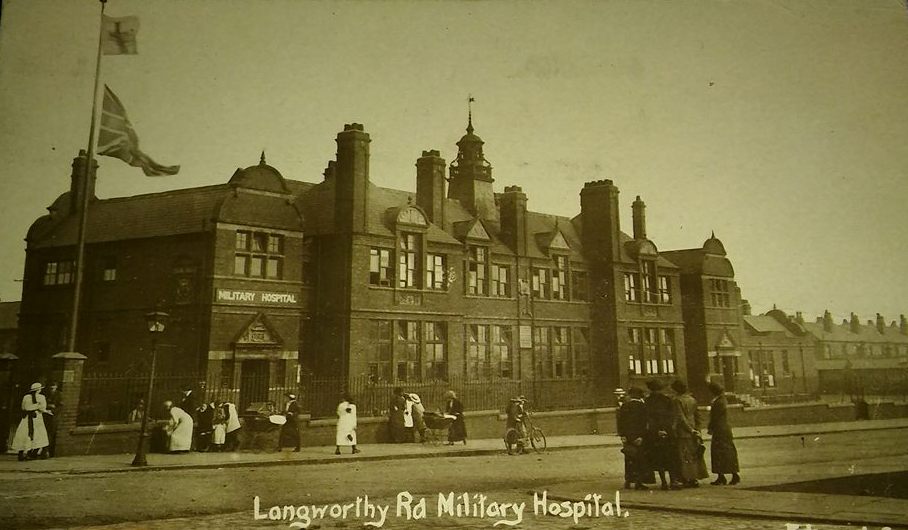
No more school at Langworthy Road ......... and in its place a military hospital

Now if you are seven years old and going to school on Langworthy Road in Salford the only bright bit of news as the Great War rolls into its second year might be that your school was to become a military hospital.

In the March of that year the authorities identified five schools which they thought might be suitable “for new hospital accommodation required by the military authorities.”*

The five were Secondary School for Boys, Leaf Square, Grecian Street Girls and Infants Schools, Halton Bank School, Langworthy Road School and Tootal Road School, with the option to substitute “Leicester Road School for one of the others.”

The attraction of the five/six were that they were all modern school.
In the case of Langworthy it had only been opened five years earlier in 1915 and had a total intake of 376 boys, 376 girls and 442 infants.

By all accounts it would have passed an Ofsted visit with flying colours.  The average attendance was nearly 100% and it was judged good by a report in 1905.

All of which just left the difficult question of what to do with 1,194 students.

The authorities had not fully worked out the answer to that question in the March of 1915 but considered that “There a number of Sunday Schools and halls in Pendleton and Broughton districts which may be utilised and suggestion has also been made that schools in the neighbourhood of the five selected schools should have two courses a day – one from 8 am. To 1pm. and the other from 1pm.to 5 pm., - one for each school."

This half day schooling was also adopted by Manchester where by 1915 the number of schools taken over amounted to eight. The first was the Central High School for Boys and Girls on Whitworth Street which had a thousand students and became the headquarters of the 2nd Western General Hospital.

The following year another seven schools were taken over.

These were Alfred Street in Harpurhey, Alma Park in Levenshulme, Grange Street in Bradford, Lilly Lane in Moston, Ducie Avenue, Moseley Road and Heald Place which amounted to the loss of 3897 places.**

It had resulted in a degree of ad hoc provision for some at least. In the February of 1916 the Manchester Museum reported that it was providing effective instruction for 900 to a 1,000 children per week drawn from the higher standards of the elementary schools.***

A similar scheme was underway at the City Art Gallery, the Whitworth Institute, and “kindred institutes in the city” and had proved so popular that children not only travelled some distance to attend but even brought their parents.

And that pretty much is that.

Location Salford

Picture; Langworthy Road Military Hospital, circa 1915-17 from the collection of David Harrop

*The New Hospitals, Five Salford Schools to be used, Manchester Guardian, March 17 1915

** 2nd Western General Hospital, Manchester, 1914-1919, Margaret Elwin Sparshot

*** War Service in the Museums, Teaching the Half Timers, Manchester Guardian, February 21, 1916

Monday, 21 November 2022

Another bit in the continuing story of the Salford soldier captured in 1918

Now I like the way that a story pops back up and in the process opens up new information and you end up becoming friends with someone you didn’t know.*

Red Cross Pow card, May 1918
So having written about young Albert Derry who was captured during the last big offensive by the German army in 1918 I was very pleased when Helen got in touch.

I wanted to thank you for the information about Albert Derry being a PoW in 1918, published on Salford facebook page.  

Albert is my nana's brother and despite many, many hours of family research I had no idea about Albert's history, except birth and death; so to have this information is wonderful.  I've no idea how you've uncovered it, but thank you anyway!"

Albert's sister, Helen's grandmother, date unknown
Well I uncovered it as part of the research for my book on Manchester and the Great War and it was a Red Cross postcard which informed his parents of his status as a POW.

The document with many others comes from the collection of David Harrop and without his vast array of Great War memorabilia the book could never have been written.

The story of Albert is one of those that draws you in from the very beginning.  He was born in 1893 and was serving with the Lancashire Fusiliers when he was take prisoner and that simple Red Cross Card must have been a welcome missing of information.

Notification of pay January 1918
I had discovered the names of his parents and that he had siblings but now the story has gone that bit further, more so because Helen lent me this picture of her grandmother who was Albert’s sister.

There is still a lot more to find out but it is another of those examples where social media brings people together and reveals a little more of our common past.

Location; The Great War;


Pictures; the Red Cross POW card, 1918, courtesy of David Harrop, and Albert’s sister from the collection of Helen Flanagan

*News of a Salford soldier from a German POW camp .............. May 1918  https://chorltonhistory.blogspot.co.uk/2016/10/news-of-salford-soldier-from-german-pow.html

**A new book on Manchester and the Great War, https://chorltonhistory.blogspot.co.uk/search/label/A%20new%20book%20on%20Manchester%20and%20the%20Great%20War

Sunday, 20 November 2022

News of a Salford soldier from a German POW camp .............. May 1918

Albert Derry was 25 years old when he was captured during the last big German offensive on the Western Front in March 1918.

News from Germany, May 1918
It was the first day of that big attack and I can fully understand the anxiety his family must have gone through, knowing that his battalion of the Lancashire Fusiliers were in the thick of the fighting.

And it would not be until May that they got confirmation that he was a Prisoner of War at Limburg an der Lahn.

The camp held 12,000 British soldiers who remained in captivity till the end of the war.

I wish I knew more.  In time I will look up the war diaries of the battalion which will give a detailed account of the fighting.

Church Street, 1911
For now I know that Private Derry had been born in 1893, that  his father was a shoe maker and he was one of eight children.

His father had married Frances in 1880 and along with the eight children there had been another three that had died.

In 1911 they were living at 155 Church Road in Pendleton and a decade earlier they had been on Pimlott Street which was close by.

With a bit more research it should be possible to discover a little more about Pimlott Street and make a comparison between the two houses.

But for now I will just reflect that in the May of 1918 Limburg an der Lahn must have seemed a long way from the butcher’s shop Albert had worked in before the war.  His army records were lost in the Blitz and while I know he was awarded the British War Medal and the Allied Victory Medal, what happened to him on his return has yet to be discovered.

There is an Albert Derry living in Salford who died in 1940 and that for the moment really is it.

Location, Salford and Germany

Pictures; POW card, May 1918, courtesy of David Harrop

*Anew book on Manchester and the Great Warhttps://chorltonhistory.blogspot.co.uk/search/label/A%20new%20book%20on%20Manchester%20and%20the%20Great%20War

Friday, 28 September 2018

A wartime photograph

There is something about this photograph that draws you in.

This is John, Annie and Nora Garvey and we must be sometime near the end of the Great War.

Nora was born in 1915 so I think this must be 1917 or perhaps even 1918.

John by then will have been 30 and Annie 28.  They had been married at St Thomas’s in Pendleton and Annie had worked at one of the local cotton mills.

The photograph is one of those standard posed pictures that professional photographers went in for with studio props and often a backdrop.

But what makes this one all the more interesting are the poses and expressions on the faces of Annie and John.

He stares directly into the camera while she looks off to the left.

It may just be that Annie’s attention has been caught at the moment the picture was taken.  Perhaps the assistant dropped something.

Or this picture was one of a series and this was the one which was never meant to be released.

But photographs cost money and I doubt John and Annie wanted an also run in the collection.

So this picture was the one they chose and I can’t help feeling that while she looks a little distant he has an air of melancholy about him.

Of course we will never really know.  Nor at this stage can I say for certain when our picture was taken.

In time I hope we will know more about his military record, including where he served and which regiment that in turn might bring us closer to a date for the picture.

Pictures; Mr & Mrs Garvey and their daughter Nora, courtesy of Alan

Thursday, 20 April 2017

Coming soon ........ Manchester Remembering 1914-18 ........... a second book signing

Now in one of the most outrageous bouts of self promotion here for all those that missed the first book signing event at Central Ref in February is news of a second opportunity to get a signed copy of Manchester Remembering 1914-18.

The first was attended by the Lord Mayor, some of the descendants of men and women who appear in the book along with a selection of Great War memorabilia from David Harrop.

So successful was the event that we have decided to repeat the day this time at the Imperial War Museum North at Salford Quays on Sunday June 4.

So as they say watch this spot for more details and as a trailer here picked from random is a page from the book.

Location; Imperial War Museum North


Pictures; page from Manchester Remembering 1914-18

*Manchester Remembering 1914-18, https://chorltonhistory.blogspot.co.uk/search/label/A%20new%20book%20on%20Manchester%20and%20the%20Great%20War