Showing posts with label Chorlton pubs and hotels. Show all posts

Monday, 14 September 2026

Just when you thought you knew the age of the Trevor Arms on Beech Road

The Trevor was my local from 1976 well into the middle of the next decade and was a busy and happy place.

At the time and until quite recently I gave little thought to its history, it was simply the pub run by Stan and Mona and their daughter Christine and always a place where you find someone you knew to talk to.

If I did give its past any thought I just assumed the date above the door of 1908 was when it was opened, but beer was being sold from this spot from 1879.

Back then the site was occupied by a row of wattle and daub cottages, one of which had been the home of Mary Crowther who was made to do penance in the church at the beginning of the 19th century.

It is unclear what Mary had done but during the closing decades of the eighteenth century she had given birth to three illegitimate children and it may be that it was for this that she was made to do penance.

She was the last person to do so, and lived out her life, with one of her sons in the cottage and was buried in the parish church yard.

By 1871 one of these cottages was owned by the Langford family.

Jonathan Langford came from an old Chorlton family and a decade earlier had given his occupation as a "gardener" and lived on Dark Lane.

In 1874 his daughter Elizabeth was living there and running the shop and  by 1879 she was renting it out to a succession of “beer housekeepers.”

The last of these tenants was William Downs.  By 1897 the property was transferred to Groves and Whitnall which had taken over the Regent Road Brewery in 1868 and began a rapid expansion which by the time they were registered in 1899 included nearly 600 pubs.

Now there is a lot more I want to know about Mrs Langford as well as William Downs who in 1898 was superseded by Miss Mary Catherine Hayes.

But that is for another story.

Picture; the Trevor early 20th century from the collection of Tony Walker

Monday, 6 July 2026

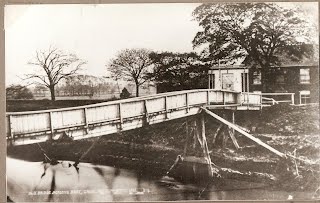
A history of Chorlton in just 20 objects number one ...... a bridge across the Mersey 1816

Now this will be a short series featuring objects which tell a story of Chorlton in just a paragraph and is also a challenge for people to suggest some that are personal to their stories.

They are in no particular order, and have been selected purely at random.

This was the first bridge across the Mersey on the edge of the township.  Samuel Wilton built it in 1816 at a cost of £200, but the ferry and the right to transport passengers across the Mersey were still in place in 1832 when the pub and the surrounding land were put up for sale.

At the time it was the landlord of the pub who benefited from the ferry charges.  The toll of a 1d to cross the bridge was abolished in the 1940s.

Picture; from the Lloyd collection 1865

Thursday, 16 April 2026

Rare pictures of the Horse and Jockey and a mysterious historian of Chorlton


This is one of three photographs that I doubt very few people have seen.

It is the Horse and Jockey in 1933 and appears in a Short History of Chorlton-cum-Hardy published privately in that year.

There are plenty of pictures of the pub from the very early years of the 20th century and lots from the 1950s onwards but so far I have only come across a couple which date to the 30s and 40s.

So this is an interesting one and shows the original before it expanded into the cottages on the left of the front door.

To our right beyond the fence had been the home of the Wilton family who lived there for most of the 19th century.  It was Samuel Wilton who around 1818 enclosed the green for his own personal garden with tall hedges and an allotment.  The space only returned to public use with the death of his daughter.

The remaining two photographs are of the parish church and Hough End Hall and all three were taken by F. Blyth who also printed the book at the College of Technology in Manchester while on his second year course.

But the text is by a J.D. Blythe and is as far as I know the first new account of Chorlton’s history since the twenty-six articles written by Thomas Ellwood during 1885-86.

Mr Blyth drew heavily on those articles and in places follows the earlier history word for word.  Not that this is to rubbish the book, particularly as I doubt it was meant as a serious rival to Ellwood’s work.  It may have just been a vehicle for F Blyth to complete a course at the college demonstrating his skill at photography and printing.

Now there is very little on either man.  J.D. Blythe was here on Claude Road between 1922 and 1929 and  is listed in the telephone directory but without trawling the street directories for the period we have no knowing when he went to live in Chorltonville and when he left.

There is a record of a J.D Blyth leaving for South Africa in 1919 with the stated purpose of settling in the Natal, but he returns just four months later in February 1920, and so far that is about it.

Location; Chorlton-cum-Hardy

Picture; the Horse & Jockey in 1933, F Blyth from A Short History of Chorlton-cum-Hardy, by J.D.Blyth, 1933

Friday, 20 March 2026

A 'gang' of 'teenagers' ........... just before the War outside the Horse and Jockey

Now I like the way that people continue to be generous with both their family pictures and the memories.

So I was very pleased when this one was sent to me by Yvonne.

The Horse and Jockey will always be special to me, not only because as one of our oldest pubs it featured in my first book and was the venue for its launch but also because as the “Pub on the Green” it has been at the centre of much of Chorlton's history.*

But rather than ramble on I will share Yvonne’s description of the picture.

"Hello Andrew!  I enjoy reading your post on the Chorlton Blog.  

I was born there - leaving when I was 8.  I have a photo of my mother and sister with their 'gang' from about 1936 outside the Horse and Jockey.  

It’s of a 'gang' of 'teenagers' just before the War outside the Horse and Jockey. 


My mum Dilys on the left, her sister Gwen on the right. She used to tell us all their names but the only one I can remember is Joe Rook!”

And that is a pretty good start.

Yvonne hopes it will “stir some memories up” and so do I.


All of which just leaves me to thank Yvonne.
Location; Chorlton

Picture; A 'gang' of 'teenagers' outside the Horse and Jockey circa 1936 courtesy of Yvonne Richardson

*The Story of Chorlton-cum-Hardy, 


Thursday, 12 February 2026

Back with Derrick A. Lea in the Chorlton of 1955


It’s one of those odd things that we have few pictures of Chorlton in the 1950s. 

Now there are a few fine collections in the Local History archive* but nothing compared with the huge range and number from the beginning of both the 20th century and the last decades of the 19th.

So when examples come up it is as well to include them in the story of Chorlton.

And so here we have another from the pen of Derrick A. Lea who drew pictures of the area in the 50s.  As I have said before along with J Montgomery Mr Lea is a bit of a mystery.

I know a little about him including where he lived in Chorlton and that some of his pictures were turned into greetings cards and that is about it.

Now given that pictures as opposed to photographs of where we live do not turn us as regularly his collection are quite unique.

This one is of Wilbraham Road sometime in 1955 and it appears to be a warm day in perhaps March or early April because despite the absence of any leaves on the trees people are walking around without those heavy overcoats everyone seemed to wear during the period.

Of course there may be a bit of poetic license here but there is much that is just as it should.

And it is a scene that has changed.  The Conservative Club and Public Hall was still solid reminder of the fact that Chorlton elected Conservative politicians to the Town Hall  and would do so until 1986.

In much the same way the Lloyd's Hotel has not changed overmuch since it was built in 1870

But with the benefit of hindsight we know that Mr Lea’s picture captured a Chorlton that has now gone forever.  The Conservative Club and Public Hall closed earlier in the year after the Conservative Association had wound itself up and currently the plans are to convert the building into flats.

The Lloyd’s may appear superficially the same, but internally much has been altered.  The small rooms have been knocked through, and the staircase taken down.

I can’t say the changes are for the worse.  I remember it from the late 1970s and early 80s as a place waiting for something to happen.

All of which would have pleased its landlady back in the 1880s.  This was a Mrs Crabtree who by all accounts “improved the place considerably in various particulars” and it may have been her who encouraged the bowling green members to build their own club house which was open on Wednesdays during the season.

She was an enterprising woman with an eye for business and also laid out a lawn tennis court on the open land along side Whitelow Road.

By the time I had washed up in Chorlton the tennis courts had become a drab car park while going inside the pub was like stepping back into the 1950s.

Nor did much seem to improve during the course of the next decade, and sadly the place became somewhere you went to only for a quick during before eating on Wilbraham Road.

But the place has undergone a series of makeovers in the course of the last few years, and is really a fun place to drop into for a drink, a meal and soon the launch of our new book, nothing to do in chorlton, Martledge Lost and Found.

Which brings me back to Wilbraham Road in 1955.

Picture;  Wilbraham Road in 1955, Derrick A. Lea


*http://images.manchester.gov.uk/index.php?session=pass


Sunday, 8 February 2026

On Chorlton Green with Derrick A Lea in 1957


We are on the green sometime between 1955 and 1958 outside the Horse and Jockey.

Now I know this because the artist who drew the scene completed a series of pictures of Chorlton during this period.

He was Derrick A Lea and he is one of those local artist who has slipped out of our history.

He lived here during the 1950s through to the ‘70s, and that is about it.  So for now it is his pictures that will have to speak for him.

And today it is this one of the pub on the green.


It is a picture which I like partly because the style reminds me of so many that I grew up with in the 1950s and early 1960s.

Often they were the sort which appeared as adverts in magazines or in prints that were displayed in railway carriages on the trains of the Southern Region.

Most were of the countryside and most showed southern England in full summer.

So this one is somewhat different and what draws me in is not just the wintry scene but the way Mr Lea captures the brisk movement of the couple on the right.  It’s partly their stride as they follow the dog but also the way the woman’s coat spills out covering as it would an equally expansive dress underneath.

This was that period when in direct contrast to the fashions of the war everything was bigger and more showy, as if to say “we are done with rationing and making do.”

And the historian in me is fascinated by the picture of the pub itself which is almost the one we know today but not quite.

In the 1950s it had not extended into the building to right of the entrance below the sign.

This was still a private residence and so had not yet been given the wooden beam effect.  Nor had the top floor of what had once been Miss Wilton’s home been taken down.

But not all in the picture is completely accurate for what looks like a pond in front of the trees is  an invention of Mr Lea’s imagination.

There were village ponds but sadly not here.  There was one further to the south by the Bowling Green Hotel and another on Beech Road stretching from Acres Road up to Chequers Road but not outside the Horse and Jockey.

Not that I am over bothered by the deliberate error.

It remains a pretty neat picture of a moment in the mid 1950s which will be one most of us never knew, and I do like his depiction of the pub and the green on a wintery snowy night.

So it just remains to close by repeating  the image he drew.

Location; Chorlton-cum-Hardy, Manchester


Picture; the Horse and Jockey, Chorlton Green, by Derrick A Lea taken from a greetings card in the possession of my old friend Margaret.


Saturday, 29 November 2025

The story of one building in Chorlton over three centuries ............. part 1 a beginning

Number 70 in 2014
Now over three centuries a building can pretty much be many things to many people and so it is with number 70 Beech Road. 

It began as a beer shop was briefly home to an upholsterer, and has also been a fish shop, a bakery and art gallery before becoming home to a jewellery and craft business.

All of which means it may well be our oldest commercial property with an unbroken record of selling various things dating back to 1832.

As such it is only beaten by the Horse & Jockey which opened its doors sometime around 1800 in a building dating back to the 16th century.

And yes the Bowling Green does date from the 1780s but is now in a building which was built in the early 20th century, while the pub over the water at Wilton's bridge is now no longer in Chorlton.

Now I can’t be sure of the exact date but 1832 is a good starting point.

Nu 70, the Travellers Rest, circa 1901
It does not show up on Hennet’s map of 1830 but was open for business just two years later when it was run as the Robin Hood.

But perhaps to distinguish it from a pub with the same name in Stretford it became the Travellers Call and by the 1840s was known as the Travellers Rest.

It fronted directly on to the road and so those who chose to visit it would walk straight in off the Row.**

Inside there was just the one room with all the natural light coming from a window beside the door.  

Judging by the size of the room which was just 3.5 metres [11.5 feet] wide by 1.75 metres [6 feet] long, and its customers were packed in sitting on simple wooden chairs and benches with just enough room for one table

It lacked the size of the Bowling Green Hotel or the position of the Horse and Jockey on the green, but it was a natural stopping off point for anyone coming down the Row.**

Grouped around about were a fair few village homes, and there was the added attraction of William Davis’s smithy just across the road.

Looking up Beech Road around 1901
For those dropping off tools to be mended or horses to be shod the “Rest” was a natural port of call, particularly for those thirsty from the heat of standing near the forge.

Like other beer shops the Travellers Rest may not even have had a bar.  It was a simple drinking room where men gathered, drank their beer and enjoyed each others’ company.

Its first “beer keeper” was Thomas White who was succeeded by Samuel and Elizabeth Nixon and they ran the place until the mid 1880s, after which it continued as a beer shop until the early years of the 20th century.

The corner of number 70 in 1979
But that is not quite all for this first chapter in the story.

Samuel’s father ran the pub over the Mersey, his son took over the post office next door at number 68 and his grandson opened the first newsagents on the corner of Beech Road and Chequers Road and had married in to the Brownlow family who had been making wheels at Lane End from early in the 19th century. ***

So less a story of one beer shop more of one family and what they did in Chorlton.

Next; from beer shop to upholster and the story of Mrs Lothian who sold fish from number 70 well into the 1930s.

Pictures; number 70 Beech Road, 2014 from the collection of Andrew Simpson, and the Travellers Rest circa 1901 and the Oven Door, 1979 from the collection of Tony Walker.

*The story of one building in Chorlton over three centuries,  

**The Row or Chorlton Row was the name  of Beech Road

***Lane End was where High Lane and what is now Sandy Lane joined Barlow Moor Road

Wednesday, 12 November 2025

A pub, an inscription, and the start of a detective story …… with a confession

I remain intrigued by the discovery at the Bowling Green Hotel of an inscription which looks to have the date 1698 carved into it.

The inscription, 2020
The story was  posted this week, with the speculation of a link between that 17th century inscription and the bowling green, coupled with an appeal to crowd fund for improvements to the green.

It is a fascinating find and could push the story of the site back a century from the conventional assumption that the first pub was opened in the1780s and takes us back to what might have been the first dwelling on the site.

According Thomas Ellwood who wrote a series of articles on the history of Chorlton-cum-Hardy which were published in the winter of 1885 and the spring of the following year, “The oldest inn in the centre of the village  is the Bowling Green Hotel, adjoining the old church – the usual situation for a village public house.


The old Bowling Green Hotel. date unknown
Formerly there stood here one of those ancient wood and plaster dwellings.

The present house was erected about a century ago.  It was first a farmhouse and hostelry combined and belonged to the Egertons of Tatton, but is now owned by Mr. Wm Roberts, the well-known brewer.

Edward Mason was the person who obtained the first licensee of the house, the business afterwards being continued by his son Edward, who was also a land surveyor.  The tenants following were George Whitelegge, William Partington, Charles Chambers,  A. P. Philips, and Edward Richards.  The tenant at present is James English.  There is a bowling-green connected to this inn.

A pond formerly existed on the plot of land bounded by the green behind, and the Chorlton brook, and had a small island in the centre.  This was let during the tenancy of Edward Mason, jun to a gentleman for fishing, but on the making of the main sewer through the village by Lord Egerton, it was drained and filled up.”

Now, Ellwood’s account is fascinating, not least because he drew on the memories of those who had lived in the township all their lives, and would in turn have called up the memories of their parents and grandparents, which might well take us back to the time King George lost the American colonies.

The old Bowling Green Hotel, date unknown
To these we can add the records from the Rate Books which list the owners, and the occupants of our building, starting with the earliest surviving entry which was for 1844.  The records confirm Mr. Ellwood chronology of owners and landlords and offers updates for when they took over the pub.

But what also comes out from those records, is that the first reference to a bowling green only comes in 1862, along with the first refence in the books to the name the Bowling Green Hotel which appears twelve years later.

Of course, history is messy, and the records as ever throw up conflicting evidence.

So, while both the Tithe map of 1845 and the OS map of 1854, show the pond there is no indication of a bowling green. That said the earlier map does list the pub as the Bowling Green Inn, which would suggest that there was indeed a bowling green to the east of old pub.

Ken playing the green, 1979
Frustratingly Mr. Elwood did not elaborate on the bowling green, although he did go into some detail on the green associated with the Horse and Jockey and a later one on the corner of Cross Road and High Lane, recording that “Bowling has always been popular in Chorlton, the well conducted greens being attended solely for healthy exercise and recreation”.

Adding “The village can boast of no fewer than six bowling greens, three in connection with the hotels, and three maintained by subscription. ……… The game may be indulged in by the public at the Lloyd’s Hotel, the Bowling Green Hotel and the old inn at Jackson’s Boat”, [with] another bowling green connected with the Chorlton Reading Rooms, [Beech Road] where the working men of the village assemble”.***

At which point I was tempted arrogantly to conclude that the Bowling Green Hotel’s link to a very old bowling green was unlikely, but history may prove me wrong.  John Lloyd in his book on the history of Chorlton-cum-Hardy commented that “the reputed date of the Bowling Green  Inn is 1693”which comes close to our inscription.****

To which can be added the assertion that “Crown green bowling of a sort is actually recorded in 1600 being played at the Bowling Green Hotel in Chorlton”.*****

Looking towards the Bowling Green, date unknown
Now that reference to 1600 will have to be followed up, but intriguingly, Olive Donohue, who is the secretary of the Chorlton Bowling Club has other sources which show a connection back to the 17th century.

All of which means that this story may have plenty more surprises to come, and along the way, confirm that simple observation that you should never make definitive assumptions about events in the past because the evidence can leap out of the shadows and bite you on the bum.

In the meantime I will finish with that crowd funding appeal, from the club’s Facebook site, "It’s our intention to conduct a crowdfunding campaign ahead of the start of next season (2021), but in the meantime here’s our banking details, in case anyone feels like making a donation. The green itself is in urgent need of some TLC, and grass seed, fertilizer, new sprinklers, etc. can be quite costly".******

Location; Chorlton

The new Bowling Green, 1978
Pictures; The old Bowling Green Hotel, date unknown, from the collections of Allan Brown, Tony Walker,and the Lloyd Collection and Ken playing the green in 1979

*Elwood, Thomas, Inns, Chapter 23, The History of Chorlton-cum-Hardy, April 17th, 1886, South Manchester Gazette.

**George Whitelegg[e] 1841-1859, William Partington, 1859, 1868, Charles Chambers, 1872-3, Edward Richards 1874-1884, James England, 1884, owners, Egertons up to 1859, William & Elizabeth Partington, 1859, Charles Chambers 1872, William Roberts 1874

***Elwood, Thomas, Bowling Greens Chapter 26, The History of Chorlton-cum-Hardy, May 17th, 1886, South Manchester Gazette.

****Lloyd John, The Township of Chorlton-cum-Hardy, 1972, page 60

*****Cheshire County Bowling Association, Centenary Souvenir Booklet, 1910-2010, Cheshire County Bowling Association

****** Bowling Green Hotel Bowling Club, Crowd Funding Appeal, Bank sort code: 20 26 20 (Barclays, Chorlton) Account no: 6019 2988

Thursday, 16 October 2025

The story that is 232 years old …… the Horse & Jockey reopens

I for one am keen to see the new Horse & Jockey which reopens on October 20th.

Summer 2022

The pub dates back to 1793, in a building which was already old when Henry V111 walked up the aisle with Anne Boleyn.

I have been going in for over half a century, and have written about   it on and off for the last two decades.*

The Jockey Gang, 1938
It also featured in the book I wrote with Peter Topping on Chorlton pubs, and because of his historic significance was the first in a new series on our pubs and bars.**

It was the venue for inquests, was the scene of an historic arrest and once had its own bowling green.

In 1793 it was just one of four cottages and the eastern end was until the early 1890s the home of the family who stole Chorlton Green and turned it into their own private garden.

All of which you can read on the blog.

Leaving me just to say the full report on the refurbished Jockey can be read by following the link to yesterday's Manchester Evening News.***

 Pictures; The Jockey 2022 from the collection of Andrew Simpson and A 'gang' of 'teenagers' outside the Horse and Jockey circa 1936 courtesy of Yvonne Richardson

*The Horse and Jockey, https://chorltonhistory.blogspot.com/search/label/The%20Horse%20and%20Jockey

**The  book is available at www.pubbooks.co.uk or the old-fashioned way on 07521 557888 or from Chorlton Bookshop, and costs £4.99.

***Historic Greater Manchester pub to reopen its doors as opening date revealed, Jenna Campbell, Manchester Evening News, October 14th, 2025, https://www.manchestereveningnews.co.uk/whats-on/food-drink-news/historic-greater-manchester-pub-reopen-32672167


Wednesday, 24 September 2025

Sunday night in the Lloyds ............ memories of the 1970s

Standing outside the pub in 1979
The first in a short series which looks at what Chorlton was like in the recent past.

Today Lorna remembers the Lloyds Hotel in the 1970s.

Back then the pub still retained its small more intimate set of rooms where if you wanted you could have one of those quiet evenings almost to yourselves with just the regular visit from the waiter who could be summoned from the bar by the push button on the wall.

Those of us who went in there will also remember the staircase which gave access to the upstairs and it was there on Sunday nights that Lorna remembers in this piece she wrote for the blog.

"I remember the Lloyds in the early 1970's when Bill Caroll was the landlord and ruled the pub with a "rod of iron". 


Sunday night upstairs in the top room was very popular and people went in early to make sure they got the best seats in order to listen to the variety of live singers (no karaoke then) who turned up voluntarily each week. 

Highlight of the night was waiting to see who would be 'top of the bill'. 

It was usually Bill, who was an ex policeman, or Jimmy Gale, who were both very good singers. 

Little Jimmy would get everyone in the swing by singing Mardi Gras where all would join in with great gusto. 

Good memories.

I should add that Sunday night always finished with the same two songs where everyone linked arms and sang together. First 'Strolling' followed by 'I'll See You In My Dreams'"

It would be nice to hear other stories about the Lloyds. I am trying to remember the name of the piano player. A Mr Quinn from Keppel Road used to step in now and again, but he was not the regular . Mr Quinn was piano player in the Royal Oak

Lorna has promised to go looking for pictures and they are important because all too often it is photographs of the inside of pubs which seldom survive.

And in the meantime perhaps it will spark off other memories we can share.

Location; Chorlton-cum-Hardy

Sunday in the Lloyds by Lorna Davies, 2015

Picture; the Lloyds Hotel, 1979, from the collection of Tony Walker

Tuesday, 16 September 2025

Outside Chorlton's Royal Oak with Thomas Kelsey

This is another of those pictures of the old Royal Oak in Chorlton I have never seen before, and it features Thomas Kelsey whose family ran the pub from 1895.

It was sent to me yesterday by Kelsey Broome, who added, "Hi Andrew, I have just come across your post on the Chorlton Facebook group with the photo of Thomas Kelsey outside the Royal Oak.* 

I hope you don't mind me getting in touch. Thomas Kelsey was my great Grandfather, and this is how I came to be named Kelsey.

Thomas Kelsey had two daughters Mamie (my grandmother) and Freda (my Great Aunty). My Great Aunty Freda is still alive and has just turned 90. We have photos of the Royal Oak when it was owned by George Henry Kelsey. Hope this photo that I have enclosed is of interest."

And of course, it is not only “of interest” but quite exciting and very unique, because there are only a handful of pictures of the old pub, and most of those only show a detail of the building.

The Royal Oak was originally a beer shop which dated back to the early part of the 19th century and consisted of little more than four rooms.

But the OS maps for 1894 and 1907 show that it had been enlarged and the 1911 census return records that there were eight rooms. All of which may have the work of George Kelsey, who was the landlord by 1895

Nor is that all because George Kelsey appears to have been more than just a publican because a sign in another picture from 1902, announces that he was also in the business of “CABS, HANSOMS” and offered a LIVERY STATION.”

And before that was working in the Glass House on Regent Road by 1881 when he was 18 years old while his parents had run a beer shop just off Regent Road.

Our picture shows his son Thomas, staring out from the car.

Thomas was born in 1893 in Salford and his parents ran the Duke of York pub at 186 Regent Road, before moving in 1895 to the Royal Oak here in Chorlton.

In an earlier picture dating from 1902, Thomas was photographed standing outside the pub, so this is a nice companion to that earlier image.

And Kelsey’s picture has much to offer.

It starts with the building to the right, which was a block of apartments, originally owned by the Renshaw family and predates 1832.  It was demolished to make way for the present Royal Oak, possibly in the 1930s.

And in front of that building is the large billboard for the Pavilion, which was our own music hall and cinema, and was located on the corner of Wilbraham Road now occupied by the Morrison’s petrol station.

The Pavilion, which also was known as The Chorlton Theatre and Winter Gardens, dates from 1904 and closed by 1924, all of which fixes our image sometime between those two dates.**

And there is more, because behind the car there is sometime detail of the pub, with that poster which includes the word closed, which in turn might just provide us with a date for the closure of the old pub and might just push the date of the new one back into the 1920s.

So yes, Kelsey’s picture is a wonderful addition to out knowledge of Chorlton’s past.

Location; Chorlton-cum-Hardy

Picture, the Royal Oak, and Thomas Kelsey, date unknown, from the collection of Kelsey Broome

*That lost picture of the Royal Oak in 1902 with young Thomas Kelsey, https://chorltonhistory.blogspot.com/2019/09/that-lost-picture-of-royal-oak-in-1902.html

**The Chorlton Theatre and Winter Gardens, https://chorltonhistory.blogspot.com/search/label/Chorlton%20Theatre%20and%20Winter%20Gardens

Tuesday, 10 June 2025

That “bright little suburb” ………… Chorlton-cum-Hardy and its pub across the water

Now I can see that attraction of these two picture postcards which were marketed by the Rapid Art Photography Company sometime in the 1930s.

In the previous fifty years, great swathes of Chorlton had been built over, and what had once been fields, farms and market gardens had become rows of terraced and semidetached houses for the middling people who worked in the city and wanted the vestiges of a rural setting when they came home.

And that stretch of land from the old Chorlton village to the Mersey offered just that degree of open countryside, with the added benefit of a pub on the banks of the river.

None of this was lost on the Manchester Guardian which reported on May 10th, 1914, that “Jackson’s Boat is the picturesque connecting link between Chorlton and Sale.  There is no boat there now, whatever there may have been at one time, but there is a half penny toll bridge for foot passengers and a pleasant inn.  You need not pay the half penny if you prefer to take a glass at the inn”.

Concluding that “Chorlton itself is a particularly bright little suburb.  

It somehow has the clean, cheery, holiday aspect of a seaside resort.  

Chorlton has been described as the favourite suburb of newly married couples, and perhaps what one notices is a honeymoon atmosphere”.*

And where better for a romantic stroll than across the Meadows to the pub across the water.

The footbridge dates from the 1880s and replaced an earlier one constructed by Samuel Wilton in 1818, although landlords of the pub continued to retain the right to ferry people across the river by boat and charge a fee well into the 1830s.**

In its time the pub was known variously as the Old Greyhound, the Greyhound and the Boathouse, and dates from the 1780s.

And for the eager tourist wanting to travel out from the city centre, “the tram fare to Chorlton is 1d to Seymour Grove, or 1½d. right through to the village, [while] a third class  railway contract costs 18s a quarter, which works out at about 1s 5d. a week”.

To which I can only add that on the side of the trams and over printed on the railway tickets should have been the simple entreaty “Go South you young couples”.

Location; Chorlton

Pictures; Jackson’s Boat, circa 1930s, courtesy of Jennie Brooks

*Where to Live and when to Buy, The Manchester Guardian, May 10th, 1914

**Jackson’s Boat, https://chorltonhistory.blogspot.com/search/label/Jackson%27s%20Boat

Sunday, 8 June 2025

Chorlton Park ….the Southern Hotel, and the Rapid Art Photography Company

Now I like the way  you can still turn up rare and unseen pictures of Chorlton.

So, I was pleased when an old friend emailed me with the news  “Jennie unearthed a packet of six postcards of Chorlton  in an envelope which you may or may not have seen. I suspect there will be nothing new here, but I thought I'd send you them nonetheless just in case.

I particularly like the one of Hough End Hall with the handcart".

The six are of familiar Chorlton landmarks, but I have only ever seen one of them before, and the remaining five are all taken from an unusual angle or contain little bits of detail which make them both fascinating and unique.

And Michael is right about the one of Hough End Hall, with its handcart and views out across open fields, which makes it special enough to be featured later in the week.

For now, it is the picture of Chorlton Park, with the Southern Hotel in the distance and the barn at the junction of Nell Lane and Mauldeth Road West which interest me.

The postcard was never sent, and so bears no postmark, nor is there a date on the card.

But we can at least get a rough starting date, because Chorlton Park was opened in1928, while permission to build the Southern Hotel was granted three years later.

And for those interested in such things, mighty had been the tussle to gain permission, with opposing parties commissioning rival polls of the residents, fears that it was too close to a local school, and if built it would draw people in to Chorlton for the sole purpose of drinking.*

The first poll of 1,665 people in the neighbourhood showed that only 570 were in favour of erecting the pub on the corner of Nell Lane and Mauldeth Road West.  But a subsequent poll of those living on the Council estate surrounding the pub showed a majority in favour which was enough for the Committee of the Council to grant permission to build it.

All of which just leaves the mystery of the company who marketed the card.

I only had the initials R.A.P.CO Ltd, London EC4 to go on.

It wasn’t a firm I was familiar with but as you do a trawl of the internet revealed that this was the “Rapid Art Photography (R.A.P. Co. Ltd) and were based at Chelsea Bridge, London EC4 as well as offices in Brighton, Eastborne, Bournemouth, Croydon, Dover, Folkestone, Southsea and Hastings..
R.A.P Co. Ltd and the logo ‘R A Series’ appear on many postcards, usually accompanied by a local publisher’s name”.**

And that in turn threw up a short but detailed history of R.A.P Co. Ltd, which I shan’t steal, but instead direct you to the link.***

Leaving me just to thank Jennie Brooks who found the six picture postcards, and Michael Billington who sent them across.

Location; Chorlton Park, date unknown

Pictures; Chorlton Park, date unknown, and envelope of, R.A.P Co. Ltd,  courtesy of Jenni Brooks

Next; Hough End Hall


*A New Chorlton Hotel, Manchester Guardian February 6, 1931

**Postcards Of The Past
Old Postcards & Photographs, http://sandgrownlass.co.uk/old-postcards/postcard-publishers

***Rapid Art Photography (R. A. P.) of Brighton, Eastbourne & Hastings, http://photohistory-sussex.co.uk/EastbneRapidArtPhotographyRAP.htm

Thursday, 29 May 2025

Ordering that pint in the Horse and Jockey ……. back in 1793

The Inn on the Green looks the part, its low ceilings, small windows and half-timbered exterior could fool anyone into thinking this was a pub half as old as time.

It offered up its first pints some time in 1793 and is part of a building which dates back to the early 16th century.  

So, for those of a romantic but a tad less historical mind, the building was already into its second decade when Henry V111 walked up the aisle with Ann Boleyn, while two centuries on  some of its customers might well have shared horror stories about the Reign of Terror across the Channel which was consuming French aristocrats as well as Revolutionaries and heaps of innocent people.

It is a pub I often come back to,* partly because I like it but also because it features in much of our history, from being the place in 1848 where Samuel Warburton was arrested for participating in an illegal prize fight to a series of public inquests which shocked the Township and the subject of popular film,** as well as of course the home of many happy memories.

That said the half-timbered effect was only added at the start of the 20th century and for almost its entire existence the pub was confined to just the two rooms either side of the front door and the two above.

But on a fine summer’s day with its view across the green, I doubt many will be over bothered about it’s past ……….. even the fact that it was here that my first book, The Story of Chorlton-cum-Hardy was launched, accompanied by a large group of friends, interested historians and a folk group.***

Not that I shall elaborate, as that might be construed as outrageous self promotion.


Location; Chorlton Green

Pictures; the Horse & Jockey on an August morning, 2022, from the collection of Andrew Simpson


*The Horse & Jockey, https://chorltonhistory.blogspot.com/search/label/The%20Horse%20and%20Jockey

**Bella’s Birthday, Frank Randle, 1949, https://chorltonhistory.blogspot.com/search?q=Bella%27s+Birthday 

***The Story of Chorlton-cum-Hardy, https://chorltonhistory.blogspot.com/search/label/A%20new%20book%20for%20Chorlton


Friday, 2 May 2025

Mrs Cordingley at Jackson’s Boat up in front of the magistrates for “selling beer during prohibited hours” in June 1876

The old bridge and pub, 1881
Now I wonder how Mrs Cordingley felt after the magistrates threw out an alleged breach of the Licensing Act.

It was June 1876 and she had been called up in front of the bench for “selling beer during prohibited hours.”

For any publican this was a serious affair but I suspect a potentially devastating one for  Mrs Cordingley who had been running the pub across the river  with her husband Joseph since at least 1861 and maybe as early as 1857 and with his death would still be pulling pints until she died in 1902.

She had fallen victim to the Sunday Trade out from Manchester.

It was a popular enough event and involved a trip out from the city which on a pleasant summers day was just 3½ miles  out along country lanes with the reward of a pint or two  at the end.

The Manchester Courier, 1872
Some were families escaping for a few hours from those dismal narrow streets and closed courts hedged in by mills timber yards and iron works.

A few like Richard Buxton were out botanizing.**  These were self taught working class men who in the case of Richard Buxton were cataloguing the plant life and would in time produce the definitive book still referred to by many today.

But then there were those less interested in the pleasures of rural Chorlton and more simply for the opportunity to down as pints as possible.

They arrived in ones and twos and sometimes in gangs and could threaten our community with anti social behaviour, vandalism and petty crime.**

So I can understand Mrs Cordingley’s concerns, only a decade and a bit before she settled in the pub large gangs of men were known to assemble in the meadows up by Barlow Farm to watch illegal prize fighting.

The pub, 1881
The attractions were of course the remoteness of the site and this in itself put the Bridge Inn out on a limb which was made worse when Sam Wilton who ran the pub in 1818 built a bridge across the Mersey.

Mrs Cordingley had replaced it in the 1880s and like her predecessor charged a small fee to cross over.

Now the pub dates from the 18th century and for most its history went under the name of the Greyhound or the Bridge Inn.  In the 1840s it was run by Samuel Nixon who described himself as a farmer and whose son ran the Traveller’s Rest on Beech Road.

Old Sam Nixon died in 1857 and this may be when the Cordingley’s took over.

And the story has a happy ending for she was found not guilty and the two chaps who tried to falsely gain a drink were themselves fined 5shillings each.

Strictly speaking neither of them were part of the Sunday Trade, for one was from Chorlton and the other was from Stretford.

Of these James Harris of Chorlton is known to us.  He lived on Beech Road was a painter with a family and more on him later.

Pictures, newspaper account from The Manchester Courier, June 21 1876, courtesy of Brian Robertson, and picture of the pub and bridge  circa 1881 from the Lloyd Collection


*"over the Mersey at Jackson’s Boat and on to Baguley Moor and Hale Moss and after having botanized there ....returned to Manchester at dusk, all pleased with our day’s excursion” Richard Buxton in Chorlton, http://chorltonhistory.blogspot.co.uk/2014/10/over-mersey-at-jacksons-boat-and-on-to.html


**A drunken jolly out from Manchester and stone throwing at Stretford........ petty crime in a rural community
http://chorltonhistory.blogspot.co.uk/search/label/Chorlton%20and%20crime

Thursday, 1 May 2025

The lost pubs of Chorlton, No 3 the Travellers Rest

It is a pity that we only have this picture of the Travellers Rest.

It stood at the bottom of Beech Road and was open for business from 1832.

Strictly speaking it was a beer shop and  not a pub and the distinction is an important one.  Beer shops or beer houses sprang up after the 1830 Beer Act which allowed anyone to brew and sell their own beer for the cost of a beer license.

It was a deliberate ploy by the government to undermine cheap gin and the “gin palaces” and it was very successful.

Gin had been a real problem and was commented upon by many social observers of the period.  In Manchester while the population had doubled “the consumption of gin and whiskey has quadrupled.......... Drunkenness has infused itself into the bosom of society.  Habit has conquered shame, and that which formerly drew a blush from the men, is now regarded as a daily habit by women and children. ” *

The1830 Beer Act which allowed anyone who was a rate payer and could afford the yearly license of two guineas [£2.10p], to brew and sell beer from their own homes.  The beer they sold was stronger

The result across the country was an explosion in the number of beer shops.  In Manchester just ten years after the Beer Act there were 812 beer shops compared to 502 pubs which rose to 920 in 1843 as against 624 pubs and 31 inns and hotels.     Ten years later there were 1572 beer shops compared to 484 pubs.

And so to the Travellers Rest.  It is one of the places I have a real affinity for.  This is partly because it served the community for over 70 years and also because for much of the 19th century it was run by the Nixon family who also ran the pub over the river.

Samuel and Sarah Nixon were selling beer from the Travellers Rest from the 1840s and were both buried in the parish church yard where their grave stone can still be seen today.  Their son ran the post office and his son the newsagents which today are occupied by the Etchells family.

Their beer shop was small, just 11 feet wide and six feet long and the building is still there. Today it is Franny and Filer Gift Shop at no 70 Beech Road.  Stand in the front part of the place and you get a very clear sense of just how little space the Nixon’s had in their beer shop.


* Faucher, Leon, Manchester 1844, Its Present Conditions and Future Prospects, 1844 l Heywood, 1844,  Frank Cass, 1969,  pages 48-49

** http://chorltonhistory.blogspot.co.uk/search/label/A%20new%20book%20for%20Chorlton

Picture; from the collection of Tony Walker, circa 1900

Wednesday, 30 April 2025

The lost pubs of Chorlton No 2, The Feathers


The Feather’s was another of those lost pubs I rarely drank in which may or may not account for its short existence.

It opened in November 1959 and just about staggered into the 21st century.  Near the end it seemed to have a number of fresh openings followed by swift closures and is now a supermarket.

Its attraction were the small front rooms which were just the right size for a gathering of a few friends or when you fancied escaping from the usual haunts.

It was opposite the cinema but I never remember visiting it after a film.

Picture; December 1959, R.E.Stanley, m49581, courtesy of Manchester Libraries, Information and Archives, Manchester City Council

Monday, 28 April 2025

New pubs for old and a disappointed confectioner

I rather think there must have been something in the air in the early months of 1907.

In the February there were two applications in front of the annual licensing meeting for the city of Manchester for new pubs in Chorlton.  Well I say new but in both cases they were for the demolition of existing buildings and their replacement with new ones.

The licensing records for the city are a wonderful treasure trove and I have to say I have trawled them over the years.  Sadly our own records only appear after 1904 when we were incorporated into Manchester and for the records of 19th century Chorlton you have to look elsewhere.

But for today thinking of the 1907 debate on new pub build the details are all here and it makes fascinating reading.

Now we had plenty of places.  Some like the Greyhound, the Bowling Green Hotel, Horse and Jockey, and Royal Oak could trace their history back to the beginning of the 19th century if not earlier, while  the Beech appeared at the beginning of the last century.  Others like the Travellers Rest and Black Horse along with countless unnamed ones were really just beer houses and surfaced and disappeared during the 19th century. Most had very short lives and more than likely existed as a part of a family strategy to make ends meet, opening when things were tight and closing when the family fortunes improved.

The exception is the Travellers Rest at the bottom of Beech Road which was opened in the late 1830s ran through to the early years of the 20th century and for most of that time was run by the Nixon family who could claim to be one of our well established families.  Samuel Nixon senior ran the Greyhound over the Mersey, his son and daughter in law ran the Travellers Rest and their son and grandson ran the stationers and newsagents on Beech Road.

Beer houses had come into existence with the Beer Act in 1830 and were designed to break the hold of the gin shops by permitting individuals to brew and sell beer for the price of a two guinea license.  In some cases like the Black Horse at Lane End and the beer shop run by Brownhill the wheelwright they were closed down when they continued to flout the license.

All of which brings me back to February of 1907. The Royal Oak had been selling beer since at least the 1830s and was the last beer house on the way out of the township to Manchester.  As such it was well placed to cater for farm labourers and the passing trade to and from the city and in its time had seen its fair share of unruly behaviour and worse from its customers.  But it was just a small house and I guess George Henry Kelsey could see the potential.  After all he had managed to get 800 residents to sign a petition “in favour of the new scheme.”* On top of which he was prepared to close his pub, the Sir Ralph Abercrombie in Great Ancoats-street for a newly built Royal Oak.

But the views of 800 residents were caught light in the balance when set against “several owners of property near the Royal Oak who were against the rebuilding.”  And Mr Kelsey may well have judged the wind when one of the licensing committee referred to the 800 as “the poor deluded people” who “in many cases because they were attracted by the prospect of a new building in place of a tumble down structure.”

There may have been more but it has been lost in time and the application was withdrawn but not after a sarcastic exchange where the committee man remarked that the applicant in withdrawing was “a very wise man” to which the reply was “I am sure I feel very gratified by that statement.”

And the same “tide in the affairs of men” was running equally against the tenant of the Bowling Green who wanted to reduce "from 1,335 feet to 1,126 feet the drinking area of the house and to have three rooms instead of ten” by demolishing the old building and putting up a new one.

It was a proposal which was not met with much enthusiasm, foundering on the official line that “there were too many licenses in old Chorlton already."  So I remain surprised that they decided to “visit the place and form our own conclusions on the spot.”

And equally surprised that within the year the old 18th century building was torn down and replaced by a new one.

The politics and workings of the committee remain a mystery to me and looking at previous decisions by earlier bodies the same holds true.

So back in 1893 when the responsibility for granting a license was with JPs, the session granted an application from a Mr Thomas Barrows of 46 Beech Road for an off wine and spirit license was successful while that of Charles Prince Hill confectioner of 28 Wilbraham Road was turned down.  He had wanted a license “to sell beer not to be consumed on the premises” and it was “not his intention to carry on a jug trade, but merely to serve families bottled beer.  The neighbourhood had increased largely and the license would be a great boon.”**

The opposition was limited to a local resident and another from Manchester Road who represented the British Women’s Temperance Association.  So in all “of the 4,700 persons in Chorlton-cum-Hardy only two had come forward to oppose the application.”  And the application was refused.

Perhaps it was because there were two businesses almost directly opposite selling alcohol or that it would be a change of direction for the 31 year old confectioner who had been on Wilbraham Road from at least 1891.


Now in time I might pursue Mr Hill who was still there in his confectioners in 1903 but had moved on by 1909 and it might be that he was successful elsewhere.

*Manchester Guardian February 8 1907
**Manchester Guardian August 23 1893

Pictures; from the collection of Tony Walker

Saturday, 26 April 2025

Two pictures ….. and more stories

I have Steve Casson to thank for these two picture postcards of the old St Clements’s Church and the Bowling Green Hotel.

St Clememt's Church, date unknown
I don’t have dates for either, but the battered state of the cards suggests we are back in the 19th century.

And that distressed state adds to their impact, offering up heaps of possible stories, of who originally owned them, how they survived and how eventually they passed to Steve.

But there is even more.

So, in the case of the church there are those steps leading up to the rear of the old Bowling Green Hotel.  

I say old because the pub was demolished to make way for the present building which dates from 1908.

All of which suggests that our photographer was standing roughly on the site of the new pub.

I had never realized that the old pub stood on a slight rise.

The image also gives a fine view of the church from an angle I have also never seen, and along with the details of the windows and great east window there is the pipe of the Arnott stove which was used to keep the church warm.

Bowling Green Hotel, date unknown
The picture of the Bowling Green Hotel is one I am familiar with, but never ceases to interest me.

Steve has also passed over a series of newspaper clippings covering the removal of the headstone memorial to PC Cock who was murdered in Whalley Range, and an act of vandalism to the churchyard when gravestones were toppled over.

PC Cook’s story is in itself a fascinating one offering up an insight into how some mistrusted the Irish, after suspicion fell on the Hebron brothers who were agricultural labourers from Ireland.

Luckily for them the real murderer confessed.

Mr. Casson in the former churchyard, 1978
The memorial stone to the policeman was removed in 1956 to the head quarters of the Lancashire Constabulary at Preston, and in its place is a modest stone inscription close to the Lych Gate.

For years there was also a wooden noticeboard above the bar in the Bowling Green which recounted the story of the murder, but alas it disappeared a long time ago.

But at least we now have this collection of material connected to the church and graveyard.

Steve told me that "I would be confident that the photos were at one time in the possession of Fred maybe through his connections as verger". 

Mr. Casson had been a verger at the church from 1930 till its closure in 1940, he served in the Great War in the Lancashire Fusiliers and was the local window cleaner. 

Location; Chorlton graveyard


Pictures; the old St Clements’s Church and Bowling Green Hotel, undated, newspaper clipping from the Journal April 13th 1978 featuring Mr. Casson, courtesy of Steve Casson