Showing posts with label Pillar boxes. Show all posts

Sunday, 24 May 2026

The Letter Box graveyeard and other posty stories

In The Woolwich Drill Hall circa 1965
Now one of the places I wish I had visited back in 1965 was the old Woolwich Drill Hall in the company of my friend Jean because there I would have seen a pretty impressive collection of old Victorian pillar boxes.

I suppose we take the pillar box like the telephone kiosk for granted and only really begin noticing them as they disappear from our streets.

And as you would expect here there is a rich and fascinating history, which is best told by Jean.

Victorian Letter Box
“In 1963 the Post Office began to replace all the single-aperture posting boxes in Central London with double-aperture ones.  

Concerned about the loss of so many Victorian examples, which were now being sold for their scrap metal value, I persuaded the manager of the SE London Postal District to send all those he recovered to the former Drill Hall in Woolwich, where I could try to identify the rarest examples and find them a Good Home.   

This he did, and I spent many Saturdays there in the task selecting boxes of all types for donation to a suitable museum. 

As I was in the early stages of researching the history of the many different kinds of Victorian letter boxes (which was to lead to my book The Letter Box, published in 1969), this gave me a unique opportunity to examine at close quarters and in one place the great variety in size and design. 

One of these recovered boxes was donated to The Eltham Society, which then (in 1965) had hopes of opening a small museum of local history in the Orangery. 


The first of many, 1952 Whitehall
Today, I am still looking after this 'Penfold' pillar box (named after its designer, J W Penfold, and dating from the 1860s) in my garden.

One of the replaced pillar boxes (of which all trace was sadly lost ) was England's first pillar box of the present Queen’s reign - erected in Whitehall, near the Horseguards' Parade in November 1952. 

Scotland's first pillar box of the present reign was unveiled at the Inch Housing Estate, Edinburgh, on 28 November. 

Within 36 hours it had been daubed with tar and, after a few more such incidents, it was blown-up by a home-made bomb.  Why?  

This was because it bore not only the legend Post Office and the crown of St Edward but also the E11R cypher, which was offensive to Scots as there had been no previous Scottish monarch of that name and, even worse, England's Elizabeth 1 was responsible for the execution of Mary, Queen of Scotland. 


A little bit of Scotland in Yorkshire
Early in 1953, the Secretary of State for Scotland proposed that future posting boxes and mail vans intended for use in Scotland should bear no cypher at all. 

His suggestion was taken up by the Post Office and, henceforth, these bore only the legend Post Office and the Scottish Crown. 

One of these Scottish post boxes was inadvertently sent to Keighley in Yorkshire- but this went unnoticed by the locals!

Many years later Royal Mail, in order to meet the demand for period letter boxes in special locations, commissioned facsimile 'Penfolds' for places such as Chislehurst in Kent.”


Story and research by Jean Gammons, November 2013

Source; The Letter Box – a history of Post Office Pillar and Wall boxes by Jean Young Farrugia-(Centaur Press 1969).  Further information can be obtained from the Letter Box Study Group www.lbsg.org

Pictures from the collection of Jean Gammons

Tuesday, 11 March 2025

A history of Didsbury in just 20 objects number 6 ........... a Victorian postbox and the story behind the wall

It began with the Victorian postbox set in the wall on Wilmlsow Road, and a vague feeling that here was a bit of research that might uncover some of Didsbury’s history.

The Post Box, 2019
I had no expectation that I would be able to date precisely the installation of the box but reasoned that as I dug deep into the archives something would popup, and of course it did.

As ever the starting point was the big house which stood behind the brick wall.

This was Fairfax House, which dates to 1872, when it was owned by William Jabez Muckley.

The property sat in its own grounds, a little away back from both Wilmslow Road and Fog Lane, and consisted of eleven rooms with views south across the road towards Didsbury Priory.

I say it dates to 1872, and on that I am fairly confident, because it doesn’t appear listed in the rate books any earlier.

That said the post box could have been inserted at any time between 1872 and 1901, but I suspect we can narrow that a little, as ours matches a design which was in use from 1881 to the death of the old Queen.**

But I am prepared to be corrected by an expert in all things posty.

Fairfax House, 1894
So, for now I shall climb the wall and deal with Mr. Muckley, who was still in residence at Fairfax House, until sometime just before 1891.  After that, we can track him to Essex where he had retired and would live out his remaining four years.

He turns out to have been an interesting chap, having been Principle/Headmaster of the Manchester School of Design which also went under the name of the Academy of Fine Arts and the School of Art

It was located on Bond Street which is now part of Princess Street and he was there by 1879 if not earlier.

The school has gone along with Fairfax House, but the romantic in me likes the idea that he might just have popped out and used the post box.

But I suspect it is more likely he asked one of his eight children or better still the servants of which there were two.

Either way that tpost box and the brick wall is all there is left of Fairfax House.

Location; Didsbury

Picture; the post box, 2019 and Fairfax House, 1894, from the OS map of South Lancashire, 1894, courtesy of Digital Archives Associationhttp://digitalarchives.co.uk/


Thursday, 9 February 2023

The Pillar Box …… and the journey

I always like to get pictures from friends, and knowing our shared liking for those old red post boxes, Barbarella sent me this one.

Barbarella's post box, 2023
She said it was “near Blackfriars Station, where Calvi got killed in the 1980s”.

Calvi was Roberto Calvi who according to my Wikipedia "was an Italian banker, dubbed 'God's Banker' by the press because of his close association with the Holy See. 

He was a native of Milan and was chairman of Banco Ambrosiano, which collapsed in one of Italy's biggest political scandals.

Calvi's death in London in June 1982 is a source of enduring controversy and was ruled a murder after two coroners' inquests and an independent investigation”.

And if you want more just follow the link or look up other biographies because that is all I am going to write about him.

Instead it is the post box and its location which has drawn me in.

At a time when people are speculating on how soon it will be before the King’s name, face or initials appear in public here is one of the red boxes with the letters for Queen Victoria.

My posty friend David Harrop will I am sure offer up a heap of interesting information on the said box so I shall await his response.

On Tudor Street, 2023
In the meantime I went on a bit of a journey to find it. 

Barbarella had said near the railway station, and the giveaway was a  sign for a restaurant.  

It was only the two letters J. D., but a search of London restaurants turned up a J. D. at 24 Tudor Street E.C.4, and the rest as they was a simple trip to google maps and the location of Jones Dairy just yards from Queen Victoria’s pillar box.

It is open all day, from 6.30 till 4 pm, has some good reviews but bizarrely the link to its website takes you to Holland.

Tudor Street is one of those longish, narrow streets which runs from New Bridge Street to Temple Avenue and is just a few minutes’ walk from the River.  

Its origins are perhaps hinted at by the names of Whitefriars and Carmelite Streets, and it is easy to slip back and recreate what it might have been like in the past.

Today huge modern buildings rise from the street which are a mix of styles and periods.  

Directly opposite J.D’s and our pillar box stands a fort like structure with few windows at ground level.  It is big, impressive and stands on the site of the City of London Gas Works, which boasted 16 gasometers of varying sizes of which the largest stood on that big and impressive Tudor Street building.

Tudor Street and a Gas Works, 1872
It is unclear as yet what stood beside our pillar box in the 1870s but they look to be smaller properties, possibly residential while just a little to the west was a glass manufacturer, and beyond that the Temple.

By 1910 the short strip bounded by Whitefriars Street and Dorset Street consisted a publishers, a manufacturing stationers and a firm of analysts with the White Swan, a coffee shop, a doctor’s surgery along with a newsagents, dinning rooms and a tobacconists all of whom would no doubt have made use of our pillar box.

Location; Tudor Street, City of London

Pictures; our Victorian pillar box, 2023, from the collection of Barbarella Bonvento and Tudor Street in 1872 from the OS map of London, 1872, courtesy of Digital Archives Association, http://www.digitalarchives.co.uk/


Tuesday, 2 August 2022

In praise of the pillar box …………

Nothing more exciting than a pillar box.

But a pillar box full of seaside picture postcards.

Location; Brixham

Pictures; In praise of the pillar box, Brixham, 2022, from the collection of Andrew Simpson

Friday, 10 July 2020

Pillar boxes and iron foundries ....from Sale to Glasgow

Now I always advise people to look up on their journey’s  through the city.

The architects of the past were always adept at adding details which both enhanced the building and left their mark.

But here Andy has spotted the flaw in my advice, which is sometimes the history is at ground level.

In this case it is the name of the manufacturer of this pillar box on Charlton Drive in Sale.

They were McDowall, Steven & Co, Glasgow which Andy told me “have been in existence under various names between 1804-1964,”, adding “they made all things cast iron including bandstands”.

And the mention of bandstands drew me in,  leaving me to go looking for them on Grace’s Guide to British Industrial History which told me “McDowall, Steven and Co Ltd, London and Falkirk, Ironworkers.

McDowall Steven had their roots amongst the founders of the cast iron industry in Scotland”.

There is lots more, but I am not in the habit of lifting other people’s research and passing it off as mine.

So, the full story of McDowall, Steven & Co, Glasgow is there to be read if you follow the link.

But that said, I can’t resist quoting the reference to the bandstands made by the company, “Several excellent bandstands of theirs are still to be found in Duthie Park, Aberdeen, West Park Wolverhampton, and in Shrewsbury. These show innovation in construction using wrought iron sheet with cast iron roof formers. 

The quality of the bandstands in constructional detail is matched by the fine detail and quality of their castings. The façade of Central Station in Glasgow over Argyle Street is an impressive example, and many lamp standards are found with the McDowall Steven stamp, including some excellent examples in Cheltenham. 

Their catalogue also notes exports of terraces and balconies to Australia. An excellent example of one of their drinking fountains is found in Kay Park, Kilmarnock, outlasting the grand Coalbrookdale fountain erected in the same park”.

So that is it ……….. always look down as well as up.

Location; Sale, Glasgow and lots of places

Pictures; a pillar box in Sale, 2020, from the collection of Andy Robertson


* Grace’s Guide to British Industrial History, https://www.gracesguide.co.uk/McDowall_Steven_and_Co


Saturday, 3 November 2018

What Mr Topping did in Ilkley ....... and a debate

Now you step into the world of Royal Mail pillar boxes at your peril.


To me, they are red, have a long history and are where you post a letter.

But woe betide anyone who incorrectly labels these big red boxes with the wrong name, or worst still the wrong date.

I know I have had plenty of incensed mail from  "incandescent of Ipswich" to know that making any comment is fraught with the possibilities of erudite and irate comments.

Even more so when they are those double aperture versions.

We still have one in Chorlton, there is another in St Ann’s Square and I remember them from home.

And today Peter has dropped his picture of one into the ring.

It is in Ilkley and because Peter painted the Chorlton one he mused on “Ilkley Twinned with Chorlton?”

It is a nice idea but the twinning would have to be done with shedloads of places, such are the locations for these pillar boxes.

And here is the controversy because I always remember them as having one opening for UK posting and another for the World.

But I also remember them being for first and second class letters, and recently came over a reference to the apertures being for “stamped and franked mail”

All of which is the point to give up.

Replies on picture postcards, directed to the “Double aperture Pillar Box Friendly Society”.

Location Ilkley

Picture, double aperture pillar box, 2018, from the collection of Peter Topping

Monday, 4 June 2018

100 things I never want to repeat ....... with apologies to the Post Office.

Now I have to say that coming across these three Post Office wall boxes was the highlight of an otherwise dismal walk around a place I won’t name or say any more about.


Suffice to say on a day when the sun was cracking the paving stones we drove north out of the city and while we enjoyed the scenery, had a good chat, there was truth in that old comment "it is better to travel than to arrive".

Still I got to see these three and that was a bonus.

Location; I cannot tell.

Picture; three Post Office wall boxes, 2018, from the collection of Andrew Simpson

Thursday, 17 May 2018

That red box on a wall at Edge Lane ...... the correction

Now yesterday I ran a story on a post box on Edge Lane, which featured the pictures of Robert Williamson and how it came to be restored to working order with the help of David Harrop.

The box is on a wall on the corner of Edge Lane and Hampton Road.

I was pleased with the story and with the response, particularly as people nominated their own one which were all relatively close by.

But I misled you, and Ian has corrected me with, “technically the box at Edge Lane is not a pillar box, but a wall box, designed to be inserted in a wall. 

Pillar boxes are the tall round ones or the 6-sided Victorian ones known as "Penfolds" [after their designer]. 

Readers may be interested in the work of the Letter Box Study Group, the world’s leading experts on post boxes. 


Their website is at: www.LBSG.org.

All of which is as it should be, and a thank you to Ian.

Locations Chorlton

Picture; the Post Office Wall Box, 2014 from the collection of Robert Williamson

*The story of that Victorian pillar box on Edge Lane, https://chorltonhistory.blogspot.co.uk/2018/05/the-story-of-that-victorian-pillar-box.html#comment-form

Wednesday, 16 May 2018

The story of that Victorian pillar box on Edge Lane

Now I like these two pictures of that post-box on the corner of Edge Lane and Hampton Road.

They were taken by Robert Williamson a few years ago, who asked if it was the oldest pillar box in Chorlton and I rather think it is.

My old friend David Harrop thinks so suggesting that it dates from the 1870s and he should know given that he has a large collection of memorabilia from both world wars and more particularly from the history of the Post Office.

Nor is that quite all, because David has a special connection with this pillar box.

Back in the 1990s he was working in the Facilities Branch of the Post Office which was responsible for the siting and maintenance of post boxes in Greater Manchester.

By then our Victorian box had become redundant replaced by a new one attached to a lamp post nearby. 

And to add insult to injury it had lost its door.

On discovering the sad plight of Queen Victoria’s best he instigated a search and the door was found in a garden restored to its rightful place which in turn led to the reinstatement of the said oldest pillar box in Chorlton.

He tells me that people are very sensitive about the position of their local pillar boxes and when the branch moved the one from outside Salford Fire Station it caused quite a storm despite only being moved 30 or so yards.

All of which leaves me to say that ours was made by Smith and Hawkes of Birmingham and given David’s interest in all things posty you won’t be surprised to know that in his collection he has a door from a Victorian pillar box.

Now that door isn’t on display in his permanent exhibition in the Remembrance Lodge at Southern Cemetery but there are lots of interesting things to see from post cards and medals from the Great War to a pillar box salvaged after the Coventry Blitz.

David was insistent I should go down to Edge Lane and take a picture but Robert has kindly let me use his.

So a winner all round, and for those wanting a bit more local history our box will have arrived on Edge Lane sometime in the 1870s reflecting that suburban creep which had seen fine new villas constructed by the well to do spreading up from the station at Stretford.

But that is another story.
Bit in the meantime I received a correction to the story, Ian has pointed out that, "technically the box at Edge Lane is not a pillar box, but a wall box, designed to be inserted in a wall. 

Pillar boxes are the tall round ones or the 6-sided Victorian ones known as "Penfolds" [after their designer]. 

Readers may be interested in the work of the Letter Box Study Group, the worlds leading experts on post boxes. Their website is at: www.LBSG.org".

Thank you Ian


Pictures the Edge Lane pillar box, 2014 from the collection of Robert Williamson


Thursday, 19 October 2017

Of double pillar boxes, gas detecting paint and that new book

Now the double aperture red pillar box is a rare thing.

Chorlton
There are some in London, one in St Ann’s Square and my old friend David Harrop has collected a gold one in Huddersfield and an impressive one near Windsor Castle, while Peter has painted our own double aperture here in Chorlton.

All of which brings me to the dilemma which once upon a time would haunt me, which was to do with posting in the wrong slot on that big pillar box by the Post Office.

Back then, and it wasn’t that long ago, one slot was marked “UK Only” while the other was for the “Rest of the World”.

And I often wondered what happened if you got it wrong?  Would the Milan Central Post Office return my letter to me or send it on to Aunt Edna in Derby and would they add extra postage to cover its return trip?

Not that I ever bothered to ask in the Post Office what would happen if I posted wrongly or for that matter why the policy seems to have changed.

Huddersfield
I can’t say I have come across many of these double pillar boxes.  There was one in St Ann’s Square and I would occasionally come across them in London.

They are according to my friend David Harrop who is an expert on all things posty, “C type pillar boxes.

The first were introduced in London in the 1880s and the double apertures have been used over the years for different destinations.

The ones in London tended to have one slot for London and the other slot for the rest of the country, while more recently one aperture was designated first class and the other second class.

There was a variation which was classified the D type which had a stamp machine on one side and during the last world war some were repainted with a special yellow paint which could detect gas”.

Windsor Castle
David has a vast collection of memorabilia from both world wars and the history of the Post Office, and some of that collection is on permanent exhibition at the Remembrance Lodge in Southern Cemetery.

All of which have been included in our new book on the Quirks of Chorlton which will be out for Christmas and in my opinion will be a wonderful present for a stocking filler.

Location; Chorlton, St Ann’s Square, London, Huddersfield, and Windsor Castle


Painting; Double aperture pillar box, Chorlton, © 2013 Peter Topping, Paintings from Pictures.
Web: www.paintingsfrompictures.co.uk

Pictures; C type pillar boxes in Huddersfield and Windsor Castle, 2014, from the collection of David Harrop

Thursday, 12 January 2017

That post box which survived the IRA bomb ........ little known facts about that day no 1 ........... 11 letters

Now if you live in Manchester the chances are you will remember where you were and what you were doing when the news of the IRA bomb came through.

It went off at 11.47 am on the Saturday of June 15 1996.

Warnings had been received earlier in the day and the authorities faced a huge task of evacuating something like 75,000 people.

I was out shopping on Beech Road and could so easily have been in town with the kids.

As it was like many others I did wander into the city weeks later to view the damage.

In those first few weeks you could only get part way down Market Street and view the scene through a window in the temporary wall which prevented access to the area.

Small groups would silently stand by the window taking in the damage and then move off.

One of my friends had only just started a new job with the Health and Safety Executive and remembered visiting the Marks and Spencer’s story which she said was eerie.

"There were great shards of glass embedded in the floor; all the tills were open with the takings still in the trays and an overpowering smell from the decaying food which had been in the freezers when the power was cut."

And yesterday my old friend David wandered past the post box which had been directly beside the explosion and survived.

In sending over the picture he revealed that “a post office colleague collected the mail when able and resurrected 11 letters including 2 to a local church.”

All of which is a nice slant on that old phrase “the mail will always get through.”

Location; Manchester

Picture; the Manchester bomb post box, 2017, from the collection of David Harrop

Wednesday, 31 August 2016

A Victorian pillar box, the Portico Library and a story about the old Queen

I wonder how many letters Mr Ernest Marriot posted in this pillar box?


He was the secretary and librarian of “the Portico Library and Newsroom” which is in the building that includes our post box.

The Portico Library which still occupies the upper floor of the building dates back to 1806 and predates our pillar box by some decades.

The Library is an elegant place with an air of serious learning which makes it easy to slip back two and bit centuries to when it was opened offering its subscribers thousands of books as well as newspapers from across the country

If you do get that invitation or just take advantage of one of the special exhibitions you enter by a side door on Charlotte Street, ascend a few flights of stone stairs and the magic begins.

Alternatively there is always the pub which is now called The Bank, and before anyone expresses sadness at the change of use of part of the Library,  it is worth noting that the downstairs area which was the Reading Room was surrendered to a bank back in the 1920s and remained so until relatively recently.

All of which takes me back to the pillar box.

Peter and I were on the first of our research trips exploring the 79 pubs which will feature in the new book and having met Duncan who manages The Bank I asked Peter to turn the post box into a painting.

We debated whether to lose the stickers and scribble, but in the interests of historical accuracy I think we will keep them in.

At which point I am sure someone will mutter “we are not amused” given that this was one of the old Queen’s post boxes.

But that would be to repeat a much misunderstood quotation from Queen Victoria, who apparently used it in the context of a rather drunken oaf who was making unfunny and obscene jokes at the dinner table.

Now I have to confess I have never used the post box but rather think it is time to do so.  Peter tells me that he is minded to convert his painting into one of his picture postcards which I will then post to me from the box.

Daft maybe but fun.

Location; Manchester

Painting, postbox outside The Bank bar © 2016, Peter Topping, Paintings from Pictures,

Web: www.paintingsfrompictures.co.uk

Wednesday, 2 March 2016

Wishing I had a letter to post .............. waiting at the Airport for the plane from Milan

Now of all the bits of street furniture I have come across these two do not rank very highly.

At T3 waiting for the plane from Milan, 2016
They are not that old and are not even on a street.

If you wanted to use either of them it would involve a trip out to the airport and a wander across to the arrivals area of T3.

But they are nevertheless post boxes and deserve a place in the category of “post boxes I have known.”

That said they may at some point in the future be on the move as the future plans for the airport unfold.*

Which just leaves me to wonder if my old friend David Harrop will get involved given that he “arranged the installation of the George V1 boxes.”

Location; T3, Manchester Airport, Manchester

Picture; at Manchester Airport, 2016, from the collection of Andrew Simpson

*Manchester Airport Master Plan to 2030, file:///C:/Users/Andrew/Documents/Downloads/AirportMasterplan.pdf

£1bn Manchester Airport transformation: Super-sized terminal, faster security, more passengers, more routes, Charlotte Cox, Manchester Evening News, June 16 2015
http://www.manchestereveningnews.co.uk/news/greater-manchester-news/manchester-airport-expansion-plan-security-9370929

Friday, 13 November 2015

Remembering the Blitz ......... the Coventry Post Box

The Coventry Post Box
In the great sweep of history it is often the little things that get overlooked or lost.

Most were everyday objects which were so commonplace at the time they were given no significance and yet they can have powerful links to the past.

Only yesterday we came across Dad’s wartime ration book dated 1947-48 with a selection of yellow, magenta olive and crimson coupons most of which were unused.

Like most people I am familiar with war time rationing  which stretched on into the years after the last world war but had never bothered to understand exactly how the system worked and in particular the different colours.

That said there will be someone who can help and I rather think I will be returning to the story.

Broadgate, Coventry, November 16, 1940
All of which is really a lead into this Post Office letter box, which belongs to my old friend David Harrop.

Like many of the items from David’s collection this one has a very personal story.

It was salvaged from the ruins of of a building in Coventry after the night the city was blitzed during the Second World War.

Coventry had been a target for enemy action from the August of 1940 into November experiencing seventeen small raids, all of which were a prelude to the main attack on November 14 which began that evening and reached its climax around midnight.

The raid was heavily concentrated in the city centre most of which was destroyed.

On display at the Remembrance Lodge
In that one night more than 4.300 homes were destroyed and around two-thirds of the city’s buildings damaged.

There were with an estimated 568 people killed and 863 badly injured.

More raids followed but the November 14th attack assumed a special significance even leading the Germans to use the term coventriert ("coventried") when describing similar levels of destruction of other enemy towns.*

I suppose the survival of the post box is quite remarkable mirrored by the story of the one unscathed after the IRA bomb in Manchester in 1996 and is a reminder of how those little things play a part in recreating the past.

The pillar box is on permanent display in the Remembrance Lodge in Southern Cemetery along with many other items from David Harrop’s collection.

Picture; the Coventry post box, 2015 from the collection of David Harrop, and Broadgate in Coventry city centre November 16, 1940, from the collections of the Imperial War Museums

*Coventry Blitz, https://en.wikipedia.org/wiki/Coventry_Blitz

Thursday, 8 May 2014

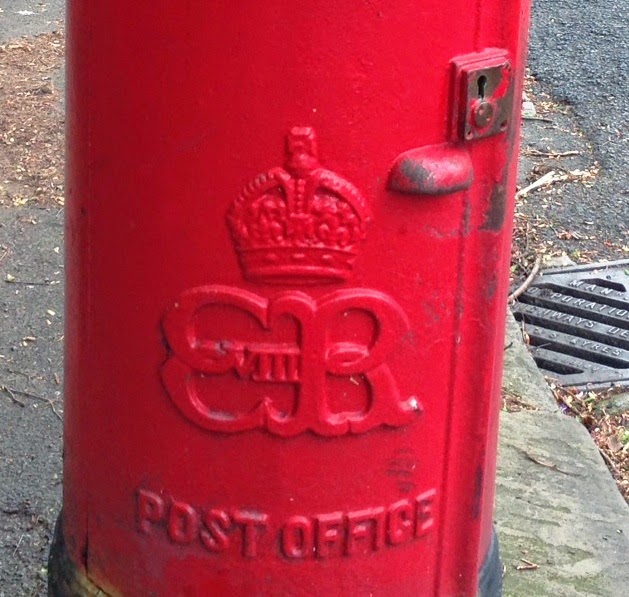
In Sale with Edward VIII

Now this is one you don’t see everyday.

My friend Lawrence came across it recently, and promised to send me this picture.

He tells me that it is an “Edward VIII post-box. It's on Framingham Road near the corner of Wood Road in Brooklands, Sale. Picture taken on a May Bank holiday Monday but the next collection was indicated for Wednesday.”

It is unusual in that there can’t be that many of them.

Edward VIII was the King we never had or to be more accurate the one who was not crowned. 

He was christened Edward Albert Christian George Andrew Patrick David and succeeded his father King George V in January 1936.

But then romance and Mrs Simpson intervened and  given the opposition from elements of the ruling class he chose her and not the crown and abdicated in December of the same year.

Meanwhile everyday life went on and post boxes were replaced and new one sited and in the way of things this one got to see the light of day on Wood Road sometime during 1936.

So it always pays to have a camera and to look out for the unusual and having spotted the  unusual  make sure it has been recorded.

After all you never know when you may be called upon to provide that all important pub quiz answer.

Picture; courtesy of Lawrence Beadle