Showing posts with label the 1930s. Show all posts

Sunday, 4 May 2025

The art of 1938 ..... and a bit more


 This is the front cover of the 1938 October edition of Homes and Garden which my friend Beba sent over a few minutes ago.


What struck me was the design and that was enough to set me off with a story.

And that might have been it had Beba not then included an article on how to train a servant and heaps of adverts for the sort of things all homes should have.

From old fashioned kitchen ranges to  steel window frames, and of course that advice to an employer'. So its got the lot and over the next few weeks the blog will cover it all.

With a special thanks to Barbarella Bonvento.

Location; 1938

Pictures; from Home and Gardens, 1938, courtesy of Bebe Bonvento

Friday, 13 October 2023

Lewis Jones ….. miner …. labour organiser …. Communist .... and author

I have just spent a delightful afternoon in the company of Lewis Jones.

Protesting for justice, Birmingham, 1983
He was a Welsh miner, a local leader during the General Strike, a County Councillor, and a member of the Communist Party.

During the 1930s he led the Welsh contingents on national hunger marches to London and campaigned for the legitimate Republican Government in the Spanish Civil War.

Added to all this he wrote two novels about the lives of working people in the Welsh valleys focusing on the great industrial struggles of the early 20th century. *

And here comes the confession, he died in 1939 of a heart attack on a day when he had addressed 30 meetings in support of the Spanish Republic and the International Brigade.

Review of We Live, 1939

So, the delightful afternoon has been courtesy of three biographies**, some reviews of his second book and two genealogical platforms.

We Live, 1939
All of which was prompted by listening to Radio 4’s Little Moscow, Britain’s Communist Thread, which featured Mr. Jones. *** 

It was a fascinating programme and amongst the well-known Communist leaders there was a piece of Lewis Jones.

Like so many people of his class he disappeared from popular history and so I am pleased to have come across him and wait for his second novel to arrive.

Pictures; Birmingham, 1983, from the collection of Andrew Simpson, extract from review of We Live, Manchester Guardian, April 18th, 1939, and cover of We Live

*Cwmardy 1937, We Live, 1939

**Lewis Jones, https://spartacus-educational.com/TUlewisLM.htm

Lewis Jones, https://grahamstevenson.me.uk/2008/09/19/lewis-jones/

Lewis Jones, https://biography.wales/article/s-JONE-LEW-1897#:~:text=Jones%20was%20elected%20a%20member,at%20Cardiff%20in%20January%201939.

***Little Moscow, Britain’s Communist Thread, https://www.bbc.co.uk/programmes/m001f5fp


Wednesday, 16 August 2023

How we did holidays in the 1920s ………..

It is easy to forget that for many people in the 1920s a holiday was something which might be limited to a day or two at the seaside.

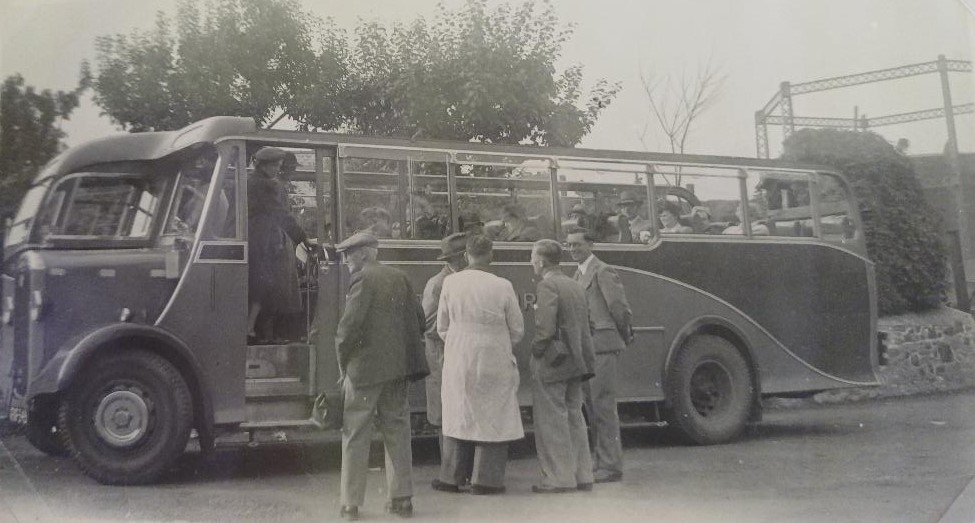
Dad with two passengers, date unknown

It would not be until 1938 that “after pressure from the unions and the International Labour Organisation, the government passed the Holidays with Pay Act. It finally gave some workers (those whose minimum rates of wages were fixed by trade boards) the right to one week of paid holiday per year.” *

Ready for the off with dad, date unknown
So, for most working people the holidays that our dad offered were far beyond their means.

He was a coach driver and for most of his career he worked for Glenton Tours of New Cross in southeast London.

After a series of jobs in the motor trade, first in Newcastle and Yorkshire he moved to London in the mid 1920s and started with the company he stayed with till he retired in 1982.

Glenton Tours offered luxury guided trips around Britain and the Continent, with hotel accommodation and full board, taking in the sights as far north as Scotland and down across Europe to the Alps. **

Happy passengers and dad, date unknown
For middle class families they were a good way to see new places, and along the way get to know the history of where they visited.

By the 1930s Dad was one of the two drivers in the fleet who worked the Continent, and apart from the interruption of the last world war did so until the 1980s.

His work, the trips he did, and the cost is something I have regularly written about including the economics of the business.

But I have always concentrated on the period from the 1950s through the 60s when I remember him coming home on a Friday night only to be off again the following morning.

Unknown passenger, unknown location, and unknown date

So, for now I shall just reflect on those earlier years with photographs from his “work album” some of which will be nearly a hundred years.

There are a lot of them, and so far, I haven’t been able to locate where any of them were taken, and the identities of the passengers are lost forever.

Boarding the coach, date unknown
A few of the passengers pose with dad and some women crop up on their own and while it is tempting to speculate on a romantic connection we will never know.

What is remarkable is that in a pre mobile age, all these pictures would have been taken, commercially developed and then they would have been sent to dad.

This I know because we do have some letters from passengers thanking him and commenting on what a wonderful holiday they had had.

Leaving me just to enjoy a collection of pictures of how we did our holidays long ago.

Location; the 1920s straying into the next decade

Pictures; dad, some coaches and a heap of happy passengers, 1920s and 1930s, from the Simpson collection.

Posing for the camera, date unknown
*Campaigning for paid holiday for everyone, TUC 150, https://tuc150.tuc.org.uk/stories/campaigning-for-paid-holiday-for-everyone/


Saturday, 4 March 2023

“The Scum of the Earth I Believe” …. “The Bloody Assassin of the Workers I Presume” ……..David Low

I have been looking back to two collections of political cartoons, by David Low.

"The Jews hitherto persecuted were now held to ransom or disposed"
The first was published by Penguin in 1940 and the second early in the 1950s.

David Low was one of our most prolific and powerful cartoonists, who worked for the London Evening Standard, the Daily Herald and the Manchester Guardian.

I first came cross him in the 1960s when his cartoons of the worsening international situation during the 1930s, were reproduced in textbooks I used.

"The refugees of Central Europe become a world problem"
And many people will be familiar with his biting comment on the Non-Aggression Pact between Nazi Germany and the Soviet Union.

It shows Hitler and Stalin standing over a body with the German dictator doffing his hat and saying, “The Scum of the Earth I Believe”.  In response, Stalin also doffs his hat and replies, “The Bloody Assassin of the Workers I Presume”.

I was always brought up to believe that the Soviet Union had been forced into such an agreement, having given up on the western democracies to deal with Hitler.

"The Nazi screw began on adjacent states"
But alas the ruthless partition of Poland later in the year, reflects the reality that both countries were more interested in expansion.

The cartoon called Rendezvous appeared on September 20th, 1939 and is the last in the Penguin collection of Mr. Low’s work, which runs from 1920 through to 1939.

In all there are 93 cartoons, and here are three of my favourites, all of which have a modern resonance.


Pictures; from the book Europe Since Versailles, by David Low, Penguin Books, 1940

Saturday, 31 July 2021

“Doing it where it won’t show” ............ having a laugh in 1930

Now I am the first to admit that humour doesn’t always travel well.

I have sat through many Italian comedy shows which testify to that simple observation.

Nor do I suspect do they travel much better through time.

So here is what Edith thought would bring a smile to Eddie and Bert in Wales in 1930.

Location; the 1930s

Picture; picture postcard, circa 1930 from the collection Ron Stubley

Tuesday, 18 May 2021

Stories from Kristallnacht …………. The Passenger ...... Alexander Boschwitz ..... rediscovered 83 years after it was written

Today I have ordered up the Passenger from Chorlton Bookshop.


It was written by Alexander Boschwitz, in the weeks after Kristallnacht.*

“It tells the story of a Jewish businessman called Otto van Silbermann, who hears a knock at his door from Nazi Storm Troopers and quickly realises he must flee.

Alexander Boschwitz himself had left Germany three years earlier after anti-Semitic laws were enacted.

His book was published in the US and UK in 1939 and 40 respectively, but made little impact and soon went out of print."**

Alexander Boschwitz and his mother emigrated to Norway, later living in France, Belgium and Luxembourg before coming to Britain just before the outbreak of the Second World War.

They were arrested as enemy aliens and Alexander was sent to Australia, where he spent two years in an internment camp.

In 1942, Boschwitz was allowed to leave the camp, but the ship taking him back to England was torpedoed by German U-boats.

Picture; book cover, The Passenger; Alexander Boschwitz, 1939

* Kristallnacht, the Night of Broken Glass,  was a pogrom against Jews carried out by the Nazi SA and civilians throughout Nazi Germany on November 9 &10th 1938 during which the German authorities did nothing to intervene.

**The Passenger; Lost German novel makes UK bestseller list 83 years on, https://www.bbc.co.uk/news/entertainment-arts-57141856


Friday, 16 December 2016

A whole lot more about Britain in 1939 has just been revealed ......... new releases from the 1939 Register

Now if you are tracking anyone in the early part of the 20th century you will know that there are pitfalls.

Uncle Roger and mum, 1938
Not least because details from the 1921 census will not be released for another five years, the 1931 census was destroyed in an air raid and there was no census taken in 1941.

All of which makes the 1939 Register pretty important.

It was compiled in late September of that year as part of the country’s response to the outbreak of the war.

The Government had taken the decision a year earlier to compile a National Register that in the event of war would list l the personal details of every civilian in Great Britain and Northern Ireland.

Mum and friend, 1942
The information was used to issue identity cards, organise rationing and  after the war for the National Health Service.

And for anyone looking for an individual or family member from the period the 1939 Register bridges the gap between the 1911 census and the list ones of the middle decades of the century,

But like all such sensitive information the details were subject to concerns over data protection and so when findmypast digitalised the records two years ago they chose to withhold some of the records.

This amounted to about 13 million or 32% of the total list of names, with details of people born less than a century ago and not known to have died before 1991.

The new records went live on November 16.

All of which meant when I went looking for my mum and grandparents I hit a brick wall.

They were there but mum’s entry had been redacted, which is that posh word for blanked out.

Mum, 1949
But now findmypast has matched millions of closed entries to other sources such as death records and has been able confirm that another three million records can now be shown.

And amongst those are mum’s.  In the September of 1939 she was at home and gave her occupation as
Unemployed cashier.  Not much perhaps but helps fill in a bit more of the story.

I know that on leaving school she had worked in a silk factory but had been “let go” when her apprenticeship ended and by 1942 she was in the RAF.  So it is a bit more.

And for that I am pleased.

Pictures; from the collection of Andrew Simpson

*The 1939 Register, findmypast, findmypast.co.uk

Friday, 21 October 2016

I cannot ‘Bare’ to leave this Plaice just yet” ..... seaside humour from 1935

Another in the series of seaside humour through time.


I am not sure what more there is to say.

It was sent to Mr and Mrs Turner if Harpurhey in the summer of 1935.

The weather had been rainy but Bertha and Edith “were having a good time.”

Location; Wales & Manchester


Picture; postcard, 1935 from the collection of Ron Stubley

Saturday, 11 April 2015

A present from 1938 and a big thank you

Now the week end has just got a little more interesting with a collection of magazines which dropped through the letter box half an hour ago.

They range from The Passing Show and My Home from 1938 to a range of periodicals culminating with Woman’s Own for January 12 1956.

And of course they are a treasure trove of our social history.

They were passed on to me by my friend Suzanne who has been the source of many wonderful bits of memorabilia, from photographs to hand painted birthday cards.  She emailed me with "in case you were wondering, I posted a couple of old magazines through your letterbox today.

I came across them in the attic and thought something in them may be of interest to you. If not recycle, or bin them."

And that I could never do, so in the fullness of time the blog will benefit from this collection.

Watch this space.

Picture; cover from the Passing Time no 532 (New Series) Vol 7 December 17th 1938, from the collection of Suzanne Moorehead